8 Best Dashword Alternatives in 2026 (Ranked and Reviewed)
Looking for Dashword alternatives? We found 8 tools with more features, better pricing, and actual auto-publishing. From $23/mo to done-for-you SEO.
Siddharth Gangal • March 18, 2026
In This Guide
Editorial disclosure: This page was written and published by Stacc, which competes with Dashword. We have a commercial interest as an alternative. All pricing and feature data was verified against each tool’s official pricing page as of March 2026.
By Stacc Editorial Team · SEO practitioners. We publish 30+ articles/month for businesses using our own platform — including this one. · Last updated: March 18, 2026
📌 Quick Picks: If you want content written AND published automatically, choose Stacc ($99/mo). If you want deep content optimization, choose Surfer SEO ($99/mo). If budget is the priority, choose NeuronWriter ($23/mo). If you need the best briefs, choose Frase ($49/mo).
Why People Switch from Dashword
Dashword positions itself as “Clearscope but simpler.” It gives you content reports, keyword suggestions, and a basic content score. But after testing it and reading user reviews, the same issues keep coming up.
The most common reasons people switch:
-
Expensive for what you get. $99/month for 30 content reports. Surfer SEO offers 360 documents at the same price. Dashword’s cost per report is 12x higher than Surfer’s.
-
Limited AI writing. Dashword’s AI features cover metas, intros, and rephrasing only. It is not a full AI writer. If you need complete articles, you still need a writer or a separate tool.
-
No content clusters or internal linking. No support for topic clusters, cannibalization detection, or internal linking recommendations. If you’re building topical authority, Dashword can’t help you plan it.
-
No auto-publish. No direct CMS publishing integration. You write in Dashword, then copy-paste into your CMS manually.
-
Restrictive usage limits. The Business plan ($349/mo) caps at 100 reports and 50,000 AI words. Agencies producing content at scale burn through this in the first week.
-
SEO content only. Limited to long-form blog optimization. No ad copy, social media, email, or local SEO features.
theStacc vs. Dashword: Where We’re Better
We wrote this page. We’re a competitor. Here’s exactly where theStacc is better — so you can weigh what follows.
| Feature | Dashword | theStacc |
|---|---|---|
| Writing included | ✗ Basic AI only (metas, intros) | ✓ 30 full articles written for you |
| Auto-publishes to your CMS | ✗ No CMS integration | ✓ WordPress, Webflow, Ghost |
| Local SEO / Google Business Profile | ✗ Not included | ✓ 30 GBP posts/month |
| Social media posts | ✗ Not included | ✓ 30 posts/month |
| Done-for-you (no workflow to manage) | ✗ DIY tool — you run everything | ✓ Fully managed, hands-off |
| Real monthly cost for 30 published articles | $99 + $2,400-$7,500 writers | $99/month flat |
See how theStacc works → Start for $1
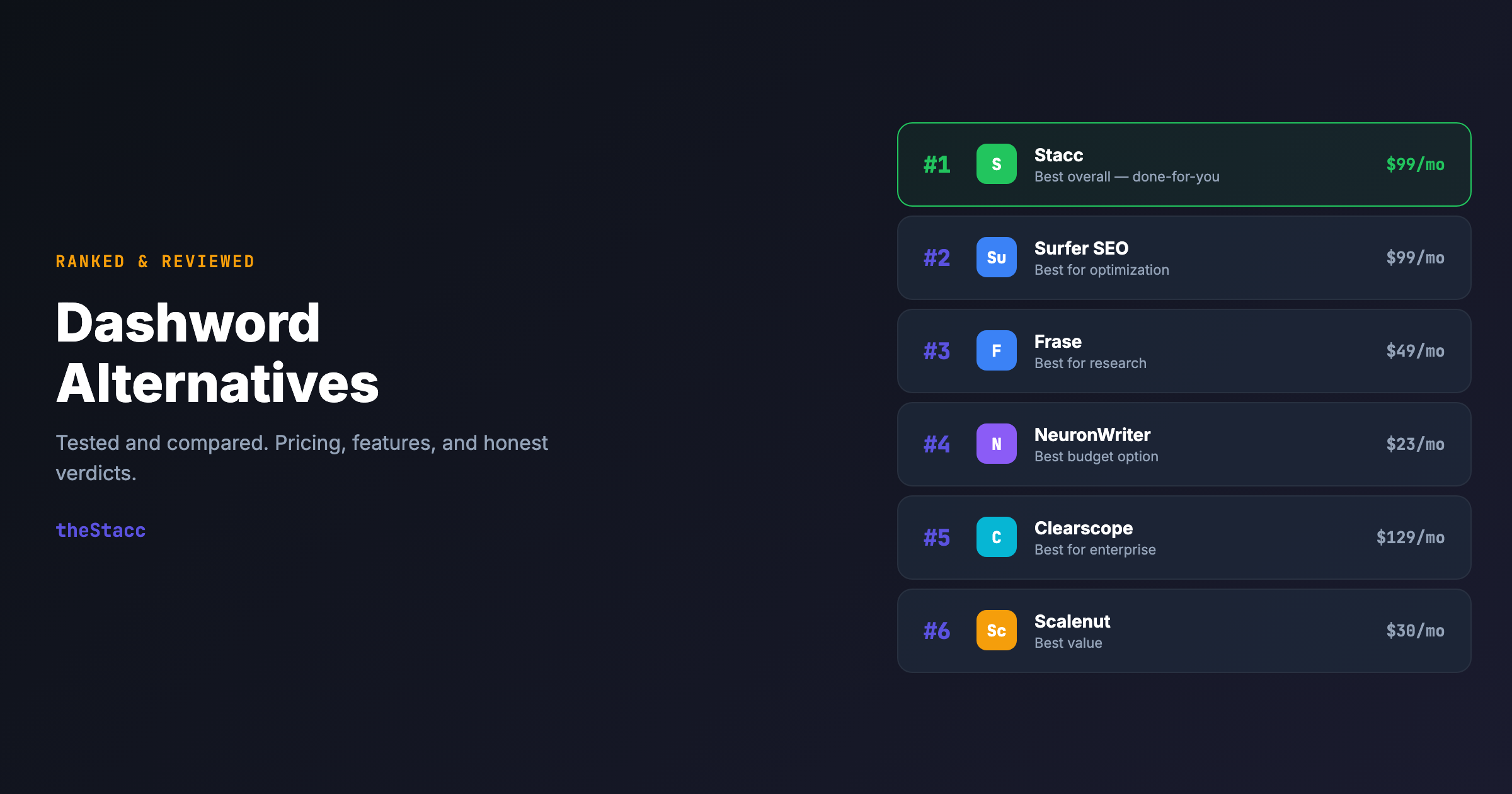
The 8 Best Dashword Alternatives at a Glance
| # | Tool | Best For | Price (Monthly) | Auto-Publish | Local SEO | Free Trial |
|---|---|---|---|---|---|---|
| 1 | Stacc | Done-for-you SEO | $99/mo | ✓ | ✓ | $1 / 3 days |
| 2 | Surfer SEO | Content optimization | $99/mo | ✓ WordPress | ✗ | — |
| 3 | Frase | Content briefs + research | $49/mo | ✓ WordPress | ✗ | 7-day free |
| 4 | NeuronWriter | Budget optimization | $23/mo | ✓ WordPress (Gold+) | ✗ | Lifetime deals |
| 5 | Clearscope | Enterprise editorial teams | $129/mo | ✗ | ✗ | ✗ |
| 6 | Scalenut | All-in-one on a budget | $59/mo ($30 annual) | ✓ WordPress | ✗ | 7-day free |
| 7 | Page Optimizer Pro | Granular on-page SEO | $40/mo | ✗ | ✗ | 7-day refund |
| 8 | MarketMuse | Content strategy + planning | Free / $99/mo | ✗ | ✗ | Free plan |
#1. Stacc — Best Overall Dashword Alternative
Dashword gives you a content score. Stacc gives you 30 published articles. It writes, optimizes, and publishes directly to your CMS every month. No writers. No briefs. No manual workflow.
Why it’s better than Dashword:
- 30 SEO articles written AND published per month for $99. Dashword scores content. Stacc executes.
- Google Business Profile posts included ($49/mo add-on). Local SEO and blog SEO in one platform.
- Social media posts included ($49/mo add-on). Instagram, LinkedIn, X, Facebook.
- No workflow to manage. No writing, no editing, no formatting, no publishing.
- WordPress, Webflow, Ghost, and Custom Webhook integrations.
Where Dashword still wins:
- Dashword’s content reports are simple and fast. If you want a quick content grade without complexity, Dashword delivers.
- Dashword supports multilingual content creation, which Stacc does not currently offer.
Stacc pricing:
- Blog SEO: $99/mo (30 articles), $149/mo (50), $199/mo (80)
- Local SEO: $49/mo (30 GBP posts)
- Social Media: $49/mo (30 posts across 3 platforms)
- Bundle: ~15% off any 2+ modules
- Trial: $1 for 3 days
Best for: Local service businesses, SMBs, and agencies — anyone spending $1,000+/month on an SEO agency or spending hours managing content themselves.
#2. Surfer SEO — Best for Content Optimization
Surfer SEO is the industry standard for content optimization. It analyzes the top-ranking pages for any keyword and gives you a detailed checklist of what to include — headings, word count, NLP terms, keyword density. At $99/month with 360 documents, it offers 12x more reports than Dashword at the same price.
Key features:
- Content Editor with real-time optimization scoring against 500+ ranking factors
- SERP Analyzer for deep competitive analysis
- Content Audit for existing pages
- Internal linking recommendations (Pro plan)
- AI writing via Surfer AI (additional credits)
Pricing: Standard $99/mo ($119 monthly) · Pro $219/mo. 360 documents on Standard.
Pros: Most comprehensive content scoring. 12x more documents than Dashword at the same price. Strong SERP analysis. WordPress auto-publish.
Cons: Pro features like internal linking cost $219/mo. Over-optimization risk if you chase high scores. Still a DIY tool — you need writers. AI writing costs extra credits.
Best for: Content teams who want the deepest optimization data and are willing to write the content themselves.
The bottom line: Surfer does everything Dashword does, with 12x the volume and deeper analysis. If you’re leaving Dashword for better optimization, Surfer is the most direct upgrade.
#3. Frase — Best for Content Research and Briefs
Frase is the best content brief builder available. It pulls headings, word counts, topics, and People Also Ask questions from top-ranking pages and assembles a structured brief in minutes. If Dashword’s basic reports feel thin, Frase’s research depth is the answer.
Key features:
- SERP research with headings, word counts, topics, and PAA questions
- One-click content brief generation
- Content optimization scoring against SERP competitors
- AI Agent with 80+ skills for drafts, rewrites, and research
- GEO (Generative Engine Optimization) scoring
- WordPress auto-publish via plugin
Pricing: Starter $49/mo ($39 annual) · Professional $129/mo ($103 annual) · Scale $299/mo ($239 annual). 7-day free trial, no credit card.
Pros: Best brief builder available. Cheaper than Dashword ($49 vs $99). GEO optimization for AI search. Free trial with no credit card.
Cons: Still a DIY tool — you need writers. Optimization scoring less granular than Surfer’s. Lifetime deal holders were moved to a “legacy” version when Frase rebuilt in 2024.
Best for: Freelance writers and content teams who build 10+ briefs per month and want better research than Dashword provides.
The bottom line: Frase gives you more research depth than Dashword at half the price. If content briefs are your primary need, Frase is the clear upgrade.
#4. NeuronWriter — Best Budget Dashword Alternative
NeuronWriter delivers content optimization at $23/month — 77% cheaper than Dashword. For solo bloggers and freelancers, it covers the basics well without the premium price tag.
Key features:
- NLP-driven content scoring and SERP-based recommendations
- AI content generation with templates and AutoInsert
- Google Search Console integration
- Competitor SERP analysis
- WordPress integration (Gold+ plans)
Pricing: Bronze $23/mo ($19 annual) · Silver $45/mo · Gold $69/mo ($57 annual) · Platinum $93/mo. Lifetime deals available via AppSumo (~$267 one-time).
Pros: 77% cheaper than Dashword. Lifetime deal option eliminates monthly costs entirely. Clean interface. Solid optimization data.
Cons: Less sophisticated SERP analysis than Surfer. WordPress integration only on Gold+ ($69/mo). AI content generation is unreliable — factual errors are common. Content generation sometimes stops midway.
Best for: Solo bloggers and freelancers who want basic optimization without Dashword’s pricing.
The bottom line: NeuronWriter is the cheapest way to get content scoring. If Dashword’s $99/month feels steep for what you’re getting, NeuronWriter gives you 80% of the functionality at 23% of the price.
#5. Clearscope — Best for Enterprise Editorial Teams
Clearscope is the tool that enterprise editorial teams reach for when they want clean, simple content grading. Used by Conde Nast, Shopify, and HubSpot. If Dashword felt simple, Clearscope is even simpler — with more accurate grading.
Key features:
- Content grading on an A++ scale (widely considered more reliable than numeric scores)
- Real-time content optimization with semantic topic discovery
- Content Inventory for tracking published content performance
- Unlimited users and projects on all plans
- Integrations: Google Docs, WordPress, Microsoft Word, GSC
Pricing: Essentials $129/mo · Business $399/mo · Enterprise custom. No annual discount. No free trial.
Pros: Simplest interface in the category. Content grading considered more accurate. Unlimited users on all plans. Strong Google Docs integration.
Cons: $129/mo with no AI writer. Business plan jumps to $399/mo. No free trial. Limited reports — adding more costs $60-$100 per batch.
Best for: Large editorial teams who prioritize simplicity and grading accuracy above all else.
The bottom line: Clearscope is Dashword’s closest competitor in simplicity — but with more accurate grading and unlimited users. The trade-off is a higher price ($129 vs $99) and no free trial.
#6. Scalenut — Best All-in-One on a Budget
Scalenut packs content optimization, AI writing, GEO features, and WordPress publishing into one platform. At $30/month on annual billing, it’s 70% cheaper than Dashword with significantly more features.
Key features:
- GEO article creation (optimized for AI search visibility)
- AI visibility tracking across ChatGPT, Google AIO, Perplexity (Pro plan)
- Content optimizer with SERP analysis and NLP scoring
- Auto-publish to WordPress with scheduled publishing
- AI content humanization
Pricing: Starter $59/mo ($30 annual) · Plus $89/mo ($45 annual) · Professional $199/mo ($100 annual). 7-day free trial, no credit card.
Pros: $30/month annual entry is 70% cheaper than Dashword. GEO optimization is forward-looking. Built-in AI writing. 7-day free trial.
Cons: Content quality is formulaic and often robotic — requires heavy editing. Multiple users report extreme difficulty cancelling subscriptions. Some ranking drops reported after publishing Scalenut content.
Best for: Budget-conscious teams who want content optimization and AI writing in one platform.
The bottom line: Scalenut offers more features than Dashword at less than a third of the price. The cancellation horror stories are a red flag — test thoroughly during the 7-day trial before committing to annual billing.
#7. Page Optimizer Pro — Best for Technical On-Page SEO
POP is for technical SEO practitioners who want the most granular on-page data available. Its US-patented scoring system gives exact keyword placement recommendations — not just density targets like Dashword.
Key features:
- Patented ranking factor scoring (exact keyword placement, not just frequency)
- POP Watchdog — SERP monitoring for target keywords
- AI Writer (GPT-4o integrated)
- E-E-A-T and Schema recommendations
- Unlimited domains on all plans
Pricing: Basic $40/mo · Unlimited $72/mo ($62 annual) · Teams $143/mo ($119 annual). 7-day refund guarantee.
Pros: Most granular on-page data available. Cheaper than Dashword ($40 vs $99). Specific keyword placement guidance. Schema and E-E-A-T recommendations.
Cons: Credits disappear fast and expire monthly. No content planning or briefs. More technical interface — steep learning curve. No auto-publish.
Best for: Technical SEO practitioners who want surgical on-page optimization data.
The bottom line: POP gives you deeper optimization data than Dashword at less than half the price. But it’s built for SEO technicians, not content writers. If you want simplicity, look elsewhere.
#8. MarketMuse — Best for Content Strategy and Planning
MarketMuse doesn’t just optimize content — it helps you plan what to write and why. Its Personalized Difficulty score calculates how hard a topic is for your specific site based on your existing topical authority. Dashword has nothing comparable.
Key features:
- Personalized Difficulty score (unique to MarketMuse)
- Content briefs with 9+ formats (Comparison, Guide, How-to, Product Review)
- Topical authority mapping
- Content inventory and site-level gap analysis
- SERP X-ray analysis
Pricing: Free (10-35 queries/month) · Optimize $99/mo · Research $249/mo · Strategy $499/mo.
Pros: Personalized Difficulty scoring is genuinely unique. Free plan lets you test. Strongest topical authority analysis in the category.
Cons: Full features require $249-$499/month. Platform is described as “buggy” by users — frequently down or malfunctioning. Steep learning curve. Users report surprise price increases.
Best for: Content strategists building long-term topical authority who need site-specific difficulty data.
The bottom line: MarketMuse’s Personalized Difficulty feature is genuinely useful — it tells you which topics you have the best chance of ranking for. But at $249-$499/month for full features, it’s hard to justify unless you’re running a dedicated content strategy team.
How to Choose the Right Dashword Alternative
Picking the right alternative depends on one question: do you want a scoring tool, or do you want published content?
Tools like Surfer, Frase, and NeuronWriter give you better data than Dashword — more features, more reports, lower prices. But you still need to write the content, edit it, and publish it.
Services like Stacc skip the entire workflow.
Choose Stacc if:
- You want content written AND published automatically — no writers, no briefs, no workflow
- You run a local service business and need Google Business Profile + blog SEO in one platform
- You’re spending $1,000+/month on content production and want the same output for $99
Choose Surfer SEO if:
- You want the deepest content optimization data and have writers to do the work
- You need 12x more reports than Dashword at the same price
Choose Frase if:
- You’re a freelance writer who builds briefs for clients
- You want better research than Dashword at half the price
Choose NeuronWriter if:
- You’re a solo blogger on a tight budget
- You want a lifetime deal and don’t need auto-publishing
Choose Clearscope if:
- You’re an enterprise editorial team that values simplicity and grading accuracy
- Budget is not a constraint
The Bottom Line
We tested all 8 tools. Here’s what we found.
Dashword is simple. That’s its strength and its weakness. It does content scoring with a clean interface — and that’s about it. Every alternative on this list offers more features, more reports, or lower pricing. Most offer all three.
But none of the optimization tools solve the actual problem: getting 30 SEO-optimized articles written, edited, and published to your website every month without hiring writers or managing freelancers.
That’s the gap Stacc fills.
| What you need | Tool approach | Stacc approach |
|---|---|---|
| Keyword research | You do it ($49-$249/mo) | Done for you |
| Content writing | You hire writers ($2,400-$7,500/mo) | Done for you |
| SEO optimization | You optimize manually | Done for you |
| Publishing to CMS | You format and publish | Done for you |
| Local SEO / GBP posts | Separate tool + manual work | Included ($49/mo) |
| Social media posts | Separate tool + manual work | Included ($49/mo) |
| Total monthly cost | $2,500-$8,000+ | $99 |
Frequently Asked Questions
What is the best Dashword alternative in 2026? For businesses that want content written and published automatically, Stacc is the best alternative — 30 articles/month for $99 with auto-publishing. For teams who want better optimization data, Surfer SEO offers 360 documents at $99/month compared to Dashword’s 30 reports at the same price.
Is there a free Dashword alternative? MarketMuse offers a free plan with 10-35 queries per month. NeuronWriter has lifetime deals starting around $267 (one-time payment). Scalenut offers a 7-day free trial. None are fully free, but they’re functional starting points.
Is Dashword worth $99/month? For simple content scoring, Dashword works. But at $99/month for 30 reports with limited AI writing and no auto-publish, the value is low compared to Surfer (360 documents, same price), Frase ($49/month with better research), or Stacc ($99/month with 30 published articles).
Which Dashword alternative is cheapest? NeuronWriter starts at $23/month ($19 annual). Scalenut is $30/month on annual billing. Page Optimizer Pro is $40/month. All three are significantly cheaper than Dashword’s $99/month entry.
Can I switch from Dashword to Stacc? Yes. Stacc replaces Dashword, your content writers, and your publishing workflow in one subscription. Sign up for $1 (3-day trial) and Stacc starts publishing optimized articles to your WordPress, Webflow, or Ghost site within days.
Does Dashword publish content automatically? No. Dashword has no CMS integration. You write or optimize content in Dashword’s editor, then manually copy and publish to your website.
Stop Scoring. Start Publishing.
Every tool on this list helps you score content. One of them writes, optimizes, AND publishes it.
30 SEO articles/month. Google Business Profile posts. Social media. $99/mo.
This page was written and published by Stacc, which competes with the tools listed here. We have a commercial interest as an alternative. All pricing and feature data verified against official sources as of March 2026.