10 Best Writesonic Alternatives in 2026 (Ranked and Reviewed)
Looking for Writesonic alternatives? We tested the top 10 options — from $9/mo budget tools to done-for-you SEO at $99/mo. Full comparison inside.
Siddharth Gangal • March 18, 2026
In This Guide
Read our full Writesonic review
Writesonic Review →Editorial disclosure: This page was written and published by Stacc, which competes with Writesonic. We have a commercial interest as an alternative. All pricing and feature data was verified against each tool’s official pricing page as of March 2026.
By Stacc Editorial Team · SEO practitioners. We publish 30+ articles/month for businesses using our own platform — including this one. · Last updated: March 18, 2026
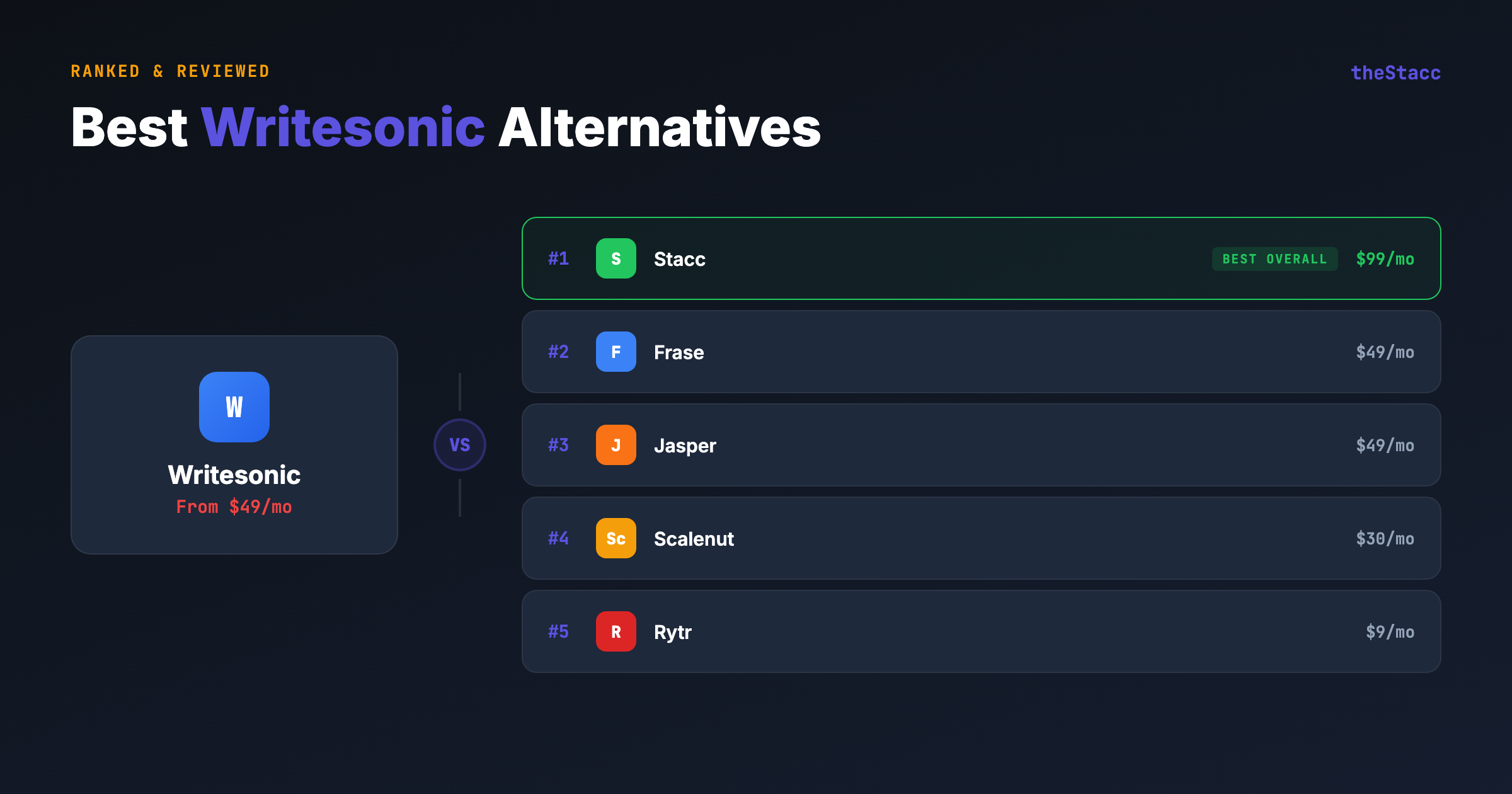
📌 Quick Picks: If you want content written AND published automatically, choose Stacc ($99/mo). If you want the best SEO optimization, choose Frase ($49/mo). If budget is the priority, choose Rytr ($9/mo). If you need enterprise brand writing, choose Jasper ($49/mo).
Why People Switch from Writesonic
Writesonic built its reputation as an affordable alternative to Jasper with a free tier and broad feature set. But after testing it alongside 10 alternatives and reading thousands of reviews on G2, Trustpilot, and Reddit, the same issues keep surfacing.
The most common reasons people switch:
-
Content quality is inconsistent. Output quality varies significantly between templates and topics. Long-form articles need heavy editing — especially for technical or niche subjects. Users on G2 report spending as much time editing Writesonic output as they would writing from scratch.
-
Confusing credit system. Writesonic uses a word-based credit system that makes it hard to predict monthly costs. Users report running out of credits mid-month with no warning. A 2,000-word blog post uses more credits than expected because rewrites and regenerations count against your limit.
-
SEO optimization is surface-level. Writesonic has a built-in SEO checker, but it doesn’t match dedicated tools like Surfer or Frase for SERP-based optimization scoring. The checker suggests keywords but doesn’t analyze top-ranking pages or provide content scoring against competitors.
-
It doesn’t publish for you. Writesonic generates content. You still need to edit, format, add images, and publish. WordPress integration exists but requires manual steps. For 30 articles/month, that’s still 60-120 hours of labor.
-
Feature overlap with ChatGPT. As GPT-4 became widely available, Writesonic’s core value proposition — easy access to GPT models with templates — eroded. Users question paying $49/month for a wrapper around the same models available in ChatGPT Plus for $20/month.
-
Billing complaints. Trustpilot reviews flag charges after cancellation and difficulty getting refunds. Multiple users report being billed for months after cancelling.
theStacc vs. Writesonic: Where We’re Better
We wrote this page. We’re a competitor. Here’s exactly where theStacc is better — so you can weigh what follows.
| Feature | Writesonic | theStacc |
|---|---|---|
| Writing included | ✓ AI drafts (you edit heavily) | ✓ 30 articles written for you |
| SEO optimization | Surface-level keyword suggestions | ✓ Full SERP-based optimization |
| Auto-publishes to your CMS | ✗ Manual steps required | ✓ WordPress, Webflow, Ghost |
| Local SEO / Google Business Profile | ✗ Not included | ✓ 30 GBP posts/month |
| Social media posts | ✗ Not included | ✓ 30 posts/month |
| No credit limits or word caps | ✗ Credit-based, runs out mid-month | ✓ Flat $99/month, 30 articles |
| Done-for-you (no workflow to manage) | ✗ DIY tool — you write, edit, publish | ✓ Fully managed, hands-off |
| Real monthly cost for 30 published articles | $49 + $2,400-$7,500 editors/writers | $99/month flat |
See how theStacc works → Start for $1
The 10 Best Writesonic Alternatives at a Glance
| # | Tool | Best For | Price (Monthly) | Auto-Publish | Local SEO | Free Trial |
|---|---|---|---|---|---|---|
| 1 | Stacc | Done-for-you SEO | $99/mo | ✓ | ✓ | $1 / 3 days |
| 2 | Frase | Content briefs + SEO | $49/mo | ✓ WordPress | ✗ | 7-day free |
| 3 | Jasper | Brand-consistent writing | $49/mo | ✗ | ✗ | 7-day free |
| 4 | Rytr | Budget AI writing | $9/mo | ✗ | ✗ | Free plan |
| 5 | Scalenut | SEO + GEO on a budget | $59/mo ($30 annual) | ✓ WordPress | ✗ | 7-day free |
| 6 | Copy.ai | Marketing workflows | $49/mo | ✗ | ✗ | Free plan |
| 7 | Surfer SEO | Content optimization | $99/mo | ✓ WordPress | ✗ | 7-day refund |
| 8 | NeuronWriter | Budget optimization | $23/mo | ✓ WordPress (Gold+) | ✗ | Lifetime deals |
| 9 | Koala AI | Bulk AI articles | $15/mo | ✓ WordPress | ✗ | Free plan |
| 10 | Anyword | Performance copy | $49/mo | ✗ | ✗ | 7-day free |
#1. Stacc — Best Overall Writesonic Alternative
Writesonic generates drafts you still need to edit, optimize, and publish. Stacc does the entire job. It writes, optimizes, and publishes 30 articles per month to your CMS. No credits. No word limits. No manual workflow.
Why it’s better than Writesonic:
- 30 SEO articles written AND published per month for $99. No credit system. No word caps.
- Full SERP-based SEO optimization on every article. Not surface-level keyword suggestions.
- Google Business Profile posts included ($49/mo add-on). Local SEO and blog SEO in one platform.
- Social media posts included ($49/mo add-on). Instagram, LinkedIn, X, Facebook.
- No workflow to manage. No editing, no formatting, no publishing.
Where Writesonic still wins:
- Writesonic has a free tier. Stacc starts at $1 for a 3-day trial.
- Writesonic covers ad copy, landing pages, and chatbot creation. Stacc focuses on SEO content, local SEO, and social media.
- Writesonic supports 25+ languages. Stacc focuses on English-language markets.
Stacc pricing:
- Blog SEO: $99/mo (30 articles), $149/mo (50), $199/mo (80)
- Local SEO: $49/mo (30 GBP posts)
- Social Media: $49/mo (30 posts across 3 platforms)
- Bundle: ~15% off any 2+ modules
- Trial: $1 for 3 days
Best for: Local service businesses, SMBs, and agencies — anyone tired of editing AI drafts and managing the content workflow themselves.
#2. Frase — Best for Content Research and SEO
Frase is the best content brief builder on the market. Where Writesonic generates drafts with basic keyword suggestions, Frase pulls headings, word counts, topics, and questions from top-ranking pages and assembles them into structured briefs. Different tools solving different problems.
Key features:
- SERP research pulling headings, word counts, topics, and PAA questions from ranking pages
- One-click content brief generation (best-in-class brief builder)
- Content optimization scoring against SERP competitors
- AI Agent with 80+ skills for drafts, rewrites, and research
- Dual SEO + GEO (Generative Engine Optimization) scoring
- WordPress auto-publish via plugin
Pricing: Starter $49/mo ($39 annual) · Professional $129/mo ($103 annual) · Scale $299/mo ($239 annual). 7-day free trial, no credit card.
Pros: Best brief builder available. Same entry price as Writesonic but with actual SEO depth. GEO optimization for AI search visibility. Free trial with no credit card.
Cons: Does not write or publish for you — still a DIY tool. Optimization scoring less granular than Surfer’s 500-factor analysis. AI writing quality is mixed — better for research than drafting. Lifetime deal holders lost access when Frase rebuilt its platform in 2024.
Best for: Freelance writers and content strategists who need research-backed briefs and SERP-level optimization scoring.
The bottom line: Frase is not a Writesonic replacement — it’s an upgrade for a different workflow. If your bottleneck is research and optimization (not writing speed), Frase at $49/month delivers far more SEO value than Writesonic at the same price.
#3. Jasper — Best for Brand-Consistent Writing
Jasper is Writesonic’s most direct competitor. Both are AI writing platforms with templates, brand voice training, and multiple content types. Jasper’s edge: stronger brand voice enforcement and better enterprise collaboration features.
Key features:
- Brand Voice training from your existing content
- 50+ writing templates for blog, email, ads, social, and landing pages
- Campaign workflows for coordinated content creation
- Team collaboration with shared brand assets
- Jasper Chat for conversational content generation
- Integrations with Surfer SEO, Grammarly, Google Docs
Pricing: Creator $49/mo ($39 annual) · Pro $69/mo ($59 annual) · Business custom. 7-day free trial.
Pros: Stronger brand voice features than Writesonic. Better enterprise collaboration tools. Larger template library. More mature platform.
Cons: Expensive at scale ($49-$69 per user). No built-in SEO optimization — requires Surfer add-on ($99+/mo). Output increasingly similar to raw ChatGPT. No auto-publishing to CMS. History of 300% price increases.
Best for: Enterprise marketing teams who need every piece of content to match a specific brand voice and have budget for per-user pricing.
The bottom line: Jasper is the premium version of what Writesonic offers. Stronger brand voice. Better collaboration. But also more expensive, especially for teams. If brand consistency is your top priority and budget isn’t a constraint, Jasper beats Writesonic. For everyone else, it’s a lateral move at a higher price.
#4. Rytr — Best Budget Writesonic Alternative
Rytr is the cheapest AI writer worth considering. At $9/month, it’s 80% less than Writesonic and covers the same short-form use cases — ad copy, email subject lines, product descriptions, social posts. The trade-off: significantly less capable for long-form content.
Key features:
- AI writing with 40+ templates and use cases
- Tone and voice selection (20+ tones)
- Built-in plagiarism checker (Copyscape-powered)
- SEO meta title and description generator
- Chrome extension for writing in any browser tab
Pricing: Free (10,000 characters/mo) · Saver $9/mo (~$7.50 annual) · Unlimited $29/mo.
Pros: 80% cheaper than Writesonic at entry level. Free plan for testing. Simple interface with no credit confusion. Good for short-form marketing copy.
Cons: Not built for long-form SEO content — articles are thin and generic. No content optimization scoring. No auto-publish. Uses older GPT-3 model with noticeably lower output quality. FTC flagged Rytr for fake reviews in 2023.
Best for: Solo bloggers and freelancers on a tight budget who need quick short-form drafts.
The bottom line: Rytr is the budget pick. If Writesonic’s credit system and pricing frustrate you, Rytr’s flat $9/month with unlimited characters on the paid plan is refreshingly simple. But the output quality gap is real — especially for anything longer than a paragraph.
#5. Scalenut — Best SEO + GEO on a Budget
Scalenut offers what Writesonic should be: AI writing with actual SERP-based SEO optimization and WordPress auto-publishing. At $30/month on annual billing, it’s cheaper than Writesonic’s Pro plan and includes features Writesonic charges extra for.
Key features:
- GEO article creation (optimized for AI search visibility)
- AI visibility tracking across ChatGPT, Google AIO, Perplexity (Pro plan)
- Content optimizer with SERP analysis and NLP scoring
- Auto-publish to WordPress with scheduled publishing
- AI content humanization
- Backlinks marketplace (Plus+ plan)
Pricing: Starter $59/mo ($30 annual) · Plus $89/mo ($45 annual) · Professional $199/mo ($100 annual). 7-day free trial, no credit card. 50% discount on annual billing.
Pros: $30/month annual entry undercuts Writesonic. Better SEO optimization than Writesonic. GEO features for AI search visibility. Built-in humanization. WordPress auto-publish. 7-day free trial.
Cons: Content quality is formulaic and often sounds robotic — requires editing. Multiple users report extreme difficulty cancelling subscriptions. Some users report ranking drops after publishing unedited Scalenut content. Feature set feels spread thin.
Best for: Budget-conscious teams wanting better SEO optimization than Writesonic at a lower annual price.
The bottom line: Scalenut’s annual pricing ($30/month) genuinely undercuts Writesonic while offering deeper SEO features. The GEO optimization is forward-looking. But test thoroughly during the 7-day trial — the cancellation horror stories and content quality concerns are real.
#6. Copy.ai — Best for Marketing Workflows
Copy.ai has pivoted from AI writing to go-to-market workflow automation. Where Writesonic generates content, Copy.ai automates the tasks around content — email sequences, ad variations, sales outreach, and content repurposing across channels.
Key features:
- Workflow automation for marketing tasks (email, ads, social)
- Chat interface with web browsing and file upload
- Brand voice and style guidelines enforcement
- API access for custom integrations
- Free plan with 2,000 words/month
Pricing: Free (2,000 words/mo) · Pro $49/mo ($36 annual) · Enterprise custom.
Pros: Strongest workflow automation on this list. Free plan for testing. Good for ad copy, email sequences, and sales outreach. API access for custom workflows.
Cons: Not built for SEO content — no content scoring, no keyword research, no SERP analysis. No CMS publishing integration. Trustpilot score of 1.9/5 with difficult cancellation reports. The GTM pivot confused existing users.
Best for: Marketing and sales teams who need automated workflows for email, ads, and outreach — not SEO blog content.
The bottom line: Copy.ai and Writesonic used to be direct competitors. Now they serve different audiences. If you want workflow automation for marketing operations, Copy.ai is worth testing. If you want AI blog writing, Copy.ai has moved away from that use case.
#7. Surfer SEO — Best for Content Optimization
Surfer SEO doesn’t write content — it optimizes it. Where Writesonic generates drafts with basic keyword suggestions, Surfer scores your content against 500+ ranking factors from top SERP results. Different category entirely, but a common Writesonic replacement for teams who prioritize SEO rankings.
Key features:
- Content Editor with 500-factor SERP-based scoring
- SERP Analyzer for competitive content analysis
- Surfer AI writer for generating optimized drafts
- Internal linking suggestions and audit
- Outline Builder with heading and topic recommendations
Pricing: Standard $99/mo ($99 annual) · Pro $219/mo. Surfer AI credits sold separately.
Pros: Best-in-class content scoring. Most granular optimization data available. Strong SERP analysis. Surfer AI can generate optimized drafts.
Cons: $99/month just for optimization — double Writesonic’s price. You still need writers or Surfer AI credits. Pro plan ($219/mo) required for advanced features. No local SEO. Over-optimization risk.
Best for: Content teams who have writers and want the most precise optimization data to improve search rankings.
The bottom line: Surfer is not a writing tool — it’s an optimization tool. If your Writesonic frustration is “my content doesn’t rank,” Surfer solves that problem. If your frustration is “I need content generated faster,” Surfer won’t help.
#8. NeuronWriter — Best Budget Optimization Tool
NeuronWriter combines AI writing and content optimization at a price that undercuts both Writesonic and Surfer. At $23/month, it delivers optimization scoring that Writesonic’s built-in SEO checker can’t match.
Key features:
- NLP-driven content scoring and SERP-based recommendations
- AI content generation with templates and AutoInsert
- Google Search Console integration
- Competitor SERP analysis
- WordPress integration (Gold+ plans)
Pricing: Bronze $23/mo ($19 annual) · Silver $45/mo · Gold $69/mo ($57 annual) · Platinum $93/mo. Lifetime deals available via AppSumo (~$267 one-time).
Pros: Half the price of Writesonic with better optimization scoring. Lifetime deal option eliminates recurring costs. Clean interface. Google Search Console integration for data-backed recommendations.
Cons: AI content generation is unreliable — factual errors are common. Content generation sometimes stops midway through articles. WordPress integration only on Gold+ ($69/mo). Smaller community and knowledge base.
Best for: Solo bloggers who want content optimization scoring at the lowest possible price.
The bottom line: NeuronWriter gives you better optimization data than Writesonic at half the price. The trade-off is a less polished AI writer and a smaller feature set. For solo bloggers on a budget, it’s the smarter pick. For teams needing broad writing features, it’s too limited.
#9. Koala AI — Best for Bulk AI Article Generation
Koala AI (koala.sh) is built for volume. Where Writesonic generates one article at a time with templates, KoalaWriter produces bulk long-form SEO articles with real-time SERP analysis baked into the writing process.
Key features:
- KoalaWriter for long-form SEO articles with real-time SERP analysis
- Amazon product roundup articles with live pricing data
- WordPress auto-publish with Gutenberg blocks
- Automatic internal linking (KoalaLinks)
- Deep Research mode with GPT-5 and Claude 4
Pricing: Free (5,000 words) · Essentials $15/mo ($9 annual) · Starter $39/mo ($25 annual) · Professional $69/mo ($49 annual).
Pros: Cheaper than Writesonic at every tier. SERP analysis baked into the writing process. WordPress auto-publish included. Free plan for testing. Built specifically for bulk production.
Cons: Content often sounds robotic at scale. Independent studies show 100% AI detection rates. Reports of Google penalties on bulk-generated content. Extremely poor customer support (5+ day response times). Unused credits expire monthly.
Best for: Affiliate bloggers and content producers who need high volume and can handle quality editing themselves.
The bottom line: Koala is cheaper than Writesonic and better optimized for SEO content specifically. But the 100% AI detection rates and Google penalty reports are serious concerns. If you need volume above all else, Koala delivers. If you need quality that ranks and converts, proceed with caution.
#10. Anyword — Best for Performance-Focused Copy
Anyword takes a data-driven approach that neither Writesonic nor Jasper offers. Its Predictive Performance Score rates every piece of copy before you publish — predicting engagement rates based on your audience data.
Key features:
- Predictive Performance Score for all content types
- Custom AI models trained on your brand’s performance data
- Brand guidelines and voice enforcement
- A/B test copy variations with predicted performance
- Blog post and long-form content generation
Pricing: Starter $49/mo (~$24 annual) · Data-Driven $99/mo · Business $499/mo. 7-day free trial.
Pros: Unique predictive scoring for ad and email copy. Custom AI models trained on your data. Strong for performance marketing teams who optimize for conversions.
Cons: Predictive scoring works best for ads and emails — less useful for SEO blog content. Chrome extension reported laggy. Long-form quality drops compared to short-form. No CMS integration. Full features require $99-$499/month.
Best for: Performance marketers optimizing ad copy, email subject lines, and landing page variations — not SEO blog content.
The bottom line: Anyword is built for a different use case than Writesonic. If your goal is predicting which ad headline or email subject line will perform best, Anyword’s data-driven approach is genuinely unique. If you need SEO blog content, this isn’t the right replacement.
How to Choose the Right Writesonic Alternative
Picking the right alternative depends on one question: do you want a better writing tool, or do you want content published?
Writesonic, Jasper, Rytr, and Copy.ai generate text you still need to edit, optimize, and publish. For a team producing 30 articles/month, that’s 60-120 hours of labor per month on top of the subscription.
Services like Stacc skip the entire workflow. Content is written, optimized, and published to your CMS automatically.
Here’s how to decide:
Choose Stacc if:
- You want content written AND published automatically — no editing, no formatting, no workflow
- You run a local service business and need Google Business Profile + blog SEO in one platform
- You’re spending $1,000+/month on an SEO agency and want the same output for $99
- You’re tired of the credit system and want a flat monthly price for 30 articles
Choose Frase if:
- You’re a content strategist who needs SERP-based research and brief building
- You want actual SEO depth, not surface-level keyword suggestions
Choose Jasper if:
- Brand voice consistency is your top priority and you have budget for per-user pricing
- You need enterprise collaboration features for a large team
Choose Rytr if:
- Budget is the primary concern and you need quick short-form drafts
- You want simple pricing without credit confusion
Choose Scalenut if:
- You want SEO optimization + GEO features at a lower annual price than Writesonic
- WordPress auto-publishing is important to you
Choose Koala AI if:
- You need bulk article production at the lowest possible cost
- You can handle editing and quality control yourself
The Bottom Line
We tested all 10 tools. Here’s what we found.
Writesonic is a capable AI writing tool. It generates drafts, offers templates, and has a free tier. But it doesn’t solve the actual problem most businesses face: getting 30 SEO-optimized articles written, edited, and published to your website every month without managing credits, editing AI output, or spending hours in a publishing workflow.
| What you need | Writesonic approach | Stacc approach |
|---|---|---|
| Content writing | AI drafts you edit ($49/mo + credits) | Done for you |
| SEO optimization | Surface-level keyword checker | Done for you |
| Editing and formatting | You do it (60-120 hours/month) | Done for you |
| Publishing to CMS | Manual steps | Done for you |
| Local SEO / GBP posts | Separate tool + manual work | Included ($49/mo) |
| Social media posts | Separate tool + manual work | Included ($49/mo) |
| Total monthly cost | $49 + $2,400-$7,500 editors | $99 |
If you want a flexible AI writing tool for ads, emails, and blog drafts, Writesonic works. Jasper has better brand voice. Rytr is cheaper. Frase has better SEO.
If you want the content done — written, optimized, published, and ranking — without touching any of it, that’s what Stacc does.
Frequently Asked Questions
What is the best Writesonic alternative in 2026? For local service businesses and SMBs, Stacc is the best alternative — it writes, optimizes, and publishes 30 articles/month for $99, plus handles Google Business Profile posts and social media. For teams who want to keep writing their own content, Frase ($49/mo) offers deeper SEO optimization at the same price.
Is there a free Writesonic alternative? Yes. Rytr offers a free plan with 10,000 characters per month. Copy.ai has a free tier with 2,000 words. Koala AI includes 5,000 words free. None match Writesonic’s full feature set for free, but they cover basic AI writing needs.
Is Writesonic worth $49/month? If you need a general-purpose AI writing tool with templates and a built-in SEO checker, Writesonic is functional. But for SEO blog content, the real cost is Writesonic ($49) plus editors to fix the output ($1,200-$3,000/month for 30 articles). Stacc delivers 30 published articles for $99/month with no editing required.
Which Writesonic alternative is cheapest? Rytr starts at $9/month. NeuronWriter starts at $19/month (annual). Koala AI starts at $9/month (annual). Scalenut is $30/month on an annual plan. All are cheaper than Writesonic’s $49/month entry.
Can I switch from Writesonic to Stacc? Yes. Stacc replaces Writesonic, your editors, and your publishing workflow in one subscription. Sign up for $1 (3-day trial) and Stacc starts publishing optimized articles to your WordPress, Webflow, or Ghost site within days.
Does Writesonic have auto-publishing? Writesonic has a WordPress integration, but it requires manual steps — you generate content, review it, edit it, then push it through. It’s not hands-off autopilot publishing. For true auto-publish, Stacc, SEO.AI, and Scalenut offer more automated workflows.
Stop Editing. Start Publishing.
Every tool on this list helps you write content. One of them writes, optimizes, AND publishes it.
30 SEO articles/month. Google Business Profile posts. Social media. $99/mo.
This page was written and published by Stacc, which competes with the tools listed here. We have a commercial interest as an alternative. All pricing and feature data verified against official sources as of March 2026.