15 Best Semrush Alternatives in 2026 (Free & Paid)
Looking for Semrush alternatives? Full access costs $249/mo. We found 15 options — free tools, budget suites, and one that does your SEO for $99/mo.
Siddharth Gangal • March 18, 2026
In This Guide
Read our full Semrush review
Semrush Review →Editorial disclosure: This page was written and published by Stacc, which competes with Semrush. We have a commercial interest as an alternative. All pricing and feature data was verified against each tool’s official pricing page as of March 2026.
By Stacc Editorial Team · SEO practitioners. We publish 30+ articles/month for businesses using our own platform — including this one. · Last updated: March 18, 2026
📌 Quick Picks: If you want content written AND published automatically, choose Stacc ($99/mo). If you want a full SEO suite, choose Ahrefs ($129/mo). If budget is the priority, choose SE Ranking ($65/mo). If you want a free option, choose Google Search Console (free).
Why People Switch from Semrush
Semrush is the most popular SEO platform in the world. 50+ tools covering keyword research, backlink analysis, site audits, rank tracking, and content optimization. But after testing it and reading hundreds of user reviews on G2, Trustpilot, and Reddit, the same complaints keep showing up.
The most common reasons people switch:
-
It’s expensive. The Pro plan is $139.95/month. But the Content Marketing Toolkit — the feature most content teams actually need — requires the Guru plan at $249.95/month. For a small business that just wants more organic traffic, that’s $3,000/year for a dashboard.
-
50+ tools create analysis paralysis. Most users use 5-10 features regularly. You’re paying for 40+ tools you’ll never open. Multiple Reddit threads describe the experience as “overwhelming” and “hard to know where to start.”
-
Single-user plans. The Pro plan allows 1 user. Adding a second user costs $45/month. Adding a third costs another $45. For a team of 3, you’re paying $230/month before even reaching the Guru tier.
-
Content tools are secondary. Semrush’s Content Marketing Toolkit is good but not best-in-class. Surfer SEO, Frase, and Clearscope all handle content optimization better. You’re paying $249/month for an SEO suite that includes a mediocre content optimizer.
-
It doesn’t write or publish for you. Semrush researches keywords and helps optimize drafts. It does not write articles, publish to your CMS, manage Google Business Profile posts, or handle social media. The real cost of SEO is execution, not research.
-
Annual billing pressure. Monthly prices are inflated to push annual commitments — locking you into $1,400-$3,000 upfront. If you’re testing tools, that’s a steep gamble.
theStacc vs. Semrush: Where We’re Better
We wrote this page. We’re a competitor. Here’s exactly where theStacc is better — so you can weigh what follows.
| Feature | Semrush | theStacc |
|---|---|---|
| Writing included | ✗ You write (or use Semrush AI credits) | ✓ 30 articles written for you |
| Auto-publishes to your CMS | ✗ No auto-publish | ✓ WordPress, Webflow, Ghost |
| Local SEO / Google Business Profile | ✗ Listing Management add-on ($20+/mo) | ✓ 30 GBP posts/month |
| Social media posts | ✗ Social Media Toolkit (Guru+ only) | ✓ 30 posts/month |
| Done-for-you (no workflow to manage) | ✗ DIY tool — you run everything | ✓ Fully managed, hands-off |
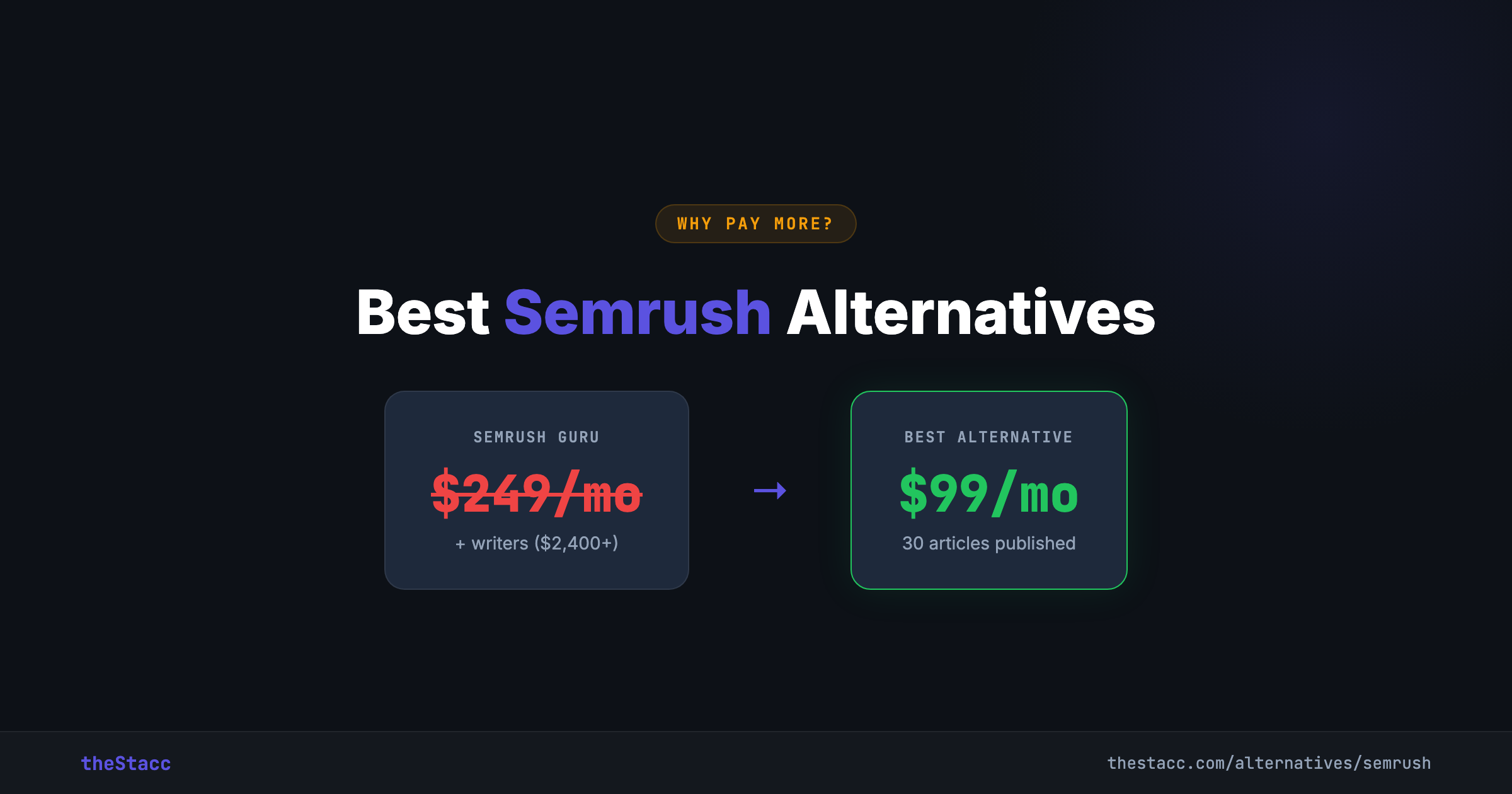
| Real monthly cost for 30 published articles | $249 + $2,400-$7,500 writers | $99/month flat |
See how theStacc works → Start for $1
The 15 Best Semrush Alternatives at a Glance
| # | Tool | Best For | Price (Monthly) | Type | Free Tier |
|---|---|---|---|---|---|
| 1 | Stacc | Done-for-you SEO | $99/mo | Content service | $1 / 3 days |
| 2 | Ahrefs | Full SEO suite | $129/mo (Lite) | SEO suite | Webmaster Tools |
| 3 | Moz Pro | Domain authority + SEO | $99/mo | SEO suite | MozBar free |
| 4 | Ubersuggest | Budget keyword research | $29/mo | SEO lite | 3 searches/day |
| 5 | SE Ranking | Budget full suite | $65/mo | SEO suite | 14-day trial |
| 6 | Mangools | Beginner-friendly SEO | $49/mo | SEO lite | Limited free |
| 7 | SpyFu | Competitor research | $39/mo | SEO suite | Limited free |
| 8 | Serpstat | Budget all-in-one | $69/mo | SEO suite | Limited |
| 9 | Surfer SEO | Content optimization | $99/mo | Content tool | ✗ |
| 10 | Frase | Content briefs | $49/mo | Content tool | 7-day free |
| 11 | Screaming Frog | Technical SEO audits | $259/yr | Crawler | 500 URLs free |
| 12 | Google Search Console | Free rank tracking | Free | Google tool | ✓ |
| 13 | Similarweb | Traffic intelligence | $149/mo | Analytics | Limited free |
| 14 | Majestic | Backlink analysis | $49.99/mo | Link tool | Limited free |
| 15 | BrightLocal | Local SEO | $39/mo | Local SEO | 14-day trial |
#1. Stacc — Best Overall Semrush Alternative
Semrush gives you data. Stacc gives you results. It writes, optimizes, and publishes 30 articles per month to your CMS. No keyword research. No content briefs. No freelancers. No workflow.
Why it’s better than Semrush:
- 30 SEO articles written AND published per month for $99. Semrush researches. Stacc executes.
- Google Business Profile posts included ($49/mo add-on). Local SEO and blog SEO in one platform.
- Social media posts included ($49/mo add-on). Instagram, LinkedIn, X, Facebook.
- No 50-tool dashboard to learn. No analysis paralysis. Content shows up on your website.
- WordPress, Webflow, Ghost, and Custom Webhook integrations.
Where Semrush still wins:
- Semrush is the most complete SEO research platform available. Keyword research, backlink analysis, site audits, rank tracking, competitive intelligence — nothing else matches the depth.
- If you’re an agency managing 20+ client sites with reporting needs, Semrush’s dashboard is built for you.
Stacc pricing:
- Blog SEO: $99/mo (30 articles), $149/mo (50), $199/mo (80)
- Local SEO: $49/mo (30 GBP posts)
- Social Media: $49/mo (30 posts across 3 platforms)
- Bundle: ~15% off any 2+ modules
- Trial: $1 for 3 days
Best for: Local service businesses, SMBs, and agencies — anyone spending $1,000+/month on an SEO agency or spending hours managing content themselves.
#2. Ahrefs — Best Full SEO Suite Alternative
Ahrefs is Semrush’s closest direct competitor and the tool most SEO professionals switch to. It has the largest backlink index in the industry, a cleaner interface, and similar feature coverage. If you want a full SEO suite but find Semrush overwhelming, Ahrefs is the default answer.
Key features:
- Largest backlink database (35+ trillion known links)
- Site Explorer for competitive analysis and organic traffic estimates
- Content Explorer for finding top-performing content in any niche
- Keywords Explorer with keyword difficulty and click data
- Site Audit with 170+ technical SEO checks
- Rank Tracker with desktop and mobile tracking
Pricing: Starter $29/mo (very limited) · Lite $129/mo · Standard $249/mo · Advanced $449/mo. Free Webmaster Tools for verified site owners.
Pros: Best backlink database. Cleaner, more intuitive interface than Semrush. Content Explorer is unique. Free Webmaster Tools for basic analysis.
Cons: Lite plan ($129/mo) still limits you to 500 credits/month. Full features require Standard at $249/mo — same price as Semrush Guru. Starter plan ($29/mo) is too limited for real work. No AI content writer. No auto-publish. No local SEO or GBP management.
Best for: SEO professionals and agencies who find Semrush’s interface overwhelming and prioritize backlink analysis.
The bottom line: Ahrefs is the best alternative if you want a different SEO suite, not a different approach. The data is excellent, the UI is cleaner, and the backlink index is unmatched. But you’re still paying $129-$249/month for research tools — and you still need writers, editors, and a publishing workflow on top of that.
#3. Moz Pro — Best for Domain Authority and Link Building
Moz invented Domain Authority — the metric that half the SEO industry uses to evaluate websites. If your primary use case is link building prospecting or tracking domain-level authority, Moz’s DA metric is the industry standard.
Key features:
- Domain Authority (DA) and Page Authority (PA) — industry-standard metrics
- Keyword Explorer with organic CTR and priority scoring
- Link Explorer with spam score and link quality analysis
- Site Crawl for technical SEO audits
- Rank tracking with local pack monitoring
- MozBar Chrome extension (free)
Pricing: Starter $49/mo ($39 annual) · Standard $99/mo ($79 annual) · Medium $179/mo ($143 annual) · Large $299/mo ($239 annual).
Pros: DA is the industry standard for link building. Good keyword research with unique Priority metric. Spam Score helps evaluate link quality. Free MozBar extension is genuinely useful.
Cons: Smaller keyword database than Semrush or Ahrefs — noticeable gaps in long-tail and non-English keywords. Slower data updates. Link index crawled less frequently than Ahrefs. Interface feels dated compared to newer tools. No content writing, optimization, or auto-publishing.
Best for: Link builders and agencies focused on domain authority metrics, spam score analysis, and link prospecting.
The bottom line: Moz is a solid SEO suite with the best-known authority metric in the industry. But the smaller database and slower updates mean you’re getting less data for the same price as Ahrefs Lite ($129/mo). If DA matters to your workflow, Moz is worth it. If you need broader keyword and backlink data, Ahrefs or Semrush cover more ground.
#4. Ubersuggest — Best Free/Budget Option
Ubersuggest is Neil Patel’s SEO tool and the cheapest entry point for keyword research and basic SEO analysis. It offers a free tier (3 searches/day) and a $120 lifetime plan — making it the most affordable option on this list.
Key features:
- Keyword research with difficulty scores, CPC, and volume data
- Site audit with SEO health scoring
- Backlink analysis (basic)
- Content ideas based on top-performing pages
- Chrome extension for SERP data
- Lifetime pricing option ($120-$400 one-time)
Pricing: Free (3 searches/day) · Individual $29/mo · Business $49/mo · Enterprise $99/mo · Lifetime plans $120-$400 one-time.
Pros: Cheapest entry point in SEO. Lifetime deal eliminates recurring costs. Free tier lets you test before buying. Simple interface good for beginners.
Cons: Keyword and backlink data is significantly less accurate than Semrush or Ahrefs. Traffic estimates are unreliable — multiple users report large discrepancies. Free plan is functionally useless (3 searches/day). Limited technical SEO auditing. No content writing or publishing.
Best for: Solopreneurs and small business owners on a tight budget who need basic keyword research.
The bottom line: Ubersuggest is the cheapest way to get keyword research data. The lifetime deal ($120 one-time) is genuinely compelling if you just need basic research. But the data accuracy gap is real — if you’re making business decisions based on keyword data, Ubersuggest’s numbers may lead you astray. Good for hobby projects and basic research. Not reliable enough for competitive SEO.
#5. SE Ranking — Best Budget Full Suite
SE Ranking is the best-value full-featured SEO suite. At $65/month, it covers keyword research, backlink analysis, site audits, rank tracking, and competitive intelligence — roughly 80% of what Semrush offers at roughly 50% of the price.
Key features:
- Rank tracking with daily updates and local tracking
- Keyword research with keyword grouping and suggestions
- Backlink monitoring and analysis
- Site audit with SEO health score
- Competitive research (organic and paid)
- White-label reports (higher tiers)
- Local SEO marketing tools
Pricing: Essential $65/mo ($52 annual) · Pro $119/mo ($95 annual) · Business $259/mo ($207 annual). 14-day free trial.
Pros: 50% cheaper than Semrush for similar features. Strong rank tracking with local monitoring. White-label reporting for agencies. Good local SEO features. 14-day free trial.
Cons: Smaller keyword and backlink database than Semrush or Ahrefs. Less brand recognition — clients may question the data source. Content marketing features are add-ons, not core. Price increases have frustrated long-term users.
Best for: Agencies and SMBs who need full-suite features at half the Semrush price and don’t need the largest possible database.
The bottom line: SE Ranking offers the best price-to-feature ratio of any SEO suite. If you’re switching from Semrush purely because of cost and you need similar features, SE Ranking is the most direct swap. The data is 80% as deep at 50% of the price. For most businesses, that’s enough.
#6. Mangools — Best for Beginners
Mangools is the most beginner-friendly SEO toolset. Its 5 tools (KWFinder, SERPChecker, SERPWatcher, LinkMiner, SiteProfiler) are designed for people who find Semrush overwhelming — which is most people.
Key features:
- KWFinder — keyword research with difficulty scoring (best UI in SEO)
- SERPChecker — SERP analysis with authority metrics
- SERPWatcher — rank tracking
- LinkMiner — backlink analysis
- SiteProfiler — domain overview and metrics
Pricing: Entry $49/mo ($29.90 annual) · Premium $69/mo ($44.90 annual) · Agency $129/mo ($89.90 annual).
Pros: Best UI/UX in the SEO tool category. KWFinder is genuinely enjoyable to use. $29.90/month on annual billing is 88% cheaper than Semrush Guru. Perfect for beginners.
Cons: Significantly smaller keyword database than Semrush, Ahrefs, or Moz. No content optimization, writing, or publishing features. No site audit tool. Rank tracking has reliability issues — some users report dropped or inaccurate data. Not enough depth for competitive niches.
Best for: Beginners, bloggers, and small business owners who want simple keyword research without the complexity of enterprise SEO suites.
The bottom line: Mangools is the friendliest SEO tool you can buy. KWFinder alone is worth the $29.90/month annual price for basic keyword research. But it’s a lightweight tool — if you’re in a competitive niche or need technical SEO auditing, you’ll outgrow it quickly.
#7. SpyFu — Best for Competitor Research
SpyFu does one thing exceptionally well: it shows you every keyword your competitors rank for, every ad they’ve run, and every domain they’ve outbid. If competitive intelligence is your primary use case, SpyFu provides more competitor data per dollar than any other tool.
Key features:
- Complete competitor keyword history (organic and paid)
- PPC competitor ad copy and spend analysis
- Backlink analysis with competitor comparison
- Keyword research with grouping
- Rank tracking
- Unlimited data on all plans
Pricing: Basic $39/mo ($16/mo annual) · Professional $79/mo ($36/mo annual). Unlimited data exports and API access on all plans.
Pros: Best competitor intelligence per dollar. Unlimited data on all plans — no credit system. $16/month on annual billing. Complete PPC history for any domain.
Cons: Narrow focus — primarily competitor/PPC research. Less useful for content optimization, technical SEO, or site auditing. Data accuracy has been questioned for smaller domains. Limited international data. No content writing or publishing.
Best for: PPC managers and SEOs focused on competitive intelligence who want unlimited data at a low price.
The bottom line: SpyFu is the cheapest way to see what your competitors are doing in search. At $16/month annually with unlimited data, it’s hard to beat for competitive research. But it’s a specialized tool — you’ll need additional tools for content, technical SEO, and link building.
#8. Serpstat — Best Budget All-in-One
Serpstat positions itself as a growth hacking tool with SEO suite features. At $69/month, it covers keyword research, backlink analysis, site audits, rank tracking, and competitive research — similar to SE Ranking but with a slightly different feature set.
Key features:
- Keyword research with clustering and search suggestions
- Backlink analysis and monitoring
- Site audit with SEO health scoring
- Rank tracking (daily updates)
- Competitive analysis (organic and paid)
- Content marketing tools
Pricing: Individual $69/mo ($55 annual) · Team $149/mo ($119 annual) · Agency $299/mo ($239 annual). Limited free plan available.
Pros: Solid feature coverage for the price. Keyword clustering is useful for content planning. Competitive pricing vs. Semrush. Good for teams.
Cons: UI feels dated compared to Ahrefs or Semrush. Inconsistent feature depth — some tools are polished, others feel unfinished. Support can have language barrier issues. Smaller database than the top 3 suites. No content writing or publishing.
Best for: Budget-conscious teams wanting an all-in-one SEO suite with keyword clustering at a fraction of Semrush’s price.
The bottom line: Serpstat covers the basics at a reasonable price. The keyword clustering feature is genuinely useful for content planning. But the inconsistent feature quality and dated UI make it feel like a tier below SE Ranking and Mangools in polish. Test during the free tier before committing.
#9. Surfer SEO — Best for Content Optimization
Surfer SEO is the best content optimization tool available. If your main Semrush use case is the Content Marketing Toolkit, Surfer does that specific job better — and at a lower price.
Key features:
- Content Editor with 500+ ranking factor analysis
- SERP Analyzer for competitive content research
- Internal linking suggestions (Pro plan)
- AI writer with SERP-data-backed drafts
- Keyword research with clustering
- Content audit and optimization scoring
Pricing: Essential $89/mo · Scale $129/mo (most popular) · Scale AI $219/mo. Annual billing saves ~17%.
Pros: Best content optimization scoring in the category. Content Editor is best-in-class. Stronger content tools than Semrush’s Content Marketing Toolkit at a lower price.
Cons: Content tool only — no backlinks, no site audits, no rank tracking. You need a separate SEO suite for everything else. Does not write or publish articles for you (unless you buy AI credits). No local SEO or GBP features.
Best for: Content teams who already have an SEO suite for research and need a dedicated content optimization layer.
The bottom line: If you’re leaving Semrush specifically because of weak content tools, Surfer is the upgrade. But you’re replacing one tool with another tool — you still need writers, editors, and a publishing workflow. Surfer optimizes. It doesn’t execute.
#10. Frase — Best for Content Briefs
Frase builds the best content briefs in the SEO industry. For any keyword, it pulls headings, topics, questions, and word counts from top-ranking pages and assembles a structured brief in minutes. If your team spends hours researching before writing, Frase compresses that to 10-20 minutes per topic.
Key features:
- SERP research and content brief generation (best-in-class)
- Content optimization scoring
- AI writing with 80+ skills
- Dual SEO + GEO scoring
- WordPress auto-publish
Pricing: Starter $49/mo ($39 annual) · Professional $129/mo ($103 annual) · Scale $299/mo ($239 annual). 7-day free trial.
Pros: Best brief builder in SEO. Cheaper than Semrush for content workflows. GEO optimization for AI search visibility. Free trial with no credit card.
Cons: Research and optimization tool only — does not write or publish for you. Optimization scoring less granular than Surfer. No backlinks, no site audits, no rank tracking.
Best for: Freelance writers and content teams who build 10+ briefs per month and want to cut research time.
The bottom line: Frase replaces the research side of Semrush’s Content Marketing Toolkit — and does it better. But it’s still a DIY tool. You research, you write, you edit, you publish. If that workflow works for your team, Frase saves time and money. If you want the work done, it’s not the right fit.
#11. Screaming Frog — Best for Technical SEO Audits
Screaming Frog is a desktop-based website crawler that technical SEOs have relied on for over a decade. If your main Semrush use case is site auditing, Screaming Frog provides deeper technical data at a fraction of the cost.
Key features:
- Full website crawling with 200+ data points per URL
- Broken link detection and redirect chain analysis
- Duplicate content and canonicalization analysis
- JavaScript rendering crawling
- Schema validation
- XML sitemap generation
Pricing: Free (500 URLs) · Paid $259/year (unlimited URLs).
Pros: Deepest technical crawl data available. $259/year is a fraction of Semrush’s cost. Free tier covers small sites. Industry standard for technical SEOs. Desktop-based — your data stays local.
Cons: Desktop application only — no cloud dashboard. Steep learning curve. Resource-intensive on large sites. No keyword research, no backlinks, no content tools. Not beginner-friendly.
Best for: Technical SEO specialists who need the deepest possible crawl data for auditing.
The bottom line: Screaming Frog is the best technical SEO auditing tool. Period. But it only does auditing. If you need keyword research, backlinks, content tools, or anything beyond crawling, you’ll need additional tools.
#12. Google Search Console — Best Free Option
Google Search Console is the only tool on this list that gives you real Google data — not estimates. Every other tool estimates your traffic and rankings. GSC tells you exactly what Google sees.
Key features:
- Real search performance data (clicks, impressions, CTR, position)
- Index coverage and URL inspection
- Core Web Vitals monitoring
- Mobile usability reports
- Manual action notifications
- Sitemap submission
Pricing: Free. No limits. No catches.
Pros: Real data from Google. Completely free. Essential for any website owner. No estimates — actual search performance.
Cons: Limited to your own site — no competitor analysis. No keyword research for new topics. No backlink analysis. No content optimization. Data limited to 16 months. Basic interface.
Best for: Every website owner. GSC should be in your stack regardless of what other tools you use.
The bottom line: GSC is not a Semrush replacement. It’s a mandatory baseline. Use it alongside whatever other tools you choose. The real data alone makes it more valuable than many paid tools’ estimates.
#13. Similarweb — Best for Traffic Intelligence
Similarweb estimates website traffic, audience demographics, traffic sources, and engagement metrics for any domain. If your Semrush use case is competitive traffic analysis, Similarweb provides deeper traffic intelligence.
Key features:
- Website traffic estimates and trends
- Traffic source breakdown (organic, paid, social, direct, referral)
- Audience demographics and geography
- Industry benchmarking
- Keyword analysis (organic and paid)
- App intelligence
Pricing: Starter $149/mo · Professional $399/mo · Enterprise custom. Limited free version.
Pros: Best traffic intelligence data available. Deeper traffic source analysis than Semrush. Industry benchmarking is unique. Good for investor and M&A research.
Cons: Expensive — $149/mo entry. Traffic estimates can be inaccurate for smaller sites. No content tools, no backlinks, no site audit. Narrow focus on traffic intelligence.
Best for: Marketing leaders and analysts who need competitive traffic intelligence and audience data.
The bottom line: Similarweb is the best tool for understanding competitor traffic patterns. But at $149/month for a narrow focus, it’s a complement to an SEO suite, not a replacement for one.
#14. Majestic — Best for Backlink Analysis
Majestic has one of the oldest and largest link indexes in SEO. Its Trust Flow and Citation Flow metrics are used by link builders worldwide. If backlink analysis is your primary Semrush use case, Majestic goes deeper on links.
Key features:
- Trust Flow and Citation Flow metrics
- Historic and Fresh Index link databases
- Backlink history and trends
- Topical Trust Flow (link relevance by topic)
- Bulk backlink checker
- Link context analysis
Pricing: Lite $49.99/mo · Pro $99.99/mo · API $399.99/mo.
Pros: Deep link index with unique Trust Flow/Citation Flow metrics. Topical Trust Flow is unique. Strong for link building prospecting. Competitive pricing for link-focused analysis.
Cons: Link analysis only — no keyword research, no site audit, no content tools, no rank tracking. Interface is dated. Requires SEO knowledge to interpret data. Free tier is extremely limited.
Best for: Link builders and agencies focused on backlink acquisition and link quality analysis.
The bottom line: Majestic is the specialist’s link analysis tool. If backlinks are your primary concern, it provides deeper link data than Semrush’s backlink module. But it does nothing else. You need additional tools for everything beyond links.
#15. BrightLocal — Best for Local SEO
BrightLocal is the leading platform for local SEO — citation management, local rank tracking, review monitoring, and Google Business Profile auditing. If Semrush’s lack of local SEO tools is driving your search, BrightLocal fills that gap.
Key features:
- Local rank tracking with map pack monitoring
- Citation building and management
- Review monitoring and generation
- Google Business Profile auditing
- Local SEO audit reports
- White-label reporting for agencies
Pricing: Track $39/mo · Manage $49/mo · Grow $59/mo. 14-day free trial.
Pros: Best local SEO platform available. Strong citation management. Review monitoring across platforms. Affordable pricing. 14-day free trial.
Cons: Local SEO only — no keyword research, no backlink analysis, no content tools, no site auditing. You need a separate SEO suite for everything else. Does not write or publish content.
Best for: Local businesses and agencies managing local SEO across multiple locations.
The bottom line: BrightLocal is the best local SEO tool on the market. If local rankings and GBP management are your primary need, it’s the move. But it only handles local — you’ll need additional tools (or a service like Stacc) for blog content and broader SEO.
How to Choose the Right Semrush Alternative
Picking the right alternative depends on one question: do you want a research tool, or do you want results?
SEO suites like Ahrefs, Moz, and SE Ranking give you data. Keyword research, backlink profiles, site audits, rank tracking. You still need to write the content, optimize it, publish it, and manage local SEO separately.
Services like Stacc skip the entire workflow. Content is written, optimized, and published to your CMS automatically.
Here’s how to decide:
Choose Stacc if:
- You want content written AND published automatically — no writers, no briefs, no workflow
- You run a local service business and need Google Business Profile + blog SEO in one platform
- You’re spending $1,000+/month on an SEO agency and want the same output for $99
- You want 30 articles/month without writing a single word
Choose Ahrefs if:
- You’re an SEO professional who needs the best backlink data and a full research suite
- You find Semrush’s interface overwhelming and want a cleaner UI
Choose SE Ranking if:
- You need Semrush-like features at 50% of the price
- You’re an agency that needs white-label reporting on a budget
Choose Mangools if:
- You’re a beginner who wants simple keyword research without the complexity
- Budget is the priority and you don’t need site auditing
Choose Ubersuggest if:
- You want the cheapest possible keyword research tool
- You’re willing to accept less accurate data in exchange for a lower price
Choose Google Search Console if:
- You want real data from Google (not estimates) for free
- You’re just getting started with SEO and want a baseline
The Bottom Line
We tested all 15 tools. Here’s what we found.
Every SEO suite on this list does the same thing: it gives you data. Keywords, backlinks, audits, ranks, competitor analysis. Some do it with bigger databases (Ahrefs, Semrush). Some do it cheaper (SE Ranking, Mangools, SpyFu). Some specialize (Majestic for links, BrightLocal for local, Screaming Frog for audits).
But none of them solve the actual problem most businesses have: getting 30 SEO-optimized articles written, edited, and published to your website every month without hiring writers, managing freelancers, or spending hours in a content workflow.
That’s the gap Stacc fills.
| What you need | Suite approach | Stacc approach |
|---|---|---|
| Keyword research | You do it ($65-$249/mo) | Done for you |
| Content writing | You hire writers ($2,400-$7,500/mo) | Done for you |
| SEO optimization | You optimize manually | Done for you |
| Publishing to CMS | You format and publish | Done for you |
| Local SEO / GBP posts | Separate tool + manual work | Included ($49/mo) |
| Social media posts | Separate tool + manual work | Included ($49/mo) |
| Total monthly cost | $2,500-$8,000+ | $99 |
If you want control over every keyword, backlink profile, and audit report, Semrush is still the most complete research platform. Ahrefs has the best backlink data. SE Ranking is the best value.
If you want the content done — written, optimized, published, and ranking — without touching any of it, that’s what Stacc does.
Frequently Asked Questions
What is the best Semrush alternative in 2026? For businesses that want SEO results without managing tools, Stacc is the best alternative — it writes, optimizes, and publishes 30 articles/month for $99, plus handles Google Business Profile posts and social media. For SEO professionals who need a full research suite, Ahrefs ($129/mo) is the closest competitor with a better backlink index and cleaner interface.
Is there a free Semrush alternative? Google Search Console is the best free option — it provides real search data directly from Google. Ubersuggest offers a limited free tier (3 searches/day). Ahrefs offers free Webmaster Tools for verified sites. Mangools has a very limited free version. None match Semrush’s full feature set for free, but they cover the basics.
Is Semrush worth $250/month? For SEO agencies managing multiple clients with reporting needs, Semrush’s Guru plan ($249/mo) is worth it. For small businesses that just want more organic traffic, the real cost is Semrush ($249/mo) plus freelance writers ($2,400-$7,500/month for 30 articles) — totaling $2,650-$7,750/month. Stacc delivers 30 published articles for $99/month flat.
Which Semrush alternative is cheapest? SpyFu starts at $16/month (annual). Mangools starts at $29.90/month (annual). Ubersuggest offers a $120 lifetime plan. Google Search Console is free. Stacc is $99/month but includes writing and publishing — making it cheaper than any suite plus freelancers.
Can I switch from Semrush to Stacc? Yes. Stacc replaces Semrush’s content workflow, your content writers, and your publishing process in one subscription. Sign up for $1 (3-day trial) and Stacc starts publishing optimized articles to your WordPress, Webflow, or Ghost site within days.
Does Semrush write content for you? Semrush includes an AI Article Generator on the Guru plan ($249/mo) that can create drafts. But it does not publish to your CMS automatically, does not manage your content calendar, and does not handle local SEO or social media. The drafts still require editing and manual publishing.
Stop Researching. Start Publishing.
Every tool on this list helps you research SEO. One of them writes, optimizes, AND publishes it.
30 SEO articles/month. Google Business Profile posts. Social media. $99/mo.
This page was written and published by Stacc, which competes with the tools listed here. We have a commercial interest as an alternative. All pricing and feature data verified against official sources as of March 2026.