Semrush Review 2026: The $140/Month Question Nobody Answers Honestly
Semrush review covering features, pricing ($139–$499/mo), pros & cons, and who it's actually worth it for in 2026.
Siddharth Gangal • March 18, 2026
In This Review
Looking for Semrush alternatives?
See top Semrush alternatives →Editorial disclosure: This review was written and published by Stacc, a competing product to Semrush. We have a commercial interest as an alternative. We’ve worked to present Semrush’s features fairly and accurately, but you should weigh that context. All pricing and feature data was verified against Semrush’s public pricing page as of March 2026.
By Stacc Editorial Team · SEO practitioners. We publish 30+ articles/month for businesses using our own platform — including this one. · Last updated: March 18, 2026
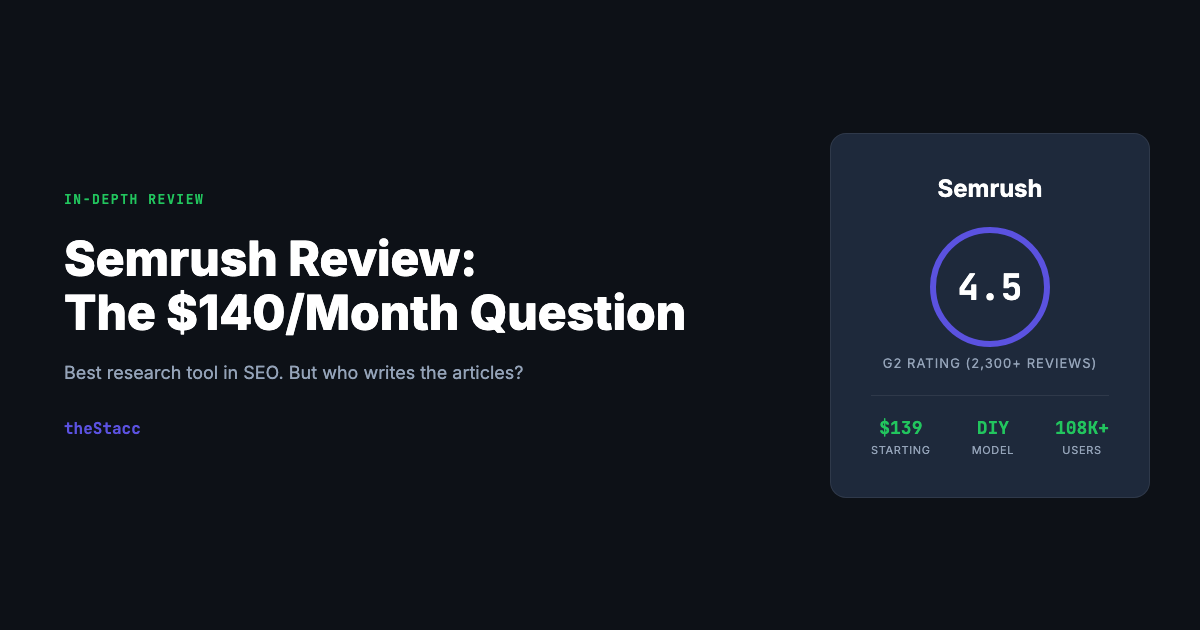
📌 Quick Verdict: This Semrush review covers the full picture: Semrush is the most comprehensive SEO platform on the market — and that’s exactly the problem for most buyers. It does keyword research, site audits, rank tracking, backlink analysis, and competitor intelligence better than almost anyone. But it doesn’t write a single article for you. It doesn’t publish anything. It doesn’t touch your Google Business Profile. You get data. What you do with that data costs extra — usually $2,400–$7,500/month extra in writers alone. G2: 4.5/5 (2,300+ reviews). Starting price: $139/month.
theStacc vs. Semrush: Where We’re Better
We wrote this review. We’re a competitor. Here’s exactly where theStacc is better — so you can weigh what follows.
| Feature | Semrush | theStacc |
|---|---|---|
| Starting price | $139/month | $99/month |
| Articles written for you | ✗ No — research tool only | ✓ 30 articles/month |
| Auto-publishes to your CMS | ✗ No | ✓ Yes (WordPress, Webflow, Ghost) |
| Local SEO / Google Business Profile posts | ✗ Add-on ($40+/month) | ✓ 30 GBP posts/month |
| Social media posts | ✗ Scheduling only (no content creation) | ✓ 30 posts/month (Instagram, LinkedIn, X, Facebook) |
| Done-for-you (no workflow to manage) | ✗ DIY — you run everything | ✓ Fully managed, hands-off |
| Real monthly cost at 30 published articles | $2,600–$7,900+/month (tool + writers + labor) | $99/month flat |
See how theStacc works → Start for $1
Here’s the thing about Semrush that every review dances around: it’s the best research tool in SEO. No serious debate. But “best research tool” and “best way to actually rank on Google” are two different conversations.
This Semrush review takes an angle most others won’t. We use SEO tools daily. We know what Semrush does well — and we know the gap between seeing opportunity data and actually publishing content that captures it. Most Semrush users spend $139–$499/month to stare at keyword data, then struggle to act on it.
We’re going to cover the full product honestly. What’s genuinely best-in-class, where the pricing gets complicated, and when the smartest move is skipping the research phase entirely and just publishing.
What Is Semrush?
Semrush is an all-in-one SEO and digital marketing platform. It started as a keyword research tool in 2008, built by Oleg Shchegolev and Dmitry Melnikov in the U.S. (originally as SEMrush LLC). Over 17 years, it expanded into a full marketing suite covering organic search, paid search, content marketing, social media management, and competitive intelligence.
The core engine: Semrush maintains one of the largest keyword databases in the world — over 26 billion keywords across 142 countries. It crawls the web continuously to build backlink profiles, track ranking positions, and audit technical SEO issues. Every feature in the platform connects back to this data layer.
What Semrush is not: a content creation service, an automated publishing platform, or a done-for-you SEO system. It tells you what keywords to target, who your competitors are, and what’s broken on your site. You (or your team) still have to write every article, optimize every page, and publish every piece of content manually.
Semrush went public on the NYSE in March 2021 (ticker: SEMR). As of 2025, it reported ~$377M in annual revenue with 108,000+ paying customers. It’s the most widely used SEO platform globally — and that market position is well-earned.
Semrush Features (2026)
Keyword Research (Keywords Explorer)
This is where Semrush is genuinely untouchable. The Keyword Magic Tool pulls from 26+ billion keywords across 142 countries. For any seed keyword, you get:
- Search volume with monthly trends and seasonality graphs
- Keyword difficulty score (KD%) with SERP feature indicators
- CPC data for paid search planning
- Related keywords, questions, and “People Also Ask” variations
- Keyword clustering by topic relevance
The data accuracy is consistently better than alternatives. Ahrefs is close on backlink data, but for keyword volume and difficulty estimates, Semrush edges ahead — particularly for lower-volume long-tail keywords where other tools return zeros.
Insight: Semrush’s keyword difficulty score accounts for referring domains, content quality, and SERP features. It’s not perfect — no KD score is — but it correlates with actual ranking difficulty more reliably than most competitors.
Site Audit
Semrush’s Site Audit crawls your entire website and flags technical SEO issues across 140+ checks:
- Crawlability problems (broken links, redirect chains, orphan pages)
- Indexability issues (noindex conflicts, canonical errors, duplicate content)
- Core Web Vitals monitoring (LCP, FID/INP, CLS)
- Internal linking optimization suggestions
- HTTPS implementation checks
- Structured data validation
The audit categorizes issues by severity: errors, warnings, and notices. The Health Score gives you a quick read on overall site condition. For agencies managing 10+ client sites, the Project Dashboard consolidates audit data across all domains.
Position Tracking
Tracks your keyword rankings daily across:
- Google (desktop and mobile separately)
- Bing
- Google Maps (local pack positions)
- Competitor comparison (track your rankings against 4 competitors simultaneously)
You can segment by location, device, and SERP feature type (featured snippets, People Also Ask, image packs). The Cannibalization Report identifies when multiple pages compete for the same keyword — genuinely useful for large content libraries.
Backlink Analytics
Semrush’s backlink database indexes 43+ trillion backlinks. For any domain:
- Total backlinks and referring domains with trend graphs
- New and lost backlinks (daily updates)
- Anchor text distribution analysis
- Referring domain authority scores
- Toxic backlink identification for disavow file prep
The Backlink Gap tool compares your backlink profile against up to 4 competitors — showing which sites link to them but not to you. This is where link building campaigns actually start.
Competitive Analysis
The Competitive Research tools let you reverse-engineer any competitor’s entire organic strategy:
- Organic Research — every keyword a domain ranks for, with position, traffic estimate, and SERP features
- Traffic Analytics — estimated traffic, top pages, geographic distribution, traffic sources
- Advertising Research — competitor ad copy, landing pages, and PPC spend estimates
- Market Explorer — industry-level competitive landscape with market share estimates
For businesses entering a competitive niche, this intelligence is genuinely valuable. The problem: having the data and acting on it are very different things.
Content Marketing Toolkit
Semrush’s content tools include:
- SEO Content Template — generates writing briefs based on top-10 ranking pages (suggested length, readability, semantically related words)
- SEO Writing Assistant — real-time optimization scoring (Google Docs and WordPress integrations)
- Topic Research — maps subtopics and questions around a seed keyword
- ContentShake AI — Semrush’s AI writing assistant that generates article drafts
Insight: ContentShake AI is Semrush’s answer to “we just do research, not writing.” It generates drafts with SEO optimization built in. The quality is improving, but the output still reads like AI-generated content that needs significant editing. It’s a $60/month add-on (or included with Guru+ plans for limited articles).
Local SEO (Add-on)
Semrush offers local SEO through Listing Management:
- Distributes business info to 150+ directories (Yelp, Facebook, Apple Maps, etc.)
- Review monitoring across platforms
- Local rank tracking
The catch: This is an add-on — $40/month on top of your Semrush subscription. And it doesn’t create Google Business Profile posts. It doesn’t write local content. It distributes your NAP data and monitors reviews.
Social Media Management
Semrush’s Social Media Toolkit includes:
- Post scheduling across platforms (Facebook, Instagram, X, LinkedIn, Pinterest, Google Business Profile)
- Social media analytics and reporting
- Competitor social media tracking
The catch: This is a scheduling tool. It doesn’t create content. You still write every caption, design every image, and plan every post. It just publishes them on a schedule you set.
Semrush Pricing (2026)
| Plan | Monthly | Annual/mo | Key Limits |
|---|---|---|---|
| Pro | $139/mo | $117/mo | 500 keywords to track · 10,000 results per report · 5 projects · 1 user |
| Guru | $249/mo | $208/mo | 1,500 keywords · 30,000 results/report · 15 projects · 1 user · Content tools |
| Business | $499/mo | $416/mo | 5,000 keywords · 50,000 results/report · 40 projects · 1 user · API access |
Add-ons (where costs escalate):
- Additional user seat: $45–$100/month per user
- Semrush Local (Listing Management): $40/month per location
- Agency Growth Kit: $150/month
- ContentShake AI: $60/month standalone (limited with Guru+)
- Trends (Traffic Analytics): $200/month
Annual discount: ~16%. Free trial: 7 days (credit card required).
The Real Cost of Semrush
Here’s the math nobody puts on the pricing page.
Semrush at its best gives you a list of keywords to target, a content brief, and a site audit to fix. To actually publish 30 articles per month using that data:
$2,600–$7,900/month — the real monthly cost. Semrush Pro ($139) + writers ($80–$250/article × 30 = $2,400–$7,500) + content optimization tool like Surfer ($119) = $2,658–$7,758 minimum.
That’s not counting your time — or your content manager’s time — coordinating writers, reviewing drafts, optimizing content, uploading to your CMS, formatting, adding images, and hitting publish 30 times a month.
Semrush gives you the map. Everything else — the car, the fuel, the driver — is on you.
How to Use Semrush: The Right 5-Step Workflow
Most Semrush users do this wrong. They open Keyword Magic Tool, find 200 keywords, create a spreadsheet, then never write a single article. Sound familiar? Here’s the workflow that actually produces results.
Step 1: Run the Site Audit first, not keyword research Fix what’s broken before building new. A site with 50 crawl errors and broken redirects won’t rank no matter how many articles you publish. Clean your technical foundation first. This takes 1–2 hours with Semrush’s audit.
Step 2: Use Competitive Analysis to find realistic targets Don’t chase keywords because they have high volume. Use Organic Research to find keywords where your closest competitors (similar DR) rank in positions 4–20. These are the gaps you can actually fill.
Step 3: Build topic clusters, not keyword lists Use Topic Research to group related keywords into clusters. One pillar page + 5–8 supporting articles per cluster. This builds topical authority faster than scattered one-off posts.
Step 4: Create content briefs using the SEO Content Template For each target keyword, generate a template. It gives you word count targets, semantically related terms, and top-10 competitor analysis. Hand this to your writers — don’t just say “write about this keyword.”
Step 5: Track rankings and audit quarterly Set up Position Tracking for every published article. Review quarterly. If a page drops from position 5 to position 15, it needs updating — not replacing. The Content Audit tool flags which pages are decaying.
Does Semrush Actually Work? What the Data Says
Let’s be direct: Semrush’s data is accurate, its tools are comprehensive, and companies using it properly see measurable results.
Enterprise validation speaks for itself. Samsung, Forbes, IBM, Tesla, P&G, and Walmart use Semrush. Over 108,000 paying customers and $377M in annual revenue confirm the product delivers value for teams that have the resources to act on the data.
The pattern: Teams with dedicated content operations — writers, editors, a content manager, a publishing workflow — get massive value from Semrush. The keyword data is better than alternatives. The competitive intelligence is unmatched. The site audit catches issues other tools miss.
Here’s the honest caveat: for businesses without a content team, Semrush is a $139–$499/month window into what they could be doing but aren’t. The data is only as valuable as your ability to execute on it.
Reddit’s r/SEO community confirms this repeatedly: “Semrush is amazing if you have a team to use it. If you’re a solo business owner, you’re paying for a dashboard you’ll check once a month.”
Semrush Pros & Cons
Pros
- Largest keyword database in the industry (26B+ keywords, 142 countries)
- Site Audit catches technical issues other tools miss (140+ checks)
- Competitive analysis tools are genuinely best-in-class
- Backlink database (43T+ links) rivals Ahrefs for accuracy
- Position Tracking with daily updates and competitor comparison
- ContentShake AI adds basic content generation capability
- 7-day free trial available (most competitors don’t offer this)
- Enterprise-grade reporting and white-label options
- NYSE-listed company — not going anywhere
Cons
- Does not write, optimize, or publish content for you
- $139/month entry point is steep for small businesses who need execution, not just data
- Additional user seats cost $45–$100/month each (expensive for teams)
- Local SEO is a $40/month add-on — not built into core plans
- ContentShake AI quality below dedicated AI writing tools
- Learning curve is real — 50+ tools in one dashboard, most users use 5–6
- Social media management is scheduling only, not content creation
- Real cost at scale ($2,600–$7,900/month) makes it impractical for businesses without writers
- Free trial requires credit card and auto-renews
Who Is Semrush Best For?
Strong fit:
- SEO agencies managing multiple client campaigns
- In-house marketing teams with dedicated writers and editors
- Enterprise companies with $10K+/month content budgets
- Freelance SEO consultants who sell strategy (not execution)
- PPC teams running Google Ads alongside organic campaigns
Probably not the right call:
- Local service businesses that need to rank on Google Maps
- Small business owners without a writing team
- Solo operators who need content published, not just keywords researched
- Anyone looking for a done-for-you content system
- Businesses spending under $500/month on total marketing
Semrush vs. Alternatives
| Tool | Price | Free trial | Best for | Content creation |
|---|---|---|---|---|
| Semrush | $139/mo | Yes (7 days) | Full SEO research + competitive intel | ✗ Research only |
| Ahrefs | $129/mo | No (free tools) | Backlink analysis + keyword research | ✗ Research only |
| Moz Pro | $99/mo | Yes (30 days) | Beginner-friendly SEO research | ✗ Research only |
| SE Ranking | $65/mo | Yes (14 days) | Budget-friendly all-in-one | ✗ Research only |
| Ubersuggest | $29/mo | Limited free | Solo operators on tight budgets | ✗ Suggestions only |
Done-for-you alternatives:
| Service | Price | Articles/mo | Auto-publishes | Local SEO |
|---|---|---|---|---|
| Stacc | $99/mo | 30 | ✓ WordPress + Webflow | ✓ GBP included |
| Outrank.so | $99/mo | Varies | ✓ WordPress | ✗ |
| SEO.AI | $149/mo | Unstated | ✓ WordPress + others | ✗ |
What Real Users Say
Review Ratings (March 2026):
- G2: 4.5/5 — 2,300+ reviews
- Capterra: 4.7/5 — 2,200+ reviews
- Trustpilot: 4.3/5 — 800+ reviews
Praised consistently: Keyword research depth, competitive analysis, site audit comprehensiveness, customer support responsiveness, all-in-one convenience.
Criticized consistently: Pricing escalation with add-ons and user seats, steep learning curve for new users, data accuracy on low-volume keywords, auto-renewal practices, content tools lagging behind dedicated writing platforms.
Is Semrush Worth It? The Verdict
For agencies and marketing teams: yes. If you have writers, editors, and a publishing workflow — Semrush gives you the best research data to fuel that machine. $139–$249/month for the intelligence layer is a no-brainer at scale.
For freelance SEO consultants: yes. The competitive analysis and client reporting tools justify the cost. One client retainer covers your subscription.
For small business owners without a content team: usually no. You’re paying $139/month for a map when what you need is someone to drive. The gap between knowing “I should target this keyword” and having a published, optimized article live on your site is where most Semrush subscribers stall.
Here’s the story that plays out every month: You log into Semrush. You find 50 great keywords. You export them to a spreadsheet. You send the list to your writer (if you have one). They deliver a draft 2 weeks later. You edit it. You upload it to WordPress. You format it. You add images. You publish it. One article. It took 3 weeks. Meanwhile, your competitor published 12.
Overall rating: 4.3/5
| Category | Rating |
|---|---|
| Keyword research | ⭐⭐⭐⭐⭐ |
| Site audit | ⭐⭐⭐⭐⭐ |
| Competitive analysis | ⭐⭐⭐⭐⭐ |
| Backlink analysis | ⭐⭐⭐⭐ |
| Position tracking | ⭐⭐⭐⭐⭐ |
| Content creation tools | ⭐⭐⭐ |
| Local SEO | ⭐⭐ |
| Pricing value (agencies) | ⭐⭐⭐⭐ |
| Pricing value (SMBs) | ⭐⭐ |
| Ease of use | ⭐⭐⭐ |
Semrush FAQ
What is Semrush? Semrush is an all-in-one SEO and digital marketing platform with 50+ tools covering keyword research, site audits, backlink analysis, competitive intelligence, rank tracking, content marketing, and paid advertising research. Used by 108,000+ paying customers worldwide.
How much does Semrush cost? $139/month (Pro), $249/month (Guru), $499/month (Business) on monthly billing. Annual billing saves ~16%. Additional user seats cost $45–$100/month each. Local SEO add-on is $40/month per location.
Is there a free version of Semrush? No free plan. Semrush offers 10 free searches per day with a registered account and limited access to some tools. A 7-day free trial of Pro or Guru is available with a credit card.
Does Semrush write content for you? Not natively. ContentShake AI (included with Guru+ or $60/month add-on) generates article drafts, but output needs significant editing. Semrush’s core function is research and analysis — you still need writers to create publish-ready content.
Is Semrush worth it in 2026? For agencies and marketing teams with writers: absolutely. For solo business owners without content operations: probably not. The real monthly cost to publish content using Semrush data is $2,600–$7,900/month (tool + writers + labor).
What are the best Semrush alternatives? For SEO research: Ahrefs ($129/mo), Moz ($99/mo), SE Ranking ($65/mo). For done-for-you content: theStacc ($99/mo, 30 articles auto-published), Outrank ($99/mo).
Can Semrush replace an SEO agency? It can replace the research an agency does, but not the execution. Agencies write content, build links, manage technical SEO, and publish consistently. Semrush gives you the data to do all of that yourself — if you have the team.
Does Semrush do local SEO? Local Listing Management is available as a $40/month add-on. It distributes NAP data to 150+ directories and monitors reviews. It does not create Google Business Profile posts or local content.
How does Semrush compare to Ahrefs? Semrush has more tools (50+ vs. Ahrefs’ 10–12). Ahrefs has a larger backlink index and a more focused interface. Semrush is better for competitive intelligence and PPC data. Ahrefs is better for pure backlink research. Neither writes or publishes content for you.
What are Semrush’s biggest limitations? No content creation or publishing. Steep learning curve. Expensive add-ons (additional users, local SEO, trends). ContentShake AI quality below dedicated writing tools. Real cost to produce content at scale exceeds $2,500/month.
Is Semrush good for beginners? The dashboard is overwhelming at first — 50+ tools with dense interfaces. New users typically learn 5–6 tools and ignore the rest. Moz Pro or Ubersuggest are more beginner-friendly starting points. Semrush is built for professionals.
Does Semrush offer a free trial? Yes — 7 days for Pro or Guru plans. Credit card required. Auto-renews at full price if not cancelled before the trial ends.
Bottom Line
Semrush earned its position as the industry standard for SEO research. The keyword database is the largest. The competitive analysis is the deepest. The site audit is the most thorough. If you need data to fuel an existing content operation, there is no better tool.
For business owners staring at a Semrush dashboard full of opportunity keywords but no writers to target them — the gap between data and results is measured in months and thousands of dollars. You found the keyword. Now who writes the article? Who optimizes it? Who publishes it? Who writes the next 29?
If what you actually need is 30 SEO articles published to your website every month — researched, written, optimized, and live — without hiring a writer, managing a workflow, or logging into a research tool, that’s a different product entirely. That’s what theStacc builds.
See how theStacc works → Start for $1
This article was researched, written, and published by Stacc — the same platform businesses use to publish SEO content automatically. That means we compete with Semrush. We’ve worked to present the tool fairly, and we’d encourage you to verify features and pricing directly on Semrush’s website before deciding.
More Reviews
- Surfer SEO Review
- Ahrefs Review
- Clearscope Review
- Frase.io Review
- Jasper AI Review
- Writesonic Review
- Scalenut Review
- SEO.AI Review
- Outrank Review
- Koala AI Review
- Junia AI Review
- MarketMuse Review
- Copy.ai Review
- NeuronWriter Review
- BrandWell Review
- Outranking Review
- GPTZero Review
- QuillBot Review
- Grammarly Review
- AISEO Review
- AIOSEO Review
This review was written and published by Stacc, a competing product. We have a commercial interest as an alternative. All pricing and feature data verified against public sources as of March 2026.