
Scalenut Review 2026: Honest In-Depth Verdict (After Testing It)
Scalenut review covering Cruise Mode, pricing ($59–$199/mo), pros & cons, real total cost at volume, and who it's actually worth it for in 2026.
Siddharth Gangal • March 16, 2026
In This Review
Looking for Scalenut alternatives?
See top Scalenut alternatives →Editorial disclosure: This review was written and published by Stacc, a competing product to Scalenut. We have a commercial interest as an alternative. We’ve worked to present Scalenut’s features fairly and accurately, but you should weigh that context. All pricing and feature data was verified against Scalenut’s public pricing page as of March 2026.
By Stacc Editorial Team · SEO practitioners. We publish 30+ articles/month for businesses using our own platform — including this one. · Last updated: March 16, 2026
👓 This post was researched, written, and published by Stacc. We automate 30 SEO articles/month for your business — written, optimized, and published automatically. See how → Start for $1
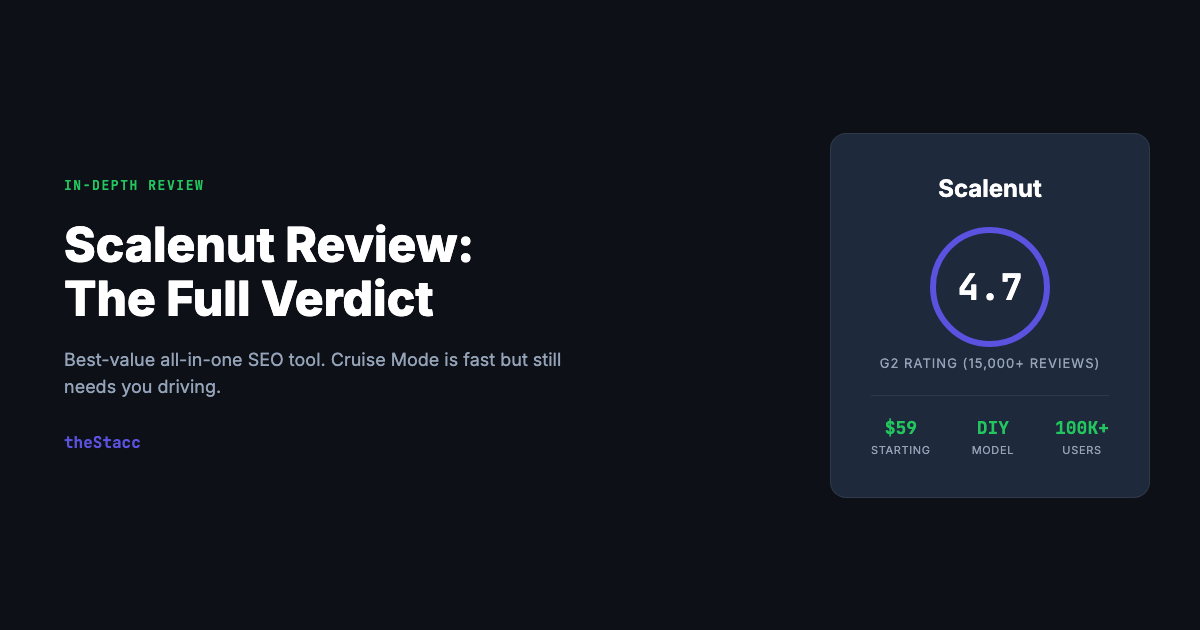
📌 Quick Verdict: This Scalenut review covers the full picture. Scalenut is the best-value all-in-one SEO content workflow tool for content teams — keyword research, guided AI writing via Cruise Mode, on-page optimization, and content auditing in one platform. The workflow is genuinely fast: users report 80% time savings vs. manual article creation. But “all-in-one” has a real cost — each layer is weaker than a dedicated best-in-class tool. And Cruise Mode requires active human operation for every article. The Plus plan ($89/mo, $45 promo) gives you 30 article drafts — but you still edit, review, and publish each one. Real total cost at 30 articles/month: $45–$89 (tool) + $1,000–$3,000 (editing labor at market rates) = $1,100–$3,100/month. G2: 4.7/5 (15,000+ reviews). Starting price: $59/month ($30 promotional).
theStacc vs. Scalenut: Where We’re Better
We wrote this review. We’re a competitor. Here’s exactly where theStacc is better — so you can weigh what follows.
| Feature | Scalenut | theStacc |
|---|---|---|
| Auto-publishes to your CMS | ✗ No — you write and publish manually | ✓ Yes (WordPress, Webflow, Ghost) |
| Local SEO / Google Business Profile posts | ✗ Not included | ✓ 30 GBP posts/month |
| Social media posts | ✗ Not included | ✓ 30 posts/month (Instagram, LinkedIn, X, Facebook) |
| Done-for-you (no workflow to manage) | ✗ DIY — Cruise Mode requires active operation per article | ✓ Fully managed, hands-off |
| No content team required | ✗ Requires writers to operate the workflow | ✓ We handle all of it |
| Real monthly cost at 30 published articles | $1,100–$3,100+/month (tool + editing labor) | $99/month flat |
See how theStacc works → Start for $1
Scalenut has over 15,000 reviews on G2 and has built a strong following, particularly among content teams in South Asian markets. This Scalenut review takes a different angle than most. The platform earned its reputation — Cruise Mode is genuinely fast, and the all-in-one workflow has real appeal. But most reviews are written by content marketers who already have structured workflows. For business owners trying to rank on Google without a dedicated content team, the picture looks different.
This review covers what Scalenut does, how Cruise Mode actually works in practice, what the tool’s real total cost is at publishing volume, and who should (and shouldn’t) pay for it.
What Is Scalenut?
Scalenut is an AI SEO content platform that combines keyword research, content briefs, AI writing, and on-page optimization into a single workflow. The core idea: instead of running 3–5 separate tools, you move from keyword input to published, optimized article entirely inside one product.
The company was founded in 2020 in Gurugram, India by Gaurav Goyal, Mayank Jain, and Saurabh Wadhawan — all with backgrounds in content marketing and technology. Scalenut raised $3.53M across two seed rounds (backed by Titan Capital and Maple Capital), scaled to approximately $10M ARR, and grew to 80+ employees at its peak before settling to around 30–60 in 2025.
The platform’s flagship feature — Cruise Mode — is a step-by-step guided article creation flow that takes you from keyword to drafted, optimized article in approximately 5 minutes of active input. This structured approach distinguished Scalenut from more freeform AI writers like Jasper or Writesonic.
In 2024, Scalenut expanded into AI Visibility tracking (monitoring brand mentions in ChatGPT and Google AI Overviews), positioning the platform as a more complete SEO intelligence tool rather than purely a content creation product.
What Scalenut is not: a done-for-you service. Cruise Mode is guided and structured — it still requires a human at the keyboard to make decisions at each step. The output is a draft, not a publish-ready article. You (or your editor) still clean up the writing, verify facts, add original insights, and publish to your CMS.
Scalenut Features (2026)
Cruise Mode
Cruise Mode is the reason most people choose Scalenut. It breaks article creation into five distinct stages, each with a clear action and AI-assisted output:
Step 1 — Keyword input: Enter your target keyword and select your target country. Scalenut runs SERP analysis on the top-ranking pages.
Step 2 — Title selection: Choose or edit from generated title options based on competitor patterns.
Step 3 — Outline generation: Scalenut generates a suggested outline pulled from competitor content. You can accept, edit, or reorganize sections before writing.
Step 4 — Section-by-section writing: For each section, you click to generate AI content. You can regenerate, expand, or edit each block individually.
Step 5 — Optimization pass: Scalenut scores your draft against NLP terms from competitor content and flags missing terms. You address the gaps before export.
The full process takes 5–15 minutes of active input for a 1,500-word article. That’s genuinely faster than any competing tool’s workflow. The structured guidance also makes it less intimidating for content teams learning SEO writing — each step is discrete and manageable.
The honest limitation: the output from Step 4 is AI-generated at its most visible. The content tends toward filler sentences and loose structure. Plan on 45–90 minutes of editing for a typical 1,500-word article to bring it to publishable quality. Cruise Mode is an efficiency tool, not a replacement for a writer.
The All-in-One Trap: When one platform covers keyword research, writing, and optimization, it’s easy to assume each layer is the best available. It isn’t. Surfer’s optimizer has a higher documented ranking correlation. Ahrefs/Semrush produce more accurate keyword data. Koala AI produces more consistent long-form writing. Scalenut bundles all three at an attractive price — but bundling means compromise at each layer. Teams that care about ranking outcomes often get better results pairing best-in-class tools at each stage.
SEO Hub / Content Optimizer
Scalenut’s Content Optimizer gives you an NLP-based real-time scoring system similar to Surfer SEO’s Content Editor. As you write, a score updates based on how well your content matches the term patterns from the top 10 ranking pages for your keyword.
Key features:
- NLP term recommendations extracted from SERP competitors
- Real-time SEO score
- Keyword density analysis
- Competitor content comparison across the top 10 results
- On-Page Pro — an advanced on-page recommendations module added in 2024
The optimizer is functional and comparable to mid-tier alternatives like Frase. It doesn’t match Surfer’s scoring accuracy or interface quality, but at Scalenut’s pricing it’s a credible tool for teams without a dedicated Surfer subscription.
Keyword Planner
Scalenut’s Keyword Planner provides keyword research with volume, KD, CPC data, and topic cluster generation. The Semrush data integration (available across plans) is the highlight here — it pipes Semrush’s keyword dataset into Scalenut’s interface, which gives you access to professional-grade keyword data without paying Semrush’s standalone price ($119–$229/month).
The limitation: the integration is read-only and supplemental. For serious keyword research — competitive gap analysis, backlink-informed difficulty scoring, keyword opportunity mapping — you’d still want a standalone tool. Scalenut’s clustering logic is useful for generating content calendar ideas but not a substitute for dedicated keyword strategy work.
Content Audit
Scalenut’s Content Audit module scans your existing published pages, scores them against current SERP benchmarks, identifies content decay, and surfaces opportunities for refreshes.
The Plus plan covers 200 pages/month. The Professional plan covers 1,000 pages/month. Cannibalization analysis (identifying keyword overlap between pages) is Professional-only.
For teams with an existing content library that’s starting to lose rankings, the Content Audit is a practical tool. It’s not as detailed as Surfer’s audit, but it covers the core use case at a lower price point.
AI Visibility Tracking
Added in 2024, this feature monitors how often your brand and content appear in AI-generated answers from ChatGPT and Google AI Overviews. The Starter plan tracks 10 prompts weekly; the Professional plan covers 100.
It’s a directionally useful feature as AI search grows. The data isn’t actionable for most SMBs yet — there’s no clear way to optimize for AI citations the way you optimize for Google rankings — but it positions Scalenut ahead of tools that haven’t added any AI search monitoring.
Internal Linking + Auto-Publish
Internal link suggestions (available on Plus+) recommend contextually relevant links between your existing pages. Available on Plus and Professional plans only.
Auto-publish directly to WordPress is available on Plus+ plans. This is one of Scalenut’s underrated advantages over tools like Surfer or Frase — it completes more of the workflow loop, getting from draft to CMS without a manual export step.
Scalenut Pricing (2026)
| Plan | Monthly | Promotional (50% off) | Key Limits |
|---|---|---|---|
| Starter | $59/mo | $30/mo | 5 articles/mo · 10 AI prompts tracked (weekly) · 1 workspace · Basic support |
| Plus | $89/mo | $45/mo | 30 articles/mo · 25 AI prompts (weekly) · 2 workspaces · 4 members · Content audit (200 pages) · Internal linking · Auto-publish |
| Professional | $199/mo | $100/mo | 75 articles/mo · 100 AI prompts (weekly) · Unlimited workspaces · Unlimited members · Audit (1,000 pages) · Cannibalization analysis · Dedicated CSM |
Free trial: 7-day free trial, no credit card required.
Promotional pricing: Scalenut has been running a 50% off promotional discount for an extended period. The promo pricing appears to be permanent-ish — a “Black Friday” offer that kept renewing. This is worth knowing: the $59/$89/$199 headline prices are technically the “real” prices, but $30/$45/$100 is what most new subscribers actually pay.
Annual discount: Available, specifics not clearly published on the pricing page.
The Real Cost of Scalenut
The Plus plan at $45/month (promotional) gives you 30 articles/month. That sounds like the deal of the category. Here’s what it doesn’t include:
Scalenut generates drafts. Those drafts need editing. A typical Cruise Mode output at 1,500 words needs 45–90 minutes of editing to reach publishable quality. At 30 articles/month, that’s 22–45 hours of editing time per month.
At a $35–50/hour content editor rate, editing alone runs $770–$2,250/month. Add a freelance editor or content manager’s time for publishing, formatting, and CMS management — another $300–$800/month — and the real cost to publish 30 edited, quality articles from Scalenut is:
$2,100–$3,100/month — the real total cost to publish 30 edited articles using Scalenut Plus ($45) + editing time at market rates ($35–50/hr × 22–45 hrs).
This isn’t a knock on Scalenut. Every AI writing tool has this math. Scalenut gets you further along the workflow than most — the auto-publish feature helps. But for business owners who looked at “$45/month for 30 articles” and thought that was the whole cost, it’s important context.
How to Use Scalenut: The 6-Step Workflow
Most new users start Cruise Mode, take the outline it generates at face value, and publish the resulting draft with minimal editing. That’s the fastest path to disappointing results. Here’s how experienced users actually run the workflow:
Step 1 — Validate the keyword in the Keyword Planner first Before launching Cruise Mode, confirm your target keyword has realistic volume and KD for your domain authority. Scalenut’s planner with Semrush data gives you enough signal. Don’t build a 1,500-word article around a keyword your domain can’t compete for.
Step 2 — Review the SERP competitors before accepting the outline Cruise Mode generates an outline based on competitor content. Read the actual top 3 ranking pages for your keyword before accepting it. The AI outline often averages competitor structures — it doesn’t identify what’s missing from them, which is where your differentiation opportunity lives.
Step 3 — Add your unique angle to the outline before writing Edit the Cruise Mode outline before clicking generate. Add a section no competitor covers. Change a generic section header to something more specific. The AI will write to whatever structure you give it — better structure in means better content out.
Step 4 — Generate section by section, not the full article at once Generate one section, review and edit it, then generate the next. Generating the full article at once gives you a wall of AI text with no natural edit checkpoints. Section-by-section keeps the output manageable.
Step 5 — Do the optimization pass last, not as you write Run the NLP term optimization check after you’ve finished editing — not during. Inserting terms mid-draft interrupts your editing flow and often results in unnatural phrasing. Treat it as a final checklist, not a live constraint.
Step 6 — Use the auto-publish to WordPress, not manual export If you’re on Plus+, use the WordPress auto-publish rather than copying and pasting. It preserves formatting and saves 10–15 minutes per article. At 30 articles/month, that’s 5–7 hours saved.
Does Scalenut Actually Work? What the Data Says
4.7/5 on G2 across 15,000+ reviews — Scalenut’s review count is one of the largest in the AI SEO content category, though the unusually high count has raised questions about potential incentivized review campaigns.
The 15,000+ G2 review count is genuinely remarkable — and worth scrutinizing. Surfer SEO, a significantly larger and more established platform, has 537 G2 reviews. Scalenut at approximately $10M ARR has nearly 30× that count. Some users and analysts have noted that Scalenut ran aggressive incentivized review campaigns, which inflates the count without necessarily invalidating individual reviews.
What the credible signal from those reviews says: Cruise Mode consistently delivers on the “faster than manual” claim. Users reporting 80% time savings is consistent across dozens of independent reviews — the guided, structured workflow genuinely accelerates drafting for content teams that commit to the process.
What the reviews also consistently report: output quality requires editing. The tool doesn’t eliminate the need for a skilled writer or editor. Teams that treat Cruise Mode output as publish-ready tend to produce generic, filler-heavy content that ranks poorly.
Notable observation: Scalenut is significantly more popular in South Asian markets than in the US and UK. G2’s data shows a higher concentration of Indian, Southeast Asian, and Middle Eastern users than competing tools. This likely reflects both the company’s origin and the pricing accessibility in those markets — but it’s worth considering if you’re targeting a US/UK audience with specific voice and tone requirements.
Scalenut Pros & Cons
Pros
- Cruise Mode is the fastest keyword-to-draft workflow in the category — 5–15 minutes of active input
- All-in-one workflow (research → write → optimize → publish) reduces tool-switching
- Semrush data integration gives professional-grade keyword data without a separate subscription
- Content Audit with cannibalization analysis (Professional) — few tools at this price point offer this
- Auto-publish to WordPress on Plus+ plans completes more of the workflow loop
- 7-day free trial with no credit card required — unusually accessible for a paid SEO tool
- Aggressive promotional pricing ($45/month for 30 articles) — best price-to-articles ratio in the category
- AI Visibility Tracking (ChatGPT + Google AI Overviews) — ahead of several competitors
- 4.7/5 G2 rating across a large review base
- Strong onboarding and customer support quality (consistently noted in reviews)
Cons
- AI output is generic and requires 45–90 min of editing per article to reach publish quality
- Cruise Mode forces keywords unnaturally in some sections — editing to fix phrasing takes time
- Keyword research less accurate than Ahrefs or Semrush standalone
- G2 review count (15,000+) may reflect incentivized campaigns — treat ratings with appropriate skepticism
- UI feels cluttered; multiple features compete for dashboard space
- Performance lags on longer articles (noted consistently in reviews)
- No Local SEO features — no Google Business Profile management or Google Maps optimization
- Pricing opacity — constant promotional pricing makes the real price hard to track
- Starter plan (5 articles/month) is too restrictive to produce meaningful results
- Less market penetration in US/UK — fewer community resources and case studies in those markets
Done-for-you alternative
Skip the tool. Get the traffic.
Stacc writes, optimizes, and publishes 30 SEO articles to your WordPress or Webflow site every month — automatically. No writers. No workflow. No logging in.
Who Is Scalenut Best For?
Strong fit:
- Content marketing teams at 10–100 person companies wanting a single tool for the full workflow
- SEO professionals managing 3–10 client websites who need structured briefs and optimization in one place
- Freelance content writers wanting faster article production with built-in optimization guidance
- Teams building topical authority in markets where Semrush data is particularly strong (US, EU)
- Organizations in South Asian markets where Scalenut has established support infrastructure
Probably not the right call:
- Business owners without a content team — Cruise Mode requires an operator at the keyboard for every article
- Local service businesses needing Google Maps or GBP ranking — no Local SEO features exist
- Teams expecting publish-ready output — every article needs human editing
- Anyone primarily needing best-in-class keyword research — dedicated tools outperform the Scalenut planner
- SMBs wanting 30 articles/month without the time investment — the editing alone adds 20–45 hours/month
The people disappointed by Scalenut aren’t usually using the wrong tool. They’re using a professional content workflow tool when what they needed was a done-for-you service.
Scalenut vs. Alternatives
Same-category DIY tools:
| Tool | Starting price | Free trial | Key differentiator | Best for |
|---|---|---|---|---|
| Scalenut | $30/mo (promo) | 7 days | Cruise Mode all-in-one workflow | Content teams wanting single platform |
| Surfer SEO | $119/mo | No | 0.28 ranking correlation, Google Docs integration | Agencies + professional content teams |
| Frase.io | $49/mo | 7 days | Brief-building + research speed | Freelancers, short-form content |
| Jasper AI | $49/mo | 7 days | Strongest pure AI writing quality | Teams prioritizing writing over optimization |
| Clearscope | $129/mo | No | Clean interface, unlimited users | Enterprise teams, education |
Done-for-you alternatives:
| Service | Price | Articles/mo | Auto-publishes | Local SEO |
|---|---|---|---|---|
| Stacc | $99/mo | 30 | ✓ WordPress + Webflow | ✓ GBP included |
| Outrank.so | $99/mo | Varies | ✓ WordPress | ✗ |
| SEO.AI | $149/mo | Unstated | ✓ WordPress + others | ✗ |
Scalenut wins in the DIY tool category at value pricing. The $45/month promotional rate for 30 articles with Semrush data integration is genuinely hard to beat on paper. The different buyer is someone who doesn’t have the time or team to operate the tool and needs a done-for-you output instead.
What Real Users Say
Review Ratings (March 2026):
| Platform | Rating | Reviews |
|---|---|---|
| G2 | 4.7/5 | 15,000+ |
| Capterra | 4.8/5 | Available |
| Trustpilot | 4.8/5 | Available |
What users consistently praise:
- “Cruise Mode makes content creation structured and fast — what used to take 4 hours now takes under an hour”
- “Cancelled 3 other tools when I switched to Scalenut — the all-in-one workflow is real”
- “The Semrush integration gives me professional keyword data in one place”
- “Customer support is responsive and the onboarding resources are thorough”
- “Best bang for buck in the category — $45/month for 30 articles with SEO built in”
What users consistently criticize:
- “The AI writes in circles — a lot of filler content that needs editing out before it reads naturally”
- “Cruise Mode lags on articles over 2,000 words”
- “Pricing is confusing — the constant promos make it hard to know what the real price is”
- “Draft word counts are inconsistent — asked for 1,500 words, got 900”
- “Customer support can be slow when things go wrong with billing”
The G2 vs. Reddit Gap: Scalenut’s formal review scores (4.7–4.8 stars) are significantly higher than the tone in SEO communities and Reddit threads, where the conversation is more mixed. Power users who’ve outgrown the guided workflow and want more control report frustration with the interface clutter and output limitations. Casual users and content teams at the earlier stages of their SEO journey consistently rate it highly. The formal scores are credible — but read Reddit threads before assuming the 4.7 represents advanced SEO practitioners.
Is Scalenut Worth It? The Verdict
For content marketing teams with a structured workflow: yes. If you have people who can operate the tool, edit outputs, and integrate it into a content calendar, Scalenut at $45–$100/month (promotional) delivers strong value. The all-in-one workflow reduces tool-switching, and the Semrush integration makes the keyword data genuinely usable.
For SEO professionals managing multiple clients: probably yes. The audit features, cannibalization analysis, and content optimization tools serve agencies well at the Professional price point. The workflow structure makes it easier to onboard client content to a repeatable process.
For small business owners and local service businesses without a writing team: no. The real cost to run Scalenut at 30 articles/month — including the editing time the platform’s output requires — is $2,100–$3,100/month, not $45. There’s no Local SEO or GBP support. And every article requires active human involvement to produce.
Overall Rating: 4.0/5
| Category | Rating |
|---|---|
| Core product quality | ⭐⭐⭐⭐ |
| AI writing quality | ⭐⭐⭐ |
| Workflow integrations | ⭐⭐⭐⭐ |
| Keyword research accuracy | ⭐⭐⭐ |
| Content optimization (NLP scoring) | ⭐⭐⭐⭐ |
| Pricing value (content teams) | ⭐⭐⭐⭐⭐ |
| Pricing value (solos/SMBs) | ⭐⭐⭐ |
| Ease of use | ⭐⭐⭐ |
| Cruise Mode effectiveness | ⭐⭐⭐⭐ |
| Local SEO / GBP features | ⭐ |
Scalenut FAQ
What is Scalenut? Scalenut is an AI SEO content platform that combines keyword research, content creation, on-page optimization, content auditing, and AI visibility tracking in one workflow. It was founded in 2020 in Gurugram, India, and has scaled to approximately $10M ARR. Its flagship feature, Cruise Mode, guides users through a structured keyword-to-draft process in 5–15 minutes of active input.
How much does Scalenut cost? Scalenut’s published prices are $59/month (Starter), $89/month (Plus), and $199/month (Professional). A 50% promotional discount has been running for an extended period, bringing active prices to approximately $30, $45, and $100/month respectively. A 7-day free trial is available with no credit card required.
Is there a free version of Scalenut? No free plan exists, but Scalenut offers a 7-day free trial with no credit card required. This is more accessible than competitors like Surfer SEO ($119/month, no trial) and Clearscope ($129/month, no trial). The trial gives access to Cruise Mode and the Content Optimizer.
Does Scalenut write content for you? Scalenut generates AI drafts through Cruise Mode and the AI Writer, but the output requires significant editing before it reaches publish quality. Plan on 45–90 minutes of editing per 1,500-word article. Scalenut does not run your content operation automatically — a human drives every step of the process.
What is Scalenut’s Cruise Mode? Cruise Mode is Scalenut’s guided, step-by-step article creation workflow. You input a keyword, and the system walks you through title selection, outline generation, section-by-section AI writing, and optimization review. The full process takes 5–15 minutes of active input. It’s the fastest keyword-to-draft process in the category, though the output requires editing before publishing.
How does Scalenut’s NLP scoring compare to Surfer SEO? Both tools analyze top-ranking SERP pages and recommend NLP terms to include for better ranking relevance. Surfer SEO has a documented ranking correlation of 0.28 from independent analysis. Scalenut has not published comparable correlation data. Surfer’s Content Editor is generally considered more accurate by SEO professionals who use both, but Scalenut’s optimizer is competitive for teams who can’t justify Surfer’s $119/month starting price.
Who owns Scalenut? Scalenut was founded in 2020 by Gaurav Goyal, Mayank Jain, and Saurabh Wadhawan in Gurugram, India. The company raised $3.53M across two seed rounds, backed by Titan Capital and Maple Capital. It remains independently operated.
Does Scalenut do local SEO? No. Scalenut has no Google Business Profile management, local citation tools, or Google Maps ranking features. It is focused entirely on website content optimization. Local service businesses that need both website SEO and Google Maps ranking need to look elsewhere.
Is Scalenut worth it for small businesses? It depends on whether you have someone to operate it. At $45/month (promotional) for 30 article drafts, the sticker price is attractive. But the drafts require 45–90 minutes of editing each. At 30 articles, that’s 22–45 hours of editing time per month — $770–$2,250 at market editor rates. For small businesses without a content team, a done-for-you alternative like Stacc publishes 30 SEO articles for $99/month with no editing required.
How accurate is Scalenut’s keyword research? Scalenut’s Keyword Planner, combined with its Semrush data integration, gives functional keyword research for content planning purposes. It’s solid for identifying topic clusters and volume estimates. For competitive keyword strategy — gap analysis, backlink-informed difficulty scoring, SERP feature analysis — dedicated tools like Ahrefs or Semrush provide more depth. Most serious SEO teams treat Scalenut’s keyword data as supplemental, not primary.
What are the best Scalenut alternatives? For DIY SEO content tools: Surfer SEO ($119/month, best optimization quality), Frase.io ($49/month, fast brief-building), and Jasper AI ($49/month, strongest AI writing). For done-for-you content publishing, Stacc ($99/month, 30 articles auto-published to WordPress/Webflow) and Outrank.so ($99/month) handle writing and publishing automatically.
What does Scalenut’s G2 rating actually reflect? Scalenut has 4.7/5 on G2 with 15,000+ reviews — one of the largest review counts in the AI SEO category. The volume has raised questions about incentivized review campaigns, given that significantly larger competitors have far fewer reviews. Individual reviews are credible, but the aggregate count should be weighted with that context. The consistent themes across reviews (Cruise Mode speed, editing requirements, pricing value) are reliable signal regardless of the total count.
Has Scalenut’s pricing changed over time? Yes, significantly. Scalenut launched with a free tier that has since been removed. Pricing has increased as features were added, and the company introduced aggressive promotional discounts (originally marketed as a Black Friday deal) that have been extended indefinitely. This makes it genuinely difficult to know the true long-term price. Always verify the current promotional terms on Scalenut’s pricing page — specifically whether the discounted rate renews or reverts to list price after the initial term.
Bottom Line
Scalenut has built a real product. Cruise Mode is the most structured and accessible keyword-to-draft workflow in the category, and the Semrush data integration makes professional keyword data available at a price point most SMBs can afford. For content teams that want a single platform to cover research, writing, and optimization — and who have the bandwidth to edit AI drafts — Scalenut at $45–$100/month (promotional) is a strong value.
The honest math for a different buyer: if you’re a business owner without a writing team, 30 Cruise Mode drafts don’t become 30 published articles without 20–45 hours of editing per month. The $45 promotional price is real; the $2,000+ in editing time is also real.
If you want 30 SEO articles written, optimized, and published to your site every month without operating a tool or managing editors.
See how theStacc works → Start for $1
This article was researched, written, and published by Stacc. Pricing and feature data was verified against Scalenut’s public website as of March 2026. See our editorial guidelines for how we review tools.
More Reviews
- Surfer SEO Review
- Semrush Review
- Ahrefs Review
- Clearscope Review
- Frase.io Review
- Jasper AI Review
- Writesonic Review
- SEO.AI Review
- Outrank Review
- Koala AI Review
- Junia AI Review
- MarketMuse Review
- Copy.ai Review
- Grammarly Review
- QuillBot Review
- GPTZero Review
- NeuronWriter Review
- BrandWell Review
- Outranking Review
- AISEO Review
- AIOSEO Review
This review was written and published by Stacc, a competing product. We have a commercial interest as an alternative. All pricing and feature data verified against public sources as of March 2026.
