Koala AI Review 2026: Honest In-Depth Verdict (The Word Credit Trap)
Koala AI review covering KoalaWriter vs KoalaChat, pricing ($9–$99/mo), the real cost at 30 articles/month, pros & cons, and who it's actually built for.
Siddharth Gangal • March 16, 2026
In This Review
Looking for Koala Ai alternatives?
See top Koala Ai alternatives →Editorial disclosure: This review was written and published by Stacc, a competing product to Koala AI. We have a commercial interest as an alternative. We’ve worked to present Koala AI’s features fairly and accurately, but you should weigh that context. All pricing and feature data was verified against Koala AI’s public pricing page as of March 2026.
By Stacc Editorial Team · SEO practitioners. We publish 30+ articles/month for businesses using our own platform — including this one. · Last updated: March 16, 2026
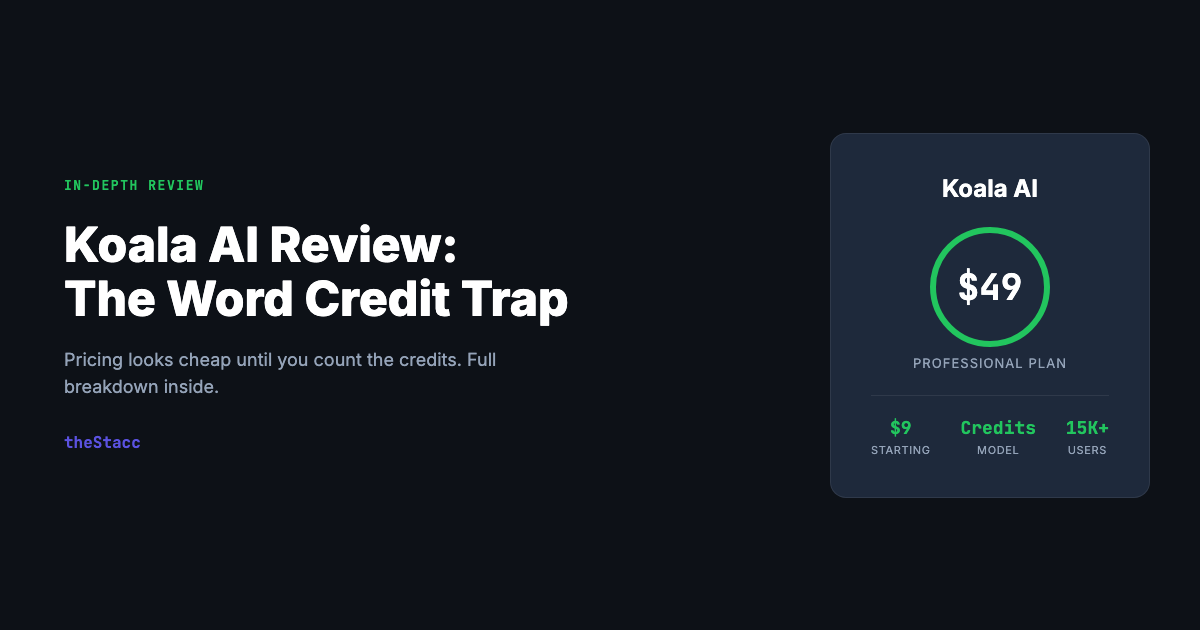
Quick Verdict: Koala AI is genuinely one of the best AI article writers available — especially for affiliate marketers and niche site owners who need volume. KoalaWriter produces SERP-researched, long-form articles with real-time internet data, and the WordPress auto-publish integration is legitimately excellent. But most Koala AI reviews miss two things: first, the product is actually two distinct tools (KoalaWriter and KoalaChat) with different use cases; second, the word credit model hides the real cost once you try to match 30 articles/month at quality settings. The math changes significantly when you turn on GPT-5.2 or Claude 4.5 Sonnet — word credits burn at 2x speed. Starting price: $9/month (Essentials), $49/month (Professional).
theStacc vs. Koala AI: Where We’re Better
We wrote this review. We’re a competitor. Here’s exactly where theStacc is better — so you can weigh what follows.
| Feature | Koala AI | theStacc |
|---|---|---|
| Local SEO / Google Business Profile posts | ✗ Not included | ✓ 30 GBP posts/month |
| Social media posts | ✗ Not included | ✓ 30 posts/month (Instagram, LinkedIn, X, Facebook) |
| CMS integrations | WordPress only | WordPress, Webflow, Ghost, Custom Webhook |
| Content calendar managed for you | ✗ Manual — you trigger each article | ✓ Fully automated schedule |
| Predictable flat pricing | ✗ Credits-based — cost scales with model quality | ✓ $99/month flat, 30 articles |
| Done-for-you (no workflow to manage) | ✗ DIY — you configure and schedule everything | ✓ Fully managed, hands-off |
See how theStacc works → Start for $1
Koala AI has earned a strong following since launching in 2022 — particularly among affiliate bloggers who need Amazon product review articles at scale. This koala ai review takes a different angle than most. Most existing reviews focus on output quality for a single article. Few have mapped what Koala actually costs when you’re trying to match a real business publishing cadence of 30 articles per month, or clarified the important distinction between KoalaWriter and KoalaChat.
This review covers both. It also shows the math behind Koala’s word credit model — something the pricing page doesn’t make obvious — so you can evaluate it against your actual publishing goals, not just the headline plan price.
Here’s what this review covers: what Koala AI actually is (including the KoalaWriter vs. KoalaChat distinction), every feature worth knowing, full pricing with the real cost calculation, a 6-step workflow, who it’s right for, and an honest verdict for three different buyer types.
What Is Koala AI?
Koala AI is an AI content platform built around one core function: generating SEO-optimized long-form articles in one click, using SERP analysis and real-time internet data as the foundation. It launched in 2022 out of South San Francisco and built its early reputation in the affiliate marketing and niche site community — particularly for Amazon product review articles, which it handles better than any direct competitor.
The mechanism is straightforward: you enter a keyword, Koala analyzes the top-ranking pages for content structure and terms, pulls live information from the web to reduce AI hallucination, and generates a full-length article — typically 1,500–5,000 words depending on your settings. The output is ready to edit and publish, not just a starting prompt.
What Koala AI explicitly does not do: It doesn’t handle keyword research. It doesn’t build a publishing calendar. It doesn’t automatically schedule or post articles on a recurring cadence. It doesn’t manage your GBP or local SEO. You trigger each article manually.
KoalaWriter vs. KoalaChat — The Distinction Most Reviews Miss
Here is the single most important thing to understand about Koala AI that most reviews gloss over: Koala AI is not one product. It’s two.
KoalaWriter is the flagship article generator. It creates long-form blog posts from a keyword. Every word it produces draws from your monthly word credit allocation. This is what 90% of Koala’s users mean when they say “Koala AI.”
KoalaChat is a separate conversational AI assistant — more like a ChatGPT competitor than an article writer. It accesses the web in real time, accepts file uploads, and lets you interact with multiple AI models. KoalaChat uses a separate “message” quota, not word credits. It’s a genuinely useful research and drafting assistant, but it’s a different workflow from KoalaWriter.
Plans include both, but the allocations are separate. A Professional plan at $49/month gives you 100,000 KoalaWriter word credits AND 1,000 KoalaChat messages. When reviewers say “I got 50 articles from the Professional plan,” they’re talking about KoalaWriter. When they say “I used it to research my topics,” they’re probably talking about KoalaChat.
Confusing them leads to unrealistic budgeting — and to the word credit trap explained in the pricing section below.
Koala was founded in 2022 and appears to be bootstrapped or early-stage — the founders aren’t prominently disclosed publicly. The small team has shipped rapidly: Amazon affiliate mode, YouTube-to-blog conversion, Deep Research mode, and multi-model AI selection have all launched since 2022. The company is growth-stage, with a clear primary ICP of affiliate marketers and niche site operators.
Koala AI Features (2026)
KoalaWriter — One-Click Article Generation
KoalaWriter is the core product. You provide a target keyword, configure your settings (word count, writing style, point of view, AI model), and it generates a complete article with headers, paragraphs, and SEO elements baked in.
The SERP analysis layer is what separates Koala from generic AI writers. Before generating, KoalaWriter analyzes the top-ranking pages for your keyword — pulling structure patterns, common subtopics, and key terms. The output reflects what Google already rewards for that topic, not just what a language model would produce in isolation.
Real-time internet data integration further reduces the hallucination problem. Rather than drawing entirely from training data, KoalaWriter pulls live information from the web — which means articles can cite current events, recent statistics, and up-to-date product information. This is particularly valuable for affiliate and review content where accuracy matters.
Writing style options: 7 modes — Balanced, Informative, Formal, Informal, Persuasive, Snarky, Analytical. Point of view: First, Second, Third, or Mixed. These combinations let you match the output voice to your site’s existing tone reasonably well.
The Model Selection Trap: The KoalaWriter output quality varies significantly by AI model selection. GPT-5 Mini (the default) is fast and credit-efficient. GPT-5.2 and Claude 4.5 Sonnet produce notably stronger output — better reasoning, more nuanced writing, fewer generic phrases. But those premium models cost 2x word credits per article. A 2,000-word article at GPT-5 Mini costs 2,000 credits; the same article at GPT-5.2 costs 4,000. Most new users don’t notice this until their credit balance runs out faster than expected.
Amazon Product Review Mode
This is Koala’s unique competitive advantage — and the reason it built its early reputation. You input an ASIN (Amazon product identifier) or product URL, and KoalaWriter generates a full affiliate review article directly from the product data: specs, features, comparison angles, pros and cons.
No competitor does this as well. Writesonic, Surfer AI, and Jasper all require you to manually input product information. Koala automates the research entirely. For affiliate marketers running product review sites, this is the single most time-saving feature in the category.
KoalaChat — Real-Time AI Research Assistant
KoalaChat functions more like a web-enabled ChatGPT than an article writer. It can search the web in real time, accept file uploads for analysis, answer research questions, and help you think through content strategy.
The key nuance: KoalaChat uses a separate message quota, not word credits. A Professional plan gives 1,000 chat messages per month — easily enough for daily research use. KoalaChat supports multiple AI model selection too, letting you choose between GPT-5.2 and Claude 4.5 Sonnet for different tasks.
For users who want a single subscription that covers both content generation and AI-assisted research, KoalaChat makes the platform genuinely multi-purpose.
Deep Research Mode (Professional+)
Available on Professional and higher plans, Deep Research mode runs a more thorough SERP analysis before generating. It spends more time analyzing competitor content, pulling more data points, and structuring the article around a deeper competitive map. The output is notably more comprehensive — better for pillar posts, detailed guides, and anything targeting competitive keywords.
The trade-off: Deep Research articles take longer to generate (2–4 minutes vs. under 60 seconds for standard). For high-stakes articles where ranking is the primary goal, it’s worth the wait.
YouTube to Blog Conversion
You input a YouTube video URL, and KoalaWriter converts the transcript into a full blog article. It restructures the spoken content into a written format — adding headers, transitions, and editorial polish.
This is a genuinely useful feature for video creators who want to extend their content’s reach without doubling their production effort. A 15-minute YouTube video becomes a 1,500-word blog post in under two minutes. The output needs a light editing pass, but the structural work is done.
WordPress Auto-Publish Integration
KoalaWriter connects directly to WordPress and can publish generated articles without any copy-pasting. You configure your WordPress credentials once, and articles publish (or queue as drafts) automatically after generation.
Users consistently call this feature a “game changer” — and it legitimately is for anyone who has manually managed the export-format-upload process at volume. It supports multiple WordPress sites, making it practical for agencies managing several client blogs.
Automatic Internal Linking and KoalaLinks (Professional+)
On Professional and higher plans, Koala offers automatic internal link insertion. As it generates an article, it scans your existing content library and adds relevant internal links. The feature works reasonably well for simple sites with clear topic clusters, but user feedback is mixed — some report the links are occasionally off-topic or anchor text is awkward.
KoalaLinks manages external linking strategy — automatically adding relevant outbound links based on the article’s topic. Combined with internal linking, this reduces manual post-generation SEO work.
AI Image Generation (KoalaImages)
All plans include KoalaImages — AI-generated featured images and inline article images. You can generate images from prompts or have Koala automatically create a relevant featured image during article generation. Available on all plans; quality is functional rather than exceptional.
API Access (All Plans)
Unusually for the category, API access is available on all paid plans — including Essentials at $9/month. This is a meaningful advantage for developers and agencies building automated content workflows. You can programmatically trigger article generation, retrieve output, and integrate Koala into custom systems without upgrading to a premium tier.
Koala AI Pricing (2026)
Koala AI offers 9 pricing tiers, ranging from $9/month to $2,000/month. Here’s the complete breakdown:
| Plan | Monthly | Annual (~20% off) | KoalaWriter Words | KoalaChat Messages |
|---|---|---|---|---|
| Essentials | $9 | ~$7/mo | 15,000 | 250 |
| Professional | $49 | ~$39/mo | 100,000 | 1,000 |
| Boost | $99 | ~$79/mo | 250,000 | 2,500 |
| Growth | $179 | ~$143/mo | 500,000 | 5,000 |
| Elite | $350 | ~$280/mo | 1,000,000 | 10,000 |
| Advanced | $500 | ~$400/mo | 1,500,000 | 12,500 |
| Scale I | $750 | ~$600/mo | 2,500,000 | 15,000 |
| Scale II | $1,250 | ~$1,000/mo | 5,000,000 | 20,000 |
| Scale III | $2,000 | ~$1,600/mo | 10,000,000 | 25,000 |
Free trial: 5,000 words + 25 chat messages. Annual discount: 20% off. Refund policy: Available within 15 days if usage is under 15,000 words and 100 messages.
Word cost note: Selecting GPT-5.2 or Claude 4.5 Sonnet counts 2x word credits. No automatic overage charges — once credits run out, you wait for the next billing cycle or upgrade.
The Real Cost of Koala AI: The Word Credit Trap
Here’s what most Koala AI reviews don’t work through — the math at business publishing volume.
The pricing page shows “Professional: $49/month, 100,000 words.” That sounds like plenty. Here’s what the math actually looks like when you try to publish 30 articles per month — the volume needed to meaningfully compete for organic traffic.
Scenario: 30 articles/month at 1,500 words each
At GPT-5 Mini (default, standard quality):
- 30 articles x 1,500 words = 45,000 word credits
- Professional plan ($49) with 100,000 words: covers this comfortably
- But: GPT-5 Mini output often needs heavier editing to be publish-ready
At GPT-5.2 or Claude 4.5 Sonnet (premium quality, 2x cost):
- 30 articles x 1,500 words x 2 = 90,000 word credits
- Professional plan ($49) with 100,000 words: barely covers 30 articles — zero buffer for KoalaChat usage, rewrites, or articles over 1,500 words
Scenario: 30 articles/month at 2,000 words each (more competitive word count)
At GPT-5.2 or Claude 4.5 Sonnet:
- 30 articles x 2,000 words x 2 = 120,000 word credits
- Professional plan ($49, 100,000 words): not enough — you’d need to upgrade to Boost ($99)
The Boost plan at $99/month gives 250,000 words — enough for 30 articles at premium quality.
But here’s the comparison that matters: Koala at $99/month (Boost plan) covers the writing only. You still need to:
- Identify and prioritize keywords yourself (add Ahrefs at $99/month or Semrush at $119/month)
- Trigger each article manually — no publishing calendar or automation
- Edit every article before publishing — Koala writes, not publishes-and-forgets
- Handle all local SEO and GBP separately (Koala has no local features)
Real total for 30 articles/month using Koala at quality settings: $99 (Boost) + $99 (Ahrefs) + editing time (estimate 2–3 hours/month minimum at light QA) = $198+/month, plus your time.
At Stacc’s flat rate, 30 articles are written, optimized, and published to your WordPress or Webflow site automatically for $99/month — keyword research included, no tools to stack.
The word credit model isn’t a flaw. It’s just not what the headline prices suggest for serious publishing volume.
How to Use Koala AI: The 6-Step Workflow
Most new Koala users generate an article, see decent output, and call it done. Here’s how experienced users actually structure a repeatable workflow.
Step 1: Build your keyword list first KoalaWriter doesn’t do keyword research. Before opening Koala, you need a prioritized list of target keywords with search volume and difficulty data. Use Ahrefs, Semrush, or a free tool like Google Search Console to identify 30+ medium-difficulty keywords where you have a realistic shot at page 1. Without this list, you’re generating articles with no strategic target — content that may never rank.
Step 2: Select your AI model deliberately Don’t leave AI model selection on default without thinking about it. GPT-5 Mini is fast and credit-efficient — good for high-volume lower-stakes posts. GPT-5.2 or Claude 4.5 Sonnet is better for competitive keywords or pillar content where quality directly affects ranking. Make this decision per article based on its strategic importance, not per account setting.
Step 3: Configure Deep Research for competitive topics For any keyword where you’re targeting page 1 against established sites, turn on Deep Research mode. The extra analysis time is worth it for articles that will drive meaningful traffic. For supporting posts or low-competition keywords, standard mode is fine.
Step 4: Generate, then edit for voice and accuracy KoalaWriter’s output is a strong first draft — not a finished article. Plan a 15–30 minute editing pass per article: verify any statistics or claims, inject your own perspective or examples, and align the voice with your existing content. Articles that get published without a human pass often read generically — and Google’s quality signals will notice.
Step 5: Use KoalaChat for research, not writing Before generating competitive articles, use KoalaChat to research your topic: ask it to summarize what competitors are covering, identify data gaps in top-ranking content, or surface recent stats. This makes your KoalaWriter output smarter because you can add specific angles to the generation prompt.
Step 6: Publish via WordPress integration and track rankings Connect your WordPress site in Koala’s settings and use direct publish or queue as draft. After publishing, track rankings in Google Search Console or your keyword tool. Set a 90-day review for any article that hasn’t moved to page 2 or above — those are candidates for a refresh or expansion.
Does Koala AI Actually Work? What the Data Says
Koala AI doesn’t publish formal ranking correlation data the way Surfer SEO does. What we have instead is user evidence — and it’s genuinely consistent.
The clearest validation comes from users who publish at volume. Across G2, Capterra, and the affiliate marketing community, the consensus from high-volume users is that KoalaWriter’s SERP-anchored generation produces content that ranks meaningfully better than generic AI output — not because of any proprietary signal, but because the articles are structured around what’s already ranking.
The real-time data integration also contributes to ranking performance. Articles with current, accurate information perform better on E-E-A-T signals than AI content filled with outdated training data. For niches where freshness matters — finance, health, tech, local services — this is a real advantage.
The honest caveat: KoalaWriter doesn’t guarantee rankings. It produces structurally sound, well-researched article drafts. Ranking still depends on your domain authority, backlink profile, technical SEO, and how well you edit the output. “Published 62 articles with Koala, got results” is a real user experience — but the articles needed editing, a keyword strategy existed beforehand, and the site had domain history.
Koala AI Pros & Cons
Pros
- Best Amazon affiliate review article generation in the category — no competitor handles ASIN-based content as cleanly
- Real-time internet data integration reduces hallucination problems and improves content accuracy
- WordPress auto-publish integration is genuinely excellent — multi-site support, no copy-paste required
- YouTube-to-blog conversion is a unique time-saver for video creators
- Multiple AI model options — choose speed/quality trade-off per article
- API access on all plans (including $9/month Essentials) — best in the category for developers
- Active development: Deep Research, KoalaLinks, KoalaMagnets all added in 2024
- KoalaChat adds a capable research assistant alongside the article writer
- Free trial: 5,000 words + 25 messages — meaningful testing before committing
- Strong community support — small team responds rapidly to user feedback
Cons
- Word credit model is confusing — premium models cost 2x credits, depleting budgets faster than expected
- 30 articles/month at quality settings requires $99 Boost plan, not $49 Professional as implied
- No built-in keyword research — requires a separate $99–$119/month tool to use strategically
- No content publishing calendar or scheduling automation — every article is triggered manually
- Can’t regenerate specific article sections after initial output — full regeneration only
- Internal linking feature quality is inconsistent per user reports
- No Google Business Profile or local SEO features
- Not a full-service solution — Koala writes the articles; strategy, scheduling, and publishing management remain entirely manual
Who Is Koala AI Best For?
Strong fit:
- Affiliate marketers and niche site builders — KoalaWriter’s Amazon product review mode and SERP-anchored output are unmatched in this specific category. If you’re running a review site, this is the best AI writing tool for your use case.
- Content creators scaling output from 5–20 articles/month — The Professional plan ($49) is genuinely good value for this cadence at standard quality. Real volume, low price.
- YouTube creators repurposing video to blog — The YouTube-to-blog converter handles the structural work; you supply the editing.
- Developers building content workflows — API on all plans makes Koala one of the most integration-friendly AI writers available.
- Bloggers who want editorial control — Koala generates; you edit and publish. If you want to stay in the loop on every article, that’s how this tool is designed.
- Small agencies producing first drafts — Use Koala for initial generation, editors for refinement. The cost-per-word at Professional is very competitive.
Probably not the right call:
- Business owners who want content to run without them — Koala doesn’t schedule, doesn’t self-trigger, doesn’t manage a calendar. You have to drive every article.
- Local service businesses — No GBP, no local SEO features, no Google Maps ranking capability. You’d need multiple additional tools to run a complete local SEO strategy.
- Anyone trying to match 30 articles/month without a keyword strategy — Without keyword research built in, you’d be generating content with no strategic targeting.
- Teams wanting fully automatic publishing without manual intervention — Koala auto-publishes to WordPress, but you trigger each article. There’s no “set and forget” cadence.
- SMBs who need blog + local SEO combined — Koala covers one half of the equation. Local SEO requires an entirely separate platform.
The people who are disappointed by Koala AI aren’t usually using the wrong tool. They’re using a professional AI writing tool when what they needed was a done-for-you content service.
Koala AI vs. Alternatives
Same-category AI writing tools:
| Tool | Starting price | Free trial | Key differentiator | Best for |
|---|---|---|---|---|
| Koala AI | $49/mo (Professional) | Yes (5,000 words) | Amazon affiliate mode, real-time data, API on all plans | Affiliate marketers, niche sites |
| Surfer AI | $119/mo (Standard) | No | Highest ranking correlation (0.28), Google Docs integration | Agencies and content teams |
| Writesonic | $49/mo | Yes | Multi-format content (ads, landing pages, blog) | General-purpose AI writing |
| Jasper AI | $59/mo | Yes (7 days) | Brand voice training, enterprise integrations | Enterprise teams, brand consistency |
| Frase.io | $49/mo | Yes (7 days) | Brief-building and content research | Freelancers, content researchers |
Done-for-you alternatives:
| Service | Price | Articles/mo | Auto-publishes | Local SEO |
|---|---|---|---|---|
| Stacc | $99/mo | 30 | Yes — WordPress + Webflow | Yes — GBP included |
| Outrank.so | $99/mo | Varies | Yes — WordPress | No |
| SEO.AI | $149/mo | Unstated | Yes — WordPress + others | No |
Koala AI is an excellent AI writer. The comparison that matters for business owners is not “which AI writer is best” — it’s “do I need an AI writer, or do I need a content service?” Tools produce words you then edit and publish. Services produce and publish for you. Different problems, different budgets, different time commitments.
What Real Users Say
Review Ratings (March 2026):
- G2: Multiple verified reviews, consistently positive on output quality
- Capterra: Verified reviews, positive on ease of use and value
- Cybernews: Positive expert review, highlighted Amazon affiliate capabilities
What users consistently praise:
- “The WordPress auto-upload is a game changer — no copy-paste needed.”
- “Amazon affiliate articles are the best I’ve seen from any AI tool. Direct from ASIN to full review.”
- “Real-time data makes the articles actually accurate, not just fluffy AI content.”
- “Support in the forum is best — responsive team members give near-immediate answers.”
- “YouTube to blog is an incredible time saver for video creators.”
What users consistently criticize:
- “Word credit system is confusing — didn’t realize premium models cost 2x credits.”
- “Can’t regenerate specific sections after initial output — annoying limitation.”
- “Internal linking feature doesn’t work as well as advertised.”
- “Need to pair with a separate keyword research tool — Koala doesn’t do strategy.”
- “Article scheduling is fully manual — not really autopilot.”
The G2 vs. Community Gap: Formal review platforms skew positive because reviewers self-select toward satisfied customers. The affiliate marketing and niche site community gives a more nuanced picture: Koala is excellent for affiliate and niche content at volume, but it’s clearly a tool for operators who understand SEO — not a plug-and-play solution for business owners who just want traffic.
Is Koala AI Worth It? The Verdict
For affiliate marketers and niche site operators: yes. KoalaWriter handles Amazon review content better than any competitor. Real-time SERP analysis and live internet data produce articles that are structurally sound and factually current. At $49–$99/month, the cost-per-article is among the lowest in the category. If your publishing model is keyword-driven blog content at 5–30 articles/month and you have the editorial bandwidth to review output, Koala is a strong choice.
For content creators and bloggers scaling output: yes, with caveats. The Professional plan ($49) is good value for 15–25 standard-quality articles per month. The KoalaChat inclusion makes it genuinely multi-purpose. The caveats: you need a keyword strategy tool separately, and you need to plan for editing time in your workflow. Koala doesn’t eliminate the work — it accelerates the writing step.
For local service businesses and SMBs who want traffic without managing it: usually no. The math at 30 articles/month at quality settings lands you at $99/month for writing only — plus a keyword tool, plus editing time, plus zero local SEO coverage. If you’re a dentist, plumber, HVAC company, or local service business, you need both blog content and GBP posts working together to rank. Koala does neither automatically, and does only one at all.
Overall Rating: 4.1/5
| Category | Rating |
|---|---|
| AI article generation quality | 5/5 |
| Amazon affiliate content | 5/5 |
| Workflow integrations (WordPress) | 5/5 |
| Pricing value (bloggers 5–20 articles/mo) | 5/5 |
| Pricing value (business 30 articles/mo) | 3/5 |
| Real-time data accuracy | 4/5 |
| Content strategy tools | 2/5 |
| Ease of use | 4/5 |
| Local SEO capability | 1/5 |
| Publishing automation (scheduling/calendar) | 2/5 |
Koala AI FAQ
What is Koala AI? Koala AI is an AI content platform built around two core products: KoalaWriter, which generates SEO-optimized long-form articles from a keyword using SERP analysis and real-time internet data; and KoalaChat, a conversational AI assistant with web search capability. It was founded in 2022 and has become particularly popular with affiliate marketers and niche site builders.
How much does Koala AI cost? Koala AI pricing starts at $9/month (Essentials, 15,000 words) and rises to $2,000/month (Scale III, 10 million words). The most popular plan is Professional at $49/month, which includes 100,000 KoalaWriter words and 1,000 KoalaChat messages. Annual billing saves approximately 20%. See Koala AI’s pricing page for current rates.
Is there a free version of Koala AI? Koala AI offers a free trial that includes 5,000 KoalaWriter words and 25 KoalaChat messages — enough to generate 2–3 articles and evaluate the output quality before committing to a paid plan. There is no ongoing free plan.
Does Koala AI write content for you? KoalaWriter generates article drafts automatically from a keyword — it doesn’t require you to write anything. However, Koala AI doesn’t schedule, queue, or automatically trigger articles on a calendar. You submit each article request manually. The output is a high-quality first draft that typically needs a 15–30 minute editing pass before publishing.
What is the word credit system in Koala AI? Word credits are the currency for KoalaWriter. Each plan includes a set number of word credits per month — 100,000 on the Professional plan, for example. Every word generated by KoalaWriter costs 1 credit at GPT-5 Mini rates. Selecting GPT-5.2 or Claude 4.5 Sonnet as the AI model costs 2x credits — a 2,000-word article at a premium model costs 4,000 word credits, not 2,000. This 2x multiplier is the most common source of budget confusion for new users.
What is the difference between KoalaWriter and KoalaChat? KoalaWriter is the article generation engine — you provide a keyword and it produces a full blog post using word credits. KoalaChat is a separate conversational AI assistant that can search the web in real time, accept file uploads, and help with research and ideation. KoalaChat uses message credits, not word credits. Both are included on all paid plans with separate quotas.
Who owns Koala AI? Koala AI is operated by a small team based in South San Francisco, California. The company appears to be bootstrapped or early-stage. The founders are not prominently disclosed publicly.
Does Koala AI do local SEO? No. Koala AI has no Google Business Profile management, local citation tools, or Google Maps ranking features. It’s a content writing platform, not a local SEO platform. Local service businesses that need both blog content and GBP/Maps ranking would need additional tools alongside Koala.
Is Koala AI worth it for small businesses? It depends on your publishing goals and bandwidth. For a small business that wants to write and publish 5–10 blog posts per month and has someone to manage the process, Koala’s Professional plan ($49/month) is good value. For businesses that want 30 articles per month published automatically without managing the process, Koala is not the right fit. A done-for-you service like Stacc ($99/month) handles writing, optimization, and publishing automatically.
How accurate are Koala AI articles? Koala’s real-time internet data integration meaningfully improves accuracy compared to AI tools that rely purely on training data. Articles pull live information from the web, reducing outdated statistics and AI hallucination. That said, all AI-generated content should be fact-checked before publishing — particularly for health, legal, financial, or YMYL topics.
What are the best Koala AI alternatives? For AI writing tools: Surfer AI ($119/month), Writesonic ($49/month), Jasper ($59/month), and Frase.io ($49/month). For done-for-you content services that handle writing, optimization, and publishing automatically: Stacc ($99/month, 30 articles auto-published to WordPress or Webflow) and Outrank.so ($99/month). For local businesses needing both blog content and GBP automation, Stacc is the only platform that combines both under $150/month.
What is KoalaWriter’s Amazon affiliate review mode? KoalaWriter’s Amazon affiliate mode lets you input an ASIN or product URL, and it generates a full product review article directly from the Amazon product data — features, specs, pros and cons, comparison angles. No other AI content tool handles Amazon affiliate review content as efficiently. It’s the primary reason Koala built its early reputation in the niche site community.
Bottom Line
Koala AI earned its strong reputation. KoalaWriter’s combination of SERP-based research, real-time data integration, and Amazon affiliate mode produces content that’s structurally better than most AI writers in the category. The WordPress auto-publish integration is genuinely excellent. The API on all plans is an unusual and developer-friendly choice. For bloggers and affiliate marketers who want to scale from 5–30 articles per month and have the editorial bandwidth to review output, Koala is a strong, cost-effective platform.
For business owners who run the math on 30 articles per month at competitive quality settings, the picture is different. The Professional plan’s 100,000 words sounds like plenty — until you factor in premium model 2x credit costs and a target word count of 1,800–2,500 words per article. At that point, you need the $99 Boost plan. Add a keyword research tool ($99/month) and editing time, and you’re at $200+/month for the writing step alone — with no scheduling, no local SEO, and no hands-off publishing.
If you’re a business owner who wants 30 SEO articles per month published automatically to your site — no editors, no tools to stack, no calendar to manage.
See how theStacc works → Start for $1
This article was researched, written, and published by Stacc. Pricing and feature data was verified against Koala AI’s public pricing page at koala.sh as of March 2026. See our editorial guidelines for how we review tools.
More Reviews
- Surfer SEO Review
- Semrush Review
- Ahrefs Review
- Clearscope Review
- Frase.io Review
- Jasper AI Review
- Writesonic Review
- Scalenut Review
- SEO.AI Review
- Outrank Review
- Junia AI Review
- MarketMuse Review
- Copy.ai Review
- Grammarly Review
- QuillBot Review
- GPTZero Review
- NeuronWriter Review
- BrandWell Review
- Outranking Review
- AISEO Review
- AIOSEO Review
This review was written and published by Stacc, a competing product. We have a commercial interest as an alternative. All pricing and feature data verified against public sources as of March 2026.