
MarketMuse Review 2026: Enterprise Content Intelligence (At Enterprise Prices)
MarketMuse review covering features, pricing ($149–$399+/mo), pros & cons, and who it's actually worth it for in 2026.
Siddharth Gangal • March 18, 2026
In This Review
Looking for Marketmuse alternatives?
See top Marketmuse alternatives →Editorial disclosure: This review was written and published by Stacc, a competing product to MarketMuse. We have a commercial interest as an alternative. We’ve worked to present MarketMuse’s features fairly and accurately, but you should weigh that context. All pricing and feature data was verified against MarketMuse’s public pricing page as of March 2026.
By Stacc Editorial Team · SEO practitioners. We publish 30+ articles/month for businesses using our own platform — including this one. · Last updated: March 18, 2026
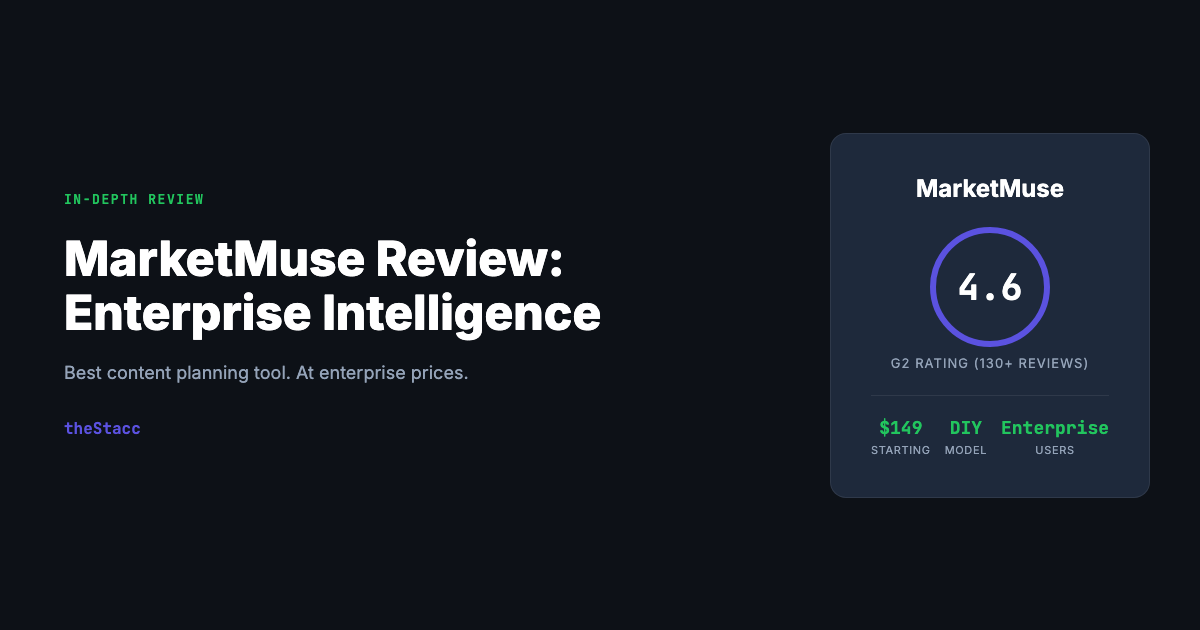
📌 Quick Verdict: This MarketMuse review covers the full picture: MarketMuse is the most sophisticated content planning and competitive analysis tool in the category. Topic Authority scoring, Content Inventory analysis, and AI-powered briefs are genuinely best-in-class for enterprise content teams. But it’s a planning tool — it plans what to write, not a tool that writes or publishes. At $149–$399+/month for plans that still require writers, the real cost is steep. G2: 4.6/5 (130+ reviews). Starting price: $149/month.
theStacc vs. MarketMuse: Where We’re Better
We wrote this review. We’re a competitor. Here’s exactly where theStacc is better — so you can weigh what follows.
| Feature | MarketMuse | theStacc |
|---|---|---|
| Starting price | $149/month | $99/month |
| Articles written for you | ✗ No — generates briefs, not articles | ✓ 30 articles/month |
| Auto-publishes to your CMS | ✗ No | ✓ Yes (WordPress, Webflow, Ghost) |
| Local SEO / Google Business Profile posts | ✗ Not included | ✓ 30 GBP posts/month |
| Social media posts | ✗ Not included | ✓ 30 posts/month (Instagram, LinkedIn, X, Facebook) |
| Done-for-you (no workflow to manage) | ✗ Planning tool — you execute everything | ✓ Fully managed, hands-off |
| Real monthly cost at 30 published articles | $2,549–$7,899+/month (tool + writers + labor) | $99/month flat |
See how theStacc works → Start for $1
MarketMuse sits in a unique position in the SEO tool market. While Surfer and Clearscope score content you’ve already written, MarketMuse works upstream — it analyzes your entire domain, identifies topical gaps, maps competitor authority, and generates detailed content briefs before a writer touches a keyboard.
This MarketMuse review is for teams considering whether that strategic layer is worth $149–$399/month on top of the writers, editors, and publishing workflow they still need. The answer depends entirely on how large your content operation already is.
What Is MarketMuse?
MarketMuse is a content intelligence platform that uses AI to analyze topical authority, identify content gaps, and generate research-backed content briefs. The thesis: most content teams publish reactively — chasing keywords one at a time. MarketMuse maps the full competitive landscape first, then tells you exactly which topics to cover, in what order, to build authority systematically.
The core technology is proprietary topic modeling — it maps the semantic relationships between topics, subtopics, and entities across your domain and your competitors’ domains. This is deeper than keyword-level analysis. It answers: “Do I have authority on this subject?” — not just “Am I targeting this keyword?”
Founded by Aki Balogh and Jeff Coyle (Chief Strategy Officer, the public face of the company). Jeff Coyle is a well-known figure in content marketing — his talks on topical authority and content strategy are widely cited. The company raised $10M+ in funding and serves primarily mid-market to enterprise content teams.
What MarketMuse is not: a writing tool or a publishing platform. It’s a strategist. It tells you what to write, how to structure it, and what gaps exist — but every word, every edit, and every publish action is on you.
MarketMuse Features (2026)
Content Inventory & Topic Authority
MarketMuse crawls your entire domain and scores your authority across topics. For each topic cluster:
- Authority Score — how comprehensively you cover the topic vs. competitors
- Coverage gaps — subtopics your competitors cover that you don’t
- Content decay — published pages losing rankings that need updating
- Cannibalization — multiple pages competing for the same topic
This is genuinely unique in the market. No other tool provides a domain-level authority map with this depth. For teams with 100+ published articles, it shows exactly where to invest next for maximum ranking impact.
Insight: The Authority Score is MarketMuse’s differentiator. It doesn’t just check if you have an article on a topic — it evaluates how comprehensively your content covers the topic, how well your articles link to each other, and how your coverage compares to competitors who rank.
Competitive Content Analysis
For any topic, MarketMuse maps:
- Which competitors own the topic (highest authority scores)
- How many articles they have in the cluster
- What subtopics they cover that you miss
- The difficulty of competing (based on current authority distribution)
Content Briefs (AI-Generated)
This is where most teams interact with MarketMuse daily. For any target topic, it generates:
- Recommended title and meta description
- Target word count based on SERP analysis
- Comprehensive list of topics and subtopics to cover
- Suggested heading structure (H2/H3)
- Questions to answer (pulled from SERP data)
- Related topics to mention for semantic coverage
- Internal linking suggestions
Briefs are detailed enough to hand directly to a freelance writer. The quality consistently exceeds what Surfer or Frase generate for content briefs — because MarketMuse accounts for domain-level authority, not just page-level optimization.
Optimize (Content Scoring)
The Optimize tool scores existing or draft content against MarketMuse’s topic model. Like Surfer’s Content Score but with a different lens — it evaluates topical completeness, not just keyword presence. The score reflects how thoroughly you cover the subject compared to the competitive field.
Questions
Generates research-backed questions that searchers ask about any topic. More targeted than Google’s “People Also Ask” because it’s filtered through MarketMuse’s topic model — prioritizing questions that indicate ranking opportunities.
Connect (Internal Linking)
Analyzes your site’s internal linking structure and recommends links between related pages. Identifies orphan content (pages with no internal links pointing to them) and suggests anchor text.
MarketMuse Pricing (2026)
| Plan | Monthly | Annual/mo | Key Limits |
|---|---|---|---|
| Standard | $149/mo | $99/mo | 1 user · 100 queries/month · Content briefs + Optimize |
| Team | $399/mo | $300/mo | 3 users · Unlimited queries · Content Inventory · Full suite |
| Premium | Custom | Custom | Custom users · API · Managed onboarding · Priority support |
No free plan. Previous free tier was discontinued.
Annual discount: ~25–33%. Free trial: Limited demo available.
The Real Cost of MarketMuse
MarketMuse generates plans and briefs. Not content. To publish 30 articles per month:
$2,549–$7,899/month — the real cost. MarketMuse Standard ($149) + writers using the briefs ($80–$250/article × 30 = $2,400–$7,500). If you want content optimization scoring on top (many teams use Surfer alongside MarketMuse), add another $119/month.
MarketMuse makes your content planning smarter. It doesn’t make your content publishing faster. Every article still needs a writer, an editor, a formatter, and someone to hit publish.
How to Use MarketMuse: The Right 5-Step Workflow
Step 1: Run Content Inventory on your domain first Before writing anything new, let MarketMuse analyze your existing content. The Authority Score reveals which topic clusters you already have a foothold in — these are where new content will rank fastest because you’re building on existing authority.
Step 2: Identify gaps in your strongest clusters Don’t chase new topics. Find the subtopics missing from clusters where you already have authority. A site with 10 articles on “content marketing” but none on “content calendar templates” is leaving authority on the table.
Step 3: Generate content briefs for gap-filling articles Use MarketMuse’s brief generator for each target. The brief gives writers specific guidance — not just a keyword to target, but a map of topics, questions, and structure that produces comprehensive content.
Step 4: Have writers produce content using the brief Hand the brief to your writer. Set expectations: match the recommended word count, cover every suggested subtopic, answer the prioritized questions. This produces measurably better content than writers working from a keyword alone.
Step 5: Score content with Optimize before publishing Run every draft through MarketMuse Optimize. Target a score of 35–50 (their scoring scale is different from Surfer’s 0–100). Iterate until topical coverage is comprehensive.
Does MarketMuse Actually Work? What the Data Says
MarketMuse’s approach — building topical authority systematically rather than targeting keywords randomly — is academically sound and practically validated.
Enterprise customers include HubSpot, Macy’s, The Motley Fool, and Kenvue. These are organizations with mature content operations that generate millions in organic traffic. Their continued use validates the strategic value.
Pattern: Teams that use MarketMuse to inform a 6–12 month content strategy — mapping topics, filling gaps systematically, building authority clusters — see measurable improvements in organic visibility. Teams that use it to generate one-off briefs are paying $149/month for a feature that Surfer and Frase provide at half the price.
The honest caveat: MarketMuse’s value scales with your content library size. For a site with 20 articles, the Content Inventory and Authority Score provide limited insight. For a site with 200+ articles, they’re transformative.
MarketMuse Pros & Cons
Pros
- Topic Authority scoring is genuinely unique — no competitor offers this
- Content Inventory analysis transforms content strategy for large sites
- AI-generated briefs are the most comprehensive in the category
- Competitive analysis goes beyond keywords to full topic coverage
- Internal linking recommendations (Connect) reduce orphan content
- Jeff Coyle’s thought leadership adds credibility and educational value
- Best for enterprises building systematic topical authority over 6–12 months
- Questions tool surfaces high-value opportunities other tools miss
Cons
- $149/month entry point for a planning tool (still need writers and optimization)
- Previous free plan discontinued — no way to test without paying
- Does not write, edit, or publish content
- No local SEO or Google Business Profile features
- 100 queries/month on Standard plan is limiting for active teams
- Learning curve is steeper than Surfer or Frase — topic modeling takes training
- No social media tools
- Real cost at scale ($2,549–$7,899/month) makes it impractical without a content team
- Authority Score requires 50+ published pages to provide meaningful data
Who Is MarketMuse Best For?
Strong fit:
- Enterprise content teams with 100+ published articles
- Content strategists building long-term topical authority plans
- Agencies managing content strategy for large client sites
- Media companies and publishers optimizing massive content libraries
- B2B SaaS companies investing in organic growth with dedicated content teams
Probably not the right call:
- Local service businesses that need to rank on Google Maps
- Small businesses with fewer than 50 published articles
- Solo operators who need content produced, not just planned
- Anyone looking for content creation and publishing
- Teams spending under $500/month on content marketing
MarketMuse vs. Alternatives
| Tool | Price | Content briefs | Topic authority | Best for |
|---|---|---|---|---|
| MarketMuse | $149/mo | ✓ Best-in-class | ✓ Unique feature | Enterprise content strategy |
| Surfer SEO | $119/mo | ✓ Good | ✗ | Content optimization (writing phase) |
| Clearscope | $129/mo | ✓ Good | ✗ | Enterprise content optimization |
| Frase.io | $49/mo | ✓ Good (budget) | ✗ | Freelancers + brief building |
Done-for-you alternatives:
| Service | Price | Articles/mo | Auto-publishes | Local SEO |
|---|---|---|---|---|
| Stacc | $99/mo | 30 | ✓ WordPress + Webflow | ✓ GBP included |
| Outrank.so | $99/mo | Varies | ✓ WordPress | ✗ |
| SEO.AI | $149/mo | Unstated | ✓ WordPress + others | ✗ |
What Real Users Say
Review Ratings (March 2026):
- G2: 4.6/5 — 130+ reviews
- Capterra: 4.6/5 — 30+ reviews
- Trustpilot: Limited reviews
Praised consistently: Topic Authority scoring, content brief quality, Jeff Coyle’s educational content, competitive topic analysis depth, strategic value for large content libraries.
Criticized consistently: Pricing too high for small teams, free plan removal, learning curve, query limits on Standard plan, UI can feel dated compared to Surfer/Frase, tool doesn’t help with execution — only planning.
Is MarketMuse Worth It? The Verdict
For enterprise content teams (100+ articles): yes. Topic Authority scoring and Content Inventory analysis provide strategic insights no other tool offers. If your content budget is $10K+/month and you’re building long-term authority, $149–$399/month for the intelligence layer is justified.
For growing content teams (20–100 articles): depends. MarketMuse’s value increases with content library size. Smaller libraries don’t generate meaningful Authority Scores. You might get better ROI from Surfer ($119/mo) which focuses on the writing and optimization phase you’re actually in.
For small businesses and solo operators: no. You’re paying $149/month for a tool that tells you what to write but doesn’t write it, optimize it, or publish it. You still need writers, editors, and a publishing workflow. The planning is excellent. The execution gap is the same as every other tool.
Overall rating: 4.0/5
| Category | Rating |
|---|---|
| Topic authority analysis | ⭐⭐⭐⭐⭐ |
| Content brief quality | ⭐⭐⭐⭐⭐ |
| Competitive analysis | ⭐⭐⭐⭐⭐ |
| Content optimization scoring | ⭐⭐⭐⭐ |
| Content creation tools | ⭐ |
| Local SEO | ⭐ |
| Pricing value (enterprise) | ⭐⭐⭐⭐ |
| Pricing value (SMBs) | ⭐⭐ |
| Ease of use | ⭐⭐⭐ |
| Publishing capabilities | ⭐ |
MarketMuse FAQ
What is MarketMuse? MarketMuse is a content intelligence platform that uses AI topic modeling to analyze topical authority, identify content gaps, generate detailed content briefs, and score content against competitive benchmarks. Built for enterprise content strategy teams.
How much does MarketMuse cost? Standard: $149/month ($99/month annual). Team: $399/month ($300/month annual). Premium: custom pricing. No free plan available.
Is there a free version of MarketMuse? No. MarketMuse discontinued its free plan. A limited demo is available but requires contacting sales.
Does MarketMuse write content for you? No. MarketMuse generates content briefs (structure, topics to cover, word count targets, questions to answer) but does not write articles. You need writers to create content from the briefs.
Is MarketMuse worth it in 2026? For enterprise teams with 100+ articles and $10K+ monthly content budgets: yes. For small businesses without writers: no. Real cost to publish 30 articles = $2,549–$7,899/month (MarketMuse + writers + optimization).
What are the best MarketMuse alternatives? For content optimization: Surfer SEO ($119/mo), Clearscope ($129/mo), Frase ($49/mo). For done-for-you content: theStacc ($99/mo, 30 articles auto-published).
Can MarketMuse replace Surfer SEO? They serve different phases. MarketMuse excels at strategy and planning (what to write). Surfer excels at optimization (how to write it). Many enterprise teams use both — MarketMuse for briefs, Surfer for real-time scoring while writing.
Does MarketMuse do local SEO? No. No GBP management, local citations, local content optimization, or Google Maps features.
What is MarketMuse’s Topic Authority score? A proprietary metric that evaluates how comprehensively your domain covers a topic compared to competitors. It accounts for content volume, depth, internal linking, and subtopic coverage — not just whether you have an article on the subject.
How does MarketMuse compare to Semrush? Semrush covers keyword research, backlinks, site audits, and competitive intelligence. MarketMuse covers topical authority, content planning, and brief generation. Semrush is broader. MarketMuse is deeper on content strategy. Neither writes or publishes content.
Is MarketMuse good for small businesses? Usually not. The tool’s value scales with content library size. Sites with fewer than 50 articles don’t generate meaningful Authority Scores. The $149/month starting price is steep for a planning-only tool when small businesses need execution more than strategy.
What is MarketMuse Connect? The internal linking tool. It analyzes your site structure and recommends links between related pages, identifies orphan content (pages with no inbound links), and suggests anchor text to improve topical connectivity.
Bottom Line
MarketMuse is the most sophisticated content strategy tool in the market. Topic Authority scoring is genuinely unique. The content briefs are the most detailed. The competitive analysis goes deeper than any alternative. For enterprise teams with large content libraries and dedicated writers, it’s a strategic advantage.
For businesses that don’t have writers, editors, or a publishing workflow — MarketMuse tells you exactly what to do, then watches while you can’t do it. The briefs are excellent. The execution gap is $2,400–$7,500/month in writer costs alone.
If you need the execution — 30 SEO articles researched, written, optimized, and published to your website every month — without managing briefs, writers, or workflows, that’s not what MarketMuse builds. That’s what theStacc builds.
See how theStacc works → Start for $1
This article was researched, written, and published by Stacc — the same platform businesses use to publish SEO content automatically. That means we compete with MarketMuse. We’ve worked to present the tool fairly, and we’d encourage you to verify features and pricing directly on MarketMuse’s website before deciding.
More Reviews
- Surfer SEO Review
- Semrush Review
- Ahrefs Review
- Clearscope Review
- Frase.io Review
- Jasper AI Review
- Writesonic Review
- Scalenut Review
- SEO.AI Review
- Outrank Review
- Koala AI Review
- Junia AI Review
- Copy.ai Review
- NeuronWriter Review
- BrandWell Review
- Outranking Review
- GPTZero Review
- QuillBot Review
- Grammarly Review
- AISEO Review
- AIOSEO Review
This review was written and published by Stacc, a competing product. We have a commercial interest as an alternative. All pricing and feature data verified against public sources as of March 2026.
