Outrank Review 2026: Honest In-Depth Verdict (After Testing It)
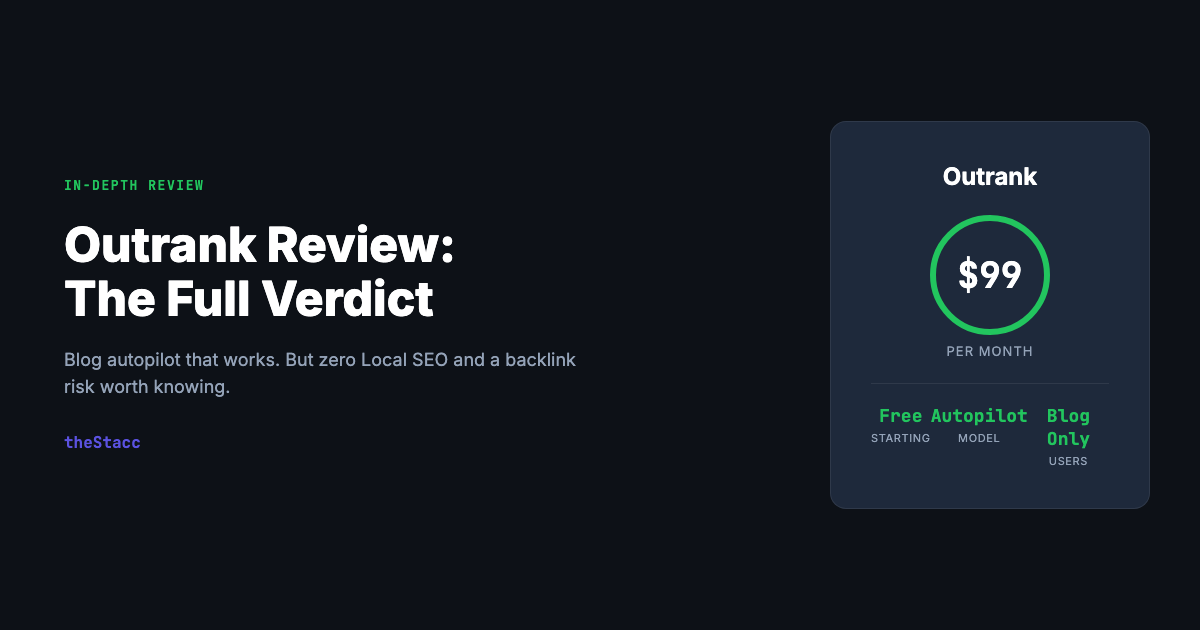
Outrank.so review covering features, pricing ($99/mo), the backlink network risk no one else covers, pros & cons, and who it's actually right for in 2026.
Siddharth Gangal • March 16, 2026
In This Review
Looking for Outranking alternatives?
See top Outranking alternatives →Editorial disclosure: This review was written and published by Stacc, a competing product to Outrank.so. We have a commercial interest as an alternative. We’ve worked to present Outrank’s features fairly and accurately, but you should weigh that context. All pricing and feature data was verified against Outrank’s public website as of March 2026.
By Stacc Editorial Team · SEO practitioners. We publish 30+ articles/month for businesses using our own platform — including this one. · Last updated: March 16, 2026
📌 Quick Verdict: This Outrank review covers the full picture. Outrank.so is a genuinely capable blog autopilot: it researches keywords, writes articles, and publishes them to your CMS without manual input after setup. For pure website content teams, that’s a compelling offer at $99/month. But two things every buyer should evaluate before committing. First: Outrank’s built-in backlink exchange connects your site to other Outrank users’ sites automatically — a practice Google’s link scheme policies explicitly flag. No other review covers this plainly. Second: Outrank has zero Local SEO or Google Business Profile features. For a local dentist, plumber, or law firm, half the ranking battle happens on Google Maps — and Outrank doesn’t touch that. Real total cost for local businesses needing full SEO coverage: $130–$250/month (Outrank + separate local SEO tool). Starting price: $99/month. Free tier available.
theStacc vs. Outrank.so: Where We’re Better
We wrote this review. We’re a competitor. Here’s exactly where theStacc is better — so you can weigh what follows.
| Feature | Outrank.so | theStacc |
|---|---|---|
| Local SEO / Google Business Profile posts | ✗ Not included — website SEO only | ✓ 30 GBP posts/month |
| Social media posts | ✗ Not included | ✓ 30 posts/month (Instagram, LinkedIn, X, Facebook) |
| Blog + Local SEO + Social in one plan | ✗ Blog only | ✓ Yes — bundle from $126/month |
| CMS integrations | WordPress, Webflow | WordPress, Webflow, Ghost, Custom Webhook |
| Backlink network exposure | Built-in inter-site link exchange | ✗ None — no link scheme involvement |
| Full SEO coverage (blog + local) | $130–$250+/month (Outrank + separate local tool) | $126/month (bundle) |
See how theStacc works → Start for $1
Outrank.so has positioned itself as one of the most direct autopilot SEO competitors in the market. Its core promise — “blog on autopilot while you sleep” — resonates with business owners who’ve looked at content marketing, done the math on what agencies and writers cost, and decided there has to be a better way.
This Outrank review goes deeper than the standard feature walkthroughs. Most reviews of Outrank cover the basics: article generation, CMS publishing, scheduling. What they consistently skip is the backlink exchange mechanism — how it works, what it does to your site’s link profile, and what Google’s own guidelines say about it. We’ll cover that in detail, fairly and without exaggeration. We’ll also run the honest math on what Outrank actually costs for a local business that needs both website SEO and Google Maps ranking.
This review covers: what Outrank is and how it works, every major feature, current pricing and real total cost, a practical 6-step workflow, who it’s right for, and a direct comparison against alternatives.
What Is Outrank?
Outrank.so is a fully automated SEO content platform built on a simple premise: most businesses can’t publish content at the volume Google rewards because writing, optimizing, and publishing every article takes too much time. Outrank automates the entire sequence — keyword research, article writing, image generation, and CMS publishing — so your blog runs without your involvement after setup.
Unlike content optimization tools like Surfer SEO or Frase.io, which give you a score and expect you to do the writing, Outrank handles production end to end. You connect your CMS, set your keyword targets and publishing frequency, and articles go live on a schedule you define. It’s closer to an automated content agency than a writing assistant.
What Outrank is not: a Local SEO platform, a Google Business Profile management tool, or a link building service in the traditional outreach sense. Its backlink exchange is automated, not outreach-based — and that distinction matters significantly (more in the features section).
Company background: Outrank.so was founded around 2022–2023 and is registered in Middletown, Delaware. The founding team is not publicly disclosed — the product leads rather than the founders. No funding rounds have been announced publicly; the company appears to be bootstrapped with a small team (estimated under 20 people). Product Hunt was the primary launch vehicle. The limited public identity is a real transparency gap compared to competitors.
Outrank Features (2026)
AI Article Generation
Outrank’s article generation is the core of the product. After connecting your domain and entering target keywords, the system researches the top-ranking competitor pages for each keyword, identifies the content structure and terms those pages share, and writes a long-form article (typically 2,000–5,000+ words) aligned to that data.
The output includes a title, meta description, header structure, body content, and a featured image. Articles are scheduled to publish directly to your CMS on the cadence you set — daily, weekly, or custom.
Article quality is consistently noted as better than generic AI tools. The SERP-anchored generation gives the content topical relevance out of the box. The honest limitation: some users report variability — some articles are publication-ready, others need a light editing pass. This is common across automated content tools at this price point.
Competitor Content Analysis
Before writing each article, Outrank analyzes the top-ranking pages for that keyword. This drives the content structure — what headers to include, what subtopics to cover, what length to hit. The result is output that’s shaped by what’s already ranking, rather than generic AI content with no SERP awareness.
This is Outrank’s most technically sound feature. Content built from live SERP analysis outperforms content built from prompts alone, because it reflects what Google is already rewarding for that query.
Keyword Research and Topic Planning
Built-in keyword research surfaces volume, difficulty, and intent data. Outrank generates a content calendar based on your keyword targets, clustering related topics into a publishing sequence designed for topical authority building over time.
For business owners who don’t want to manage keyword strategy manually, this is genuinely useful — the system handles prioritization and sequencing alongside the writing.
Multi-Platform CMS Publishing
Outrank supports direct publishing to:
- WordPress (most popular)
- Webflow
- Shopify
- Notion
- Wix
- Framer
- Custom Webhook (any CMS)
This is the broadest CMS support in the category. Stacc currently covers WordPress, Webflow, Ghost, and Custom Webhook — Shopify and Wix are on the roadmap. For teams already on Notion, Wix, or Framer, Outrank’s integration breadth is a genuine advantage worth noting.
Content Scheduling and Calendar
A visual content calendar lets you set publishing frequency and manage the article queue. Articles are generated and published on schedule — the “while you sleep” experience is real for users who configure this correctly. Publishing modes include draft-only, requires-approval, and full auto-publish.
The Backlink Exchange Network — What You Need to Know
This is the feature no other Outrank review covers plainly. Outrank’s built-in backlink exchange automatically places links from your published articles to other Outrank users’ sites, and vice versa, based on niche relevance matching.
The intent is reasonable: links are one of Google’s strongest ranking signals, and most autopilot content tools don’t address the link building problem at all. Outrank is attempting to solve content and links simultaneously.
How it works: When you publish articles through Outrank, the system automatically embeds outbound links to other Outrank users’ sites within your content. In return, other users’ articles link back to yours. The exchange is automated — you don’t approve individual links, and the placements happen without editorial review of each link decision.
Why this matters for your site: Google’s link spam policies state: “Any links that are intended to manipulate PageRank or a site’s ranking in Google Search results may be considered link spam. This includes any behavior that manipulates links to your site or outgoing links from your site.” The policy specifically flags “link exchange schemes” and “widely distributed links in the footers or templates of various sites.”
Automated link exchanges — where links are placed programmatically across multiple sites without editorial intent — sit in territory these policies directly address. Google has historically taken action against private blog networks (PBNs) and link exchange schemes when the pattern becomes identifiable at scale.
The fair assessment: Outrank’s implementation uses niche relevance matching and contextual body placement — both better signals than footer links or irrelevant exchanges. Whether Google identifies the network pattern at scale is the open variable. What’s clear is that this is a practice Google’s guidelines explicitly discourage, and the risk to your domain is real rather than hypothetical.
Insight: Most users who report positive results from the backlink exchange are niche site builders and affiliate marketers, where short-term ranking velocity is worth accepting more risk. Local service businesses — dental practices, law firms, contractors — that depend on their domain’s long-term reputation for years of leads should evaluate this feature with specific care. Importantly, you can use Outrank with the backlink exchange disabled. The content automation works independently of the link exchange.
Google Search Console Integration
Connect your Google Search Console account to track rankings and organic traffic for published content. Outrank uses this data to surface gaps — keywords you’re appearing for but not ranking well — and can inform content strategy adjustments over time.
Domain Authority Tracking
Outrank monitors your domain authority score, tracking the impact of the content + backlink combination over time. Useful directionally, though domain authority is a third-party estimate (Ahrefs DR or Moz DA), not a direct Google ranking signal.
Image Generation
AI-generated featured images accompany each article, plus relevant body images. This replaces the manual step of finding or creating images for every post at scale.
Multi-Language Support
Content generation in multiple languages, with international content calendar support. For businesses targeting non-English audiences, this is a practical differentiator most content automation competitors don’t offer.
Outrank Pricing (2026)
| Plan | Monthly Price | Annual Price | Key Details |
|---|---|---|---|
| Free Tier | $0/month | $0 | Limited access — platform exploration |
| Standard | $99/month | Not publicly advertised | Core automation — article limits not clearly published |
| Custom / Enterprise | Contact Outrank | Contact Outrank | Multi-site agencies |
Pricing notes:
- $99/month is the primary advertised entry price — same as Stacc’s Blog SEO plan
- Specific article limits per plan are not clearly stated on the public pricing page
- No annual billing discount is publicly advertised (most SaaS competitors offer 15–17%)
- Free tier available — no time-limited trial with full access
- Confirm article volume in writing before committing to a paid plan
The Real Cost of Outrank
$130–$250/month — the real monthly cost for a local business that needs full SEO coverage: Outrank for website blog SEO + a separate local SEO tool for Google Maps/GBP.
Outrank covers website blog SEO. For local businesses — dentists, plumbers, law firms, realtors — Google Maps ranking is driven by Google Business Profile activity, local citations, and GBP posts. Outrank doesn’t touch any of that.
To cover both channels using Outrank:
- Outrank Standard: $99/month (website blog SEO only)
- Separate local SEO tool (BrightLocal, Whitespark, or similar): $29–$79/month
- GBP post creation (manual or additional tool): $0–$79/month
Total: $128–$257/month — for coverage that Stacc handles in a single $99–$148/month subscription, including 30 blog posts plus 30–60 Google Business Profile posts per month.
How to Use Outrank: The 6-Step Workflow
Most new users expect to click a button and see rankings in 30 days. That expectation leads to cancellations before the tool has had time to work. Here’s how experienced users actually set up the system for results.
Step 1: Audit your domain before connecting Check your existing domain authority and published content count before you start. Outrank produces content volume — but content velocity on a low-authority or thin-content domain takes longer to convert into rankings. Set realistic expectations based on where you’re starting.
Step 2: Do keyword research before handing off Outrank’s built-in keyword tool is functional, but supplement it with a pass in Ahrefs, Semrush, or Google Keyword Planner. Identify your 20–30 highest-priority keywords by volume and commercial intent before inputting them. The system generates content around whatever you give it — input quality directly affects output quality.
Step 3: Start on “Requires Approval” publishing New users should start with draft mode or approval-required publishing for the first 10 articles. Read them before setting full auto-publish. You’ll calibrate quality expectations and catch any systematic issues (tone, factual accuracy, brand fit) before they go live at scale.
Step 4: Evaluate the backlink exchange feature deliberately The backlink exchange is opt-in. Before enabling it, read how Outrank’s niche matching works and decide whether the risk profile fits your domain and goals. For a niche affiliate site, the risk tolerance is different than for a medical practice domain you’ve built over 10 years.
Step 5: Connect Google Search Console from day one Connect GSC before your first article publishes so you capture impressions data from the beginning. Set a calendar reminder for 60–90 days. Early GSC signals — impressions appearing for target keywords before ranking — confirm the content is being indexed and crawled correctly.
Step 6: Review and refresh at 6 months At 6 months, run a content audit: which articles are getting impressions but not clicks? Which are sitting on page 2 ready for a refresh? The system generates new content well; the gap is ongoing optimization of what’s already published. Build in a quarterly review cycle.
Does Outrank Actually Work? What the Data Says
60–90 days — the typical timeframe before first ranking movement on new or low-authority domains using automated SEO content, per user reports and standard SEO benchmarks.
Outrank’s user reports cluster around two outcomes: users who published consistently for 90+ days and saw measurable organic traffic growth, and users who cancelled within 60 days without seeing results. The difference is almost always timeline expectations, not product failure.
SEO content does not produce rankings in 2–3 weeks on most domains. Google needs to crawl, index, and evaluate content through multiple update cycles. For newer or lower-authority domains, meaningful ranking movement typically takes 3–6 months. This applies to any automated content strategy — not specific to Outrank.
What the user data suggests Outrank does well:
- Consistent article volume — articles publish reliably on the configured schedule
- SERP-shaped content structure — articles cover the right subtopics because structure is derived from competitor analysis
- CMS reliability — publishing integrations work as advertised, particularly for WordPress and Webflow
What the data shows is variable:
- Article quality — some excellent, some generic; depends on keyword competitiveness and niche specificity
- Backlink exchange impact — users report domain authority improvements, but isolating this from content impact alone is difficult to measure independently
Important caveat: No independent ranking correlation data exists for Outrank comparable to Surfer SEO’s published 0.28 content score correlation. User reports are positive but largely anecdotal. Treat the timeline as 3–6 months minimum, not 30 days.
Outrank Pros and Cons
Pros
- True end-to-end automation — research, write, generate images, publish, and link, all without manual input after initial setup
- Broadest CMS support in the category — WordPress, Webflow, Shopify, Notion, Wix, Framer, and Webhook
- Backlink exchange addresses the links problem — the only content automation tool attempting to solve link building alongside content production
- Daily publishing cadence — designed to publish one article per day continuously; higher raw volume than most competitors
- Competitive entry price — $99/month for full automation is strong value for website-only SEO
- SERP-anchored article structure — content built from competitor page analysis, not generic prompts
- Multi-language support — serves international teams; most content automation competitors are English-only
- Free tier available — explore the platform before committing
- Search Console integration — ranking data feeds back into the content strategy
Cons
- Backlink exchange is a gray-zone practice — automated link placement across a user network falls into territory Google’s link spam policies explicitly flag
- No Local SEO or GBP features — purely website blog SEO; zero Google Maps or Google Business Profile automation
- Article volume not transparently published — how many articles per month on the Standard plan is not clearly stated
- Content quality inconsistency — users report variability; some articles excellent, some generic
- Company transparency is limited — founding team not public-facing; limited public company identity
- Setup takes longer than advertised — initial configuration undersells the actual time investment
- No annual billing discount advertised — most competitors offer 15–17% off annual; Outrank doesn’t publish one
- Limited formal review presence — fewer G2/Capterra reviews than established competitors makes external validation harder
- Local businesses need a second tool — adds $29–$79+/month for Local SEO coverage, raising real total cost to $130–$250/month
Done-for-you alternative
Skip the tool. Get the traffic.
Stacc writes, optimizes, and publishes 30 SEO articles to your WordPress or Webflow site every month — automatically. Plus Google Business Profile posts for local businesses. No writers. No workflow. No logging in.
See how theStacc works → Start for $1
Who Is Outrank Best For?
Strong fit:
- Niche site builders and affiliate marketers — high content volume, website-only SEO, willing to accept link profile risk for ranking velocity
- E-commerce brands on Shopify, Wix, or Framer — CMS support coverage that most competitors don’t offer natively
- Digital agencies managing multiple client websites — multi-site dashboard and scheduling tools scale to agency workflows
- B2B companies with website-only SEO goals — no Google Maps presence needed; pure organic blog traffic objective
- International businesses needing non-English content — multi-language support is a genuine differentiator
- Tech-comfortable SMBs willing to invest in configuration — the setup investment pays off at 3–6 months
Probably not the right call:
- Local service businesses (dentists, plumbers, lawyers, realtors) — Google Maps ranking is half the organic equation; Outrank covers none of it
- Business owners who want truly zero involvement — setup and initial configuration take meaningful time; this is not fully plug-and-play
- Brands with long-term domain trust concerns — the backlink exchange introduces risk that doesn’t belong on high-trust professional domains
- Anyone who needs transparent pricing before committing — article volume limits are not clearly published
- New domains with zero authority — content velocity takes 3–6 months minimum to move rankings; manage expectations accordingly
The people who are disappointed by Outrank aren’t using a bad tool. They’re using a website-only content platform when what they needed was a service that covers both their blog and their Google Business Profile — which is a different problem entirely.
Outrank vs. Alternatives
DIY Content Tools (same category):
| Tool | Starting Price | Free Trial | Key Differentiator | Best For |
|---|---|---|---|---|
| Outrank.so | $99/mo | Free tier | Backlink exchange + broadest CMS | Niche sites, agencies, e-commerce |
| SEO.AI | $49/mo | 7-day trial | Autopilot for SMBs, lower entry | Budget-conscious SMBs |
| Jasper AI | $49/mo | 7-day trial | Brand voice training | Teams writing their own content |
| Surfer SEO | $119/mo | No trial | 0.28 ranking correlation | Agencies with writers |
| Frase.io | $49/mo | Yes | Brief creation, research | Freelancers, mid-market content ops |
Done-For-You Alternatives:
| Service | Price | Articles/mo | Auto-publishes | Local SEO |
|---|---|---|---|---|
| Stacc | $99/mo | 30 | ✓ WordPress + Webflow + Ghost | ✓ GBP included |
| Outrank.so | $99/mo | Unstated | ✓ WordPress + 6 others | ✗ None |
| SEO.AI | $149/mo | Unstated | ✓ WordPress + others | ✗ None |
| SEO agency | $1,000–$5,000/mo | 4–8 | Manual | Sometimes |
Outrank competes well on CMS breadth and the unique backlink exchange feature. For pure website SEO automation at scale across multiple platforms, it’s one of the more capable tools in the category. The buyer who needs Stacc instead is the one for whom Google Maps ranking matters as much as Google Search — which describes most local service businesses.
What Real Users Say
Review Ratings (March 2026):
- Trustpilot: Available (mixed scores across individual reviews)
- Product Hunt: Available (primarily early adopters and niche site builders)
- Community discussion: BacklinkManagement.io, Reddit SEO communities
What users consistently praise:
- “Finally set it and forget it — articles go live without me touching anything”
- “The backlink exchange is a clever idea that saves me hours of outreach”
- “Great for agencies managing multiple client sites from one dashboard”
- “Content quality is genuinely high for AI — requires minimal editing”
- “The SERP-based structure means articles don’t feel like generic AI content”
What users consistently report as friction:
- “While the concept is interesting, the execution falls short in several areas”
- “Content quality is inconsistent — some great, some generic”
- “Setup takes much longer than advertised — not plug-and-play on day one”
- “Users who expected fully hands-off automation are often disappointed”
- “Cancelled after 2 months — didn’t see the ranking results promised”
- “Hard to tell how many articles per month I’m actually getting”
Insight: Outrank’s formal review presence on G2 and Capterra is significantly smaller than established competitors — Surfer SEO has 537 G2 reviews; Jasper has 1,000+. Most Outrank feedback lives in Product Hunt comments and SEO community forums, which skew toward early adopters and technical users. If you’re a traditional business owner evaluating the tool, look for feedback from users in your specific niche — not just early-adopter testimonials — before making a decision.
Is Outrank Worth It? The Verdict
For niche site builders and digital agencies managing website-only SEO: yes. The end-to-end automation is genuine, the CMS support is the broadest in the category, and $99/month for full content autopilot is a strong value proposition. Evaluate the backlink exchange with open eyes — it may accelerate domain authority or introduce risk, depending on how Google evaluates the network pattern at scale.
For e-commerce brands on Shopify, Wix, or Framer: worth evaluating. Outrank’s CMS coverage includes platforms most competitors don’t natively support. If your goal is blog SEO for an e-commerce site and Local SEO isn’t a factor, Outrank is one of the few tools that covers your exact stack.
For local service businesses — dentists, plumbers, law firms, realtors: the math doesn’t work. Google Maps ranking is driven by Google Business Profile activity, and Outrank doesn’t touch it. Real total cost to cover both channels: $130–$250/month using Outrank plus a separate Local SEO tool. Stacc covers both channels for $99–$148/month in a single subscription with no secondary tool required.
Overall Rating: 3.7/5
| Category | Rating |
|---|---|
| Core content automation quality | ⭐⭐⭐⭐ |
| Article output volume and reliability | ⭐⭐⭐⭐ |
| CMS integrations | ⭐⭐⭐⭐⭐ |
| Backlink exchange value | ⭐⭐⭐ |
| Pricing transparency | ⭐⭐ |
| Local SEO coverage | ✗ Not available |
| Ease of initial setup | ⭐⭐⭐ |
| Pricing value for website-only teams | ⭐⭐⭐⭐ |
| Pricing value for local businesses | ⭐⭐ |
| Company transparency | ⭐⭐ |
Outrank FAQ
What is Outrank? Outrank (outrank.so) is an automated SEO content platform that handles keyword research, article writing, image generation, and CMS publishing without manual involvement after setup. It positions itself as a “blog on autopilot” tool for business owners, agencies, and niche site builders who want organic content published consistently without hiring writers or managing a workflow.
How much does Outrank cost? Outrank’s Standard plan is advertised at $99/month. A free tier is available for exploring the platform, and an enterprise plan is available on request for agencies. Specific article limits per plan are not clearly stated on the public pricing page — confirm volume before committing. No annual billing discount is publicly advertised.
Is there a free version of Outrank? Yes, a limited free tier exists that lets you explore the platform before upgrading. It doesn’t provide full article generation and auto-publishing functionality. Unlike a time-limited trial, it’s a permanent restricted-access tier — useful for evaluation but not for production use.
Does Outrank write content for you? Yes. Outrank generates full-length SEO articles (typically 2,000–5,000+ words) from your target keywords, including title, meta description, headers, and body content. Articles are built from SERP analysis — the system analyzes top-ranking competitor pages before generating each article. Unlike Surfer SEO or Frase, you don’t write anything; the system handles production end to end.
What is Outrank’s backlink exchange, and is it safe? Outrank’s backlink exchange automatically places contextual links from your published articles to other Outrank users’ sites in relevant niches, and vice versa. The intent is passive link building alongside content publishing. Google’s link spam policies flag automated link exchange schemes — this is a real risk factor to evaluate before enabling. You can use Outrank with the backlink exchange disabled; the content automation works independently.
Does Outrank do local SEO? No. Outrank is focused entirely on website blog SEO. It has no Google Business Profile management, local citation building, or Google Maps ranking features. Local service businesses that need Google Maps traffic need a separate local SEO tool — which adds $29–$79/month to the real total cost of using Outrank.
Is Outrank worth it for small businesses? For website-only SEO goals, Outrank at $99/month is competitively priced. For local service businesses that need Google Search and Google Maps ranking, real total cost is $130–$250/month with Outrank plus a separate local SEO tool. Stacc covers both channels starting at $99/month in a single subscription.
How does Outrank compare to Stacc? Both products automate blog content publishing at $99/month. The key differences: Outrank has broader CMS support (Shopify, Notion, Wix, Framer) and includes a backlink exchange. Stacc includes Google Business Profile automation and Local SEO — Outrank does not. Stacc publishes explicit article counts (30/month at $99); Outrank’s volume is not clearly stated publicly.
Who owns Outrank? Outrank.so is registered in Middletown, Delaware. The founding team is not publicly disclosed. No funding rounds have been announced; the company appears bootstrapped. It launched around 2022–2023 primarily through Product Hunt. Company transparency is limited compared to competitors.
How many articles does Outrank publish per month? Outrank markets a daily publishing cadence — up to one article per day after setup, which implies up to ~30 articles per month on a continuous schedule. However, the Standard plan’s specific article limit is not clearly published. Confirm volume before signing up. Stacc’s Standard plan explicitly publishes 30 articles per month.
What are the best Outrank alternatives? For automated blog SEO with Local SEO included: Stacc ($99/month, 30 articles, GBP posts included). For website-only automation: SEO.AI ($49/month+). For DIY content optimization: Surfer SEO ($119/month, best-in-class Content Editor), Frase.io ($49/month, brief creation). Stacc is the only platform combining blog SEO + Local SEO under $150/month.
Can I use Outrank without the backlink exchange? Yes. The backlink exchange is an opt-in feature, not a required part of the platform. Outrank’s article generation, CMS publishing, keyword research, and content scheduling all operate independently of the link exchange. If you’re concerned about Google’s link spam policies, disabling the exchange doesn’t limit the core automation functionality.
Bottom Line
Outrank is a capable automated content platform for the right buyer. The CMS support is the broadest in the category. The end-to-end automation genuinely delivers what the “autopilot” promise implies — after a meaningful setup investment. And at $99/month, the price-to-automation ratio is hard to argue with if website blog SEO is your primary goal.
Two things give pause. The backlink exchange network sits in territory Google has historically flagged — automated link placement across a user network is a risk you should enter with full awareness, not something to opt into by default. If you’re protecting a domain you’ve built over years, consider using Outrank with the exchange disabled.
And for local service businesses — the dentists, plumbers, contractors, and law firms — the website blog alone doesn’t cover the full organic picture. Google Maps drives a significant portion of local intent traffic, and a blog autopilot tool won’t move that needle. Adding a separate local SEO tool takes the real cost to $130–$250/month.
If you want a single subscription that covers both your blog and your Google Business Profile — 30 SEO articles and 30–60 GBP posts per month, published automatically.
See how theStacc works → Start for $1
30 SEO Articles/Month. $99. Published Automatically.
Stacc writes, optimizes, and publishes your blog content to WordPress or Webflow — every month, on autopilot. Plus Google Business Profile posts for local businesses. No writers. No workflow to manage.
See how theStacc works → Start for $1
3-day trial · Cancel anytime · No writing required
This article was researched, written, and published by Stacc. Pricing and feature data was verified against Outrank’s public website as of March 2026. See our editorial guidelines for how we review tools.
More Reviews
- Surfer SEO Review
- Semrush Review
- Ahrefs Review
- Clearscope Review
- Frase.io Review
- Jasper AI Review
- Writesonic Review
- Scalenut Review
- SEO.AI Review
- Koala AI Review
- Junia AI Review
- MarketMuse Review
- Copy.ai Review
- Grammarly Review
- QuillBot Review
- GPTZero Review
- NeuronWriter Review
- BrandWell Review
- Outranking Review
- AISEO Review
- AIOSEO Review
This review was written and published by Stacc, a competing product. We have a commercial interest as an alternative. All pricing and feature data verified against public sources as of March 2026.