
How to Get Your Local Business Recommended by ChatGPT
Get your local business recommended by ChatGPT in 8 steps. Covers GBP, Bing Places, citations, reviews, schema, and AI visibility monitoring. Updated 2026.
Siddharth Gangal • 2026-04-02 • Local SEO
In This Article
How to Get Your Local Business Recommended by ChatGPT
ChatGPT now has over 800 million weekly active users. Many of them ask it for local business recommendations instead of searching Google.
If your business does not show up in those answers, you are losing customers to competitors who do.
The local business ChatGPT recommendation problem is new. Most business owners do not know ChatGPT pulls from specific data sources. They do not know which platforms matter. And they do not know that AI referral traffic converts at 4.4x the rate of traditional search traffic.
We publish 3,500+ blog posts across 70+ industries. We track how AI search engines source, rank, and cite local businesses every day. This guide is built on that data.
Here is what you will learn:
- How ChatGPT actually sources local business recommendations
- The 8 steps to make your business visible to AI search
- Which platforms feed ChatGPT directly (some will surprise you)
- How to monitor whether ChatGPT recommends your business
No fluff. No theory. Just the exact steps that get local businesses cited by AI.
How ChatGPT Sources Local Business Recommendations
ChatGPT does not search the internet the same way Google does. Understanding where it pulls data is the first step to showing up in its answers.
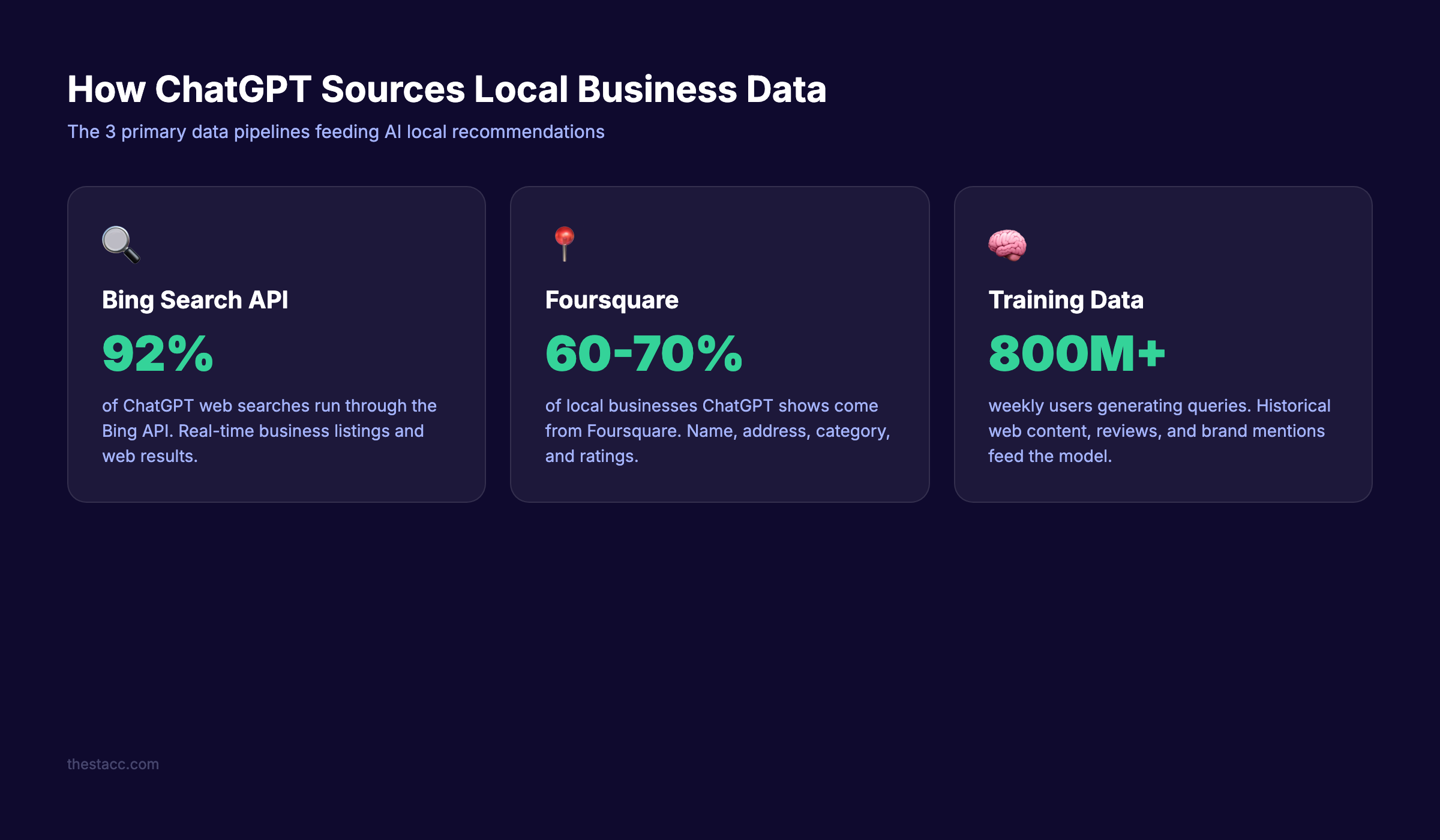
ChatGPT uses 3 primary sources for local business information:
| Source | What It Provides | Priority |
|---|---|---|
| Bing Search API | Real-time web results, business listings | High |
| Foursquare | Business name, address, category, ratings | High |
| Training Data | Historical web content, reviews, mentions | Medium |
A study from Local Falcon found that 60% to 70% of local businesses ChatGPT shows come directly from Foursquare data. ChatGPT also relies on Bing’s search API for 92% of its real-time web searches.
This means your traditional Google-first SEO strategy leaves major gaps. You need to be visible on the platforms ChatGPT actually reads.
ChatGPT evaluates 5 signals before recommending a business:
- Authoritative list mentions on high-ranking websites
- Awards and accreditations from recognized organizations
- Online reviews across platforms like Google, Yelp, and Trustpilot
- Customer usage data showing real adoption and engagement
- Social sentiment from Reddit, X, and news coverage
Businesses with review scores below 70% positive are far less likely to get recommended. The bar is not perfection. It is consistent quality across multiple platforms.
Now let us walk through each step.
Step 1: Claim and Optimize Your Google Business Profile
Your Google Business Profile remains the single most important local listing on the internet. It feeds AI tools that pull from Google’s data ecosystem. And it is the foundation every other optimization builds on.
Specifically:
- Claim your profile at business.google.com if you have not already
- Complete every field: name, address, phone, website, hours, service area
- Select the most specific primary category for your business
- Add 3 to 5 secondary categories that describe your services
- Upload at least 10 high-quality photos (exterior, interior, team, work)
- Write a business description with your primary services and location
- Add all services and products with descriptions
A complete GBP sends strong signals to both Google and the AI systems that pull from Google’s index. ChatGPT cross-references multiple data points. The more complete your profile, the more confident the AI is in recommending you.
Why this step matters: ChatGPT mirrors many of the top Google results. If your GBP is incomplete, you rank lower in Google. That means you also rank lower in ChatGPT’s data pool.
Pro tip: Choose your GBP categories carefully. The primary category carries the most weight. A plumber who lists “Plumber” as the primary category ranks better than one who lists “Home Improvement.”
Post regularly to your GBP. Businesses that publish GBP posts consistently signal active engagement. AI systems interpret freshness as reliability.
Step 2: Create and Optimize Your Bing Places Listing
This is the step most local businesses skip. It is also the most impactful for ChatGPT visibility.
ChatGPT uses the Bing Search API for 92% of its real-time web searches. Bing Places is the local business directory that feeds Bing’s search results. If your business is not on Bing Places, ChatGPT may never see you.
Specifically:
- Go to bingplaces.com and claim your listing
- Import your Google Business Profile data to save time
- Verify your business via phone, email, or postcard
- Add photos, business hours, and a detailed description
- Include all service categories and areas served
- Add your website URL with proper tracking parameters
Your Bing Places listing should mirror your Google Business Profile exactly. Same name. Same address. Same phone number. Same categories. AI models cross-reference data across platforms. Inconsistencies reduce trust.
Why this step matters: Bing Places is ChatGPT’s primary source for local business data. Skipping this step is like ignoring Google for traditional SEO.
Pro tip: Bing Places allows you to import your GBP data directly. The entire setup takes under 15 minutes. There is no excuse to skip it.
Step 3: Build Citations Across AI Data Sources
Citations are mentions of your business name, address, and phone number (NAP) on other websites. For AI search, specific platforms carry more weight than others.
ChatGPT and other AI models cross-check data across multiple sources. Consistent information across 20+ platforms builds the kind of trust that earns recommendations.
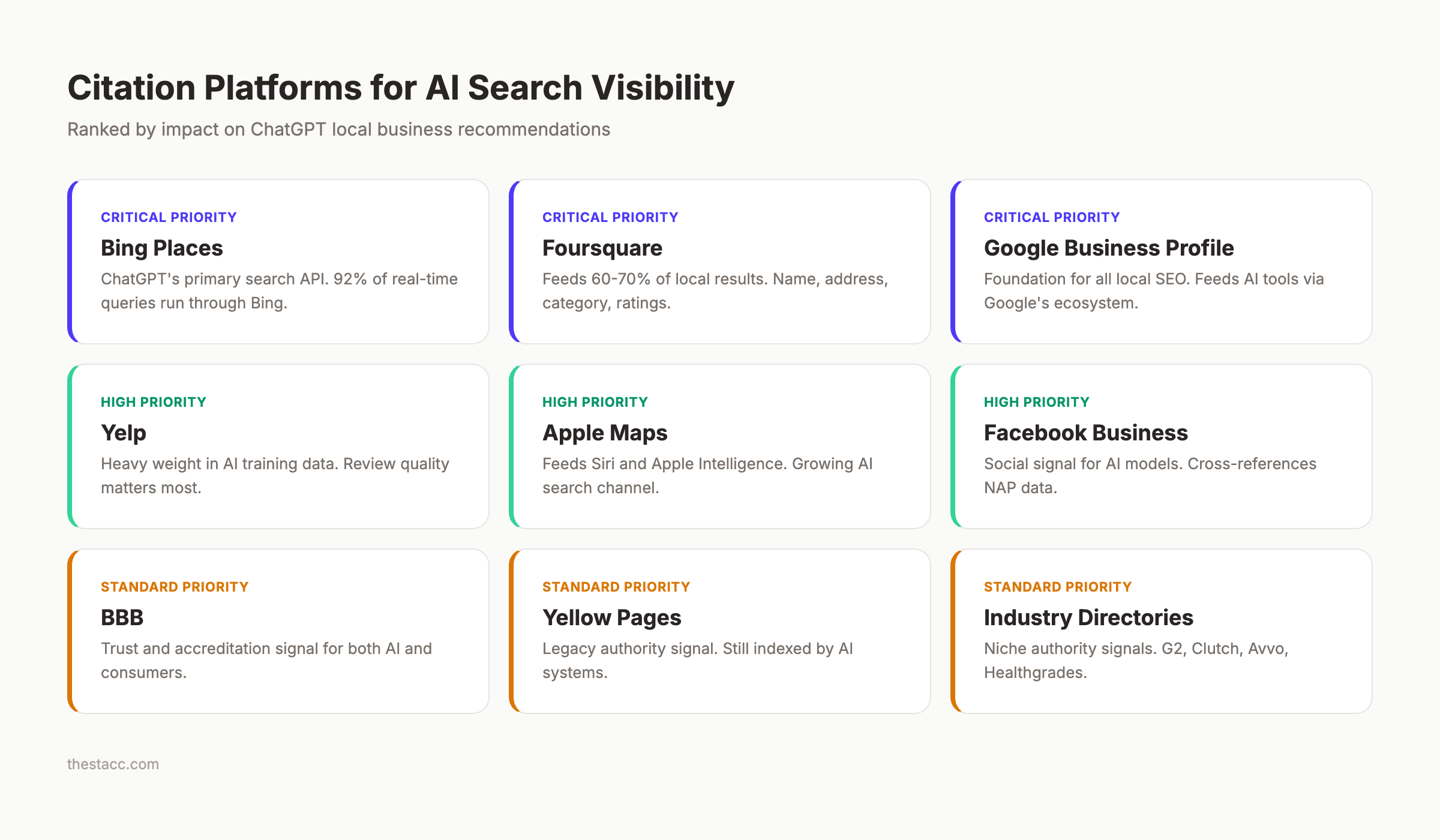
Priority citation sources for AI visibility:
| Platform | Why It Matters | Setup Time |
|---|---|---|
| Foursquare | Feeds 60-70% of ChatGPT local results | 10 min |
| Yelp | Top review platform for AI training data | 15 min |
| Apple Maps | Feeds Siri and Apple Intelligence | 10 min |
| Facebook Business | Social signal for AI models | 15 min |
| Yellow Pages | Legacy authority signal | 10 min |
| BBB | Trust signal for both AI and consumers | 20 min |
| Industry directories | Niche authority signals | Varies |
Specifically:
- Create or claim your Foursquare listing first (highest ChatGPT impact)
- Claim your Yelp business page and complete all fields
- Submit to Apple Maps via Apple Business Connect
- Verify your Facebook Business page with accurate NAP data
- Submit to 10 to 15 industry-specific directories
- Audit all listings for NAP consistency monthly
The local SEO checklist covers the full citation-building process. But for AI visibility, prioritize Foursquare and Yelp above all others.
Why this step matters: AI models treat consistent multi-platform presence as a trust signal. A business that appears on 25 platforms with identical information looks more legitimate than one on 3 platforms.
Pro tip: Use a citation management tool to monitor NAP consistency. One wrong phone number on a single platform can create confusion for AI systems that cross-reference data.
Step 4: Earn Reviews on Platforms AI Models Trust
Reviews are the most powerful signal that determines whether AI tools recommend your business. First Page Sage research found that businesses with review scores below 70% positive are far less likely to appear in ChatGPT answers.
Volume matters. Quality matters more. But platform diversity matters most.
The review platforms that influence ChatGPT:
- Google Reviews — Highest volume, strongest overall signal
- Yelp — Heavy weight in ChatGPT training data
- Trustpilot — Common in B2B and service recommendations
- BBB — Trust and accreditation signal
- Industry platforms — G2, Clutch, Avvo, Healthgrades (depends on your industry)
Specifically:
- Build a system to ask every customer for a review
- Focus on Google first, then Yelp and industry platforms
- Respond to every review within 24 to 48 hours
- Address negative reviews professionally and specifically
- Aim for 70% or higher positive sentiment across all platforms
Do not chase only star ratings. ChatGPT reads review text. A 4.2 star business with 200 detailed reviews outperforms a 4.8 star business with 12 generic ones.
Why this step matters: AI models use review sentiment, volume, and recency to determine recommendation confidence. Thin review profiles equal low confidence. Low confidence means no recommendation.
Your review management system should treat AI visibility as a core KPI. Not just Google rankings.
AI search is now a customer acquisition channel. Your reviews feed ChatGPT, Gemini, and Perplexity. Every review is a data point that helps or hurts your AI visibility. Start for $1 →
Step 5: Add Schema Markup for Local Businesses
Schema markup is structured data that tells search engines and AI systems exactly what your business does. Without it, AI models have to guess. With it, they get clean, machine-readable facts.
Think of schema as your business card for AI. It lists your name, address, services, hours, reviews, and more in a format machines understand instantly.
Required schema types for local AI visibility:
{
  "@context": "https://schema.org",
  "@type": "LocalBusiness",
  "name": "Your Business Name",
  "address": {
    "@type": "PostalAddress",
    "streetAddress": "123 Main St",
    "addressLocality": "Your City",
    "addressRegion": "State",
    "postalCode": "12345"
  },
  "telephone": "+1-555-555-5555",
  "url": "https://yourbusiness.com",
  "openingHours": "Mo-Fr 09:00-17:00",
  "aggregateRating": {
    "@type": "AggregateRating",
    "ratingValue": "4.8",
    "reviewCount": "156"
  }
}
Specifically:
- Add LocalBusiness schema to your homepage
- Include Service schema on each service page
- Add FAQ schema to FAQ pages and blog posts
- Use Review schema for testimonial pages
- Test with Google’s Rich Results Test tool
- Validate with Schema.org validator
The local business schema guide covers every property and sub-type. Use the most specific type available. “Plumber” is better than “LocalBusiness.” “Dentist” is better than “MedicalBusiness.”
Why this step matters: Schema tells AI assistants what you do. Reviews tell them if you are trusted. Conversational content tells them how to phrase you as an answer. Schema is the foundation layer.
Read the full structured data guide for implementation details beyond local business types.
Step 6: Publish Content That Makes Your Business Citable
AI models recommend businesses they can describe clearly. They need specific, factual content to pull from. Generic “about us” pages do not give them enough material.
The goal is to create content that answers the exact questions people ask ChatGPT about businesses like yours.
Content types that drive AI citations:
| Content Type | Example | Why AI Uses It |
|---|---|---|
| Service pages | ”Emergency Plumbing Repair in Denver” | Matches specific local queries |
| Comparison guides | ”Tankless vs Traditional Water Heaters” | Feeds comparison questions |
| FAQ pages | ”How Much Does a Roof Replacement Cost?” | Direct answer format |
| How-to guides | ”How to Prevent Frozen Pipes” | Expertise signal |
| Local resource pages | ”Best Neighborhoods in Austin for Families” | Local authority signal |
Specifically:
- Create a dedicated page for each core service you offer
- Write location-specific content for every city or area you serve
- Build an FAQ page that answers 15 to 20 common customer questions
- Publish educational blog posts that demonstrate expertise
- Include specific data points: pricing ranges, timelines, success rates
ChatGPT gravitates toward content with specific numbers and clear positioning. “We have served over 2,000 homeowners since 2015” is citable. “We provide quality service to our community” is not.
Why this step matters: Generic content gets ignored by AI. Specific, factual, well-structured content gets cited. Your content strategy determines whether ChatGPT has anything useful to say about you.
Your local content marketing strategy should prioritize citable content over promotional content.
Consistent publishing builds AI authority. We call it the Content Compound Effect. Every article, every GBP post, every service page adds to your digital footprint. AI models notice. Start for $1 →
Step 7: Build Brand Mentions and Authority Signals
Here is a data point that changes everything: brand mentions correlate 3x more with AI visibility than backlinks do.
Traditional SEO prioritizes links. AI search prioritizes mentions. A business name that appears across news articles, Reddit threads, industry publications, and local media gets recommended. One that only appears on its own website does not.
High-impact mention sources:
- Local news and media — Press releases, local business features, event sponsorships
- Reddit — Genuine participation in local and industry subreddits
- Industry publications — Guest posts, expert quotes, case studies
- Podcast appearances — Transcripts become crawlable content
- Awards and lists — “Best of” lists, industry rankings, chamber awards
Specifically:
- Submit to local “Best of” lists and awards programs
- Pitch local media for business features and expert commentary
- Participate genuinely on Reddit in relevant subreddits
- Seek guest posting on industry blogs and local publications
- Sponsor local events that generate media coverage
- Get listed on authoritative industry directories like Clutch or G2
Brand mentions work differently than backlinks for AI visibility. A mention without a link still counts. ChatGPT reads content. It does not follow links. The mention itself is the signal.
Why this step matters: AI models build confidence through consensus. When multiple independent sources mention your business positively, ChatGPT treats you as a safe recommendation. Without mentions, you are invisible.
The exception: brand mentions on low-quality or spammy sites can hurt more than help. Focus on reputable sources. Quality over quantity applies here too.
Step 8: Monitor Your AI Search Visibility
You cannot improve what you do not measure. Most local businesses have no idea whether ChatGPT recommends them. They find out only when a customer mentions it.
How to check your current AI visibility:
- Ask ChatGPT directly: “What are the best [your service] in [your city]?”
- Try 10 to 15 variations of the question with different phrasing
- Test on ChatGPT, Gemini, Perplexity, and Copilot
- Document which competitors appear and why
- Record the specific language ChatGPT uses to describe businesses
AI monitoring tools:
| Tool | What It Tracks | Price |
|---|---|---|
| Otterly.ai | AI citations across ChatGPT, Perplexity, Gemini | Paid |
| Brand24 | Brand mentions across web and social | From $79/mo |
| Semrush Position Tracking | Traditional + AI search visibility | From $139/mo |
| Manual testing | Direct queries to AI chatbots | Free |
Specifically:
- Set a weekly schedule to test 5 to 10 queries per AI platform
- Track changes in recommendations month over month
- Monitor competitor mentions for gaps and opportunities
- Adjust your strategy based on which platforms cite you most
The full AI search visibility tracking guide covers setup for every major AI platform.
Why this step matters: AI recommendations change as models update. A business recommended today may not be recommended next month. Ongoing monitoring catches drops before they cost you customers.
Pro tip: Screenshot your results. AI responses are not cached the same way Google results are. Having a record lets you track progress over time.
Results: What to Expect
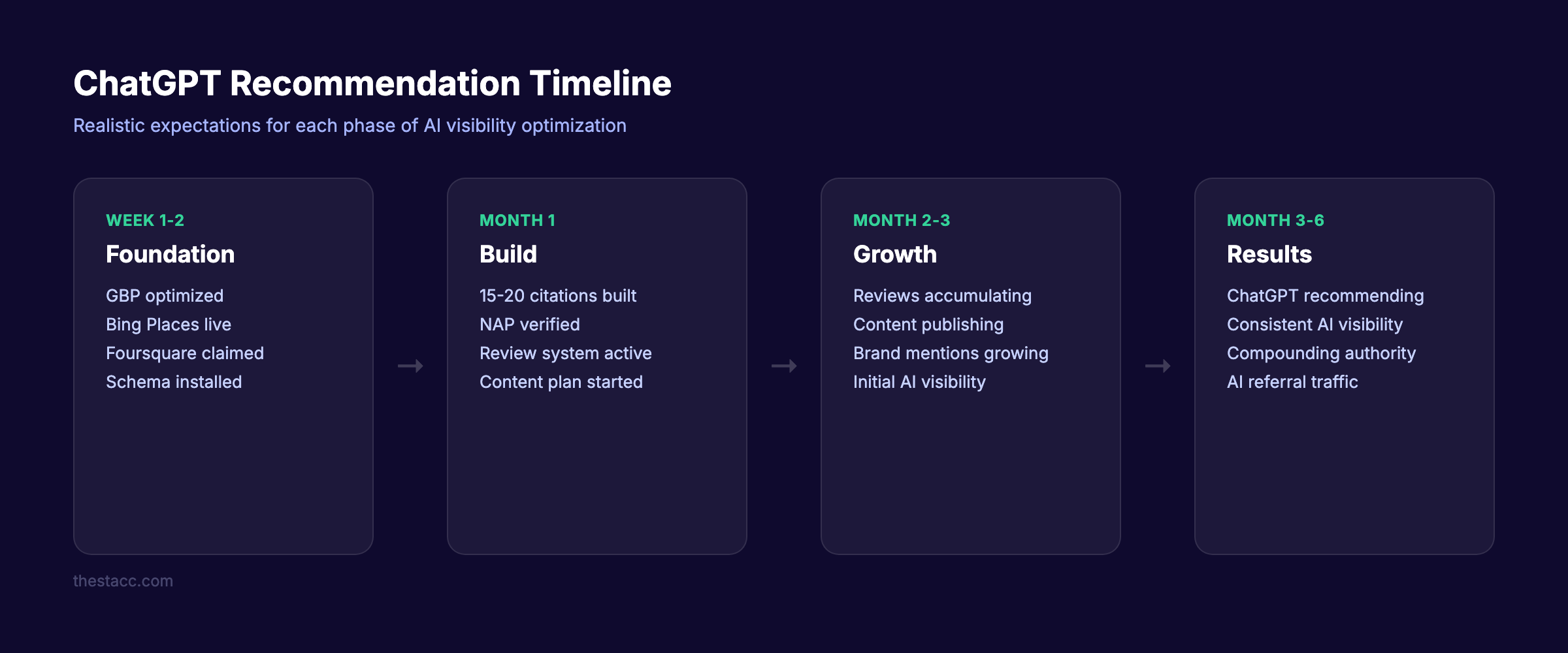
After completing these 8 steps, here is a realistic timeline:
- Week 1 to 2: Bing Places and Foursquare listings live. GBP fully optimized.
- Month 1: Citations built across 15 to 20 platforms. Schema markup installed. NAP consistency verified.
- Month 2 to 3: Review generation system producing consistent new reviews. Content publishing in progress. First AI visibility checks show improvement.
- Month 3 to 6: Brand mentions accumulating. Content library growing. ChatGPT begins including your business in relevant answers.
This is not an overnight fix. AI models update on their own schedules. Some changes take days to appear. Others take months.
The businesses that show up in AI search 6 months from now are the ones that start building their presence today. Every step compounds on the last.
Troubleshooting
Problem: ChatGPT recommends competitors but not your business. Solution: Compare your citation count, review volume, and content depth to theirs. The gap is usually in one of those 3 areas. Fix the weakest one first.
Problem: Your business information in ChatGPT is outdated or incorrect. Solution: Update your Bing Places, Foursquare, and GBP listings. ChatGPT pulls from these in real time. Changes propagate within days to weeks.
Problem: ChatGPT mentions your business but describes it incorrectly. Solution: Audit your website’s service pages and schema markup. Ensure your business description is clear, specific, and consistent across every platform.
Done-for-you AI visibility. Stacc publishes optimized content and GBP posts automatically. Your business builds authority while you focus on customers. Start for $1 →
Frequently Asked Questions
Does ChatGPT recommend local businesses?
Yes. ChatGPT with web search enabled recommends local businesses when users ask for service providers, restaurants, shops, and other local queries. It pulls from Bing, Foursquare, and web content to generate these recommendations. The recommendations include business names, locations, and often brief descriptions of services and reviews.
How does ChatGPT decide which businesses to recommend?
ChatGPT evaluates 5 primary signals: authoritative list mentions, awards and accreditations, online reviews, customer usage data, and social sentiment. First Page Sage research found that review quality and list placements carry the highest weight. Businesses with strong, consistent presence across multiple platforms get recommended most often.
Is Foursquare really important for ChatGPT visibility?
Extremely. Research shows that 60% to 70% of the local businesses ChatGPT displays come from Foursquare data. Creating and optimizing your Foursquare listing is one of the highest-impact steps you can take. It takes 10 minutes and costs nothing.
Can I pay to get recommended by ChatGPT?
No. ChatGPT does not accept paid placements in its recommendations. Paid ads on Google or Bing do not influence ChatGPT answers. The only way to get recommended is through genuine optimization: strong profiles, quality reviews, consistent citations, and authoritative content.
How long does it take to start appearing in ChatGPT results?
Most businesses see initial improvements within 2 to 3 months of implementing all 8 steps. Full visibility with consistent recommendations typically takes 3 to 6 months. The timeline depends on your starting point, industry competition, and how quickly you build reviews and citations.
Should I optimize for ChatGPT differently than Google?
The strategies overlap significantly. But ChatGPT weighs brand mentions more heavily than backlinks. It also relies on Bing rather than Google for real-time search. Optimizing for both requires a multi-platform approach. The GEO optimization guide covers the differences in detail.
Start Now
AI search is not coming. It is here. Over 800 million people use ChatGPT weekly. AI referral traffic converts 4.4x better than traditional search.
Your competitors are already building their AI presence. The businesses that get recommended by ChatGPT 6 months from now are the ones taking action today.
Pick step 1. Start with your Google Business Profile. Then move to Bing Places. Build from there.
Written and published by Stacc. We publish 3,500+ articles per month across 70+ industries. All data verified against public sources as of March 2026.
