Tracking AI search visibility means measuring whether ChatGPT, Google AI Overviews, and Perplexity mention your brand, not only where you rank. This guide defines the metrics worth watching, runs a manual visibility audit, sets up AI referral traffic tracking in analytics, and turns the results into a monitoring routine.
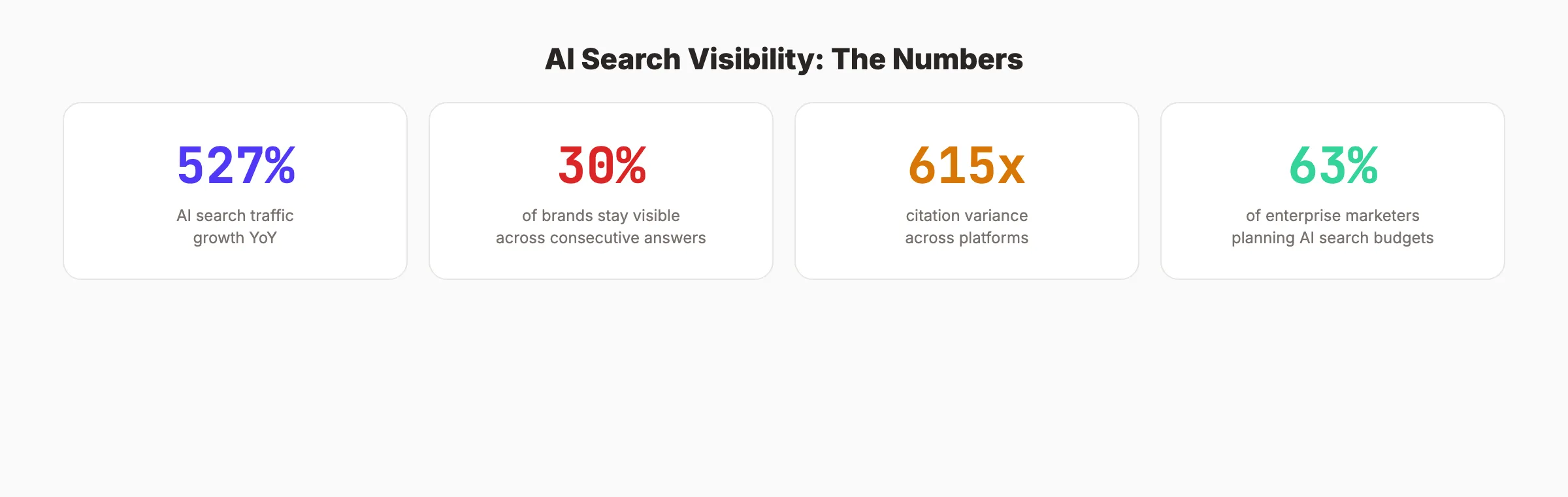
You cannot improve what you cannot measure. AI search traffic grew 527% year-over-year between 2024 and 2025. Google AI Overviews now appear on over 25% of searches. ChatGPT drives 87.4% of all AI referral traffic. Yet most businesses have no idea whether AI search engines mention their brand at all.
The problem is not awareness. Most marketers know AI search matters. The problem is measurement. Traditional SEO tools track rankings. They do not track AI search visibility. You need different tools, different metrics, and a different monitoring system.
This guide shows you how to track AI search visibility in 7 steps. You will learn which metrics matter, which tools to use, and how to build a monitoring system that catches visibility changes before they impact traffic.
We publish 3,500+ blog posts across 70+ industries. Our average SEO score is 92%. Tracking AI visibility is part of every reporting cycle we run.
Here is what you will learn:
- The 5 metrics that define AI search visibility
- How to manually audit your visibility across 4 AI platforms
- The best tools for automated AI visibility tracking
- How to measure AI referral traffic in your analytics
- A monthly monitoring schedule you can start today
- How to benchmark against competitors in AI search
What You Will Need
Time required: 1 to 2 hours for initial setup. 30 minutes per month ongoing.
Difficulty: Beginner to Intermediate
What you will need:
- Google Analytics 4 (or your analytics platform)
- Google Search Console
- Access to ChatGPT, Perplexity, and Google AI Overviews
- Optional: A dedicated AI visibility tool (free options available)
- A spreadsheet for tracking results
What AI Search Visibility Means
AI search visibility measures how often and how prominently your brand appears in AI-generated answers. It is different from traditional search rankings.
| Traditional SEO | AI Search Visibility |
|---|---|
| Your page ranks at position X | Your brand is mentioned or cited in an AI answer |
| Measured by keyword position | Measured by citation frequency and brand mentions |
| Stable rankings over weeks | Only 30% of brands stay visible across consecutive answers |
| Tools: Ahrefs, Semrush, GSC | Tools: Otterly, Peec AI, Profound, manual testing |
| Traffic from organic clicks | Traffic from AI referral links |
The volatility is the biggest difference. Traditional rankings change slowly. AI visibility fluctuates up to 615 times across different AI platforms for the same query. That is why tracking matters. Without it, you are flying blind in the fastest-growing search channel.
For background on how AI citations work, see our guide on getting cited by AI search engines.
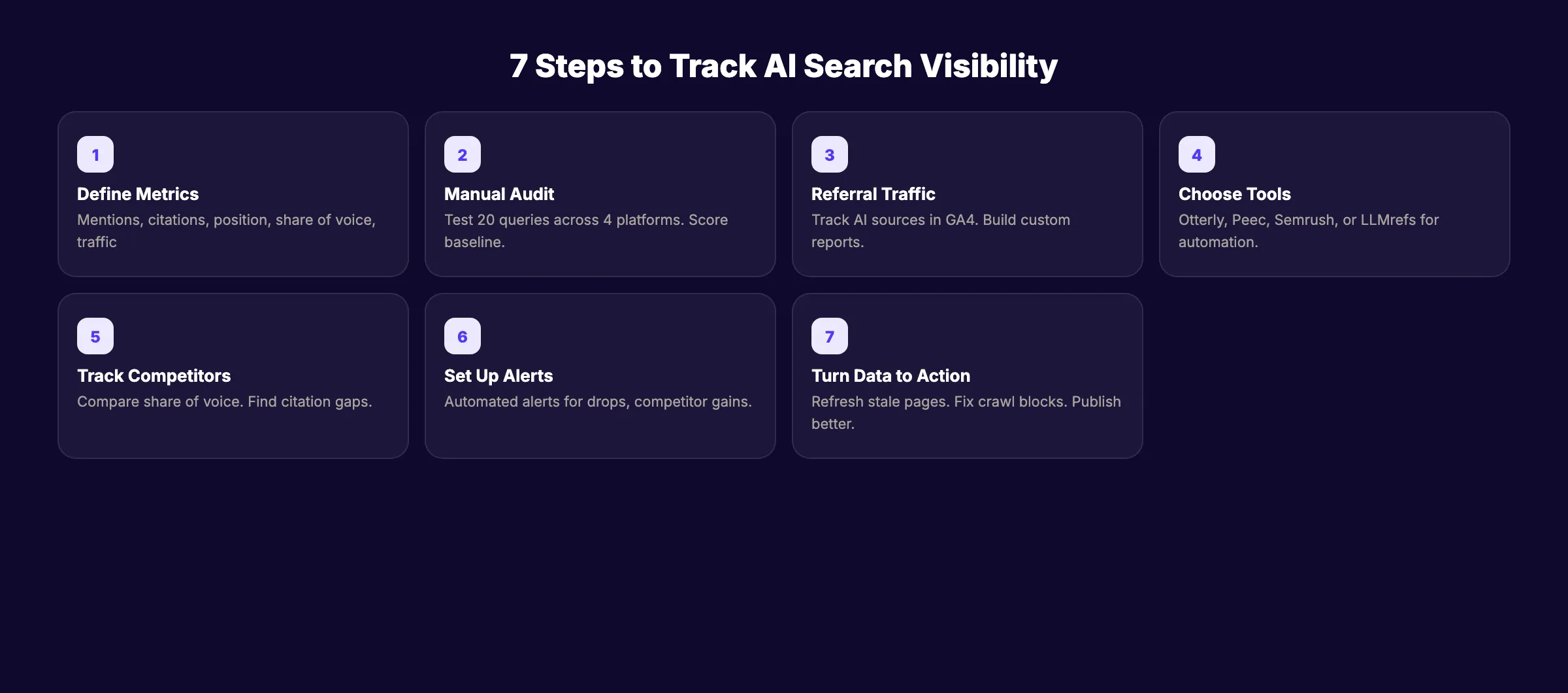
Step 1: Define Your AI Visibility Metrics
Before tracking anything, define what you are measuring. AI visibility has 5 core metrics.
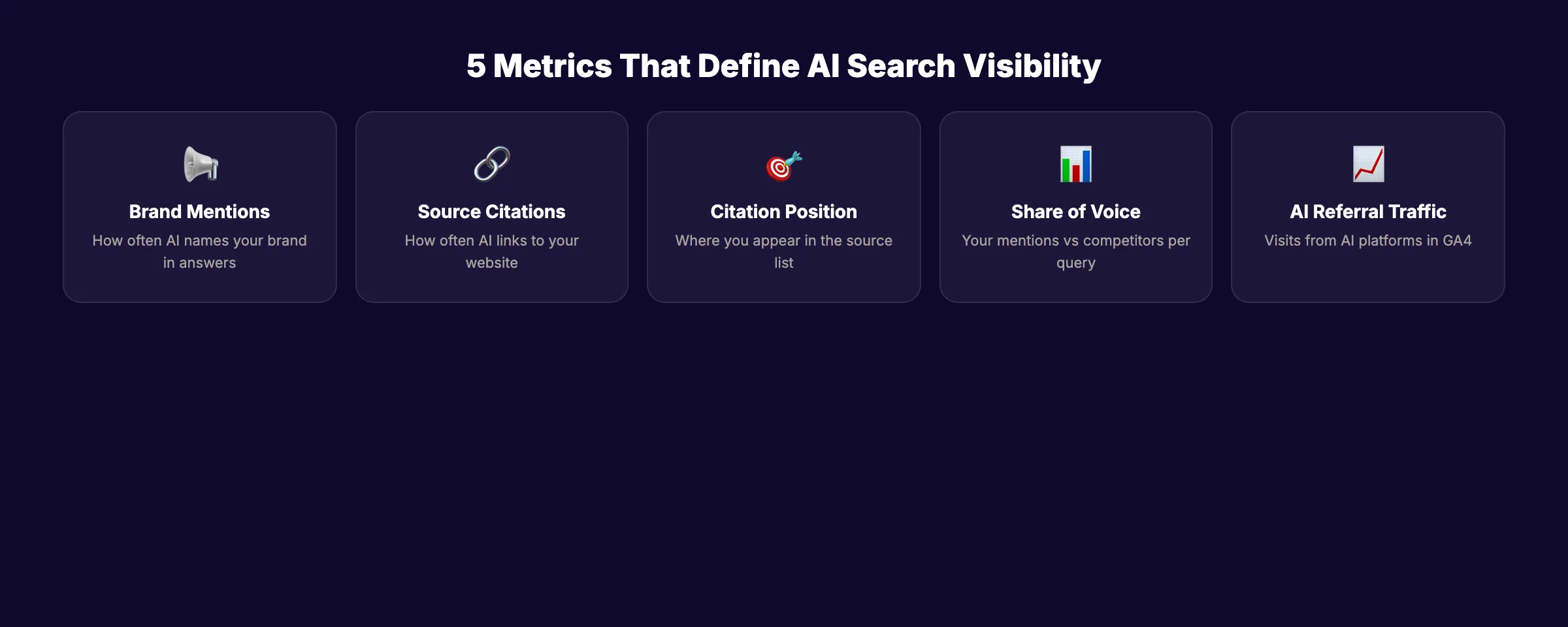
1A. Brand Mentions
How often does your brand name appear in AI-generated answers? This includes mentions with and without a link. A brand mention without a link still drives awareness. Track mentions across ChatGPT, Perplexity, Google AI Overviews, and Gemini separately.
1B. Source Citations
How often does an AI platform link to your website as a source? Citations are stronger than mentions because they drive direct traffic. Track the specific URLs being cited. Some pages get cited 10 times more often than others.
1C. Citation Position
When your site is cited, where does it appear in the citation list? First citation gets the most clicks. Third or fourth citation gets significantly less attention. Track your average citation position per platform.
1D. Share of Voice
For your target keywords, what percentage of AI answers mention your brand versus competitors? If 10 AI answers for your category mention 3 competitors but not you, your share of voice is 0%. This is the metric that reveals competitive gaps.
1E. AI Referral Traffic
How many visits does your site receive from AI search platforms? This is the bottom-line metric. Brand mentions and citations are inputs. Referral traffic is the output.
Why this step matters: Tracking "AI visibility" without defined metrics leads to vague reporting. These 5 metrics give you specific, measurable data points that connect to business outcomes.
Step 2: Run a Manual AI Visibility Audit
Before spending money on tools, run a manual audit. It takes 30 to 45 minutes and gives you an immediate baseline.
2A. Prepare Your Query List
Write 20 queries that your target audience would ask AI search engines. Include:
- 5 branded queries ("what is [your brand]", "[your brand] reviews")
- 5 category queries ("best [your category] tools", "top [your category] services")
- 5 problem queries ("how to [problem your product solves]")
- 5 comparison queries ("[your brand] vs [competitor]", "alternatives to [competitor]")
2B. Test Each Platform
Run all 20 queries on each platform and record the results:
| Platform | How to Test | What to Record |
|---|---|---|
| ChatGPT | Use web search mode (globe icon) | Brand mentioned? Cited? Position? |
| Perplexity | Standard search at perplexity.ai | Sources listed? Your URL included? Position? |
| Google AI Overviews | Search on google.com, check AI summary | Cited in overview? Which URL? Position? |
| Gemini | Search at gemini.google.com | Brand mentioned? Source linked? |
2C. Score Your Baseline
For each query, score: 2 points for a citation with link, 1 point for a brand mention without link, 0 points for no mention. Sum the scores per platform. This is your baseline AI visibility score.
Example scoring:
| Platform | Score (out of 40) | Interpretation |
|---|---|---|
| 30+ | Strong visibility. Focus on maintaining. | |
| 15-29 | Moderate. Specific optimization gaps to fill. | |
| 0-14 | Low. Major optimization needed. |
Repeat this audit monthly. Track the trend.
Why this step matters: A manual audit reveals exactly which queries and platforms you are visible on. Automated tools give you scale. Manual testing gives you accuracy and insight.
Pro tip: Screenshot every result. AI answers change with every query. Screenshots are your proof of what the AI said on a specific date.
Stop writing. Start ranking. theStacc publishes 30 SEO articles per month for $99.
Step 3: Set Up AI Referral Traffic Tracking
AI referral traffic is the one metric you can track for free right now with tools you already have.
3A. Google Analytics 4
In GA4, go to Reports > Acquisition > Traffic Acquisition. Look for these referral sources:
| Source | Platform |
|---|---|
chatgpt.com | ChatGPT web search |
perplexity.ai | Perplexity |
gemini.google.com | Gemini |
copilot.microsoft.com | Bing Copilot |
If you do not see these sources yet, your site is either not being cited or the traffic volume is still small. Check back monthly. AI referral traffic is growing at roughly 1% month over month.
3B. Create a Custom Report
Build a GA4 custom report that isolates AI referral traffic. Group the sources above into a channel called "AI Search." Track sessions, engaged sessions, conversions, and revenue from this channel. Compare month over month.
3C. Google Search Console
Search Console does not show AI-specific data directly. But you can infer AI Overview impact. Look for queries where impressions remain stable but clicks drop. That pattern often means AI Overviews are capturing the clicks that used to go to organic results.
Filter by queries that lost clicks but not impressions. Cross-reference those queries with a manual test on Google. Check if an AI Overview appears for each one.
For more on using Search Console effectively, see our Google Search Console guide.
Why this step matters: Referral traffic is the closest thing to revenue impact. Mentions and citations are leading indicators. Traffic is the lagging indicator that proves those citations are working.
Step 4: Choose an AI Visibility Tracking Tool
Manual audits work for baselines. But tracking 20 queries across 4 platforms monthly is tedious. Dedicated tools automate this.
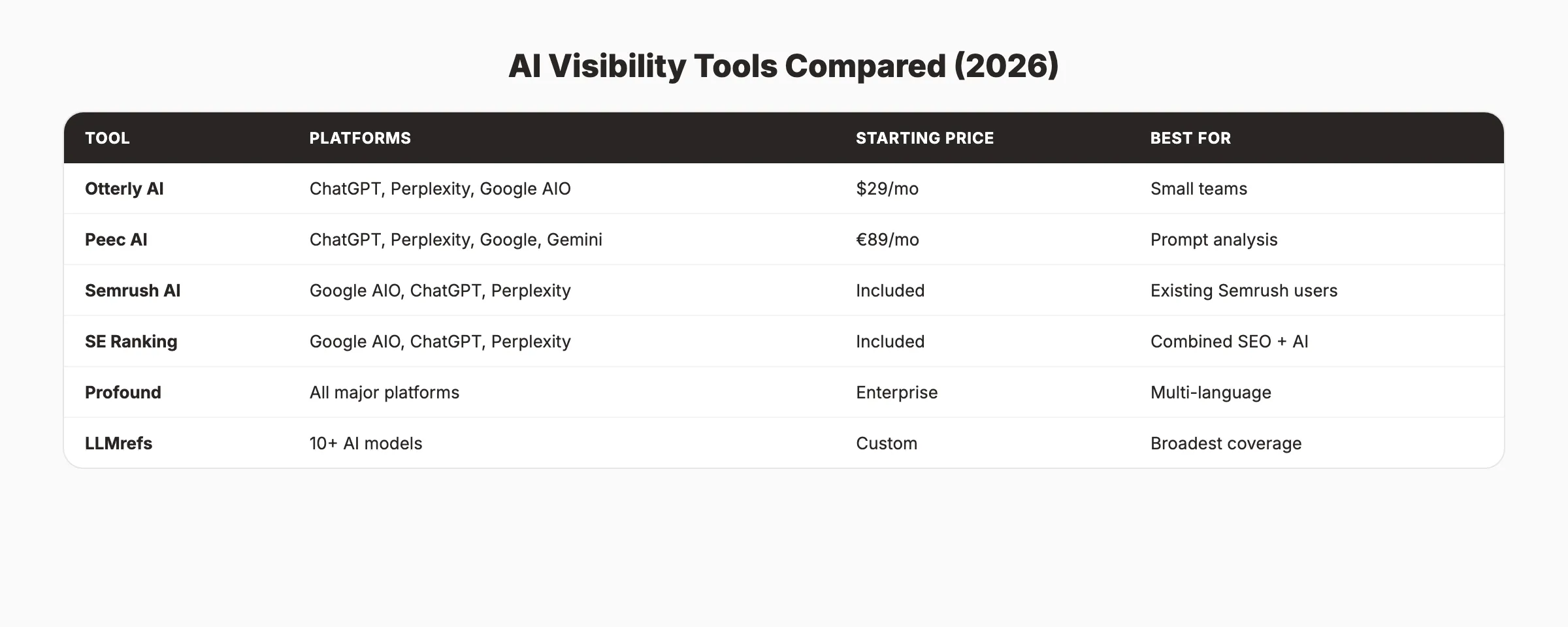
Tool Comparison
| Tool | Platforms Tracked | Starting Price | Free Tier | Best For |
|---|---|---|---|---|
| Otterly AI | ChatGPT, Perplexity, Google AIO | $29/month | 14-day trial | Small teams, citation monitoring |
| Peec AI | ChatGPT, Perplexity, Google, Gemini | €89/month | Limited trial | Prompt-level visibility analysis |
| Semrush AI Toolkit | Google AIO, ChatGPT, Perplexity | Included in plans | Free checker tool | Teams already using Semrush |
| SE Ranking | Google AIO, ChatGPT, Perplexity | Included in plans | Limited | Combined traditional + AI SEO |
| Profound | ChatGPT, Google, Perplexity, Gemini | Enterprise pricing | Demo only | Multi-language, enterprise |
| LLMrefs | 10+ AI models | Custom pricing | Free tier | Broadest model coverage |
How to Choose
- Budget under $50/month: Start with Otterly AI or the free Semrush checker
- Already using Semrush or SE Ranking: Use their built-in AI visibility features
- Enterprise with multiple brands: Profound or custom LLMrefs setup
- Want the broadest coverage: LLMrefs tracks 10+ AI models
What to Track in Your Tool
Configure your tool to monitor:
- ✓ 20 to 50 target queries (from Step 2A)
- ✓ Your brand name and top 3 competitor brands
- ✓ Weekly or daily check frequency
- ✓ Citation URL tracking (which specific pages get cited)
- ✓ Alerts for visibility drops below your baseline
Why this step matters: Manual audits give you a baseline. Tools give you a trend. Without a trend, you cannot tell if your optimization efforts are working or if visibility is naturally fluctuating.
Step 5: Track Competitor AI Visibility
Your AI visibility only matters relative to competitors. If your visibility score is 15 but your top competitor scores 35, you know exactly how much ground to cover.
5A. Identify AI Search Competitors
Your AI search competitors may differ from your traditional SEO competitors. Run your 5 category queries on ChatGPT and Perplexity. Note which brands get mentioned most. Those are your AI search competitors.
5B. Build a Competitive Tracking Sheet
Create a spreadsheet with these columns:
| Query | Your Brand | Competitor A | Competitor B | Competitor C | Platform | Date |
|---|---|---|---|---|---|---|
| "best [category] tools" | Cited (pos 2) | Cited (pos 1) | Mentioned | Not found | ChatGPT | 2026-03-27 |
Run this comparison monthly. Track trends over time.
5C. Analyze What Competitors Do Differently
For queries where competitors get cited and you do not, visit the competitor's cited page. Analyze:
- How is their content structured?
- Do they have FAQ sections?
- Do they include original data or statistics?
- Is their page more recently updated?
- Do they have better schema markup?
The answers tell you what to fix on your own content.
For more on analyzing competitors, see our guide on competitive keyword analysis.
Why this step matters: AI visibility is a zero-sum game for brand mentions. If an AI engine recommends 3 brands per answer, your goal is to be one of them. Competitive tracking tells you who you need to displace.
Your SEO team. $99 per month. 30 optimized articles, published automatically.
Step 6: Set Up Alerts and Automated Monitoring
Reactive monitoring misses problems. By the time you check manually and discover a visibility drop, you may have already lost weeks of traffic. Alerts catch drops in real time.
6A. Tool-Based Alerts
Most AI visibility tools offer alert configurations. Set alerts for:
- Your brand disappears from a query where it was previously cited
- A competitor overtakes your position in citations
- Your citation count drops below a threshold you set
- A new competitor starts appearing in your target queries
6B. Google Analytics Alerts
In GA4, create a custom alert for AI referral traffic. Set it to notify you if traffic from chatgpt.com or perplexity.ai drops more than 30% week over week. A sudden drop may indicate your content was removed from AI citation pools.
6C. Monthly Reporting Schedule
| Week | Action | Time |
|---|---|---|
| Week 1 | Run manual audit on 20 queries (Step 2) | 30 min |
| Week 2 | Review AI referral traffic in GA4 (Step 3) | 15 min |
| Week 3 | Check competitor positions (Step 5) | 20 min |
| Week 4 | Review tool alerts and update tracking sheet | 15 min |
Total monthly time: about 80 minutes. That is the cost of knowing whether your AI visibility is growing or shrinking.
Why this step matters: AI visibility changes faster than traditional rankings. 40 to 60% of cited domains change month over month. Without alerts, you discover problems too late to act on them.
Step 7: Turn Data Into Action
Tracking without action is just record-keeping. Each metric should trigger a specific response.
7A. If Brand Mentions Drop
Check whether your content was recently updated. AI models prefer fresh content updated within the last 2 months. Pages updated within that window earn 28% more citations. If your key pages are stale, refresh them with updated data, new sections, and a current date.
7B. If Citation Position Drops
Analyze the pages that outrank you in citations. They likely have stronger schema markup, more specific data, or clearer answer formatting. See our guide on optimizing content for SEO for actionable improvements.
7C. If AI Referral Traffic Drops
Check your robots.txt file for AI crawler blocks. Verify your pages are still indexed in Google and Bing. Test the specific URLs that were driving traffic by searching for them manually on each AI platform.
7D. If Competitors Gain Visibility
Do not panic. Check what they published recently. AI models respond to new, high-quality content quickly. Your response: publish better content on the same topic. Include more specific data, better structure, and stronger E-E-A-T signals.
7E. Build a Content Refresh Calendar
Based on your tracking data, identify the top 10 pages that get AI citations. Schedule refreshes for these pages every 60 days. Keep the data current. Keep the publish date fresh. These pages are your AI search assets. Protect them.
For a complete system on maintaining content, see our guide on updating old blog posts.
Why this step matters: Data without action is wasted effort. Each visibility signal maps to a specific optimization you can make. The tracking system tells you what to fix. This step tells you how to fix it.
3,500+ blogs published. Every article is SEO-scored before publish. See what theStacc can do for your site.
Results: What to Expect
After setting up your AI visibility tracking system:
- Week 1: You have a baseline score across all 4 platforms and 20 queries
- Month 1: You identify which pages get cited, which queries you miss, and where competitors beat you
- Month 2: Content optimizations from Step 7 begin improving your visibility scores
- Month 3: AI referral traffic trends become visible in GA4
- Ongoing: Monthly tracking reveals long-term visibility trends and informs content strategy
63% of enterprise marketers are now planning dedicated AI search budgets for 2026. The ones tracking their visibility will spend those budgets effectively. The ones guessing will not.
Troubleshooting
Problem: No AI referral traffic appears in GA4. Solution: AI referral traffic is still small for most sites. If you see zero visits from chatgpt.com or perplexity.ai, it likely means your content is not being cited yet. Focus on optimization first (see our AI search citation guide), then track the results.
Problem: Manual audit results differ every time you run the same query. Solution: This is normal. AI answers are non-deterministic. They vary by session, location, and model version. Run each query 3 times and record the average. Over time, patterns emerge despite individual query variance.
Problem: Your AI visibility tool shows different data than manual testing. Solution: Tools query AI platforms on a fixed schedule (often daily). Manual tests happen in real time. Differences are expected. Trust the tool for trend data. Trust manual tests for spot-checking accuracy.
What practitioners are saying on X
AI search advice ages quickly. Here is high-signal public discussion from SEO and growth operators — context for your roadmap, not a substitute for primary data.
- @jakezward (Feb 2026): 2026 SEO predictions emphasize AI Overview share-of-SERP, schema for LLM token efficiency, brand mentions in AI answers as a KPI, proprietary data as a moat, and content refresh beating net-new AI slop. See the post on X.
- @alexgroberman (Jul 2026): Case narrative: organic value plus multi-engine citations (ChatGPT, Perplexity, Grok) from knowledge-hub pages, category authority links, commercial intent content, and tight internal linking — not thin product copy. See the post on X.
- @varunram (Jul 2026): Critique of GEO slopfarm products that combine SEO clickbait with unresearched content marketing — quality and research still separate winners from farms. See the post on X.
Grok, AI Overviews, and multi-engine visibility
For topics covered in “track ai search visibility”, multi-engine visibility still starts with clear definitions, sourced statistics, and extractable section answers. Grok additionally factors live X discussion — keep public claims consistent with this page.
- Google AI Overviews: Use passage-ready answers and structured data.
- ChatGPT / Perplexity: Cite named sources next to key claims.
- Grok: Maintain accurate entity facts on-site and in high-signal X posts.
Publish content built for Google and AI citations. theStacc’s Content SEO module ships SEO-scored articles structured for rankings and generative engines — including clearer entity pages models like Grok can quote.
How to measure multi-engine visibility in 2026
Split KPIs: classic GSC, AI Overview citations, chat referrals, and brand accuracy in Grok-style answers.
- GSC: non-brand clicks with annotation for AIO-heavy queries.
- Citations: are you named inside the AI summary?
- Referrals: ChatGPT/Perplexity sessions in GA4.
- Grok: on-site facts match public X discussion.
FAQ
AI search visibility measures how often your brand appears in AI-generated answers from platforms like ChatGPT, Perplexity, Google AI Overviews, and Gemini. It includes brand mentions (named without a link), source citations (named with a link), and citation position (where you appear in the source list).
The leading tools in 2026 are Otterly AI ($29/month), Peec AI (€89/month), Semrush AI Toolkit (included in existing plans), SE Ranking, Profound (enterprise), and LLMrefs. Semrush also offers a free AI visibility checker for basic checks.
Monthly at minimum. Weekly if you are actively optimizing for AI search. 40 to 60% of cited domains change month over month, so quarterly checks miss too many shifts. Set up automated alerts to catch critical drops between manual checks.
Indirectly. AI Overviews reduce organic CTR by up to 61% for affected queries. But sites cited in AI Overviews earn 35% more clicks than non-cited competitors. Tracking AI visibility helps you identify which queries are losing organic traffic to AI answers and which ones you can win back by getting cited.
Yes, partially. Manual audits (Step 2) cost nothing. GA4 AI referral traffic tracking (Step 3) is free. Google Search Console inference (Step 3C) is free. For automated tracking at scale, you need a paid tool. But the free methods cover 60 to 70% of what most sites need. For a full approach to increasing organic traffic across all channels, see our complete guide.
AI search visibility is the newest metric in SEO. The tracking infrastructure is still maturing. But the sites building measurement systems now will have 12 months of trend data when their competitors are just starting. Start with Step 1, define your metrics, and build from there.
Rank everywhere. Do nothing. Blog SEO, Local SEO, and Social on autopilot.
Related Tools & Resources
Free SEO Tools:
Best Lists:
Sources & references
- [1] Princeton / Georgia Tech et al. — GEO research (arXiv:2311.09735)
- [2] @jakezward on X — 2026 SEO predictions emphasize AI Overview share-of-SERP, schema for LLM token efficiency, brand mentions in AI answers
- [3] @alexgroberman on X — Case narrative: organic value plus multi-engine citations (ChatGPT, Perplexity, Grok) from knowledge-hub pages, category
- [4] Referenced source — www.airops.com

Plan topics, review article drafts, and publish to a connected CMS.
Weekly local SEO teardowns
One practical email a week. Map Pack, GBP, AI Overviews — no fluff. Unsubscribe anytime.
Explore this topic: Search Visibility.