Learn how to analyze competitor keywords with a 7-step process. Find gaps, steal rankings, and build a content plan. Updated for 2026.
Analyzing competitor keywords means reverse-engineering the terms your ranking rivals already win, then finding the gaps they left open. The seven steps below cover picking the right competitors, exporting their ranking terms, filtering by intent, scoring difficulty, and turning the shortlist into a publishing plan you can start this week.
96.55% of web pages get zero traffic from Google. The most common reason is targeting keywords no one searches for. Or keywords too competitive to win.
Competitor keyword analysis fixes both problems. Instead of guessing which terms to target, you reverse-engineer what already works for sites ranking in your space. You find the gaps they missed. You identify the pages where they rank weakly. Then you build content that fills those openings.
Most businesses skip this step entirely. They pick keywords from a brainstorming session, write a few blog posts, and wonder why nothing ranks. Meanwhile, their competitors publish strategically and capture the traffic.
We have published 3,500+ blogs across 70+ industries. The pattern is consistent: businesses that analyze competitor keywords before writing outperform those that guess by 3 to 5 times in organic traffic growth.
Here is what you will learn:
- How to identify your real search competitors (not just business rivals)
- How to pull and compare keyword lists across multiple competitors
- A scoring framework to prioritize the right keywords
- How to turn competitor gaps into a content plan that ranks
- The monitoring cadence that keeps your strategy current
What You Will Need
Time required: 2 to 3 hours for the initial analysis, 30 minutes for quarterly updates
Difficulty: Beginner to intermediate
What you will need:
- Google Search Console access (free)
- One keyword research tool: Semrush, Ahrefs, or a free keyword research tool
- A spreadsheet (Google Sheets or Excel)
- A list of 3 to 5 competitor websites
Step 1: Identify Your Real Search Competitors
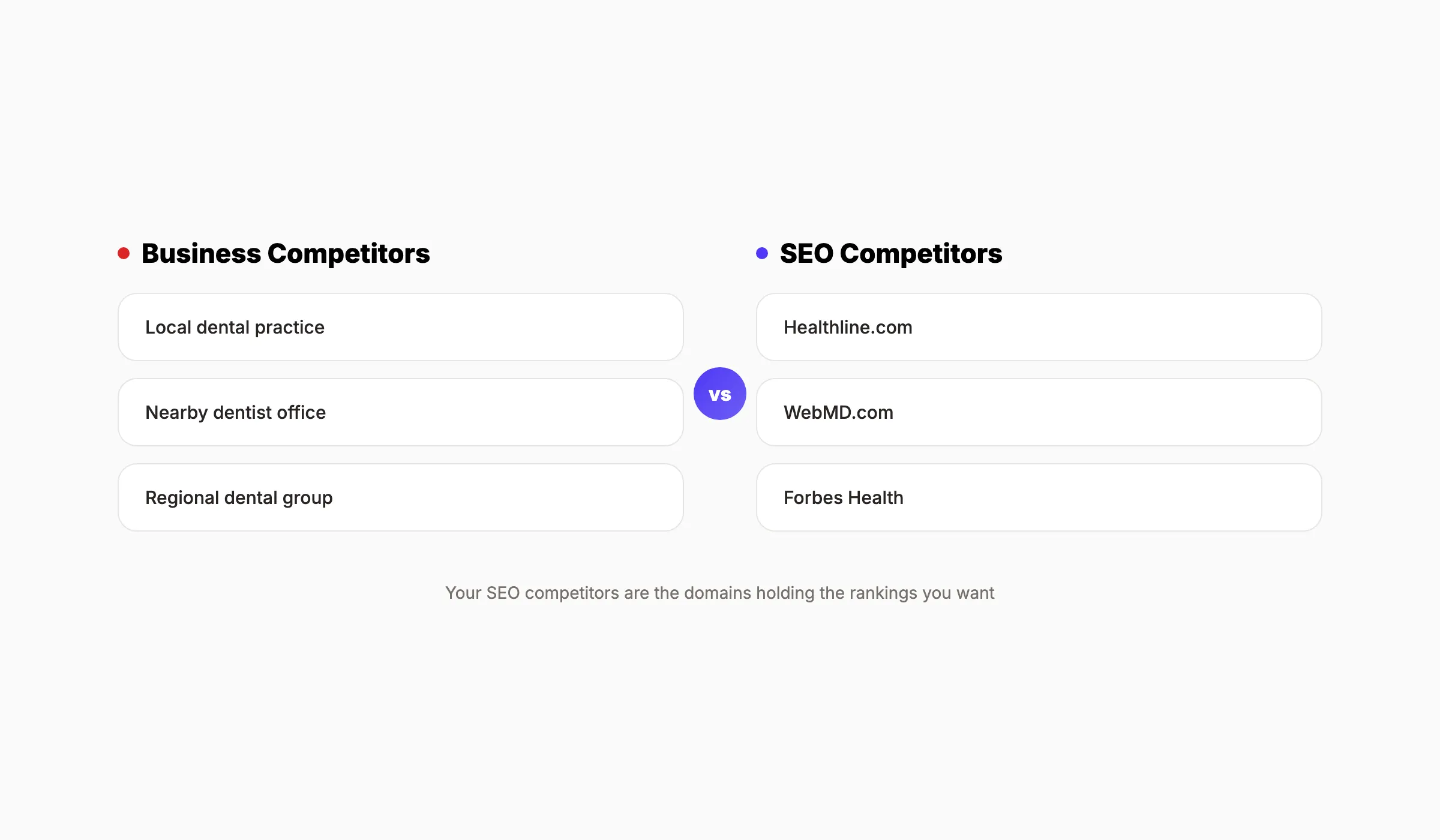
Your SEO competitors and your business competitors are not always the same. A local plumber competes with other plumbers for customers. But on Google, that plumber competes with Angi, Yelp, Forbes, and HomeAdvisor for keyword rankings.
Start by searching your top 5 target keywords. Write down every domain that appears in the top 10 results. Do this for all 5 keywords. The domains that show up repeatedly across multiple searches are your true search competitors.
Specifically:
- Search each keyword in an incognito browser window
- Record the top 10 domains for each search (not just the top 3)
- Look for domains that appear across 3 or more of your searches
- Include informational sites, not just direct business rivals
- Note any SERP features like featured snippets or People Also Ask boxes
You should end up with 3 to 5 primary search competitors. These are the sites you will analyze in the following steps.
Why this step matters: Analyzing the wrong competitors wastes every hour you spend on the remaining steps. A dentist analyzing another small dental practice misses the fact that Healthline and WebMD dominate their target keywords. Your strategy must account for who actually holds the rankings.
Pro tip: Use Google Search Console to check which domains appear alongside yours most frequently. The "Search Results" report shows impressions. Sites competing for the same queries will share similar impression patterns.
Step 2: Pull Competitor Keyword Lists
Once you know who your search competitors are, extract every keyword they rank for. This gives you a full picture of their organic strategy.
In Semrush, enter a competitor domain in the Organic Research tool. In Ahrefs, use the Site Explorer. Both tools show every keyword a domain ranks for, along with position, search volume, and traffic estimates.
Specifically:
- Enter each competitor domain one at a time
- Export the full keyword list (not just top 100)
- Filter for keywords in positions 1 through 20 (anything beyond page 2 is noise)
- Note the total number of ranking keywords for each competitor
- Sort by estimated traffic to see which keywords drive the most visitors
If you do not have a paid tool, use free alternatives. Google Search Console shows which keywords your own site ranks for. Ubersuggest offers limited competitor keyword data on its free tier. You can also manually review competitor pages and extract keyword themes from their titles, headings, and meta descriptions.
Why this step matters: You cannot find gaps without first seeing the full picture. Skipping this step means working with incomplete data. According to Ahrefs' search traffic study, the average top-ranking page also ranks for nearly 1,000 other keywords. One competitor page can reveal dozens of keyword opportunities you never considered.
Pro tip: Export keyword lists into a single spreadsheet with columns for keyword, competitor domain, position, volume, and keyword difficulty. This master sheet becomes the foundation for every step that follows.
Step 3: Run a Keyword Gap Analysis
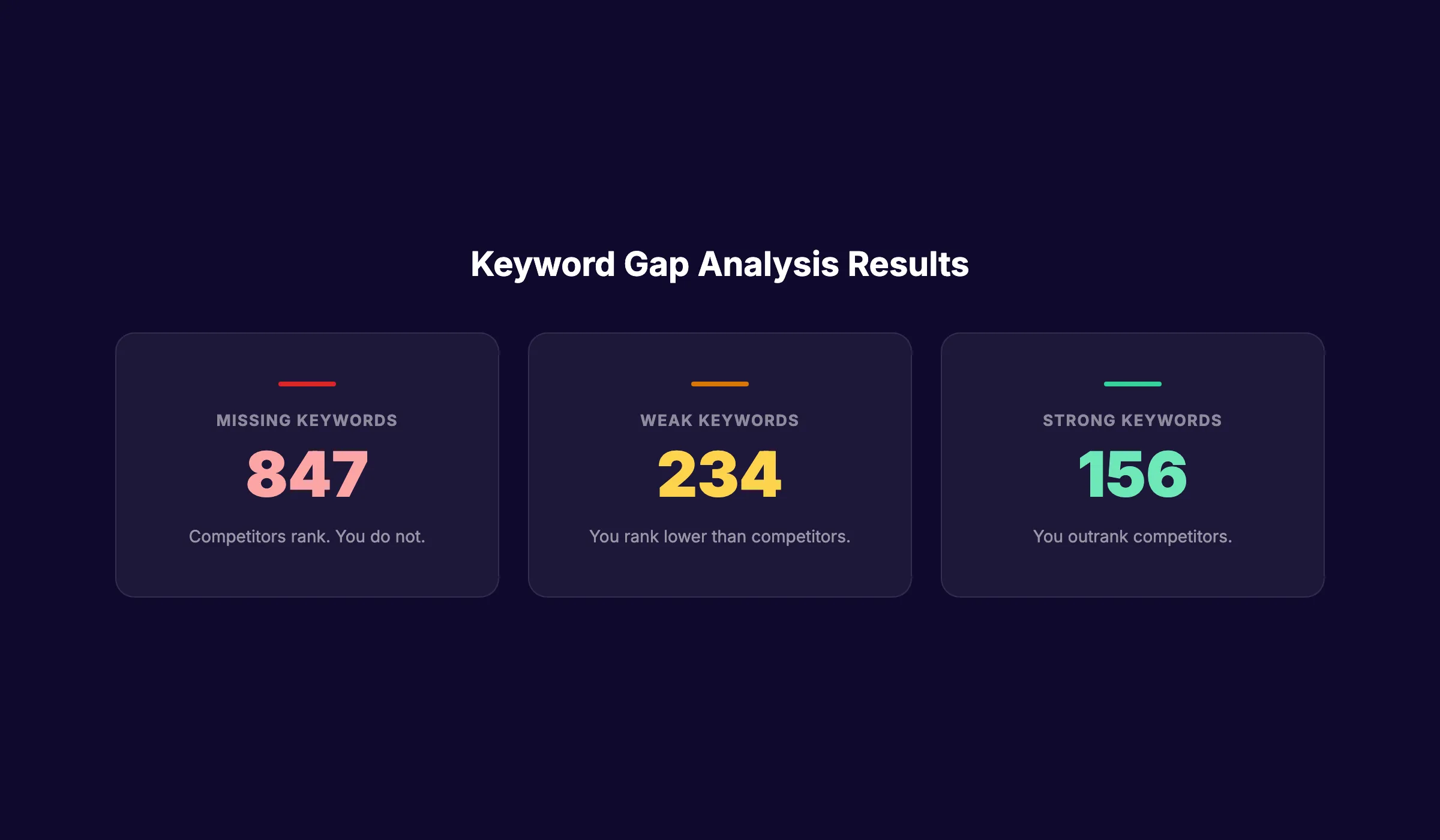
A keyword gap analysis compares your keyword profile against your competitors. It reveals 3 categories: keywords only your competitors rank for, keywords you both rank for (where you might be losing), and keywords only you rank for.
The third category. Keywords only you rank for. Is your current advantage. Protect those. The first category. Keywords only competitors rank for. Is your opportunity.
Specifically:
- In Semrush, use the Keyword Gap tool. Enter your domain plus up to 4 competitors.
- In Ahrefs, use the Content Gap tool under Site Explorer.
- Filter results to show "Missing" keywords (competitors rank, you do not)
- Filter results to show "Weak" keywords (you rank but lower than competitors)
- Export both lists separately
The "Missing" list is your biggest opportunity. These are proven keywords. Real people search for them, and your competitors already rank. You just need content that covers them.
The "Weak" list is your quick-win list. You already have pages ranking for these keywords. Improving those pages is faster than creating new ones from scratch.
Why this step matters: Gap analysis prevents two common mistakes. First, it stops you from creating content for keywords you already rank well for. Second, it stops you from ignoring keywords where competitors hold every position. Without this step, you waste time on redundant content or impossible targets.
Stop guessing which keywords to target. theStacc writes and publishes SEO articles built on competitor gap data and keyword research.
Step 4: Filter and Score Keywords by Priority
A raw keyword gap report can contain thousands of terms. Publishing content for all of them is not realistic. You need a scoring system to pick the keywords with the highest return on effort.
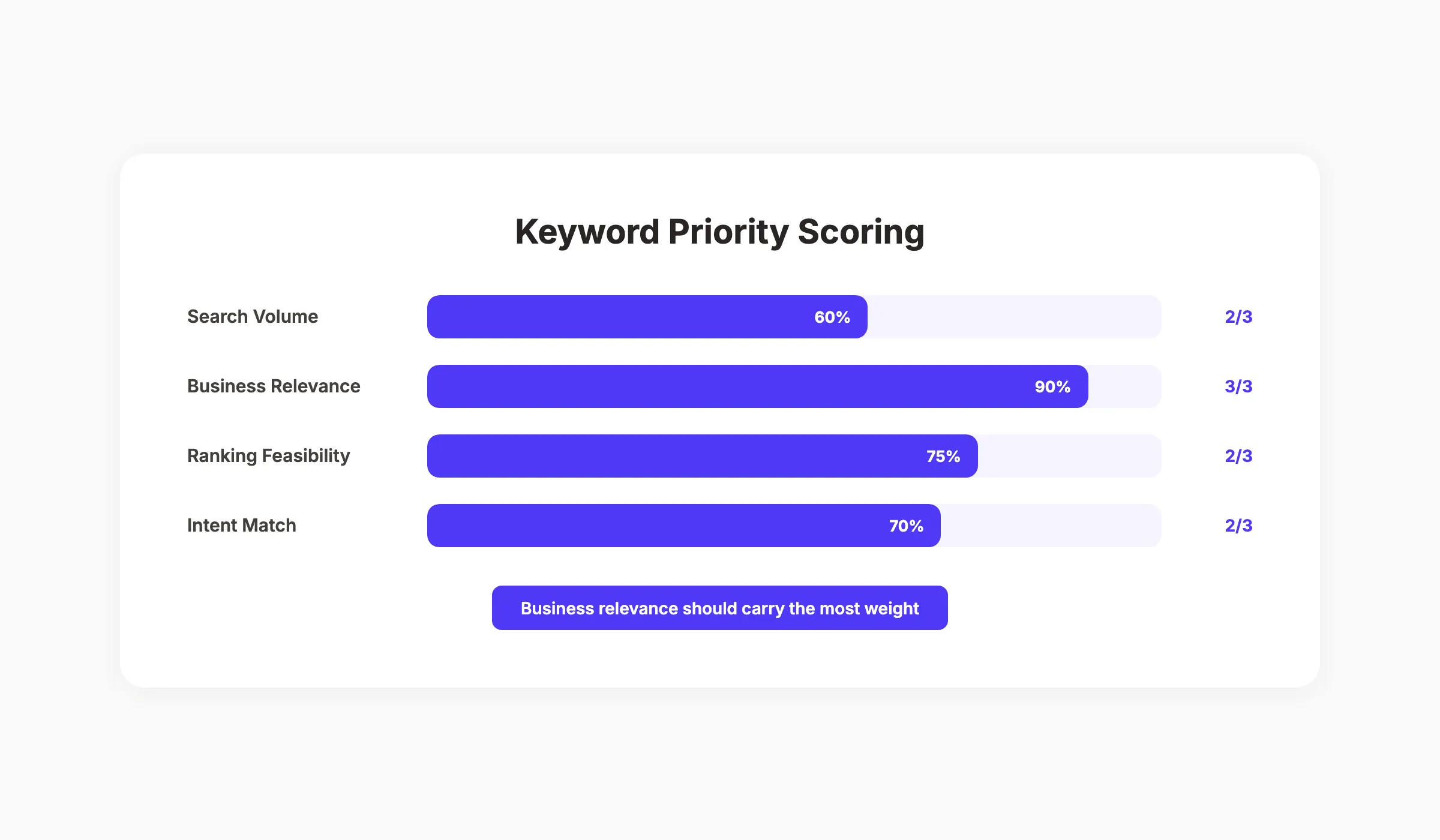
Score each keyword on 4 factors. Rate each factor from 1 to 3. Add the scores. Keywords scoring 9 or higher go to the top of your content plan.
| Factor | Score 1 (Low) | Score 2 (Medium) | Score 3 (High) |
|---|---|---|---|
| Search volume | Under 100/mo | 100 to 1,000/mo | Over 1,000/mo |
| Business relevance | Loosely related | Related to your service | Directly describes what you sell |
| Ranking feasibility | KD over 70, top results are major sites | KD 30 to 70, mixed authority | KD under 30, similar-authority sites rank |
| Search intent match | Informational only | Mixed intent | Commercial or transactional |
Business relevance deserves the most weight. A keyword with 50 monthly searches that directly describes your service is worth more than a keyword with 5,000 searches that attracts browsers who will never buy.
Specifically:
- Add scoring columns to your master spreadsheet
- Score every keyword from your "Missing" and "Weak" lists
- Sort by total score (highest first)
- Mark the top 20 to 30 keywords as priority targets
- Group related keywords into clusters (these become single pages targeting multiple terms)
Why this step matters: 91.8% of all searches are long-tail keywords, and they convert 2.5 times higher than short-tail terms. A scoring system forces you to find these high-converting terms instead of chasing vanity metrics. Without prioritization, most businesses target the highest-volume keywords and never rank for any of them.
Pro tip: Check the actual search results for each priority keyword before committing. Tools estimate keyword difficulty, but the real difficulty shows in the SERP. If the top 5 results are all from sites with 10 times your domain authority, that keyword is not feasible yet. Regardless of what the tool says.
Step 5: Analyze Competitor Content Structure
Most guides stop at the keyword list. That is a mistake. Keywords tell you what to write about. Competitor pages tell you how to write it. And how to write it better.
For each priority keyword, open the top 3 ranking pages. Study the content itself, not just the keyword data.
Specifically:
- Record the exact H2 and H3 heading structure of each page
- Estimate word count (use a browser extension or copy-paste into a word counter)
- Note the content format: is it a listicle, step-by-step guide, comparison, or long-form article?
- Check for tables, images, videos, and interactive elements
- Look at internal and external linking patterns
- Read the opening paragraph. How do they hook the reader?
- Identify what they cover well and what they skip entirely
The content gaps are your edge. If every competitor writes a 1,500-word overview but none provides a step-by-step process, your 3,000-word guide with actionable steps wins. If none includes data or original examples, adding those elements differentiates your page.
Why this step matters: Google does not rank pages by keyword density. It ranks pages that best satisfy search intent. Understanding what top pages include. And what they miss. Lets you create content that satisfies intent more completely. According to GrowthSRC's CTR study, positions 6 through 10 saw a 30.63% increase in click-through rate in 2025. A better-structured page can earn more clicks even from a lower position.
Pro tip: Pay attention to the featured snippet format. If Google shows a paragraph snippet, structure your answer in a clear paragraph under the relevant heading. If it shows a list snippet, use a numbered or bulleted list. Matching the snippet format increases your chances of capturing that position.
Step 6: Build Your Content Attack Plan
You have your priority keywords. You know what competitors publish. Now turn that data into an execution plan.
Map each keyword cluster to a content piece. Assign the format based on what the SERP rewards. Set a publishing schedule.
Specifically:
- Create a content calendar with 1 column for each: keyword cluster, target keyword, secondary keywords, content format, word count target, publish date
- Assign content formats based on SERP analysis (if top results are lists, write a list; if guides, write a guide)
- Plan internal links from new content to existing pages and vice versa
- Set word count targets that exceed the top 3 results by 20 to 30%
- Batch related keywords into single pages (one page can rank for dozens of related terms)
- Schedule publication in priority order. Highest-scoring keywords first
A realistic publishing cadence matters more than volume spikes. Publishing 4 articles per week consistently outperforms publishing 20 in one week and none for the next month. Topical authority builds through sustained coverage, not one-time bursts.
Why this step matters: Keyword research without a content plan is just data. The plan converts intelligence into action. Businesses that publish consistently on a content calendar rank faster because Google rewards sustained topical coverage. SEO leads close at a 14.6% rate compared to 1.7% for outbound methods, so every article you publish compounds your pipeline.
Your SEO team. $99 per month. Optimized articles published automatically, each targeting keywords your competitors rank for.
Step 7: Monitor and Repeat Quarterly
Competitor keyword analysis is not a one-time project. Search results shift. Competitors publish new content. New competitors emerge. Algorithm updates reshuffle rankings.
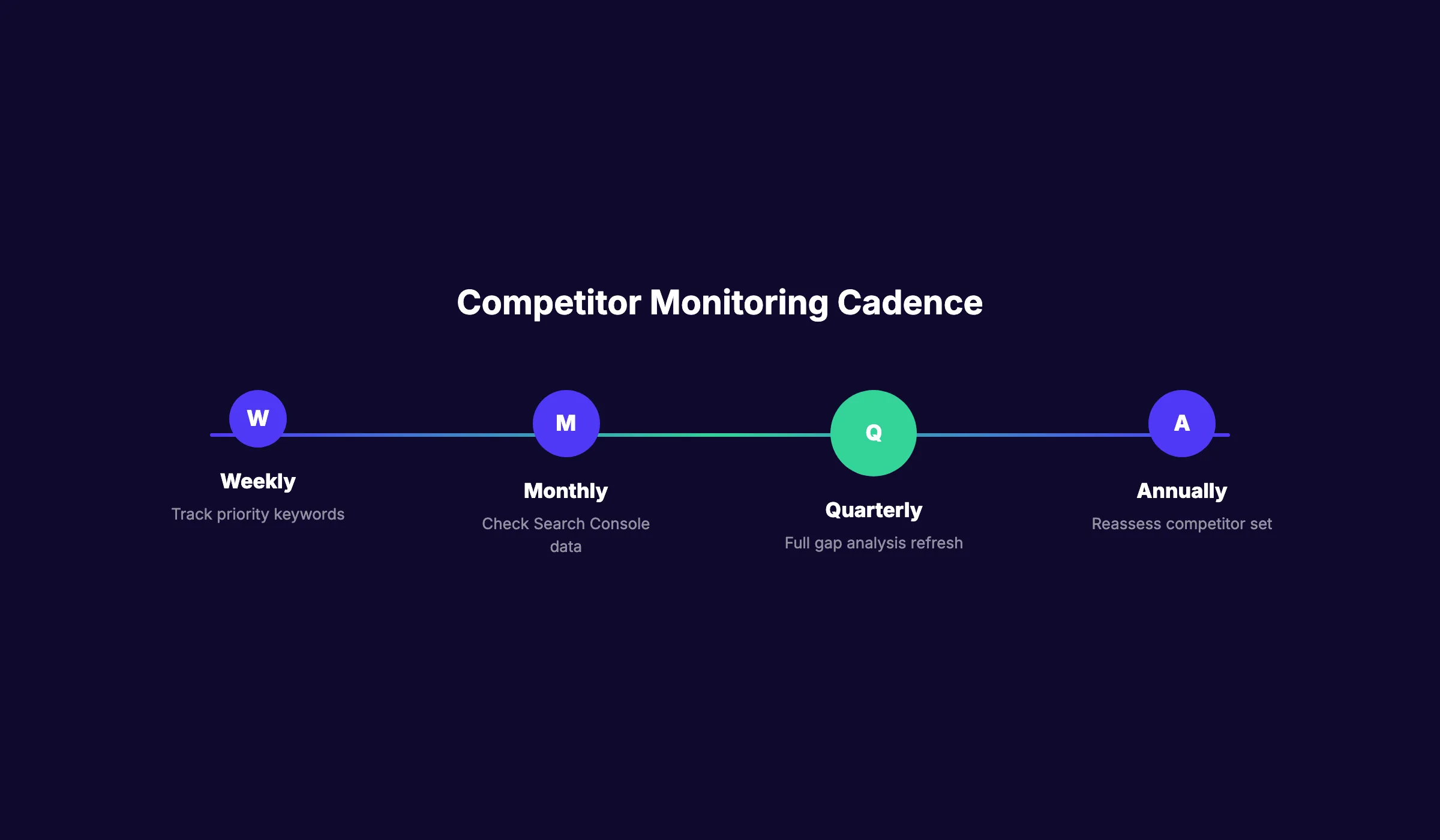
Set a quarterly review cadence. Each review takes about 30 minutes once you have the initial framework built.
Specifically:
- Re-run keyword gap analysis every 90 days
- Check ranking changes for your priority keywords in Google Search Console
- Identify new competitors that appeared in the top 10 since your last review
- Look for keywords where your position dropped. These need content updates
- Track which of your published articles gained rankings and which did not
- Add new keyword opportunities to your content calendar
- Update old posts that lost rankings with fresh data and expanded sections
Why this step matters: Keyword rankings shift quarterly. 60% of Google searches now end without a click as AI Overviews and featured snippets absorb traffic. The sites that maintain rankings are the ones that monitor shifts and respond. A quarterly cadence catches changes before they cost you significant traffic.
Pro tip: Create a simple dashboard in Google Sheets that tracks your top 20 keywords, their positions, and traffic. Update it quarterly. Trend lines reveal whether your strategy is working faster than any individual keyword check.
Results: What to Expect
After completing these 7 steps, you should expect:
- Week 1: A complete keyword gap report with 50 to 200+ opportunity keywords identified
- Month 1 to 2: First content pieces published targeting priority keywords
- Month 3 to 4: Initial ranking movement for lower-difficulty keywords (positions 10 to 30)
- Month 4 to 6: Meaningful traffic increases as content matures and earns backlinks
- Month 6+: Compound growth as topical authority builds across your keyword clusters
The timeline depends on your domain authority, publishing frequency, and keyword difficulty targets. Sites with an established backlink profile see faster results. New sites should target keywords with difficulty scores under 30 for the first 6 months.
Do not expect overnight results. SEO takes 3 to 6 months for meaningful movement. But competitor keyword analysis ensures every article you publish targets a proven opportunity instead of a guess.
Organic search drives 57.8% of all web traffic according to SparkToro data cited by Backlinko. Every keyword you capture from a competitor is traffic redirected from their pipeline to yours. The compounding effect is real: each ranking page strengthens your domain authority, which makes the next keyword easier to win.
Common Mistakes to Avoid
Chasing volume over relevance. A keyword with 10,000 monthly searches means nothing if those searchers do not need your product. Score business relevance higher than volume.
Confusing business competitors with search competitors. Your biggest business rival might not rank for a single keyword you care about. Analyze who actually holds the SERP positions.
Copying keywords without checking intent. A competitor ranks for "CRM software" but their page is a product page. If you write a blog post targeting that same keyword, the intent mismatch means Google will not rank it. Always check what type of content the SERP rewards.
Analyzing once and never revisiting. Keyword rankings are not static. Set the quarterly cadence from Step 7 and follow it. The businesses that treat competitor analysis as ongoing outperform those that treat it as a project.
Ignoring content structure. Two pages can target the same keyword. The one with better structure, deeper coverage, and clearer formatting wins. Step 5 exists for this reason.
3,500+ blogs published. Every article is SEO-scored before publish. See what theStacc can do for your keyword strategy.
What practitioners are saying on X
Fundamentals plus AI-search measurement remain the dual stack.
- @jakezward (Feb 2026): 2026 SEO predictions emphasize AI Overview share-of-SERP, schema for LLM token efficiency, brand mentions in AI answers as a KPI, proprietary data as a moat, and content refresh beating net-new AI slop. See the post on X.
- @hridoyreh (Mar 2026): Widely shared SEO skill tree: foundations, research, technical, on-page, content, links, AI SEO/GEO, analytics, UX, brand, programmatic — useful map for stats and how-to posts. See the post on X.
- @HlynurStefDev (Jul 2026): Public case: niche site traffic jumped from ~18 to 4,162 Google visits/month after focused technical/on-page SEO work (GSC screenshots claimed) — reminds that fundamentals still move numbers. See the post on X.
Grok, AI Overviews, and multi-engine visibility
Research topics like “analyze competitor keywords” get cited when frameworks and decision rules are extractable. Lead with definitions and tables; keep Grok-ready entity language for tools and SERP features named on the page.
- Google AI Overviews: Use passage-ready answers, tables, and FAQ schema where relevant.
- ChatGPT / Perplexity: Cite named sources next to key claims.
- Grok: Maintain accurate entity facts on-site and in high-signal X posts.
Publish content built for Google and AI citations. theStacc’s Content SEO module ships SEO-scored articles structured for rankings and generative engines — including clearer entity pages models like Grok can quote.
FAQ
Competitor keyword analysis is the process of identifying which keywords your competitors rank for on Google, finding gaps between their keyword profile and yours, and using that data to build a targeted content strategy. It replaces guesswork with proven keyword opportunities.
Yes. Google Search Console shows your own keyword data. Ubersuggest offers limited competitor data on its free tier. You can also manually search your target keywords and study the ranking pages. Paid tools like Semrush and Ahrefs provide deeper data, but a free workflow covers the basics. Check our list of free SEO tools for more options.
Run a full analysis quarterly. Between quarterly reviews, monitor your priority keywords monthly in Google Search Console. If you notice a significant ranking drop or a new competitor entering your space, run an unscheduled review immediately.
Competitor keyword analysis is the broader process of studying what keywords competitors rank for. A keyword gap analysis is one specific step within that process. It compares your keyword profile directly against competitors to find keywords they rank for that you do not.
Start with 3 to 5. Fewer than 3 gives you an incomplete picture. More than 5 creates data overload without adding meaningful insight. Pick 2 direct competitors (similar business size and type) and 1 to 3 aspirational competitors (larger sites in your space) for a balanced view.
Semrush and Ahrefs are the most widely used. Both offer keyword gap tools, competitor organic research, and content analysis features. For budget-conscious users, SE Ranking and Mangools offer solid competitor keyword features at lower price points. See our full list of keyword research tools.
Every ranking your competitor holds is a ranking you could take. The 7-step process above gives you the exact playbook to identify those opportunities, prioritize the right ones, and execute a content plan that captures traffic your competitors currently own. Start with Step 1 today. Pull up an incognito window, search your top keyword, and write down the domains that appear. That 10-minute exercise will change how you think about your content strategy.
Related Tools & Resources
Free SEO Tools:
Best Lists:
Sources & references
- [1] Princeton / Georgia Tech et al. — GEO research (arXiv:2311.09735)
- [2] @hridoyreh on X — Widely shared SEO skill tree: foundations, research, technical, on-page, content, links, AI SEO/GEO, analytics, UX, bran
- [3] @jakezward on X — 2026 SEO predictions emphasize AI Overview share-of-SERP, schema for LLM token efficiency, brand mentions in AI answers
- [4] Referenced source — www.semrush.com

Plan topics, review article drafts, and publish to a connected CMS.
Weekly local SEO teardowns
One practical email a week. Map Pack, GBP, AI Overviews — no fluff. Unsubscribe anytime.