
What Is Topical Authority in SEO? (2026)
Topical authority explained: what it is, how Google measures it, why it beats domain authority, and how content clusters build it. Updated for 2026.
Google does not rank websites. It ranks topics. A site that covers one subject deeply will outrank a site with higher domain authority that covers it thinly. That shift defines how SEO works in 2026.
The concept behind this is topical authority. 88% of SEO professionals rate it as “very important” to their strategy. A study of 253,800 search results found that page-level topical authority is the single largest on-page ranking factor, beating even domain traffic volume.
Yet most websites still publish content at random. A blog post about productivity on Monday. A product update on Wednesday. A thought leadership piece on Friday. Google indexes all of it. It rewards none of it.
This guide explains what topical authority is, how Google measures it, why it matters more than domain authority, and what it looks like when done right.
We have published 3,500+ blog posts across 70+ industries. Topical authority is the system behind every article we produce. Our average on-page SEO score is 92%.
Here is what you will learn:
- The exact definition of topical authority and why Google rewards it
- How topical authority differs from domain authority (and which matters more)
- The signals Google uses to measure topic expertise
- Why topical authority determines AI search visibility in 2026
- Real examples of topical authority producing ranking results
- How content clusters create topical authority systematically
- Warning signs that your site lacks topical authority
- How to measure your own topical authority score
What Is Topical Authority
Topical authority is a measure of how deeply and thoroughly a website covers a specific subject. A site with strong topical authority on “local SEO” does not just have one blog post about it. It has dozens of interconnected pages covering every subtopic: Google Business Profile optimization, local citations, review management, NAP consistency, and local keyword research.
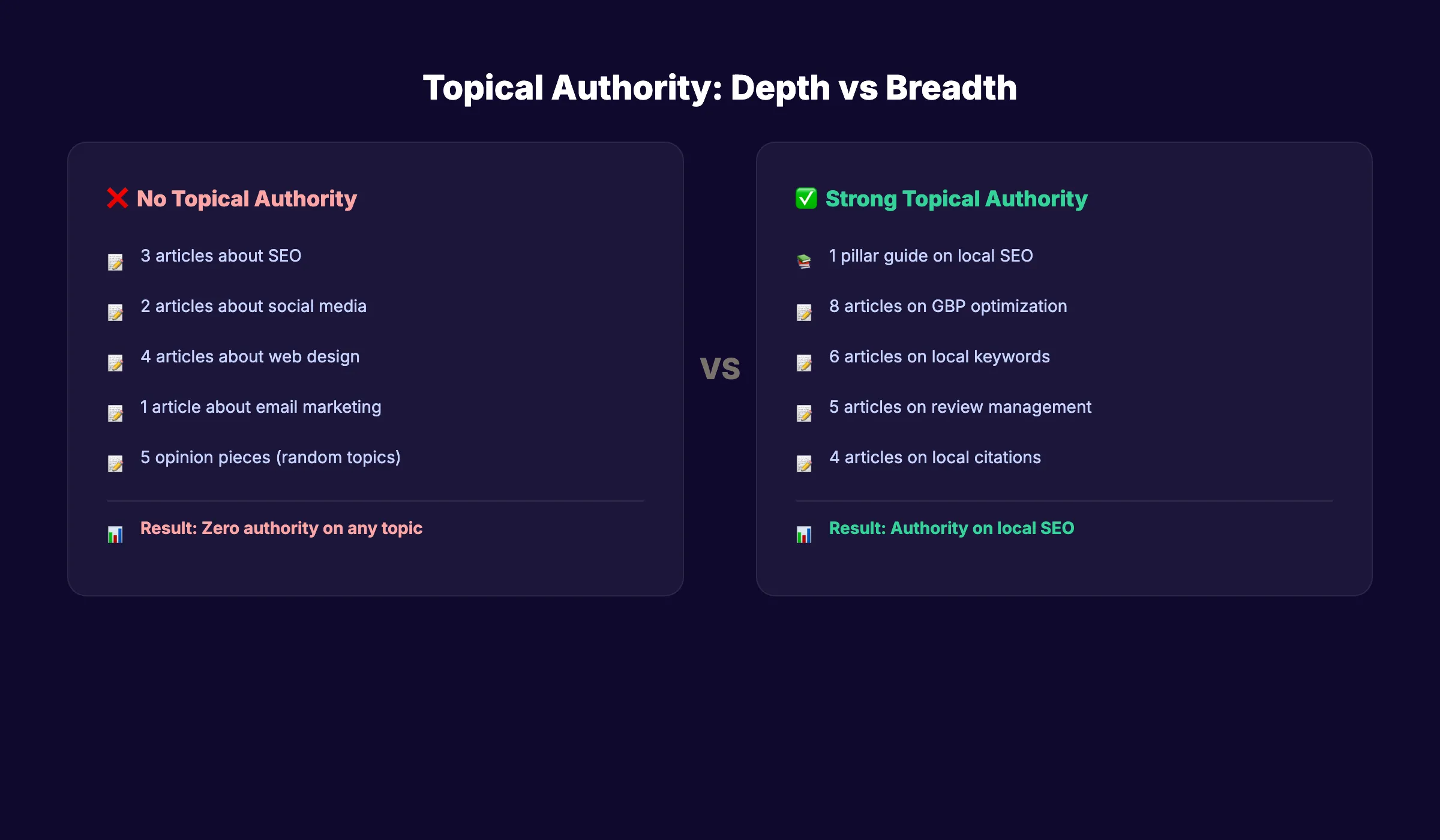
Google evaluates topical authority at the site level, not the page level. A single well-written article on a topic you have never covered before will struggle to rank. That same article on a site with 30 related pieces around it will rank faster and hold its position longer.
The concept traces back to Google’s Hummingbird update in 2013, which shifted Google from keyword matching to understanding topics and intent. Google’s Helpful Content updates in 2023 and 2024 accelerated this shift. Sites with thin, scattered content saw rankings collapse. Sites with deep topical coverage saw rankings improve.
A Simple Way to Think About It
Imagine two websites. Site A has 5 articles about email marketing scattered among 200 posts about random topics. Site B has 40 articles about email marketing organized into clusters covering strategy, automation, deliverability, list building, and analytics.
When someone searches “best email marketing strategy,” Google trusts Site B more. Not because of backlinks. Not because of domain age. Because Site B has proven it understands the topic thoroughly.
Your SEO team. $99 per month. Stacc publishes 30 optimized articles per month, all organized into topical clusters that build authority. Start for $1 →
Topical Authority vs Domain Authority
These two concepts get confused constantly. They measure different things.
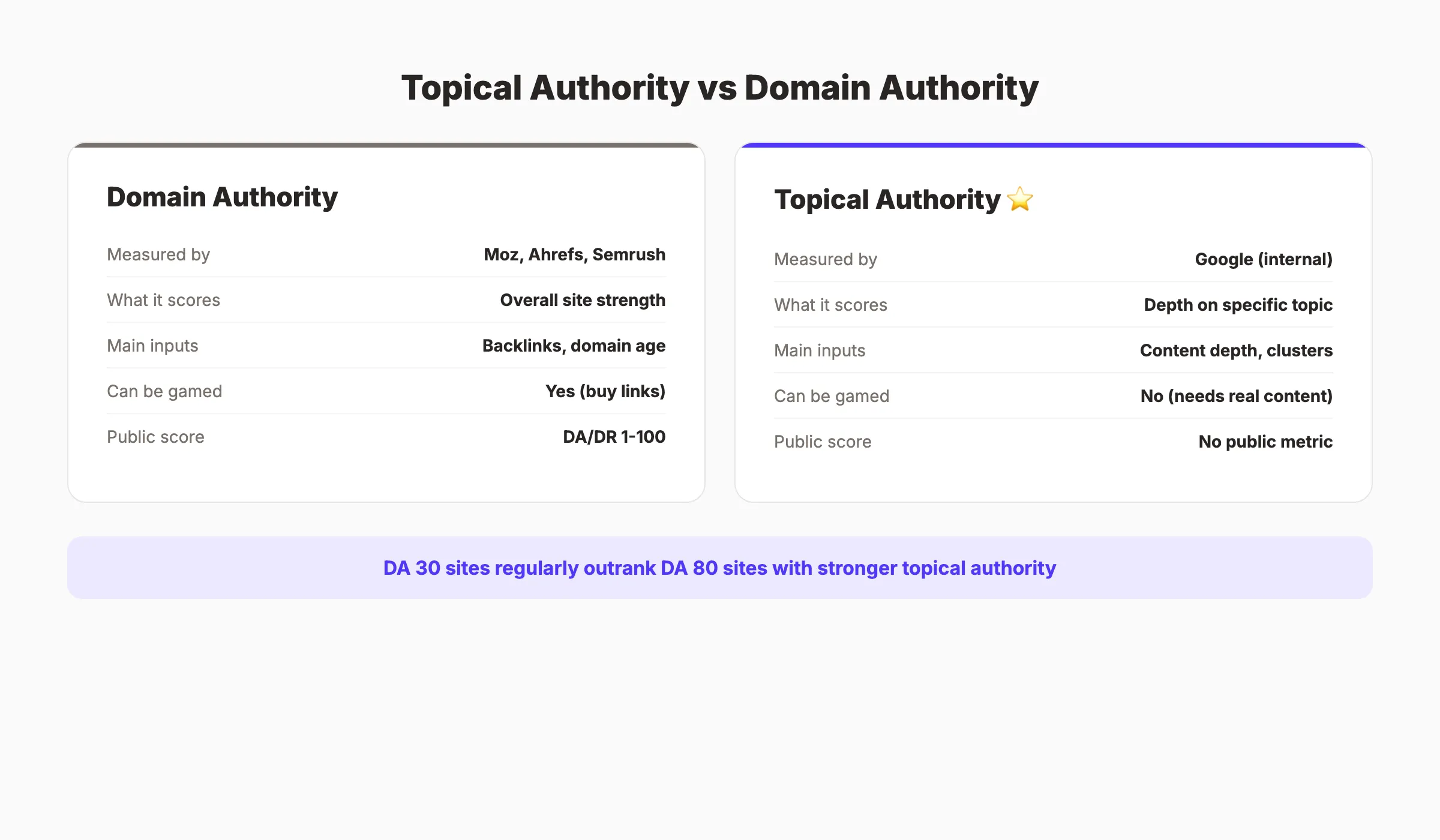
Domain Authority (DA) is a third-party metric created by Moz. It scores the overall strength of a website from 1 to 100 based on backlink profile, domain age, and site-wide signals. Ahrefs calls their version Domain Rating (DR). Semrush calls theirs Authority Score.
Topical authority is not a single score. It is Google’s internal assessment of how well your site covers a specific subject. There is no public metric for it. You cannot see your topical authority score in any tool.
| Factor | Domain Authority | Topical Authority |
|---|---|---|
| Who defines it | Moz, Ahrefs, Semrush | Google (internal signal) |
| What it measures | Overall site strength | Depth on a specific topic |
| Main inputs | Backlinks, domain age | Content depth, clusters, coverage |
| Can be gamed | Yes (buy links, PBNs) | No (requires real content) |
| Visible score | Yes (DA/DR 1-100) | No public metric |
| Impact on rankings | Moderate | High (largest on-page factor) |
Here is the critical insight: a site with DA 30 can outrank a site with DA 80 if the smaller site has stronger topical authority on the specific query.
This is not theory. It happens every day. Niche blogs outrank major publications for specific topics because they cover those topics with more depth, structure, and consistency.
Which Matters More in 2026
Topical authority. The Surfer SEO study of 253,800 results found that page-level topical authority is a stronger ranking signal than domain traffic volume. Smaller sites with deeper topic coverage regularly outperform larger sites with shallow coverage.
That does not mean domain authority is irrelevant. Backlinks still matter. Site age still matters. But Google increasingly uses topical signals to decide who deserves to rank for a specific query.
How Google Measures Topical Authority
Google does not publish exactly how it evaluates topical authority. But between patents, algorithm updates, and confirmed ranking factors, the signals are clear.
Google’s Topic Authority Patent
Google holds a patent titled “System and Method for Determining Topic Authority” (US8458196B1). This patent describes a system that assigns authority scores to sources based on how strongly their content associates with specific topics.
The patent outlines 3 key inputs:
- Topic purity: How tightly focused a site’s content is around a subject
- Click signals: How users interact with search results from that source on the topic
- Site rank: The overall ranking position of the source for related queries
A second patent, “Extracting Key Phrase Candidates and Producing Topical Authority Ranking” (US20210004416A1), describes how Google extracts key phrases from documents and uses them to rank sources by topical authority.
What the Google API Leak Revealed
In 2024, leaked Google Content Warehouse API documentation confirmed that Google mathematically models topical authority using specific metrics:
- siteFocusScore: Quantifies how concentrated a site is around a specific subject. Higher score means greater topical concentration.
- siteRadius: Measures how far individual pages deviate from the site’s core theme. Lower radius means tighter topical focus.
- siteEmbeddings: A vector representation of the site’s overall topical identity.
- pageEmbeddings: Vector representations of individual pages, compared against siteEmbeddings to calculate siteRadius.
The system compares each page’s embedding against the site’s overall embedding. Pages that stray too far from the core topic increase siteRadius and dilute topical authority. This makes pruning off-topic content a measurable way to strengthen authority.
The 7 Signals Google Uses
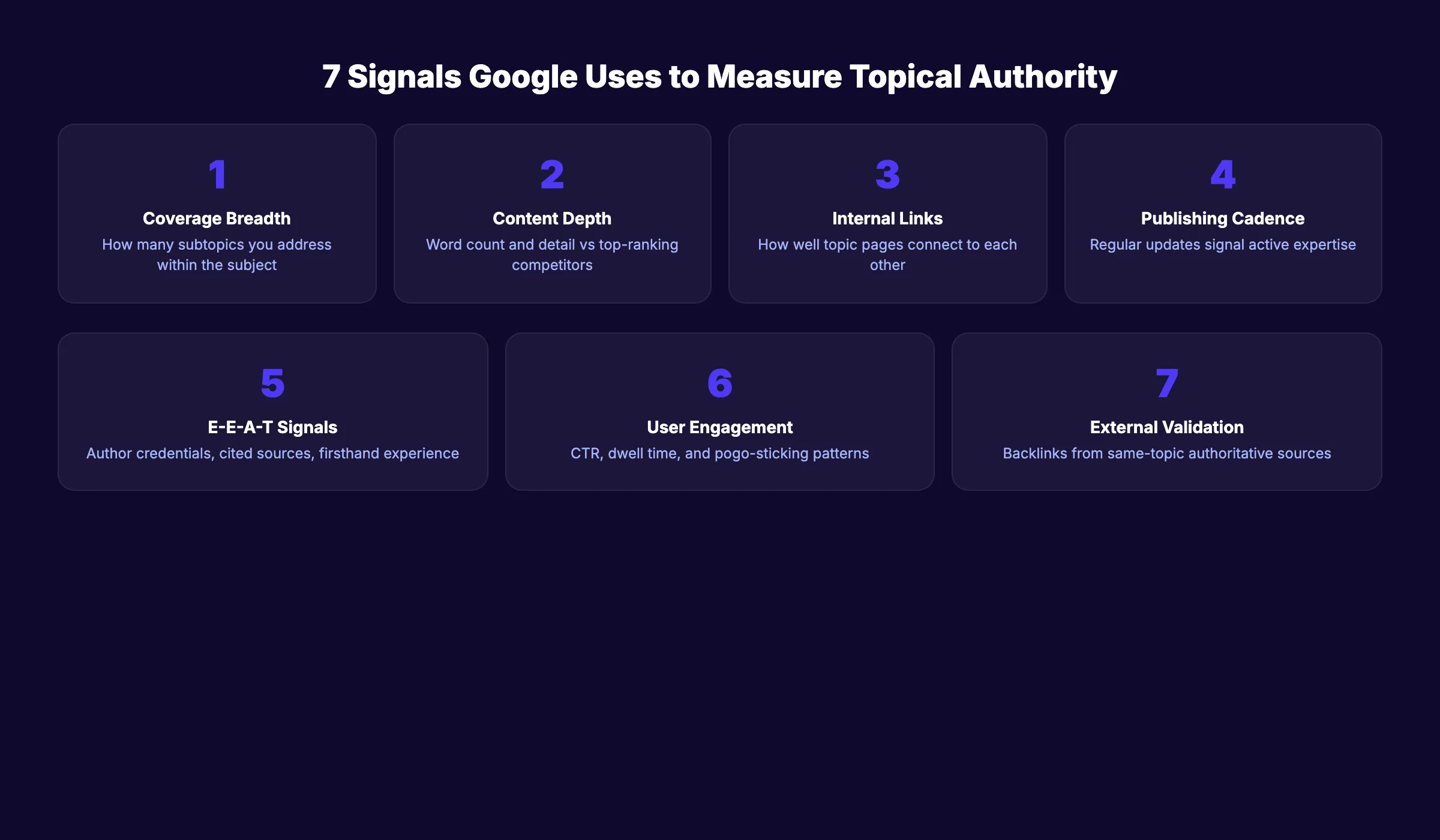
Based on patents, algorithm updates, and observable ranking patterns, Google evaluates topical authority through these signals:
1. Content coverage breadth. How many subtopics within a subject does your site address? A site covering “SEO” needs content on on-page SEO, technical SEO, content strategy, keyword research, and link building. Gaps signal incomplete expertise.
2. Content depth per subtopic. Covering a subtopic in 300 words does not build authority. Google compares your content depth against the top-ranking pages for each subtopic. Thin content actively hurts topical authority.
3. Internal linking structure. Google follows your internal links to understand how topics connect. A clear internal linking structure where pillar pages link to supporting articles and supporting articles link back signals organized expertise.
4. Publishing consistency. Sites that publish regularly on a topic signal active expertise. Sporadic publishing suggests casual interest, not authority. Content calendars that maintain a steady publishing cadence build stronger signals.
5. E-E-A-T signals. Author expertise, cited sources, and firsthand experience all contribute to topical authority. A medical site with credentialed authors has stronger topical authority on health topics than a generic content farm.
6. User engagement patterns. Click-through rates, dwell time, and pogo-sticking (returning to search results quickly) all inform Google’s assessment. Content that satisfies search intent reinforces topical authority.
7. External validation. Backlinks from other authoritative sources on the same topic amplify topical authority. A link from Moz to your SEO guide matters more than a link from a cooking blog.
3,500+ blogs published. 92% average SEO score. Every article we publish fits into a topical cluster designed to build authority. Start for $1 →
Why Topical Authority Matters More in 2026
Three shifts have made topical authority the most important ranking factor this year.
AI Search Rewards Depth
Google AI Overviews, ChatGPT web search, Perplexity, and other AI search tools pull answers from sources they trust on specific topics. AI systems do not just match keywords. They evaluate whether a source has thorough coverage of a subject before citing it.
Sites with strong topical authority get cited by AI search engines more frequently. Scattered content rarely gets cited because AI models cannot establish that the source is a reliable expert.
Google’s Helpful Content System
Google’s Helpful Content updates penalize sites that publish content outside their area of expertise. A SaaS blog that publishes random travel articles alongside product guides sends mixed signals. Google’s system evaluates whether your content demonstrates genuine expertise or whether it exists purely to capture search traffic.
The sites that recovered from Helpful Content penalties did so by pruning off-topic content and doubling down on their core subject areas. That is topical authority in action.
Backlinks Alone No Longer Win
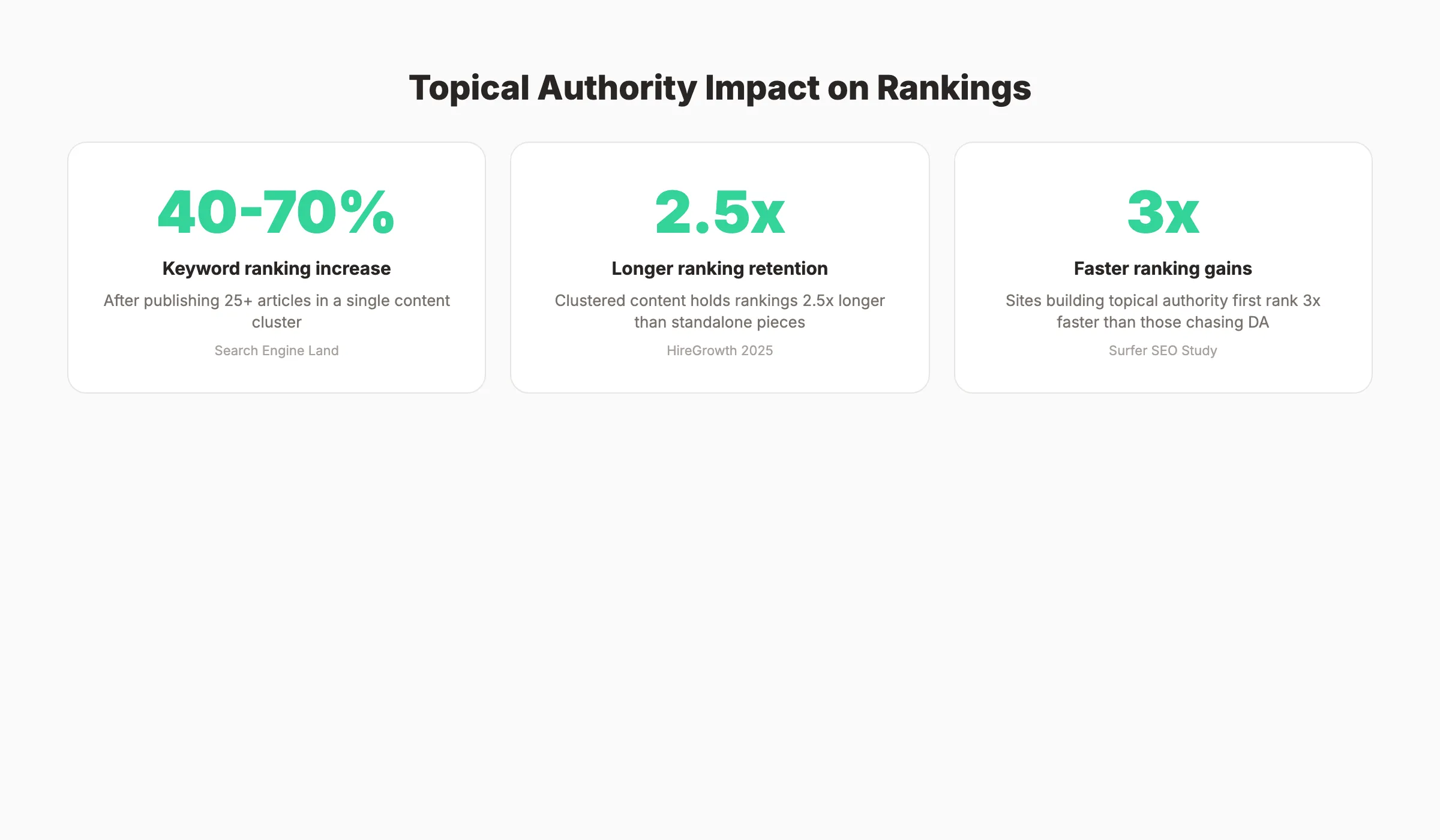
The Surfer SEO study confirmed what many SEO practitioners had observed anecdotally. Smaller sites with focused content beat larger sites with bigger backlink profiles. Sites focusing on topical authority first see ranking gains up to 3x faster than those chasing domain authority alone.
Backlinks still matter. But they matter most when they come from sources within the same topic area and when they point to a site that already demonstrates topical depth.
What Topical Authority Looks Like in Practice
Abstract definitions only go so far. Here is what topical authority looks like when executed well.
Example 1: A Niche SEO Blog
A blog about “local SEO for small businesses” publishes content organized into clusters:
| Cluster | Pillar Page | Supporting Articles |
|---|---|---|
| Google Business Profile | GBP Complete Guide | Optimization checklist, posting strategy, review response, category selection, photos guide |
| Local Keywords | Local Keyword Research Guide | Near me keywords, city landing pages, service area targeting, competitor analysis |
| Reviews and Reputation | Getting Google Reviews Guide | Review templates, QR codes, responding to negative reviews, review velocity |
| Local Citations | Citation Building Guide | NAP consistency, directory list, citation audit, cleanup process |
After publishing 25+ articles in the “Google Business Profile” cluster, the site ranks for over 40 GBP-related keywords. The pillar page alone would not rank without the supporting content building topical depth around it.
Example 2: SaaS Product Content
A project management SaaS company covers “team productivity” as their core topic. They publish:
- 15 articles about remote team management
- 12 articles about project planning methodologies
- 10 articles about meeting efficiency
- 8 articles about time tracking
Each cluster links back to relevant product pages. After 6 months of consistent publishing, their organic traffic increased 40% and they rank for 1,100+ keywords they previously had zero visibility for.
Example 3: The Anti-Pattern
A marketing agency publishes 3 articles about SEO, 2 about social media, 4 about web design, 1 about email marketing, and 5 opinion pieces about industry trends. None of these topics have enough depth to establish authority. Google does not recognize the site as an expert on any single subject.
This is the most common pattern we see. Random publishing feels productive. It produces no topical authority.
The Content Cluster Model
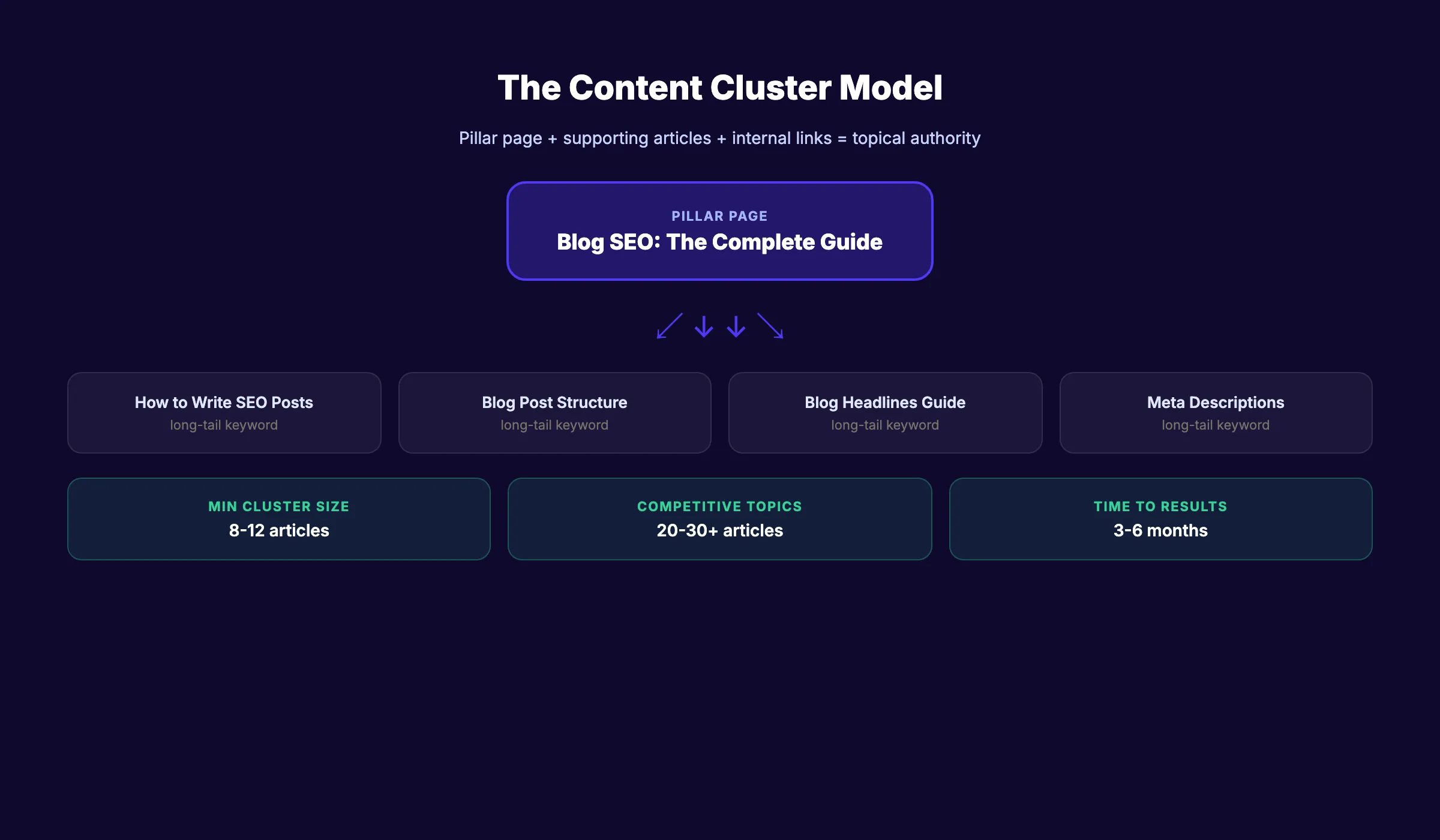
Topical authority does not build itself. It requires a deliberate content architecture called the content cluster model.
How Content Clusters Work
A content cluster has 3 components:
Pillar page. A long-form guide covering the broad topic in full depth. This is your most important page for the cluster. Target your highest-volume keyword here. Example: “Blog SEO: The Complete Guide”
Supporting articles. Individual posts covering specific subtopics in depth. Each targets a long-tail keyword related to the pillar topic. Example: “How to Write SEO Blog Posts,” “Blog Post Structure for SEO,” “Blog Headlines Guide”
Internal links. Every supporting article links to the pillar page. The pillar page links out to every supporting article. Supporting articles link to each other when relevant. This creates a web of interconnected content that Google can crawl and understand.
How Many Articles Per Cluster
The minimum viable cluster has 8 to 12 supporting articles around 1 pillar page. Competitive topics need 20 to 30+ articles. Publishing 25 or more articles within a single cluster produces a 40 to 70% increase in keyword rankings within 3 to 6 months.
Clustered content holds rankings 2.5x longer than standalone pieces. Pages with high topical authority gain organic traffic 57% faster than pages with low authority. A single isolated article can rank temporarily but often loses position once competitors with deeper topical coverage enter the space.
Building Your First Cluster
Start with a topical map. Map every subtopic within your core subject. Use keyword research to validate search demand for each subtopic. Group subtopics by intent: informational, commercial, and navigational. Then prioritize by business impact.
For a complete process on building topical authority from scratch, read our step-by-step guide to building topical authority.
Rank everywhere. Do nothing. Blog SEO, Local SEO, and Social on autopilot. Every article Stacc publishes builds your topical authority. Start for $1 →
Signs Your Site Lacks Topical Authority
These are the warning signs that your content strategy is not building topical authority:
You rank for few long-tail keywords. Sites with topical authority rank for hundreds of related long-tail queries without specifically targeting them. If you only rank for the exact keywords you optimize for, Google does not see you as a topic expert.
New content takes months to rank. Sites with strong topical authority benefit from faster indexing and faster initial rankings. Google already trusts the site for that topic. If every new post takes 6+ months to gain traction, your topical signals are weak.
Rankings fluctuate with every algorithm update. Sites with genuine topical authority tend to be more stable through core updates. Thin sites with surface-level coverage see wild swings because Google is uncertain about their expertise.
Your top pages have no supporting content. A service page that ranks today will lose position once a competitor builds a cluster of content around the same topic. One page cannot hold a position against 20 interconnected pages.
Blog topics are scattered across unrelated subjects. If your content covers 10+ different topics with fewer than 5 articles each, you have breadth without depth. Google sees a generalist, not an expert.
You get few featured snippets. Google awards featured snippets to sources it considers authoritative on a topic. Low snippet acquisition signals low topical trust.
How to Measure Topical Authority
There is no single “topical authority score” in any SEO tool. But you can measure it through proxy signals.
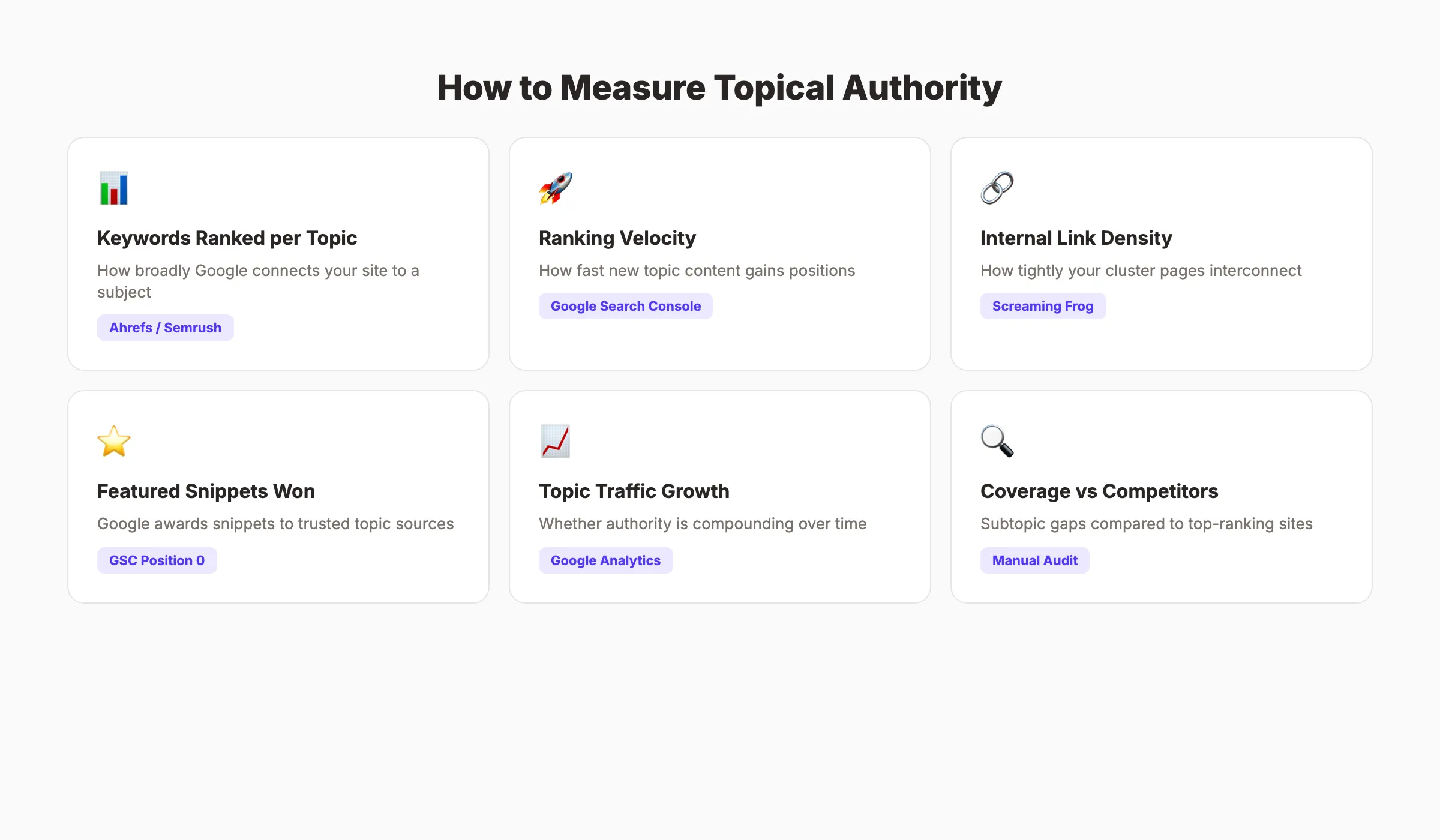
Proxy Metrics That Indicate Topical Authority
| Metric | What It Tells You | Where to Find It |
|---|---|---|
| Total keywords ranked for a topic | How broadly Google associates your site with the subject | Ahrefs or Semrush organic keywords report |
| Keyword ranking velocity | How fast new content on the topic ranks | Google Search Console performance over time |
| Content coverage vs competitors | Whether you have gaps in subtopic coverage | Semrush Topic Research or manual audit |
| Internal link density within clusters | How well your cluster is interconnected | Screaming Frog or site crawl tools |
| Featured snippet acquisition rate | Whether Google trusts your site as a source | Google Search Console queries with position 0 |
| Organic traffic growth within topic | Whether your authority is compounding | Google Analytics filtered by topic URL patterns |
The Quick Audit
Run this 5-step audit to assess your topical authority right now:
- Pick your most important topic
- List every page on your site that covers it (manually or with a site crawl)
- Count the total pages. Under 10 means weak authority. Over 25 means strong.
- Check whether pages link to each other. Isolated pages with no internal links contribute less authority.
- Compare your coverage against the top 3 ranking sites for your primary keyword. If they cover subtopics you do not, those are gaps that weaken your position.
For a deeper process, run a full content audit and content gap analysis.
FAQ
What is topical authority in simple terms?
Topical authority is how much Google trusts your website as an expert on a specific subject. You build it by publishing many interconnected articles that cover a topic deeply and completely. The more subtopics you cover within your area of expertise, the stronger your topical authority becomes.
Is topical authority a confirmed Google ranking factor?
Google has not explicitly confirmed “topical authority” as a named ranking factor. However, Google holds patents describing topic authority scoring systems, and Google representatives have repeatedly emphasized the importance of demonstrating expertise and depth on topics. The observable ranking data confirms that sites with deeper topic coverage rank better.
How long does it take to build topical authority?
Expect initial improvements in 3 to 6 months with consistent publishing. Sites that publish 25+ articles within a single content cluster typically see meaningful ranking improvements within 3 to 6 months. Full topical authority on a competitive topic can take 12 to 18 months of sustained effort.
Can a small website build topical authority against big competitors?
Yes. Topical authority rewards depth on specific subjects, not overall site size. A 50-page site focused entirely on “local SEO for dentists” can outrank a 10,000-page marketing publication for dental SEO queries. The key is focus. Cover fewer topics but cover them completely.
What is the difference between topical authority and E-E-A-T?
E-E-A-T (Experience, Expertise, Authoritativeness, Trustworthiness) is the quality framework Google uses to evaluate content. Topical authority is one way a site demonstrates E-E-A-T. Deep topical coverage proves expertise and authoritativeness. Author credentials and cited sources prove experience and trustworthiness. E-E-A-T is the standard. Topical authority is how you meet it.
Does topical authority help with AI search visibility?
Yes. AI search systems like Google AI Overviews, ChatGPT, and Perplexity cite sources they recognize as topical experts. Sites with strong topical authority are more likely to be cited in AI-generated answers. Read our guide on getting cited by AI search for specific tactics.
Topical authority is not a tactic. It is the foundation of modern SEO. Every article, every internal link, every content cluster builds on the last. The sites that commit to deep, organized expertise on specific topics dominate search results. The ones that publish randomly wonder why nothing ranks.
Build depth. Build structure. The rankings follow.

Written by
Siddharth GangalSiddharth is the founder of theStacc and Arka360, and a graduate of IIT Mandi. He spent years watching great businesses lose organic traffic to competitors who simply published more. So he built a system to fix that. He writes about SEO, content at scale, and the tactics that actually move rankings.
30 SEO blog articles published every month
Keyword-optimized, scheduled, and live on your site. Automatically.
30-day trial · Cancel anytime
theStacc
Stop writing SEO content manually
30 blog articles, 30 GBP posts, and social media content. Published every month. Automatically.
Start Your $1 Trial$1 for 3 days · Cancel anytime