
How to Optimize for Google AI Overviews (2026)
Learn how to optimize for Google AI Overviews. 8 steps covering content structure, E-E-A-T, schema, and citation tracking. Updated March 2026.
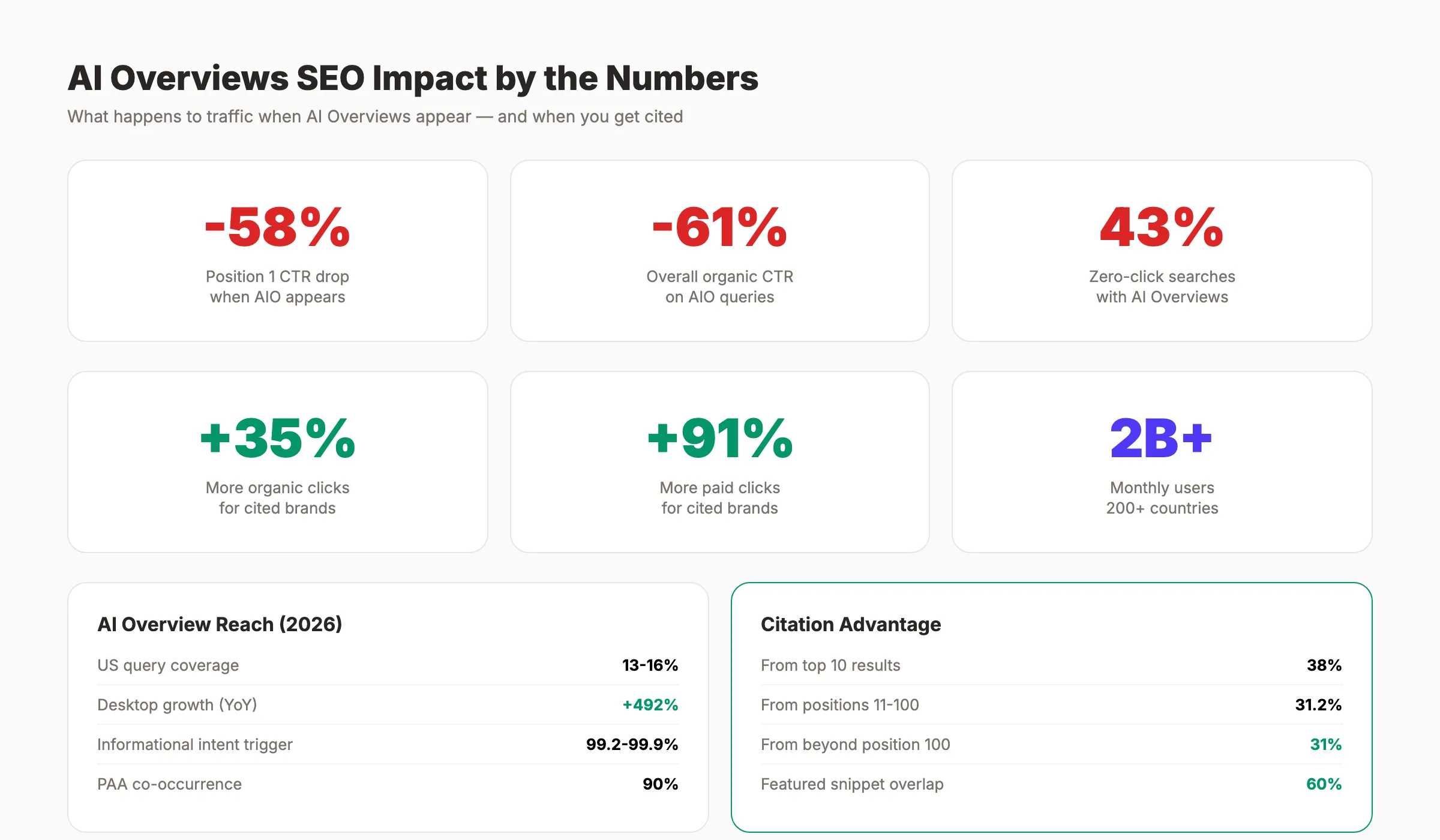
Google AI Overviews now appear for 13 to 16% of all US queries. When they show up, position 1 organic CTR drops by 58%.
That is not a small leak. That is a structural shift in how search traffic flows.
Every informational keyword you rank for is exposed. 43% of AI Overview searches produce zero clicks. Your rankings stay the same. Your traffic erodes. And most site owners do not notice until months of data confirm the decline.
The fix is not to fight AI Overviews. The fix is to get cited in them.
This guide walks through 8 steps to optimize for Google AI Overviews. You will learn how citation selection works, how to structure content for extraction, and how to track your visibility over time.
We publish 3,500+ blogs across 70+ industries. We have studied how AI Overviews pull sources, which formats earn citations, and what separates cited pages from ignored ones.
Here is what you will learn:
- How AI Overviews select sources (it is not the same as traditional rankings)
- How to audit your current AI Overview visibility
- The content formats that earn the most citations
- Why semantic completeness matters more than keyword density
- How E-E-A-T signals determine 96% of citations
- Schema markup strategies for AI extraction
- How to win adjacent features (PAA and featured snippets)
- A monthly monitoring system to track AI citation performance
Overview
Time required: 2 to 4 hours for initial optimization. 30 minutes per post ongoing.
Difficulty: Intermediate
What you need: Google Search Console, an existing content library, and a CMS
Step 1: Understand How AI Overviews Select Sources
AI Overviews pull citations from indexed pages. But they do not simply cite the top-ranking results.
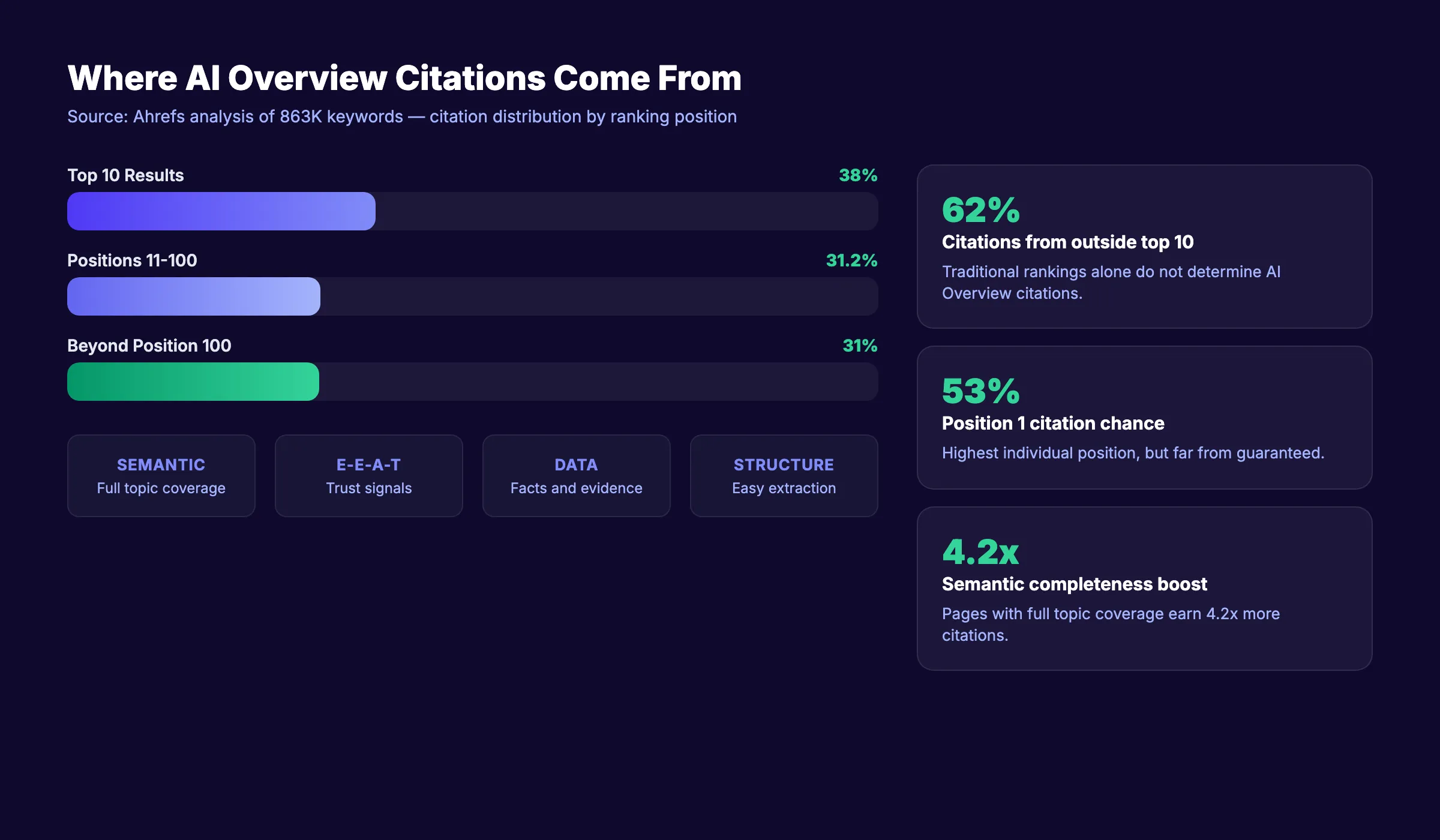
Ahrefs data reveals the citation distribution. 38% of AI Overview citations come from top 10 results. 31.2% come from positions 11 through 100. And 31% come from pages ranked beyond position 100.
Read that again. Nearly two-thirds of AI Overview citations go to pages outside the top 10.
This breaks a fundamental assumption in traditional SEO. Ranking on page 1 helps, but it is not required. Position 1 has a 53% chance of citation. Position 10 still has a 36.9% chance. The gap is smaller than most expect.
So what does Google actually look for when selecting AI Overview sources?
4 citation criteria drive selection:
- Semantic completeness. Does your page cover the full scope of the topic?
- E-E-A-T signals. Does Google trust your site as a source?
- Factual density. Does your content include specific data, numbers, and evidence?
- Structured formatting. Can the AI easily extract and present your content?
Traditional on-page SEO still matters. But AI Overview optimization adds a layer on top. You need to think about extractability, not just rankability.
The broader field of generative engine optimization covers this shift in detail. AI Overviews are the most visible example.
Why this step matters: If you optimize only for traditional rankings, you miss 62% of the citation pool. Understanding the selection model changes every decision that follows.
Pro tip: Check your Google Search Console for queries where you rank positions 11 through 30 but still get impressions. These are prime AI Overview citation opportunities.
Step 2: Audit Your Current AI Overview Visibility
You cannot optimize what you have not measured. Before changing any content, run a visibility audit.
AI Overview Visibility Audit Checklist:
- Open an Incognito browser window (logged out of Google)
- Search your top 20 target keywords one by one
- Record which queries trigger AI Overviews
- Note whether your site appears as a citation in any AI Overview
- Check the format of each AI Overview (list, paragraph, table)
- Record which competitors are cited instead
- Open Google Search Console and pull a 90-day query report
- Flag queries with stable impressions but declining clicks
- Cross-reference declining CTR queries with AI Overview triggers
Stable impressions plus declining clicks is the signature pattern of AI Overview impact. Your page still shows in results. Fewer people click because the AI answered their question.
Focus your optimization efforts on 2 groups. First, queries where AI Overviews appear and you are not cited. Second, queries where AI Overviews do not yet appear but likely will. Informational queries are the highest risk. 99.2 to 99.9% of AI Overviews trigger on informational intent keywords.
A full content audit can reveal which pages need restructuring. Start with your highest-traffic informational pages.
You can also use third-party tools to track AI Overview appearances at scale. Several of the best AI SEO tools now include AI Overview monitoring as a core feature.
Why this step matters: Without a baseline, you have no way to measure improvement. The audit identifies your highest-impact optimization targets and reveals where competitors are earning citations you are missing.
Step 3: Structure Content for AI Extraction
AI Overviews prefer content that is easy to extract. Format determines whether your content gets cited or skipped.
Here is how different content formats perform in AI Overview citations:
| Format | Citation Rate | Best For |
|---|---|---|
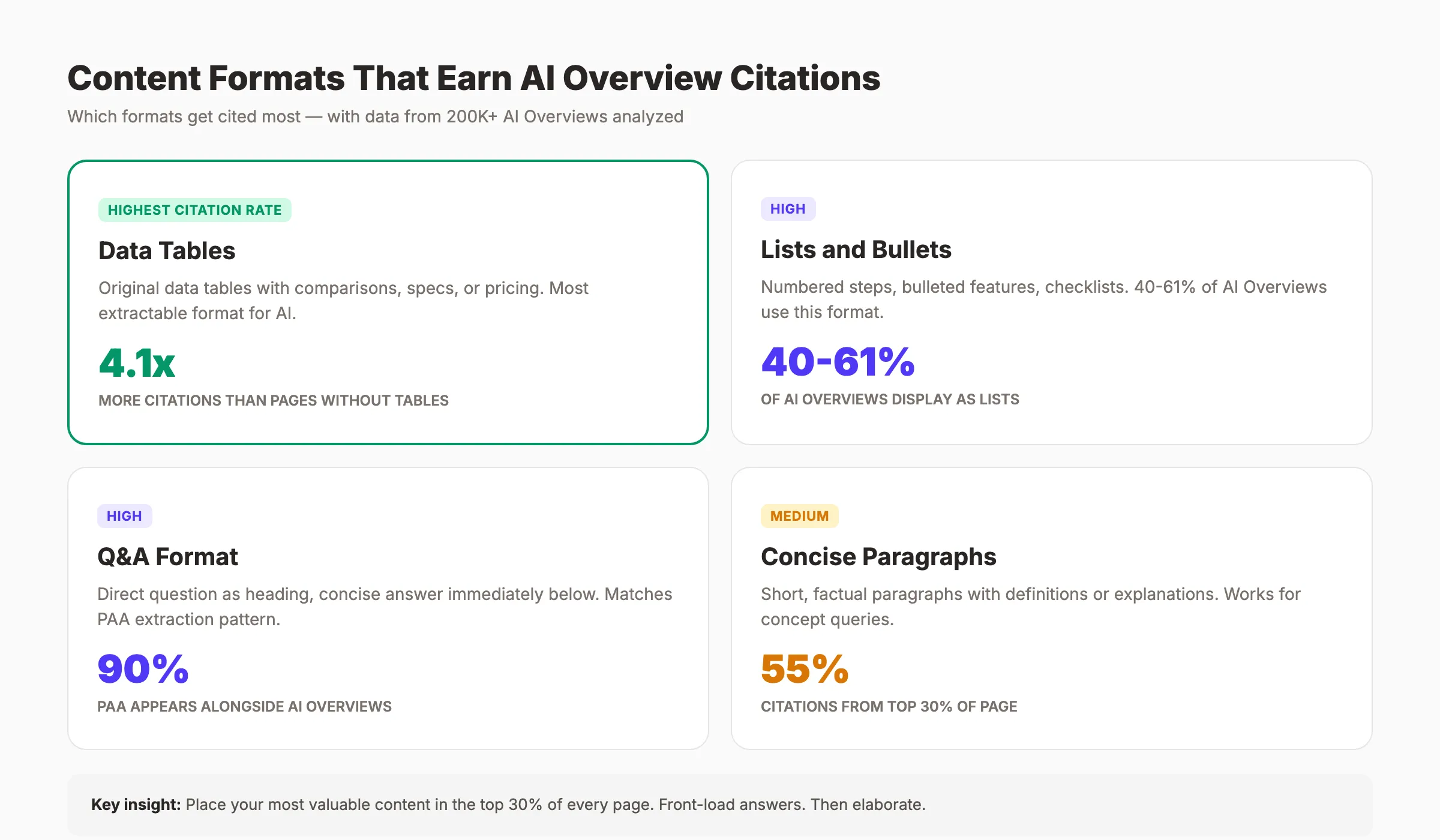
| Lists and bullets | High (40 to 61% of AI Overviews use lists) | How-to queries, step-by-step instructions |
| Data tables | Very high (4.1x more citations) | Comparisons, specifications, pricing data |
| Concise paragraphs | Medium | Definitions, concept explanations |
| Q&A format | High | Specific questions, troubleshooting |
Pages with original data tables earn 4.1x more citations than pages without them. That is the single largest format advantage in AI Overview optimization.
3 structural rules for AI extraction:
Place your best content early. 55% of AI Overview citations pull from the top 30% of a page. If your most valuable answer sits below the fold or buried in paragraph 12, the AI will skip it.
Use clear H2 and H3 headings that match search queries. AI Overviews map headings to user intent. A heading that reads “Content Structure Best Practices” is less extractable than “How to Structure Content for AI Overviews.”
Answer the query directly in the first 2 to 3 sentences under each heading. Do not build up to your answer. State it. Then elaborate.
Good SEO content writing already follows these principles. AI Overview optimization makes them non-negotiable. Every heading becomes a potential extraction point.
Review your top pages and restructure them. Move key answers higher. Add tables where comparisons exist. Convert long paragraphs into scannable lists.
For a deeper look at content formatting, see our guide on how to optimize content for SEO.
Why this step matters: Poorly structured content gets skipped even if it ranks number 1. Format is not cosmetic. It is a citation factor.
Pro tip: Look at the AI Overview format for your target query. If Google shows a list, your content should use a list. Mirror the format the AI already prefers.
Step 4: Build Semantic Completeness for Every Topic
Content with semantic completeness is 4.2x more likely to appear in AI Overviews. This is the strongest single predictor of citation.
Semantic completeness means covering every subtopic the AI model expects for a given query. Partial coverage loses to full coverage every time.
Here is how to build it:
Use People Also Ask as a subtopic map. PAA appears alongside 90% of AI Overviews. Each PAA question represents a subtopic that Google considers relevant. If your page does not address those subtopics, it is semantically incomplete.
See our guide on People Also Ask optimization for the full strategy.
Build content clusters, not standalone pages. A single blog post cannot achieve semantic completeness for a broad topic. You need a pillar page supported by cluster posts that cover subtopics in depth.
The pillar page earns the AI Overview citation. The cluster posts provide the topical depth that signals completeness. This is how topical authority compounds.
Start by creating a topical map for your core topics. Map every subtopic. Identify content gaps where you have no coverage.
Check coverage against competitors. Search your target keyword. Read the top 5 pages. List every subtopic they cover. If your page misses any of them, add that content. Then go further. Add subtopics they miss.
Content that covers 80% of a topic loses to content that covers 100%. The gap between 80% and 100% is where citations are won or lost.
Here is a practical example. If you write about “how to do keyword research,” a semantically complete page covers: what keyword research is, why it matters, free and paid tools, search volume analysis, keyword difficulty, long-tail keywords, competitor keyword analysis, and how to organize results. Missing any of these subtopics drops your semantic score.
Proper keyword research for each topic reveals the full subtopic map before you write.
Internal linking between your pillar and cluster posts reinforces the semantic relationship. Google sees the connected content as a unified resource.
Why this step matters: Semantic completeness has the highest correlation with AI Overview citations. No amount of formatting fixes a page that only partially covers its topic.
Step 5: Strengthen E-E-A-T Signals Across Your Site
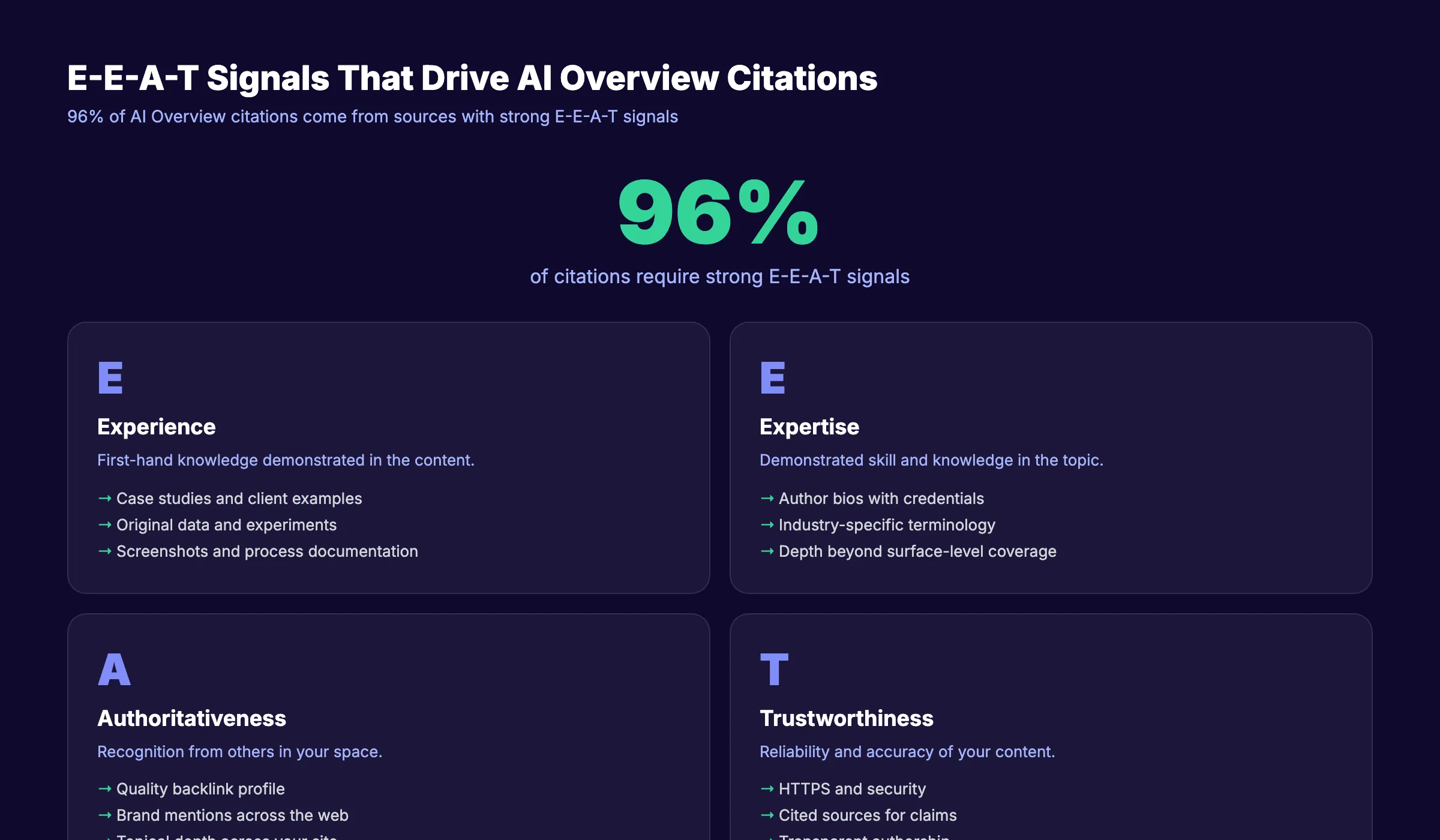
96% of AI Overview citations come from sources with strong E-E-A-T signals. This is not a suggestion. It is a gate.
E-E-A-T stands for Experience, Expertise, Authoritativeness, and Trustworthiness. Google has stated that quality and reliability drive AI feature sourcing.
Experience
Add first-hand examples to your content. Case studies, original data, screenshots of real results. AI Overviews favor content that demonstrates direct experience with the topic.
Pages with original data tables earn 4.1x more citations. Create your own research. Run surveys. Publish benchmarks. Original data is the strongest experience signal.
Expertise
Add detailed author bios with credentials. Show why the author is qualified to write on this topic. Include years of experience, certifications, and industry-specific knowledge.
Every page should have a visible author attribution. Anonymous content signals lower expertise.
Authoritativeness
Backlinks still matter. Sites with strong backlink profiles earn more AI Overview citations. Build authority through consistent publishing, earning mentions, and developing depth across your topic area.
This is where the Content Compound Effect works. Every article you publish adds to your site-wide authority. 30 posts per month builds authority faster than 2.
Trustworthiness
HTTPS is baseline. Beyond that, cite your sources. Link to authoritative external references. Display clear contact information. Remove outdated or inaccurate content.
To humanize AI content and strengthen trust signals simultaneously, add personal observations and specific examples that only a practitioner would know.
Why this step matters: AI Overviews overwhelmingly cite trusted sources. Optimizing structure alone will not help if Google does not trust your site. E-E-A-T is the foundation.
Rank everywhere. Do nothing. Stacc publishes 30 SEO-optimized articles per month. Structured for AI Overviews and traditional search. Start for $1 →
Step 6: Add Schema Markup and Structured Data
Schema markup helps Google understand your content structure. It does not guarantee AI Overview inclusion. But it increases the chance Google correctly interprets what your page covers.
3 schema types matter most for AI Overview optimization:
FAQ Schema
Mark up your FAQ sections with FAQPage schema. This tells Google exactly which questions your page answers. AI Overviews frequently pull from FAQ-structured content.
HowTo Schema
For step-by-step content like this guide, HowTo schema maps each step clearly. Google can extract individual steps for AI Overviews without guessing at your page structure.
Article Schema
Article schema identifies your author, publication date, and topic. It reinforces E-E-A-T signals by making authorship and freshness machine-readable.
Our guide on schema markup covers implementation for each type. You can also use our schema markup generator to create the code.
Implementation checklist:
- Add FAQPage schema to every page with a FAQ section
- Add HowTo schema to every step-by-step guide
- Add Article schema with author and datePublished to every blog post
- Validate all schema using Google Rich Results Test
- Monitor schema errors in Google Search Console
Do not over-mark your pages. Only add schema that accurately represents your content. Misleading schema can trigger manual actions.
Google recommends focusing on high-quality content first and using structured data as a supporting signal.
Why this step matters: Schema does not guarantee AI Overview inclusion. But it removes ambiguity. When Google can machine-read your content structure, extraction becomes easier.
Step 7: Optimize for Adjacent Features (PAA and Featured Snippets)
PAA appears alongside 90% of AI Overviews. Featured snippet pages have a 60% chance of also appearing in AI Overview citations.
These features share underlying signals. Winning one increases your odds for all three.
Featured Snippets
Pages that earn featured snippets already demonstrate the qualities AI Overviews look for. Clear structure. Direct answers. Factual density.
To win featured snippets, answer the query in 40 to 60 words directly under a heading that matches the search phrase. Use the format Google prefers for that query (paragraph, list, or table).
People Also Ask
PAA questions reveal subtopics Google considers essential. Each PAA answer you provide adds semantic completeness to your page.
Target 4 to 6 PAA questions per page. Answer each in 2 to 3 sentences. Use the exact question as a heading or bold lead-in. Our full guide on People Also Ask optimization covers the process.
The Overlap Effect
Winning a featured snippet does not guarantee an AI Overview citation. But the data shows 60% overlap. Optimizing for snippets is the fastest path to AI Overview visibility because the optimization work transfers directly.
The same is true for PAA. Pages that answer PAA questions thoroughly build the semantic completeness that AI Overviews require.
Focus your efforts on queries where you already rank in the top 5. These are your best opportunities to win all 3 features simultaneously.
A practical approach: Pick your top 10 informational keywords. Check which ones trigger AI Overviews, PAA, and featured snippets. Prioritize the queries where all 3 features appear. One round of optimization can capture visibility across every feature on the page.
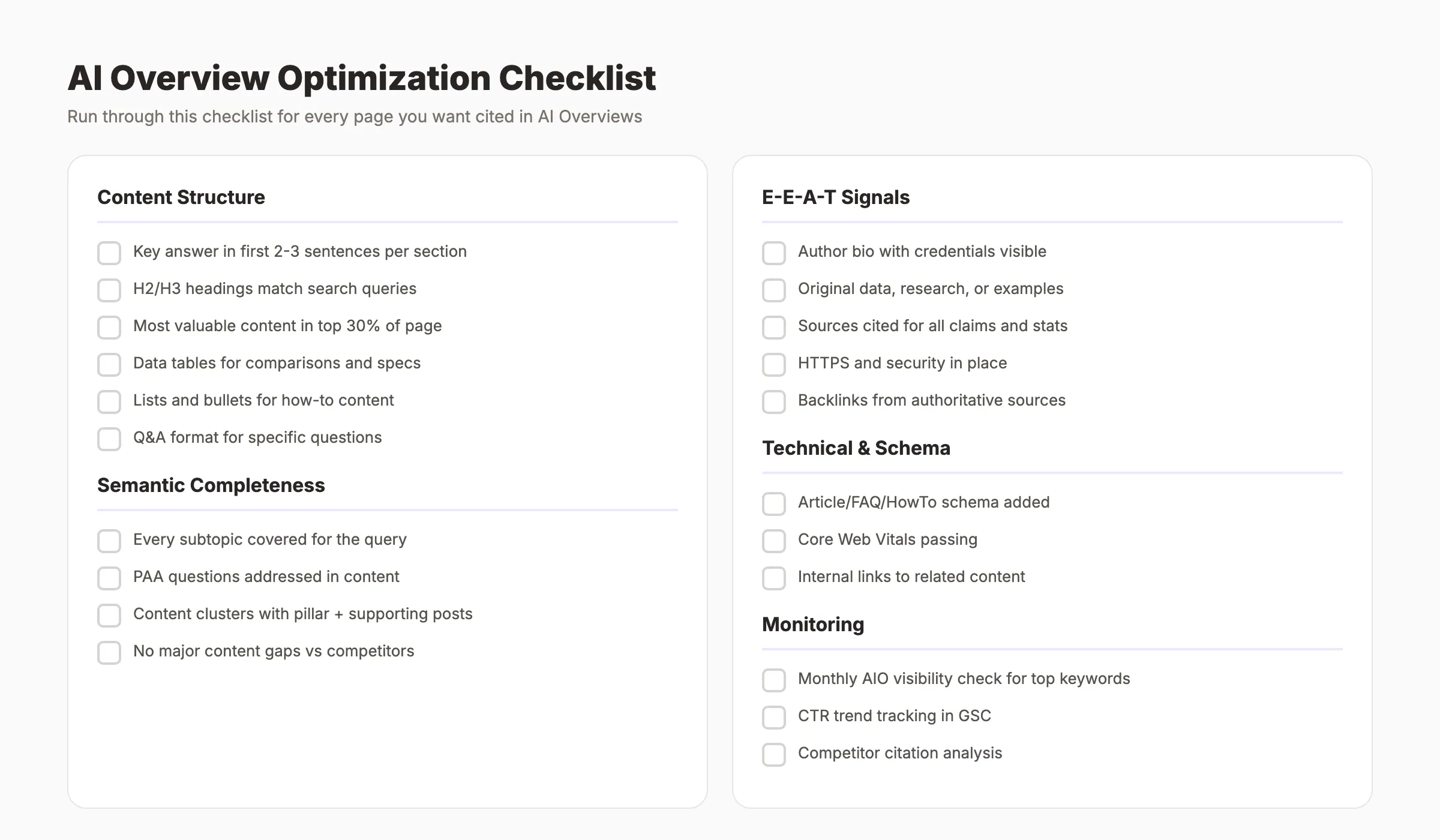
Why this step matters: These features share the same underlying signals. Optimizing for one helps all three. It is the most efficient optimization you can make.
Step 8: Monitor, Measure, and Iterate Monthly
AI Overviews evolve faster than organic rankings. Monthly monitoring catches shifts before they become traffic problems.
4 KPIs to track:
| KPI | What It Tells You | How to Measure |
|---|---|---|
| AI citation rate | How often your pages appear in AI Overviews | Manual spot checks + third-party tracking tools |
| CTR by query type | Whether AI Overviews are stealing your clicks | Google Search Console query report |
| Zero-click rate | Percentage of queries where users do not click any result | GSC impressions vs clicks ratio |
| Indexed page coverage | Whether Google can access and index your content | GSC Coverage report |
Monthly monitoring process:
- Search your top 20 keywords in Incognito mode
- Record AI Overview presence and citation status for each
- Pull GSC data and compare CTR month over month
- Flag any queries with rising impressions but falling clicks
- Review newly published pages for AI Overview optimization compliance
- Update old blog posts that have lost CTR
- Check competitor citations to identify new content angles
- Document format changes in AI Overviews for your queries
Build a simple spreadsheet. Track each target keyword, its AI Overview status, your citation status, and CTR trend. Update it monthly. Patterns emerge after 2 to 3 months that reveal which optimization tactics work best for your specific niche.
Compare your results against your baseline audit from Step 2. Track citation appearances over time. Look for patterns in which content formats and topics earn the most citations.
Keyword research should now include an AI Overview filter. Before targeting a keyword, check whether AI Overviews appear for it. Prioritize keywords where you can earn both organic rankings and AI citations.
The best AI SEO tools now include AI Overview tracking features. Use them to automate monitoring at scale.
Why this step matters: AI Overviews change constantly. Google adjusts citation criteria, expands to new query types, and modifies display formats. Monthly monitoring ensures your strategy stays current.
Results: What to Expect
AI Overview optimization is not instant. It compounds over time as your content, authority, and coverage improve.
Brands cited in AI Overviews earn 35% more organic clicks than non-cited brands. They also earn 91% more paid clicks. Citation builds brand visibility across the entire SERP.
Realistic timeline:
- Month 1 to 2: Audit complete. First 10 to 20 pages restructured for extraction. Schema markup added.
- Month 3 to 4: Citation appearances begin increasing. Featured snippet wins improve. CTR stabilization on optimized pages.
- Month 6 and beyond: Compounding visibility as topical authority builds. More pages earn citations. Organic traffic stabilizes or grows even on AI Overview queries.
The sites that see the fastest results are those with existing topical depth. If you already publish consistently and cover your topic broadly, restructuring for AI extraction produces results within weeks.
If you are starting from a small content library, focus on building semantic completeness first. The Content Compound Effect means every article you publish strengthens citation potential for every other article on your site.
The exception is brand-new sites. Without any existing authority or backlink profile, AI Overview citations take longer. Start by building a content foundation of 30 to 50 posts covering your core topic area. Then optimize for extraction. Authority and structure must work together.
To rank higher on Google in both traditional and AI results, treat every page as a potential citation source from day one.
Troubleshooting: 5 Common AI Overview Optimization Mistakes
Mistake 1: Optimizing only for traditional rankings
38% of citations come from the top 10. That means 62% do not. If your strategy is “rank higher and the citations will follow,” you are leaving the majority of citation opportunities on the table.
Fix: Optimize for extractability and semantic completeness regardless of your current ranking position.
Mistake 2: Publishing thin content with no original data
AI Overviews skip generic content. Pages with original data tables earn 4.1x more citations. Pages that restate what everyone else says add no unique value for the AI to cite.
Fix: Add original data, unique research, or first-hand experience to every page you want cited.
Mistake 3: Burying the answer deep in the page
55% of AI Overview citations pull from the top 30% of a page. If your best content sits at the bottom, the AI never reaches it.
Fix: Front-load your most valuable answers. Put definitions, key stats, and direct answers near the top of each section. Restructure existing content so the core answer appears within the first 3 sentences of each H2 section.
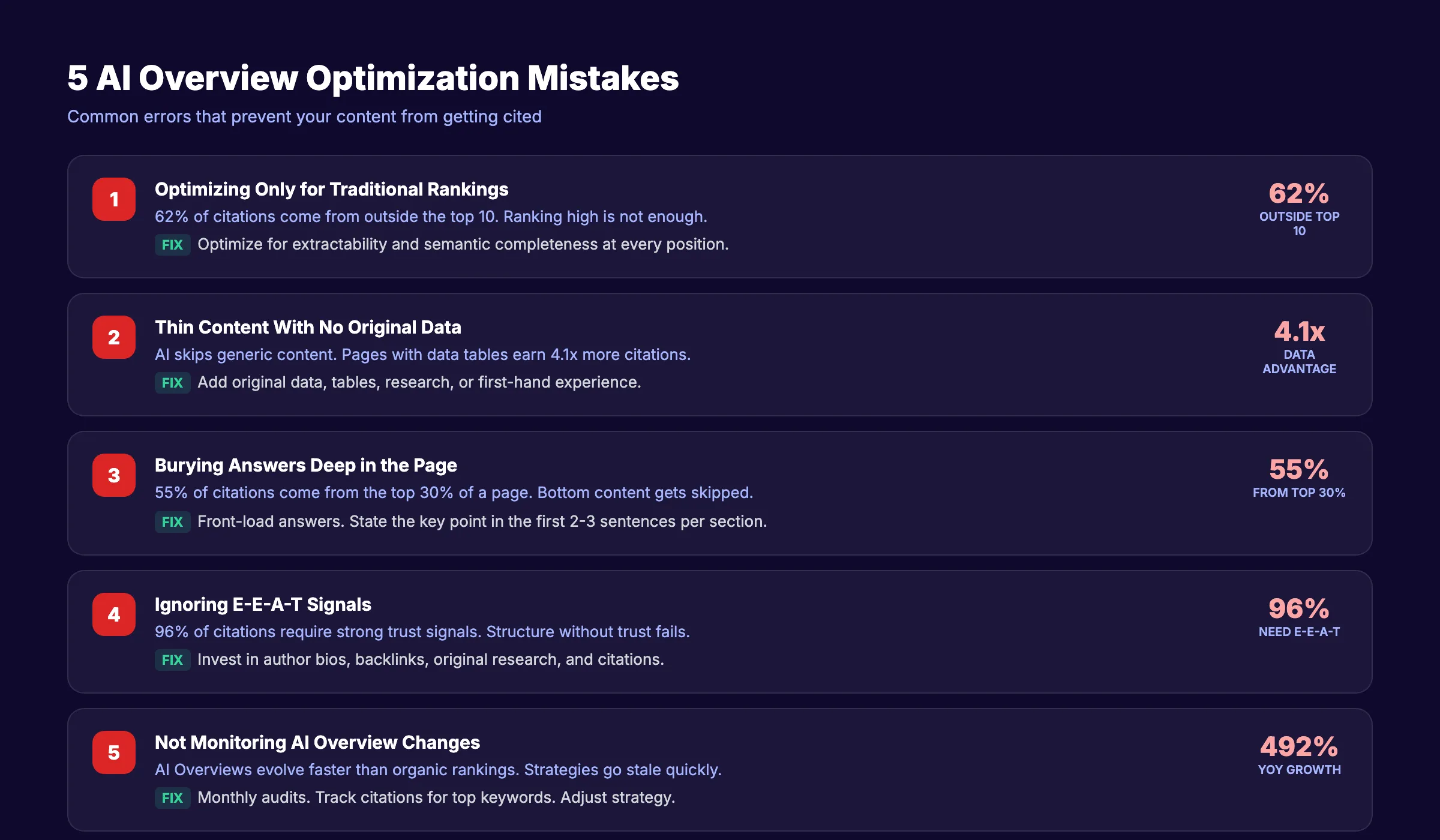
Mistake 4: Ignoring E-E-A-T signals
96% of citations come from sources with strong E-E-A-T signals. Perfect structure on an untrusted site produces zero citations.
Fix: Invest in author bios, backlinks, original research, and transparent sourcing. E-E-A-T is not optional.
Mistake 5: Not monitoring AI Overview changes
AI Overviews evolve faster than organic rankings. Google expands them to new query types and adjusts citation criteria without announcement. A strategy that worked 3 months ago may not work today.
Fix: Run monthly audits. Track citation status for your top keywords. Adjust your strategy based on what you observe. Set calendar reminders. Do not rely on memory.
To increase organic traffic in an AI Overview world, you need both traditional SEO and AI citation optimization working together. They are not competing strategies. They are complementary.
The brands winning in 2026 treat AI Overview optimization as a core part of their SEO workflow. Not an afterthought. Not a one-time project. A recurring process that runs alongside traditional on-page SEO and content production.
3,500+ blogs published. 92% average SEO score. Optimized for both traditional search and AI Overviews. Start for $1 →
Frequently Asked Questions
What are Google AI Overviews?
Google AI Overviews are AI-generated summaries that appear at the top of search results for certain queries. They pull information from multiple web sources and present a synthesized answer. AI Overviews are available in 200+ countries and serve 2 billion+ monthly users. They are different from featured snippets because they combine information from multiple sources rather than featuring a single page.
Do AI Overviews hurt SEO?
AI Overviews reduce organic CTR for informational queries. Ahrefs research shows position 1 CTR drops 58% when an AI Overview appears. Organic CTR drops 61% overall. However, sites cited in AI Overviews earn 35% more organic clicks. The impact depends on whether you are cited or not.
Can you opt out of AI Overviews?
You cannot opt out of AI Overviews entirely. Google may cite your content regardless of your preference. You can use the nosnippet meta tag to prevent your content from appearing in snippets and AI features. But this also removes your regular search snippets, which typically hurts CTR more than it helps.
What percentage of searches trigger AI Overviews?
AI Overviews appear for approximately 13 to 16% of all US queries as of early 2026. Desktop AI Overview appearance rose 492% from September 2024 to September 2025 according to Semrush data. The percentage continues to grow as Google expands the feature to more query types and countries.
Does schema markup help with AI Overviews?
Schema markup supports AI Overview optimization but does not guarantee inclusion. FAQ, HowTo, and Article schema help Google understand your content structure. This makes extraction easier. Google has stated that structured data is a supporting signal for AI features. Combine schema with strong content, E-E-A-T, and semantic completeness for the best results.
Are AI Overviews the same as featured snippets?
No. Featured snippets pull from a single source and display a direct excerpt. AI Overviews synthesize information from multiple sources into a generated summary. However, there is a 60% overlap. Pages that win featured snippets also appear in AI Overview citations 60% of the time. The optimization strategies share significant overlap, which is why targeting both simultaneously is the most efficient approach.
AI Overviews are not replacing search. They are reshaping how traffic flows from search results to websites.
The sites that structure content for AI citation today will capture the traffic that others lose. Every month you wait, competitors fill the citation slots that could be yours. Start with Step 1. Run the audit. Restructure your highest-traffic pages first. The compounding effect begins with the first optimized page.

Written by
Siddharth GangalSiddharth is the founder of theStacc and Arka360, and a graduate of IIT Mandi. He spent years watching great businesses lose organic traffic to competitors who simply published more. So he built a system to fix that. He writes about SEO, content at scale, and the tactics that actually move rankings.
30 SEO blog articles published every month
Keyword-optimized, scheduled, and live on your site. Automatically.
30-day trial · Cancel anytime
theStacc
Stop writing SEO content manually
30 blog articles, 30 GBP posts, and social media content. Published every month. Automatically.
Start Your $1 Trial$1 for 3 days · Cancel anytime