
How to Find Content Gaps on Your Website (7 Steps)
Learn how to find content gaps on your website in 7 steps. Free and paid methods, prioritization framework, and action plan. Updated March 2026.
Most websites have dozens of content gaps they do not know about. These are topics your audience searches for, your competitors rank for, and your site completely ignores. Every gap is a missed opportunity for traffic, leads, and revenue.
According to Ahrefs’ study of 14 billion pages, 96.55% of all pages get zero organic traffic from Google. The primary reason is not poor writing or weak backlinks. It is publishing content that does not match what people actually search for. That is a content gap problem.
We have published 3,500+ blog posts across 70+ industries. The pattern is consistent: sites that run a structured content gap analysis before planning their editorial calendar rank faster and waste less budget on content that goes nowhere.
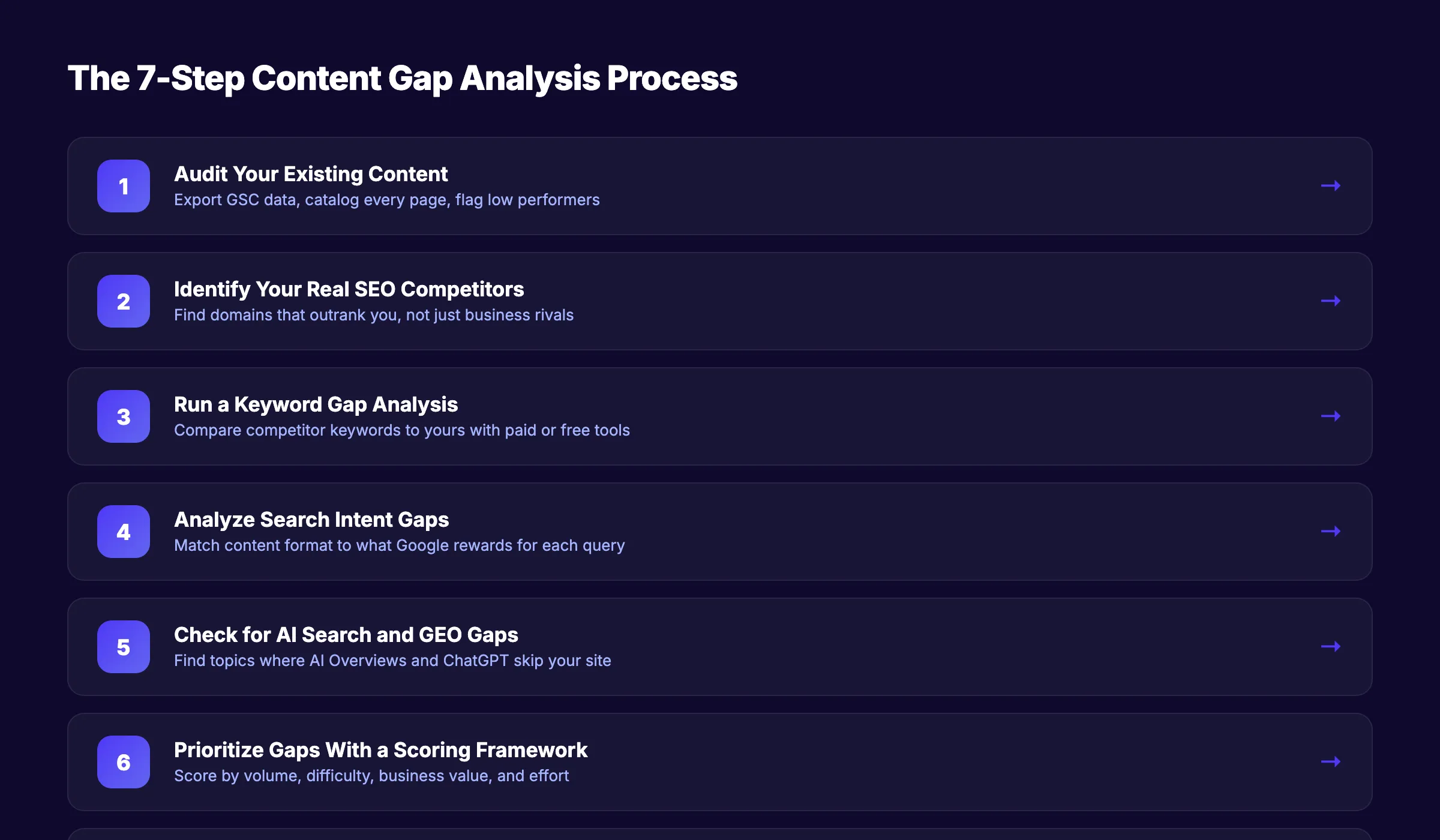
Here is what you will learn:
- How to audit your existing content and spot what is missing
- How to find the exact keywords your competitors rank for that you do not
- How to use free tools (Google Search Console, Google Trends) alongside paid platforms
- A prioritization framework so you fill the right gaps first
- How to turn gap analysis into a production plan that drives results
What You Will Need
Time required: 2-4 hours for a thorough analysis
Difficulty: Beginner to Intermediate
What you will need:
- Google Search Console access (free)
- Google Analytics 4 access (free)
- A spreadsheet (Google Sheets or Excel)
- Optional: Ahrefs, Semrush, or Surfer SEO for deeper competitor analysis
Step 1: Audit Your Existing Content
Before you look for gaps, you need to know what you already have. Most sites have more content than their owners realize. Some of it ranks. Most of it does not.
Start with a full content inventory. Open Google Search Console, move through to Performance, and export the full list of pages with impressions, clicks, CTR, and average position. This gives you a reality check on every page Google has indexed.
Specifically:
- Export the last 6 months of GSC data (Pages tab) to a spreadsheet
- Add columns for: page URL, target keyword, word count, last updated date, and content type (guide, listicle, how-to, comparison)
- Flag every page with fewer than 100 impressions per month as “low visibility”
- Flag every page with position 8-20 as “striking distance” (these are quick wins)
Sort by impressions descending. The pages at the bottom of the list are either thin content, outdated, or targeting the wrong keywords entirely.
Why this step matters: You cannot find what is missing until you map what exists. Skipping this step leads to duplicate content, keyword cannibalization, and wasted effort writing articles that overlap with pages you already have.
Pro tip: Use Google Search Console query data to find keywords you rank for on positions 11-20. These are topics where you have some authority but your content is not strong enough to reach page 1. They represent gaps in depth, not gaps in coverage.
Step 2: Identify Your Real SEO Competitors
Your SEO competitors are not always your business competitors. A local plumber competes with Angi, HomeAdvisor, and niche blogs for search visibility, not just the plumber down the street.
Identifying the wrong competitors is the most common mistake in content gap analysis. If you plug the wrong domains into Ahrefs or Semrush, every result will be irrelevant.
Specifically:
- Search Google for your 5 most important keywords
- Note which domains appear in the top 5 results for at least 3 of those keywords
- These are your SEO competitors regardless of whether they sell the same product
- Aim for 3-5 competitor domains that consistently outrank you
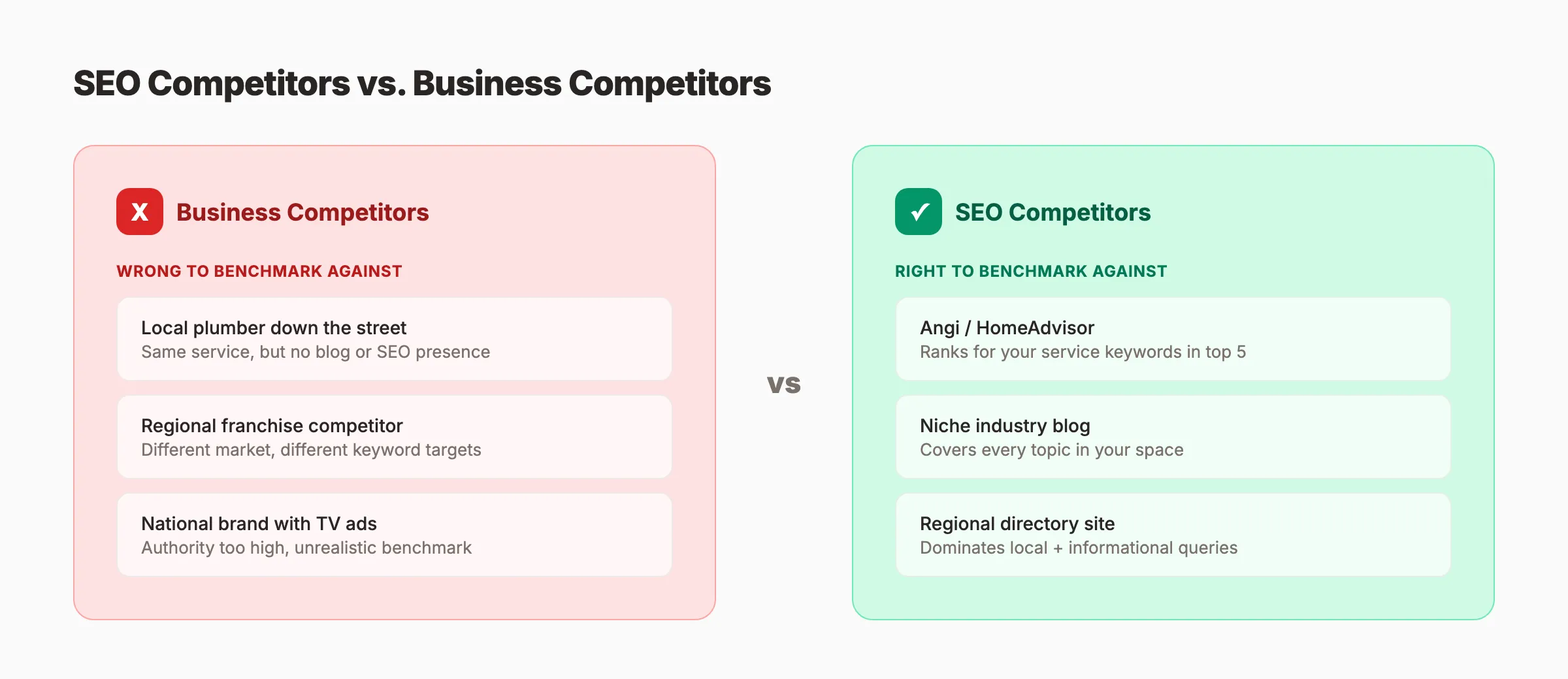
If you do not have access to paid tools, use this manual method: search your core keyword, open the top 3 ranking pages, and browse their blog or resource section. Note every topic they cover that you do not. That is your gap list.
Why this step matters: Gap analysis is only as good as the competitors you benchmark against. A SaaS company benchmarking against enterprise blogs will find gaps that are irrelevant to their audience. Match your competitor set to domains that rank for the same keywords you want to rank for.
Pro tip: Check whether Reddit threads rank in the top 3 for any of your target keywords. If Reddit outranks every dedicated website, it signals that no authoritative content exists on that topic. That is a high-opportunity gap worth filling fast.
Step 3: Run a Keyword Gap Analysis
This is the step most people think of when they hear “content gap analysis.” You compare the keywords your competitors rank for against the keywords your site ranks for. The difference is your keyword gap.
A keyword gap analysis reveals every ranking opportunity you are leaving on the table. The bigger your gap list, the more traffic your competitors capture that should go to your site.
With paid tools (Ahrefs or Semrush):
- Open the Keyword Gap or Content Gap tool
- Enter your domain and 2-3 competitor domains
- Filter for keywords where competitors rank in positions 1-10 and you do not rank at all
- Export the results and sort by search volume
- Remove branded keywords (competitor brand names you would never rank for)
Without paid tools (free method):
- Open Google Search Console and export all queries you rank for
- Search Google for each of your competitor’s blog post titles
- Note every topic they cover that does not appear in your GSC query list
- Use Google’s “People Also Ask” boxes to find related questions you have not answered
- Search
site:reddit.com [your topic]to find questions your audience asks that no one answers well
| Method | Cost | Depth | Speed |
|---|---|---|---|
| Ahrefs Content Gap | $99/mo+ | Deep (thousands of keywords) | 10 minutes |
| Semrush Keyword Gap | $129/mo+ | Deep (thousands of keywords) | 10 minutes |
| Google Search Console + manual search | Free | Moderate (dozens to hundreds) | 2-3 hours |
| People Also Ask mining | Free | Surface level (10-20 questions) | 30 minutes |
| Reddit/Quora research | Free | High for pain points | 1-2 hours |
Why this step matters: Without keyword gap data, your content calendar is based on guesswork. Keyword research for blog posts is the foundation of every successful content strategy. Gap analysis builds on that foundation by showing you exactly where competitors have coverage and you do not.
Pro tip: Do not stop at keywords. Look at the content format too. If competitors rank with comparison tables and you wrote a text-heavy guide, you have a format gap, not just a keyword gap. Google rewards the format that matches search intent best.
Stop writing. Start ranking. Stacc publishes 30 SEO articles per month for $99. Every article targets a gap in your content strategy. Start for $1 →
Step 4: Analyze Search Intent Gaps
Finding missing keywords is only half the job. The other half is identifying pages where you have the right keyword but the wrong intent match.
Search intent falls into 4 categories:
| Intent Type | Signal | Example Query | Best Content Format |
|---|---|---|---|
| Informational | ”what is”, “how to”, “guide" | "what is content gap analysis” | Guide or explainer |
| Commercial | ”best”, “top”, “review”, “vs" | "best content gap tools” | Listicle or comparison |
| Transactional | ”buy”, “pricing”, “sign up" | "ahrefs pricing 2026” | Landing page or pricing page |
| Navigational | Brand name, product name | ”semrush content gap tool” | Product page |
Most content gap analyses find keyword gaps but miss intent gaps entirely. You might rank for “content gap analysis” with a tool roundup when Google actually wants a step-by-step guide. That mismatch kills your rankings regardless of how well the content is written.
Intent gaps are often easier to fix than keyword gaps. You do not need to write new content. You need to restructure what you already have to match the format Google prefers.
Specifically:
- For every target keyword, search it in Google and note the format of the top 3 results
- Compare that format to what you currently have published
- If the top results are all how-to guides and yours is a listicle, that is an intent gap
- If the top results include videos and yours is text-only, that is a format gap
Why this step matters: Search intent alignment is the single biggest ranking factor after topical relevance. Google will not rank a comparison page for a “how to” query, no matter how good the content is. Fixing intent mismatches often delivers faster ranking improvements than creating entirely new content.
Step 5: Check for AI Search and GEO Gaps
This is the step every competitor guide misses. Traditional content gap analysis only looks at Google’s organic results. But in 2026, AI Overviews appear on 21% of all keyword searches, and platforms like ChatGPT, Perplexity, and Gemini drive a growing share of discovery.
Your content might rank on page 1 of Google but never get cited in AI-generated answers. That is a GEO gap.
Specifically:
- Search your target keywords in ChatGPT, Perplexity, and Google (with AI Overviews enabled)
- Note which sources get cited in the AI-generated answers
- Check if your site appears in any AI citations for your core topics
- Look for topics where AI gives incomplete or outdated answers, these are gaps you can fill with authoritative, well-structured content
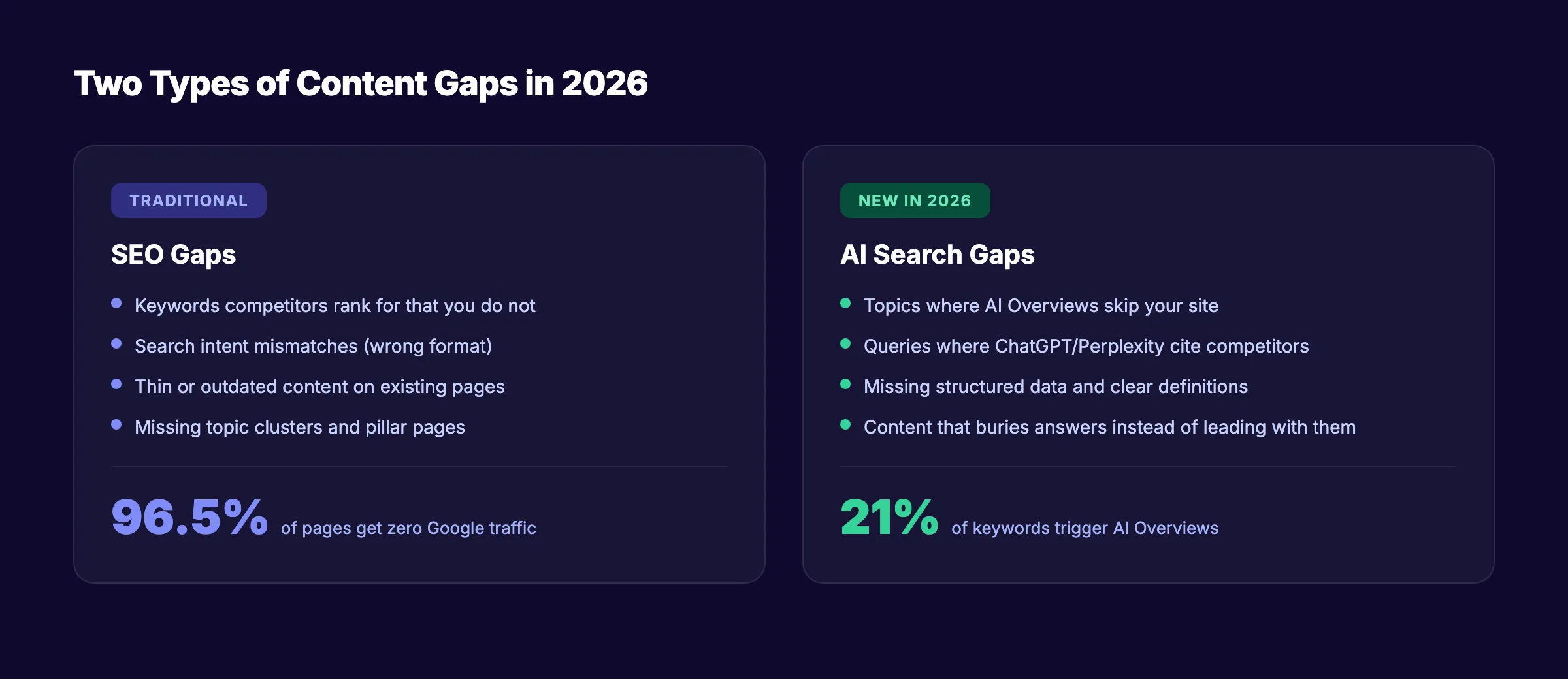
Content that gets cited by AI models shares specific traits: clear definitions in the first 2 sentences, structured data, authoritative sourcing, and concise factual statements. If your content buries the answer in paragraph 7, AI will skip it.
Read our generative engine optimization guide for a complete breakdown of how to structure content for AI citations.
Why this step matters: 26% of people end their session after reading an AI-generated summary without clicking any link. If your content is not being cited in those summaries, you are invisible to a growing segment of searchers. GEO gaps will only widen as AI search adoption increases.
Step 6: Prioritize Gaps With a Scoring Framework
After Steps 1-5, you will have a long list of content gaps. Most sites find 50-200 gaps on their first analysis. You cannot fill them all at once. You need a prioritization system.
Score every gap on 4 factors using a 1-5 scale:
| Factor | Weight | What to Measure |
|---|---|---|
| Search Volume | 25% | Monthly searches (GSC impressions or keyword tool data) |
| Keyword Difficulty | 25% | How hard it is to rank (competitor authority, backlink count) |
| Business Value | 30% | Does this topic attract buyers or just browsers? |
| Production Effort | 20% | Time, research depth, and resources needed to create |
Scoring formula: (Volume score x 0.25) + (Inverse difficulty x 0.25) + (Business value x 0.30) + (Inverse effort x 0.20) = Priority Score
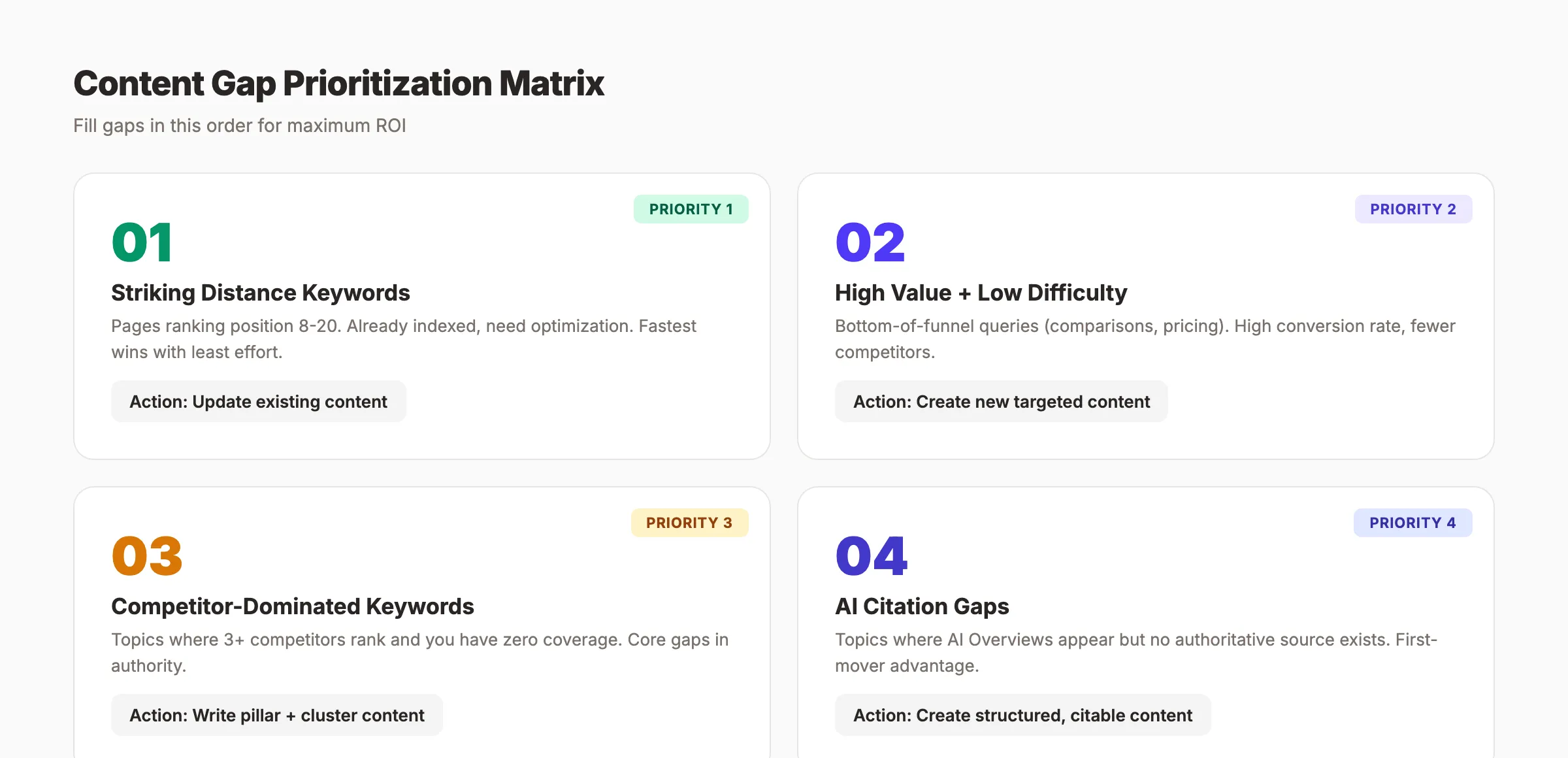
Category quick wins to target first:
- Striking distance keywords (position 8-20): Update existing content rather than creating new pages. Updating old blog posts is the fastest path to results.
- High business value + low difficulty: Bottom-of-funnel comparison and pricing queries that convert well and have fewer competitors.
- Competitor-dominated keywords: Topics where 3+ competitors rank and you have nothing published.
- AI citation gaps: Topics where AI Overviews appear but no authoritative source exists yet.
Why this step matters: Without prioritization, teams default to writing about whatever seems interesting. That leads to a content calendar full of high-difficulty, low-conversion topics. The scoring framework ensures every article you publish moves the needle on traffic and revenue.
Pro tip: Map every gap to a stage in the buyer journey. A common mistake is filling only top-of-funnel informational gaps. Bottom-of-funnel gaps (comparisons, pricing guides, implementation tutorials) convert at 3-5x the rate of awareness content.
Your SEO team. $99 per month. 30 optimized articles, published automatically. Every one targets a real gap in your content strategy. Start for $1 →
Step 7: Build Your Production Plan and Fill the Gaps
Finding gaps means nothing if you do not fill them. This is where most content strategies stall. The analysis sits in a spreadsheet and never becomes published content.
Turn your prioritized gap list into a production plan with clear deadlines, assignments, and publishing targets. Without a plan, gap analysis becomes an academic exercise. The value is in execution, not in the spreadsheet.
Every gap you identified in Steps 1-6 needs an owner, a deadline, and a content type. Group related gaps into clusters so each new article strengthens the ones around it.
Specifically:
- Take your top 20 gaps by priority score
- Group related gaps into topic clusters (a pillar page + 4-6 supporting articles)
- Assign each gap to a content type: new article, content update, or page merge
- Set a realistic publishing cadence (aim for consistency over volume)
- Build an SEO content calendar with publish dates for the next 90 days
| Gap Type | Action | Timeline |
|---|---|---|
| Striking distance (position 8-20) | Update existing content | Week 1-2 |
| Missing topic (competitors rank, you do not) | Write new article | Week 2-6 |
| Intent mismatch | Rewrite or restructure | Week 1-3 |
| Thin content (under 500 words) | Expand and optimize | Week 1-2 |
| Format gap (text vs. video/table) | Add missing format elements | Week 1 |
| AI citation gap | Add structured data + clear definitions | Week 1-2 |
Internal linking after publishing: Every new article should link to 3-5 existing pages, and 3-5 existing pages should link back to the new article. This creates the cluster structure that builds topical authority. Read our internal linking guide for the full strategy.
Why this step matters: HubSpot research shows that businesses publishing 16+ articles per month get 3.5x more organic traffic than those publishing 0-4. Consistency matters more than perfection. A gap analysis that produces 4 published articles per month will outperform a perfect analysis that sits in a spreadsheet.
Pro tip: Track results at 30, 60, and 90 days after publishing. Use Google Search Console to monitor impressions and position for each new page. If a page does not gain traction by day 90, revisit the search intent and competitor positioning. The SERP may have shifted since your analysis.
Results: What to Expect
After completing these 7 steps, you should expect:
- Week 1-2: A complete content inventory, competitor map, and prioritized gap list with 50-200 opportunities scored by business value
- Month 1-2: First batch of gap-filling content published, with striking distance keywords showing position improvements within 30 days
- Month 3-6: Meaningful organic traffic increases as new content gets indexed, builds internal links, and earns authority
Case studies show that structured content gap analysis followed by consistent execution can lead to a 576% increase in organic sessions. The key word is “consistent.” One round of gap analysis and publishing is a start. Repeating the process quarterly is what compounds results.
The sites that see the fastest results combine gap analysis with a high publishing cadence. Businesses publishing 16+ articles per month get 3.5x more organic traffic than those publishing 0-4. Gap analysis tells you what to write. Publishing cadence determines how fast you close those gaps.
Troubleshooting
Problem: Your gap analysis returned 500+ keywords and you feel overwhelmed. Solution: Focus only on the top 20 by priority score. Ignore the rest until the first batch is published and performing. You can always return to the list in 90 days.
Problem: You do not have budget for Ahrefs or Semrush. Solution: Use the free method from Step 3. Google Search Console + manual SERP analysis + People Also Ask mining covers 70-80% of what paid tools find. It takes more time but delivers actionable results.
Problem: You found gaps but do not have the team to produce content consistently. Solution: Prioritize ruthlessly. Four well-researched articles per month beat 20 thin ones. Or consider a done-for-you service that handles SEO content writing and publishing on a set cadence.
FAQ
What is a content gap?
A content gap is a topic your target audience searches for that your website does not cover. It can be a missing keyword, a topic your competitors rank for, a search intent mismatch, or a format gap where your content type does not match what Google rewards for that query.
How do you find content gaps without paid tools?
Use Google Search Console to export your ranked queries. Compare that list against competitor blog topics found through manual Google searches. Mine “People Also Ask” boxes, search Reddit and Quora for unanswered questions, and use Google Trends to spot rising topics. This free approach covers most gaps that paid tools find.
How often should you run a content gap analysis?
Every 90 days. Quarterly analysis catches seasonal shifts, new competitor content, and algorithm updates. Monthly is overkill for most sites. Annual analysis misses too many changes. Mark it on your content calendar as a recurring task.
What is the difference between a keyword gap and a content gap?
A keyword gap is a specific search term your competitor ranks for that you do not. A content gap is broader. It includes missing topics, intent mismatches, format gaps, thin content, and missing coverage of subtopics within a topic cluster. Every keyword gap is a content gap, but not every content gap is a keyword gap.
Can AI tools help find content gaps?
Yes. AI tools like ChatGPT and Perplexity can brainstorm topic ideas, identify questions your content does not answer, and analyze competitor content structure. However, AI cannot replace data from Google Search Console or keyword tools. Use AI as a supplement for brainstorming and pattern recognition, not as a replacement for search data analysis.
Does filling content gaps guarantee higher rankings?
No. Filling gaps with thin, generic content will not improve rankings. Google’s December 2025 Core Update penalized sites that mass-produced low-quality content, with some seeing up to 71% visibility drops. Every gap-filling article needs original insight, proper on-page SEO, and genuine value that exceeds what already ranks.
3,500+ blogs published. 92% average SEO score. See what Stacc can do for your site. Start for $1 →
Now you know how to find content gaps on your website. The process works whether you use free tools or paid platforms, whether your site has 10 pages or 10,000.
Start with Step 1. Audit what you have. Then work through each step sequentially. The sites that rank are not the ones with the most content. They are the ones with the fewest gaps.
Related Tools & Resources
Free SEO Tools:
Best Lists:

Written by
Siddharth GangalSiddharth is the founder of theStacc and Arka360, and a graduate of IIT Mandi. He spent years watching great businesses lose organic traffic to competitors who simply published more. So he built a system to fix that. He writes about SEO, content at scale, and the tactics that actually move rankings.
30 SEO blog articles published every month
Keyword-optimized, scheduled, and live on your site. Automatically.
30-day trial · Cancel anytime
theStacc
Stop writing SEO content manually
30 blog articles, 30 GBP posts, and social media content. Published every month. Automatically.
Start Your $1 Trial$1 for 3 days · Cancel anytime