
Search Intent (With Examples) (2026): Guide
Step-by-step search intent guide guide for 2026: proven tactics, real examples, common mistakes to avoid, and implementation tips.
Every keyword has an intent behind it. Someone searching “what is email marketing” wants to learn. Someone searching “Mailchimp pricing” wants to buy. If your content does not match the intent behind the keyword, it will not rank. Period.
Search intent is the reason Google shows blog posts for some keywords and product pages for others. Get it right and your content matches exactly what the searcher needs. Get it wrong and you waste months creating content that Google will never surface.
57.3% of all Google searches are informational. Only 0.69% are transactional. That single stat from Semrush’s research explains why most SEO strategies fail. They target high-volume informational keywords and then wonder why traffic does not convert.
We have published 3,500+ blogs across 70+ industries. Every article we produce starts with search intent analysis. This guide covers everything you need to understand, identify, and optimize for search intent.
Here is what you will learn:
- The 4 types of search intent and how to recognize each one
- Real keyword examples for every intent type
- How to identify intent from the SERP in under 2 minutes
- The 3Cs framework for intent analysis
- How to optimize existing content to match intent
- Common intent mistakes that kill rankings
What Is Search Intent?
Search intent (also called user intent or keyword intent) is the reason behind a search query. It answers the question: what does this person want to accomplish by typing these words into Google?
Google’s entire algorithm is built around satisfying search intent. When you search “how to tie a tie,” Google shows step-by-step guides with images and videos. When you search “buy silk tie,” Google shows product pages with prices. The algorithm reads the intent and matches the result format.
Google’s Quality Rater Guidelines (Section 12.7) instruct human evaluators to judge search results based on how well they satisfy user intent. Pages receive a “Needs Met” rating on a scale from Fully Meets to Fails to Meet. The highest rating goes to pages that completely satisfy the likely intent behind the query.
Understanding search intent matters for 3 reasons:
- Rankings. Google will not rank your page if it does not match intent. A product page will not rank for an informational query. A blog post will not rank for a transactional query.
- Traffic quality. Matching intent means attracting visitors who actually want what you offer. Mismatched intent means high bounce rates and zero conversions.
- Content efficiency. When you know the intent first, you build the right content format from the start. No rewrites. No pivots. No wasted effort.
The 4 Types of Search Intent
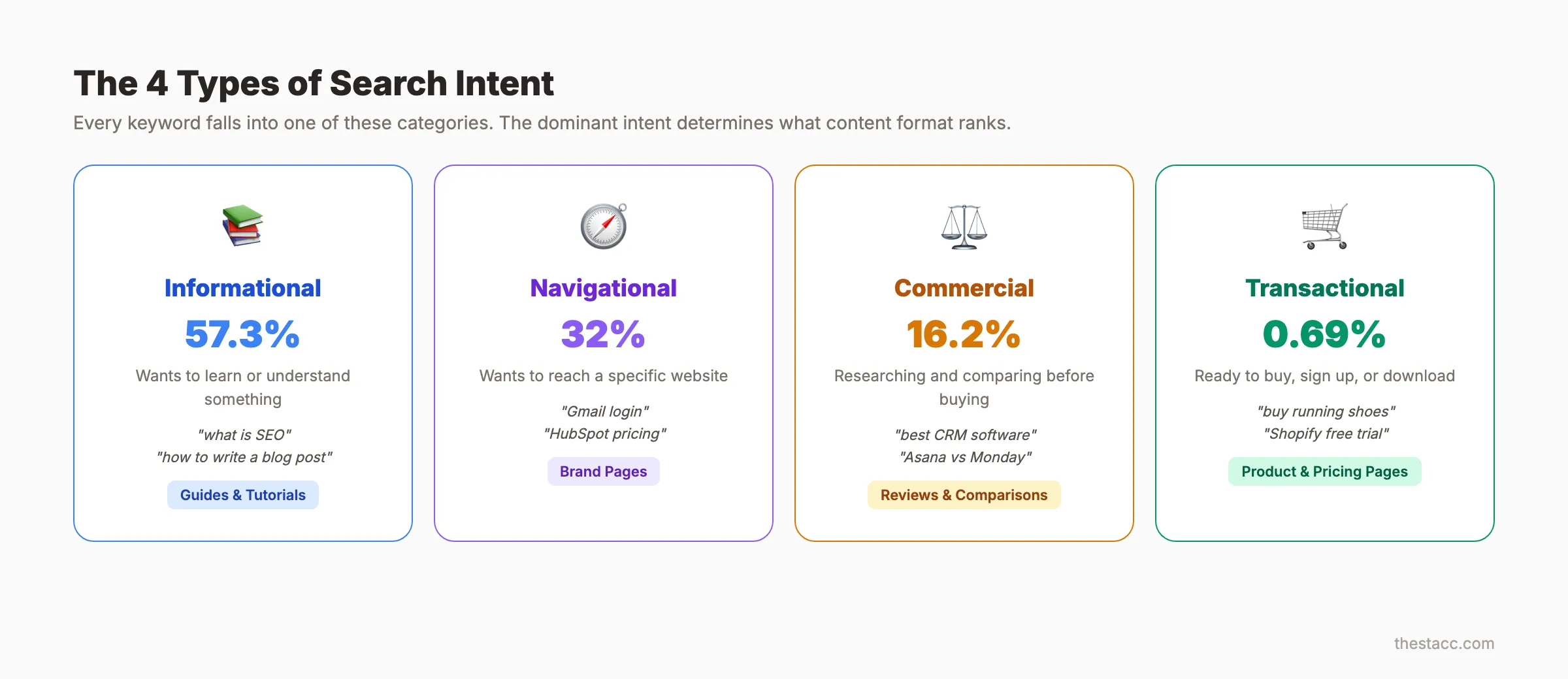
Every search query falls into one of 4 intent categories. Some queries blend multiple intents, but one primary intent always dominates.
1. Informational Intent
The searcher wants to learn something. They are not ready to buy. They want answers, explanations, or instructions.
Signals: Queries starting with “what,” “how,” “why,” “when,” or “guide.”
Examples:
| Query | What the Searcher Wants |
|---|---|
| ”what is search intent” | A definition and explanation |
| ”how to write a blog post” | Step-by-step instructions |
| ”why is SEO important” | Reasons and evidence |
| ”email marketing best practices” | Tips and strategies |
| ”difference between SEO and SEM” | A comparison explanation |
Content format that ranks: Blog posts, guides, tutorials, how-to articles, explainer videos.
Percentage of all searches: 57.3%. The majority of Google searches are informational. People use search engines to learn more than to buy.
Informational content builds topical authority and attracts top-of-funnel traffic. It does not convert directly, but it creates the trust that leads to future conversions.
2. Navigational Intent
The searcher wants to reach a specific website or page. They already know where they want to go. They use Google as a shortcut instead of typing the full URL.
Signals: Queries containing brand names, product names, or specific page types.
Examples:
| Query | What the Searcher Wants |
|---|---|
| ”Gmail login” | The Gmail sign-in page |
| ”Semrush blog” | Semrush’s blog section |
| ”HubSpot pricing” | HubSpot’s pricing page |
| ”YouTube” | The YouTube homepage |
| ”Shopify help center” | Shopify’s support documentation |
Content format that ranks: The brand’s own website pages. It is nearly impossible to rank for another brand’s navigational queries unless you are a major review site or directory.
Percentage of all searches: 32%. Nearly a third of all searches are people trying to get to a specific website.
You cannot optimize for other brands’ navigational queries. But you can optimize for your own. Make sure your homepage, pricing page, login page, and support docs rank for “[your brand] + [page type]” searches.
3. Commercial Investigation Intent
The searcher is researching before making a purchase. They are comparing options, reading reviews, and evaluating features. They have buying intent but have not decided yet.
Signals: Queries containing “best,” “vs,” “review,” “comparison,” “top,” “alternatives.”
Examples:
| Query | What the Searcher Wants |
|---|---|
| ”best project management tools” | A ranked list to compare options |
| ”Asana vs Monday.com” | A head-to-head comparison |
| ”Surfer SEO review” | An honest evaluation with pros and cons |
| ”Mailchimp alternatives” | Options to replace a specific tool |
| ”best SEO tools for small business” | A filtered recommendation list |
Content format that ranks: Comparison pages, review posts, “best of” listicles, alternatives pages.
Percentage of all searches: 16.2%. These are the most valuable keywords for businesses because the searcher is actively evaluating products.
Commercial intent keywords drive the highest conversion rates for content. A well-written comparison page converts better than almost any other content type.
4. Transactional Intent
The searcher is ready to take action. They want to buy, sign up, download, or complete a specific transaction right now.
Signals: Queries containing “buy,” “price,” “coupon,” “discount,” “free trial,” “sign up,” “download,” “order.”
Examples:
| Query | What the Searcher Wants |
|---|---|
| ”buy running shoes online” | A product page to purchase |
| ”Ahrefs pricing plans” | Pricing details to subscribe |
| ”download free SEO checklist” | A direct download link |
| ”Shopify free trial” | A signup page |
| ”order pizza near me” | A local ordering page |
Content format that ranks: Product pages, pricing pages, landing pages, app store listings, order forms.
Percentage of all searches: 0.69%. Transactional searches are rare in raw volume but extremely valuable per query. Every click represents someone ready to spend money.
Stop writing. Start ranking. Stacc publishes 30 SEO-optimized articles per month, each one matched to the right search intent. Start for $1 →
How to Identify Search Intent
You do not guess intent. You read it from the SERP. Google has already determined the intent for every keyword based on billions of data points. Your job is to analyze what Google shows and match it.
The 3Cs Framework
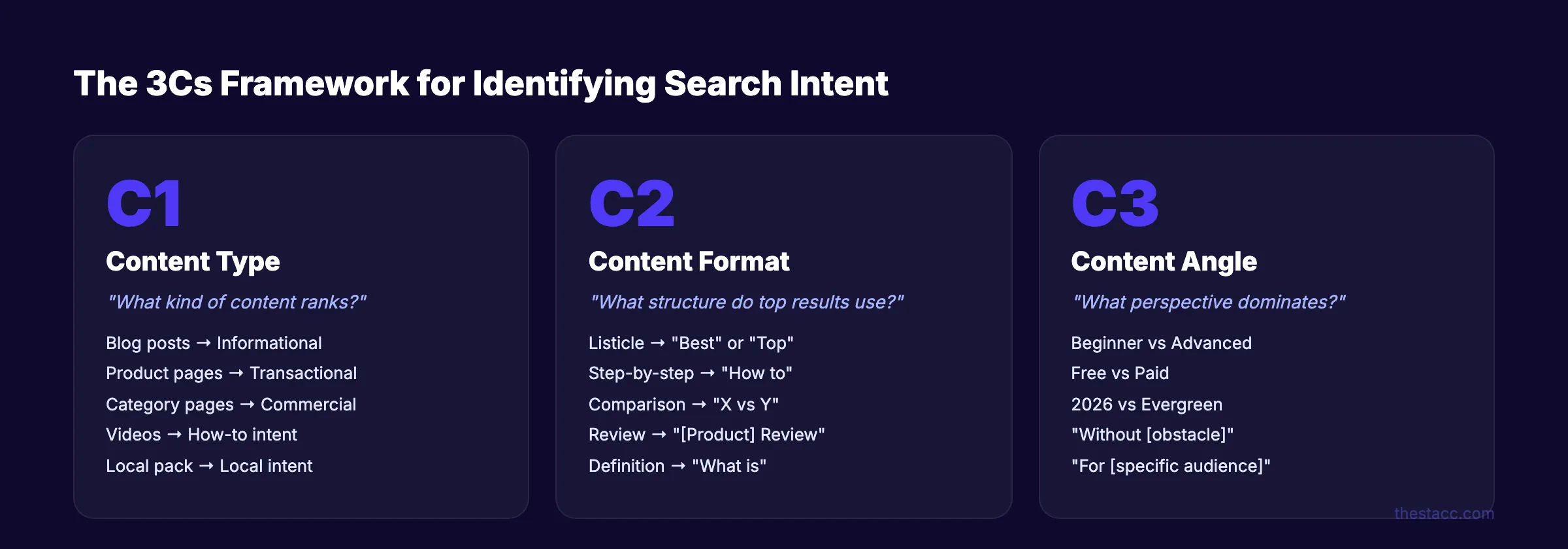
The 3Cs framework gives you a systematic way to analyze intent from the search results. Check all 3 before creating any content.
1. Content Type
What type of content dominates page 1?
| Content Type | Indicates |
|---|---|
| Blog posts and articles | Informational intent |
| Product pages | Transactional intent |
| Category pages | Commercial intent |
| Landing pages | Transactional or commercial intent |
| Video results | Informational (how-to) intent |
| Local pack / maps | Local intent |
If 8 out of 10 results are blog posts, write a blog post. Do not write a product page for a keyword where only blog posts rank.
2. Content Format
What format do the top-ranking pages use?
- Listicle (“10 Best,” “7 Tips”). Used for commercial and informational
- Step-by-step guide (“How to X in Y Steps”). Used for informational
- Comparison (“X vs Y”). Used for commercial investigation
- Review (“[Product] Review 2026”). Used for commercial investigation
- Definition (“What Is X”). Used for informational
- Tool or calculator. Used for transactional or informational
Match the format, not just the topic.
3. Content Angle
What perspective or hook do the top results use?
- “for beginners” vs “advanced”
- “free” vs “paid”
- “2026” vs evergreen
- “without [obstacle]” vs “with [tool]”
The content angle tells you what the searcher values. If every result says “for beginners,” do not write an advanced guide.
Quick Intent Check: 2-Minute Process
- Search the keyword on Google (use incognito mode)
- Note the content type of the top 5 results
- Check for featured snippets (paragraph, list, or table)
- Read the People Also Ask questions
- Check if Google Ads appear (indicates commercial or transactional intent)
- Look at the “Related searches” at the bottom
- Decide: informational, navigational, commercial, or transactional
This process takes 2 minutes. It prevents months of wasted effort creating content that will never rank.
Search Intent and the Content Funnel
Search intent maps directly to the marketing funnel. Understanding this connection determines which content types drive traffic vs. which drive revenue.
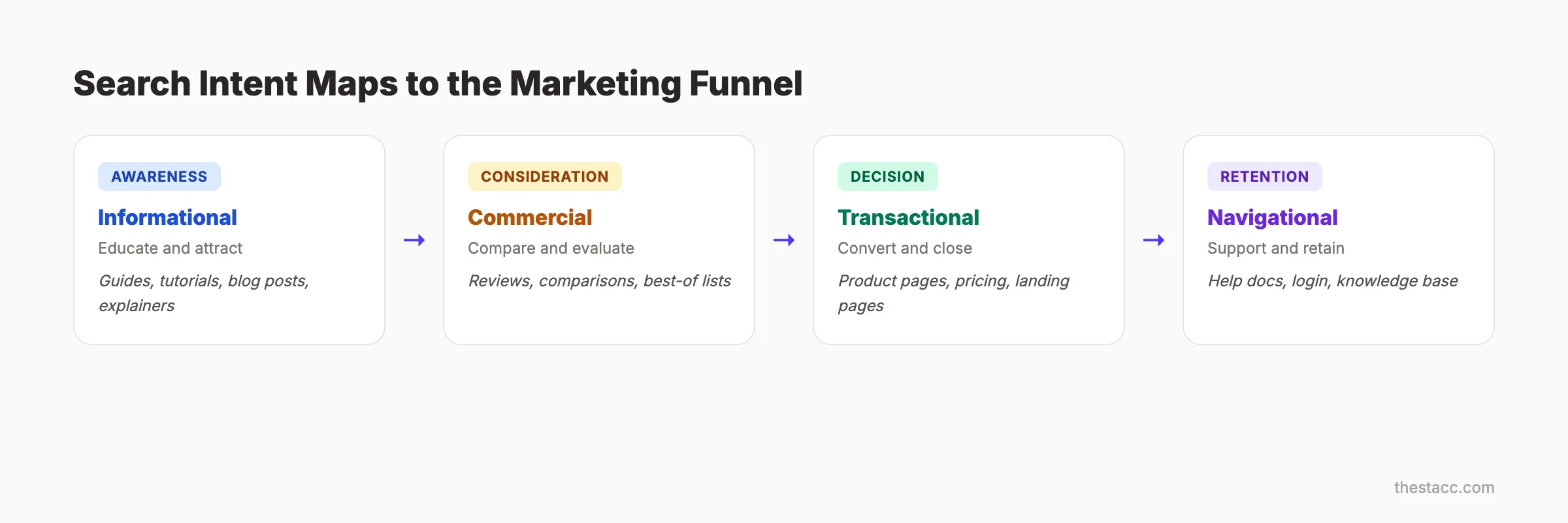
| Funnel Stage | Intent Type | Goal | Content Type |
|---|---|---|---|
| Awareness | Informational | Educate and attract | Blog posts, guides, videos |
| Consideration | Commercial | Compare and evaluate | Comparisons, reviews, best-of lists |
| Decision | Transactional | Convert and close | Product pages, pricing, landing pages |
| Retention | Navigational | Support and retain | Help docs, knowledge base, login pages |
Most businesses make the mistake of creating only informational content. They fill their blog with “what is” and “how to” posts but never create the commercial and transactional pages that actually drive revenue.
The right approach is to work from the bottom up. Build transactional and commercial pages first. Then create informational content that funnels readers toward those conversion pages through internal links.
Our guide on keyword research for blog posts covers how to identify keywords at each funnel stage.
Your SEO team. $99 per month. 30 articles matched to the right intent, published automatically. Start for $1 →
How to Optimize Content for Each Intent Type
Knowing the intent is step one. Optimizing your content to satisfy that intent is step two.
Optimizing for Informational Intent
Informational searchers want clear, complete answers. They do not want sales pitches.
- Lead with the answer. Do not bury it 500 words into the article
- Use H2 and H3 headings that match People Also Ask questions
- Include visuals (tables, diagrams, screenshots) that explain concepts
- Add a FAQ section targeting related informational queries
- Link to deeper resources for readers who want more detail
- Target featured snippets with concise, well-structured answers
Read our SEO content writing guide for the full optimization process.
Optimizing for Commercial Intent
Commercial searchers want to compare options and make informed decisions.
- Include comparison tables with clear scoring or recommendations
- Cover pros and cons honestly. Readers distrust content that only highlights positives
- Add pricing information whenever possible
- Include screenshots and real product details
- Link to individual review pages for deeper analysis
- Make your recommendation clear. Do not leave the reader guessing
Check our guide on how to write SEO blog posts for formatting tips on comparison content.
Optimizing for Transactional Intent
Transactional searchers want to act. Remove every obstacle between them and the conversion.
- Put the CTA above the fold
- Include pricing, availability, and key product details immediately
- Add trust signals (reviews, ratings, security badges, guarantees)
- Minimize navigation distractions. One page, one action
- Optimize page speed. Every second of delay reduces conversions
- Add schema markup for products, pricing, and reviews
Optimizing for Navigational Intent
Navigational searchers want to reach your specific page.
- Make sure your key pages rank for “[brand] + [page type]” searches
- Use clear, descriptive title tags (“[Brand] Login” not just “Login”)
- Add sitelinks by structuring your site with clear internal navigation
- Claim and optimize your Google Business Profile for branded local searches
- Monitor branded SERP results for competitor ads targeting your brand name
Mixed Intent Keywords
Some keywords trigger multiple intent types on the same SERP. “SEO audit” is a good example. Page 1 shows free tools (transactional), how-to guides (informational), and service pages (commercial). Google is not sure which intent dominates, so it hedges.
How to Handle Mixed Intent
Option 1: Match the dominant intent. Count the content types on page 1. If 6 out of 10 results are blog posts and 4 are tools, write a blog post. Go with the majority.
Option 2: Create multiple pages. Build one page for each intent. Create a blog post (“How to Do an SEO Audit”) and a tool page (“/tools/seo-audit”). Each targets the same keyword but satisfies a different intent. Our SEO audit tool is an example of this approach.
Option 3: Serve both intents on one page. Start with the informational content (the guide), then include the tool or CTA within the same page. This works when the intents are complementary, not conflicting.
The wrong approach is to create one page that tries to be everything. A page that is half blog post and half sales page satisfies neither intent well.
Intent Shifts: When Keywords Change Meaning
Search intent is not static. The same keyword can shift intent over time as user behavior changes, industries evolve, or Google updates its algorithm.
Examples of intent shifts:
- “AI tools” was informational in 2022 (what are AI tools?). By 2025, it shifted to commercial (which AI tool should I use?).
- “COVID vaccine” was informational in 2020. It became transactional (where can I get vaccinated?) by 2021.
- Seasonal keywords like “Christmas gifts” shift from informational (October) to transactional (December).
How to track intent shifts:
- Monitor your rankings monthly. If a page drops suddenly, the intent may have shifted
- Re-check the SERP every quarter for your primary keywords
- Watch for new SERP features (shopping results, map packs) appearing for previously informational queries
- Use Google Search Console to track click-through rate changes. A CTR drop on a stable ranking suggests intent mismatch
When intent shifts, update your content to match the new dominant format. Sometimes that means rewriting a blog post as a tool page. Sometimes it means adding product recommendations to an informational guide.
3,500+ blogs published. 92% average SEO score. Every article starts with intent analysis. Every article matches what Google wants to see. Start for $1 →
Common Search Intent Mistakes
These mistakes cost rankings, traffic, and conversions. Each one is preventable with basic intent analysis.
1. Writing a sales page for an informational keyword. If the SERP shows guides and blog posts, a sales page will not rank. Check the SERP before writing anything.
2. Writing a blog post for a transactional keyword. If the SERP shows product pages and pricing, a blog post will not compete. Match the content type to the intent.
3. Ignoring the SERP entirely. Guessing intent from the keyword alone is unreliable. “Apple” could mean the fruit, the company, or Apple Records. Only the SERP tells you what Google thinks the intent is.
4. Targeting volume without intent. A keyword with 50,000 monthly searches and informational intent will generate traffic but zero revenue. A keyword with 500 searches and transactional intent will generate actual sales. Intent determines value, not volume.
5. Not updating stale content for intent changes. Your page ranked well 12 months ago but traffic dropped. The keyword intent may have shifted. Re-check the SERP and update accordingly. Our guide on updating old blog posts covers this process.
6. Creating one page for multiple intents. A page that is half guide and half product pitch satisfies neither intent. Split conflicting intents into separate pages.
Search Intent in the AI Era
Google AI Overviews, ChatGPT, and Perplexity are changing how search intent works. 34% of Google searches now involve AI assistance. The intent behind AI-driven queries looks different from traditional search.
How AI Changes Intent
AI search users tend to ask longer, more specific questions. Instead of “best CRM,” they ask “what CRM works best for a 10-person sales team selling B2B software under $50 per user.” The intent is the same (commercial investigation), but the query is more precise.
This means your content needs to answer specific questions, not just cover broad topics. Structured content with clear question-and-answer formatting gets cited more frequently by AI models.
According to a TryProfound study, only 32% of ChatGPT queries are informational, compared to 57% on Google. ChatGPT users skip the learning phase and go straight to evaluation and comparison. Optimize your commercial and transactional content for AI citations by including specific data points, clear recommendations, and structured comparisons.
Our guide on optimizing for Google AI Overviews covers the full strategy for AI search visibility.
FAQ
What are the 4 types of search intent?
The 4 types are informational (seeking knowledge), navigational (seeking a specific website), commercial investigation (comparing products), and transactional (ready to buy or act). Google’s Quality Rater Guidelines use slightly different terms: Know, Website, Know/Do, and Do.
How do you identify search intent for a keyword?
Search the keyword on Google in incognito mode. Analyze the top 10 results using the 3Cs framework: Content Type (blog vs product page), Content Format (listicle vs guide vs review), and Content Angle (beginner vs advanced, free vs paid). The dominant pattern reveals the intent.
Why is search intent important for SEO?
Google ranks pages based on how well they satisfy the intent behind a query. If your content format does not match what Google expects for a keyword, it will not rank regardless of content quality, backlinks, or domain authority. Matching intent is a prerequisite for ranking.
Can a keyword have more than one search intent?
Yes. Some keywords trigger mixed intent, where Google shows multiple content types on page 1. “SEO audit” shows tools, guides, and service pages. For mixed intent keywords, either target the dominant format or create separate pages for each intent.
What is the difference between commercial and transactional intent?
Commercial intent means the searcher is researching and comparing before buying. They search “best email marketing tools” or “Mailchimp vs ConvertKit.” Transactional intent means the searcher is ready to act now. They search “Mailchimp pricing” or “sign up ConvertKit.” Commercial is evaluating. Transactional is executing.
How does search intent affect content strategy?
Intent determines the content format, structure, and conversion goal for every page. Build transactional and commercial pages first to capture revenue. Then create informational content that funnels readers toward those conversion pages. Read our content marketing strategy guide for the full framework.
Search intent is the foundation of every ranking decision Google makes. Before you write a single word, search your target keyword, analyze the SERP, and match the format that Google already rewards. The content that ranks is the content that satisfies intent.

Written by
Siddharth GangalSiddharth is the founder of theStacc and Arka360, and a graduate of IIT Mandi. He spent years watching great businesses lose organic traffic to competitors who simply published more. So he built a system to fix that. He writes about SEO, content at scale, and the tactics that actually move rankings.
30 SEO blog articles published every month
Keyword-optimized, scheduled, and live on your site. Automatically.
30-day trial · Cancel anytime
theStacc
Stop writing SEO content manually
30 blog articles, 30 GBP posts, and social media content. Published every month. Automatically.
Start Your $1 Trial$1 for 3 days · Cancel anytime