
SEO Content Writing (2026): Strategies, Tactics & Examples
Practical seo content writing strategies for 2026: step-by-step tactics, real examples, and tools to improve rankings and drive organic traffic.
96.55% of all web pages get zero organic traffic from Google. The problem is not a shortage of content. Over 7.5 million blog posts go live every single day. The problem is that most content is written without a process for ranking.
SEO content writing fixes that. It is the practice of creating web content designed to rank in search engines while delivering real value to readers. Every first-page result you see earned its position through some form of SEO content writing. Accidental rankings almost never happen.
The gap between companies that generate leads from organic search and those that do not is rarely about writing quality. It is about process. Companies spend $2,400 to $7,500 per month on freelance writers and still miss page 1 because the content was never optimized for search.
We have published 3,500+ blog posts across 70+ industries. The pattern is consistent: content written with an SEO process outperforms content written without one by 5 to 10 times in organic traffic.
Here is what you will learn in this guide:
- What SEO content writing is and how it differs from regular writing
- The 6-step process for writing content that ranks
- How to research keywords and match search intent
- On-page optimization techniques for every element
- Content structure rules that Google rewards
- How to write for both humans and search algorithms
- Common mistakes that prevent content from ranking
What Is SEO Content Writing?
SEO content writing is the practice of creating web content that ranks in search engine results. It combines writing skill with keyword research, search intent analysis, on-page optimization, and strategic content structure.
The goal is direct: create content that answers real search queries better than competing pages. Google processes over 8.5 billion searches per day. Each one is a person looking for a specific answer.
What SEO Content Writing Is NOT
SEO content writing is not keyword stuffing. It is not gaming algorithms. It is not writing for robots instead of humans.
The best SEO content reads naturally. It answers questions clearly. It uses keywords because those keywords describe what the content covers, not because a tool said to insert them 47 times.
Google’s algorithms in 2026 evaluate content quality through hundreds of signals including dwell time, scroll depth, return visits, and user satisfaction metrics. Content that reads like spam triggers these negative signals within seconds.
SEO Content Writing vs Regular Content Writing
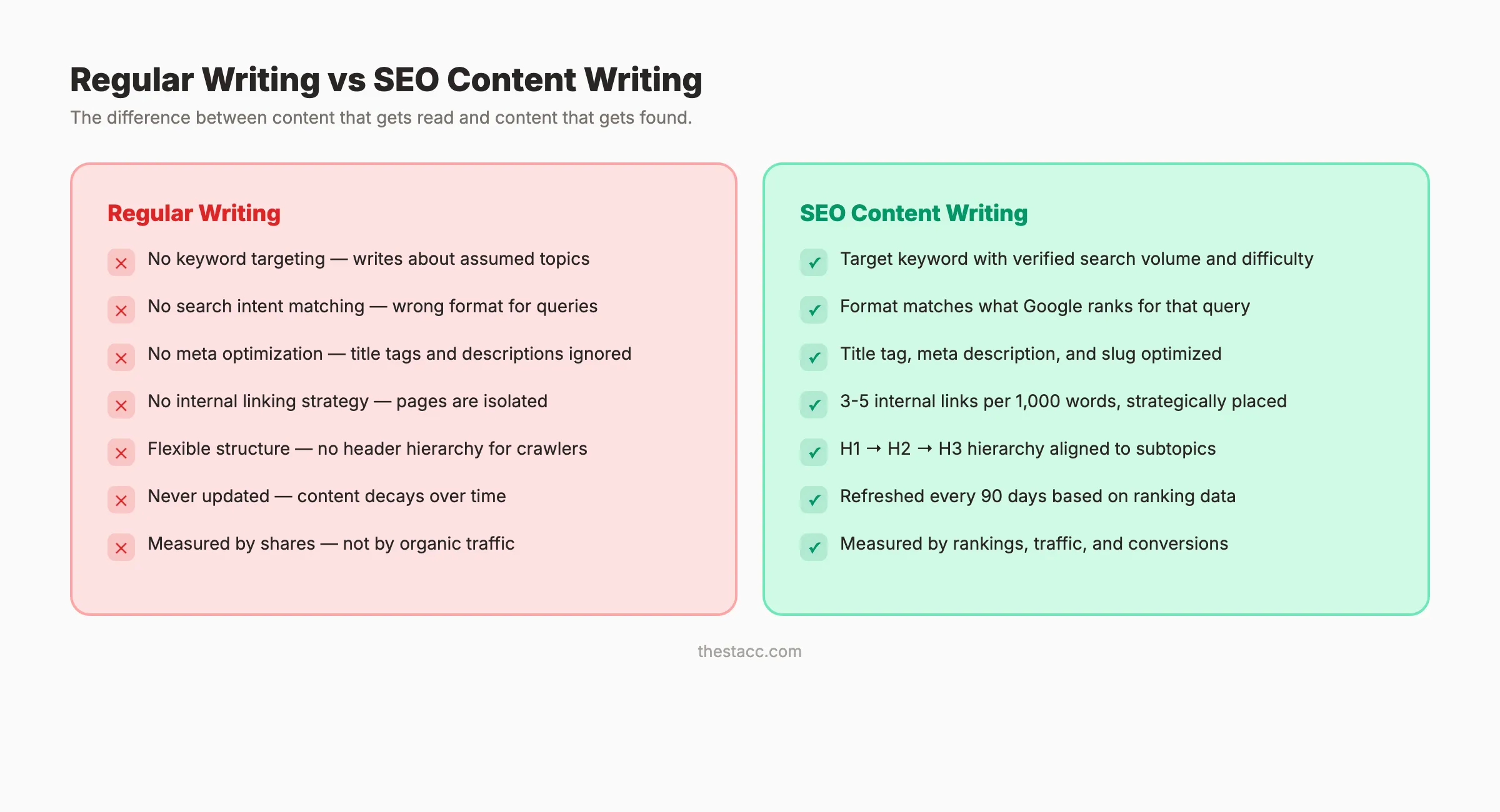
Regular content writing focuses on clarity, engagement, and messaging. SEO content writing adds a search-visibility layer on top of those fundamentals.
| Factor | Regular Content Writing | SEO Content Writing |
|---|---|---|
| Primary goal | Inform or persuade | Rank in search results and inform |
| Keyword strategy | None or minimal | Primary + secondary keywords mapped to intent |
| Structure | Flexible | Header hierarchy aligned to search queries |
| Meta data | Optional | Title tags, meta descriptions, URL slugs optimized |
| Internal linking | Occasional | Strategic linking to related pages |
| Success metric | Engagement, shares | Organic traffic, rankings, conversions |
| Content length | Whatever feels right | Matched to SERP competition |
| Updates | Rare | Regular refreshes based on ranking data |
The best SEO content writing does both. It reads well for humans and ranks well on Google. One without the other produces either invisible content or content nobody wants to read.
Why SEO Content Writing Matters in 2026
Organic search drives 53% of all website traffic. That share has held steady for over a decade. Despite the rise of social media, paid ads, and AI search, organic remains the largest single traffic channel for most businesses.
The Economics of Organic Traffic
A single first-page ranking can deliver 50 to 500 organic visits per month, depending on the keyword. Those visits cost $0 after the content is published. Compare that to Google Ads, where every click costs $2 to $50+ depending on the industry.
Over 12 months, a business ranking for 50 keywords on page 1 can generate 10,000 to 50,000 free visits. The same traffic from paid ads would cost $50,000 to $500,000.
Content Is the Foundation of Every SEO Strategy
Links, technical SEO, and page speed all matter. But without content, there is nothing to rank. Every indexed page on your site is a potential ranking opportunity. Every blog post targeting a keyword is a net cast into the search results.
Companies that publish 16+ blog posts per month get 3.5 times more traffic than those publishing 0 to 4 per month. The correlation between publishing frequency and organic traffic is well documented across HubSpot’s research.
AI Search Makes Content Quality More Important
AI Overviews now appear on 48% of Google queries. ChatGPT, Perplexity, and Gemini all pull from web content to generate answers. The average visitor from AI search converts at 4.4 times the rate of a traditional search visitor.
AI systems prefer content that is clearly structured, factually accurate, and written with E-E-A-T signals. Thin, generic content gets filtered out. Deep, expert-level content gets cited.
Stop writing content that ranks nowhere. Stacc publishes 30 SEO-optimized articles per month with keyword research, intent matching, and on-page optimization built in. Start for $1 →
The 6-Step SEO Content Writing Process
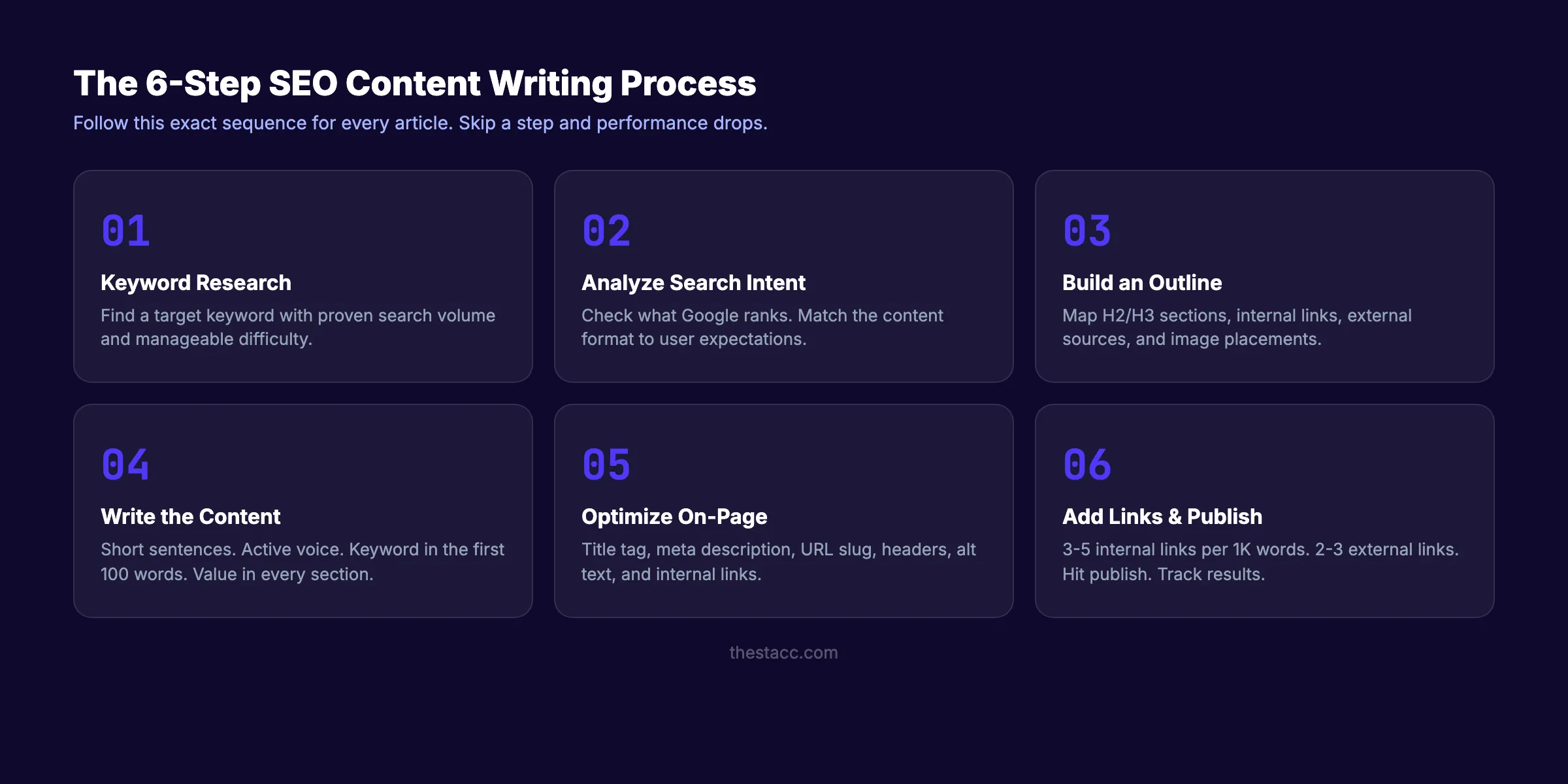
Every piece of content that ranks follows a sequence. Skip a step and the content underperforms. This is the exact process behind the 3,500+ articles we have published.
Step 1: Keyword Research
Every article starts with a target keyword. Without one, you write for no specific audience.
How to find keywords:
- Use Google autocomplete. Type your topic and note every suggestion.
- Check Google Search Console. Filter to positions 11 to 20 for “almost ranking” opportunities.
- Use a keyword tool (Ahrefs, Semrush, or Ubersuggest) to find search volume and difficulty data.
- Review competitor blogs. What terms do they rank for that you do not?
What to look for:
| Metric | Target Range |
|---|---|
| Monthly search volume | 100 to 10,000 |
| Keyword difficulty | Under 40 for newer sites |
| Search intent | Informational or commercial |
| Content gap | Topic your competitors miss |
Read our full guide on keyword research for blog posts for the detailed 7-step process.
Step 2: Analyze Search Intent
Search intent is the reason behind a query. Google ranks pages that match intent. Write the wrong format for the intent and you will not rank, regardless of content quality.
The 4 types of search intent:
| Intent | Signal Words | Best Format |
|---|---|---|
| Informational | ”what is,” “how to,” “guide” | Blog post, tutorial, guide |
| Commercial | ”best,” “top,” “review,” “vs” | Listicle, comparison, review |
| Transactional | ”buy,” “pricing,” “sign up” | Product page, pricing page |
| Navigational | Brand name, “login” | Homepage, specific page |
How to verify intent: Search the keyword in Google. Look at the top 3 results. Note the format (guide, list, video, product page). Match that format.
For a deeper breakdown, read our guide on search intent.
Step 3: Build a Content Outline
An outline prevents two problems: missing key subtopics and writing without direction. The outline is your blueprint.
Every outline should include:
- H1 title with primary keyword
- 6 to 10 H2 sections covering every subtopic the reader expects
- H3 subsections under each H2 for depth
- Planned internal links to related pages
- Planned external links to authoritative sources
- Image placement notes
- Target word count (match or beat top SERP results)
Check what the top 5 ranking pages cover. Your outline should include everything they cover plus at least 1 subtopic they miss. That gap is your competitive edge.
Read our blog post outline guide for the full outline-building process.
Step 4: Write the Content
Writing SEO content follows specific rules that differ from regular writing.
Opening paragraph rules:
- Start with a pain point, surprising stat, or bold claim
- Include the primary keyword within the first 100 words
- Preview what the reader will learn
- Keep it under 150 words
Body content rules:
- Max 20 words per sentence
- Max 3 sentences per paragraph (prefer 1 to 2)
- Active voice always (“Google ranks pages” not “pages are ranked by Google”)
- Use numerals for all numbers (“30 articles” not “thirty articles”)
- Open each section with a claim, stat, or observation. Never a transition word.
Formatting for readability:
- Bold key terms and important numbers
- Use bullet lists for features, steps, and tips
- Use tables for comparisons and data
- Break long sections with images, callouts, or checklists
- Use
inline codefor technical terms likerobots.txtormeta description
Step 5: Optimize On-Page Elements
After writing, optimize the elements that search engines read directly.
Title tag: Under 60 characters. Primary keyword front-loaded. Include a power word (proven, complete, ultimate) or a number.
Meta description: 145 to 155 characters. Primary keyword included. State a benefit. Add a freshness signal (year or “updated”).
URL slug: Short, descriptive, hyphenated. Remove stop words. Match the primary keyword phrase.
Header hierarchy: One H1 (the title). Multiple H2s for major sections. H3s under H2s. No skipping levels.
Image alt text: Describe what the image shows. Include the keyword naturally. Keep it under 125 characters.
Read our full on-page SEO guide for every optimization element.
Step 6: Add Links and Publish
Internal links connect your content to the rest of your site. They distribute page authority, help Google discover new pages, and keep readers on your site longer.
Rules for internal linking:
- 3 to 5 internal links per 1,000 words
- Use descriptive anchor text (not “click here”)
- Link to topically related pages
- Distribute links across sections, not clustered in one spot
Read our guide on internal linking for blog posts for the full strategy.
External links point to authoritative sources that support your claims. They signal to Google that your content is well-researched.
- 2 to 3 external links per article minimum
- Link to the specific page with the data (not just the homepage)
- Prioritize Google official docs, Ahrefs/Semrush studies, and .gov/.edu sources
Your SEO team. $99 per month. 30 articles researched, written, optimized, and published automatically. No writers. No editors. No guesswork. Start for $1 →
Content Structure Rules Google Rewards
Google does not read content like a human. It scans structure. Pages with clear, logical structure rank better than walls of text with the same information.
Use a Logical Header Hierarchy
Headers tell Google what each section covers. A clear hierarchy helps the algorithm understand the relationship between topics and subtopics.
H1: Main Topic (title ,  1 per page)
  H2: Major Section 1
    H3: Subsection 1a
    H3: Subsection 1b
  H2: Major Section 2
    H3: Subsection 2a
Never skip levels. An H4 under an H2 (without an H3 in between) confuses both Google and readers.
Read our guide on blog post structure for SEO for the full framework.
Front-Load Value
The inverted pyramid works for SEO content. Put the most important information at the top of each section. Readers who scan (most of them) get the key point immediately. Google extracts answers from opening sentences for featured snippets and AI Overviews.
Weak structure: Background → context → eventually the answer Strong structure: Answer → supporting evidence → examples
Use Tables, Lists, and Visual Breaks
Google rewards content diversity. Pages with mixed formatting (paragraphs, lists, tables, images) outperform pages with only paragraphs.
| Format Element | When to Use |
|---|---|
| Bullet list | Features, steps, quick tips |
| Numbered list | Sequential processes, ranked items |
| Table | Comparisons, data, specifications |
| Blockquote | Key stats, notable insights |
| Image | Every 300 to 500 words |
| Checklist | Actionable items the reader should complete |
Match Content Length to SERP Competition
There is no universal “ideal” word count. The right length is whatever beats the top 3 ranking pages.
Check the top 5 results for your keyword. Note the average word count. Aim for 20 to 30% longer, but only if the additional content adds genuine value. Padding with fluff hurts rankings.
General benchmarks by content type:
| Content Type | Typical Range |
|---|---|
| Definition / hub entry | 800 to 1,500 words |
| How-to guide | 1,500 to 3,500 words |
| Ultimate guide | 3,000 to 8,000 words |
| Listicle (best-of) | 3,500 to 6,000 words |
| Comparison (vs) | 2,000 to 4,000 words |
Writing for Humans and Search Engines
The best SEO content writing serves both audiences simultaneously. Google rewards content that satisfies users. Users engage with content that reads naturally. The two goals align more than they conflict.
Write for the Reader First
If a sentence sounds awkward because you forced a keyword into it, rewrite it. Google understands synonyms, related terms, and context. You do not need to use the exact keyword phrase in every paragraph.
Example:
- Forced: “When doing SEO content writing, the SEO content writing process requires SEO content writing skills.”
- Natural: “Writing content that ranks requires research, structure, and optimization. Each step builds on the one before it.”
Google connects the natural version to “SEO content writing” through semantic understanding. The forced version triggers keyword-stuffing penalties.
Demonstrate E-E-A-T
E-E-A-T (Experience, Expertise, Authoritativeness, Trustworthiness) is Google’s quality framework. Pages that demonstrate E-E-A-T rank higher, especially for topics that affect health, finances, or safety.
How to show E-E-A-T in your content:
- Experience: Share firsthand observations. “We published 30 articles per month for 6 months. Here is what happened.”
- Expertise: Cite specific data, use industry terminology correctly, and go deeper than surface-level advice.
- Authoritativeness: Link to credible sources. Get linked from credible sources.
- Trustworthiness: Display author credentials. Include dates. Update content regularly.
Avoid These SEO Writing Traps
Keyword stuffing. Using the target keyword 50 times in a 2,000-word article is spam. Aim for 1 to 2% keyword density. That means 20 to 40 mentions in a 2,000-word post, distributed naturally.
Writing for word count alone. Adding 500 words of fluff to hit a target hurts more than it helps. Every sentence should earn its place with new information or a new perspective.
Ignoring readability. A 50-word paragraph with 3 semicolons and 2 parenthetical asides is hard to read on desktop and impossible on mobile. Short sentences. Short paragraphs. Simple words.
Copying competitors. Rewriting the top 3 ranking articles produces a fourth version of the same content. Google does not need another copy. It needs a better one. Add original data, a unique framework, or a perspective no one else offers.
On-Page SEO Optimization Checklist
Use this checklist before publishing any piece of SEO content. Every item directly affects ranking potential.
Title Tag
- Primary keyword appears within the first 60 characters
- Keyword is front-loaded (first 3 to 5 words)
- Includes a power word or number
- Under 60 characters total (no truncation in SERPs)
- Clearly different from top 5 competing titles
Meta Description
- 145 to 155 characters
- Primary keyword included naturally
- States a clear benefit to the reader
- Includes a freshness signal (year or “updated”)
- Complements the title (does not repeat it)
URL Slug
- Short (3 to 5 words ideal)
- Includes primary keyword
- Uses hyphens, not underscores
- No stop words (a, the, in, of)
- Lowercase only
Headers
- Exactly 1 H1 (the page title)
- 6 to 10 H2s covering all major subtopics
- H3s used for subsections under H2s
- No skipped levels (H2 → H4 without H3)
- Primary keyword in at least 1 H2
- Every H2 is descriptive and unique
Content Body
- Primary keyword in first 100 words
- 1 to 2% keyword density
- 3 to 5 internal links per 1,000 words
- 2 to 3 external links to authoritative sources
- At least 1 image per 500 words with descriptive alt text
- At least 1 table or list per 500 words
- No consecutive headings without body text between them
Images
- Alt text describes the image and includes keyword when relevant
- Alt text under 125 characters
- File names are descriptive (not
IMG_001.jpg) - Images are compressed for page speed
3,500+ blogs published. 92% average SEO score. Stacc handles keyword research, writing, optimization, and publishing. Every article passes this checklist automatically. Start for $1 →
How to Update and Refresh SEO Content
Publishing is not the end. The highest-performing SEO content gets updated regularly. Google rewards freshness, and search results shift as competitors publish new content.
When to Update
- Rankings drop from page 1 to page 2 (check Google Search Console monthly)
- Traffic declines by 20%+ over 3 months
- The content includes outdated statistics, tools, or recommendations
- A competitor publishes a better version of the same topic
- Google releases an algorithm update that affects your niche
What to Update
- Add new statistics and data from the current year
- Remove outdated information that is no longer accurate
- Expand thin sections that competitors now cover in more depth
- Add new internal links to recently published content
- Refresh the title tag and meta description for improved CTR
- Add new images, tables, or formatting elements
The Refresh Cycle
Check every published post every 90 days. A 30-minute content refresh can recover lost rankings faster than publishing a new post from scratch.
Read our full guide on updating old blog posts for the step-by-step refresh process.
Common SEO Content Writing Mistakes
These mistakes appear in the majority of content we audit. Each one directly reduces ranking potential.
Writing Without Keyword Research
Publishing a blog post without a target keyword is like opening a store without a sign. You might get walk-in traffic, but you will never get search traffic. Always start with a keyword. Always verify its volume and difficulty before writing.
Ignoring Search Intent
A product page will not rank for an informational query. A 5,000-word guide will not rank for a transactional query. Check what Google currently ranks and match that format.
Stuffing Keywords
Google’s algorithms detect keyword stuffing and penalize it. Use keywords naturally. If a sentence sounds wrong with the keyword in it, remove the keyword from that sentence. Google understands context.
Skipping Internal Links
Every blog post should link to 3 to 5 related pages on your site. Internal links distribute authority, help Google discover content, and keep readers engaged. Skipping them leaves ranking potential on the table.
Publishing and Forgetting
Content decays. Rankings drop. Competitors publish. If you never update a post after publishing, its performance will decline within 6 to 12 months. Build a refresh cycle.
Writing Thin Content
A 500-word post on a topic where the top 5 results average 3,000 words will not rank. Match or exceed the content depth of your competition. Thin content is the single most common reason new blogs fail to generate organic traffic.
Not Measuring Results
If you do not track which posts rank, which ones earn traffic, and which ones convert, you cannot improve. Use Google Search Console for ranking data and Google Analytics for traffic and conversion data. Measure monthly. Adjust quarterly.
SEO Content Writing Tools
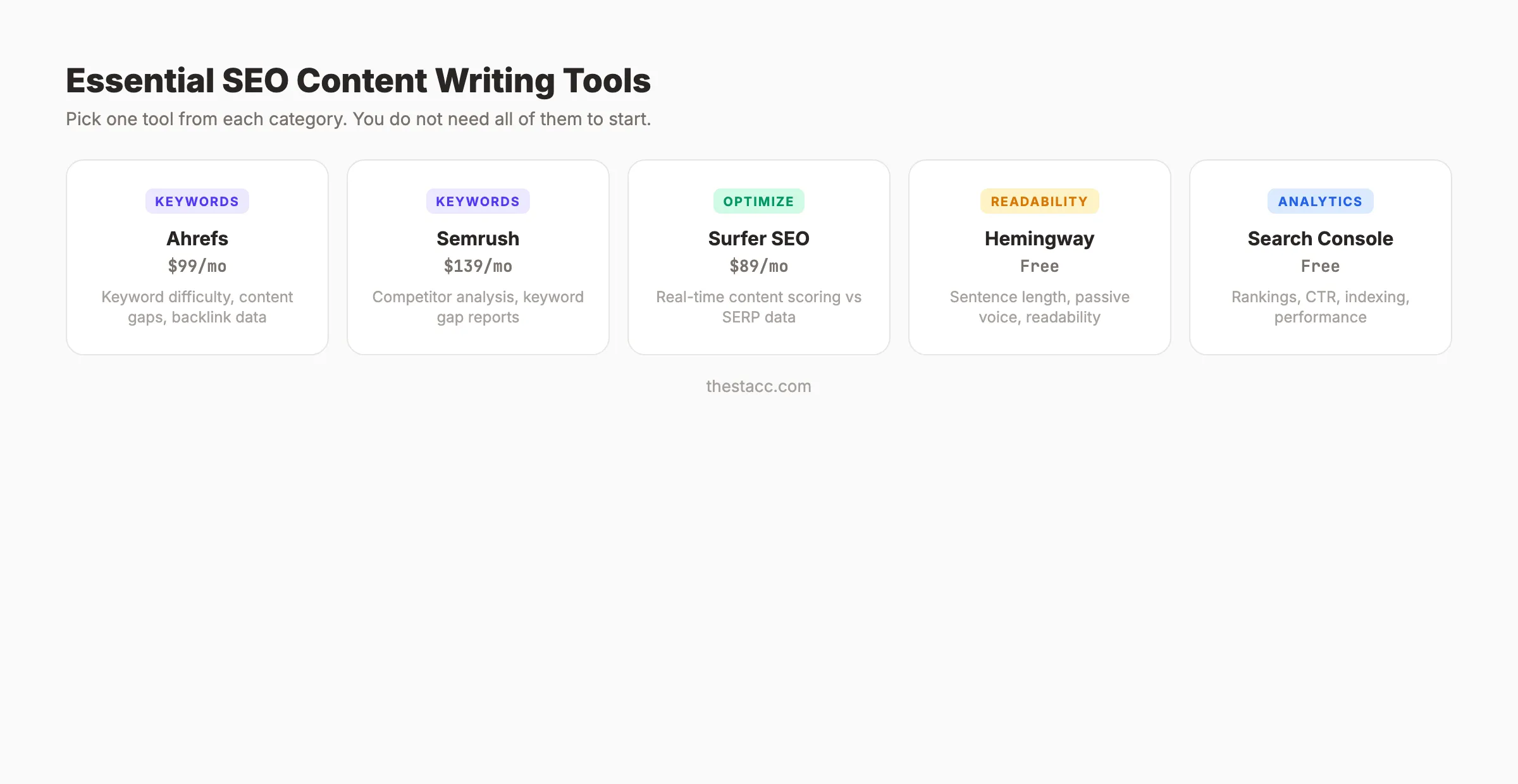
These tools support each step of the SEO content writing process. You do not need all of them. Pick 1 from each category.
| Category | Tool | Price | Best For |
|---|---|---|---|
| Keyword research | Ahrefs | $99/mo | Accurate difficulty scores, content gap analysis |
| Keyword research | Semrush | $139/mo | Competitor analysis, keyword gap reports |
| Keyword research | Ubersuggest | Free/limited | Budget-friendly starting point |
| Content optimization | Surfer SEO | $89/mo | Real-time content scoring against SERP data |
| Content optimization | Clearscope | $170/mo | NLP-based topic coverage analysis |
| Readability | Hemingway Editor | Free | Sentence length and readability scoring |
| Grammar | Grammarly | Free/paid | Grammar, tone, and clarity checks |
| SEO audit | Google Search Console | Free | Ranking data, CTR, indexing issues |
| Analytics | Google Analytics 4 | Free | Traffic, engagement, conversion tracking |
| Headlines | Headline Analyzer | Free | Character count and SEO readiness |
Check our guide on the best SEO content writing tools for detailed reviews of each option.
FAQ
What is the difference between SEO writing and regular writing?
SEO writing adds keyword research, search intent matching, on-page optimization, and strategic structure to regular writing skills. Regular writing focuses on clarity and engagement. SEO writing focuses on ranking in search results while maintaining clarity and engagement. The best SEO content does both.
How long should SEO content be?
There is no fixed answer. The right length matches or beats the top 3 ranking pages for your target keyword. How-to guides typically need 1,500 to 3,500 words. Ultimate guides need 3,000 to 8,000 words. Definition posts need 800 to 1,500 words. Check the SERP before setting a word count target.
How many keywords should I use in one article?
One primary keyword and 2 to 3 secondary keywords. The primary keyword appears in the title, slug, first 100 words, at least 1 H2, and the meta description. Secondary keywords appear naturally in the body. Aim for 1 to 2% density for the primary keyword.
How often should I publish SEO content?
More is better, up to a point. Companies publishing 16+ posts per month see 3.5 times more traffic than those publishing 0 to 4. Consistency matters more than volume. 4 posts per month, every month, outperforms 30 posts in January and nothing in February.
Can AI write SEO content?
AI tools can assist with drafts, outlines, and research. But AI-generated content without human editing, fact-checking, and optimization performs poorly. Google evaluates content quality regardless of how it was produced. The process matters more than the tool. Read our guide on using AI to write blog posts for the right approach.
Does Stacc handle SEO content writing?
Yes. Stacc researches keywords, matches search intent, writes optimized content, and publishes 30 blog posts per month automatically. Every article follows the 6-step process outlined in this guide. You do not need a writer, editor, or SEO specialist on your team.
SEO content writing is not about tricks or shortcuts. It is about matching what people search for with content that answers their questions better than anything else on page 1. Follow the 6-step process in this guide for every article you publish. The results compound with every post.
Related Tools & Resources
Free SEO Tools:
Best Lists:

Written by
Siddharth GangalSiddharth is the founder of theStacc and Arka360, and a graduate of IIT Mandi. He spent years watching great businesses lose organic traffic to competitors who simply published more. So he built a system to fix that. He writes about SEO, content at scale, and the tactics that actually move rankings.
30 SEO blog articles published every month
Keyword-optimized, scheduled, and live on your site. Automatically.
30-day trial · Cancel anytime
theStacc
Stop writing SEO content manually
30 blog articles, 30 GBP posts, and social media content. Published every month. Automatically.
Start Your $1 Trial$1 for 3 days · Cancel anytime