
How to Write a Blog Post Outline in 7 Steps (2026)
A step-by-step guide to writing blog post outlines that improve structure, rankings, and writing speed. Used across 3,500+ published articles. Updated 2026.
The average blog post takes 3.5 hours to write. Most of that time goes to staring at a blank screen, reorganizing paragraphs, and rewriting sections that do not fit together. The result? 96.55% of published pages get zero traffic from Google.
The problem is not the writing. It is the lack of a blog post outline before the writing starts.
Without a clear outline, content drifts. Keywords get buried or missed entirely. Sections repeat each other. Revisions stack up. And the finished post fails to match what searchers actually want.
A structured outline fixes every one of those problems. Research shows that well-structured posts receive 250% more engagement than unstructured ones. Outlining also cuts drafting time by 30 to 50 percent and reduces revisions by 40 percent.
We have published 3,500+ blogs across 70+ industries. Every single one starts with an outline. The process below is what our editorial team uses to produce content at scale without sacrificing quality or SEO performance.
Here is what you will learn:
- How to build a blog post outline from keyword research to final stress-test
- How to match your outline to search intent and post format
- How to structure headings for both readers and Google
- How to plan internal links, external sources, and visuals before you write a single paragraph
- How to adapt this process for different post types (guides, listicles, comparisons)
What Is a Blog Post Outline (and Why It Matters for SEO)
A blog post outline is the skeletal structure of your article. It maps out every heading, subheading, and key point before you write the first draft.
Think of it as architectural blueprints. No builder starts pouring concrete without a plan. No writer should start drafting without an outline.
Outline vs. Content Brief
These two terms get confused often. They serve different purposes.
A content brief is the strategy document. It defines the target keyword, audience, intent, competitors, and goals. A blog post outline is the execution plan. It takes the brief and turns it into a heading-by-heading writing guide.
| Element | Content Brief | Blog Post Outline |
|---|---|---|
| Purpose | Define what to write and why | Define how to structure it |
| Contains | Keyword, intent, audience, goals | H2s, H3s, key points, links |
| Created by | Strategist or SEO lead | Writer or editor |
| Used for | Planning | Drafting |
You need both. The brief comes first. The outline comes second.
Why Outlines Improve SEO Performance
Google evaluates content structure. Heading hierarchy signals topic coverage and depth. A clear H2/H3 structure helps search engines understand what each section covers and how sections relate to each other.
80% of high-performing content teams have a documented strategy. That strategy includes outlining.
The data backs this up across 3 dimensions:
- Speed: Outlining cuts drafting time by 30 to 50 percent
- Quality: Structured content gets 250% more engagement
- Efficiency: Fewer revisions mean lower production costs
Skipping the outline does not save time. It wastes it.
Step 1: Define Your Target Keyword and Search Intent
Every blog post outline starts with a keyword. Not a topic. Not a vague idea. A specific keyword that real people type into Google.
Topic brainstorming leads to content that sounds interesting but ranks for nothing. Keyword research for blog posts leads to content that matches actual demand.
How to Choose the Right Keyword
Open your keyword research tool. Look for terms with:
- Monthly search volume above 100
- Keyword difficulty you can realistically compete for
- Clear commercial or informational intent
- Relevance to your business or niche
For this article, the target keyword is “blog post outline.” It has clear informational intent, steady search volume, and direct relevance to content creators.
Identify the Search Intent
Every keyword carries intent. Google classifies intent into 4 types:
| Intent Type | Searcher Wants | Example Keywords |
|---|---|---|
| Informational | Learn something | ”what is a blog post outline” |
| Navigational | Find a specific page | ”HubSpot blog outline template” |
| Commercial | Compare options before buying | ”best outline tools for bloggers” |
| Transactional | Take action or purchase | ”buy blog outline template” |
Check the SERP for your keyword. What format dominates the top 10 results? If every top result is a how-to guide, write a how-to guide. If listicles dominate, write a listicle. Fighting the SERP format is fighting Google.
For “blog post outline,” the SERP shows step-by-step guides and how-to posts. That tells us the format before we even start outlining.
Why This Step Matters
The keyword and intent determine everything that follows. The wrong keyword means zero traffic no matter how good the outline is. The wrong intent means high bounce rates even if you rank. Get this step right and the rest of the outline builds itself.
Step 2: Analyze the Top 5 Ranking Pages
Open the top 5 Google results for your target keyword. Study them. This is not optional.
You are not copying. You are mapping the competitive standard. Google already told you what it considers the best content for this query. Your job is to understand why those pages rank and then build something better.
What to Document From Each Page
For each of the top 5 results, record:
- H2 and H3 structure: Write down every heading in order
- Word count: Use a browser extension or copy-paste into a word counter
- Format: Is it a listicle, step-by-step, ultimate guide, or something else?
- Unique angles: What does this page cover that others do not?
- Visual elements: Tables, images, infographics, videos, downloadable templates
- Internal and external links: What sources do they reference?
Find the Content Gap
The content gap is what separates your post from a rewrite of existing content. After reviewing all 5 pages, ask:
- What questions do they all leave unanswered?
- What sections feel thin or rushed?
- What data or examples are missing?
- What reader objections go unaddressed?
For blog post outline content specifically, most competitors miss 3 things. They do not cover outlining for SEO at scale. They do not connect outline quality to ranking outcomes with data. And they do not provide type-specific templates for different post formats.
Those gaps become your advantage. The ability to find content gaps is what separates content that ranks from content that sits on page 5.
You can also analyze competitor keywords to discover related terms your outline should cover.
Why This Step Matters
Competitor analysis gives you a minimum quality bar. Your outline needs to meet or exceed the depth, structure, and value of existing top results. Without this step, you are guessing. With it, you are building on proven data.
Step 3: Choose the Right Post Format
The format of your blog post determines the entire heading structure. Pick the wrong format and the outline falls apart before you start writing.
Format selection is not creative expression. It is pattern matching. Google rewards content that matches the dominant SERP format for a given keyword.
Format Selection Guide
Use the keyword pattern to determine the right format:
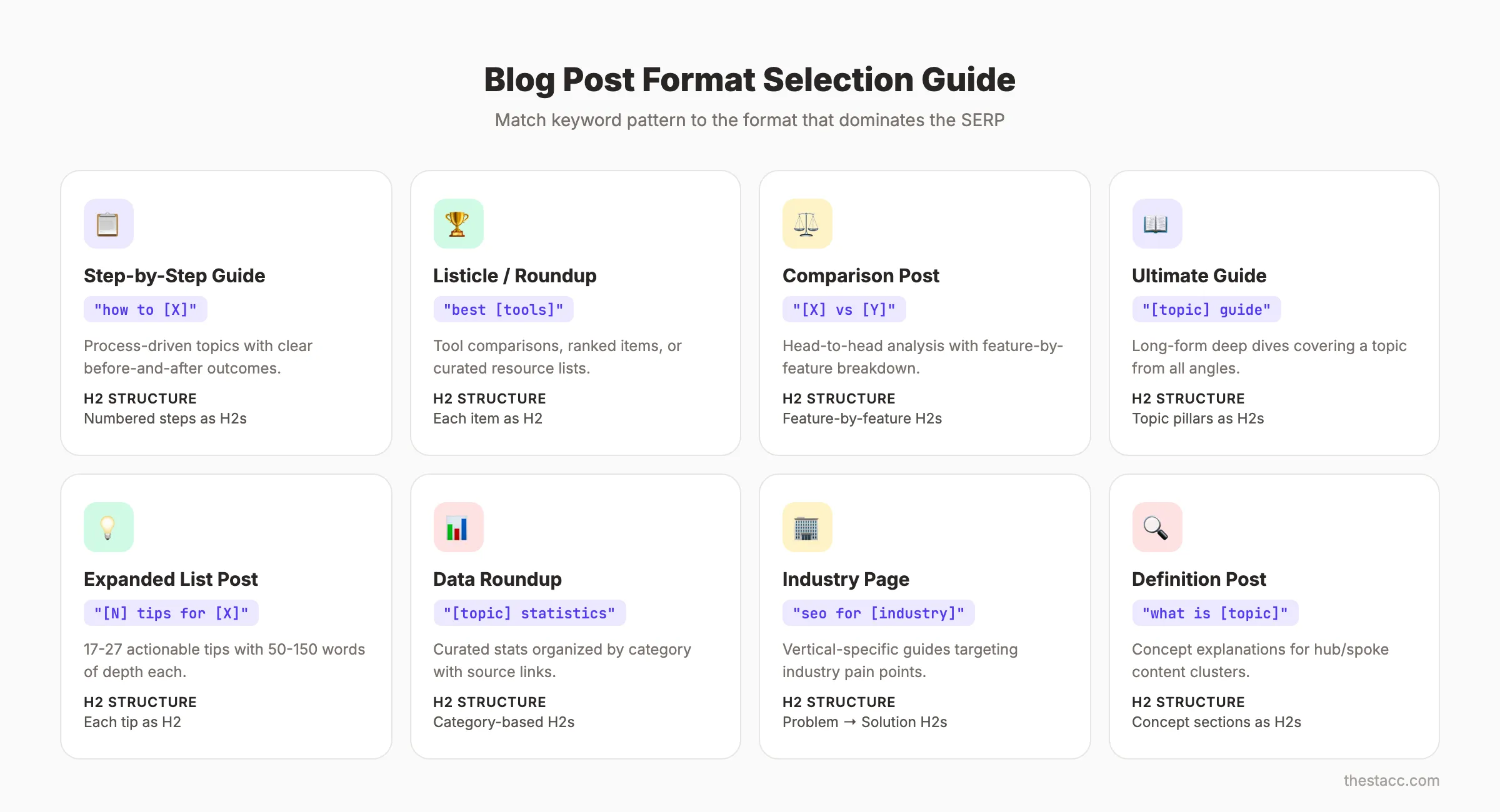
| Keyword Pattern | Best Format | H2 Structure |
|---|---|---|
| ”how to [X]“ | Step-by-step guide | Numbered steps as H2s |
| ”best [tools/software]“ | Listicle or roundup | Each tool as H2 |
| ”[X] vs [Y]“ | Comparison | Feature-by-feature H2s |
| ”what is [topic]“ | Ultimate guide | Concept sections as H2s |
| ”[N] tips for [X]“ | Expanded list post | Each tip as H2 |
| ”[topic] statistics” | Data roundup | Category-based H2s |
| ”[topic] guide” | Long-form guide | Topic pillars as H2s |
51% of blog-producing businesses report that how-to guides perform best. That makes the step-by-step format a strong default when the keyword supports it.
When Format and Keyword Conflict
Sometimes the keyword suggests one format but the SERP shows another. Trust the SERP.
If your keyword is “content marketing tips” but the top 5 results are all long-form guides, write a guide. The SERP is the final authority on format.
This connects directly to how you structure a blog post for SEO. The right structure starts with the right format.
If you want deeper guidance on writing within any format, read our guide on how to write SEO blog posts.
Why This Step Matters
Format is the skeleton of your outline. Every heading, every section, and every transition flows from the format you choose. A step-by-step guide has numbered sections. A roundup has individual item sections. A comparison has feature-based sections. Choose the format first. Then build the headings.
Step 4: Map Your H2 and H3 Headings
This is where the blog post outline takes shape. You are building the heading hierarchy that will guide both the writer and the reader through the content.
Start with H2s. These are your main sections. Each H2 should represent a distinct subtopic or step. Then add H3s under each H2 for subsections that break down the main point.
Rules for Strong Headings
Follow these 5 rules for every heading in your outline:
- Make headings action-oriented (“Map Your Headings” not “Headings”)
- Include the target keyword in at least 1 H2
- Avoid vague labels (“Things to Know” tells the reader nothing)
- Keep headings under 70 characters
- Maintain logical hierarchy (no orphan H3s without a parent H2)
Assign Word Counts Per Section
Not every section needs equal length. Assign target word counts based on the complexity and importance of each section.
| Section Type | Suggested Word Count |
|---|---|
| Introduction (PASBA) | 200-300 words |
| Definition or overview H2 | 250-400 words |
| Each step or main H2 | 200-400 words |
| FAQ section | 300-500 words |
| Closing | 100-150 words |
Add up all section targets. Your total should meet or beat the top SERP result by 20 to 30 percent. If the top result is 2,500 words, aim for 3,000 to 3,250.
39% of marketers publishing posts over 2,000 words report strong results. That is nearly double the 21% benchmark for shorter content.
Example Heading Map
Here is a simplified heading map for a “how to start a blog” outline:
H2: What You Need Before Starting a Blog
  H3: Choose a Niche
  H3: Pick a Blogging Platform
H2: Step 1. Register Your Domain Name
  H3: Where to Buy a Domain
  H3: Domain Name Best Practices
H2: Step 2. Set Up Hosting
  ...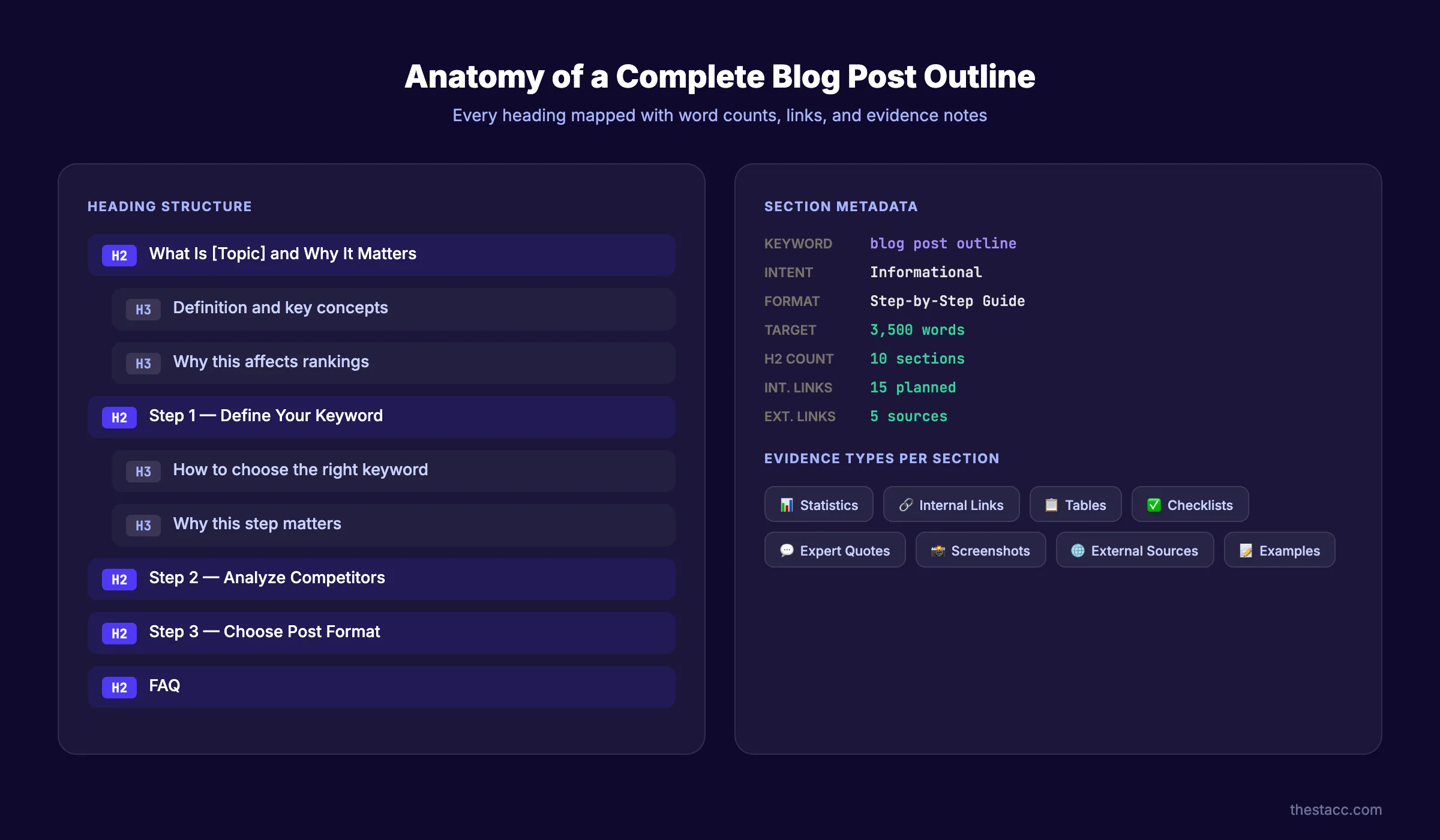
Each H2 has at least 1 supporting H3. No heading sits alone without body text beneath it. The structure flows logically from setup to execution.
Strong headings also help you earn featured snippets. Google pulls structured content directly into snippet boxes.
For more on heading strategy and SEO content writing, follow the link.
Why This Step Matters
The heading map is the single most important part of your outline. It determines the reader’s experience, Google’s understanding of your content, and the writer’s clarity during drafting. A strong heading map makes writing almost mechanical. A weak one guarantees confusion.
Stop writing. Start ranking. Stacc publishes 30 SEO articles per month for $99. Every article starts with a heading-optimized outline. Start for $1 →
Step 5: Add Supporting Evidence to Each Section
Headings without substance produce thin content. Under each H2 and H3, list the specific points, data, examples, and resources you plan to include.
This step transforms a heading map into a full blog post outline. It is the difference between a skeleton and a body.
What to Add Under Each Heading
For every section in your outline, note:
- Key points: 2 to 4 bullet points summarizing what the section will cover
- Statistics or data: Specific numbers from credible sources
- Examples: Real-world cases, screenshots, or before-and-after comparisons
- Internal links: Pages on your site that support the section
- External links: Authoritative sources that add credibility
- Visual elements: Tables, checklists, images, or diagrams
Plan Your Internal Links
Internal links are not an afterthought. Plan them during the outline phase.
Target 3 to 5 internal links per 1,000 words of content. Use descriptive anchor text that tells the reader and Google what the linked page covers.
For example, instead of “click here for more,” use “internal linking best practices” as the anchor.
Map each link to a specific section in your outline. This prevents link clustering (too many links in one section) and ensures even distribution.
If you plan to reference external authority, source it now. Credible external links strengthen your E-E-A-T signals and build trust with both readers and search engines.
Plan Your Visual Elements
Visual variety keeps readers engaged. Plan at least 1 visual element per 500 words.
Types that work well in blog outlines:
- Tables for comparisons and data
- Checklists for actionable steps
- Screenshots for tool walkthroughs
- Infographics for process flows
- Blockquotes for expert insights or callouts
Planning visuals at the outline stage prevents the common problem of walls of text with no visual breaks.
You can also plan where to build backlinks by identifying sections with original data or unique frameworks. Linkable assets start in the outline.
Why This Step Matters
An outline with just headings is a table of contents. An outline with supporting evidence is a drafting blueprint. Writers who complete this step report 30 to 50 percent faster drafting times because they never wonder “what goes here?”
Step 6: Write Your Opening and Closing Notes
The opening and closing are the hardest sections to write from scratch. That is why you plan them in the outline.
Outline Your Opening With PASBA
PASBA is a 5-part opening framework:
| Element | Purpose | Length |
|---|---|---|
| P. Problem | Name the reader’s exact pain point | 1-2 sentences |
| A. Agitate | Show what this problem costs them | 1-2 sentences |
| S. Solution | State what this article delivers | 1 sentence |
| B. Bridge | Establish credibility | 1 sentence |
| A. Action | Preview what they will learn | Bullet list |
One critical rule: include your target keyword in the first 100 words. This is a basic on-page SEO signal that many writers miss.
Write brief notes for each PASBA element in your outline. You do not need full sentences. Just capture the core idea.
Example outline notes for this article:
P: Blog posts take 3.5 hours. Most rank for nothing.
A: Without structure, content drifts, misses keywords, needs heavy revisions.
S: 7-step outlining process used across 3,500+ articles.
B: We publish 3,500+ blogs across 70+ industries.
A: Bullets. Keyword research, heading maps, link planning, stress-testing.
Those notes took 2 minutes. They saved 20 minutes during drafting.
Strong openings also depend on strong blog headlines. The headline pulls readers in. The opening keeps them reading.
Outline Your Closing
The closing is not a summary. It is a forward action.
Plan 2 to 3 sentences that:
- Restate the single most important takeaway
- Point the reader toward their next step
- Include a call to action
Do not repeat your introduction. Do not list everything the article covered. Readers who reach the closing already read the article. They need direction, not repetition.
Why This Step Matters
Openings determine whether readers stay or bounce. Closings determine whether readers take action or leave. Planning both at the outline stage ensures they connect to the article’s core message instead of feeling tacked on.
Step 7: Review, Refine, and Stress-Test the Outline
A finished outline needs testing before it goes to a writer. This final step catches structural problems, gaps, and misalignment before they cost you drafting time.
The 5-Point Stress Test
Run every outline through these 5 checks:
- Intent alignment: Does every section serve the searcher’s intent?
- Heading hierarchy: No orphan H3s, no skipped heading levels, no consecutive headings without body text
- Word count target: Total target beats the top SERP result by 20 to 30 percent
- Link verification: Every internal link target exists, every external source is live
- Table of contents test: Would you click every heading if you saw them listed?
The Table of Contents Test
This test is simple but revealing. List all your H2 headings in order. Read them as a table of contents.
Ask yourself:
- Does the sequence make logical sense?
- Does each heading promise clear value?
- Are there any headings that feel redundant?
- Would a reader scanning this list understand the full scope of the article?
If any heading fails this test, rewrite it or remove it.
Refine for Scale
If you produce content at high volume, your outline process needs to scale. At 30 to 50 posts per month, inconsistency kills quality.
Standardize your outline format. Use templates for each post type. Train every writer on the same heading rules and evidence requirements.
This is what allows operations to scale blog content with AI without losing editorial quality. The outline is the quality control layer.
61% of content marketers already use AI to write blog posts and assist with outlining. AI can accelerate outline creation. But the strategic decisions. Keyword selection, intent matching, gap identification. Still require human judgment.
A MIT study found that AI-assisted writing reduced task completion time by 40 percent. Outlining is the stage where that productivity gain is largest.
Why This Step Matters
An unreviewed outline becomes an unstructured post. The stress test takes 10 to 15 minutes. It saves hours of revision and rewriting later. Every outline our team produces goes through this check before a single word of the draft is written.
Your SEO team. $99 per month. 30 optimized articles, published automatically. Every one starts with a stress-tested outline. Start for $1 →
What to Expect After Outlining
A strong blog post outline changes your entire content workflow. Here is what the data shows.
Time Investment
The outline itself takes 20 to 40 minutes. That investment pays off immediately during drafting.
| Metric | Without Outline | With Outline |
|---|---|---|
| Drafting time | 3-4 hours | 1.5-2.5 hours |
| Revision rounds | 3-5 rounds | 1-2 rounds |
| Keyword coverage | Inconsistent | Systematic |
| Internal links | Afterthought | Pre-planned |
| Heading structure | Disorganized | SEO-optimized |
Quality at Scale
Single posts benefit from outlining. But the real impact shows at scale.
When you publish enough blog posts to rank consistently, outline quality becomes the bottleneck. A team producing 30 posts per month with outlines will outperform a team producing 30 posts per month without them every single time.
Outlines also support content clusters and topical authority. Each outline maps to a specific keyword within a broader topic cluster. That deliberate structure builds authority faster than random publishing.
Before and After
Teams that adopt structured outlining report:
- 30 to 50 percent faster drafting
- 40 percent fewer revision cycles
- Higher average SEO scores across published content
- More consistent brand voice across writers
- Easier onboarding for new writers
The outline does not replace good writing. It creates the conditions for it.
A documented content strategy, starting with outlines, also feeds into your content calendar. When every post has a pre-built outline, scheduling and assigning content becomes predictable instead of chaotic.
Blog Post Outline Templates by Format
Different post types need different outline structures. Here are starter templates for the 4 most common blog formats.
How-To Guide Template
H2: What Is [Topic] (and Why It Matters)
H2: Step 1 ,  [Action Verb] + [Object]
  H3: How to [Sub-action]
  H3: Why This Step Matters
H2: Step 2 ,  [Action Verb] + [Object]
  ...
H2: Common Mistakes to Avoid
H2: FAQ
Listicle Template
H2: What Makes a Great [Category Item]
H2: 1. [Item Name]
  H3: Key Features
  H3: Pricing
  H3: Best For
H2: 2. [Item Name]
  ...
H2: How to Choose the Right [Category Item]
H2: FAQ
Comparison Template
H2: [X] vs [Y]. Quick Overview
H2: Feature 1 Comparison
H2: Feature 2 Comparison
  ...
H2: Pricing Comparison
H2: Which One Should You Choose?
H2: FAQ
Ultimate Guide Template
H2: What Is [Topic]
H2: Why [Topic] Matters for [Audience]
H2: [Core Concept 1]
  H3: [Sub-concept]
  H3: [Sub-concept]
H2: [Core Concept 2]
  ...
H2: [Topic] Best Practices
H2: FAQ
Use these as starting points. Customize based on your SERP analysis from Step 2.
For a detailed look at blogging statistics that support each format, follow the link.
FAQ
What is a blog post outline and why do I need one?
A blog post outline is a structured plan of headings, subheadings, and key points created before writing the draft. You need one because it prevents content drift, ensures keyword coverage, and cuts drafting time by 30 to 50 percent. Without an outline, writers waste time reorganizing content during revisions instead of producing new work.
How long should a blog post outline be?
A typical outline runs 300 to 600 words. It includes all H2 and H3 headings, 2 to 4 bullet points under each heading, planned links, and target word counts per section. The outline for a 3,000 word article should take 20 to 40 minutes to build. Spending more time on the outline saves more time during drafting.
What is the difference between a blog outline and a content brief?
A content brief defines the strategy: target keyword, audience, intent, competitors, and goals. A blog outline defines the execution: heading structure, key points, evidence, and links. The brief answers “what should we write and why?” The outline answers “how should we structure it?” You need both for consistent, high-quality output.
Can I use AI to create a blog post outline?
Yes. 61 percent of content marketers use AI for outlining tasks. AI works well for generating initial heading structures and suggesting subtopics. But the strategic decisions. Keyword selection, intent matching, content gap identification, and internal link planning. Require human judgment. Use AI to accelerate the outline. Do not use it to replace the strategy behind it. Read more on how to use AI to write blog posts effectively.
How do you outline different types of blog posts?
Each post format has a different heading structure. How-to guides use numbered steps as H2s. Listicles use individual items as H2s. Comparisons use feature-based H2s. Ultimate guides use topic pillar H2s. Match the outline structure to the format that dominates the SERP for your target keyword. See the templates section above for starter outlines by format.
How does Stacc handle blog post outlining?
Every article Stacc publishes starts with a keyword-driven outline. We match the outline to search intent, analyze competitor headings, identify content gaps, and pre-plan all internal and external links. The result is consistent, SEO-optimized content at scale. We publish 3,500+ blogs across 70+ industries with a 92 percent average SEO score. You do not need to create outlines yourself. We handle the entire process from keyword to published post.
3,500+ blogs published. 92% average SEO score. See what Stacc can do for your site. Every article starts with a research-backed outline. Start for $1 →
Start With the Outline
A blog post outline is the single most impactful step in your content workflow. It takes 20 to 40 minutes. It saves hours of drafting, revision, and restructuring.
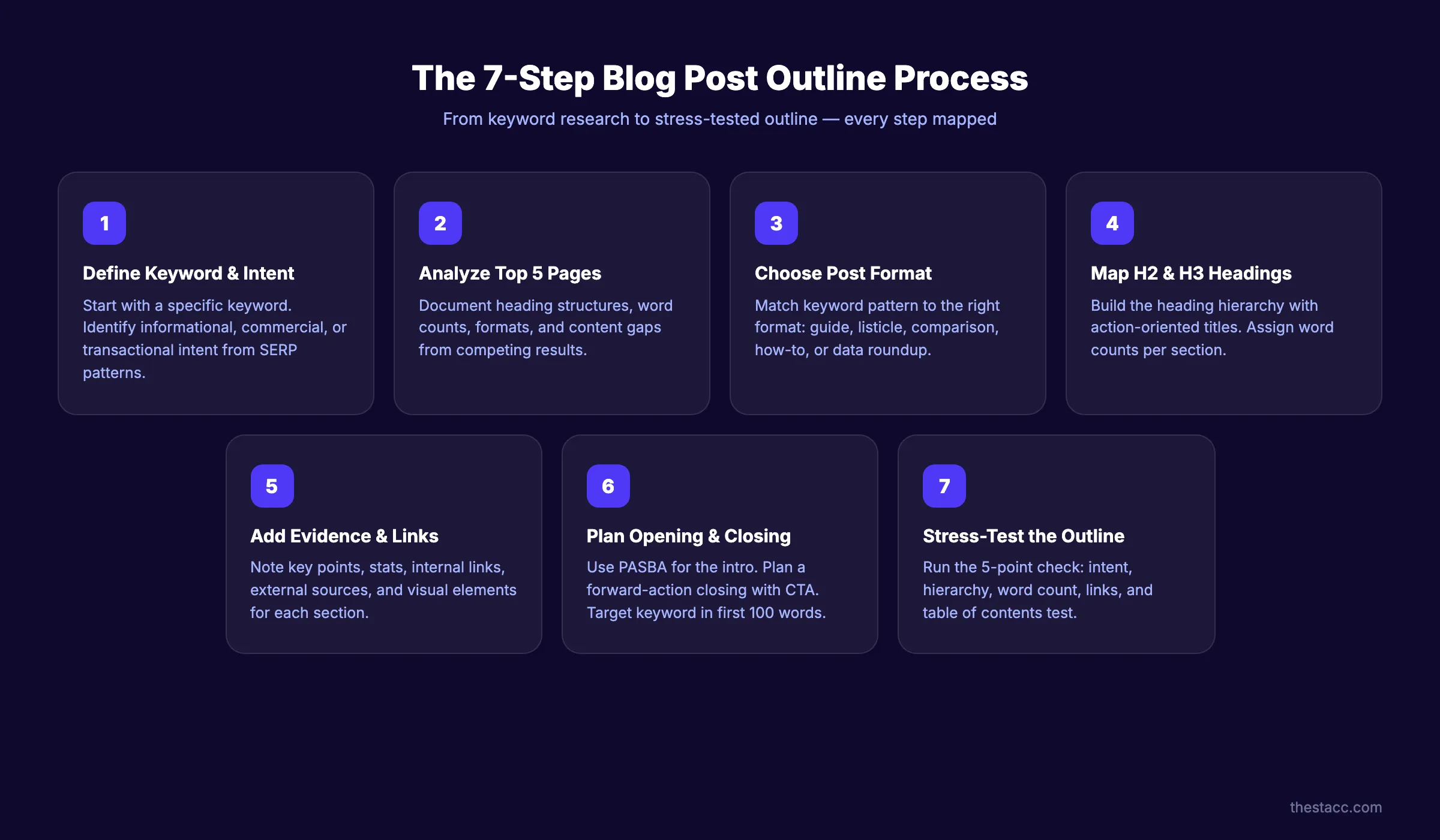
Follow the 7 steps: define your keyword, analyze the competition, choose your format, map your headings, add supporting evidence, plan your opening and closing, and stress-test the result. Do this for every post and your content quality, speed, and SEO performance will compound over time.
If you want outlines and articles handled for you, Stacc publishes 30 optimized blog posts per month for $99. Every post follows this exact process. Your next article is already waiting.

Written by
Siddharth GangalSiddharth is the founder of theStacc and Arka360, and a graduate of IIT Mandi. He spent years watching great businesses lose organic traffic to competitors who simply published more. So he built a system to fix that. He writes about SEO, content at scale, and the tactics that actually move rankings.
30 SEO blog articles published every month
Keyword-optimized, scheduled, and live on your site. Automatically.
30-day trial · Cancel anytime
theStacc
Stop writing SEO content manually
30 blog articles, 30 GBP posts, and social media content. Published every month. Automatically.
Start Your $1 Trial$1 for 3 days · Cancel anytime