
How Many Blog Posts to Rank on Google? (2026 Data)
Data shows you need 30-50 focused blog posts to start ranking on Google. See the exact benchmarks, publishing frequency stats, and topical authority thresholds.
You need 30 to 50 focused blog posts to start ranking on Google consistently. That number assumes you are targeting long-tail keywords within a single topic cluster. Sites that cross the 50-article threshold in a focused niche see a measurable organic traffic jump. Publishing more does not guarantee rankings. Publishing the right amount, on the right topics, does.
Most businesses publish 1 to 4 blog posts per month and wonder why Google ignores them. The math is brutal. Ahrefs reports that 96.55% of all published pages get zero organic traffic. Zero.
The problem is not effort. It is volume, focus, and consistency. Most blogs never hit the critical mass needed to signal topical authority to search engines. That leaves rankings, traffic, and revenue on the table every single month.
This post compiles 30+ data points from HubSpot, Ahrefs, Semrush, Orbit Media, and Backlinko to answer one question: how many blog posts do you actually need to rank? We publish 3,500+ blogs across 70+ industries, so we see the patterns firsthand.
Here is what you will learn:
- The exact blog volume thresholds that correlate with ranking improvements
- How publishing frequency affects lead generation and traffic
- Minimum article counts for topical authority in competitive niches
- New website benchmarks for your first 6 months
- Where quality outweighs quantity (and where it does not)
General Blog Volume Statistics
1. 96.55% of all published pages get zero organic traffic from Google. Source: Ahrefs, 2023 The vast majority of content never earns a single visitor from search. Volume alone does not fix this. You need targeted, well-structured content to land in the 3.45% that gets traffic.
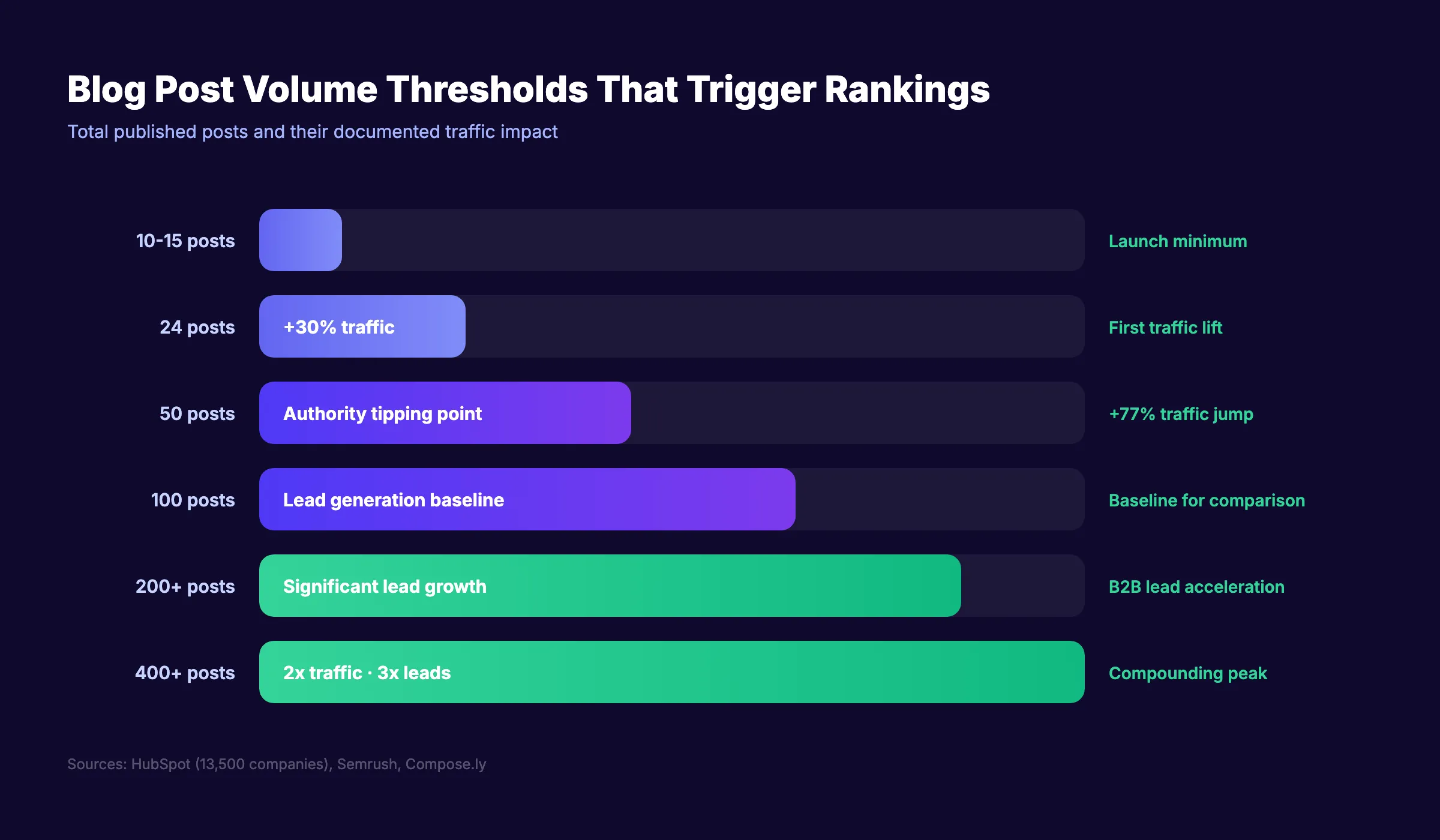
2. Companies with 400+ blog posts generate roughly 2x more traffic than those with 301 to 400 posts. Source: HubSpot, 2024 This is not a linear curve. Traffic growth accelerates after a blog crosses a large content threshold. The compounding effect kicks in once Google sees sustained depth on a topic.
3. Companies with 400+ posts generate 3x more leads than companies with fewer than 100 posts. Source: HubSpot, 2024 Leads, not just traffic. A larger content library captures more long-tail queries and moves readers deeper into the funnel through internal linking.
4. Sites crossing 50 articles in a focused niche see a significant organic traffic jump. Source: Semrush, 2024 The 50-article mark functions as a tipping point. Below it, Google lacks enough signals to trust your site on a topic. Above it, crawl frequency and ranking velocity both increase.
5. A site with 20 interconnected articles on a topic consistently outranks a single 5,000-word guide. Source: Semrush, 2024 Depth beats length. Twenty targeted posts covering subtopics, linked together, signal far more authority than one long page. This is the foundation of topical map strategy.
6. The average first-page Google result contains 1,447 words. Source: Backlinko, 2024 Each post in your library needs substance. Thin 300-word posts do not count toward the volume thresholds above. Aim for 1,200 to 2,000 words per article as your baseline for blog post length.
Publishing Frequency and Ranking Correlation
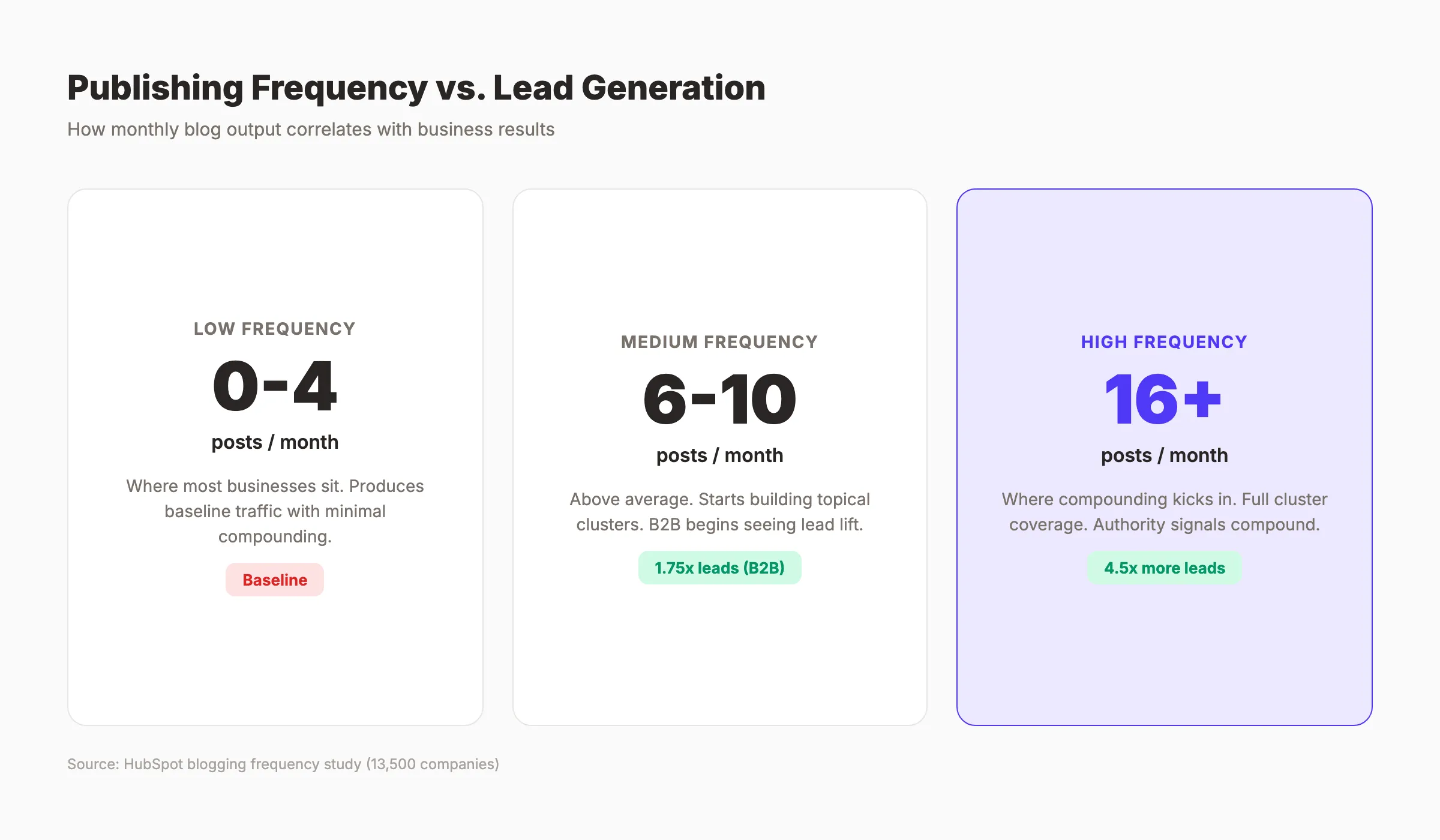
7. Companies publishing 16+ posts per month generate 4.5x more leads than those publishing 0 to 4. Source: HubSpot, 2024 This is the single most cited stat in content marketing. The gap between 4 and 16 monthly posts is not incremental. It is exponential in lead generation impact.
8. B2B companies blogging 11+ times per month earn 3.75x more leads than those blogging 3 or fewer times. Source: HubSpot, 2024 Even in B2B, where sales cycles are longer, higher publishing frequency directly correlates with lead volume. The key is maintaining quality at scale through a disciplined content calendar.
9. B2C companies with 400+ blog posts earn 4.5x more leads than those with 100 or fewer. Source: HubSpot, 2024 B2C sees an even sharper compounding effect. Consumer search queries are more varied. A larger content library captures more of that long-tail demand through keyword research.
10. Only 39% of bloggers publish at least once per week. Source: Orbit Media, 2025 The majority of blogs publish less than weekly. That means consistent weekly publishing already puts you in the top 40% by frequency alone. The bar is lower than most people assume.
11. About half of all marketers publish 2 to 4 times per month. Source: Orbit Media, 2025 This is the average. Average produces average results. Breaking above 4 posts per month separates you from the pack and begins triggering the compounding traffic effects HubSpot documented.
12. Sites publishing weekly content targeting long-tail keywords averaged 1,200 monthly visitors within 6 months. Source: Semrush, 2024 Weekly publishing plus long-tail targeting is a reliable formula. That is roughly 24 posts over 6 months to reach 1,200 monthly visitors. For new sites, this benchmark is realistic and achievable with a focused content strategy.
13. Weekly publishers see 34% year-over-year organic growth without active link building. Source: Semrush, 2024 Consistent publishing builds organic traffic even without backlinks. The content itself earns internal authority signals through topical coverage and interlinking.
Stop publishing 2 posts per month and wondering why nothing ranks. Stacc publishes 30 to 80 SEO-optimized articles per month for your business, starting at $99. Start for $1 →
Topical Authority and Content Clusters
14. Topic clusters increase organic traffic by 40% compared to standalone posts. Source: HubSpot, 2024 Clustering content around a pillar page and supporting subtopics creates a network of relevance signals. Google rewards the structure, not just the individual posts.
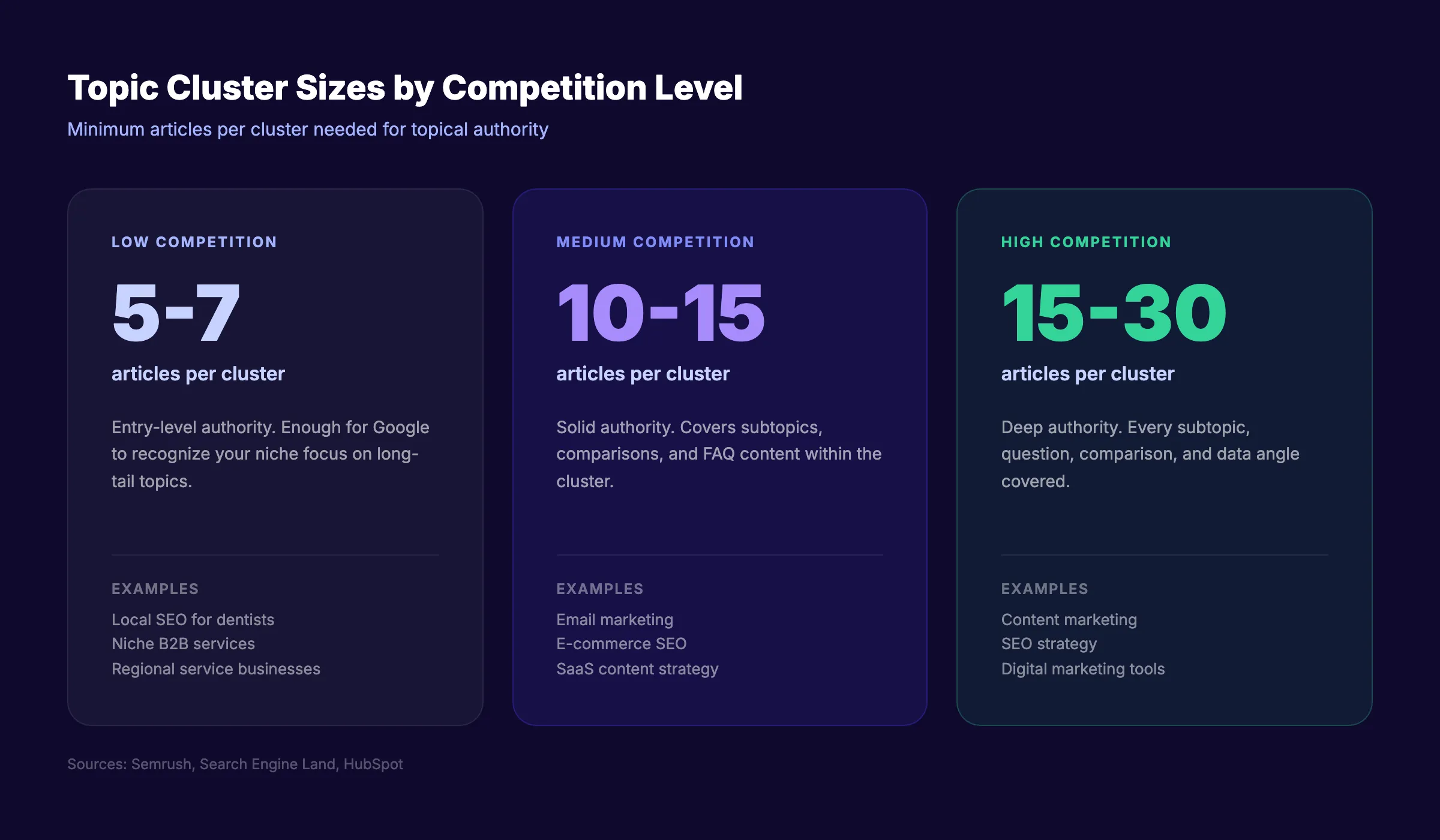
15. You need a minimum of 5 to 7 articles per topic cluster for basic authority. Source: Semrush, 2024 Five articles is the entry-level threshold. Below that, the cluster is too thin for Google to recognize your site as a credible source on the topic.
16. Competitive topics require 15 to 30 articles per cluster. Source: Semrush, 2024 If you are targeting keywords like “content marketing” or “SEO strategy,” 5 posts will not cut it. You need deep coverage across subtopics, questions, comparisons, and data posts. Learn how to find those content gaps.
17. Topic clusters produce a 10 to 20% SERP ranking bump versus isolated articles. Source: Search Engine Land, 2024 The ranking lift from clustering is measurable. A post about “blog post length” performs better when surrounded by related posts on blog structure, SEO content writing, and headline optimization.
18. B2B companies blogging 11+ times per month earn 1.75x more leads than those posting 6 to 10 times. Source: HubSpot, 2024 The jump from 6 to 11 monthly posts is where cluster depth starts to matter. At 11+ posts per month, you are adding enough content to build meaningful authority in multiple topic areas simultaneously.
19. Blogs that build topical authority rank faster for new content in the same niche. Source: Semrush, 2024 Once Google trusts your site on a topic, new articles in that topic index and rank faster. This is the Content Compound Effect in action. Each article makes the next one easier to rank.
New Website Blog Post Benchmarks
20. New websites should have 10 to 15 blog posts published before launch. Source: Semrush, 2024 Launching with zero content wastes your initial crawl budget. Google needs something to evaluate. Having 10 to 15 posts gives crawlers enough material to understand your site’s topic focus from day one. See our guide on SEO for new websites.
21. New blogs should target 6 to 8 posts per month to build momentum. Source: Semrush, 2024 This is the minimum effective dose for new sites. Fewer than 6 posts per month extends the time to reach critical mass beyond what most businesses can tolerate.
22. It takes 3 to 6 months for a new page to reach its ranking potential. Source: Ahrefs, 2023 Even excellent content needs time. Google evaluates user signals, backlink acquisition, and content freshness over months. Patience plus consistency is the formula. Plan your timeline with a content marketing strategy.
23. New sites publishing weekly content averaged 1,200 monthly visitors within 6 months. Source: Semrush, 2024 At 4 posts per month for 6 months, you reach 24 total posts. That volume, focused on long-tail keywords, reliably generates 1,000+ monthly visitors for most niches. Start with our guide on how to start a blog that gets organic traffic.
24. 96.55% of pages get zero traffic, meaning most new site content fails without a strategy. Source: Ahrefs, 2023 Random publishing does not work. Every post on a new site must target a specific keyword with clear search intent. Wasting posts on untargeted content delays your path to rankings.
25. The 50-article threshold applies to new sites as well. Source: Semrush, 2024 New sites that reach 50 focused articles in their niche cross a trust threshold with Google. At 8 posts per month, that takes roughly 6 months. At 4 posts per month, it takes a year.
Building a new site? Do not spend 12 months getting to 50 posts. Stacc gets you there in under 2 months with 30 articles per month at $99. Start for $1 →
Content Quality vs. Quantity Statistics
26. Bloggers who spend 6+ hours on a post are 56% more likely to report strong results. Source: Orbit Media, 2025 Time investment matters. The average post takes 3 hours 46 minutes to write. Those who invest nearly double that time see dramatically better outcomes. Quality and quantity are not opposites. You need both.
27. The average blog post takes 3 hours 46 minutes to write, up from 2 hours 24 minutes in 2014. Source: Orbit Media, 2025 Content creation time has increased 57% in a decade. Google’s quality standards keep rising. Posts that ranked in 2014 at 500 words now require 1,200+ words and deeper expertise to compete.
28. Average blog post length is now 1,333 words. Source: Orbit Media, 2025 The industry average has climbed steadily. First-page results average 1,447 words (Backlinko). This means the average post is still too short to compete for most keywords. See our guide on blog post length for SEO.
29. Pages with more thorough content consistently rank higher. Source: Backlinko, 2024 Thorough coverage is a ranking signal. Google rewards content that fully answers the query without requiring the user to bounce back and search again. Learn how to optimize content for SEO.
30. Only 3.45% of published pages receive any organic traffic at all. Source: Ahrefs, 2023 This stat is the strongest argument for quality over volume alone. Publishing 100 mediocre posts means roughly 97 of them get zero traffic. Publishing 30 well-researched, well-structured posts yields far more total traffic.
31. Updating old blog posts can recover and increase rankings faster than publishing new ones. Source: Orbit Media, 2025 Quality is not just about new posts. Refreshing existing content with updated stats, better structure, and stronger keywords produces faster ranking gains. Updating old blog posts should be part of every content plan.
Key Takeaways
- 30 to 50 focused posts is the minimum to start ranking consistently in a niche
- 50 articles in a single topic area triggers a measurable organic traffic jump
- 16+ posts per month generates 4.5x more leads than 0 to 4 monthly posts
- 5 to 7 articles per topic cluster is the bare minimum for basic topical authority
- 96.55% of pages get zero organic traffic, so strategy matters more than raw output
- 3 to 6 months is the timeline for a new page to reach its ranking potential
- Quality plus quantity wins. Bloggers spending 6+ hours per post are 56% more likely to report strong results
Your competitors are publishing 16+ posts per month. Stacc makes that easy with 30 to 80 articles per month, done for you. No writers to manage. No briefs to create. Start for $1 →
Methodology
Sources used in this article:
- HubSpot Marketing Benchmarks Study (2024) , 13,500 companies analyzed
- Ahrefs Search Traffic Study (2023). Analysis of 1 billion+ web pages
- Orbit Media Annual Blogging Survey (2025) , 1,000+ bloggers surveyed
- Semrush Topic Clusters Research (2024)
- Semrush Content Marketing Statistics (2024)
- Search Engine Land Topic Clusters Guide (2024)
- Backlinko Blogging Statistics (2024)
Last updated: March 2026
Note: We update this page quarterly to keep all statistics current. When a stat changes from its original publication, we note the update date.
FAQ
How many blog posts does it take to rank on Google? Most sites need 30 to 50 focused posts within a niche before seeing consistent ranking results. The exact number depends on competition level, keyword difficulty, and content quality. Sites in low-competition niches can rank with fewer posts. Competitive industries may need 100+ articles to break through. Focus on building topical authority rather than hitting an arbitrary number.
How often should I publish blog posts for SEO? HubSpot data shows that companies publishing 16+ posts per month generate 4.5x more leads than those publishing 0 to 4. For most businesses, 4 to 8 quality posts per month is a realistic minimum. Weekly publishing produces 34% year-over-year organic growth even without backlinks. Use a content calendar to maintain consistency.
Can I rank with just 10 blog posts? It is possible but unlikely for competitive keywords. Ten posts may rank for very long-tail, low-competition phrases. For meaningful organic traffic, you need enough content to establish authority on a topic. The 50-article threshold is where most sites see a real traffic shift. Start with 10 to 15 posts and scale to 50 within your first 6 months.
Does blog post quality or quantity matter more for rankings? Both matter, but quality has a higher ceiling. Orbit Media data shows bloggers spending 6+ hours per post are 56% more likely to see strong results. At the same time, 96.55% of pages get zero traffic regardless of quality. The winning formula combines quality writing with consistent volume. Learn to write SEO blog posts that rank at scale using AI writing tools.
How long does it take for a blog post to rank on Google? Ahrefs data shows most pages take 3 to 6 months to reach their ranking potential. New domains take longer than established ones. Consistent publishing during that waiting period is critical because Google evaluates your entire site, not just individual pages. Track progress using Google Search Console and focus on ranking higher over time.
What is the fastest way to get blog content ranking? Target long-tail keywords with low competition. Build topic clusters of 5 to 7 related articles with strong internal linking. Publish at least weekly. Use the best SEO content writing tools to maintain quality at speed. Sites following this approach average 1,200 monthly visitors within 6 months. Or let Stacc scale your blog content and reach 50 posts in under 2 months.
Ready to hit the 50-post threshold this quarter? Stacc publishes 30 to 80 SEO articles per month for your business. No writers. No agencies. Just rankings. Start for $1 →

Written by
Siddharth GangalSiddharth is the founder of theStacc and Arka360, and a graduate of IIT Mandi. He spent years watching great businesses lose organic traffic to competitors who simply published more. So he built a system to fix that. He writes about SEO, content at scale, and the tactics that actually move rankings.
30 SEO blog articles published every month
Keyword-optimized, scheduled, and live on your site. Automatically.
30-day trial · Cancel anytime
theStacc
Stop writing SEO content manually
30 blog articles, 30 GBP posts, and social media content. Published every month. Automatically.
Start Your $1 Trial$1 for 3 days · Cancel anytime