
Content Marketing Strategy: Complete Guide (2026)
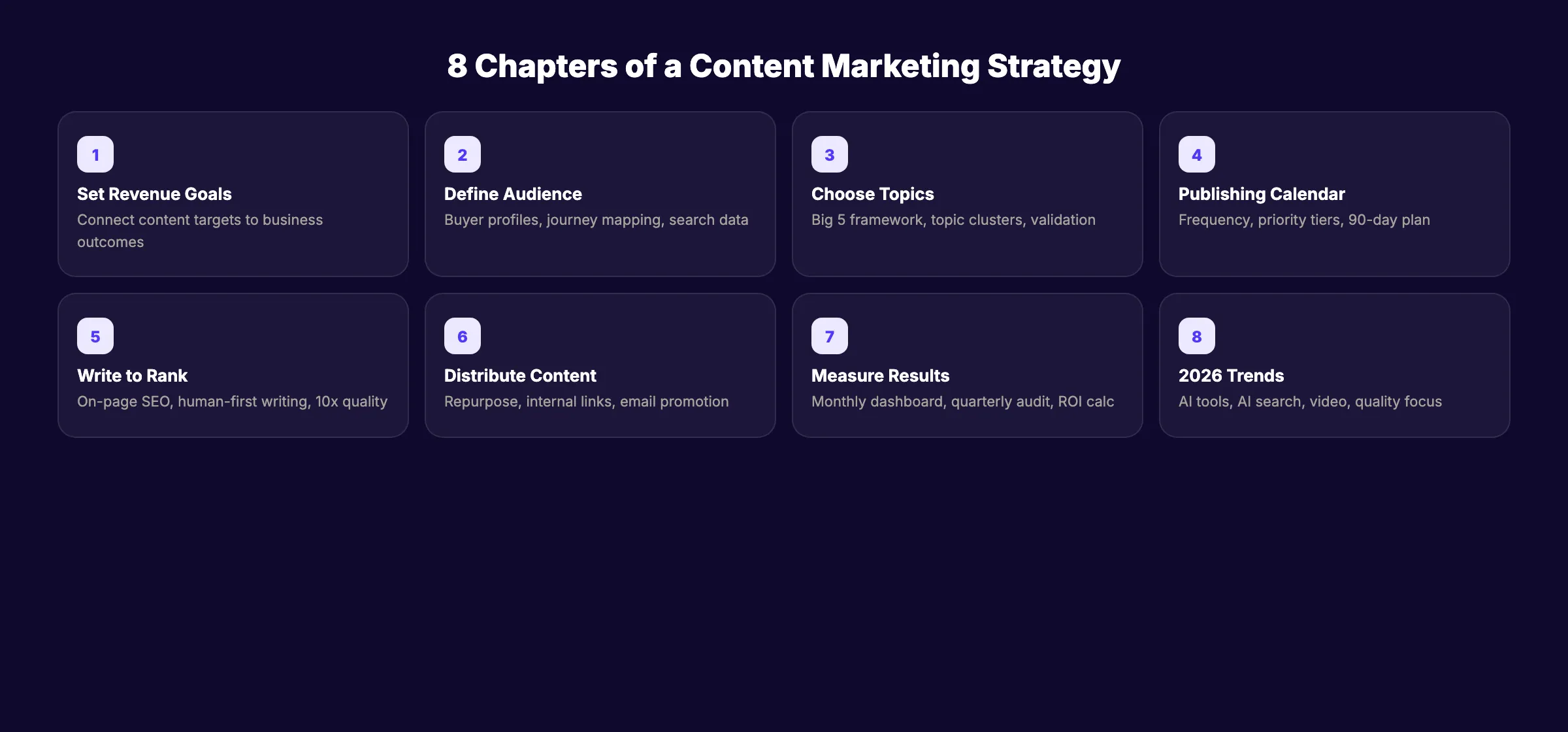
Build a content marketing strategy that drives organic traffic and leads. 8 chapters covering goals, topics, publishing, and measurement. Updated March 2026.
Most businesses publish content without a strategy. They write what feels interesting, post it when they have time, and hope something ranks. That approach produces a blog full of random articles and zero organic traffic growth.
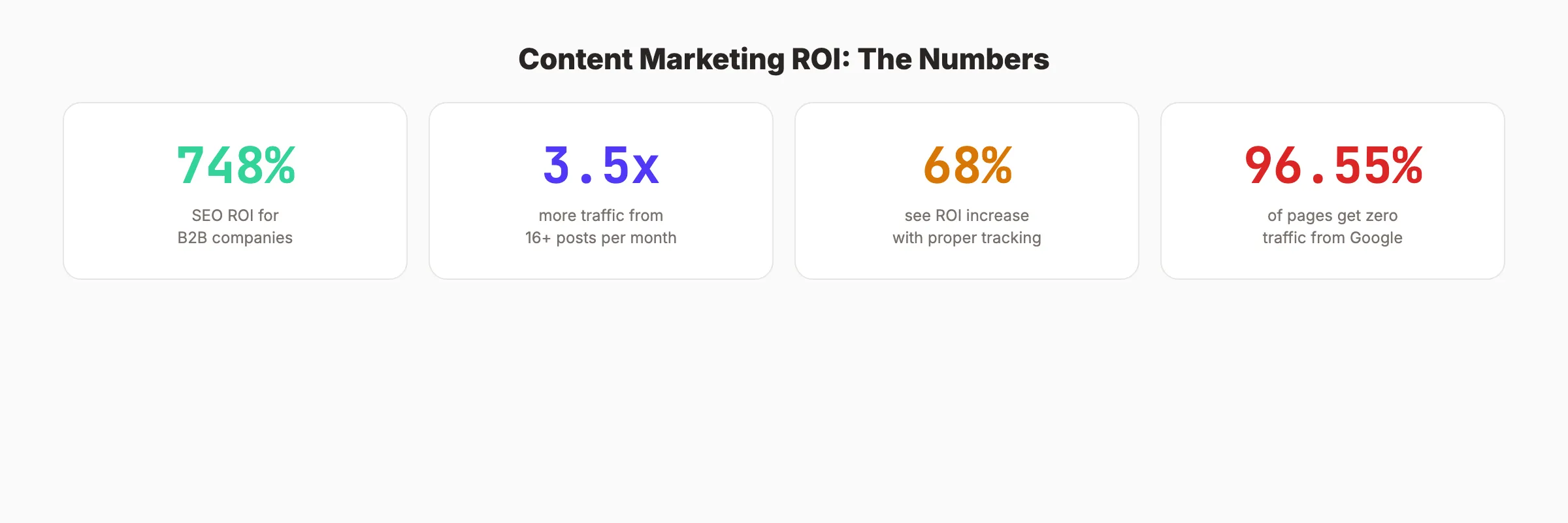
The numbers tell the same story. 96.55% of all indexed pages get zero traffic from Google. The pages that do get traffic share one thing in common: they were created as part of a content marketing strategy, not as one-off efforts.
A content marketing strategy is the system that turns publishing into revenue. It defines what to create, who to create it for, how to optimize it, and how to measure whether it works. Without that system, content is an expense. With it, content becomes an investment that compounds.
We publish 3,500+ blog posts across 70+ industries. Our average SEO score is 92%. The framework in this guide is the same one we use for every client we serve.
Here is what you will learn:
- How to set content goals that connect to revenue
- The topic selection framework that guarantees search traffic
- How to build a publishing calendar that compounds over time
- Why most content fails and the specific fixes that prevent it
- How to measure content ROI beyond vanity metrics
- The 2026 trends changing how content marketing works
Chapter 1: Set Goals That Connect to Business Outcomes
Most content marketing fails at the starting line. The goals are wrong. “Publish 12 blog posts per month” is a production target, not a business goal. It tells you nothing about whether those posts generate leads, traffic, or revenue.
1A. Start With Revenue, Work Backward
Every content marketing strategy should trace back to a revenue number. Here is the math:
If you need 10 new customers per month and your website converts visitors to leads at 2%, and leads to customers at 25%, you need 2,000 monthly organic visitors to hit your target.
That gives you a real goal: 2,000 monthly organic visitors. Now you can calculate how many articles, targeting which keywords, at what publishing frequency will get you there.
1B. Set Quarterly Content Goals
Annual goals are too vague. Monthly goals shift too fast. Quarterly goals hit the right balance.
| Quarter | Goal Type | Example |
|---|---|---|
| Q1 | Foundation | Publish 24 SEO-optimized articles targeting 24 keywords |
| Q2 | Growth | Reach 5,000 monthly organic sessions |
| Q3 | Conversion | Generate 100 content-attributed leads |
| Q4 | Authority | Earn 50 backlinks from published content |
1C. Avoid Vanity Metrics
Page views, social shares, and word count published are vanity metrics. They make dashboards look good without connecting to revenue.
Track these instead:
- Organic sessions (are people finding your content through search?)
- Keyword rankings (are your target terms moving up?)
- Leads attributed to content (did the visitor come from a blog post before converting?)
- Revenue per article (which posts actually drive business?)
For more on tracking content performance, see our guide on how to measure content ROI.
Chapter 2: Define Your Audience With Precision
Generic content attracts generic traffic. Specific content attracts buyers.
2A. Build Buyer Profiles, Not Personas
Traditional personas include demographic details that do not affect content decisions. A buyer profile focuses on what matters for content: their problems, questions, and decision process.
| Profile Element | What to Document | Why It Matters |
|---|---|---|
| Primary problem | The specific pain they search for | Determines your keyword targets |
| Knowledge level | Beginner, intermediate, expert | Determines content depth and vocabulary |
| Decision stage | Awareness, consideration, decision | Determines content format |
| Search behavior | What they type into Google | Determines your exact topics |
| Trust triggers | Data, case studies, reviews, credentials | Determines what to include in content |
2B. Map Content to the Buyer Journey
Each stage of the buyer journey needs different content.
Awareness stage: The buyer knows they have a problem but not the solution. Target informational keywords. Publish guides, explainers, and “how to” posts.
Consideration stage: The buyer knows the solution category and compares options. Target comparison keywords. Publish “best of” lists, comparisons, and reviews.
Decision stage: The buyer is ready to act. Target commercial keywords. Publish case studies, pricing pages, and product-specific content.
Most businesses only publish awareness-stage content. They blog about general topics but never create content that helps buyers compare and choose. That gap is where revenue leaks.
2C. Use Search Data, Not Assumptions
Do not guess what your audience wants. Use keyword research to find out.
Google Search Console shows what queries already bring traffic to your site. Keyword research tools show what your audience searches for that you do not rank for yet. Reddit and Quora show the exact language your audience uses when describing their problems.
Stop writing. Start ranking. Stacc publishes 30 SEO articles per month for $99. Start for $1 →
Chapter 3: Choose Topics That Drive Traffic
Topic selection separates strategies that work from strategies that waste time. The wrong topics produce content nobody searches for. The right topics deliver compounding organic traffic for years.
3A. The Big 5 Topic Framework
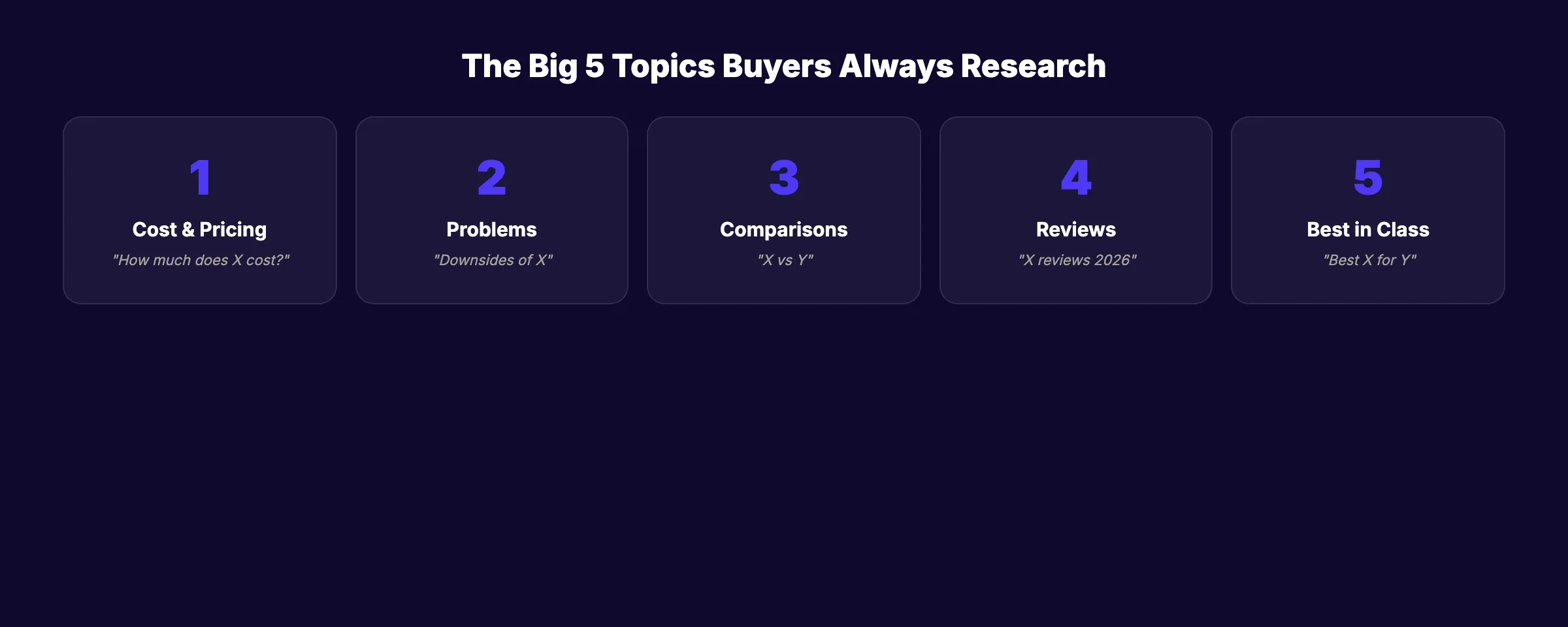
Marcus Sheridan’s “Big 5” framework identifies the 5 topic categories that buyers always research before purchasing:
- Cost and pricing , “How much does [solution] cost?”
- Problems and drawbacks , “What are the downsides of [solution]?”
- Comparisons , “[Option A] vs [Option B]”
- Reviews , “[Product/service] reviews”
- Best in class , “Best [solution] for [use case]”
Most businesses avoid these topics because they feel uncomfortable discussing pricing or drawbacks publicly. That discomfort is exactly why the content opportunity exists. Your competitors are avoiding the same topics.
3B. Build Topic Clusters
A topic cluster is a group of related articles that cover one subject from every angle. Each cluster has a pillar page (the main guide) and supporting articles (subtopics that link back to the pillar).
Example cluster for “Local SEO”:
- Pillar: “Local SEO: The Complete Guide”
- Supporting: “How to Optimize Google Business Profile”
- Supporting: “Local Keywords: How to Find Them”
- Supporting: “How to Get More Google Reviews”
- Supporting: “Local Citations: What They Are and Why They Matter”
Topic clusters build topical authority. Google ranks sites higher when they demonstrate deep expertise on a subject through multiple related articles, not just one.
3C. Validate Topics With Search Volume
Before writing any article, confirm the topic has search demand.
- Use Ahrefs, Semrush, or Google Keyword Planner to check monthly search volume
- Target keywords with 100 to 10,000 monthly searches for best results
- Avoid keywords with zero search volume unless they serve a strategic purpose (like brand-building)
- Check keyword difficulty. Target terms under KD 30 if your domain authority is below 40
For a full walkthrough on creating a topical map, see our dedicated guide.
Chapter 4: Create a Publishing Calendar
Consistency beats intensity. Publishing 4 articles per week for one month then stopping for three months produces worse results than publishing 4 articles per month every month for a year.
4A. Set Your Publishing Frequency
| Monthly Budget | Recommended Frequency | Expected Timeline to Results |
|---|---|---|
| Under $500 | 4 to 8 articles/month | 6 to 9 months |
| $500 to $2,000 | 8 to 20 articles/month | 4 to 6 months |
| $2,000+ | 20 to 30 articles/month | 2 to 4 months |
Companies publishing 16+ blog posts per month get 3.5 times more traffic than those publishing 0 to 4 per month. More content means more keywords ranked, more pages indexed, and more entry points for organic traffic.
4B. Plan Content by Priority
Not all articles are equal. Prioritize based on business impact:
Priority 1: Bottom-of-funnel content. Comparison pages, pricing guides, case studies. These convert the fastest.
Priority 2: Middle-of-funnel content. How-to guides, best-of lists, tool reviews. These attract qualified traffic.
Priority 3: Top-of-funnel content. Educational guides, industry overviews, trend posts. These build authority and backlinks.
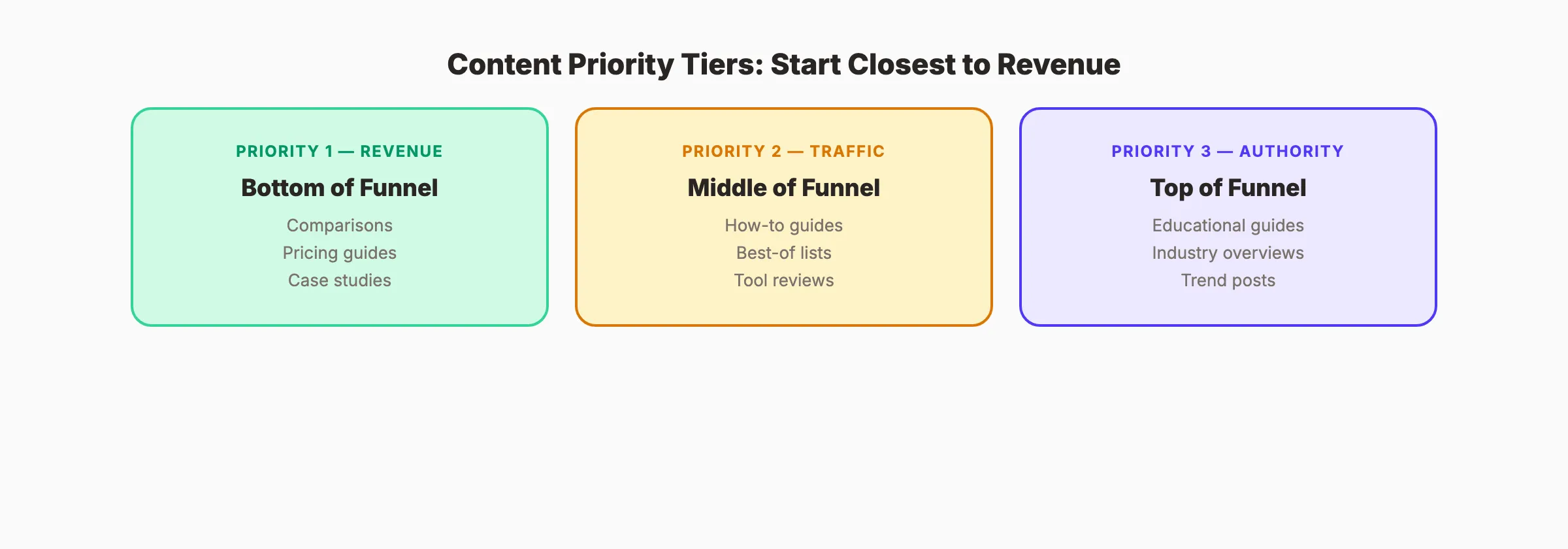
Most strategies incorrectly start with Priority 3 (broad educational content) and never get to Priority 1. Start with the content closest to revenue first.
4C. Build a 90-Day Calendar
Plan 90 days at a time. For each article, document:
- Target keyword and search volume
- Content format (guide, listicle, comparison, how-to)
- Target word count
- Assigned publish date
- Internal linking targets (which existing pages to link to)
For a detailed walkthrough on creating a content calendar for SEO, see our full guide.
Chapter 5: Write Content That Ranks
Publishing volume matters. But publishing volume without quality produces pages that sit on page 5 and never move. Every article needs to be optimized for both readers and search engines.
5A. Follow On-Page SEO Fundamentals
Every article should include:
- Title tag under 60 characters with the primary keyword
- Meta description of 145 to 155 characters with keyword and benefit
- H2 headings that use secondary keywords naturally
- Internal links to 3 to 5 related pages on your site
- External links to 2 to 3 authoritative sources
- Images with descriptive alt text including the keyword
For a complete checklist, see our on-page SEO guide.
5B. Write for Humans First
Google’s helpful content guidelines explicitly reward content created for people, not search engines. That means:
- Answer the searcher’s question in the first 100 words
- Use specific examples and real data instead of generic advice
- Take clear positions instead of hedging
- Include original insights from your own experience
Content written exclusively for keywords reads like keyword-stuffed filler. Content written for readers that includes keywords naturally reads like expert advice. Google rewards the second approach.
5C. Aim for 10x, Not 2x
If the top-ranking article for your target keyword is 2,000 words with 5 H2 sections and no images, your article should be 3,000 to 4,000 words with 8 to 10 H2 sections, tables, images, and a FAQ. Do not aim to be slightly better. Aim to be the definitive resource.
The cost of writing a mediocre article and a great article is nearly the same. The traffic difference is not.
5D. Update Published Content Regularly
Content decays. A guide published in January is less relevant by December. Google favors fresh content. Update your top-performing articles every 90 days with new data, updated examples, and a current publication date.
Sites that update old blog posts see an average of 106% increase in organic traffic to those posts. It is often easier to improve an existing article than to write a new one from scratch.
For more on writing that ranks, see our SEO content writing guide.
Your SEO team. $99 per month. 30 optimized articles, published automatically. Start for $1 →
Chapter 6: Distribute and Promote Your Content
Publishing is not the finish line. It is the starting point. Most content gets zero promotion beyond hitting “publish.” That leaves traffic on the table.
6A. Repurpose Every Article
One blog post can become 5 to 10 pieces of distribution content:
| Source | Repurposed Format | Platform |
|---|---|---|
| Blog post key points | Short-form carousel | LinkedIn, Instagram |
| Blog post stats | Quote graphics | Twitter/X |
| Blog post outline | Video script | YouTube Shorts |
| Blog post FAQ | Answer posts | Quora, Reddit |
| Blog post data | Infographic | Pinterest, blog embed |
For a full system on repurposing blog content for social media, see our guide.
6B. Build an Internal Linking System
Every new article should link to 3 to 5 existing articles on your site. Every existing article that relates to the new one should be updated to link to it. Internal links pass ranking power and help Google discover your content faster.
For a complete framework, see our guide on internal linking for blog posts.
6C. Email Your List
If you have an email list, send new content to it. Email subscribers who visit your blog post send positive engagement signals to Google. They spend more time on page, visit more pages, and bounce less than cold organic visitors.
Even a small email list (500 subscribers) can accelerate the ranking of a new post by driving initial engagement before organic traffic kicks in.
Chapter 7: Measure What Matters
68% of businesses see increased content marketing ROI when they track the right metrics. The ones that do not track see content as a cost center instead of a growth engine.
7A. Monthly Metrics Dashboard
Track these metrics every month:
| Metric | Tool | Target |
|---|---|---|
| Organic sessions | Google Analytics 4 | Month-over-month growth |
| Keywords ranking top 10 | Ahrefs or Semrush | Increasing count |
| New referring domains | Ahrefs | 5+ per month |
| Content-attributed leads | CRM + UTM tracking | Tied to revenue goal |
| Average position | Google Search Console | Declining (lower is better) |
7B. Quarterly Content Audit
Every 90 days, audit your published content:
- Winners: Articles ranking in the top 10 and driving traffic. Refresh and expand these.
- Movers: Articles ranking positions 11 to 30. These are close. Optimize title tags, add internal links, and update content.
- Losers: Articles ranking below position 30 after 6 months. Merge with better articles, redirect, or rewrite entirely.
For a full walkthrough, see our guide on how to do a content audit.
7C. Calculate Content ROI
Content marketing ROI = (Revenue from content - Cost of content) / Cost of content x 100
Example: You spend $2,970 per month on content (30 articles at $99 with Stacc). Those articles generate 5,000 organic visits. 2% convert to leads (100 leads). 10% of leads become customers (10 customers). Average customer value is $500. Monthly content revenue: $5,000. ROI: 68%.
SEO delivers 748% ROI for B2B companies over time because content compounds. An article published today can drive traffic for 3 to 5 years.
3,500+ blogs published. 92% average SEO score. See what Stacc can do for your site. Start for $1 →
Chapter 8: Content Marketing in 2026: What Has Changed
Content marketing fundamentals remain the same. But the channels, tools, and expectations have shifted.
8A. AI Changes the Speed, Not the Strategy
94% of marketers plan to use AI in content creation by 2026. AI accelerates drafting, research, and editing. It does not replace strategy, expertise, or original thinking.
The winning approach: Use AI for the first draft. Add human expertise, real data, and original insights. Publish content that AI alone cannot produce. This is what Google rewards. For more on this, see our guide on how to humanize AI content.
8B. AI Search Creates a New Distribution Channel
Google AI Overviews, ChatGPT, and Perplexity now drive measurable referral traffic. Content optimized for AI citations gets an additional traffic source beyond traditional organic search.
The basics: structure content for passage extraction, add schema markup, and ensure AI crawlers can access your pages. For a full guide, see our article on getting cited by AI search engines.
8C. Video and Short-Form Content Complement Blogs
Video delivers ROI 49% faster than text. But blogs still generate 3.5 times more traffic for consistent publishers. The strategy is not either/or. It is both. Write the blog. Repurpose it into video. Distribute both.
8D. Quality Over Quantity Is No Longer Optional
Google’s helpful content system penalizes sites that publish large volumes of low-quality content. 10 well-researched, well-structured articles outperform 50 thin ones. Publish fewer, better articles rather than more mediocre ones.
FAQ
What is a content marketing strategy?
A content marketing strategy is the plan that defines what content to create, who to create it for, how to distribute it, and how to measure results. It connects publishing activity to business outcomes like traffic, leads, and revenue. Without a strategy, content is random output. With one, it is a growth engine.
How long does content marketing take to work?
Most SEO-driven content strategies show measurable traffic growth within 3 to 6 months. Competitive keywords take longer. Low-competition long-tail keywords can rank within weeks. Companies publishing 16+ articles per month see results faster than those publishing 4 or fewer.
How much should a small business spend on content marketing?
Start with what you can sustain consistently. A small business spending $99 per month on 30 SEO-optimized articles (with Stacc) will outperform one spending $5,000 on 4 agency-written articles. Volume and consistency matter more than per-article cost. The global content marketing industry is projected to reach $107.5 billion by 2026.
What content formats drive the most traffic?
Long-form blog posts (2,000+ words) drive the most organic search traffic. How-to guides, listicles, and comparison posts perform best for SEO. Short-form video delivers the fastest ROI for social media distribution. The most effective strategies combine blog content with video and social repurposing.
Is content marketing still worth it in 2026?
Yes. SEO-driven content marketing delivers 748% ROI for B2B companies. Content compounds over time. An article published today can drive traffic and leads for 3 to 5 years without additional spend. No paid channel offers that kind of long-term return. For help building your content engine, see our guide on how to start a blog for organic traffic.
Content marketing works when it is treated as a system, not a series of one-off projects. The 8 chapters in this guide give you that system. Start with Chapter 1, set your goals, and build from there. Every article you publish is an asset that compounds.
Rank everywhere. Do nothing. Blog SEO, Local SEO, and Social on autopilot. Start for $1 →
Related Tools & Resources
Free SEO Tools:
Best Lists:

Written by
Siddharth GangalSiddharth is the founder of theStacc and Arka360, and a graduate of IIT Mandi. He spent years watching great businesses lose organic traffic to competitors who simply published more. So he built a system to fix that. He writes about SEO, content at scale, and the tactics that actually move rankings.
30 SEO blog articles published every month
Keyword-optimized, scheduled, and live on your site. Automatically.
30-day trial · Cancel anytime
theStacc
Stop writing SEO content manually
30 blog articles, 30 GBP posts, and social media content. Published every month. Automatically.
Start Your $1 Trial$1 for 3 days · Cancel anytime