
How to Get Cited by AI Search Engines (2026)
Get your content cited by ChatGPT, Perplexity, and Google AI Overviews. 8 steps covering structure, authority, schema, and crawlability. Updated March 2026.
AI search engines are replacing the click. Google AI Overviews now appear on over 50% of search queries and growing. Perplexity processes millions of queries per day. ChatGPT web search is becoming a default research tool. The question is no longer whether AI search matters. The question is whether your content gets cited when it answers.
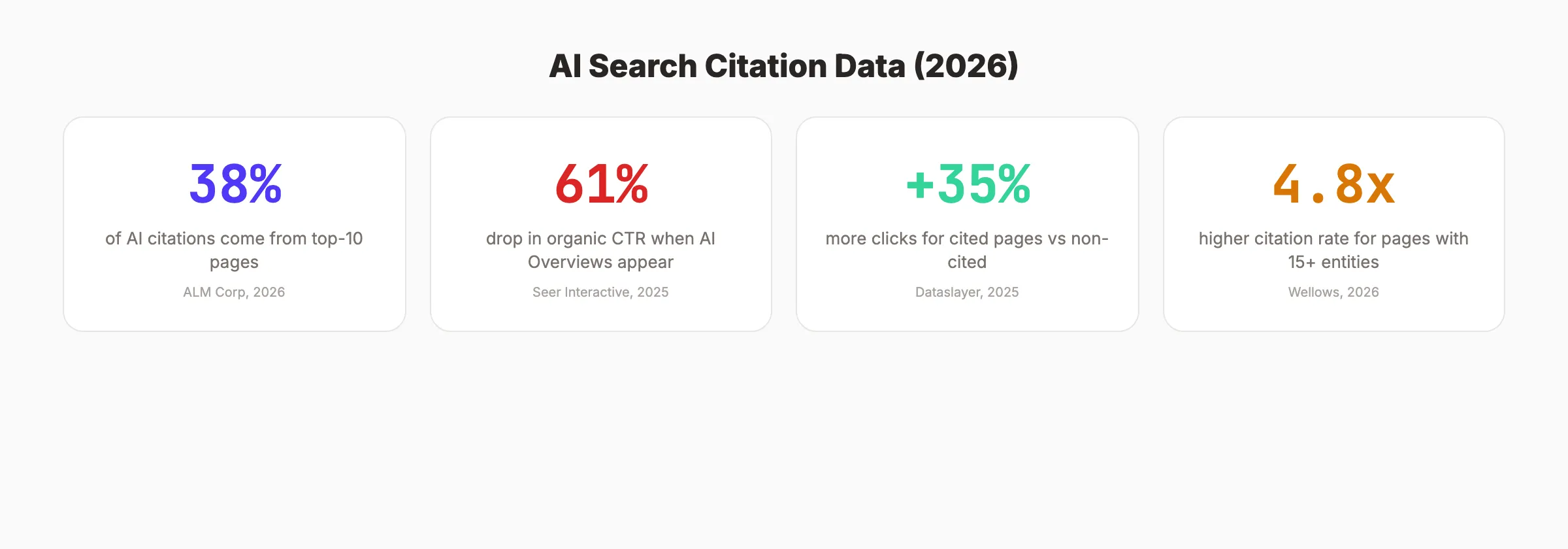
Most content does not. Only 38% of AI Overview citations come from top-10 ranking pages. Five out of six citations come from pages that do not even appear on page 1 of traditional search. That means getting cited by AI search engines requires a different playbook than ranking in organic results.
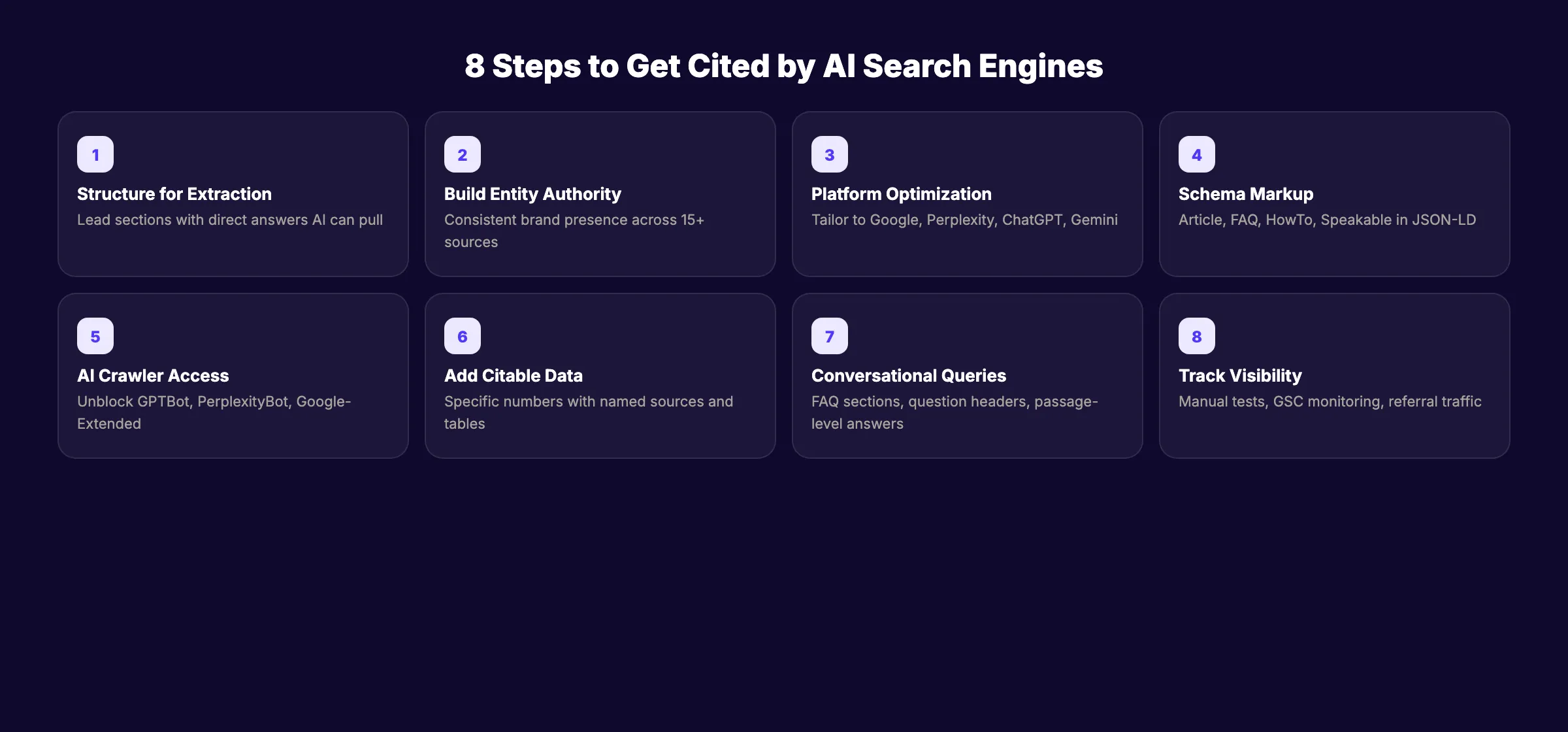
This guide shows you how to get cited by AI search engines in 8 steps. You will learn what AI citation systems look for, how to structure content for extraction, and how to build the authority signals that make AI platforms trust your site.
We publish 3,500+ blog posts across 70+ industries. Our average SEO score is 92%. We optimize every piece of content for both traditional search and AI visibility.
Here is what you will learn:
- Why AI citations work differently than traditional rankings
- How to structure content so AI models can extract and cite it
- The authority signals ChatGPT, Perplexity, and Google AI Overviews weight most
- Technical requirements for AI crawler access
- How to track whether AI platforms are citing your content
- Platform-specific optimization for each major AI search engine
What You Will Need
Time required: 2 to 4 hours for initial optimization. Ongoing maintenance.
Difficulty: Intermediate
What you will need:
- Access to your CMS or site files
- Google Search Console
- A schema markup generator or JSON-LD knowledge
- Your
robots.txtfile - Optional: Perplexity Pro for testing citation behavior
How AI Search Citations Work
AI search engines do not rank pages. They synthesize answers from multiple sources and cite the ones they used. Each platform has different citation behavior.
| Platform | How It Cites | What It Prefers |
|---|---|---|
| Google AI Overviews | Links to 3+ sources per answer | E-E-A-T signals, structured content, pages with entities |
| ChatGPT (web search) | Inline citations with source links | Recent content, authoritative domains, direct answers |
| Perplexity | Numbered footnote-style citations | Machine-readable schema, clear data, primary sources |
| Gemini | Source cards below the answer | Google-indexed content, structured data, topic authority |
96% of AI Overview citations come from sources with strong E-E-A-T signals. Pages with 15 or more recognized entities show 4.8 times higher selection probability.
The reward for getting cited is significant. Cited pages earn 35% more organic clicks than non-cited competitors. In a world where AI Overviews reduce overall CTR by 61%, being one of the cited sources is the difference between getting traffic and getting nothing.
For a deeper dive on the broader topic, see our generative engine optimization guide.
Step 1: Structure Content for AI Extraction
AI models extract specific passages from your content. They do not read your entire page and summarize it creatively. They pull the sentence or paragraph that best answers a query. Your job is to make those passages easy to find and extract.
1A. Lead Every Section With a Direct Answer
The first 1 to 2 sentences of each H2 section should directly answer the question that section addresses. Do not start with context or backstory. Start with the answer.
Weak: “Many businesses wonder about the best approach to local SEO. There are several factors to consider before implementing a strategy.”
Strong: “The most effective local SEO strategy combines Google Business Profile optimization with consistent blog publishing. Businesses that do both see 3 to 5 times more local visibility than those that do just one.”
The second version is extractable. An AI model can pull that passage and cite it as an answer. The first version says nothing citable.
1B. Use Definition-Style Formatting
For “what is” queries, use this pattern:
[Term] is [concise definition]. [One supporting sentence with a specific detail.]
AI models consistently extract this pattern for definition queries. It mirrors how dictionaries and encyclopedias format entries. Both Google AI Overviews and Perplexity prefer this structure.
1C. Create Standalone Paragraphs
Each paragraph should make sense on its own without requiring the reader to read the paragraph before it. AI models extract individual passages. If your paragraph depends on the previous one for context, it will not be selected.
Research from Otterly AI shows that 44.2% of all LLM citations come from the first 30% of a page’s text. Your introduction and early sections carry disproportionate citation weight.
Why this step matters: AI citation is passage-level, not page-level. A 5,000-word guide with poorly structured passages will get cited less than a 2,000-word guide with clean, extractable answers.
Step 2: Build Entity Authority
AI platforms do not just evaluate individual pages. They evaluate your entity. Your brand, your authors, and your domain all carry entity signals that influence citation probability.
2A. Establish Your Brand as a Known Entity
AI models recognize entities from consistent mentions across the web. If your brand name appears on your website, LinkedIn, Crunchbase, industry directories, press mentions, and social profiles with consistent information, AI systems build confidence in your entity.
- Claim and verify your Google Business Profile
- Ensure your brand appears consistently on LinkedIn, Crunchbase, and industry directories
- Get mentioned (with links) on Wikipedia, industry publications, and news sites
- Publish under named authors with verifiable credentials
2B. Build Topical Authority Through Content Depth
AI models trust sources that demonstrate deep expertise on a topic. A single blog post about SEO does not establish you as an SEO authority. Publishing 50 articles across all aspects of SEO does.
This is why content clusters matter for AI citations. A hub page on “Local SEO” linked to 20 supporting articles on GBP optimization, local keywords, review management, and citation building creates a topical footprint that AI models recognize.
For more on building topical authority, see our full guide.
2C. Earn Multi-Platform Mentions
AI platforms scan for agreement across independent sources. If your brand appears on Reddit, YouTube, industry publications, and review platforms with consistent positioning, AI systems gain confidence in citing you.
A brand mentioned only on its own website triggers lower trust than a brand mentioned across 15 independent sources.
Why this step matters: Pages with 15+ recognized entities show 4.8 times higher citation probability. Entity authority is the foundation that every other optimization builds on.
Stop writing. Start ranking. Stacc publishes 30 SEO articles per month for $99. Start for $1 →
Step 3: Optimize for Each AI Platform
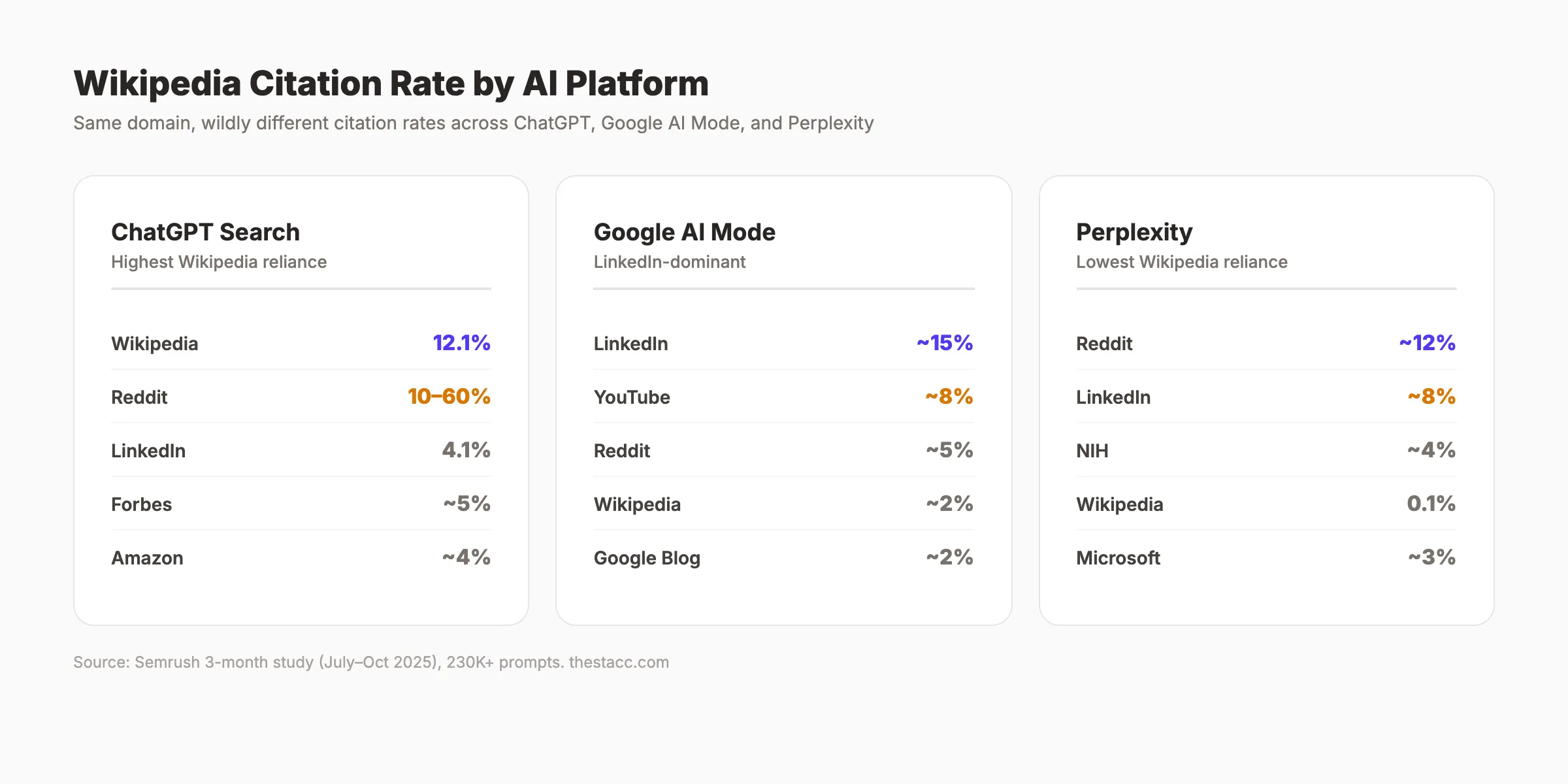
Each AI search engine has different citation preferences. Optimizing for all of them requires understanding what each one weights most.
3A. Google AI Overviews
Google AI Overviews pull from its own search index. If you rank well in traditional search, you have a better starting point. But ranking alone is not enough.
What Google AI Overviews prefer:
- Structured content with clear H2/H3 hierarchy
- Pages that directly answer the query in the first paragraph of a section
- Content with schema markup (FAQ, HowTo, Article)
- High E-E-A-T signals: author bios, credentials, cited sources
- Content freshness: recently updated pages get cited more often
3B. Perplexity
Perplexity uses its own web crawler (PerplexityBot) and values machine-readable content heavily.
What Perplexity prefers:
- Pages with
schema.org, OpenGraph, and JSON-LD markup - Clear, factual content with specific numbers and data
- Primary sources over secondary summaries
- Content accessible to its crawler (check your
robots.txt) - Well-structured FAQ sections
3C. ChatGPT Web Search
ChatGPT uses Bing’s index for web search results. It cites pages that provide direct, authoritative answers.
What ChatGPT prefers:
- Recent content (published or updated within the last 12 months)
- Authoritative domains with high domain authority
- Content that answers specific questions concisely
- Pages indexed by Bing (verify in Bing Webmaster Tools)
3D. Gemini
Gemini uses Google’s search index and Knowledge Graph.
What Gemini prefers:
- Structured data and schema markup
- Content from Google-indexed pages with strong backlink profiles
- Clear entity relationships (People, Organizations, Topics)
- Content that matches conversational query patterns
Why this step matters: A one-size-fits-all approach leaves citations on the table. Each platform has different crawlers, indexes, and preferences. Optimizing for all 4 covers the full AI search market.
Step 4: Implement Schema Markup for AI
Schema markup is the language AI systems use to understand your content. Pages with proper schema get cited more because AI models can confidently identify what the content is about.
4A. Essential Schema Types
| Schema Type | What It Does | Where to Use |
|---|---|---|
| Article | Identifies content type, author, date | Every blog post |
| FAQPage | Marks questions and answers | FAQ sections |
| HowTo | Marks step-by-step instructions | Tutorial content |
| Organization | Establishes your brand entity | Homepage, about page |
| Person | Establishes author entities | Author pages |
| SpeakableSpecification | Marks content suitable for voice/AI reading | Key answer paragraphs |
4B. Implement SpeakableSpecification
Most sites skip this. SpeakableSpecification tells AI systems which parts of your page are the most important and suitable for reading aloud or extracting. Add it to your key answer paragraphs.
4C. Use JSON-LD Format
Google, Perplexity, and ChatGPT all prefer JSON-LD over microdata or RDFa. Place your schema in the <head> of your page for fastest processing.
For a full guide on schema markup for blog posts, see our dedicated article. You can also generate markup with our free schema markup generator.
Why this step matters: Schema markup is the clearest signal you can send to AI systems about what your content contains. Without it, AI models have to infer meaning from raw HTML. With it, they know exactly what each section covers.
Step 5: Ensure AI Crawler Access
AI platforms cannot cite content they cannot crawl. Many sites accidentally block AI crawlers in their robots.txt file.
5A. Check Your Robots.txt
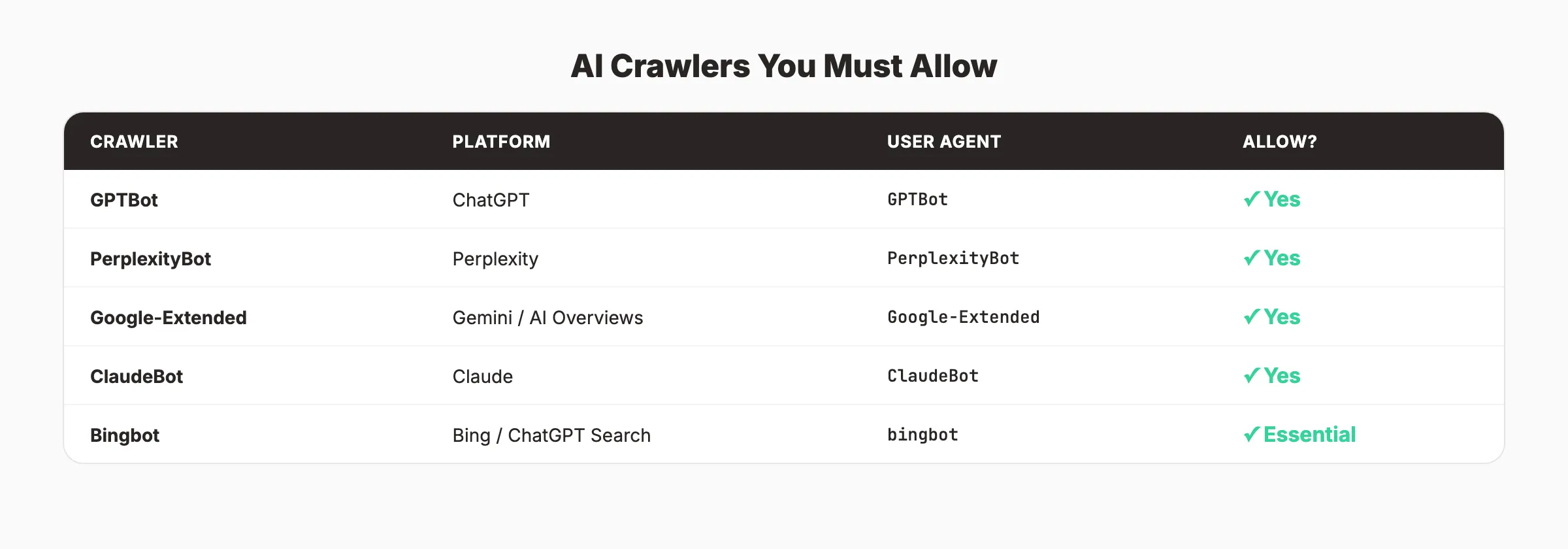
Open your robots.txt file and check for these user agents:
| Crawler | Platform | Should Be Allowed? |
|---|---|---|
GPTBot | ChatGPT | Yes (for citation) |
PerplexityBot | Perplexity | Yes (for citation) |
Google-Extended | Gemini/AI Overviews | Yes (for citation) |
ClaudeBot | Claude | Yes (for citation) |
Bingbot | Bing/ChatGPT web search | Yes (essential) |
If you see Disallow: / for any of these crawlers, they cannot access your content. Remove the block.
5B. Create an llms.txt File
The llms.txt standard is an emerging convention. Place a file at yoursite.com/llms.txt that describes your site, its purpose, and its key content areas. This helps AI models understand your site before crawling it.
5C. Verify Indexation
Google Search Console shows which pages Google has indexed. Bing Webmaster Tools shows Bing’s index. If a page is not indexed by either search engine, no AI platform built on those indexes can cite it.
For more on making your site accessible to AI crawlers, see our guide on optimizing for AI search.
Why this step matters: This is the most common reason sites fail to get AI citations. They produce great content, optimize their structure, and then block the crawlers that would cite them.
Your SEO team. $99 per month. 30 optimized articles, published automatically. Start for $1 →
Step 6: Add Citable Data and Original Research
AI models prefer to cite specific, verifiable claims over general statements. A page that says “SEO is important” will never get cited. A page that says “companies publishing 16+ blog posts per month get 3.5 times more traffic” will.
6A. Include Specific Numbers With Sources
Every data claim should include a number and a source. AI systems verify claims by checking if the source actually says what you claim it does.
Not citable: “Many businesses see improved results from blogging.”
Citable: “Companies publishing 16+ blog posts per month get 3.5 times more traffic than those publishing 0 to 4 per month (HubSpot, 2025).“
6B. Create Original Data When Possible
If you have access to proprietary data, publish it. Original research gets cited because no other source has the same data. Industry surveys, benchmark reports, and case studies with real numbers are citation magnets.
6C. Use Tables for Data Presentation
AI systems extract data from tables more reliably than from prose. If you have comparison data, pricing data, or benchmark data, format it as a markdown table. AI models can parse tables and cite specific cells.
For more on writing content that earns citations, see our SEO content writing guide.
Why this step matters: AI models face a trust problem. They need to cite sources that provide verifiable claims. Specific numbers with named sources are the highest-trust content format for AI citation.
Step 7: Optimize for Conversational Queries
People ask AI search engines questions differently than they type Google searches. AI queries tend to be longer, more conversational, and more specific.
7A. Target Question-Format Keywords
Traditional SEO targets “local SEO tips.” AI search optimization targets “what are the most effective local SEO strategies for a dentist in a mid-size city.”
Add FAQ sections to every article. Write headers as questions. Answer directly in the first sentence. These patterns match how users query AI systems.
7B. Address Follow-Up Questions
AI search conversations go deeper than single queries. Users ask follow-ups. If your content anticipates and answers those follow-ups, it stays in the citation pool longer.
After answering the main question, address:
- “How long does this take?”
- “How much does this cost?”
- “What tools do I need?”
- “What is the most common mistake?“
7C. Write at a Passage Level
AI systems cite passages, not pages. Optimize at the passage level. Each 2 to 3 sentence block should be self-contained, specific, and directly address a potential query.
For more on targeting featured snippets and AI answers, see our full guide.
Why this step matters: 60% of AI search queries are conversational in nature. Content structured for keyword-match SEO misses conversational queries entirely. The passage-level approach captures both.
Step 8: Track Your AI Search Visibility
You cannot improve what you do not measure. Tracking AI citations is harder than tracking traditional rankings. But it is possible.
8A. Manual Testing
Query ChatGPT, Perplexity, and Google AI Overviews with your target keywords. Check if your site appears in the citations. Do this weekly for your top 20 keywords.
8B. Google Search Console
Look for changes in impressions and clicks on pages that would be affected by AI Overviews. A drop in clicks with stable impressions often means AI Overviews are capturing the traffic.
8C. Third-Party Tools
Tools like Semrush, Ahrefs, and specialized platforms like Profound and Peec AI are beginning to track AI citation visibility. Set up monitoring for your core keywords across all platforms.
8D. Track Referral Traffic
Check your analytics for referral traffic from perplexity.ai, chatgpt.com, and other AI platforms. This traffic shows direct citation-driven visits.
Why this step matters: AI search visibility is a new metric. Sites that track it early will optimize faster than competitors who discover the channel years later.
3,500+ blogs published. 92% average SEO score. See what Stacc can do for your site. Start for $1 →
Results: What to Expect
After implementing these 8 steps:
- Within 2 to 4 weeks: AI crawlers index your updated content. Schema markup is processed.
- Within 30 to 60 days: Citation frequency begins increasing for well-optimized pages.
- Within 90 days: Measurable referral traffic from AI platforms appears in analytics.
- Ongoing: Entity authority builds with each new piece of content published. Citation rates compound over time.
AI search is growing. Google AI Overviews are projected to appear on 70 to 80% of queries by end of 2026. Sites that optimize for citations now will capture traffic that their competitors never see.
Troubleshooting
Problem: Your content ranks on page 1 but never gets cited in AI Overviews. Solution: Ranking and citation are different signals. Check that your content directly answers the query in the first 2 sentences of the relevant section. Add schema markup. Verify AI crawler access.
Problem: Perplexity cites your competitors but not you.
Solution: Check if PerplexityBot is blocked in your robots.txt. Verify your pages have schema markup. Perplexity heavily weights machine-readable structure.
Problem: You get cited once but then stop appearing. Solution: AI citation is dynamic. Fresher content wins. Update your pages regularly. Add new data points. AI models re-evaluate sources with each query.
FAQ
What is the difference between ranking and getting cited by AI?
Traditional ranking puts your page on a search results page. AI citation pulls a specific passage from your content into an AI-generated answer. You can rank on page 1 without getting cited, and you can get cited from a page that ranks on page 3. Only 38% of AI Overview citations come from top-10 ranking pages.
Which AI search engine is most important to optimize for?
Google AI Overviews, because they appear on the most searches. But Perplexity and ChatGPT web search are growing rapidly. Optimizing for all 4 major platforms (Google, Perplexity, ChatGPT, Gemini) requires the same core actions: structured content, schema markup, AI crawler access, and entity authority.
Do I need to allow AI crawlers to access my site?
Yes, if you want AI citations. Blocking GPTBot, PerplexityBot, or Google-Extended prevents those platforms from crawling and citing your content. Some sites block AI crawlers to prevent training data extraction. That is a valid choice, but it eliminates citation opportunities.
How do I know if AI search engines are citing my content?
Manually test by searching your target keywords on ChatGPT, Perplexity, and Google with AI Overviews enabled. Check your analytics for referral traffic from AI platforms. Track impressions and clicks in Google Search Console for pages in AI Overview-heavy niches.
Can small sites get cited by AI search engines?
Yes. AI citations favor content quality and structure over domain authority. Small sites with original data, clear answers, and proper schema markup get cited alongside major publications. The key is passage-level quality, not site-level size. For help building the content that gets cited, see how we help with increasing organic traffic.
AI search is not replacing traditional SEO. It is adding a new layer on top. The sites that optimize for both traditional rankings and AI citations will capture traffic from two channels instead of one. Start with Step 1 and work through each step in order.
Rank everywhere. Do nothing. Blog SEO, Local SEO, and Social on autopilot. Start for $1 →

Written by
Siddharth GangalSiddharth is the founder of theStacc and Arka360, and a graduate of IIT Mandi. He spent years watching great businesses lose organic traffic to competitors who simply published more. So he built a system to fix that. He writes about SEO, content at scale, and the tactics that actually move rankings.
30 SEO blog articles published every month
Keyword-optimized, scheduled, and live on your site. Automatically.
30-day trial · Cancel anytime
theStacc
Stop writing SEO content manually
30 blog articles, 30 GBP posts, and social media content. Published every month. Automatically.
Start Your $1 Trial$1 for 3 days · Cancel anytime