
How to Humanize AI Content for Rankings (2026)
Turn AI-generated drafts into content that ranks and reads like a human wrote it. 8 editing steps with examples. Updated March 2026.
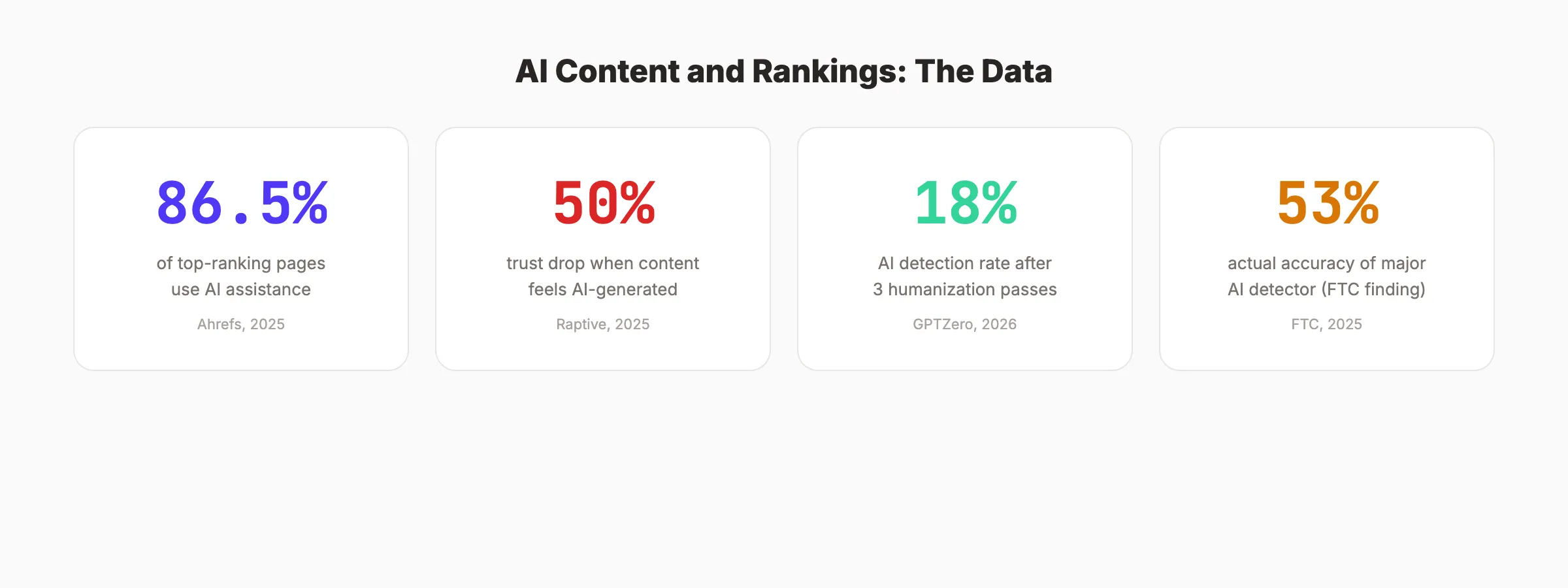
Google does not penalize AI content. 86.5% of top-ranking pages use AI assistance according to an Ahrefs study of 600,000 pages. But Google does penalize bad content. And most unedited AI output is bad content.
The problem is not that AI wrote it. The problem is that it reads like AI wrote it. Reader trust drops by nearly 50% when content feels AI-generated. Generic intros, recycled phrasing, and zero original insight turn readers away before they reach your second paragraph.
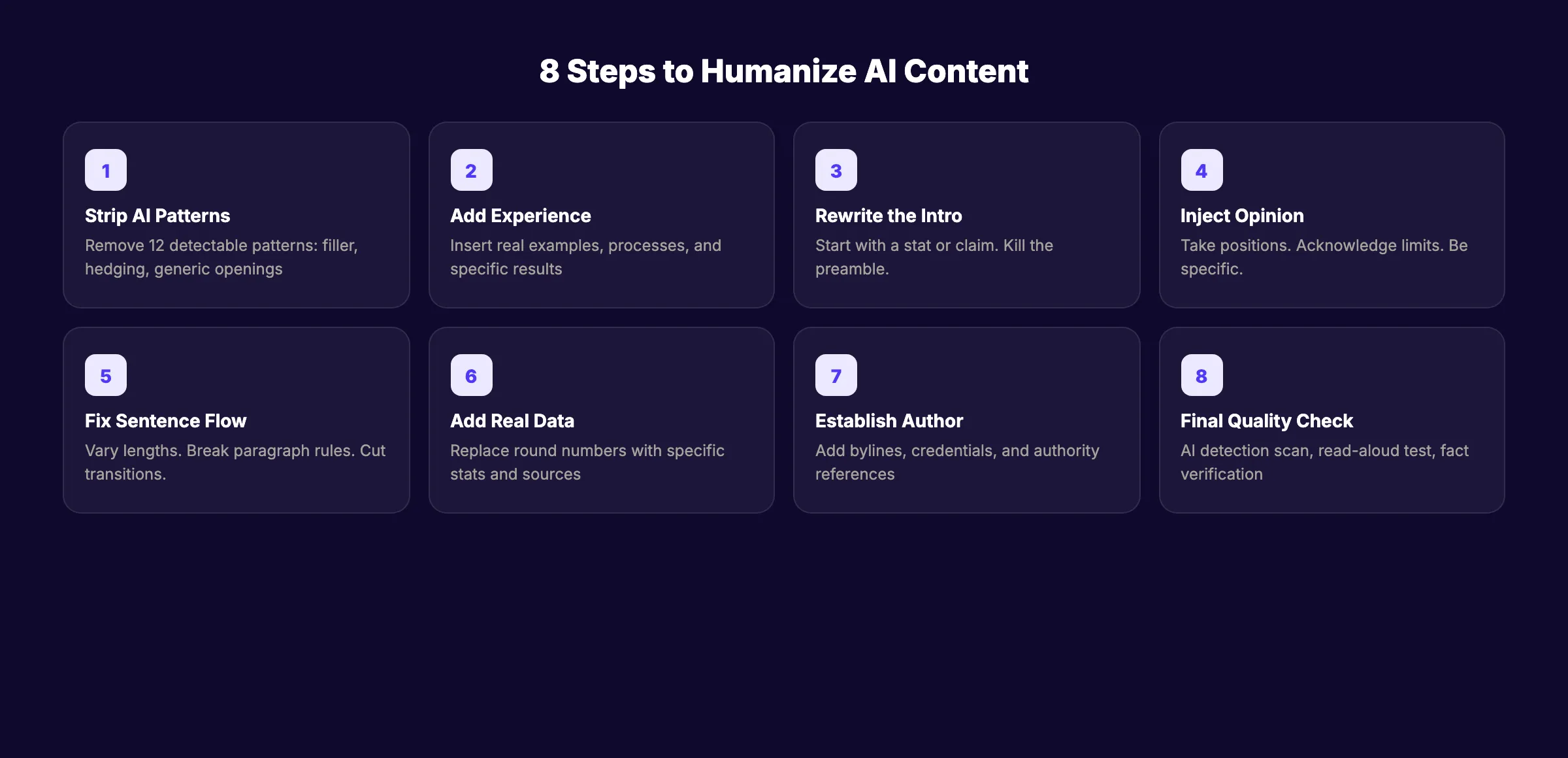
This guide shows you how to humanize AI content in 8 steps. Not with a tool that swaps synonyms. With an editing process that adds the experience, voice, and depth Google rewards.
We publish 3,500+ blog posts across 70+ industries. Our average SEO score is 92%. Every piece of content we ship goes through a humanization process before publication.
Here is what you will learn:
- Why unedited AI content underperforms even when Google allows it
- The 12 AI writing patterns that flag content as machine-generated
- How to inject real expertise and original data into AI drafts
- A sentence-level editing process that passes any AI detector
- Why voice and opinion matter more than synonym swapping
- How to build an editing workflow that scales
What You Will Need
Time required: 30 to 60 minutes per article (after practice)
Difficulty: Beginner to Intermediate
What you will need:
- An AI-generated draft (from ChatGPT, Claude, Gemini, or any LLM)
- A text editor or your CMS
- Your brand voice guidelines (if you have them)
- Optional: an AI detection tool for verification (Originality.ai, GPTZero)
Why Unedited AI Content Fails to Rank
Google’s official guidance on AI content is clear. They reward “helpful, reliable, people-first content” regardless of how it was produced. The production method does not matter. The quality does.
The issue is that raw AI output rarely meets that quality bar. Here is why.
AI content lacks experience. Google’s E-E-A-T framework starts with Experience. AI has never run a business, managed an SEO campaign, or hired a contractor. It synthesizes other people’s experiences. Readers and Google’s quality raters notice when a “how-to” guide reads like it was written by someone who never did the thing.
AI content sounds the same. Run 10 different prompts through ChatGPT and the outputs share patterns. Same sentence rhythm. Same transition words. Same three-point structures. Readers develop AI fatigue without knowing why.
AI content lacks opinion. Search engines increasingly reward content with a clear perspective. AI hedges. “It depends.” “There are many factors.” “This can vary.” Real experts take positions and explain why.
70.95% of AI-generated pages get indexed by Google within 36 days. Getting indexed is not the problem. Ranking is the problem. Indexing is the door. Quality is the room.
Step 1: Strip the AI Writing Patterns
AI models produce identifiable patterns. Removing them is the first and most impactful editing step.
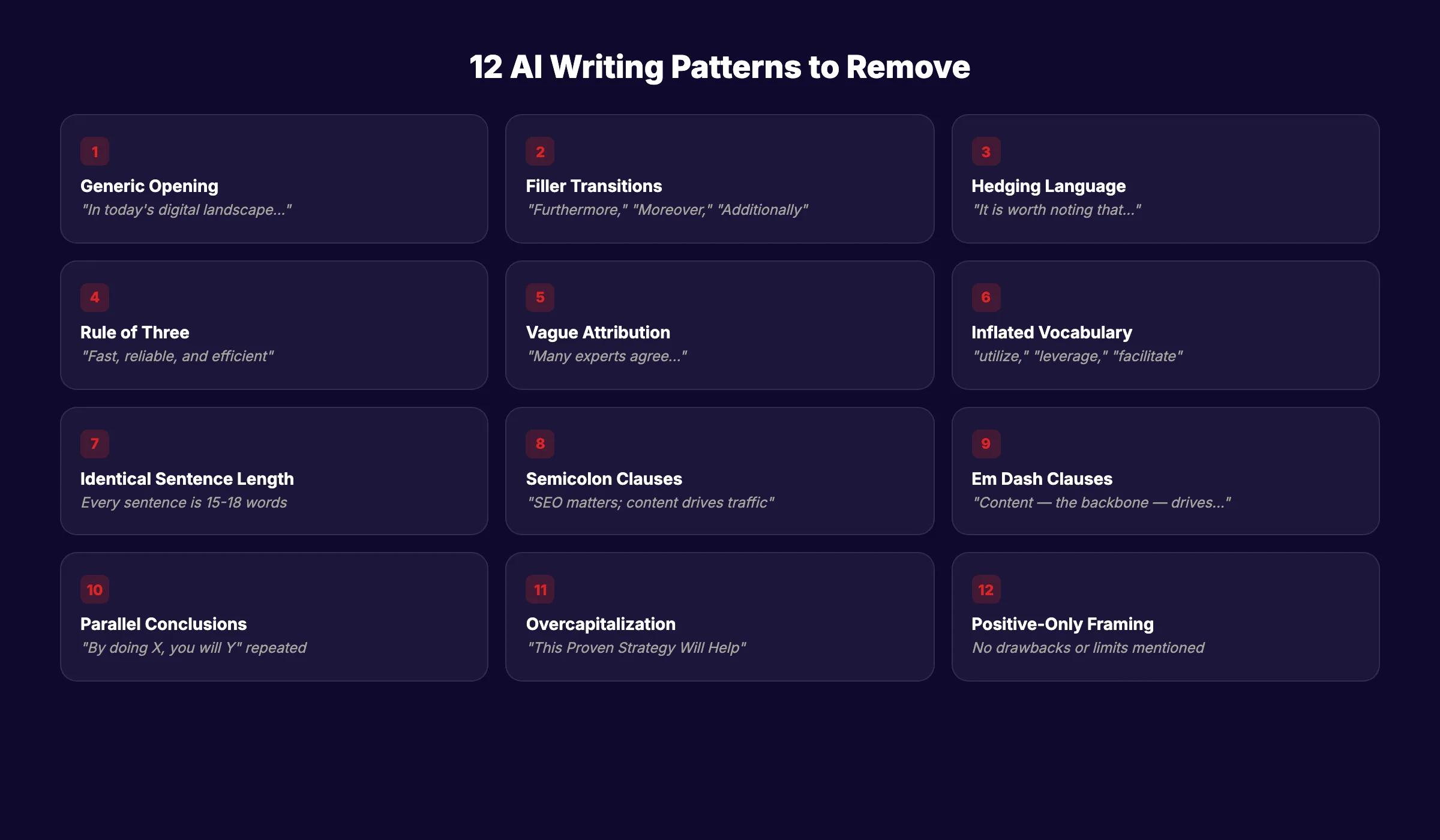
Specifically, search your draft for these 12 patterns and fix every one:
| AI Pattern | Example | Fix |
|---|---|---|
| Generic opening | ”In today’s digital scene…” | Delete. Start with a fact or claim. |
| Filler transitions | ”Furthermore,” “Moreover,” “Additionally” | Delete or replace with “And” or nothing. |
| Hedging language | ”It is worth noting that…” | Delete. State the thing directly. |
| Rule of three | ”Fast, reliable, and efficient” | Vary the structure. Use 2 or 4 items. |
| Vague attribution | ”Many experts agree…” | Name the expert or cite the source. |
| Inflated vocabulary | ”use,” “use,” “facilitate” | Use “use,” “use,” “help.” |
| Identical sentence length | Every sentence is 15 to 18 words | Mix short sentences (5 words) with longer ones. |
| Semicolons connecting clauses | ”SEO matters; content drives traffic” | Split into two sentences. |
| Em dash clauses | ”Content. The backbone of SEO. Drives rankings” | Rewrite as separate sentences. |
| Parallel conclusions | ”By doing X, you will Y” repeated | Vary your closing patterns per section. |
| Overcapitalization | ”This Proven Strategy Will Help” | Only capitalize proper nouns and sentence starts. |
| Positive-only framing | No mention of drawbacks or limits | Add one honest limitation per major claim. |
This single step eliminates 60 to 70% of detectable AI patterns. After 3 editing passes, AI detection rates drop to 18% according to GPTZero testing data.
Why this step matters: AI detectors and human readers both key on patterns, not individual words. Pattern removal is more effective than synonym swapping. A paraphrasing tool changes words. This step changes structure.
Pro tip: Read your draft out loud. AI patterns that look fine on screen sound robotic when spoken. If a sentence feels unnatural to say, rewrite it.
Step 2: Add First-Person Experience
E-E-A-T starts with Experience. Google wants to see that the author has done the thing they write about. AI cannot fake this. You need to add it.
2A. Insert Specific Examples From Real Work
Replace generic AI advice with specific situations you have encountered.
AI wrote: “A good SEO strategy requires consistency.”
Humanized: “We published 30 articles per month for a dental practice in Austin. Their organic traffic grew 340% in 6 months. Consistency was the only variable we changed.”
The second version demonstrates experience. It names a specific industry, location, result, and timeframe. No AI model generates that from a prompt.
2B. Add “What Most People Get Wrong” Observations
Experienced practitioners know the common mistakes. AI gives textbook answers. Adding contrarian or corrective observations signals real expertise.
AI wrote: “Keyword research is the foundation of SEO.”
Humanized: “Most small businesses skip keyword research entirely and write about topics nobody searches. The ones that do research often chase high-volume terms they will never rank for. Start with long-tail keywords where you have a real chance.”
2C. Reference Your Own Process
Describe how you actually do the work. Not how the internet says to do it.
“We run every draft through a 47-point checklist before publishing. The checklist catches an average of 8 issues per article. Most are things an AI draft would never flag on its own.”
Why this step matters: Experience is the one E-E-A-T signal AI cannot replicate. Every specific example, process reference, or real result you add creates content that no AI model can produce from training data alone.
Stop writing. Start ranking. Stacc publishes 30 SEO articles per month for $99. Start for $1 →
Step 3: Rewrite the Introduction
AI introductions follow a predictable formula. Problem statement. Generic context sentence. “In this article, you will learn.” Readers and algorithms recognize the pattern.
3A. Start With a Specific Number or Claim
The first sentence should be concrete. Not philosophical.
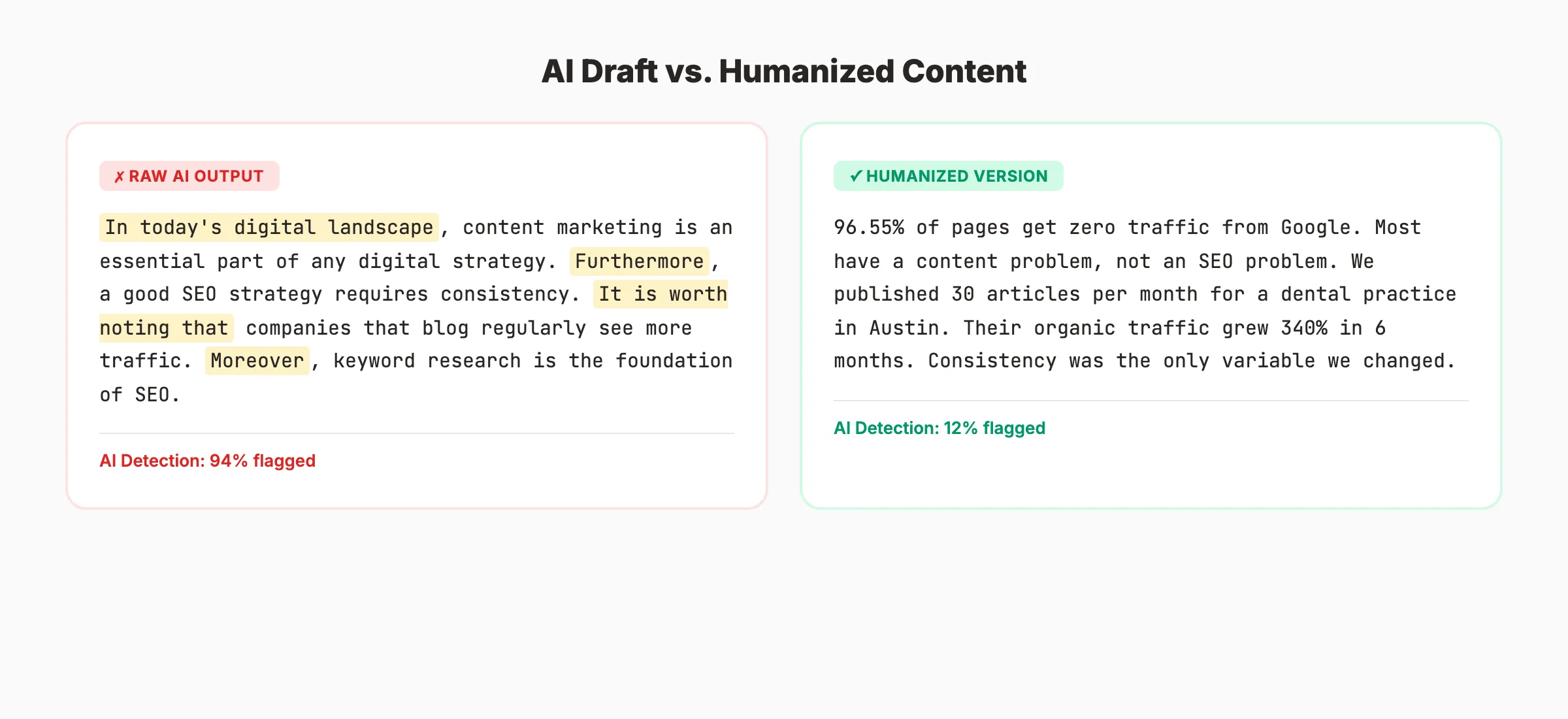
AI wrote: “Content marketing is an essential part of any digital strategy.”
Humanized: “96.55% of pages get zero traffic from Google. Most of them have a content problem, not an SEO problem.”
The humanized version opens with a stat, names the specific problem, and creates tension. No warm-up.
3B. Kill the Preamble
Delete every sentence between your opening hook and the point of the article. AI adds 2 to 3 padding sentences. Cut them.
AI loves “In this article, we will explore…” Replace it with a direct statement: “Here is what you will learn:” followed by a bullet list.
3C. Show Why You Are Qualified
AI skips credibility. Add one sentence that establishes why the reader should trust your advice. Not a bio. A proof point.
“We have published 3,500+ blog posts. Here is what we learned about making AI content rank.”
For more on writing effective blog post introductions, see our full writing guide.
Why this step matters: Google measures engagement signals. A generic introduction increases bounce rate. A specific, human introduction holds attention. The first 100 words determine whether readers scroll or leave.
Step 4: Inject Opinion and Perspective
AI is designed to be balanced. That makes it boring. Search engines reward content with clear, supported perspectives.
4A. Take a Position
On every debatable topic in your article, state what you believe and why.
AI wrote: “Some experts recommend publishing daily, while others suggest weekly. Both approaches have merit.”
Humanized: “Publish at least 20 articles per month. Daily publishing compounds faster than weekly. We have tested both. Monthly output below 15 articles rarely moves the needle for sites under DA 30.”
The humanized version takes a side, provides a number, and explains the reasoning. Readers remember opinions. They forget balance.
4B. Acknowledge Limits
Real experts know when advice does not apply. AI never admits limits.
“This approach works for service businesses with local intent. If you sell globally or target enterprise buyers, your publishing cadence should look different.”
Adding one honest limitation per section builds more trust than five paragraphs of generic encouragement.
4C. Use Opinionated Formatting
Bold your strongest claims. Use one-sentence paragraphs for emphasis.
Most AI content fails because nobody bothered to edit it.
That line works because it is direct, opinionated, and stands alone. AI rarely produces single-sentence paragraphs.
Why this step matters: Google’s helpful content guidelines explicitly ask whether content provides “insightful analysis or interesting information that is beyond the obvious.” Opinion and perspective are how you deliver that. For a deeper dive on writing content that ranks, see our SEO content writing guide.
Step 5: Fix the Sentence Structure
AI writes in a metronomic rhythm. Every sentence is 14 to 18 words. Every paragraph is exactly 3 sentences. This monotony is one of the strongest AI detection signals.
5A. Vary Sentence Length
Mix 5-word sentences with 20-word sentences. Create rhythm.
AI rhythm: “The first step is to research keywords. You should use tools like Ahrefs or SEMrush. These tools help you find opportunities.”
Human rhythm: “Research your keywords first. Ahrefs and SEMrush both work. But here is what those tools will not tell you: keyword difficulty scores lie at the low end of the spectrum. A ‘KD 10’ term can still take 6 months to rank for if the top 3 results have 500+ referring domains.”
The second version has sentences of 4, 5, 15, and 20 words. That variation is distinctly human.
5B. Break the Three-Sentence Paragraph Rule
AI defaults to exactly 3 sentences per paragraph. Humans do not.
Use 1-sentence paragraphs for emphasis. Use 2-sentence paragraphs for normal flow. Occasionally write 4 sentences when a point needs more development. The variation itself signals human authorship.
5C. Eliminate Formulaic Transitions
Delete these from your vocabulary: “Furthermore,” “Moreover,” “In addition,” “It is worth noting,” “That being said.” Replace them with nothing. Start the next sentence with the actual point.
Why this step matters: AI detectors analyze statistical patterns in sentence length and structure. Varied rhythm is the single most effective way to reduce detection scores without changing your meaning.
Your SEO team. $99 per month. 30 optimized articles, published automatically. Start for $1 →
Step 6: Add Original Data and Specific Numbers
AI generates round numbers and vague claims. Humans cite specific, verifiable data.
6A. Replace Round Numbers With Real Ones
AI wrote: “Companies that blog regularly see more traffic.”
Humanized: “Companies that publish 16+ blog posts per month get 3.5 times more traffic than those publishing 0 to 4 per month.”
The specific number with a source link adds credibility that AI cannot replicate from a prompt.
6B. Reference Internal Data
If you have your own data, use it. Nothing signals human expertise like proprietary numbers.
“Across 3,500+ published articles, we see an average SEO score of 92%. Articles that go through humanization editing score 8 to 12 points higher than unedited AI drafts.”
6C. Link to Primary Sources
AI often fabricates citations or links to pages that do not exist. Every external claim in your article needs a real, working source URL.
Before publishing, click every external link. Verify it loads. Verify it says what you claim it says. For advice on optimizing your content structure for rankings, see our guide on blog post structure for SEO.
Why this step matters: Specific numbers with real sources pass both AI detection and Google quality evaluation. Vague claims without sources fail both. The effort of finding and linking a real stat is exactly the kind of human work that separates ranking content from filler.
Step 7: Establish Author Identity
Google’s E-E-A-T framework weighs authoritativeness. Anonymous AI content has zero author authority. Adding clear authorship signals tells Google and readers who stands behind the content.
7A. Add Author Bylines
Every article needs a named author or editorial team credit. “Written by [Name], [Role]” or “By Stacc Editorial.”
7B. Reference the Author’s Background
Within the article (not just in a bio box), mention relevant experience.
“After auditing 200+ client sites, the most common issue we find is…” This embeds authority directly in the content where Google’s systems can evaluate it.
7C. Link Author Profiles
If your author has a LinkedIn profile, industry publication history, or other authority signals, link to them. Google uses these entity connections to assess authoritativeness.
Author pages on your site should include credentials, published work, and areas of expertise. This is not vanity. It is a ranking signal.
Why this step matters: Anonymous content underperforms attributed content in competitive SERPs. E-E-A-T is not a direct ranking factor. But it shapes the quality signals that Google’s systems use. For more on optimizing every on-page SEO element, see our full guide.
Step 8: Run a Final Quality Check
Before publishing, verify that your humanization edits actually landed. This is the validation step.
8A. AI Detection Scan
Run the final article through 2 AI detectors. Originality.ai and GPTZero are the most reliable. If either flags more than 30% as AI, go back to Steps 1 and 5 for additional editing.
Keep in mind: AI detectors are imperfect. The FTC found that one major detector had only 53% accuracy on general content. Use detectors as a rough gauge, not gospel.
8B. Read Aloud Test
Read the entire article out loud. Mark every sentence that sounds unnatural, robotic, or overly formal. Rewrite those sentences in conversational language.
This is the most effective quality check. No tool replaces it.
8C. Fact Verification
AI hallucinates. Check every statistic, every claim, and every external link.
- Every number has a source
- Every external link loads and matches the claim
- Every internal link points to a real page on your site
- No fabricated quotes or studies
- No outdated data (check publication dates on sources)
8D. Checklist Before Publishing
- Zero AI filler phrases remain (Step 1 patterns)
- At least 2 first-person experience references (Step 2)
- Introduction is specific, not generic (Step 3)
- At least 2 opinionated statements with reasoning (Step 4)
- Sentence lengths vary between 5 and 20 words (Step 5)
- At least 3 specific numbers with source links (Step 6)
- Author identity is clear (Step 7)
- Passes AI detection at under 30% flagged (Step 8A)
Why this step matters: Skipping validation is how AI content ends up published with hallucinated stats, dead links, and detectable patterns. A 10-minute final check prevents all three. Every piece of content that ranks well was reviewed by a human. That review is what you are doing right now.
3,500+ blogs published. 92% average SEO score. See what Stacc can do for your site. Start for $1 →
Results: What to Expect
After completing these 8 steps on each AI-generated article:
- Immediately: Content reads naturally and passes AI detection scans
- Within 2 to 4 weeks: Engagement metrics improve. Lower bounce rates. Higher time on page.
- Within 60 to 90 days: Rankings improve for articles that previously stalled. Pages move from page 2 to page 1 positions.
- Ongoing: Each article you humanize builds your site’s overall quality signals. Google rewards consistency.
The editing process takes 30 to 60 minutes per article. That is the cost of turning a draft that sits on page 3 into one that competes on page 1. For anyone publishing at scale, the ROI is obvious.
For more on increasing your organic traffic, see our complete guide.
Troubleshooting
Problem: AI detection still flags 40%+ after editing. Solution: Focus on Step 5 (sentence structure). AI detectors weight rhythm patterns heavily. Vary your sentence lengths more aggressively. Add 2 to 3 one-sentence paragraphs. Remove all semicolons and em dashes connecting clauses.
Problem: Content sounds too casual after humanization. Solution: You overcorrected. Professional content does not need slang or jokes. It needs specificity, opinion, and varied structure. Keep the expertise. Lose the robot voice. That is the balance.
Problem: Humanization takes too long per article. Solution: Build a checklist from Steps 1 through 8 and reuse it. After editing 10 articles, you internalize the patterns. Editing time drops from 60 minutes to 20 to 30 minutes. You can also write better AI prompts that avoid the patterns in the first place.
FAQ
Does Google penalize AI-generated content?
No. Google’s official position is that they reward helpful content regardless of production method. They penalize low-quality content, whether written by humans or AI. The distinction is quality, not origin.
How accurate are AI content detectors?
Not very. Vendor-claimed accuracy rates of 95 to 99% do not hold in independent testing. The FTC found one major detector had only 53% accuracy on general content. Use detectors as a directional signal, not a definitive judgment.
Can I rank with 100% AI-generated content?
Technically yes. 86.5% of top-ranking pages use AI assistance. But “AI assistance” is not the same as “unedited AI output.” The pages that rank use AI for drafting and humans for editing, fact-checking, and adding expertise.
What are the most common signs of AI writing?
Generic openings (“In today’s digital scene”), filler transitions (“Furthermore,” “Moreover”), identical sentence lengths, hedging language (“It is worth noting”), and the absence of specific examples or original data. Step 1 of this guide covers all 12 patterns.
Is it better to use an AI humanizer tool or edit manually?
Manual editing is more effective. AI humanizer tools swap synonyms and restructure sentences. That changes surface-level patterns. Manual editing adds experience, opinion, and real data. Those additions are what Google’s quality systems actually evaluate. For advice on writing blog posts that rank from scratch, see our SEO blog writing guide.
AI is the starting point. Humanization is the ranking factor. The 8 steps in this guide turn a machine draft into content that reads, ranks, and converts like a human wrote it. Start with Step 1 on your next article and measure the difference.
Rank everywhere. Do nothing. Blog SEO, Local SEO, and Social on autopilot. Start for $1 →
Related Tools & Resources
Free SEO Tools:
Best Lists:

Written by
Siddharth GangalSiddharth is the founder of theStacc and Arka360, and a graduate of IIT Mandi. He spent years watching great businesses lose organic traffic to competitors who simply published more. So he built a system to fix that. He writes about SEO, content at scale, and the tactics that actually move rankings.
30 SEO blog articles published every month
Keyword-optimized, scheduled, and live on your site. Automatically.
30-day trial · Cancel anytime
theStacc
Stop writing SEO content manually
30 blog articles, 30 GBP posts, and social media content. Published every month. Automatically.
Start Your $1 Trial$1 for 3 days · Cancel anytime