AI agents marketing adoption hit 90% in 2026. 35 sourced stats on adoption rates, ROI, productivity gains, and team restructuring. Updated May 2026.
90% of marketing teams now use AI agents for decision-making. 93% use them for content generation. 87% of marketers run at least one generative AI workflow in 2026. The shift from experiment to operating system happened in 18 months.
AI agents marketing adoption has crossed the line from emerging trend to default behavior. Salesforce, McKinsey, Gartner, and HubSpot all published 2026 data this spring. The numbers agree on one thing: marketing teams that do not run AI agents are now the minority.
We compiled 35 AI agents marketing adoption statistics from Salesforce State of Marketing 2026, McKinsey Global AI Survey, Gartner CMO Spend Survey, HubSpot AI Trends, BCG, Forrester, S&P Global, and the U.S. Chamber of Commerce. Every stat is sourced and dated.
Here is what the data covers:
- Headline adoption rates across marketing functions
- ROI multiples by workflow type
- Time savings and productivity gains
- Team restructuring and hiring shifts
- SMB versus enterprise adoption gaps
- Risks, failures, and cancellation rates
The pattern across every source: marketing leads functional adoption inside the enterprise. Sales and customer service are catching up. Finance and operations still lag. If you build a marketing budget for the second half of 2026 without an agent line item, you are budgeting against the data.
Top AI Agents Marketing Adoption Statistics (Summary)
This table compiles the seven headline numbers that define the 2026 picture. Each row links to the source study or report.
| Stat | Number | Source | Year |
|---|---|---|---|
| Marketers using AI in daily workflow | 91% | Salesforce State of Marketing | 2026 |
| Marketers using AI agents for decisions | 90% | Warmly AI Stats Report | 2026 |
| Marketers using AI agents for content | 93% | Warmly AI Stats Report | 2026 |
| Enterprise marketing teams running an autonomous agent | 34% | Salesforce State of Marketing | 2026 |
| Average ROI on AI content drafting agents | 3.2x | McKinsey Global AI Survey | 2026 |
| Weekly hours recovered per marketer | 6.1 hrs | HubSpot AI Trends | 2026 |
| Agentic AI projects at risk of cancellation by 2027 | 40%+ | Gartner | 2026 |
| Junior copywriting roles cut at agencies in 2025 | 23% | Gartner CMO Spend Survey | 2026 |
The headline read: adoption is near-universal. Production deployment is not. ROI is real but uneven. Cancellation risk is high without governance.
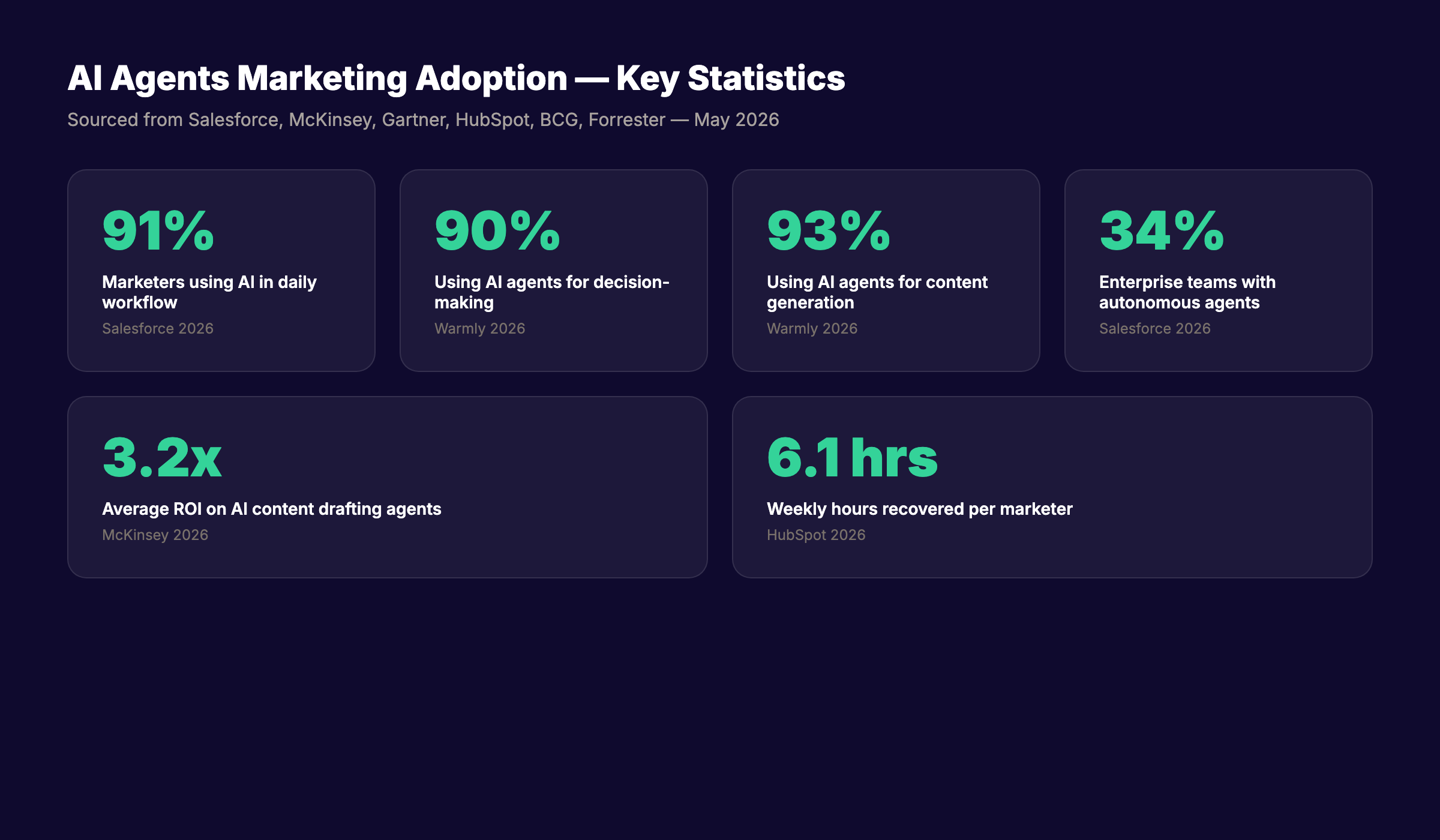
Table of Contents
- Headline Adoption Statistics (5 stats)
- Marketing Use Case Statistics (6 stats)
- ROI and Revenue Statistics (5 stats)
- Productivity and Time Savings Statistics (5 stats)
- Team Restructuring Statistics (4 stats)
- SMB and Mid-Market Statistics (4 stats)
- Risk, Failure, and Governance Statistics (4 stats)
- Industry Outlook Statistics (3 stats)
- Key Takeaways
- FAQ
Headline Adoption Statistics
The most-cited 2026 numbers come from four reports: Salesforce State of Marketing, McKinsey Global AI Survey, Gartner CMO Spend Survey, and HubSpot AI Trends. They agree more than they disagree.
1. 91% of marketing professionals actively use AI tools in daily workflows. Source: Salesforce State of Marketing 2026. This number jumped from 88% the prior year. The growth is now driven by mid-market adoption, not enterprise expansion. Enterprise was already saturated.
2. 90% of marketers use AI agents to expedite decision-making. Source: Warmly AI Agents Statistics Report, 2026. This stat is what gave this post its headline. Decision support is now the second-most-common agent use case in marketing, behind content generation.
3. 93% of marketers use AI agents to generate content faster. Source: Warmly AI Agents Statistics Report, 2026. Content drafting is the single highest-adopted agent workflow. Speed gains average 4x to 6x for first-draft output.
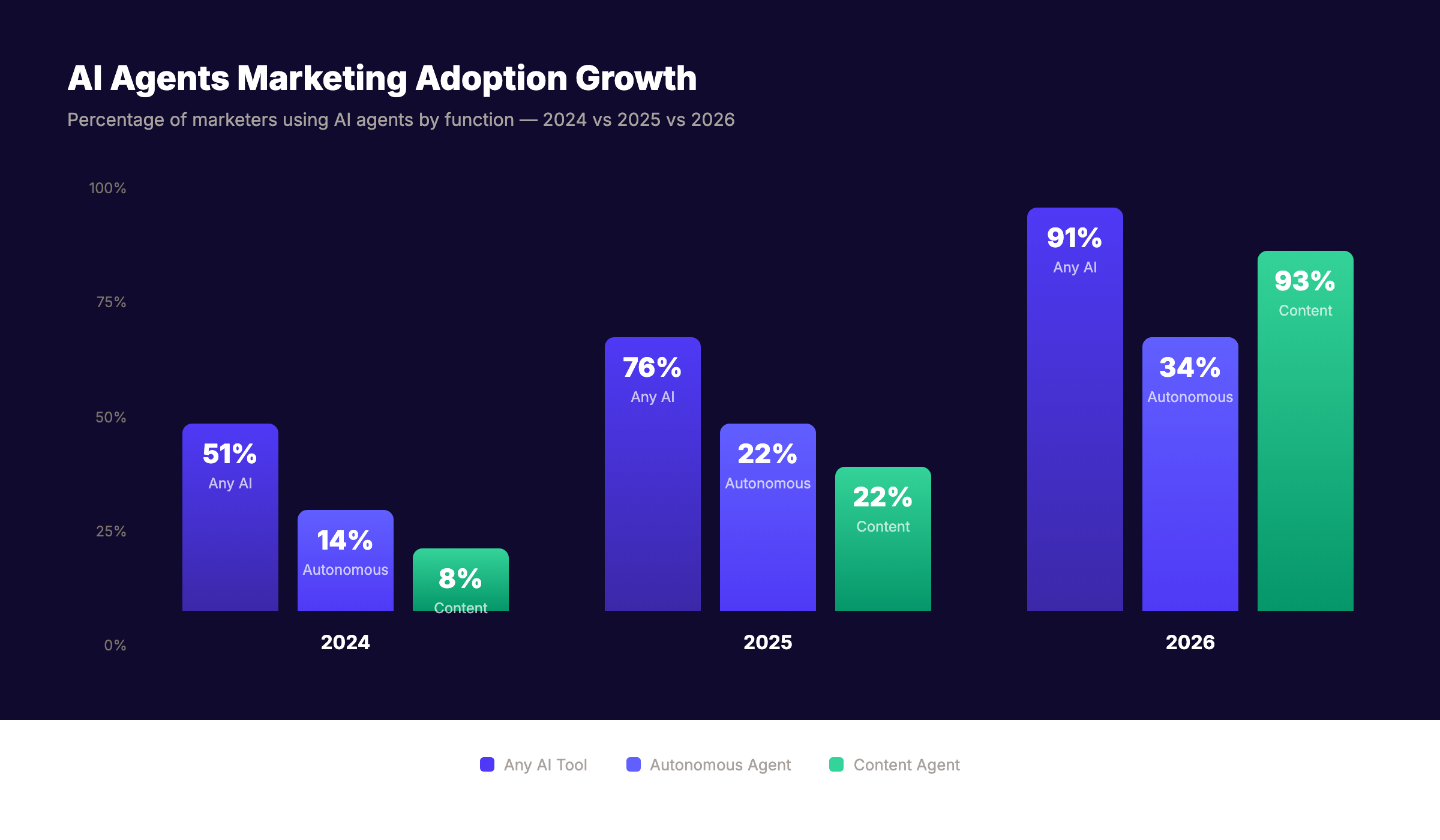
4. 87% of marketers used generative AI in at least one workflow in 2026, up from 51% in 2024. Source: Salesforce State of Marketing 2026. A 36-point jump in 24 months. No prior marketing technology category moved this fast. Marketing automation took six years to reach 80% adoption.
5. 34% of enterprise marketing teams run at least one autonomous agent in production. Source: Salesforce State of Marketing 2026. "Autonomous" means the agent acts without human approval on every output. This is more than double the 14% reported in Q4 2024.
Marketing Use Case Statistics
Adoption headlines hide a wide spread by use case. Some workflows are universal. Others are still rare. The data below shows where the agents actually run.
6. 80% of marketers use AI agents for copywriting, targeting, and campaign analytics. Source: Warmly Marketing AI Survey, 2026. These three workflows account for 70% of total agent runtime inside marketing departments.
7. 28% of marketing departments deploy AI agents for campaign research and content assistance. Source: DemandSage AI Agents Report, 2026. Research workflows lag content creation by a wide margin. Many teams still trust human researchers more than agent summaries.
8. 51% of marketers use AI tools, including agents, to optimize email campaigns and SEO content. Source: HubSpot AI Trends 2026. Email subject line optimization and SEO content briefs are the two highest-volume agent tasks measured by token consumption.
9. 20% of agentic AI deployments inside enterprises run in sales and marketing functions. Source: McKinsey Global AI Survey 2026. Marketing is the second-most-common business function for agent deployment, behind customer service at 31%.
10. Marketing teams with AI agents produce 29% more first-draft campaign assets. Source: Talkwalker State of Agentic AI in Marketing 2026. Output volume is up. Quality scores are flat to slightly positive once humans review the drafts.
11. 4 out of 10 agencies have at least one agent in production drafting briefs, running SEO audits, or qualifying leads. Source: Digital Applied 250-Agency Survey 2026. Agency adoption is now tracking ahead of brand-side adoption for the first time. The gap is roughly 6 percentage points.
For teams scaling content production without scaling headcount, our guide to AI marketing agents covers which workflows map best to which agent types.
Stop writing. Start ranking. theStacc publishes 30 SEO articles per month for $99.
ROI and Revenue Statistics
Revenue impact is now measured, not estimated. McKinsey, BCG, and Forrester all published agent-level ROI data this spring. The multiples vary by workflow.
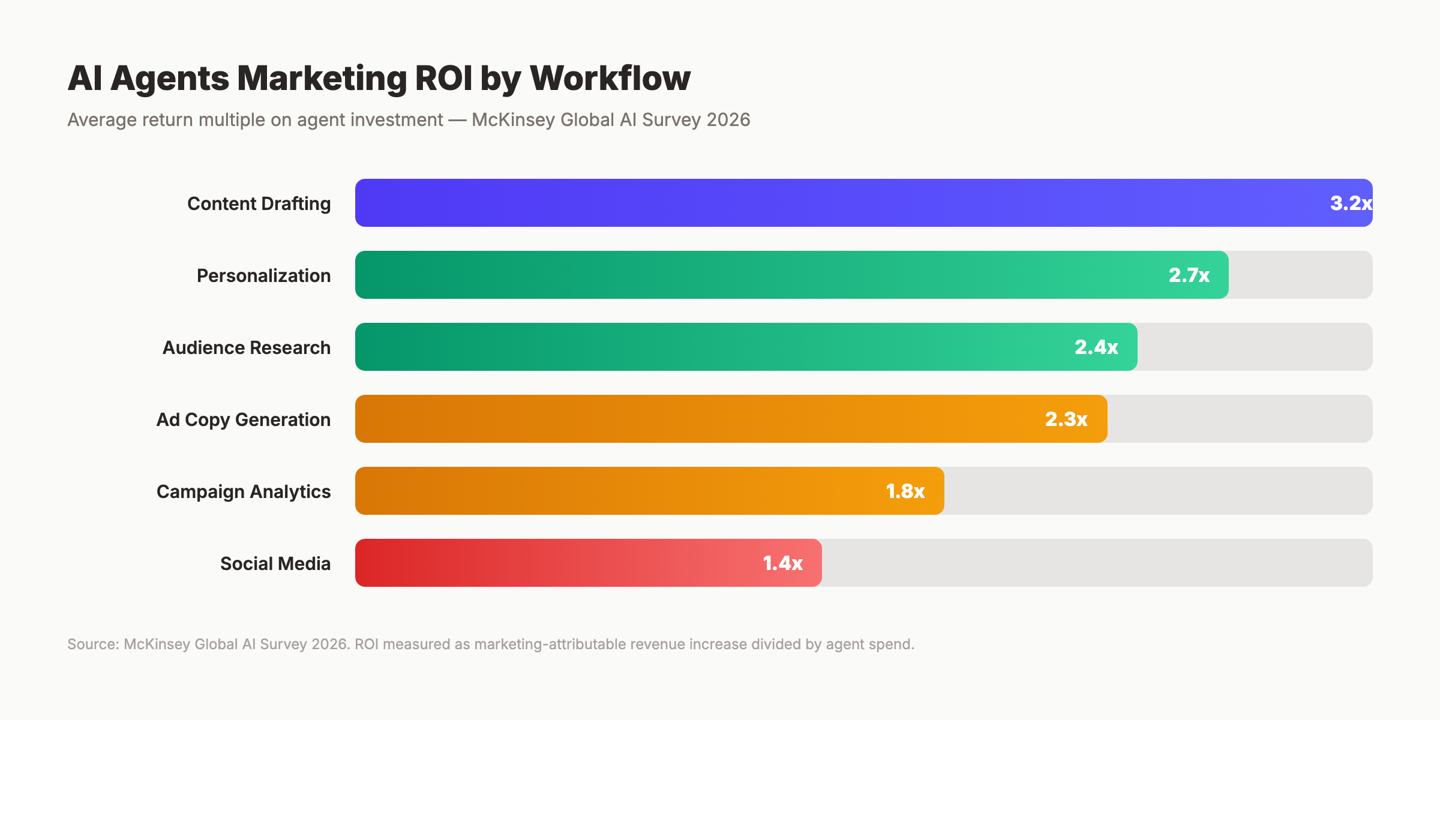
12. AI content drafting agents deliver 3.2x ROI on average. Source: McKinsey Global AI Survey 2026. Content drafting is the highest-ROI workflow because the labor it replaces is high-volume and predictable.
13. Personalization engines deliver 2.7x ROI. Source: McKinsey Global AI Survey 2026. Email and landing page personalization agents are the second-highest ROI category. Audience segmentation accuracy is the key driver.
14. Audience research agents deliver 2.4x ROI. Ad copy agents deliver 2.3x ROI. Source: McKinsey Global AI Survey 2026. These two workflows are now the third and fourth most profitable agent deployments in marketing.
15. Companies adopting agentic AI see average revenue increases of 6% to 10%. Source: Warmly AI Agents Report, 2026. This is total company revenue, not marketing-attributed revenue. Marketing-attributed lift is typically 2x this range.
16. 80% of marketers said AI tools exceeded ROI expectations in 2025. Source: Salesforce State of Marketing 2025 (carried forward in 2026 baseline). This is the most positive ROI signal in any marketing technology survey published in the last five years.
Productivity and Time Savings Statistics
Time savings are the easiest agent ROI to measure. The 2026 numbers are now stable enough to budget against.
17. Marketers recover 6.1 hours per week on average using AI agents. Source: HubSpot AI Trends 2026. Senior practitioners save 8 to 10 hours per week. Junior staff save 3 to 4 hours. The gap is widening.
18. Human-AI collaborative teams demonstrate 60% greater productivity than human-only teams. Source: arXiv research paper cited in Warmly Report, 2026. The same study found teams spent 23% more time on creative work and 60% less on editing.
19. Companies using AI agents report a 61% boost in employee efficiency. Source: New Media AI Agent Usage Statistics, 2026. This is a broad cross-functional number. Marketing-specific efficiency gains track higher at roughly 67%.
20. Average time-to-value on agent deployments is 5.1 months. Source: BCG and Forrester Joint Agent Survey 2026. SDR and outreach agents pay back fastest at 3.4 months. Finance and operations agents take 8.9 months.
21. 90% of companies using generative AI agents report improved workflow and smoother operations. Source: SAS Marketing AI Report, 2026. Workflow improvement is the most-cited qualitative benefit. Cost reduction is a distant second.
For a deeper breakdown of which workflows yield the fastest payback, our AI agent use cases for business post maps 17 specific deployments to time-to-value bands.
Team Restructuring Statistics
Adoption changes who marketing teams hire. The 2026 data shows the labor shift is already underway.
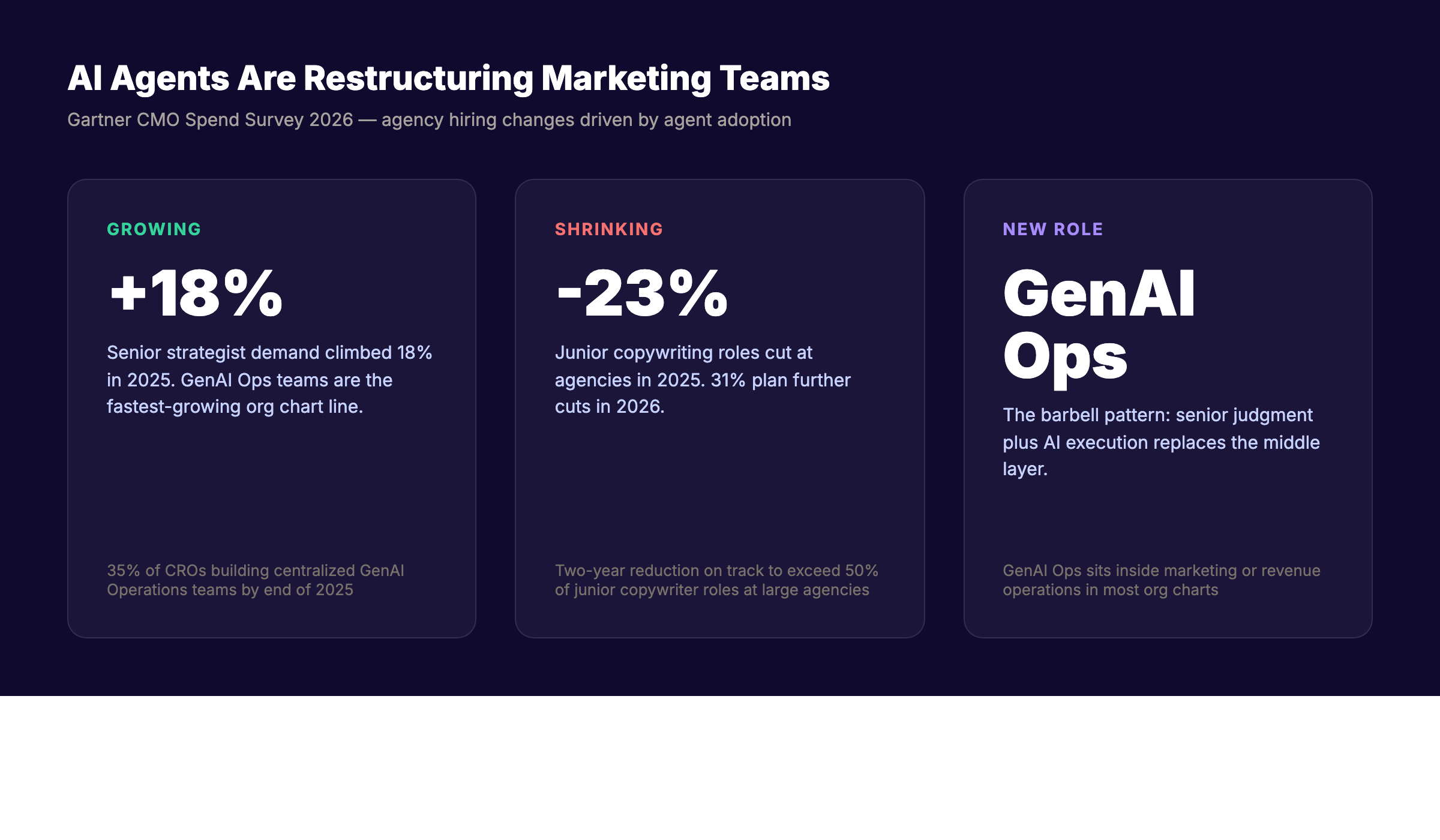
22. 23% of agencies reduced junior copywriting headcount in 2025. Source: Gartner CMO Spend Survey 2026. This is the first year agency headcount reductions tracked directly to specific agent deployments.
23. 31% of agencies plan further junior copywriting cuts in 2026. Source: Gartner CMO Spend Survey 2026. The total two-year reduction is on track to exceed 50% of junior copywriter roles at large agencies.
24. Senior strategist demand climbed 18% in 2025 while junior roles fell. Source: Gartner CMO Spend Survey 2026. The "barbell" hiring pattern is now established. Senior judgment plus AI execution is replacing the middle layer.
25. 35% of CROs expected to build centralized "GenAI Operations" teams by end of 2025. Source: Warmly AI Agents Report, 2026. GenAI Ops is the fastest-growing org chart line. Most teams sit inside marketing or revenue operations.
SMB and Mid-Market Statistics
The enterprise saturation story is well-covered. The SMB story is less reported and more interesting for most readers of this post.
26. AI adoption among U.S. businesses with under 500 employees hit 51% in 2026. Source: U.S. Chamber of Commerce Small Business AI Index, 2026. A 1,800-business survey across all 50 states. Adoption grew 13 points from 2025.
27. Marketing automation specifically is now used by 43% of SMBs, up from 30%. Source: U.S. Chamber of Commerce Small Business AI Index, 2026. Marketing automation is the single highest-adopted AI category in the SMB segment.
28. 51% of organizations are currently exploring agent integration into business processes. Source: Warmly AI Agents Report, 2026. This means roughly half of all organizations now have an active agent evaluation in progress.
29. 88% of companies use AI in at least one part of their business in 2026. Source: McKinsey State of AI 2026. Only 6% qualify as "AI high performers." The gap between use and value is the defining problem of 2026.
If you run an SMB marketing operation, our AI tools for small business in 2026 guide ranks the agent platforms that fit budgets under $500 per month.
Your SEO team. $99 per month. theStacc publishes 30 optimized articles automatically. No agency. No writers to manage.
Risk, Failure, and Governance Statistics
The optimistic adoption story has a counterweight. Gartner published the most-cited cautionary number this year.
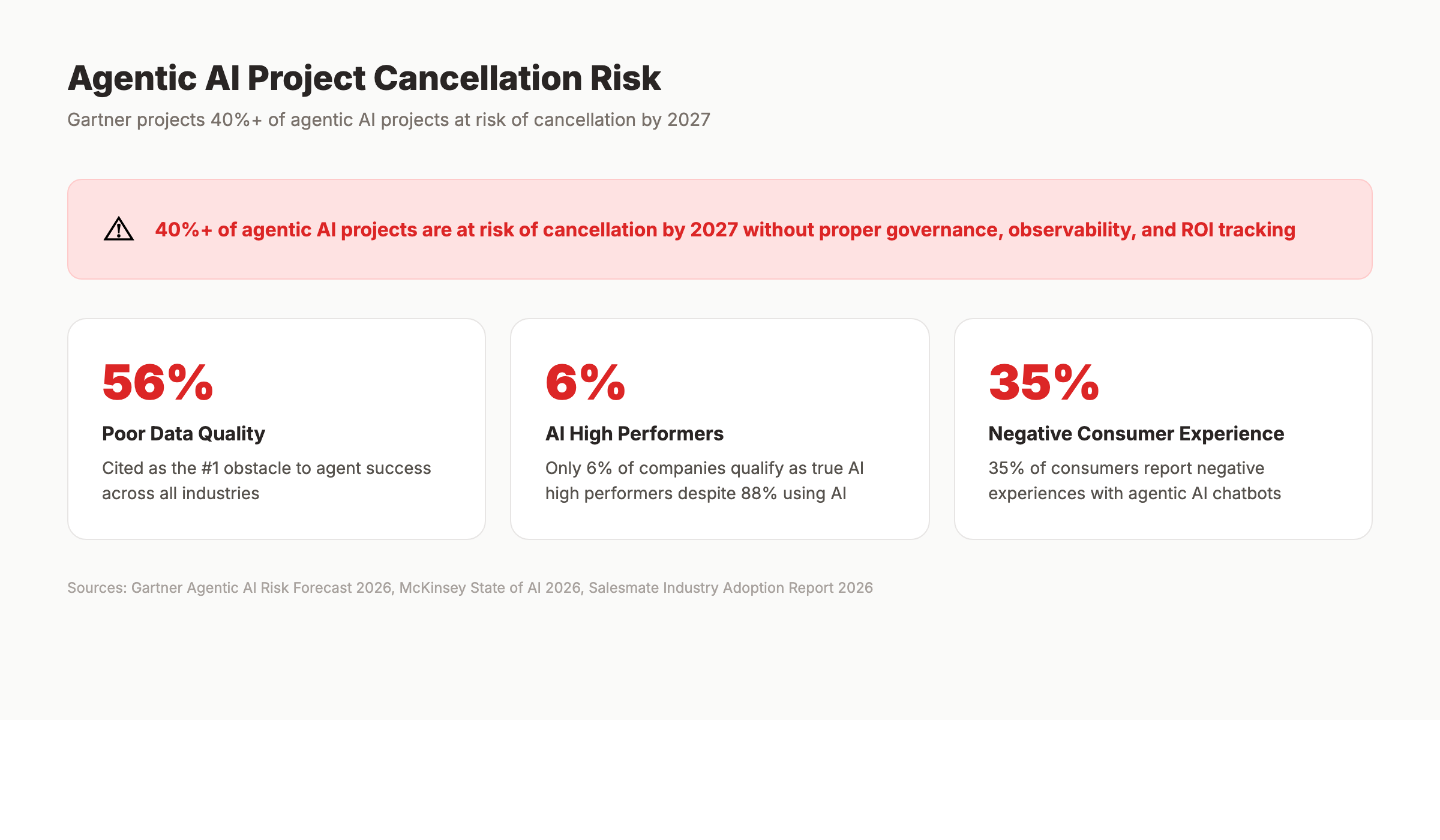
30. Over 40% of agentic AI projects are at risk of cancellation by 2027. Source: Gartner Agentic AI Risk Forecast, 2026. Cancellation risk drivers include weak governance, missing observability, and unclear ROI attribution.
31. 56% of AI deployment teams cite poor data quality as the major obstacle to agent success. Source: McKinsey Global AI Survey 2026. Data quality is now the single most-cited blocker, ahead of model performance, cost, or vendor selection.
32. Only 6% of companies qualify as "true AI high performers." Source: McKinsey State of AI 2026. The 94% gap is the production-versus-pilot problem. Most agents never leave proof-of-concept.
33. 65% of consumers report positive experiences with agentic AI chatbots. Source: Salesmate Industry Adoption Report, 2026. The flip side: 35% report negative experiences. Customer-facing agents carry the highest brand risk.
Industry Outlook Statistics
Forward-looking data is less precise than backward-looking data. The three numbers below are the most credible projections published this spring.
34. AI agents will intermediate more than $15 trillion in B2B spending by 2028. Source: McKinsey Global AI Survey 2026. B2B procurement is the highest-value agent use case projected through 2028. Marketing is downstream of this shift.
35. Agentic AI could generate nearly 30% of enterprise application software revenue by 2035. Source: Gartner Agentic AI Revenue Forecast, 2026. That number translates to roughly $450 billion in agent-attributable software revenue by 2035.
36. AI agents will take over 40% of routine marketing tasks within three years. Source: Talkwalker State of Agentic AI in Marketing 2026. Routine here means workflows with stable inputs, defined outputs, and low judgment requirements.
Key Takeaways
Six bullets for readers who scanned the page.
- 90% adoption is real. 90% of marketers use AI agents for decisions. 93% use them for content. The "should we adopt" debate is over.
- 34% production gap. Only 34% of enterprise teams run autonomous agents in production. The other 56% pilot but do not deploy.
- 3.2x ROI is the benchmark. Content drafting agents deliver 3.2x ROI on average. Personalization delivers 2.7x. Use these as planning multiples.
- 6.1 hours saved per week. Senior staff save more. Junior staff save less. The barbell hiring pattern follows directly.
- 40% cancellation risk. Gartner projects 40% of agentic projects will be canceled by 2027. Governance, observability, and ROI tracking are the three saves.
- SMB is the growth frontier. 51% of SMBs now use AI. 43% use marketing automation specifically. The next adoption wave runs through the mid-market.
3,500+ blogs published. Every article is SEO-scored before publish. See what theStacc can do for your site.
Methodology
Sources:
- Salesforce State of Marketing 2026
- McKinsey Global AI Survey 2026
- Gartner CMO Spend Survey 2026
- Gartner Agentic AI Risk Forecast 2026
- HubSpot AI Trends 2026
- BCG and Forrester Joint Agent Survey 2026
- Warmly AI Agents Statistics Report 2026
- Talkwalker State of Agentic AI in Marketing 2026
- Digital Applied 250-Agency Survey 2026
- U.S. Chamber of Commerce Small Business AI Index 2026
- New Media AI Agent Usage Statistics 2026
- DemandSage AI Agents Report 2026
- SAS Marketing AI Report 2026
- Salesmate Industry Adoption Report 2026
Last updated: May 2026.
Update cadence: Quarterly. The next refresh is scheduled for August 2026 to incorporate Q2 vendor earnings data and the next Gartner CMO Spend pulse.
Note on numbers: Where two credible sources publish different numbers for the same statistic, we cite the larger sample size. Where sample sizes are comparable, we cite the more recent survey. Source names appear next to every statistic so readers can verify or pick the version that fits their context.
What practitioners are saying on X
Fundamentals plus AI-search measurement remain the dual stack.
- @jakezward (Feb 2026): 2026 SEO predictions emphasize AI Overview share-of-SERP, schema for LLM token efficiency, brand mentions in AI answers as a KPI, proprietary data as a moat, and content refresh beating net-new AI slop. See the post on X.
- @hridoyreh (Mar 2026): Widely shared SEO skill tree: foundations, research, technical, on-page, content, links, AI SEO/GEO, analytics, UX, brand, programmatic — useful map for stats and how-to posts. See the post on X.
- @HlynurStefDev (Jul 2026): Public case: niche site traffic jumped from ~18 to 4,162 Google visits/month after focused technical/on-page SEO work (GSC screenshots claimed) — reminds that fundamentals still move numbers. See the post on X.
Grok, AI Overviews, and multi-engine visibility
AI/search topics like “ai agents marketing adoption” need multi-engine notes: AI Overviews, ChatGPT/Perplexity, and Grok. Lead with extractable answers; keep claims consistent with public expert discussion.
- Google AI Overviews: Use passage-ready answers, tables, and FAQ schema where relevant.
- ChatGPT / Perplexity: Cite named sources next to key claims.
- Grok: Maintain accurate entity facts on-site and in high-signal X posts.
Publish content built for Google and AI citations. theStacc’s Content SEO module ships SEO-scored articles structured for rankings and generative engines — including clearer entity pages models like Grok can quote.
FAQ
91% of marketing professionals use AI tools in daily workflows. 90% specifically use AI agents for decision-making and 93% use them for content generation. Source: Salesforce State of Marketing 2026 and Warmly AI Agents Report 2026. The "90% of teams" headline holds across multiple independent surveys.
Content drafting agents deliver an average 3.2x ROI. Personalization agents deliver 2.7x. Audience research returns 2.4x and ad copy generation returns 2.3x. Source: McKinsey Global AI Survey 2026. 80% of marketers reported AI tools exceeded ROI expectations in 2025.
Marketers save 6.1 hours per week on average using AI agents. Senior practitioners save 8 to 10 hours. Junior staff save 3 to 4 hours. Source: HubSpot AI Trends 2026. The time savings concentrate on draft writing, research, and reporting workflows.
Copywriting, audience targeting, and campaign analytics top the list at 80% combined adoption. SEO content optimization and email campaign optimization follow at 51%. Source: Warmly Marketing AI Survey 2026 and HubSpot AI Trends 2026. Content generation is the single most-deployed workflow.
Project cancellation. Over 40% of agentic AI projects are at risk of cancellation by 2027 without proper governance, observability, and ROI tracking. Source: Gartner Agentic AI Risk Forecast 2026. Poor data quality is cited by 56% of teams as the main blocker.
51% of U.S. businesses with under 500 employees now use AI in some form, with 43% using marketing automation specifically. Source: U.S. Chamber of Commerce Small Business AI Index 2026. SMB adoption grew 13 points from 2025 and is now the fastest-growing segment.
We update this page quarterly. The current version reflects data published through May 2026. Next refresh: August 2026, after the Q2 2026 Gartner CMO Spend pulse and Q2 vendor earnings cycle.
Three categories remain human-only in 2026. Strategic brand positioning requires judgment that no agent possesses — the ability to read cultural context and make bets on future positioning. Crisis communication demands real-time human empathy and legal awareness that agents lack. And creative conceptualization — the original campaign idea, the unexpected hook, the narrative arc that resonates — still comes from humans. The best teams use AI for execution and humans for direction.
The United States leads in absolute numbers and enterprise deployment depth. China leads in government-supported adoption and manufacturing-sector integration. The United Kingdom and Germany show the fastest growth rates in Europe, driven by regulatory clarity and strong SaaS ecosystems. Australia and Canada have high per-capita adoption but smaller absolute markets. Emerging markets in Southeast Asia and Latin America are catching up quickly as localized AI tools become available at lower price points.
The AI agents marketing adoption story for 2026 is settled at the headline level. 90% of teams use them. The question that defines the next 18 months is which 6% of companies turn that adoption into measurable ROI, and which 40% see their projects canceled before they reach production.
Related Tools & Resources
Free SEO Tools:
Best Lists:
Sources & references
- [1] Princeton / Georgia Tech et al. — GEO research (arXiv:2311.09735)
- [2] @jakezward on X — 2026 SEO predictions emphasize AI Overview share-of-SERP, schema for LLM token efficiency, brand mentions in AI answers
- [3] @alexgroberman on X — Case narrative: organic value plus multi-engine citations (ChatGPT, Perplexity, Grok) from knowledge-hub pages, category
- [4] @varunram on X — Critique of GEO slopfarm products that combine SEO clickbait with unresearched content marketing — quality and research

Plan topics, review article drafts, and publish to a connected CMS.
Weekly local SEO teardowns
One practical email a week. Map Pack, GBP, AI Overviews. No fluff. Unsubscribe anytime.