
How to Scale Blog Content With AI (8 Steps)
Learn how to scale blog content production with AI. 8 steps covering systems, workflows, editing, and quality control. Updated March 2026.
94% of marketers plan to use AI for content creation in 2026. Yet most businesses still publish 1 to 4 blog posts per month. That is not enough to rank for anything competitive.
Your competitors publish 20 to 30 posts per month. They build topical authority across entire keyword clusters. They dominate search results while your 4 posts sit on page 3.
The math makes the problem worse. At $200 per article from freelance writers, scaling to 30 posts costs $6,000 per month. Most small and mid-size businesses cannot absorb that. So they stay stuck. They publish when they can, watch traffic flatline, and wonder why blog SEO does not work for them.
AI changes the equation. Not by replacing writers. By replacing the bottleneck.
We publish 3,500+ blogs across 70+ industries with a 92% average SEO score. AI is central to our workflow. But the tool alone does not produce results. The system does.
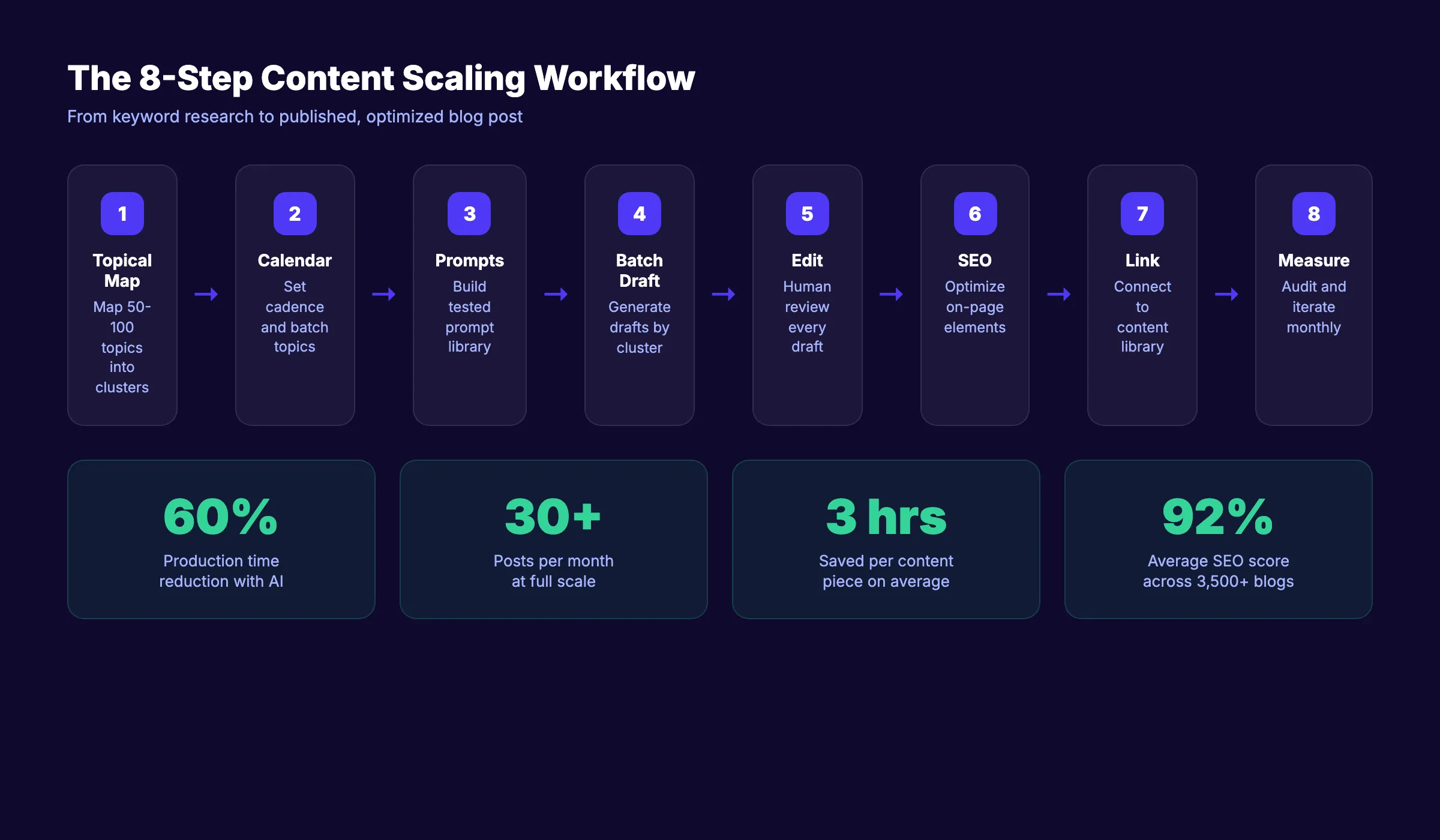
This guide walks through 8 steps to scale blog content production with AI. You will go from 4 posts per month to 30+ without sacrificing quality or burning out your team.
Here is what you will learn:
- How to build a topical map that prevents wasted content
- The batching workflow that cuts production time by 60%
- Why editing is the single most important step (and what happens when you skip it)
- A cost comparison of every scaling method
- The 5 mistakes that cause 40 to 60% traffic drops for AI content
- How to measure and iterate so quality compounds over time
Overview
Time required: 2 to 4 hours to set up the system. 30 to 60 minutes per post after that.
Difficulty: Intermediate
What you need: An AI writing tool (ChatGPT, Claude, or similar), a keyword research tool, a CMS, and an editorial process.
Step 1: Build a Topical Map Before You Write Anything
Most teams that try to scale blog content with AI start in the wrong place. They open ChatGPT, pick a random topic, and generate a post. Then they do it again tomorrow with another random topic.
After 30 posts, they have 30 disconnected articles that compete with each other for the same keywords. Google sees no structure. No authority signal. No reason to rank any of them.
This is keyword cannibalization at scale. And AI makes it worse because you can create bad content faster.
The fix is a topical map. Before you write a single post, map out 50 to 100 topics organized into clusters.
Each cluster has one pillar page and 5 to 15 supporting posts. The pillar covers a broad topic. The supporting posts cover specific subtopics and link back to the pillar.
For example, a “local SEO” cluster might include:
| Content Type | Topic | Target Keyword |
|---|---|---|
| Pillar | Complete Local SEO Guide | local SEO guide |
| Supporting | Google Business Profile Setup | optimize Google Business Profile |
| Supporting | Local Citation Building | local citations SEO |
| Supporting | Getting More Google Reviews | get more Google reviews |
| Supporting | Local Keyword Research | local keyword research |
Start with your 3 to 5 core topics. Break each into 10 to 20 subtopics. Prioritize by keyword difficulty and business relevance.
Read our full guide on how to create a topical map for the complete process.
Why this step matters: Without a map, you publish 30 disconnected posts that compete with each other. Sites with clear topic authority gained 23% organic visibility after Google’s December 2025 update. Structure beats volume every time.
Pro tip: Use your AI tool to brainstorm subtopics for each cluster. Ask it to generate 20 related questions for your pillar keyword. Then validate each one with a keyword research tool.
Step 2: Create a Content Calendar With Publishing Cadence
A topical map tells you what to write. A content calendar tells you when.
Scale without a calendar is chaos. You duplicate topics. You miss deadlines. You lose momentum. And momentum matters because SEO compounds. Publishing 7 posts per week for 12 weeks beats publishing 84 posts in a single week.
Set your target cadence based on your resources:
| Scale Level | Posts Per Week | Posts Per Month | Team Required |
|---|---|---|---|
| Starter | 2-3 | 8-12 | 1 editor |
| Growth | 5-7 | 20-30 | 1-2 editors |
| Aggressive | 10-15 | 40-60 | 2-3 editors |
| Full scale | 15-20 | 60-80 | 3-5 editors or a service like Stacc |
Batch similar topics together. If you are writing 5 posts about keyword research for blog posts, write them in the same session. You stay in the same mental context. Your AI prompts build on each other. And your internal linking happens naturally.
Assign priority to each post. High-priority posts target low-difficulty keywords with direct business value. Low-priority posts fill gaps in your topical clusters.
Why this step matters: Consistency signals authority to Google. A site that publishes 5 posts per week for 6 months builds more trust than one that publishes 130 posts in month 1 and nothing after.
Step 3: Build a Prompt Library and Style Guide
Generic prompts produce generic content. If you type “write a blog post about SEO” into ChatGPT, you get something that sounds like every other AI-generated article on the internet.
At scale, this problem multiplies. Thirty posts with the same AI voice, the same filler transitions, and the same hedging language creates a site that reads like a content farm. Google’s helpful content system flags exactly this pattern.
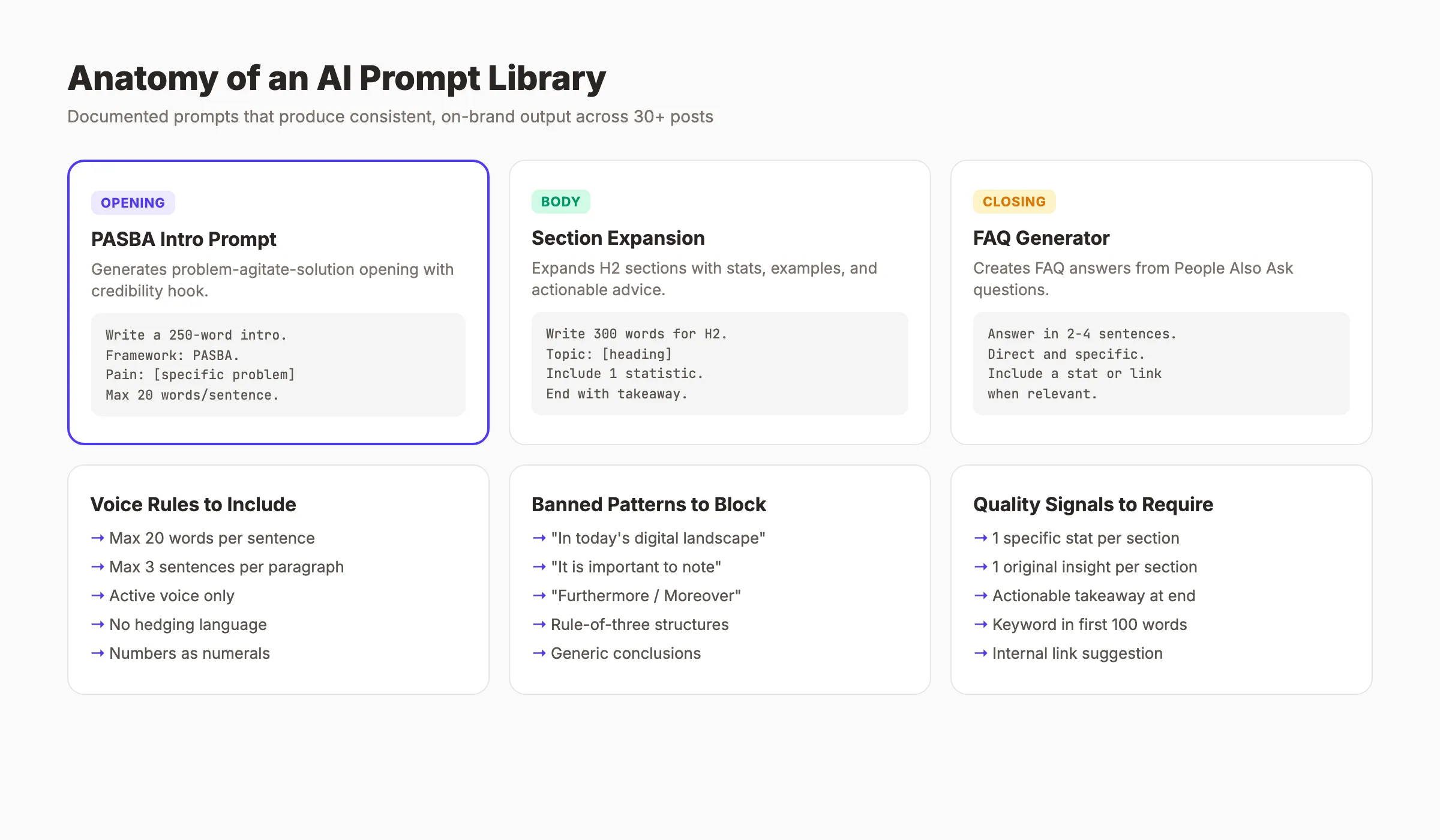
The fix is a prompt library. A documented set of tested prompts that produce consistent, on-brand output.
Your prompt library should include:
- Voice rules: Sentence length limits, banned words, tone descriptors
- Structure templates: PASBA openings, H2/H3 patterns, CTA placement
- Per-section prompts: Separate prompts for introductions, body sections, conclusions, and FAQs
- Example outputs: 2 to 3 “gold standard” posts that define what good looks like
Here is an example prompt template for body sections:
Write a 300-word section for an SEO blog post.

Topic: [H2 heading]
Target keyword: [keyword]
Audience: Small business owners with no SEO background.

Rules:
- Max 20 words per sentence
- Max 3 sentences per paragraph
- Active voice only
- No hedging words (might, could, perhaps)
- Include 1 specific statistic or example
- End with an actionable takeaway
For AI prompts for SEO articles, we maintain a library of 30+ prompt templates organized by content section and post type.
Your style guide should define what makes your content different. Document your brand voice. List banned phrases. Specify formatting rules. The more specific your guide, the more consistent your output at scale.
Why this step matters: Consistency across 30+ posts per month requires documented standards. Without them, every post sounds different. Or worse, every post sounds the same. In the generic AI way that readers and Google both penalize.
Pro tip: Test each prompt with 3 different topics before adding it to your library. If it produces good output across topics, it is ready. If it only works for one topic, it is too narrow.
Step 4: Generate First Drafts in Batches
Now you have a topical map, a calendar, and a prompt library. Time to produce content.
The key principle is batching. Do not write one post at a time. Write all posts in a topic cluster in a single session.
Batching works because of context. When you write 5 posts about on-page SEO in one sitting, each post builds on what you already know. Your AI tool maintains context between prompts. Your internal links connect naturally. And your voice stays consistent.
Here is the batching workflow:
- Select a cluster from your topical map (5 to 10 posts)
- Generate outlines first for every post in the cluster. Read our guide on creating a blog post outline for the framework.
- Review and adjust outlines before expanding. This is where you catch overlap and gaps.
- Expand section by section. Use your prompt library. Do not ask the AI to write the entire post in one shot.
- Include your target keyword in the title, first paragraph, and at least 1 H2
For each post, the AI generates a first draft in 15 to 30 minutes. Compare that to the 3 to 4 hours a writer needs for a 2,000-word article. According to Siege Media, AI reduces content production time by up to 60%.
That means a 10-post cluster that would take a writer 30 to 40 hours takes 5 to 8 hours with AI-assisted batching. The time savings compound as your prompt library improves.
When you use AI to write blog posts, remember that the draft is a starting point. Step 5 is where the real work happens.
Why this step matters: Batching reduces context-switching and produces more cohesive content. Individual post creation at scale leads to inconsistent quality, missed internal links, and topic overlap.
Stop writing. Start ranking. Stacc publishes 30 SEO-optimized articles per month for $99. Same system. Zero effort on your end. Start for $1 →
Step 5: Edit Every Draft With a Human Eye
This is the most important step in the entire process. Skip it, and nothing else matters.
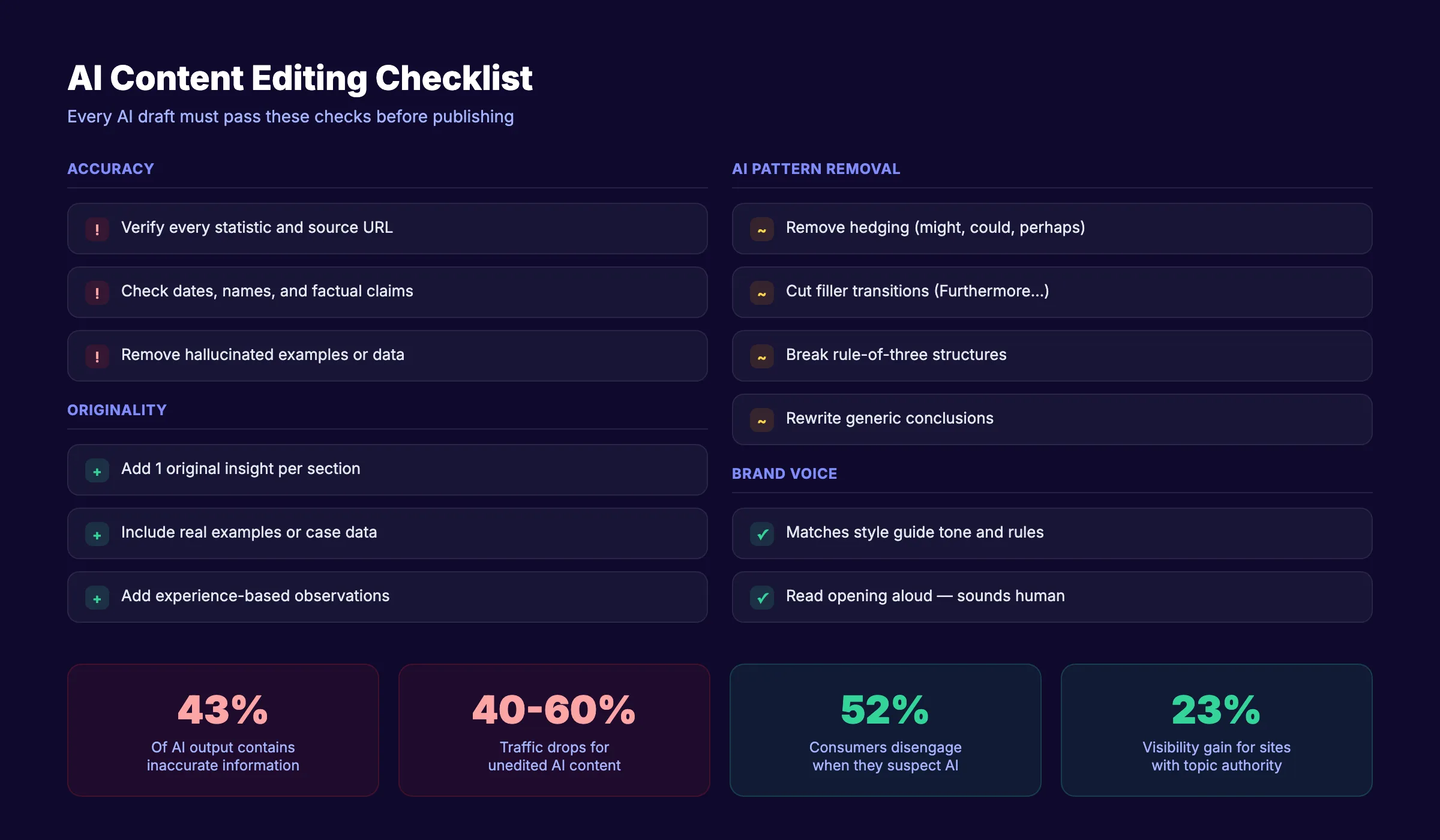
Google’s December 2025 update caused 40 to 60% traffic drops for sites publishing unedited AI content. That is not a penalty for using AI. It is a penalty for publishing low-quality content at volume. AI just made it easier to do that.
Every AI draft needs human editing. Not light proofreading. Substantive editing that transforms a generic draft into something worth reading.
Here is what to fix in every AI draft:
Factual accuracy. HubSpot reports that 43% of marketers say AI sometimes produces inaccurate information. Verify every statistic, date, and claim. One wrong fact damages your credibility across your entire site.
Original insights. AI can only remix existing information. Add your experience. Add client examples. Add data from your own work. This is what Google’s E-E-A-T framework rewards and what AI cannot generate.
AI writing patterns. Remove these from every draft:
- Hedging language (“might,” “could potentially,” “it is possible that”)
- Filler transitions (“Moving on to the next point”)
- Rule-of-three structures (AI loves listing exactly 3 examples for everything)
- Generic conclusions that summarize instead of adding value
- Overuse of em dashes connecting independent clauses
Brand voice alignment. Check against your style guide from Step 3. Does this sound like your brand? Or does it sound like ChatGPT?
For a detailed framework, read our guide on how to humanize AI content. It covers the specific patterns to find and fix.
You can also run your content through tools that detect AI content to identify sections that need more human touch. The goal is not to hide that you used AI. The goal is to ensure the content genuinely helps readers.
Why this step matters: Unedited AI content damages rankings and reader trust. The editing step is what separates AI content at scale from spam at scale. Every minute you spend editing saves hours of recovery from a traffic drop.
Pro tip: Create an editing checklist. Check factual claims, add 1 original insight per section, remove 3 AI patterns per draft, and read the opening paragraph aloud. If it sounds robotic, rewrite it.
Step 6: Optimize On-Page SEO for Every Post
AI does not optimize for SEO by default. It writes content. On-page SEO is a separate step that requires manual attention for every post you publish.
Most SEO content writing tools handle some of this. But at scale, you need a repeatable checklist.
For every post, verify:
- Title tag under 60 characters with the primary keyword
- Meta description between 145 and 155 characters. Write meta descriptions that include the keyword and a clear benefit.
- Primary keyword in the first 100 words
- Primary keyword in at least 1 H2
- Internal links: 3 to 5 per 1,000 words, using descriptive anchor text
- Image alt text with keywords where it makes sense naturally
- URL slug that includes the primary keyword
- Proper heading hierarchy (H1 to H2 to H3, no skipped levels)
The biggest on-page mistake at scale is thin optimization. Teams generate 30 posts but only optimize titles and meta descriptions. They skip internal links. They ignore image alt text. They use the same meta description template for every post.
Read our full guide on how to optimize content for SEO for the complete checklist.
The right blog post length also matters. AI tends to produce shorter content unless prompted otherwise. For competitive keywords, aim for word counts that match or exceed the top-ranking pages.
Why this step matters: Publishing 30 unoptimized posts is worse than publishing 10 optimized ones. On-page SEO is the bridge between content creation and organic rankings. Without it, your AI drafts never reach the audience they were written for.
Step 7: Build Internal Links Across Your Content Library
Internal links are the most underrated part of scaling content. Most teams focus on creating new posts and forget to connect them.
A site with 100 interlinked posts outranks a site with 100 isolated posts. Google uses internal links to discover content, understand topic relationships, and distribute page authority. Without them, your posts are orphans.
At scale, internal linking requires a system:
Link new posts to existing ones. Every new post should link to 3 to 5 related articles already on your site. Use descriptive anchor text that tells readers what to expect.
Update older posts to link to new content. This is the step most teams skip. When you publish a new post about keyword research, go back to your existing posts about SEO and add links to it.
Create hub-and-spoke structures. Your pillar pages should link to every supporting post in their cluster. Every supporting post should link back to the pillar. This creates clear topical signals for search engines.
Here is a simple linking matrix for a 5-post cluster:
| Post | Links To | Links From |
|---|---|---|
| Pillar: SEO Guide | All 4 supporting posts | All 4 supporting posts |
| Supporting: Keyword Research | Pillar + 2 other supporting | Pillar + 1 other supporting |
| Supporting: On-Page SEO | Pillar + 2 other supporting | Pillar + 1 other supporting |
| Supporting: Technical SEO | Pillar + 2 other supporting | Pillar + 1 other supporting |
| Supporting: Link Building | Pillar + 2 other supporting | Pillar + 1 other supporting |
Track your links in a spreadsheet. For every post, record which pages it links to and which pages link to it. Orphan posts (posts with zero internal links pointing to them) need immediate attention.
Why this step matters: Internal links compound. Each new post you publish strengthens every post it connects to. After 6 months of consistent linking, your older posts start climbing rankings because of the authority flowing from newer content. This is the Content Compound Effect in action.
Step 8: Measure, Audit, and Iterate Monthly
Scale without measurement is guessing. You need to know which posts rank, which posts fail, and why.
Only 19% of content marketers track AI-specific KPIs. That means 81% are flying blind. Do not be in the majority.
Track these metrics monthly:
- Indexed pages: Are your new posts getting indexed? If not, check crawl errors and internal links.
- Organic traffic by post: Which posts drive traffic? Which ones sit at zero?
- Keyword rankings: Track position changes for your target keywords.
- Bounce rate and time on page: Low engagement signals quality problems.
- Conversion rate: How many readers take the next action?
Run quarterly content audits to clean up your content library. At scale, not every post will perform. Some will cannibalize each other. Some will go stale. Some will simply miss the mark.
For underperforming posts, you have 3 options:
- Update: Add new data, improve the structure, strengthen internal links
- Merge: Combine 2 weak posts into 1 strong one
- Prune: Remove or noindex posts that add no value
Use Google Search Console and your SEO audit tool to identify opportunities. Look for posts ranking on page 2. Those are your biggest quick wins.
AI-specific metrics to track:
- Edit time per post: Is it decreasing as your prompts improve?
- Factual error rate: How many corrections per draft?
- Publication rate: What percentage of AI drafts make it to publication?
Why this step matters: Monthly reviews reveal what works and what does not. Without them, you scale your mistakes along with your successes. The teams that measure and iterate produce better content in month 6 than month 1. The teams that do not produce the same mediocre content 6 months in a row.
Results: What to Expect
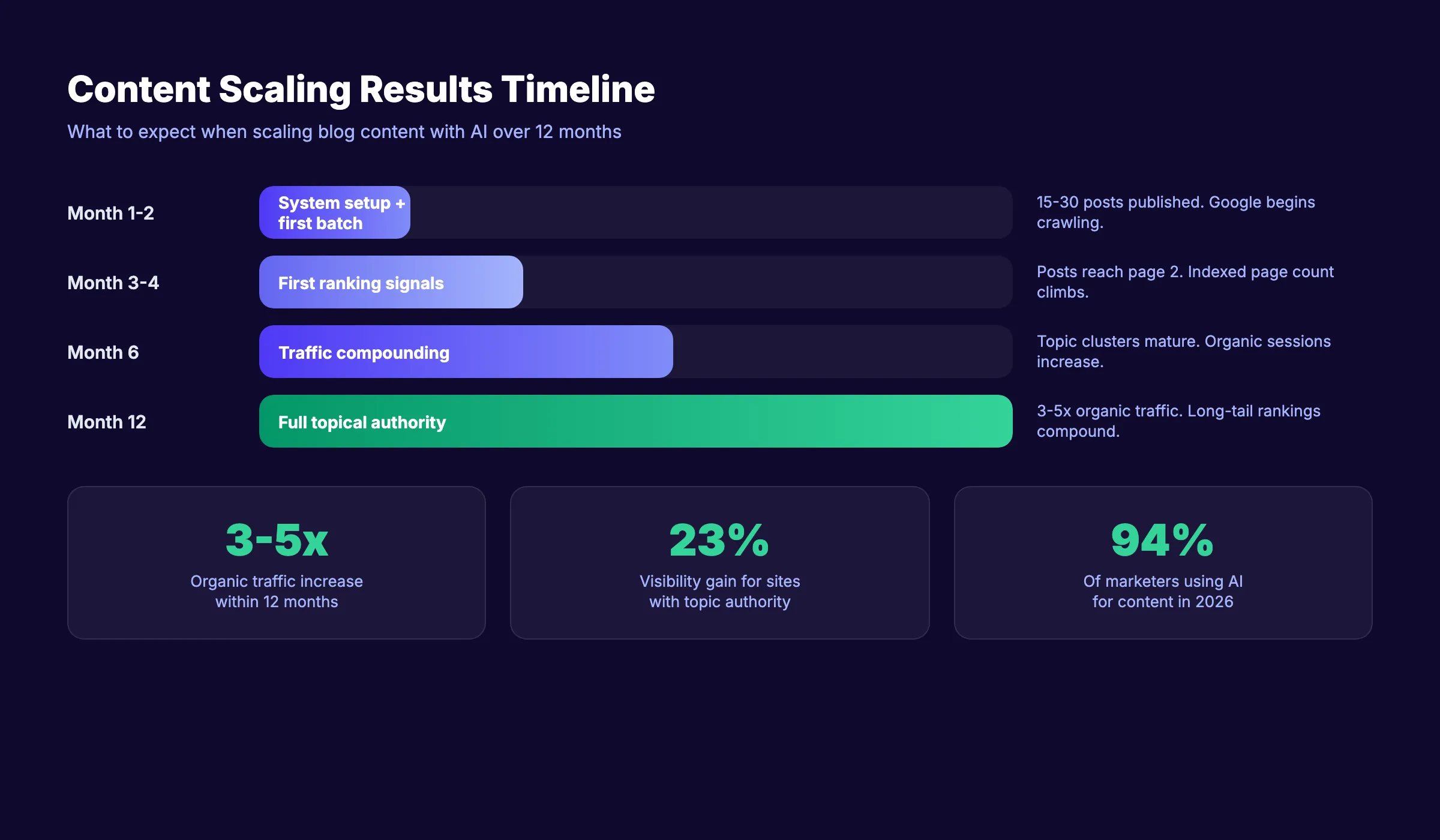
Scaling blog content with AI does not produce overnight results. SEO compounds. Here is a realistic timeline:
Month 1 to 2: System setup complete. First batch of 15 to 30 posts published. Google begins crawling and indexing your new content. You will not see significant traffic yet.
Month 3 to 4: First ranking signals appear. Some posts reach page 2. Indexed page count climbs steadily. Internal links start distributing authority across your site.
Month 6: Organic traffic begins compounding as topic clusters mature. Posts published in month 1 start ranking higher because of the supporting content you added since. You should see measurable increases in organic sessions.
Month 12: Full topical authority in your target areas. Your site ranks for long-tail keywords you never explicitly targeted because Google recognizes your depth. The Content Compound Effect is in full swing.
The teams that follow this system consistently increase organic traffic by 3 to 5x within 12 months. The key word is consistently. Publishing 30 posts in month 1 and stopping does not work.
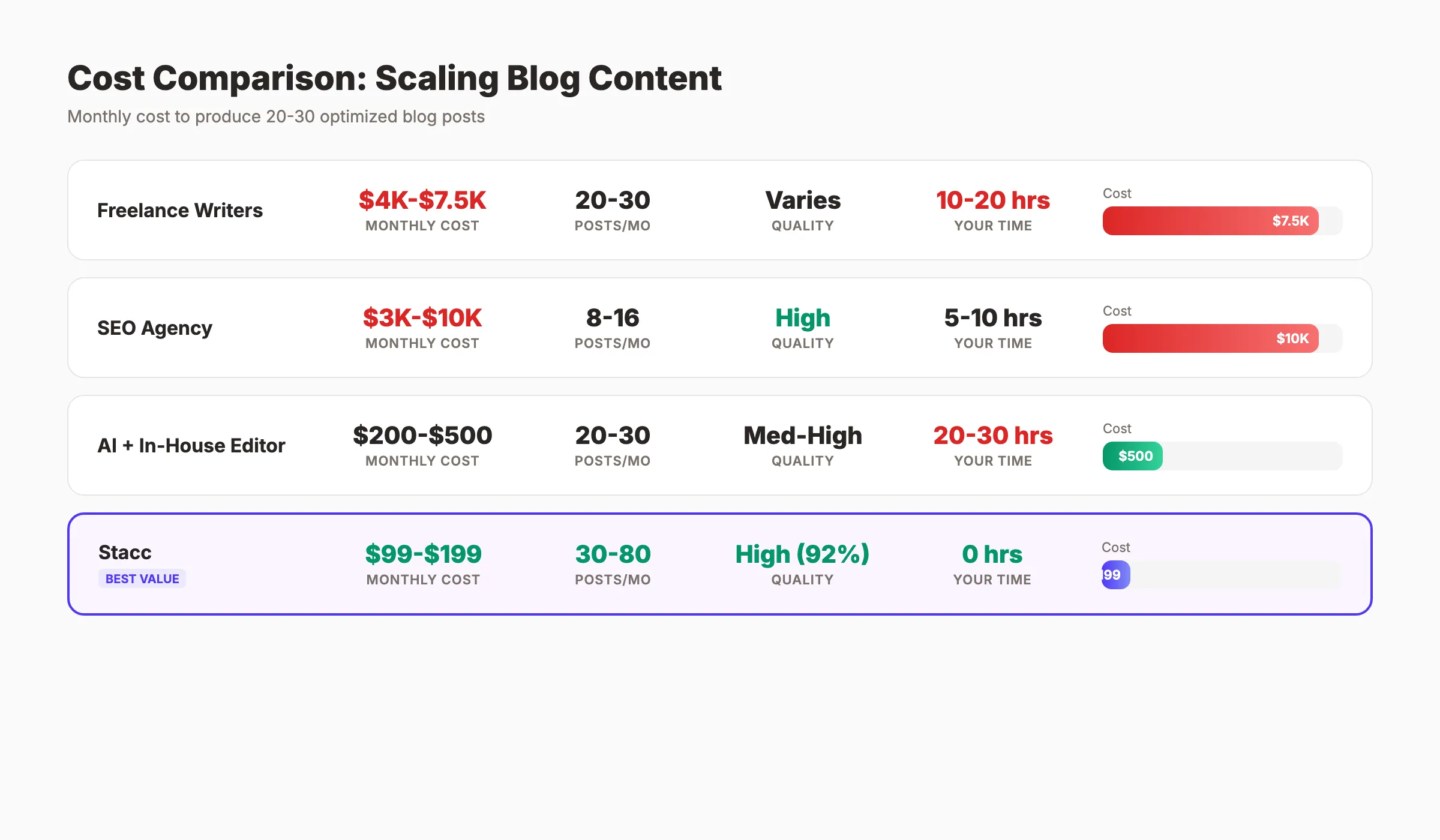
Cost Comparison: AI Content Scaling Methods
Before you choose a scaling method, understand the real costs.
| Method | Monthly Cost | Posts/Month | Quality Control | Time Required |
|---|---|---|---|---|
| Freelance writers | $4,000-$7,500 | 20-30 | Varies | 10-20 hrs editing |
| SEO agency | $3,000-$10,000 | 8-16 | High | 5-10 hrs managing |
| AI + in-house editor | $200-$500 | 20-30 | Medium-High | 20-30 hrs |
| Stacc | $99-$199 | 30-80 | High (92% avg SEO score) | 0 hrs |
Freelance writers produce quality content but cost $150 to $250 per article at the skill level needed for SEO. Scaling to 30 posts means $4,500 to $7,500 per month before editing time.
Agencies deliver high quality but charge for strategy, management, and overhead. Most produce 8 to 16 posts for $3,000 to $10,000 per month.
AI plus an in-house editor is the most common DIY approach. The AI tools cost $20 to $100 per month. The real cost is editor time. At 1 hour per post, 30 posts requires 30 hours of editorial work per month.
Stacc handles the entire pipeline. From keyword research to published post. 30 articles for $99 per month. No writing time. No editing time. No prompt engineering.
Troubleshooting: 5 Common AI Content Scaling Mistakes
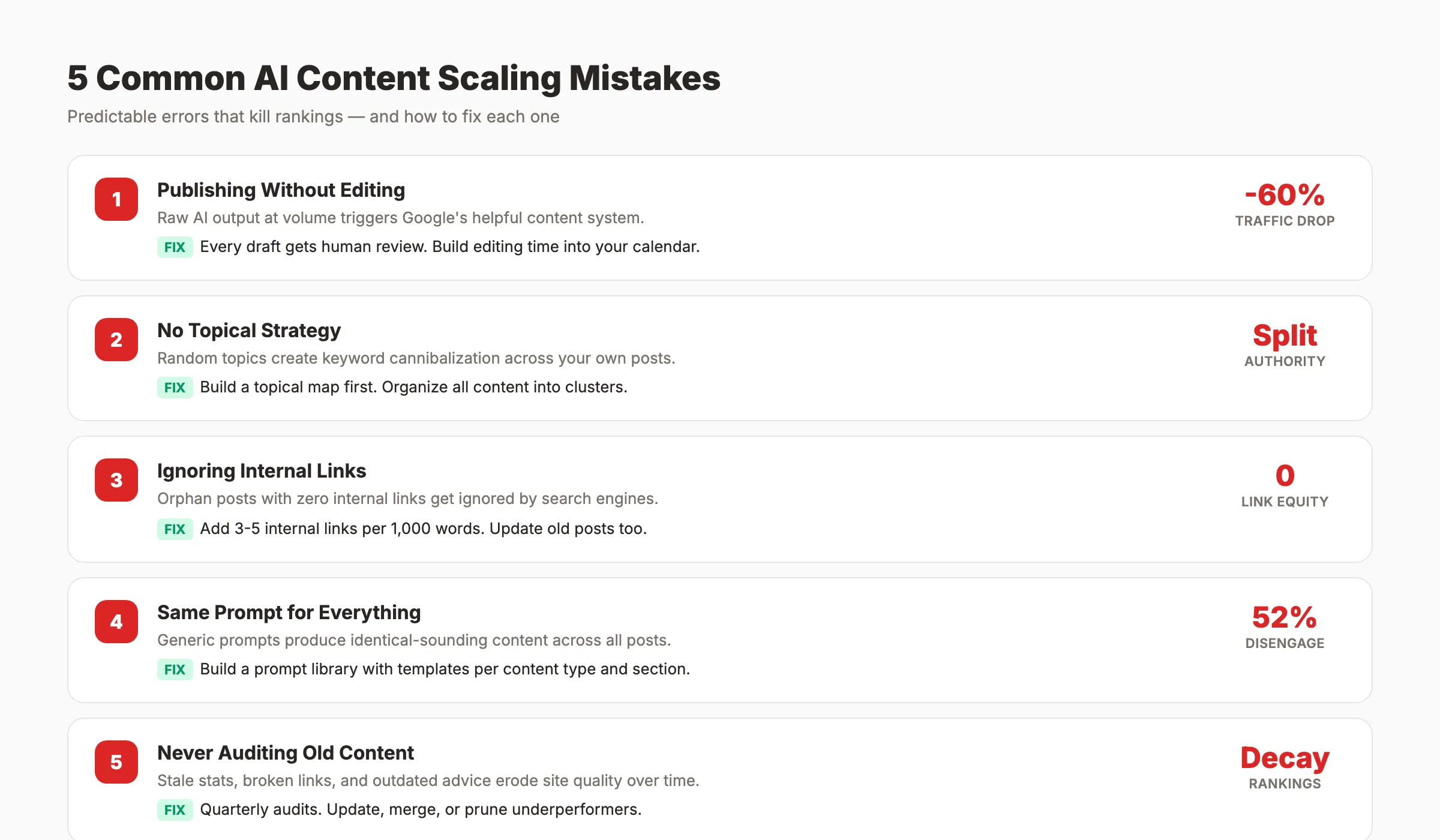
Even with a good system, teams make predictable errors when they scale. Here are the 5 most common and how to fix them.
Mistake 1: Publishing AI content without editing. This is the fastest path to a traffic collapse. Google’s December 2025 update proved it. Sites that published raw AI output saw 40 to 60% traffic drops. The fix: never publish a draft that has not been reviewed by a human editor. Build editing time into your calendar.
Mistake 2: No topical strategy. Random AI posts create random results. Worse, they create keyword cannibalization. Three posts targeting similar keywords split your authority instead of building it. The fix: build your topical map (Step 1) and stick to it.
Mistake 3: Ignoring internal links. Orphan posts do not rank. A post with zero internal links pointing to it tells Google it is not important. The fix: add every new post to your linking matrix (Step 7). Update old posts to link to new ones.
Mistake 4: Same prompt for every post. If every post uses the same generic prompt, every post sounds the same. Readers notice. Google’s helpful content system notices. The fix: build a prompt library (Step 3) with templates for different content types, topics, and sections.
Mistake 5: Never auditing old content. Content decays. Statistics go stale. Rankings shift. A post that ranked well 6 months ago might need an update. The fix: run quarterly audits (Step 8). Identify underperformers. Update, merge, or prune.
The best AI SEO tools can help you catch some of these issues. But no tool replaces a systematic review process.
3,500+ blogs published. 92% average SEO score. See what Stacc can do for your site. Start for $1 →
FAQ
Can AI write blog posts that rank on Google?
Yes. AI-assisted blog posts rank on Google every day. The key word is “assisted.” Raw AI output rarely ranks for competitive keywords. But AI drafts that are edited for accuracy, originality, and on-page SEO perform as well as human-written content. Google’s official position is that they reward helpful content regardless of how it was produced. The quality of the final output matters. The production method does not.
Does Google penalize AI-generated content?
Google does not penalize content for being AI-generated. Google penalizes content for being unhelpful, thin, or spammy. The December 2025 update hit sites publishing unedited AI content at volume because that content was low quality. Sites using AI as part of a quality editorial process were not affected. Read Google’s guidelines on creating helpful content for their official stance.
How many blog posts can AI produce per month?
There is no technical limit. AI can generate hundreds of drafts per month. The bottleneck is editing. A single editor can review and polish 20 to 30 AI drafts per month working full time. With 2 editors, you can scale to 50 to 60 posts. The real question is not how many posts AI can produce. It is how many posts your team can edit to a publishable standard.
How do you maintain brand voice when using AI at scale?
A style guide and prompt library (Step 3) are the foundation. Document your voice rules. Specify sentence length, banned words, and tone. Include example outputs that demonstrate what good looks like. Then enforce those standards during editing. Every editor should have the style guide open while reviewing drafts. The combination of specific prompts and consistent editing keeps 30+ posts sounding like the same brand.
What is the best AI tool for blog writing at scale?
The tool matters less than the system. ChatGPT, Claude, Gemini, and other models all produce usable first drafts. The difference between mediocre and great AI content is the workflow around the tool. Your topical map, prompt library, editing process, and SEO optimization matter more than which AI model you use. That said, choose a tool that allows long-form output, accepts detailed system prompts, and integrates with your workflow. Read our review of the best AI SEO tools for specific recommendations.
How much does it cost to scale blog content with AI?
DIY costs range from $200 to $500 per month for AI tools plus 20 to 30 hours of editor time. At $40 per hour, that is $1,000 to $1,700 total monthly cost for 20 to 30 posts. Compare that to $4,000 to $7,500 for the same volume from freelancers. Stacc offers another option at $99 per month for 30 articles with no time investment required. The right choice depends on whether you have editorial capacity in-house or need a done-for-you approach. See our pricing page for current plans.
Scaling blog content with AI is a system problem, not a writing problem. The 8 steps above give you that system. The teams that build and follow these workflows now will dominate organic search for years. Start with Step 1. Build your topical map. The rest follows from there.
Related Tools & Resources
Free SEO Tools:
Best Lists:

Written by
Siddharth GangalSiddharth is the founder of theStacc and Arka360, and a graduate of IIT Mandi. He spent years watching great businesses lose organic traffic to competitors who simply published more. So he built a system to fix that. He writes about SEO, content at scale, and the tactics that actually move rankings.
30 SEO blog articles published every month
Keyword-optimized, scheduled, and live on your site. Automatically.
30-day trial · Cancel anytime
theStacc
Stop writing SEO content manually
30 blog articles, 30 GBP posts, and social media content. Published every month. Automatically.
Start Your $1 Trial$1 for 3 days · Cancel anytime