
Blog SEO (2026): Strategies, Tactics & Examples
Practical blog seo strategies for 2026: step-by-step tactics, real examples, and tools to improve rankings and drive organic traffic.
Blog SEO is the practice of optimizing blog posts to rank higher in search engines. It covers keyword research, content structure, on-page optimization, internal linking, technical performance, and publishing strategy. Every element works together as a system that compounds over time.
Businesses that blog consistently generate 67% more leads per month than those that do not. Yet 96.55% of all web pages get zero organic traffic from Google. The gap between publishing and ranking is where blog SEO lives. Most blogs fail not because the writing is bad. They fail because there is no optimization process.
That gap is expensive. Every blog post takes 3 to 5 hours to produce. At 8 posts per month, that is 24 to 40 hours of work. If none of those posts rank, you are spending 300+ hours per year creating content nobody finds. Blog SEO turns that wasted effort into a compounding asset.
This guide covers every part of blog SEO that matters in 2026. We publish 3,500+ blog posts per month across 70+ industries. Every one follows this system. By the end, you will have a repeatable framework for ranking blog content in both traditional search and AI-generated answers.
In this guide, you will learn:
- What blog SEO is and how it differs from general SEO
- Why blog SEO matters more in 2026 than any previous year
- The fundamentals: keywords, search intent, and content structure
- An 8-point optimization checklist for every blog post
- How to build content clusters that compound topical authority
- Technical SEO fundamentals that most blogs ignore
- How to format blog content for AI search engines
- Which metrics to track and how to build a monthly review routine
Chapter 1: What Is Blog SEO?
Blog SEO is the process of making blog content discoverable through search engines. It involves optimizing individual posts and the blog as a whole for Google, Bing, and AI search platforms like ChatGPT and Perplexity.
The 3 Layers of Blog SEO
Blog SEO operates on 3 layers. Each must work for the others to produce results.
1. Content SEO covers keyword targeting, search intent matching, topic depth, and content quality. This is the “what you write” layer. A blog post targeting the wrong keyword or mismatching intent will not rank regardless of technical optimization.
2. On-page SEO covers title tags, meta descriptions, heading hierarchy, internal links, and image optimization. This is the “how you structure what you write” layer. These elements tell Google what your page covers and how it connects to the rest of your site.
3. Technical SEO covers page speed, mobile experience, crawlability, indexing, schema markup, and Core Web Vitals. This is the “can Google access and render what you wrote” layer. A fast, mobile-friendly, well-indexed site is the foundation everything else builds on.
Blog SEO vs General SEO
Blog SEO is a subset of general SEO. General SEO covers your entire website: homepage, product pages, category pages, and site architecture. Blog SEO focuses specifically on ranking long-form informational content consistently.
The skills overlap heavily with on-page optimization and SEO content writing. But blog SEO is about building a content engine. One that compounds over time as each article stacks authority on the last.
Chapter 2: Why Blog SEO Matters in 2026
Search has changed. AI Overviews now appear in roughly 48% of Google queries. Zero-click searches represent 60% of all search interactions. But organic search still drives 53% of all website traffic. The channel is not dying. It is evolving.
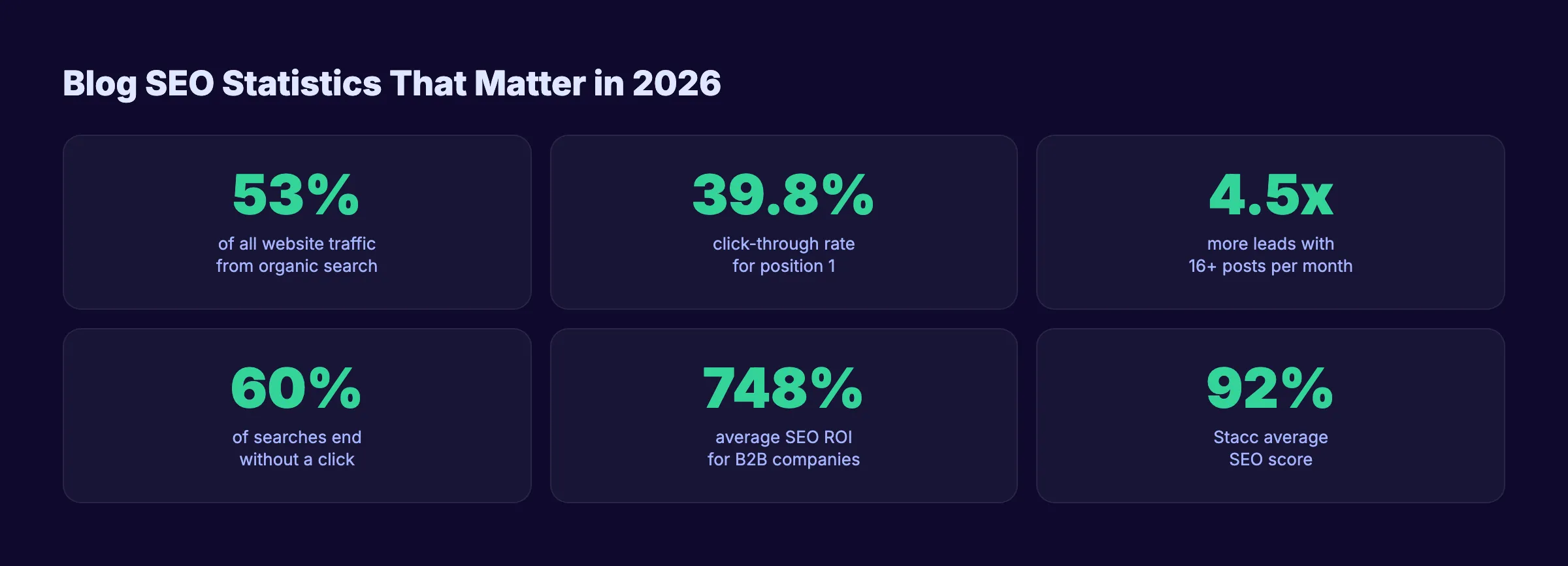
The Numbers Behind Blog SEO
Here are the statistics that define blog SEO in 2026:
| Metric | Data Point | Source |
|---|---|---|
| Organic traffic share | 53% of all website traffic | BrightEdge |
| Position 1 CTR | 39.8% of all clicks | Backlinko |
| Blogging leads | 67% more leads per month for companies with blogs | HubSpot |
| Publishing multiplier | 4.5x more leads for companies posting 16+ times per month | HubSpot |
| SEO ROI | 748% average ROI for B2B | First Page Sage |
| Zero-click rate | 60% of searches end without a click | Incremys |
These numbers make one thing clear. Organic search is still the highest-ROI acquisition channel for most businesses. Blog content is the most scalable way to capture it.
The Compounding Effect
A blog post published today can generate traffic for 2 to 5 years. Unlike paid ads that stop the moment you stop paying, organic content compounds. Each new post adds to your site authority. Each ranking page sends link equity to other pages. The effect stacks.
This is the Content Compound Effect. Companies that publish 16+ posts per month see 4.5x more leads than those publishing 0 to 4. Not because each individual post generates 4.5x leads. Because the compounding effect of topical authority, internal linking, and fresh content accelerates everything.
AI Search Creates New Opportunity
Google AI Overviews, ChatGPT, and Perplexity now cite blog content directly in their answers. AI-referred visitors convert at 4.4x the rate of standard organic visitors. They spend 68% more time on site. They view 3x as many pages per session.
Blog posts with clear structure, direct answers, and original data get cited most often. The same content that ranks in traditional search also performs well in AI search. Blog SEO and AI search optimization are now inseparable.
Your SEO team. $99/month. Stacc publishes 30 optimized blog posts per month. Keywords, structure, on-page SEO, and AI formatting handled on autopilot. Start for $1 →
Chapter 3: Blog SEO Fundamentals
Before optimizing a single post, you need 3 foundations in place: keyword research, search intent alignment, and content structure. Skip any of these and the rest of the process falls apart.
Keyword Research for Blog Posts
Every blog post should target 1 primary keyword and 2 to 5 secondary keywords. Without keyword research, you are publishing content without knowing whether anyone searches for it.
Free methods that work:
- Google Autocomplete. Type your topic and note every suggestion. These are real queries.
- People Also Ask. Each PAA question reveals a related keyword with proven demand.
- Google Search Console. Shows queries your site already ranks for. Positions 5 to 20 are your best optimization targets.
For paid tools, Ahrefs, Semrush, and Surfer SEO provide exact volume and difficulty data.
3 Metrics That Determine Keyword Value
- Search volume measures demand. Target keywords with 100 to 10,000 monthly searches.
- Keyword difficulty measures competition. Aim for a KD score under 30 for newer sites.
- Search intent reveals what the searcher actually wants. This is the most important metric of all.
94.74% of keywords get 10 or fewer monthly searches. Long-tail keywords with 3 or more words make up 91.8% of all searches. They are less competitive and convert at 2.5x the rate of head terms. Start here if your blog is new.
Understanding Search Intent
Every keyword carries an intent. There are 4 types:
- Informational. The searcher wants to learn. (“how to write a blog post”)
- Navigational. The searcher wants a specific site. (“Semrush blog”)
- Commercial. The searcher is comparing options. (“best SEO tools 2026”)
- Transactional. The searcher is ready to buy. (“buy SEO audit service”)
Blog content targets informational and commercial intent. If the top 5 results for your keyword are all how-to guides, write a how-to guide. If they are all product pages, a blog post will not rank. This is called intent mismatch. No amount of optimization fixes it.
Content Structure That Ranks
Structure separates a post that ranks from one that does not. Google and AI systems can only rank content they understand.
The ideal blog post anatomy:
- H1 title containing the primary keyword
- Introduction that hooks the reader (under 200 words)
- H2 sections for each major subtopic
- H3 subsections for supporting details
- Visual breaks every 300 words (tables, lists, images)
- FAQ section at the end
- Conclusion with a clear call to action
Keep paragraphs to 2 to 3 sentences. Keep sentences under 20 words. Use bullet points for any set of 3 or more items. Read our full guide on blog post structure for SEO for the complete breakdown.
Chapter 4: How to Optimize Every Blog Post
This is the step-by-step checklist for optimizing any blog post. Apply it to every piece of content before publishing.
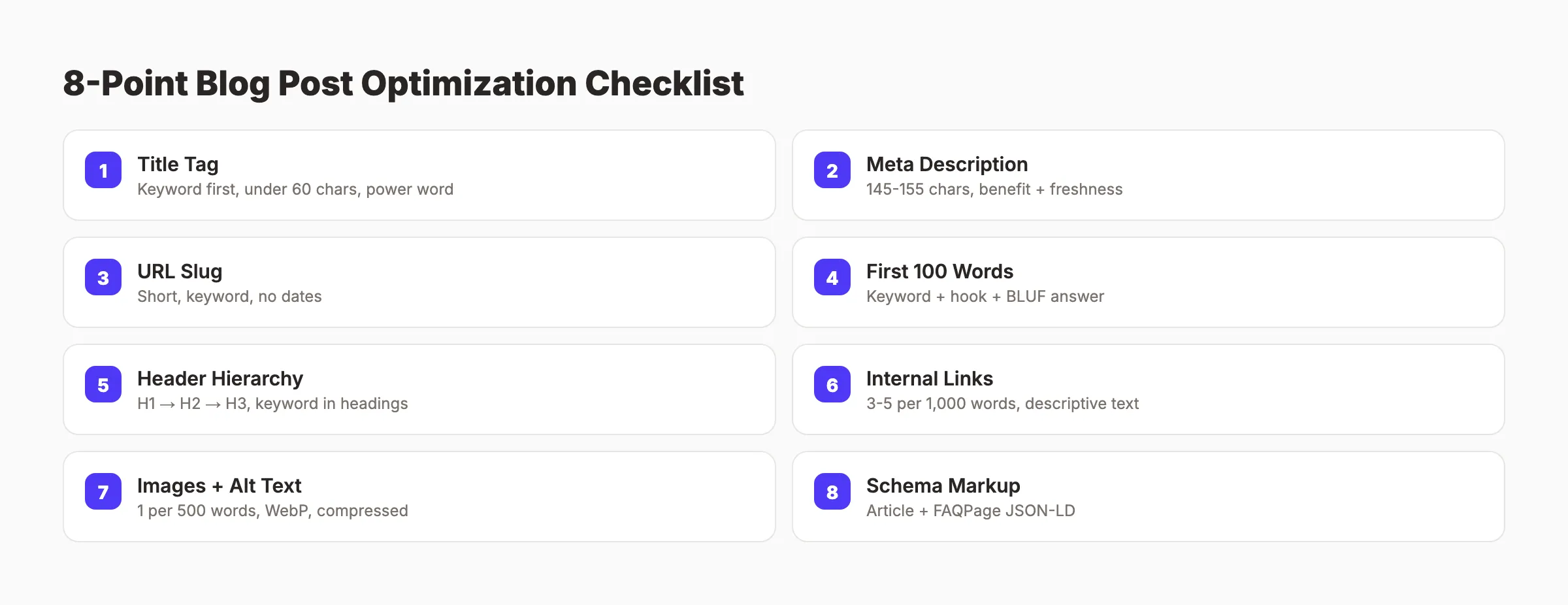
The 8-Point Blog Post Optimization Checklist
1. Title tag. Include the primary keyword within the first 5 words. Keep it under 60 characters. Add a number, year, or power word. Test it with a headline analyzer.
2. Meta description. Write 145 to 155 characters. Include the keyword. State a specific benefit. Add a freshness signal. Write it like ad copy. Check with our meta tag analyzer.
3. URL slug. Keep it short. Use the primary keyword. Hyphens between words. No dates or stop words. /blog/blog-seo not /blog/2026/03/the-complete-guide-to-blog-seo.
4. First 100 words. Include the primary keyword naturally. Hook the reader with a stat or bold claim. Preview what the post covers. 44.2% of AI citations come from the first 30% of an article. Front-load your best information.
5. Heading hierarchy. Use 1 H1 (the title). Use H2s for major sections. Use H3s for subsections. Never skip levels. Include the primary keyword in at least 1 H2. Use secondary keywords in other headings naturally.
6. Internal links. Add 3 to 5 internal links per 1,000 words. Use descriptive anchor text. Link to related posts, tool pages, and pillar content. After publishing, go back to 2 to 3 older articles and add links to the new post.
7. Images. Add at least 1 image per 500 words. Every image needs descriptive alt text (under 125 characters). Compress to WebP format. Set explicit width and height attributes to prevent layout shift.
8. Schema markup. Add Article schema to every blog post. Add FAQPage schema to FAQ sections. Use our schema markup generator to create valid JSON-LD.
Run the completed post through our SEO audit tool to catch anything you missed. It checks all 8 elements in seconds.
Stop optimizing manually. Stacc handles every item on this checklist for 30 articles per month. Automatically. $99/month. Start for $1 →
Chapter 5: Content Strategy. Clusters, Frequency, and Pillar Pages
Individual post optimization is necessary but not sufficient. You need a content strategy that builds topical authority over time. That means publishing the right content, at the right frequency, in the right structure.
Publishing Frequency
Companies publishing 16 or more blog posts per month generate 4.5x more leads than those publishing 0 to 4. Frequency matters because it accelerates indexing, builds topical authority, and creates more ranking opportunities.
For most businesses, 8 to 12 posts per month is the minimum effective frequency. 20 to 30 posts per month is the range where the compounding effect accelerates dramatically.
Most businesses publish 1 to 4 posts per month. That pace cannot compete with sites publishing 8 to 12 per month. The question is not whether to publish more. The question is how to sustain it.
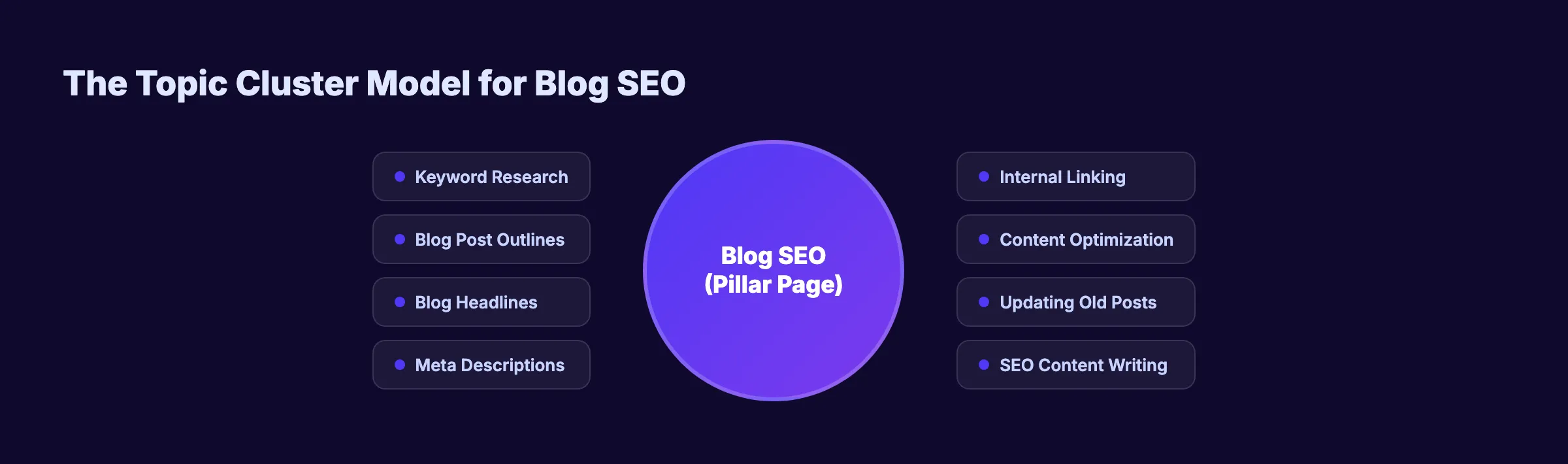
The Topic Cluster Model
Organize your blog into topic clusters. Each cluster has 3 components:
- Pillar page. A long-form guide covering the broad topic (like this post)
- Cluster pages , 5 to 15 posts covering specific subtopics
- Internal links. Every cluster page links to the pillar. The pillar links to every cluster page.
For this blog, the “Blog SEO” pillar connects to clusters on keyword research, blog post outlines, blog headlines, meta descriptions, internal linking, updating old posts, and content optimization.
Each cluster page links back to this pillar. This pillar links to each cluster page. The interlinking signals topical authority to Google. Sites that build connected clusters drive 30% more organic traffic than sites with isolated, unlinked posts.
Content Refresh Strategy
Publishing new content is half the job. The other half is updating existing content. Google favors fresh content. A content refresh can boost rankings for posts that have plateaued or declined.
When to refresh:
- Rankings drop from page 1 to page 2
- The post is older than 12 months
- Competitor content has surpassed yours
- Statistics or examples are outdated
What to update:
- Year in the title and throughout the content
- Statistics with current data
- New sections covering subtopics competitors now cover
- Internal links to newer content
- FAQ section (add one if missing)
Review top-performing posts quarterly. Review all posts at least once per year. See our full guide on how to update old blog posts for the complete refresh process.
Chapter 6: Technical Blog SEO
Great content on a slow, poorly structured site will not rank. Technical SEO creates the foundation that allows your content to perform.
Page Speed and Core Web Vitals
Google uses 3 Core Web Vitals as ranking signals:
| Metric | What It Measures | Good Threshold |
|---|---|---|
| LCP (Largest Contentful Paint) | Loading speed | Under 2.5 seconds |
| INP (Interaction to Next Paint) | Responsiveness | Under 200 milliseconds |
| CLS (Cumulative Layout Shift) | Visual stability | Under 0.1 |
Only 47% of websites pass all 3 thresholds. Compress images. Minimize JavaScript. Use a CDN. Enable browser caching. Test with Google PageSpeed Insights and fix every red flag.
Mobile Optimization
60% of all searches happen on mobile. Google uses mobile-first indexing. Your blog must render perfectly on mobile. Use responsive design. Keep tap targets 48 pixels apart. Ensure text is readable without zooming.
Crawlability and Indexing
Google cannot rank pages it cannot find. Submit your XML sitemap in Google Search Console. Check for crawl errors weekly. Ensure every blog post has a canonical tag. Pages stuck in “Discovered, not indexed” need stronger internal links or better content quality to earn indexing.
Schema Markup
Add structured data to every blog post. At minimum, include:
- Article schema. Tells Google this is editorial content with an author and publish date
- FAQPage schema. Enables FAQ rich results for FAQ sections
- BreadcrumbList schema. Shows navigation path in search results
Schema does not directly boost rankings. But it earns rich results that increase CTR. Use our schema markup generator to create valid JSON-LD.
URL Architecture
Keep your blog URL structure flat. /blog/post-slug is better than /blog/category/subcategory/post-slug. Flat URLs get crawled more efficiently and pass link equity more effectively.
Chapter 7: Blog SEO for AI Search
Blog traffic in 2026 does not come only from traditional search results. AI Overviews, ChatGPT, Perplexity, and other AI search engines cite blog content directly in their answers. Optimizing your blog for AI citation is no longer optional.
How AI Search Engines Use Blog Content
AI models extract specific answers, data points, and step-by-step instructions from blog posts. They prefer content with:
- Clear heading hierarchies
- Direct answers under specific headings
- Numbered lists and comparison tables
- FAQ sections with concise answers
- Statistics with named sources
The BLUF Principle
BLUF stands for Bottom Line Up Front. Place the direct answer in the first 40 to 60 words of each section. Do not build up to the answer. Lead with it.
Before BLUF: “There are many factors that affect blog ranking. After extensive research and analysis…”
After BLUF: “The 3 main factors that affect blog ranking are content depth, keyword targeting, and internal linking structure.”
AI systems extract the opening content of each section. If your answer is buried at the end, AI will skip your page and cite a source that leads with the answer.
Format for Machine Extraction
Structure data-heavy content as tables, numbered lists, or bullet points. AI models extract structured formats at higher rates than plain paragraphs. Add FAQ sections with FAQPage schema. Each FAQ item is a self-contained Q&A pair that AI can extract directly.
Include specific statistics with named sources. Content with named sources earns citations up to 40% more often than content without them. “According to Ahrefs” is verifiable. “Studies show” is not.
AI Crawler Access
Check your robots.txt file. Ensure Googlebot, OAI-SearchBot (ChatGPT), and PerplexityBot are not blocked. Many sites inadvertently block AI crawlers. If a crawler cannot access your content, that platform will never cite it.
Rank in Google AND get cited by AI. Every Stacc article includes schema markup, BLUF formatting, and citation-ready data blocks. 30 posts per month. Start for $1 →
Chapter 8: Measuring Blog SEO Success
You cannot improve what you do not measure. Blog SEO success requires tracking specific metrics and reviewing them on a consistent schedule.
The 4 Metrics That Matter
| Metric | Where to Find It | What It Tells You |
|---|---|---|
| Organic sessions | Google Analytics 4 | Total visits from search engines |
| Keyword rankings | Google Search Console | Position for target keywords |
| Click-through rate | Google Search Console | % of impressions that result in clicks |
| Pages indexed | Google Search Console | How many posts Google recognizes |
Rising organic sessions confirms your blog SEO is working. Improving keyword positions shows content is competing. A strong CTR means your titles and meta descriptions earn clicks. Growing indexed pages means your content is being discovered.
Monthly Review Routine
Every month, spend 60 minutes on this review:
- Compare last 28 days vs previous 28 days in Search Console. Track clicks, impressions, CTR, and average position.
- Find keyword opportunities. Filter for queries in positions 5 to 20 with high impressions. These are your quick-win optimization targets.
- Check CTR on top pages. Any page with impressions over 1,000 and CTR below 2% needs a better title tag or meta description.
- Review indexing health. Check the Pages report for new errors. Fix crawl issues immediately.
- Update declining content. Flag any page that lost 20%+ traffic in 3 months. Refresh statistics, add new sections, and update the published date.
Benchmarks for Blog SEO
- New blogs: Expect measurable traffic within 60 to 90 days of consistent publishing.
- Established blogs: Expect 10% to 20% monthly traffic growth with consistent publishing at 8+ posts per month.
- CTR: Average is 3% to 5% for positions 3 to 5. Aim above average with optimized titles and descriptions.
Run a full SEO audit quarterly to catch technical issues before they compound.
Chapter 9: Common Blog SEO Mistakes
These mistakes quietly kill blog rankings. Avoid all 8.
1. Publishing Without Keyword Research
Every post needs a target keyword. Publishing without one means hoping for traffic instead of planning for it. Use the keyword research process before writing a single word.
2. Ignoring Search Intent
A product page will never rank for an informational query. A blog post will never rank for a transactional query. Check the SERP before writing and match the dominant format.
3. Thin Content
Posts under 800 words rarely rank for competitive keywords. The average first-page result is 1,447 words. Match the depth of top-ranking content. Do not pad for length. Add depth on subtopics competitors miss.
4. No Internal Linking
Blog posts without internal links are dead ends. They do not pass authority. They do not keep readers on your site. Link to 3 to 5 related pages from every post. Update older articles to link back.
5. Inconsistent Publishing
Publishing 10 posts in January and zero in February sends negative signals. Google rewards consistent activity. Set a publishing cadence and maintain it. A site publishing 4 posts per week for 12 months outperforms one that publishes 48 posts in month 1 and stops.
6. Missing Meta Descriptions
Google auto-generates descriptions for 25% of top-ranking pages. The auto-generated version is almost always worse. Write a custom meta description for every page.
7. Slow Page Speed
Pages loading over 3 seconds lose 53% of mobile visitors. Core Web Vitals are a ranking factor. Compress images. Defer non-critical scripts. Test monthly.
8. Ignoring AI Search
AI Overviews appear on 48% of queries in 2026. Content formatted for AI extraction earns citations that drive high-converting traffic. Structure content with BLUF formatting, named sources, and FAQ schema.
FAQ
How long does blog SEO take to show results?
Most blogs see initial ranking movement within 60 to 90 days of consistent publishing. Meaningful traffic growth typically takes 3 to 6 months. Blogs publishing 16 or more posts per month see results faster than those publishing 2 to 4. The compounding effect accelerates after 50 to 100 published posts.
How many blog posts do I need to rank on Google?
There is no single magic number. Data shows that 16+ posts per month correlates with 4.5x more leads. For competitive niches, you need enough posts to establish topical authority. That typically means 30 to 50 posts within a topic cluster. Quality and keyword targeting matter as much as quantity.
Is blogging still worth it for SEO in 2026?
Yes. Organic search drives 53% of all website traffic. Blog content is also the primary source material for AI Overview citations. Blogs that follow structured optimization and answer specific questions get cited by both Google and AI search engines like ChatGPT and Perplexity.
What is the best blog post length for SEO?
Match your competitors. The average first-page result is 1,447 words. Positions 1 through 3 average 2,100 to 2,500 words. For competitive guide-style keywords, 3,000 to 5,000 words is common. Do not pad for length. Add depth on subtopics others miss.
How do I optimize blog posts for AI search?
Lead with direct answers in the first 40 to 60 words of each section. Use clear headings, numbered lists, and FAQ sections. Add schema markup. Include specific statistics with named sources. Structure content so AI systems can extract clean answers. Check your robots.txt to confirm AI crawlers can access your pages.
Does blog SEO work for small businesses?
Yes. Small businesses often compete in local markets with a limited number of competitors. A dentist in Scottsdale targeting “emergency dentist Scottsdale” faces far less competition than a SaaS company targeting “project management software.” Local long-tail keywords are among the fastest to rank for with a structured blog SEO approach.
Blog SEO is not 1 tactic. It is a system. Keyword research, content structure, on-page optimization, internal linking, publishing frequency, content refreshes, and AI formatting all work together. Skip 1 element and the system breaks.
The biggest mistake is publishing 5 great posts and stopping. Blog SEO compounds. Every article stacks on the last. The question is not whether to invest in blog SEO. The question is whether you can sustain the volume needed to trigger compounding.
The playbook is clear. The sites ranking in 2026 share 3 traits: they publish consistently, they optimize every post, and they format for both Google and AI search. Now you have the framework. Start building.
Stacc publishes 30 optimized blog posts per month for $99. Keyword research, writing, on-page SEO, and publishing handled on autopilot. 3,500+ posts published across 70+ industries. Average SEO score: 92%. Start for $1 →
Related Tools & Resources
Free SEO Tools:
Best Lists:

Written by
Siddharth GangalSiddharth is the founder of theStacc and Arka360, and a graduate of IIT Mandi. He spent years watching great businesses lose organic traffic to competitors who simply published more. So he built a system to fix that. He writes about SEO, content at scale, and the tactics that actually move rankings.
30 SEO blog articles published every month
Keyword-optimized, scheduled, and live on your site. Automatically.
30-day trial · Cancel anytime
theStacc
Stop writing SEO content manually
30 blog articles, 30 GBP posts, and social media content. Published every month. Automatically.
Start Your $1 Trial$1 for 3 days · Cancel anytime