
AI Prompts for SEO Articles: Complete Guide (2026)
30+ AI prompts for writing SEO articles that rank. Organized by workflow stage: research, outlines, writing, editing. Updated March 2026.
The difference between AI content that ranks and AI content that sits on page 5 is the prompt. 86% of SEO professionals use AI tools like ChatGPT for content creation. But most use vague prompts that produce vague content.
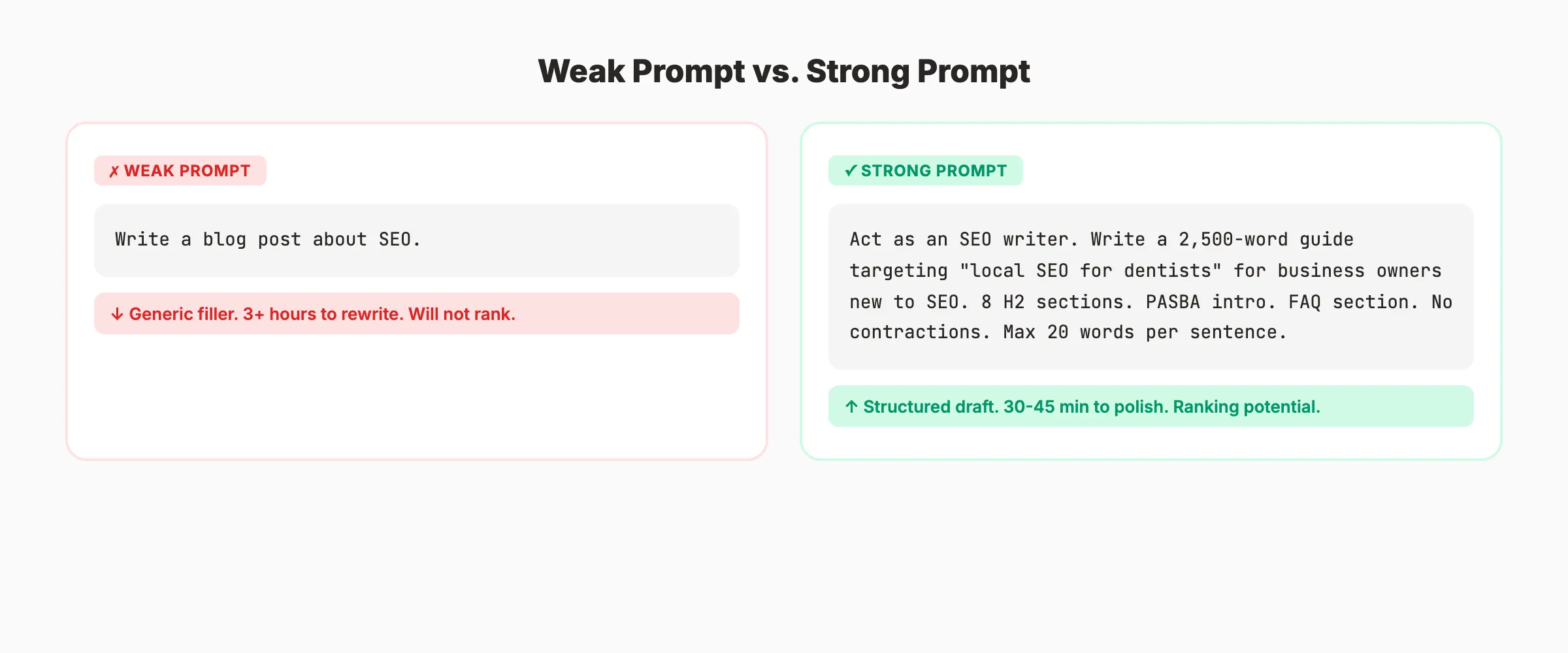
“Write a blog post about SEO” produces garbage. “Write a 2,500-word guide targeting the keyword ‘local SEO for dentists’ for business owners who have never done SEO, using the PASBA framework, with 8 H2 sections and a FAQ” produces something you can actually edit into a ranking article.
This guide gives you 30+ AI prompts for SEO articles organized by workflow stage. Not a random list. A system you can follow from keyword research through final editing.
We publish 3,500+ blog posts across 70+ industries. Our average SEO score is 92%. Every prompt in this guide comes from the workflow we use daily.
Here is what you will learn:
- The prompt structure that produces ranking-quality drafts
- Prompts for keyword research, outlines, body content, and meta tags
- How to prompt AI for E-E-A-T signals Google rewards
- The editing prompts that turn AI drafts into human-quality content
- 7 prompt mistakes that guarantee your content underperforms
Chapter 1: Why Prompt Quality Determines Article Quality
AI models do exactly what you ask. That is the problem and the opportunity.
A weak prompt gives the AI no constraints. It defaults to generic, hedging, balanced content. That content reads like every other AI-generated article on the topic. Google has millions of those already. Yours will not rank.
A strong prompt acts like a creative brief. It specifies the audience, keyword, structure, tone, length, and unique angle. The AI fills in the details. But the strategic decisions come from you.
The Prompt Equation
Prompt specificity = Output quality.
| Prompt Type | Output Quality | Editing Time |
|---|---|---|
| ”Write about SEO” | Unusable. Generic filler. | 3+ hours to rewrite |
| ”Write an SEO guide” | Below average. Missing structure. | 2 hours to fix |
| ”Write a 2,500-word guide on [keyword] for [audience] with [structure]“ | Strong first draft. | 30 to 45 minutes to polish |
The goal is not to eliminate editing. The goal is to get a first draft that needs polishing, not a complete rewrite.
What a Good Prompt Includes
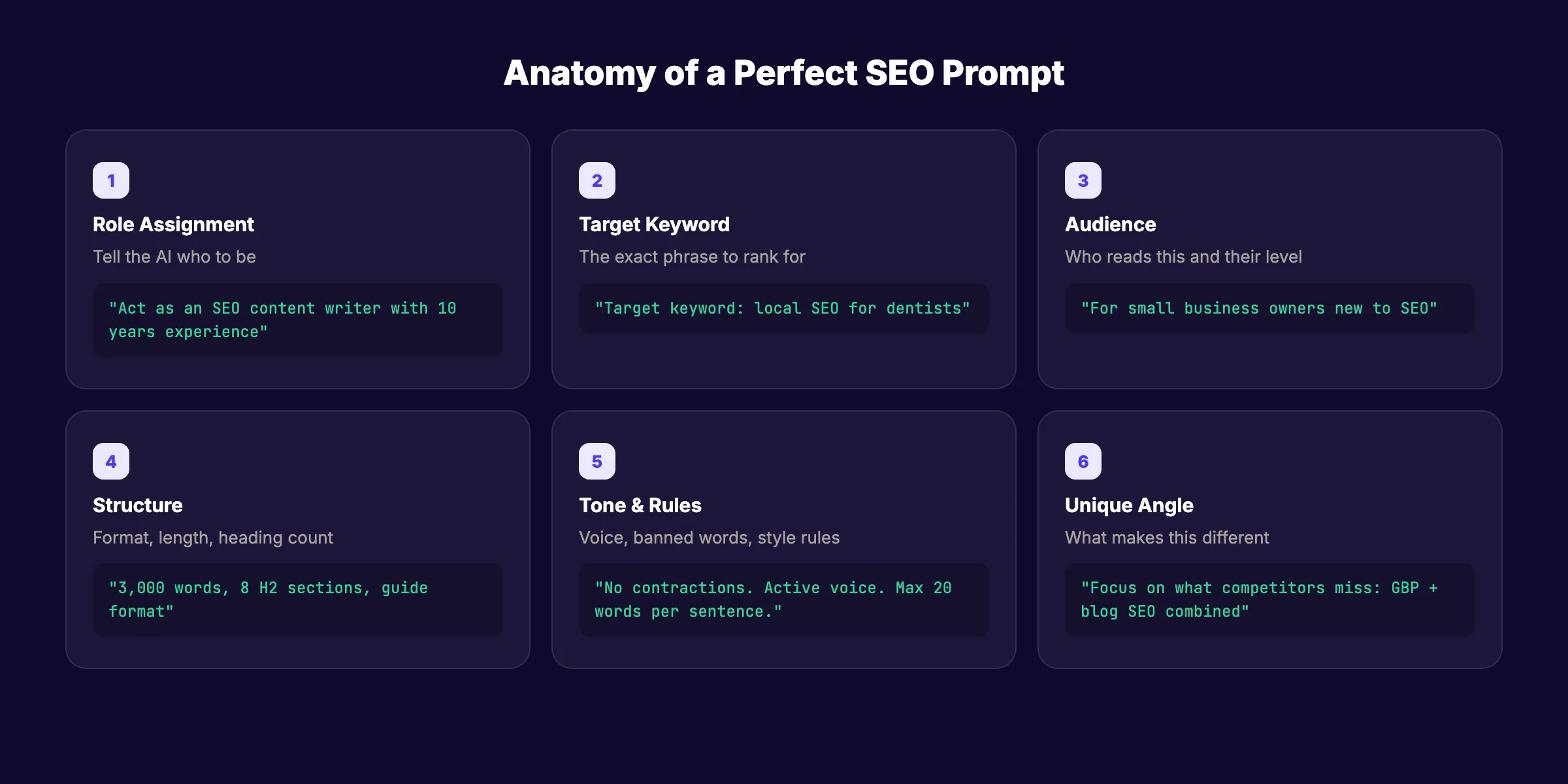
Every effective SEO prompt contains 6 elements:
- Role assignment. Tell the AI who to be (“Act as an SEO content writer with 10 years of experience”)
- Target keyword. The exact phrase you want to rank for
- Audience. Who reads this and what they already know
- Structure. H2 count, word count, format (guide, listicle, how-to)
- Tone and rules. Voice guidelines, words to avoid, contraction rules
- Unique angle. What makes this different from existing content on the topic
Missing any one of these produces a weaker draft. Missing 3 or more produces content you should not publish.
For more on writing SEO content that ranks, see our SEO content writing guide.
Chapter 2: Prompts for Keyword Research and Topic Selection
Keyword research is where most AI-assisted workflows start wrong. People ask ChatGPT for “keyword ideas” and get a list of obvious terms with no data behind them.
AI models do not have access to real-time search volume or keyword difficulty data. They estimate based on training data. Use them for brainstorming and clustering. Use actual SEO tools (Ahrefs, Semrush, Google Search Console) for data.
Prompt 1: Generate Seed Keywords
Act as an SEO keyword researcher. I run a [business type] targeting
[audience] in [location]. Generate 30 seed keyword ideas across these
categories: informational queries, commercial queries, and comparison
queries. Format as a table with columns: Keyword, Search Intent, and
Content Format (guide, listicle, comparison, how-to).
Prompt 2: Find Long-Tail Variations
Take this seed keyword: "[your keyword]". Generate 20 long-tail keyword
variations that a [target audience] would search when they are ready to
[desired action]. Group them by search intent: informational, commercial,
transactional. Focus on keywords with 4 or more words.
Prompt 3: Cluster Keywords Into Topics
Here are 30 keywords I want to target: [paste your keyword list]. Group
these into topical clusters where each cluster shares a parent topic.
Name each cluster. For each cluster, identify the pillar page keyword
and the supporting article keywords. Format as a nested list.
Prompt 4: Analyze Search Intent
For each keyword below, determine the dominant search intent
(informational, commercial, navigational, transactional) and the ideal
content format (guide, listicle, comparison, tool page, how-to). Explain
your reasoning in one sentence per keyword.

Keywords: [paste 10 to 15 keywords]
These prompts give you a structured starting point. But always validate against real search data before committing to a topic. For a deeper dive into keyword research, see our guide on keyword research for blog posts.
Stop writing. Start ranking. Stacc publishes 30 SEO articles per month for $99. Start for $1 →
Chapter 3: Prompts for Article Outlines
The outline is the most underrated step. Most people skip it and ask AI to write the full article in one shot. That produces disorganized content with no strategic structure.
An outline prompt should produce a complete content map that you review and approve before the AI writes a single paragraph.
Prompt 5: Generate a Detailed Outline
Act as an SEO content strategist. Create a detailed outline for a
[word count]-word [format: guide/listicle/how-to] targeting the keyword
"[primary keyword]".

Requirements:
- Target audience: [describe audience and their knowledge level]
- Include 8 H2 sections minimum
- Each H2 needs 2 to 3 H3 subsections
- Mark where to place tables, lists, and images
- Include a FAQ section with 5 questions from "People Also Ask"
- Mark CTA placement every 1,500 words
- Suggest 5 internal link opportunities (topics, not URLs)
- The first H2 should NOT be "Introduction" or "What is [keyword]"

Format the outline with word count estimates per section.
Prompt 6: Outline Based on SERP Analysis
I analyzed the top 5 ranking pages for "[keyword]". Here are their H2
structures:

Page 1: [paste H2 headings]
Page 2: [paste H2 headings]
Page 3: [paste H2 headings]

Based on this, create a superior outline that:
1. Covers everything the top 3 cover
2. Adds 2 to 3 sections they ALL miss
3. Uses a different structural approach than the majority
4. Targets [word count] words (20% longer than the average competitor)

Mark your unique sections with [UNIQUE] and explain why each adds value.
Prompt 7: Create a Content Brief
Write a content brief for an SEO article targeting "[keyword]". Include:
- Primary keyword and 5 secondary keywords
- Target word count
- Search intent analysis
- Recommended title tag (under 60 characters)
- Recommended meta description (145 to 155 characters)
- H2 section titles with brief descriptions (2 sentences each)
- Suggested internal linking topics
- 3 external sources to reference
- Key differentiator from existing content
A solid outline saves more time than any other prompt. Approving the structure before writing prevents the “this entire article needs restructuring” problem that burns hours. For more on building outlines, see our blog post outline guide.
Chapter 4: Prompts for Writing SEO Body Content
This is where most articles go wrong. Writers give the AI a keyword and tell it to “write the article.” The result is 2,000 words of generic content that reads like every other AI article on the topic.
Body content prompts work best when you write section by section, not all at once.
Prompt 8: Write the Introduction (PASBA Framework)
Write the introduction for a blog post targeting "[keyword]" for
[audience]. Use this framework:

1. Problem: State the reader's exact pain in 1 to 2 sentences
2. Agitate: What does this problem cost them?
3. Solution preview: What this article delivers
4. Credibility: Include this line: "We publish 3,500+ blog posts
   across 70+ industries."
5. Action: End with "Here is what you will learn:" followed by 5 bullet
   points previewing key takeaways

Rules: No contractions. No "In today's digital scene." Start with a
stat or bold claim. Keep it under 250 words. The keyword "[keyword]"
must appear in the first 100 words.
Prompt 9: Write an H2 Section
Write the section "[H2 title]" for a blog post about "[keyword]".

Context: This section covers [brief description of what to cover].
Target audience: [audience description].

Requirements:
- 300 to 500 words
- Start with a bold claim, stat, or observation (not a transition word)
- Include 2 to 3 H3 subheadings
- Use short sentences (max 20 words per sentence)
- Max 3 sentences per paragraph
- Active voice only
- No contractions (use "do not" instead of "don't")
- Include a specific example or data point
- End with an actionable takeaway
- Do not use these words: furthermore, moreover, additionally,
  complete, use, use, strong, smooth
Prompt 10: Write With E-E-A-T Signals
Rewrite this section to add Experience, Expertise, Authoritativeness,
and Trustworthiness signals:

[paste your draft section]

Specifically:
- Add 1 first-person experience reference ("In our experience..." or
  "After publishing 3,500+ articles, we found...")
- Add 1 specific data point with a source attribution
- Add 1 opinionated statement where the author takes a clear position
- Add 1 limitation or nuance acknowledgment
- Keep the same word count and structure
Prompt 11: Write a Comparison Table
Create a comparison table for [topic]. Compare [items] across these
columns: [list columns]. Format as a markdown table. Include a 1-sentence
verdict row at the bottom recommending the best option for [audience].
Keep cell content under 15 words each.
Prompt 12: Write the FAQ Section
Write a FAQ section for a blog post about "[keyword]". Include 5
questions sourced from:
- 3 questions from Google's "People Also Ask" for this keyword
- 1 question about common mistakes or misconceptions
- 1 question with a commercial angle related to [your product/service]

Format: Bold question as H3. Answer in 2 to 4 sentences. Be direct and
specific. No filler. Include a stat or link reference where relevant.
For more on how to write SEO blog posts that rank, see our full writing guide.
Your SEO team. $99 per month. 30 optimized articles, published automatically. Start for $1 →
Chapter 5: Prompts for Meta Tags and On-Page Elements
Meta tags are small but critical. A good title tag earns the click. A good meta description earns the visit. AI can generate dozens of variations in seconds for you to test.
Prompt 13: Generate Title Tag Options
Generate 10 title tag options for a blog post targeting "[keyword]".
Rules:
- Each title must be under 60 characters
- Include the primary keyword in each title
- Use these power words where natural: Best, Complete, Proven, Essential
- Vary the formats: question, how-to, number, year, bracket hook
- Do not use clickbait or misleading titles
Prompt 14: Write Meta Descriptions
Write 5 meta description options for a blog post titled "[title]"
targeting "[keyword]". Rules:
- Each must be 145 to 155 characters
- Include the primary keyword
- Include a benefit for the reader
- Include a freshness signal (year or "updated" reference)
- Use active voice
- No contractions
Prompt 15: Generate Alt Text for Images
Write alt text for [number] images in a blog post about "[keyword]".
For each image, I will describe what the image shows. Generate alt text
that:
- Describes what the image visually contains
- Includes the target keyword naturally (not forced)
- Stays under 125 characters
- Does not start with "Image of" or "Picture of"

Image 1: [describe image]
Image 2: [describe image]
Prompt 16: Internal Linking Suggestions
Here is a list of existing blog posts on my site:
[paste 20 to 30 titles with URLs]

I am writing a new article about "[keyword]". Suggest 10 internal
linking opportunities. For each, provide:
- The page to link to
- The section of the new article where the link fits
- Suggested anchor text (descriptive, not "click here")
For a deeper look at optimizing on-page elements, see our on-page SEO guide.
Chapter 6: Prompts for Editing and Humanization
Raw AI output is a draft. Not a finished article. These editing prompts turn that draft into something that reads like a human expert wrote it. This is the step most AI content creators skip. It is also the step that determines whether your content ranks.
Prompt 17: Remove AI Writing Patterns
Review this article and remove all detectable AI writing patterns.
Specifically:
- Delete every instance of "In today's," "It is worth noting,"
  "Furthermore," "Moreover," "Additionally," "In conclusion"
- Break up sentences that all have the same length (14 to 18 words)
- Vary paragraph lengths (mix 1-sentence and 3-sentence paragraphs)
- Replace vague attributions ("many experts") with specific names or
  "data from [source]"
- Replace inflated vocabulary (use, use, facilitate) with
  simpler words
- Add 2 one-sentence paragraphs for emphasis

Return the edited article with changes marked in bold.
Prompt 18: Add Voice and Personality
Rewrite this article section to sound like a confident SEO practitioner,
not a textbook. Specifically:
- Add 1 opinionated statement ("Most guides get this wrong because...")
- Add 1 nuanced caveat ("This works for most sites. The exception is...")
- Replace generic advice with specific recommendations including numbers
- Remove all hedging language ("might," "could potentially," "perhaps")
- Keep the same word count and structure

[paste section]
Prompt 19: Contraction and Banned Word Sweep
Scan this article for the following issues and fix all of them:

1. Contractions: Replace all contractions (don't, won't, can't, it's,
   they're, we're, you're, doesn't, isn't, etc.) with their full forms
2. Banned phrases: Remove or rewrite any sentence containing:
   "in today's," "it is worth noting," "when it comes to," "at its
   core," "plays a crucial role," "in the realm of," "a game-changer"
3. Banned words: Replace: use, use, strong, smooth,
   new, advanced, complete

Return the cleaned article. List every change you made at the end.
Prompt 20: Fact-Check and Source Verification
Review this article and flag every claim that needs a source citation.
For each flagged claim:
1. State the claim
2. Rate confidence that it is accurate (high, medium, low)
3. Suggest a specific source URL where this claim can be verified
4. If the claim appears fabricated, say so and suggest removing it

Do not fabricate sources. If you cannot find a reliable source, say
"needs manual verification."
For our full humanization process, see our guide on how to humanize AI content.
Chapter 7: Advanced Prompts for Specific Content Types
Different article formats need different prompt approaches. A listicle prompt and a how-to guide prompt should look nothing alike.
Prompt 21: Best-Of Listicle
Write entry #[N] for a "Best [Category] Tools" article. The tool is
[tool name].

Format:
- H3: [Tool Name]
- 1-sentence positioning statement
- 3 to 4 bullet points: key features (specific, not generic)
- "Best for:" 1 sentence naming the ideal user
- "Pricing:" specific plan and price
- "Limitation:" 1 honest drawback

Word count: 150 to 200 words per entry. No promotional language.
Prompt 22: How-To Step
Write Step [N] of a how-to guide titled "[article title]".

Step title: "[step title]"
This step covers: [brief description]

Format:
- Open with what to do (not why)
- Include "Specifically:" followed by 3 bullet points with sub-actions
- If relevant, include a code example or command
- End with "Why this step matters:" (1 to 2 sentences)
- Optional: "Pro tip:" (1 sentence shortcut or insight)

Word count: 250 to 350 words. Active voice. No contractions.
Prompt 23: Comparison Article
Write the comparison section for [Tool A] vs [Tool B] on the factor
"[factor name]".

Format:
- Open with what this factor measures and why it matters
- [Tool A] analysis: 2 to 3 sentences with specific details
- [Tool B] analysis: 2 to 3 sentences with specific details
- Verdict: 1 sentence declaring a winner for this factor and why

Be fair. If it is a tie, say so. Do not force a winner.
Prompt 24: Industry-Specific Content
Write a section about [SEO topic] specifically for [industry].

Requirements:
- Use [industry]-specific language and examples throughout
- Reference real challenges [industry] businesses face
- Include 1 specific scenario ("A [industry] business in [city]
  might...")
- Do not use generic advice that applies to every industry
- If you reference a tool or tactic, explain how it applies to
  [industry] specifically
3,500+ blogs published. 92% average SEO score. See what Stacc can do for your site. Start for $1 →
Chapter 8: The 7 Prompt Mistakes That Kill Rankings
Knowing what not to do saves as much time as knowing what to do. These are the mistakes we see most often in AI-generated SEO content.
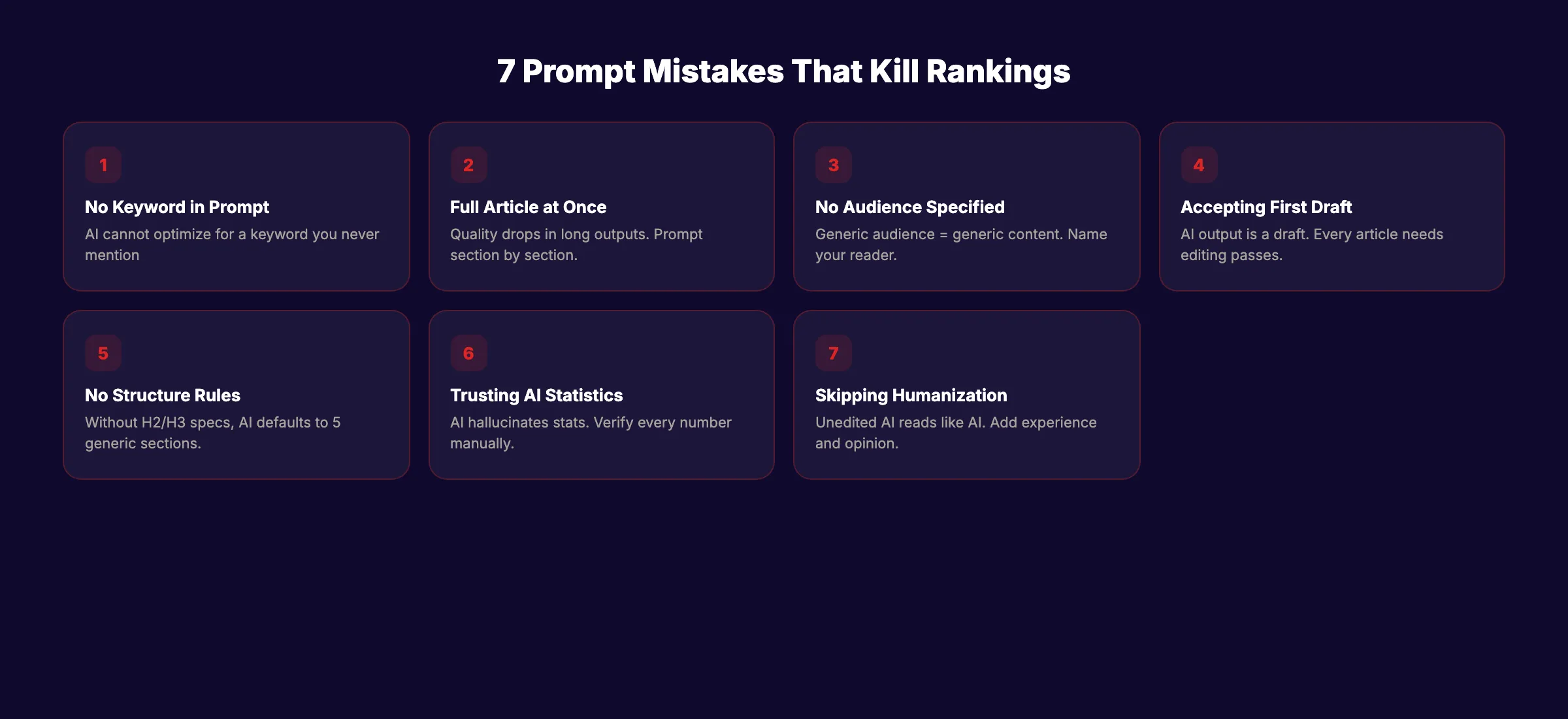
Mistake 1: No Keyword in the Prompt
If you do not tell the AI your target keyword, it cannot optimize for it. The keyword should appear in the prompt for the title, introduction, H2 headings, and meta description. Do not assume the AI knows what you want to rank for.
Mistake 2: Asking for the Whole Article at Once
A single prompt for a 3,000-word article produces worse output than 8 section-level prompts. The AI loses context and quality in long outputs. Break your article into sections and prompt each one individually with specific instructions.
Mistake 3: No Audience Specification
“Write about local SEO” produces textbook content. “Write about local SEO for a dentist in Austin who has never done marketing” produces useful content. The audience defines the vocabulary, examples, and depth.
Mistake 4: Accepting the First Draft
AI outputs are drafts. They contain AI patterns, hallucinated stats, missing nuance, and generic phrasing. Every draft needs at least one editing pass. Most need two. Treat AI output the way you would treat a junior writer’s first draft.
Mistake 5: No Structure Requirements
Without structure instructions, AI defaults to 5 generic sections with 3 paragraphs each. Specify H2 count, H3 count, word count per section, table requirements, and list formats. Structure is the skeleton. Without it, the article collapses.
Mistake 6: Using AI for Data and Statistics
AI models hallucinate statistics. They generate plausible-sounding numbers that do not exist. Never trust an AI-generated stat. Always verify every number against the original source. Better yet, find your own data first and include it in the prompt.
Mistake 7: Skipping the Humanization Step
Unedited AI content reads like AI content. Google does not penalize AI content directly. But Google does penalize thin, unhelpful content. Adding experience, opinion, and real data is what turns AI output into content Google wants to rank.
For more on building content that ranks, see our guide on how to optimize content for SEO.
The Complete Prompt Workflow
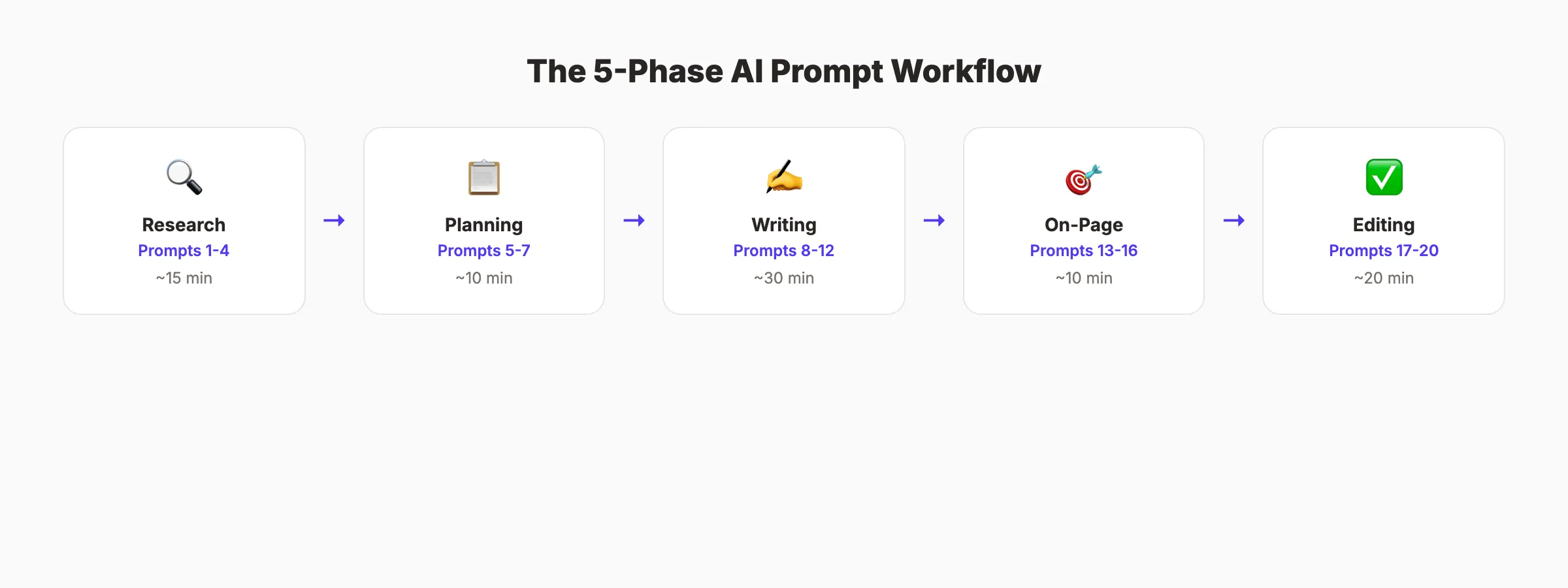
Here is the order to run your prompts for maximum efficiency:
| Phase | Prompts | Time |
|---|---|---|
| 1. Research | Prompts 1 to 4 (keywords, clustering, intent) | 15 minutes |
| 2. Planning | Prompts 5 to 7 (outline, brief, structure) | 10 minutes |
| 3. Writing | Prompts 8 to 12 (intro, sections, FAQ) | 30 minutes |
| 4. On-Page | Prompts 13 to 16 (titles, meta, alt text, links) | 10 minutes |
| 5. Editing | Prompts 17 to 20 (patterns, voice, sweep, facts) | 20 minutes |
| Total | 20 prompts, 1 article | ~85 minutes |
That 85-minute workflow produces a draft that needs 30 to 45 minutes of human editing. Total time per article: under 2 hours. Compare that to 6 to 8 hours writing from scratch.
FAQ
What is the best AI for writing SEO articles?
ChatGPT (GPT-4o) and Claude produce the best long-form SEO content as of 2026. ChatGPT handles structured prompts well. Claude follows detailed instructions with fewer deviations. Both require human editing before publishing.
Do AI-written articles rank on Google?
Yes. 86% of top-ranking pages use AI assistance. Google does not penalize AI content. Google penalizes low-quality content regardless of who or what wrote it. The key is editing AI drafts to add experience, data, and expertise.
How many words should an AI prompt be?
Effective SEO prompts are 100 to 200 words. They include the role, keyword, audience, structure, tone rules, and unique angle. Shorter prompts produce generic output. Longer prompts can confuse the model. Aim for specific, not lengthy.
Should I disclose that I used AI to write content?
Google does not require disclosure. Focus on quality and accuracy instead. If your industry or audience values transparency, a brief note like “Drafted with AI assistance, edited by [name]” works. But it is not an SEO requirement.
Can AI replace human SEO writers?
Not yet. AI produces strong first drafts 5 to 10 times faster than writing from scratch. But it cannot add real experience, original data, or strategic judgment. The best workflow uses AI for speed and humans for quality. That combination outperforms either one alone. For help scaling content production, see our guide on how to write SEO blog posts.
AI prompts are tools. Like any tool, they produce better results in skilled hands. The prompts in this guide give you the starting framework. Your expertise, editing, and strategic judgment are what turn AI drafts into content that ranks.
Rank everywhere. Do nothing. Blog SEO, Local SEO, and Social on autopilot. Start for $1 →
Related Tools & Resources
Free SEO Tools:
Best Lists:

Written by
Siddharth GangalSiddharth is the founder of theStacc and Arka360, and a graduate of IIT Mandi. He spent years watching great businesses lose organic traffic to competitors who simply published more. So he built a system to fix that. He writes about SEO, content at scale, and the tactics that actually move rankings.
30 SEO blog articles published every month
Keyword-optimized, scheduled, and live on your site. Automatically.
30-day trial · Cancel anytime
theStacc
Stop writing SEO content manually
30 blog articles, 30 GBP posts, and social media content. Published every month. Automatically.
Start Your $1 Trial$1 for 3 days · Cancel anytime