
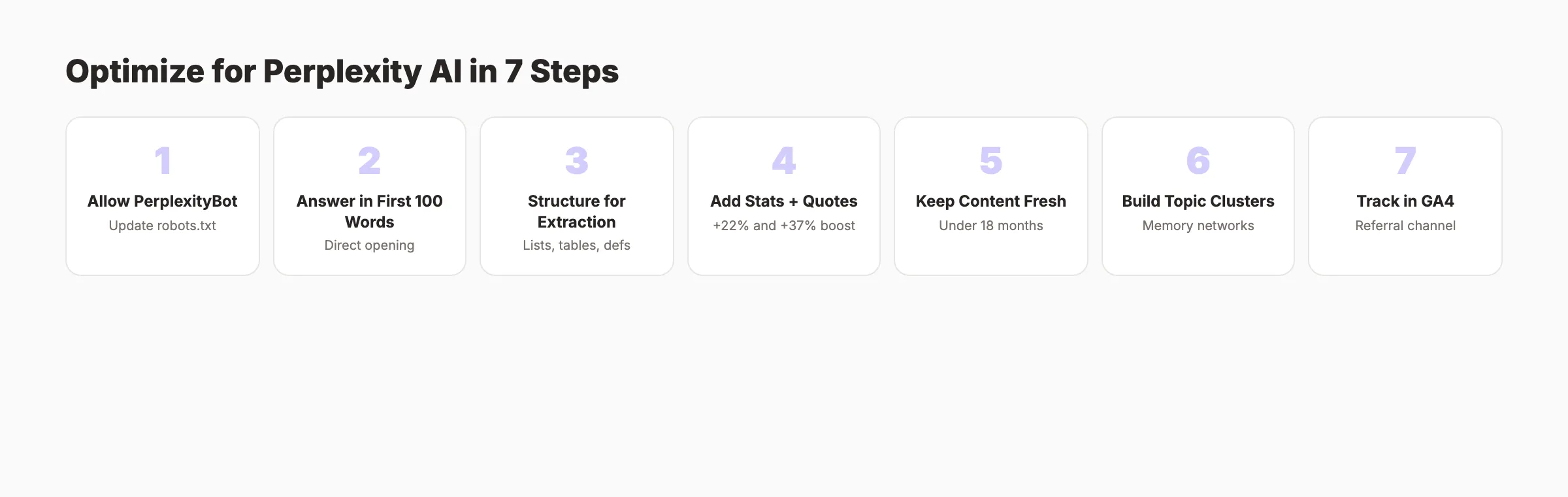
How to Optimize for Perplexity AI in 7 Steps (2026)
Learn how to optimize for Perplexity AI with 7 proven steps. Covers PerplexityBot setup, citation tactics, and tracking. Updated March 2026.
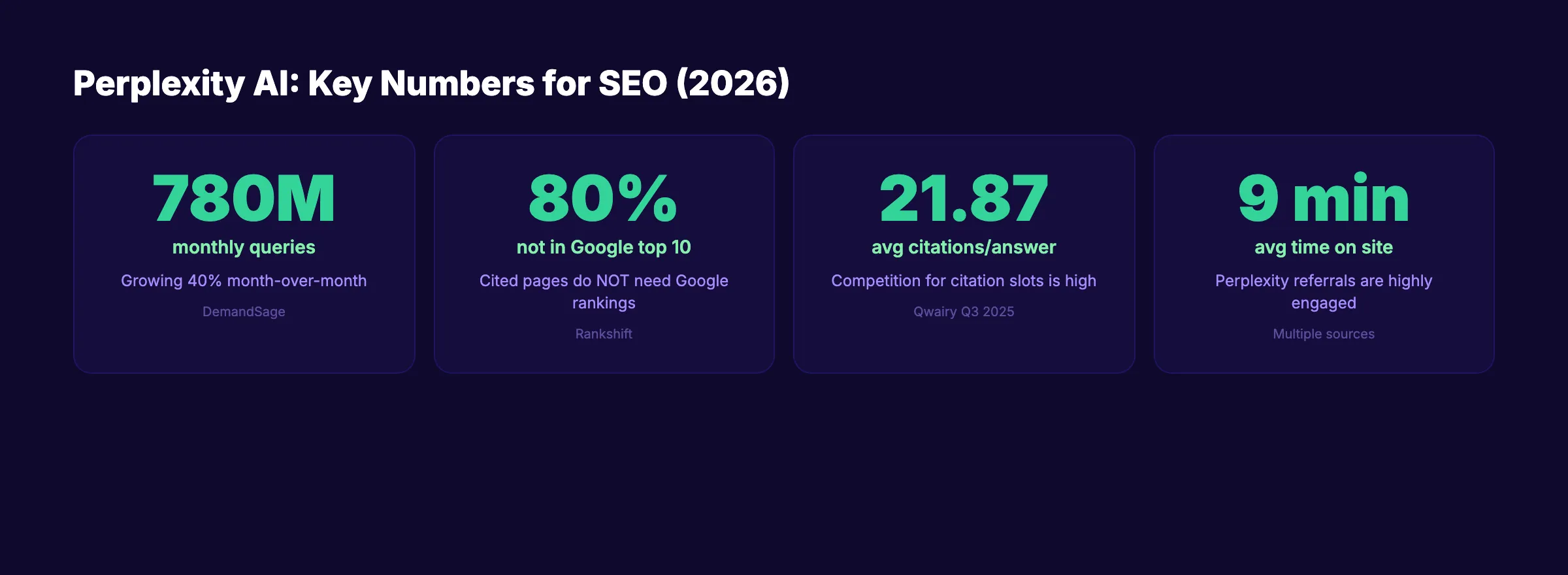
Perplexity AI processes over 780 million queries per month. That number grew 800% year-over-year, according to DemandSage. And 80% of the sources Perplexity cites do not rank in Google’s top 10.
That last stat changes everything. You do not need to dominate Google to get cited by Perplexity. The ranking factors are different. The content formats are different. The timeline is faster.
Most SEO guides treat Perplexity optimization as a footnote. “Just write good content and the AI will find you.” That advice is useless. Perplexity uses a retrieval-augmented generation pipeline with specific source selection signals. Understanding those signals is how you optimize for Perplexity AI and earn citations.
We have published 3,500+ blogs across 70+ industries. We track AI search visibility across every major platform. This guide walks through the exact 7-step process for getting your content cited in Perplexity AI answers.
Here is what you will learn:
- How Perplexity selects and ranks sources differently from Google
- The technical setup required for PerplexityBot to crawl your site
- Content structure patterns that earn citations
- Why the first 100 words of your page matter more than anything else
- How to track and measure your Perplexity referral traffic
How Perplexity AI Selects Sources
Before optimizing, you need to understand how Perplexity works. It does not use a traditional search index like Google. Perplexity uses a Retrieval-Augmented Generation (RAG) pipeline built on Vespa.ai infrastructure.
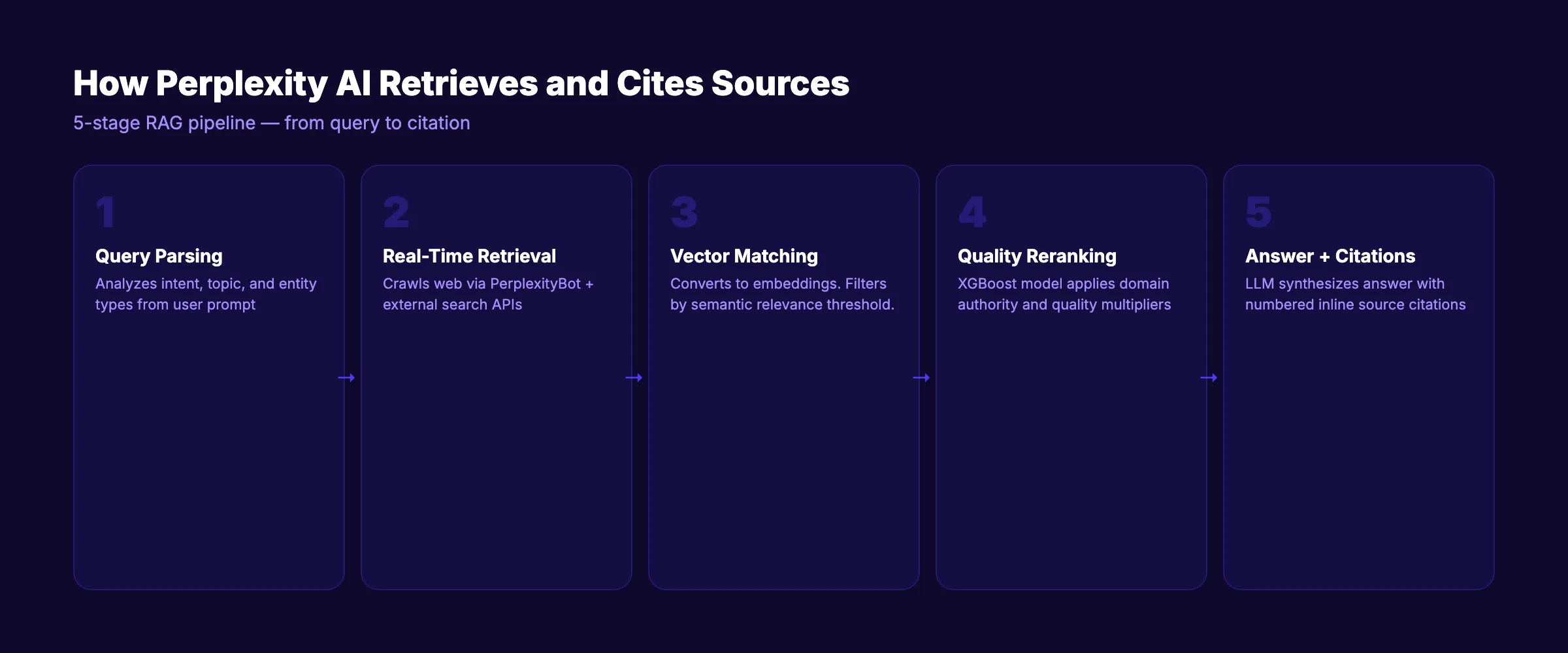
The process follows 5 stages:
- Query parsing. Perplexity analyzes the user prompt for intent and topic
- Real-time retrieval. It crawls the web in real-time using PerplexityBot and external search APIs
- Vector matching. Retrieved content is converted to numerical vectors and filtered by semantic relevance
- Quality reranking. An XGBoost model reranks results using domain authority multipliers and quality signals
- Answer generation. The LLM synthesizes passages into a coherent answer with numbered inline citations
The critical difference from Google: Perplexity cites specific passages, not pages. Your page does not need to rank #1 overall. A single well-structured paragraph that directly answers a question can earn a citation even if the rest of the page is average.
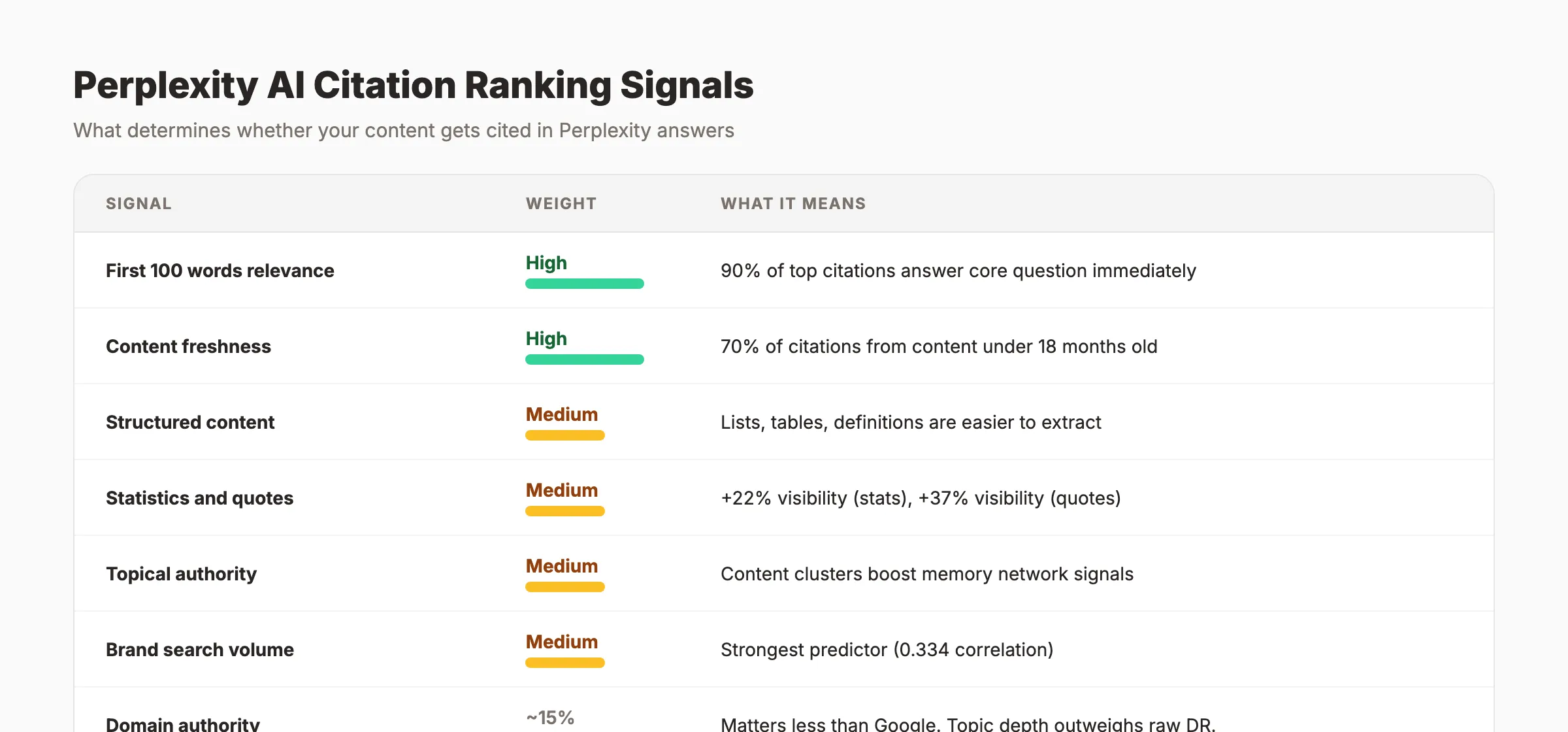
Key citation signals Perplexity uses:
| Signal | Weight | What It Means |
|---|---|---|
| Content relevance to query | High | Direct answer match in first 100 words |
| Content freshness | High | 70% of top citations are under 18 months old |
| Domain authority multiplier | Medium | Curated list of trusted domains get boosted |
| Topic authority | Medium | Sites with content clusters on the topic rank higher |
| Structured content | Medium | Lists, tables, and definitions are easier to extract |
| Statistics and quotes | Medium | Adding stats boosts visibility by 22%. Quotes boost by 37%. |
| Brand search volume | Medium | Strongest predictor of citations (0.334 correlation) |
| Schema markup | Low-Medium | Contributes roughly 10% of ranking factors |
Overview: What You Will Need
Time required: 30 to 60 minutes for initial setup. Ongoing content optimization.
Difficulty: Intermediate
What you will need:
- Access to your website’s
robots.txtfile - A Google Analytics 4 account
- Content management system access
- Existing content to optimize (or the ability to publish new content)
Step 1: Allow PerplexityBot in Your Robots.txt
If PerplexityBot cannot crawl your site, Perplexity cannot cite your content. This is the most common reason sites get zero AI citations.
Check your current setup:
Open https://yoursite.com/robots.txt and look for any rules that block PerplexityBot.
What to add:
User-agent: PerplexityBot
Allow: /
If you already have a blanket Allow: / rule for all user agents, PerplexityBot can crawl your site. But an explicit allow rule ensures future changes to your robots.txt do not accidentally block it.
Also allow these AI crawlers while you are editing:
User-agent: GPTBot
Allow: /

User-agent: ClaudeBot
Allow: /

User-agent: PerplexityBot
Allow: /
Blocking AI crawlers is the fastest way to become invisible in AI search. Unless you have a specific legal reason to block them, allow access.
Technical requirements:
- Pages must load in under 3 seconds
- Content must be server-side rendered or pre-rendered
- Heavy client-side JavaScript blocks Perplexity from parsing your content
- Ensure your XML sitemap is accessible and up to date
Why this step matters: Perplexity performs real-time web crawls for every query. If PerplexityBot is blocked, your content does not exist in Perplexity’s retrieval pipeline. No crawl access means zero citations.
Pro tip: Add your sitemap URL to your robots.txt file with a Sitemap: directive. This helps all crawlers, including PerplexityBot, discover your content structure.
Your SEO team. $99 per month. 30 optimized articles, published automatically. Start for $1 →
Step 2: Answer the Core Question in the First 100 Words
90% of Perplexity’s top-cited sources answer the core question within the first 100 words, according to an LLMClicks 30-query study. This is the single most important content optimization for Perplexity.
Google rewards pages that keep users scrolling. Perplexity rewards pages that answer immediately.
How to structure your opening:
- State the direct answer to the query in the first 1 to 2 sentences
- Follow with a supporting stat or fact
- Then expand with context and depth in the sections below
Example for the query “what is domain authority”:
Domain authority is a score from 0 to 100 that predicts how likely a website is to rank in search results. Moz created the metric based on link profile quality and quantity. A score above 50 is considered strong for most industries.
That opening would earn a Perplexity citation. Compare it to the typical approach: “In the world of SEO, many factors influence how well a website performs. One of these factors is something called domain authority, which we will explore in this guide.” That opening gets ignored.
Apply this to every page:
- Blog posts: answer the title question in the first paragraph
- FAQ sections: put the answer in the first sentence after each question
- Product pages: state what the product does immediately
- How-to guides: preview the outcome in the first 2 sentences
Why this step matters: Perplexity extracts specific passages to cite. The retrieval system scores passage relevance. Opening paragraphs that directly match query intent score highest. Burying the answer below 200 words of context means the retrieval system finds a competitor’s direct answer first.
Step 3: Structure Content for Extraction
Perplexity does not read content the way humans do. It extracts structured passages. Content that is easy to extract earns more citations than dense prose.
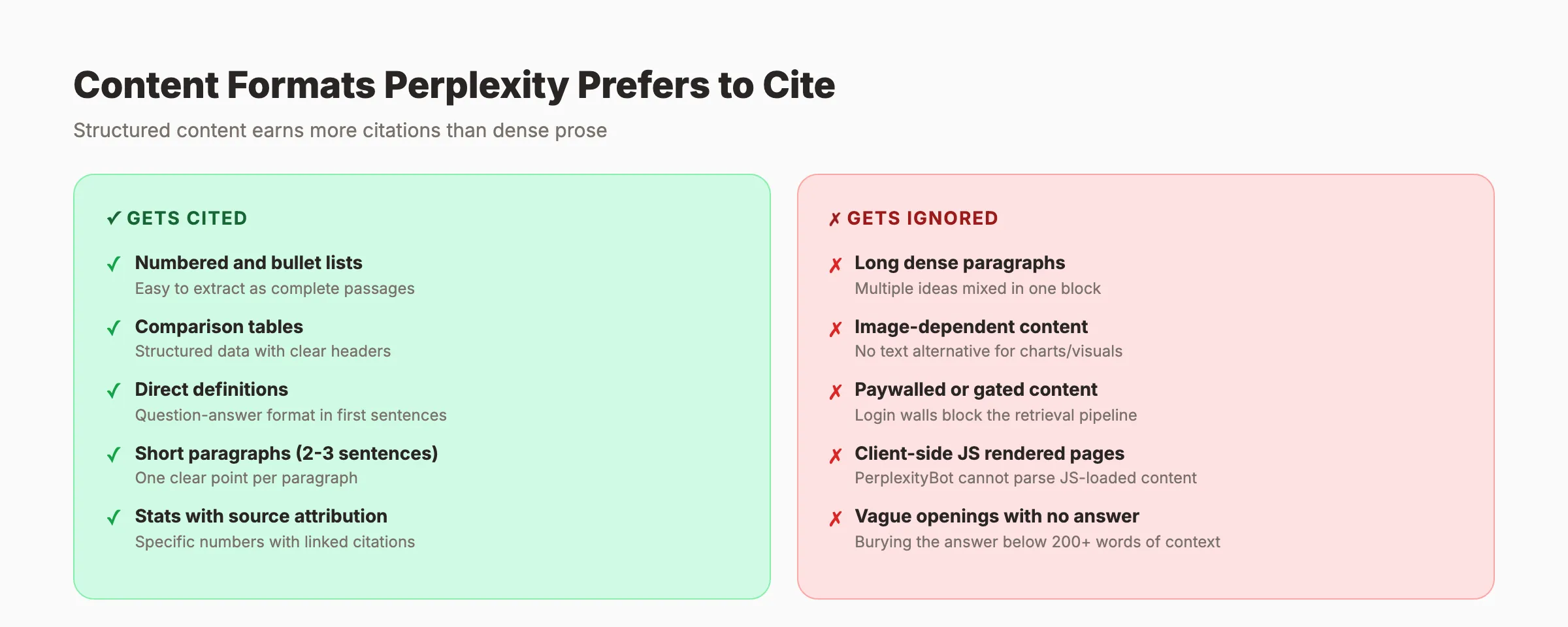
Formats Perplexity prefers to cite:
| Format | Why It Works | Example Use |
|---|---|---|
| Numbered lists | Easy to extract as a complete passage | Step-by-step processes, ranked items |
| Bullet lists | Clean extraction of multiple points | Feature lists, pros/cons |
| Tables | Structured data with clear comparisons | Pricing, specifications, comparisons |
| Definitions | Direct question-answer format | Glossary terms, “what is” content |
| Short paragraphs | 2-3 sentences with one clear point | Factual explanations |
Formats that get ignored:
- Long paragraphs with multiple ideas mixed together
- Content that relies on images or charts without text descriptions
- Pages behind login walls or paywalls
- Content loaded via client-side JavaScript
Practical changes to make:
- Break long paragraphs into 2-3 sentence chunks
- Add a definition or summary box at the top of each major section
- Use tables for any comparison data
- Write FAQ sections with concise, direct answers
- Include the target question as an H2 heading (Perplexity matches headings to queries)
Why this step matters: Perplexity’s vector matching system converts text into numerical representations. Structured, clearly labeled content produces stronger vector matches than ambiguous prose. A clean H2 heading followed by a direct 2-sentence answer is the ideal citation target.
Pro tip: Think of each H2 section as an independent unit that can be cited on its own. If someone read just that section without any surrounding context, would it make sense? If yes, it is citation-ready.
Step 4: Add Statistics, Data, and Expert Quotes
Adding statistics to your content boosts AI visibility by 22%. Adding expert quotes boosts visibility by 37%, according to research compiled by Position Digital. These are the two easiest content changes you can make.
Why stats and quotes work:
Perplexity’s quality reranker prioritizes content with verifiable claims. A page that states “many businesses use SEO” gets a low quality score. A page that states “96% of web pages get zero organic traffic from Google” gets a high quality score because the claim is specific, measurable, and attributable.
How to add statistics effectively:
- Include the exact number (not “most” or “many”)
- Name the source (not “studies show”)
- Link to the original research
- Use the stat within a complete, citation-worthy sentence
- Place stats near the beginning of sections, not buried in the middle
How to add expert quotes:
- Quote specific people with named credentials
- Use direct quotes in quotation marks (not paraphrased)
- Include the person’s title and organization
- Position quotes as evidence supporting your argument
Do not fabricate statistics. Perplexity cross-references claims against multiple sources. Fabricated data gets filtered by the quality reranker. Only use stats from sources you can link to.
Why this step matters: A Qwairy study found that Perplexity generates an average of 21.87 citations per answer. The competition for those citation slots is intense. Pages with verifiable data outperform pages with opinions alone.
3,500+ blogs published. 92% average SEO score. See what Stacc can do for your site. Start for $1 →
Step 5: Keep Content Fresh
Content freshness is a stronger signal for Perplexity than for Google. 70% of top-cited sources were published or updated within the last 12 to 18 months, per LLMClicks research.
Perplexity applies an exponential time decay to content. A page published today gets maximum freshness weight. That weight drops sharply over weeks and months. By month 18, the freshness signal is near zero.
Freshness strategy:
| Action | Frequency | Impact |
|---|---|---|
| Update existing posts with new data | Monthly | High |
| Add new sections to existing guides | Biweekly | High |
| Publish new content on target topics | Weekly | High |
Update lastmod dates in your sitemap | On every content change | Medium |
| Refresh statistics with current-year data | Quarterly | Medium |
What counts as a meaningful update:
- Adding new statistics from recent studies
- Updating examples to reflect current-year context
- Adding new sections that address emerging subtopics
- Removing outdated information that is no longer accurate
- Expanding existing sections with more depth
What does NOT count:
- Changing the publish date without changing content
- Minor typo fixes or formatting changes
- Adding a single sentence to an otherwise stale page
Google can sometimes be fooled by cosmetic updates. Perplexity cannot. Its retrieval system evaluates content substance, not just timestamps.
Why this step matters: Perplexity’s time decay function is exponential, not linear. A 6-month-old article loses citation potential faster than you expect. Regular updates reset the freshness clock and keep your content competitive.
Step 6: Build Topical Authority with Content Clusters
Perplexity uses “memory networks” that boost interconnected content clusters. A single article on a topic is weaker than a cluster of 5 to 10 related articles that link to each other and cover different angles of the same subject.
This is topical authority applied to AI search. The concept is the same as traditional SEO, but the impact is amplified because Perplexity’s retrieval system detects topic coverage patterns.
How to build a Perplexity-optimized content cluster:
- Choose a core topic (e.g., “local SEO”)
- Create a pillar page that covers the topic broadly
- Create 5 to 10 supporting articles on specific subtopics
- Link every supporting article back to the pillar page
- Link between supporting articles where topically relevant
- Use consistent terminology across the cluster
Example cluster for “local SEO”:
- Pillar: Local SEO guide
- Support: Google Business Profile optimization
- Support: Google reviews strategy
- Support: Local SEO statistics
- Support: Home services SEO
When a user asks Perplexity about local SEO, the retrieval system finds your cluster of 5+ authoritative pages on the topic. That pattern signals deep expertise. A competitor with a single generic page on local SEO gets lower topical authority scores.
Brand search volume matters too. A Digital Bloom report found that brand search volume has a 0.334 correlation with AI citations. That is the strongest single predictor they measured. Building brand awareness through consistent publishing increases your Perplexity citation rate over time.
Why this step matters: Perplexity’s domain authority multiplier is not just raw DR. It includes topic-specific authority. A niche site with deep expertise on one topic can outrank a high-DR generalist site for that topic’s queries.
Step 7: Track Perplexity Referral Traffic in GA4
You cannot optimize what you do not measure. Perplexity sends referral traffic from perplexity.ai. Here is how to track it.
Set Up a Custom Channel Group
- Open Google Analytics 4
- Go to Admin → Data display → Channel groups
- Click Create new channel group
- Add a new channel called “AI Search”
- Set the rule: Source matches regex
perplexity\.ai|chatgpt\.com|gemini\.google\.com - Save the channel group
This groups all AI search referrals into a single channel for easy reporting.
Create a Custom Exploration Report
- Go to Explore → Blank exploration
- Add dimensions: Source, Landing page, Session medium
- Add metrics: Sessions, Engaged sessions, Average engagement time
- Filter Source to include
perplexity.ai - Sort by Sessions descending
This report shows you which specific pages receive Perplexity referral traffic and how engaged those visitors are.
What to Monitor Monthly
- Total Perplexity referral sessions (track month-over-month growth)
- Top landing pages from Perplexity (these are your most-cited pages)
- Engagement time from Perplexity visitors (should average 2+ minutes)
- Conversion rate from Perplexity traffic vs. Google traffic
- New pages appearing in Perplexity referrals (signals new citations)
Why this step matters: Perplexity users spend an average of 9 minutes on referred sites. That is significantly higher than Google organic traffic. Identifying which pages earn Perplexity citations tells you exactly what content format and topic approach works. Double down on what gets cited.
Stop writing. Start ranking. Stacc publishes 30 SEO articles per month for $99. Start for $1 →
Results: What to Expect
After implementing these 7 steps:
- Within days: PerplexityBot crawls your site if previously blocked
- Within 1 to 2 weeks: Newly published or updated content starts appearing in Perplexity answers
- Within 1 to 3 months: Consistent publishing builds topical authority signals
- Ongoing: Referral traffic from Perplexity grows as your citation count increases
Perplexity optimization works faster than traditional Google SEO. New content can earn citations within hours of publication. But sustained results require the same fundamentals: regular publishing, content freshness, and topical depth.
Troubleshooting
Problem: PerplexityBot is allowed in robots.txt but your site still gets zero citations.
Fix: Check if your content is rendered server-side. Perplexity cannot parse content loaded via client-side JavaScript. Also verify your pages load in under 3 seconds. Slow pages get dropped during the retrieval phase.
Problem: Your content is cited for irrelevant queries.
Fix: Tighten your opening paragraphs. If the first 100 words are vague or cover multiple topics, Perplexity may match them to unrelated queries. Make the first 2 sentences hyper-specific to your target query.
Problem: Citations drop after a few weeks.
Fix: Content freshness decay. Update the page with new data, expand a section, or add a new subsection. Changing the lastmod date in your sitemap without changing content does not work. The update must be substantive.
Problem: Competitors with lower domain authority get cited instead of you.
Fix: Domain authority alone accounts for roughly 15% of Perplexity’s ranking signal. Topical authority, content structure, and freshness outweigh raw DR. Focus on building a content cluster around your target topic rather than building backlinks.
Perplexity vs Google: Key Differences for SEO
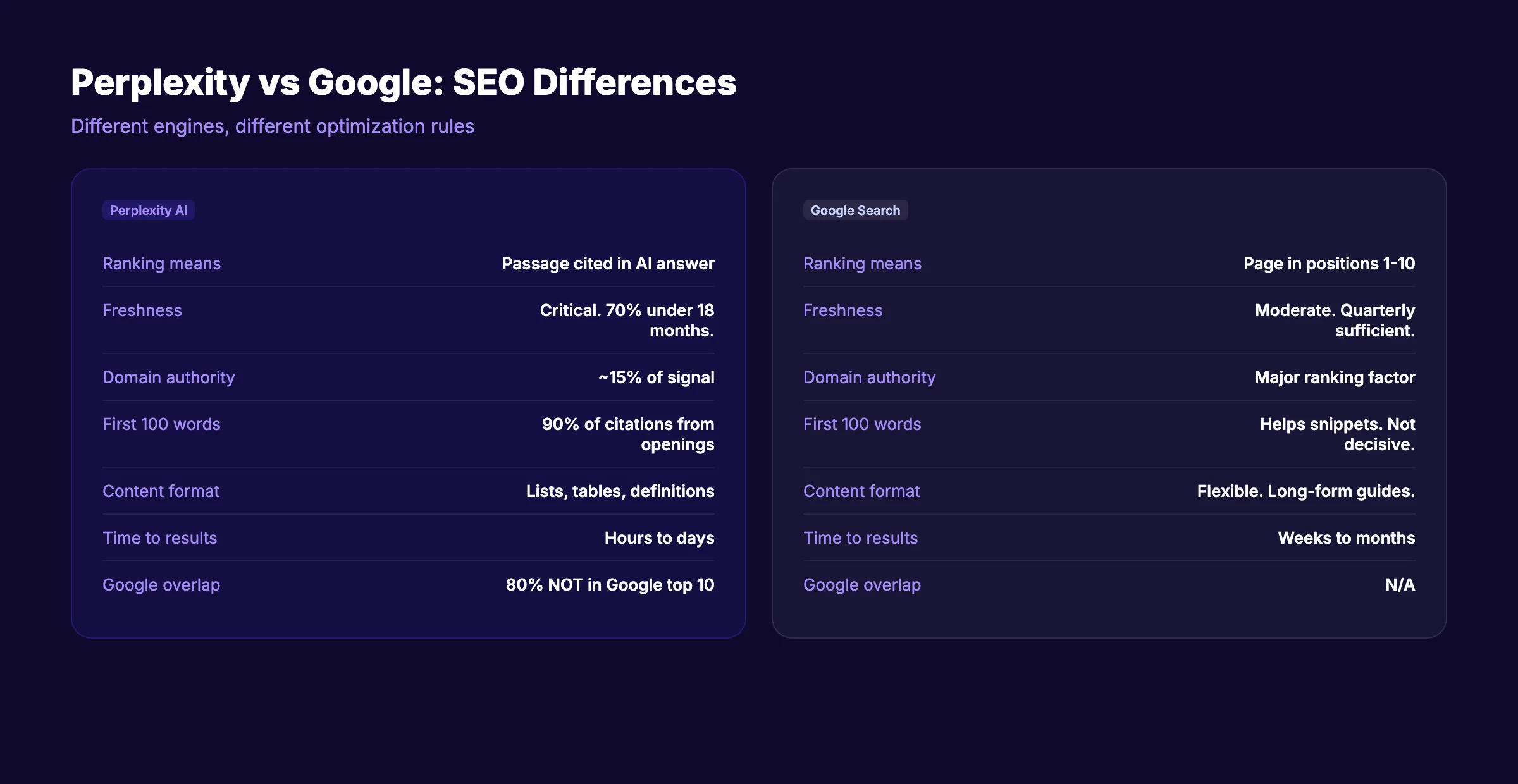
| Factor | Perplexity | |
|---|---|---|
| What “ranking” means | Your passage is cited in an AI answer | Your page ranks in positions 1-10 |
| Content freshness weight | Very high. 70% of citations under 18 months. | Moderate. Quarterly updates sufficient. |
| Domain authority weight | ~15% of signal. Topic authority outweighs raw DR. | Major factor. High DR dominates. |
| First 100 words | Critical. 90% of citations come from openings. | Important for snippets. Not decisive. |
| Content format | Structured. Lists, tables, definitions preferred. | Flexible. Long-form guides work. |
| Time to results | Hours to days for new content. | Weeks to months. |
| Overlap with Google rankings | 80% of cited pages are NOT in Google top 10. | N/A |
| Stats and quotes | +22% and +37% visibility boost respectively. | Helpful but unquantified. |
The biggest takeaway: Perplexity optimization is not about ranking on Google first. It is an independent channel with its own rules.
FAQ
How does Perplexity AI choose which sources to cite?
Perplexity uses a 5-stage RAG pipeline that retrieves content in real-time, scores it for relevance and quality, then generates an answer with inline citations. The strongest signals are content relevance to the query, freshness, domain authority multipliers, and structured content that is easy to extract. An average answer includes 21.87 citations.
Does domain authority matter for Perplexity citations?
Yes, but less than for Google. Domain authority accounts for roughly 15% of Perplexity’s ranking signal. Topical authority, content freshness, and content structure carry more weight. A niche site with deep coverage of one topic can outrank a high-DR generalist site for that topic.
How do I check if Perplexity is citing my content?
Search for your brand or key topics on perplexity.ai and check the source citations. For systematic tracking, set up GA4 to monitor referral traffic from perplexity.ai. Pages receiving Perplexity referrals are your cited pages.
Is optimizing for Perplexity different from optimizing for Google AI Overviews?
Yes. Google AI Overviews heavily favor pages already ranking in Google’s top 10. Perplexity uses its own real-time retrieval and 80% of its cited pages do not rank in Google’s top 10. Perplexity also weights content freshness more aggressively and favors structured, extractable content formats over long-form guides.
Should I add an llms.txt file for Perplexity?
An llms.txt file helps AI systems understand your site structure and content. While Perplexity’s primary discovery mechanism is real-time crawling, an llms.txt file provides additional context that can improve how Perplexity categorizes your content. It takes 10 minutes to set up and has no downside.
Does Reddit content really get 46.7% of Perplexity citations?
According to BrightEdge research, Reddit is among the top-cited sources on Perplexity. User-generated content performs well because it is conversational, up-to-date, and directly answers specific questions. For businesses, this means participating in relevant subreddit discussions can increase your brand visibility in Perplexity answers.
Rank everywhere. Do nothing. Blog SEO, Local SEO, and Social on autopilot. Start for $1 →
Related Tools & Resources
Free SEO Tools:
Best Lists:

Written by
Siddharth GangalSiddharth is the founder of theStacc and Arka360, and a graduate of IIT Mandi. He spent years watching great businesses lose organic traffic to competitors who simply published more. So he built a system to fix that. He writes about SEO, content at scale, and the tactics that actually move rankings.
30 SEO blog articles published every month
Keyword-optimized, scheduled, and live on your site. Automatically.
30-day trial · Cancel anytime
theStacc
Stop writing SEO content manually
30 blog articles, 30 GBP posts, and social media content. Published every month. Automatically.
Start Your $1 Trial$1 for 3 days · Cancel anytime