Local SEO: The Complete Guide for 2026
Everything you need to rank in local search — GBP, citations, reviews, schema, and AI search. 10-chapter guide updated for 2026.
Siddharth Gangal • 2026-03-28 • Local SEO
In This Article
98% of consumers search online before choosing a local business. That number was 90% in 2019. It will not go back down.
If your business serves a specific area and you do not show up in local search results, you are invisible to nearly every potential customer. Paid ads can fill the gap, but they stop working the moment you stop paying. Local SEO compounds over time. Every optimization you make today builds on itself for months and years.
The problem is that most local SEO advice is either outdated or written by agencies selling retainers. This guide is different. It covers every ranking factor, every tactic, and every tool you need to dominate local search in 2026, including the new AI search channels that most guides ignore.
We have published 3,500+ blog posts across 70+ industries, including hundreds for local service businesses. Our average SEO score is 92%. This guide covers everything we know about local SEO.
Here is what you will learn:
- How Google ranks local businesses (the 3 ranking pillars)
- How to optimize your Google Business Profile for maximum visibility
- The exact steps for local keyword research, citations, and link building
- How to get and manage reviews that drive both rankings and conversions
- How to prepare for AI search, voice search, and zero-click results
- Common mistakes that silently kill local rankings
What Is Local SEO and Why It Matters
Local SEO is the process of optimizing your online presence to attract customers from location-based searches. When someone searches “plumber near me” or “best dentist in Austin,” Google returns a set of local results. Local SEO determines whether your business appears in those results.
It differs from traditional SEO in one critical way. Traditional SEO targets national or global rankings. Local SEO targets geographic-specific visibility, particularly the Google Map Pack (the top 3 local results with a map) and localized organic results.
The Numbers That Matter
The case for local SEO is not theoretical. The data is overwhelming:
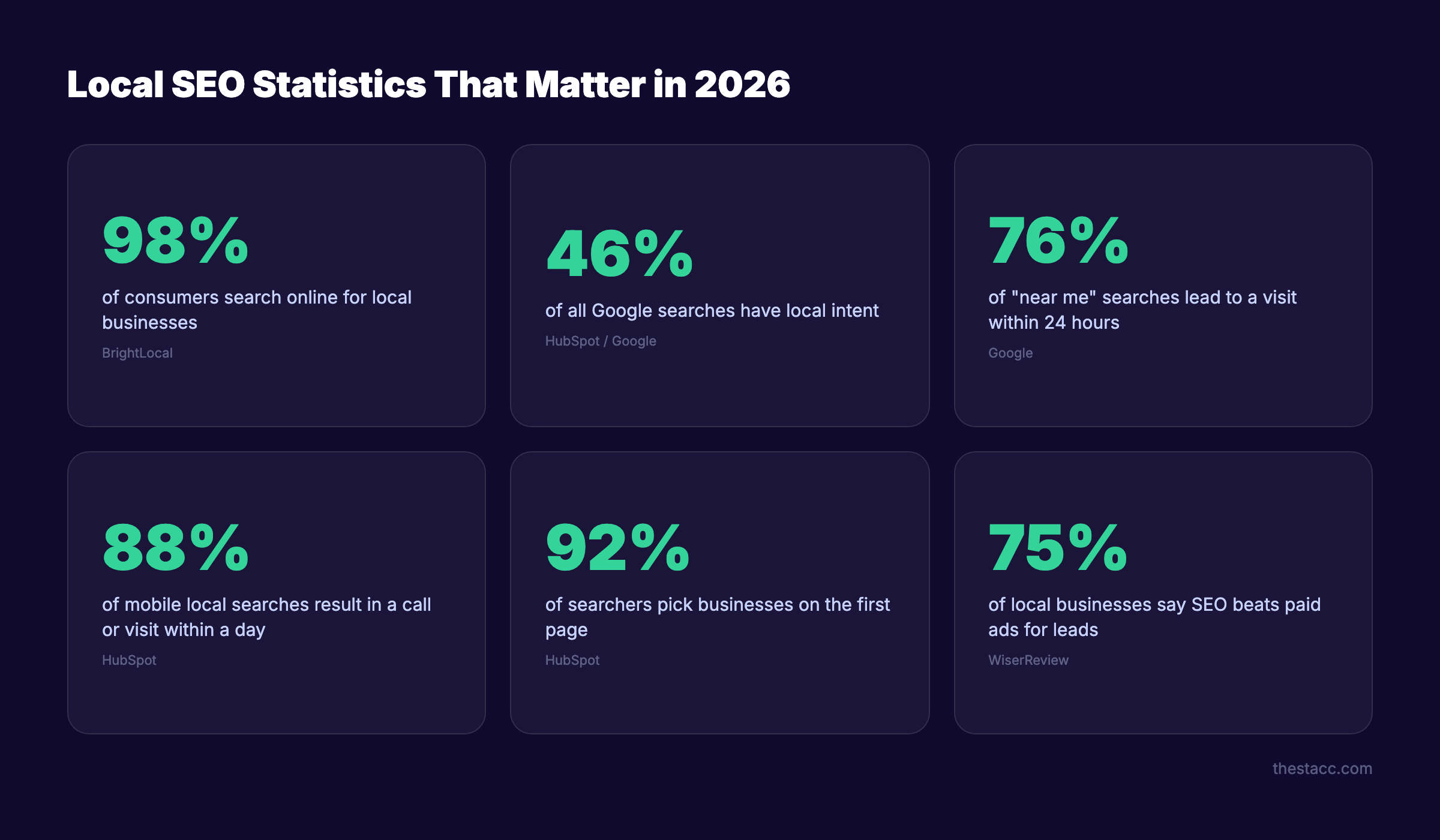
- 46% of all Google searches have local intent
- 76% of “near me” searches lead to a store visit within 24 hours
- 88% of mobile local searches result in a call or visit within a day
- 92% of searchers pick businesses on the first page of local results
- 75% of local businesses say SEO generates more leads than paid ads
Local search is not a marketing channel you can ignore. It is the primary way customers find local businesses in 2026.
How Local Search Ranking Works
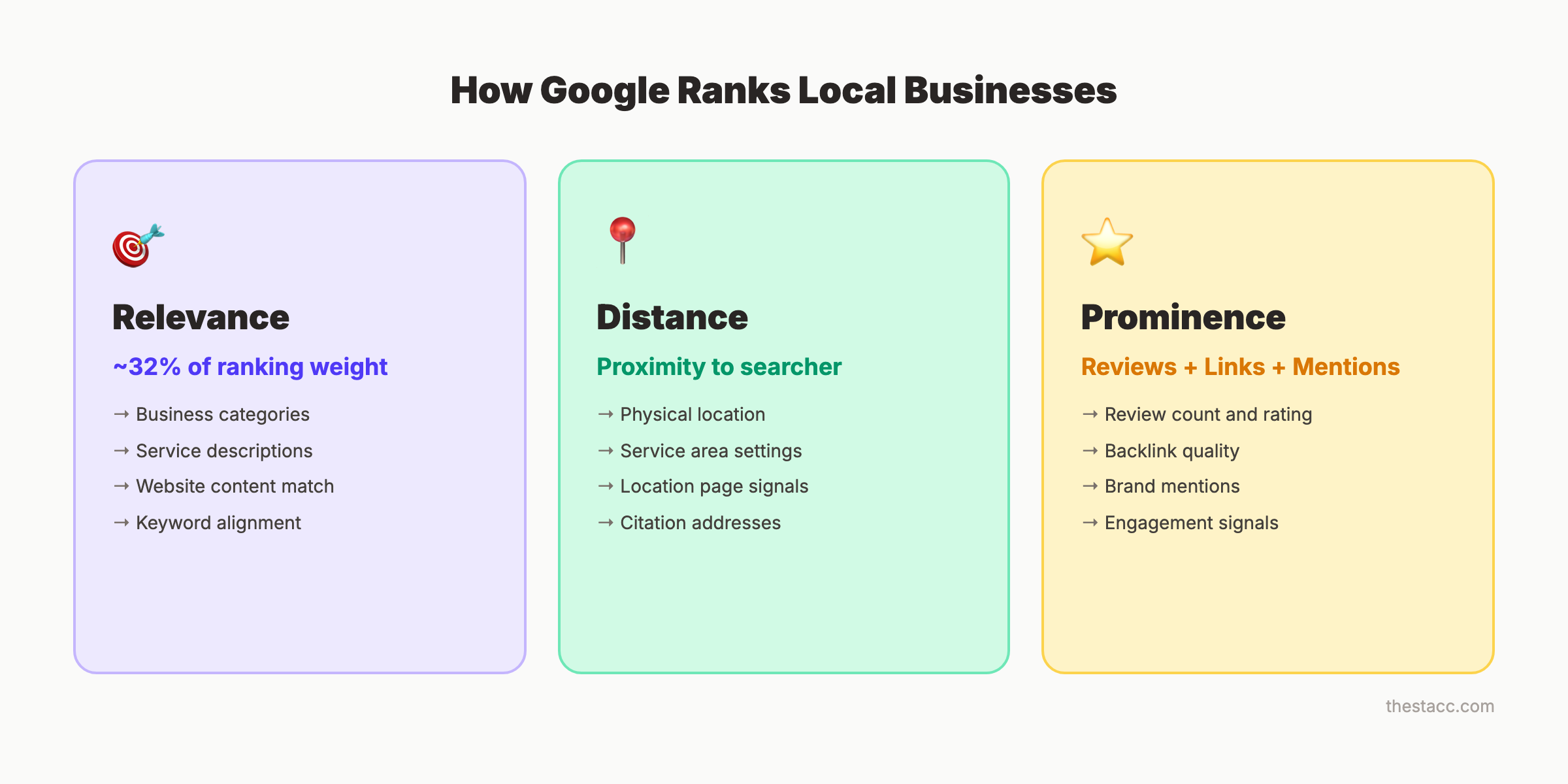
Google uses three core pillars to rank local businesses. Understanding these pillars is the foundation of every tactic in this guide.
Relevance
Relevance measures how well your business profile matches what the searcher is looking for. If someone searches “emergency plumber,” Google checks whether your business category, description, services, and website content signal that you offer emergency plumbing.
You control relevance through:
- Accurate business categories on your Google Business Profile
- Detailed service and product descriptions
- Website content that matches local search queries
- Consistent terminology across your profile and website
Distance
Distance is the proximity between the searcher and your business location. You cannot change where your business is located, but you can influence distance signals by:
- Setting accurate service areas in your GBP
- Creating location-specific pages for each area you serve
- Building citations in local directories that confirm your address
Prominence
Prominence reflects how well-known and trusted your business is. Google measures prominence through:
- Review count and average rating
- Citation volume and consistency
- Backlink quality and quantity
- Brand mentions across the web
- Engagement signals (clicks, calls, direction requests)
Of these three pillars, relevance and prominence are the ones you can directly improve. The rest of this guide shows you how.
Google Business Profile Optimization
Your Google Business Profile is the single most important local SEO asset you own. GBP signals account for roughly 32% of Map Pack ranking factors, more than any other category.
Yet 56% of retailers have not claimed their profile. If you have not claimed yours, do that before reading another word of this guide.
Complete Every Field
Businesses with complete profiles receive up to 7x more clicks than incomplete ones. Complete means every single field:
- Business name — Exact legal name. Do not stuff keywords.
- Primary category — The most specific category that describes your core service.
- Secondary categories — Add every relevant category. A dentist might add “Cosmetic Dentist,” “Pediatric Dentist,” and “Emergency Dental Service.”
- Address — Exact match with your website and all citations.
- Phone number — Local number preferred over toll-free.
- Website URL — Link to your homepage or a dedicated landing page.
- Business hours — Keep updated. Being open at the time of search is the 5th most influential Map Pack factor.
- Services/Products — List every service with descriptions.
- Business description — 750 characters. Include your primary keyword naturally.
- Attributes — Mark all that apply (wheelchair accessible, free Wi-Fi, veteran-owned, etc.).
Add Photos and Videos
Profiles with 100+ photos receive 520% more calls, 2,700% more direction requests, and 1,065% more website clicks than profiles with fewer photos.
Upload these photo types:
- Exterior (storefront from multiple angles)
- Interior (clean, well-lit shots)
- Team photos (builds trust)
- Product/service photos
- Before-and-after photos (if applicable)
- Short videos (under 30 seconds)
Post Regularly
Google Business Profile posts keep your profile active and signal relevance. Post at least weekly with:
- Offers and promotions
- Event announcements
- Service highlights
- Tips related to your industry
- New product or service launches
For a deeper walkthrough, read our full Google Business Profile optimization guide.
Stop writing. Start ranking. Stacc publishes 30 optimized GBP posts per month on autopilot. Start for $1 →
Local Keyword Research
Local keyword research is different from standard keyword research. You are targeting searches with geographic intent, which means every keyword has a location modifier (explicit or implied).
Types of Local Keywords
| Keyword Type | Example | Search Intent |
|---|---|---|
| Service + Location | ”plumber in Dallas” | High intent, specific area |
| ”Near me" | "dentist near me” | High intent, proximity-based |
| Service only (local intent) | “emergency plumber” | Implicit local intent |
| Question-based | ”how much does a plumber cost” | Informational, pre-purchase |
| Review-based | ”best plumber in Dallas” | Commercial investigation |
How to Find Local Keywords
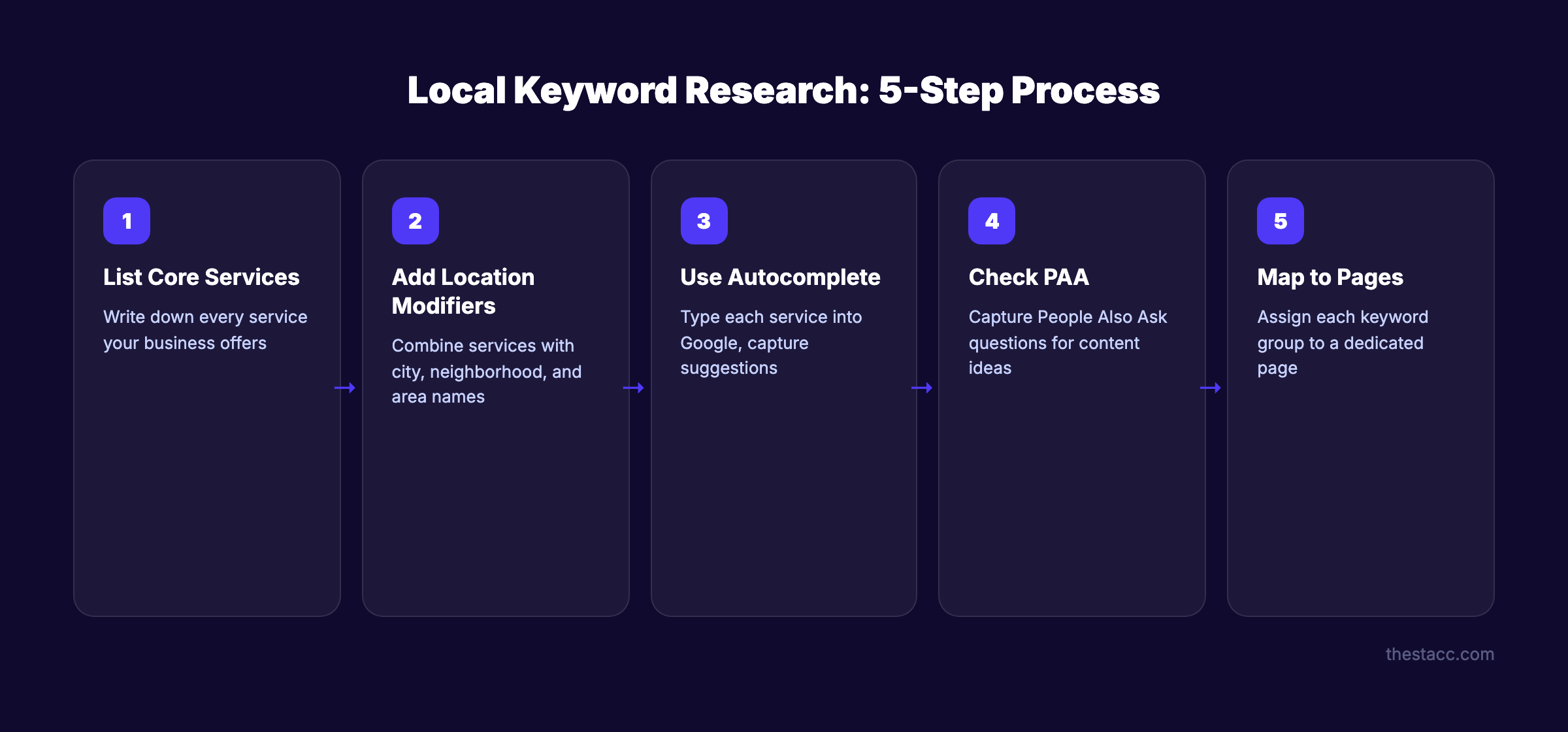
Step 1: List your core services. Write down every service you offer. A dentist might list: teeth cleaning, dental implants, root canal, teeth whitening, emergency dental care.
Step 2: Add location modifiers. Combine each service with your city, neighborhood, county, and surrounding areas. “Teeth whitening Dallas,” “teeth whitening Plano,” “teeth whitening Fort Worth.”
Step 3: Use Google Autocomplete. Type each service into Google and note the suggestions. These are real searches people make.
Step 4: Check People Also Ask. Every local search triggers PAA questions. These are ready-made content topics.
Step 5: Analyze competitor keywords. Use a tool like Semrush or Ahrefs to see what keywords your top local competitors rank for. Look for gaps where they rank and you do not.
For a complete walkthrough of keyword research tools and techniques, see our keyword research guide.
Map Keywords to Pages
Every keyword group needs a dedicated page:
- Homepage — Primary service + primary city
- Service pages — One page per core service
- Location pages — One page per city or area you serve
- Blog posts — Target question-based and long-tail keywords
- FAQ page — Target “how much” and “what is” queries
Do not try to rank one page for 50 keywords. One page targets one primary keyword and 2-3 closely related terms.
On-Page SEO for Local Businesses
On-page SEO for local businesses follows the same principles as standard on-page SEO, with one addition: every page must send clear geographic signals.
Title Tags and Meta Descriptions
Your title tag is the most important on-page element. For local pages, follow this formula:
[Primary Service] in [City] | [Business Name]Examples:
- “Emergency Plumber in Dallas | Smith Plumbing”
- “Teeth Whitening in Austin | Bright Dental”
Keep title tags under 60 characters. Include your primary keyword and city.
Meta descriptions should be 145-155 characters and include a benefit:
Same-day emergency plumbing in Dallas. Licensed, insured, 4.9-star rated. Call now for a free estimate.Header Structure
Use one H1 per page (your primary keyword + location). Break content into H2 and H3 sections that cover related subtopics. Every service page should include:
- H1: [Service] in [City]
- H2: What we offer
- H2: Service area
- H2: Pricing or estimates
- H2: Why choose [Business Name]
- H2: FAQ
Local Content Signals
Add these elements to every page:
- NAP in footer — Business name, address, and phone number on every page
- Embedded Google Map — On your contact page and location pages
- Local schema markup — LocalBusiness structured data (covered in Chapter 8)
- Location-specific content — Mention neighborhoods, landmarks, and local details
- Internal links — Connect service pages to location pages and blog posts with strategic internal linking
NAP Consistency and Local Citations
NAP stands for Name, Address, Phone Number. It must be identical everywhere your business appears online. 68% of consumers stop using a business after finding inaccurate information in online listings.
What Are Citations?
A citation is any online mention of your business name, address, and phone number. Citations come in two types:
Structured citations appear in business directories with dedicated fields for NAP data:
- Google Business Profile
- Yelp
- Apple Maps
- Bing Places
- Facebook Business
- Better Business Bureau
- Industry-specific directories (Avvo for lawyers, Healthgrades for doctors, HomeAdvisor for contractors)
Unstructured citations appear in blog posts, news articles, event pages, and social media where your business is mentioned with NAP details.
How to Build Citations
- Start with the big 4: Google Business Profile, Apple Maps, Bing Places, Yelp
- Add industry directories: Search “[your industry] directory” and submit to the top 10
- Add local directories: Chamber of commerce, local business associations, city-specific sites
- Check data aggregators: Submit to Foursquare, Data.com, and Neustar Localeze — these feed data to hundreds of smaller directories
Audit Existing Citations
Search your business name on Google. Check every listing for:
- Correct business name (no old names, abbreviations, or variations)
- Correct current address
- Correct phone number
- Correct website URL
- Consistent formatting across all listings
Fix every inconsistency you find. Even small differences (“St.” vs “Street” or a missing suite number) can confuse Google.
Your SEO team. $99 per month. 30 optimized articles published automatically. No writers. No agencies. Start for $1 →
Reviews: The Trust Signal That Drives Rankings
Reviews are both a ranking factor and a conversion factor. 97% of consumers read reviews before choosing a local business. Google uses review count, rating quality, and recency as direct ranking signals.
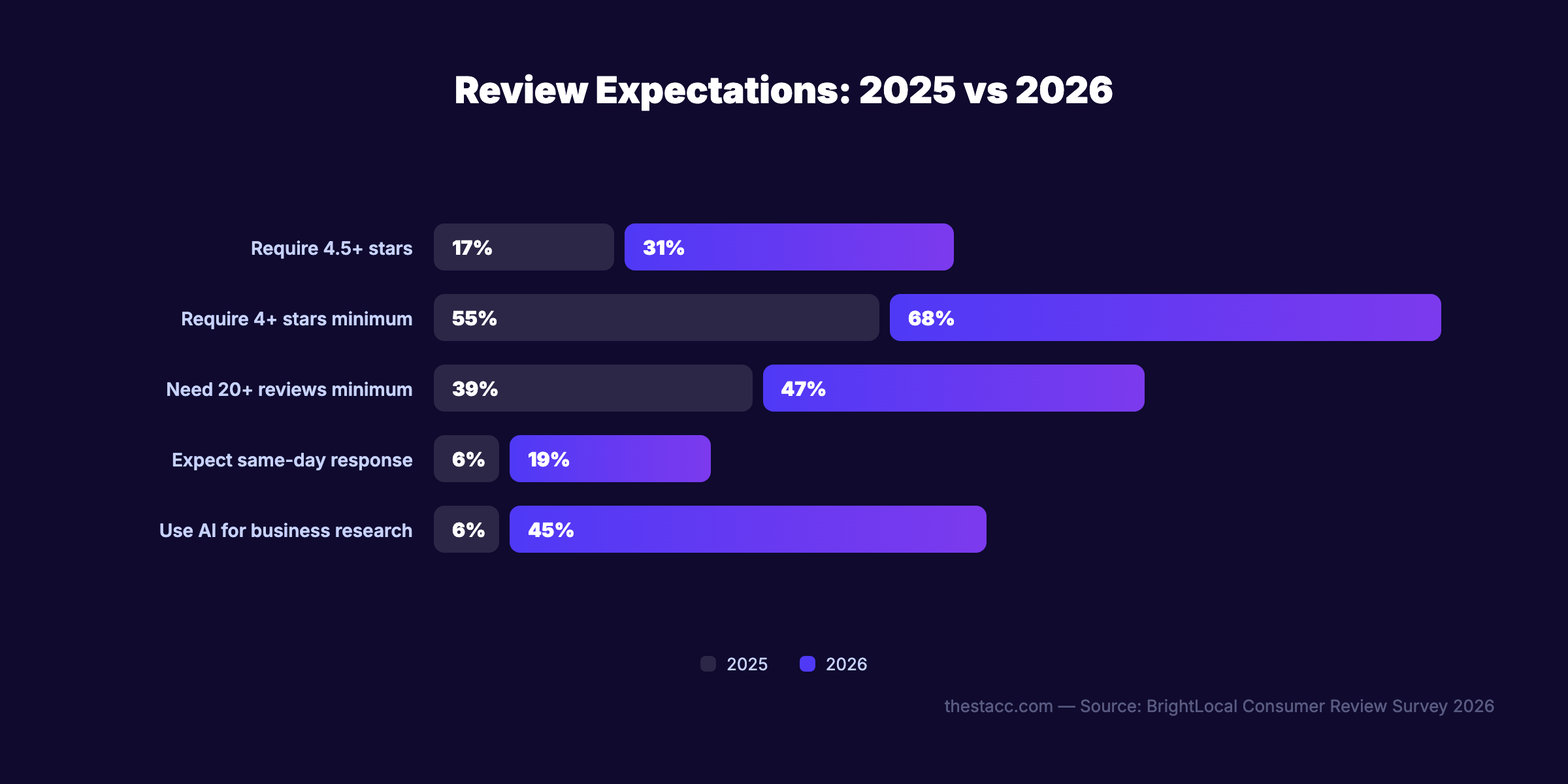
The 2026 Review Landscape
Consumer expectations around reviews have shifted dramatically:
| Metric | 2025 | 2026 |
|---|---|---|
| Require 4.5+ stars | 17% | 31% |
| Require 4+ stars minimum | 55% | 68% |
| Will not use businesses with fewer than 20 reviews | 39% | 47% |
| Expect same-day review response | 6% | 19% |
| Use AI tools for business research | 6% | 45% |
The bar is higher than ever. A 4.0-star rating with 15 reviews is no longer enough. You need volume, recency, and responsiveness.
How to Get More Reviews
Do not wait for reviews to happen. Build a system:
- Ask at the point of service. The best time to ask is immediately after delivering a positive outcome.
- Send a follow-up email or text. Within 24 hours of service completion, send a direct link to your Google review page.
- Use a QR code. Print it on receipts, business cards, and in-store signage. Our review QR code generator creates these instantly.
- Respond to every review. 80% of consumers are more likely to choose businesses that respond to all reviews. Generic responses do not count. 50% of consumers are unlikely to choose businesses with generic review responses.
For a detailed review strategy, see our guide on getting more Google reviews for local businesses.
How to Respond to Reviews
Positive reviews: Thank the reviewer by name. Mention the specific service. Keep it under 3 sentences.
Negative reviews: Acknowledge the issue. Apologize without being defensive. Offer to resolve it offline. Never argue publicly.
Our review response generator creates personalized responses in seconds.
Local Link Building Strategies
Links remain one of the strongest ranking signals. For local businesses, the quality of links matters more than quantity, and local relevance matters more than domain authority.
High-Value Local Link Sources
| Link Source | Difficulty | Impact |
|---|---|---|
| Local news coverage | Medium | Very High |
| Chamber of commerce membership | Low | High |
| Local sponsorships (sports teams, events, charities) | Low | High |
| Industry associations | Low | Medium-High |
| Local blogger partnerships | Medium | Medium |
| University or school partnerships | Medium | High |
| Supplier/vendor pages | Low | Medium |
| Local event hosting | Medium | High |
Tactics That Work
Sponsor local events. Every sponsorship typically earns a link from the event website, local news coverage, and social media mentions.
Create local resources. A “Best Restaurants in [City]” guide or a “Moving to [City] Checklist” attracts links from local blogs and media.
Partner with complementary businesses. A dentist partners with an orthodontist. A plumber partners with a real estate agent. Cross-link websites and co-create content.
Get quoted in local media. Sign up for journalist query services. Respond to local reporters covering your industry.
Host community events. Workshops, seminars, or charity drives generate links from event calendars, local blogs, and news outlets.
For more strategies, read our guide on building backlinks for your blog.
Schema Markup for Local Businesses
Schema markup is structured data you add to your website so search engines understand your business details. It does not directly rank your site, but it increases click-through rates by enabling rich results (star ratings, business hours, price ranges in search results).
LocalBusiness Schema
Every local business website should have LocalBusiness schema on the homepage. Here is the minimum JSON-LD:
{
  "@context": "https://schema.org",
  "@type": "LocalBusiness",
  "name": "Your Business Name",
  "image": "https://yourdomain.com/logo.png",
  "address": {
    "@type": "PostalAddress",
    "streetAddress": "123 Main St",
    "addressLocality": "Dallas",
    "addressRegion": "TX",
    "postalCode": "75201",
    "addressCountry": "US"
  },
  "telephone": "+1-555-123-4567",
  "url": "https://yourdomain.com",
  "openingHoursSpecification": [
    {
      "@type": "OpeningHoursSpecification",
      "dayOfWeek": ["Monday", "Tuesday", "Wednesday", "Thursday", "Friday"],
      "opens": "08:00",
      "closes": "17:00"
    }
  ],
  "priceRange": "$$",
  "aggregateRating": {
    "@type": "AggregateRating",
    "ratingValue": "4.8",
    "reviewCount": "127"
  }
}
Additional Schema Types
Depending on your business type, add these:
- Service schema — For each service you offer
- FAQ schema — For FAQ sections on any page
- Review schema — For testimonial pages
- Event schema — For upcoming events or workshops
- Product schema — For businesses that sell physical products
Use a more specific @type when possible. A dentist should use "@type": "Dentist" instead of "LocalBusiness". A law firm should use "@type": "LegalService".
For implementation details, see our schema markup guide. You can also generate schema instantly with our schema markup generator.
3,500+ blogs published. 92% average SEO score. See what Stacc can do for your site. Start for $1 →
Local Content Strategy
Content is how you scale local SEO beyond your homepage and service pages. Every blog post, location page, and FAQ entry creates a new opportunity to rank for local queries.
Location Pages
If you serve multiple areas, create a dedicated page for each. A plumber in Dallas should have pages for:
- /plumber-dallas
- /plumber-plano
- /plumber-fort-worth
- /plumber-arlington
Each location page must be unique. Do not duplicate content and swap city names. Include:
- Location-specific service details
- Area-specific pricing (if it varies)
- Local landmarks and neighborhood references
- Testimonials from customers in that area
- An embedded map showing your service area
Blog Content for Local Businesses
Your blog should target long-tail local keywords that service pages cannot:
- “How much does a roof replacement cost in Dallas?”
- “Best time to service your HVAC in Texas”
- “What to do when your pipes freeze in Fort Worth”
Every blog post should link to relevant service pages and location pages. This builds topical authority and helps Google understand your site structure.
Content Calendar
Aim for consistent publishing. Even 4 posts per month builds momentum over time. We call this the Content Compound Effect: every article stacks on the last. Businesses that publish 30+ articles per month see 3-4x more organic traffic than those publishing 4-8.
Voice Search and AI Search Optimization
Local SEO in 2026 has two new frontiers: voice search and AI-driven search. Ignoring them means missing a growing share of local discovery.
Voice Search
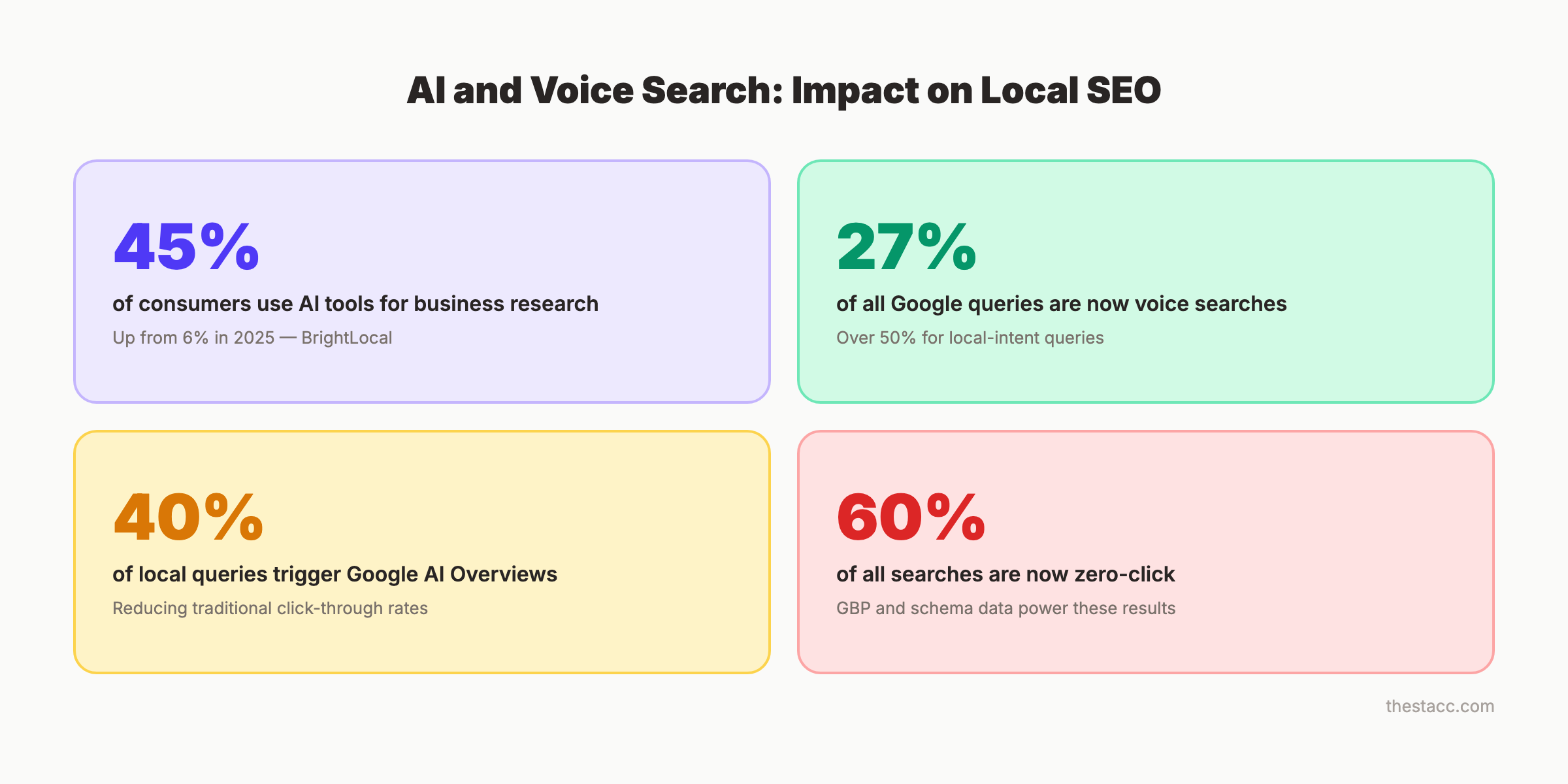
27% of all Google queries are now voice searches. For local-intent queries, that number exceeds 50%. Voice searches tend to be:
- Conversational (“Where is the closest pharmacy that is open right now?”)
- Question-based (“How much does an oil change cost?”)
- Action-oriented (“Call the nearest pizza place”)
To optimize for voice search:
- Target question keywords. Structure content around “who,” “what,” “where,” “when,” and “how” queries.
- Write concise answers. Voice assistants pull from featured snippets. Answer questions in 1-2 sentences, then elaborate below.
- Keep your GBP updated. Voice assistants pull hours, phone numbers, and addresses directly from GBP.
- Optimize for “near me.” These queries dominate voice search for local businesses.
AI Search (AI Overviews, ChatGPT, Perplexity)
45% of consumers now use AI tools like ChatGPT for business research, up from 6% in 2025. 40% of local business queries trigger Google AI Overviews.
This changes local SEO in three ways:
1. Zero-click results are growing. 60% of all searches are now zero-click. Your GBP profile, reviews, and schema data are what AI systems pull from. Make sure they are complete and accurate.
2. AI models cite structured content. Content with clear headings, lists, tables, and FAQ sections is more likely to be referenced by AI search tools. See our generative engine optimization guide for details.
3. Review platforms are diversifying. Consumers now use an average of 6 review platforms. Apple Maps usage doubled from 14% to 27%. Your business needs to be visible and well-reviewed across all major platforms, not just Google.
How to Track Local SEO Results
You cannot improve what you do not measure. Here are the metrics and tools that matter for local SEO.
Key Metrics
| Metric | Tool | What It Tells You |
|---|---|---|
| Map Pack rankings | Local rank tracker | Visibility in the top 3 map results |
| Organic local rankings | Google Search Console | Rankings for location-based keywords |
| GBP views and actions | GBP Insights | How many people see and interact with your profile |
| Click-to-call rate | GBP Insights / Call tracking | Phone leads from local search |
| Direction requests | GBP Insights | In-store visit intent |
| Website clicks from GBP | GBP Insights | Traffic driven by your profile |
| Review count and rating | GBP / Review monitoring | Trust signal strength |
| Citation accuracy | Citation audit tool | NAP consistency score |
Tools to Use
- Google Search Console — Free. Shows which queries bring traffic. Read our Google Search Console guide for setup instructions.
- Google Analytics 4 — Free. Tracks website behavior and conversions. See our GA4 setup guide.
- GBP Insights — Built into your Business Profile. Shows views, searches, and actions.
- Local rank tracker — Tools like BrightLocal or Whitespark track Map Pack positions across grid points in your service area.
What Good Looks Like
Set benchmarks based on your market size and competition level. As a general guide:
- Month 1-3: GBP fully optimized, citations built, review system running
- Month 3-6: First ranking movement for low-competition keywords, steady review growth
- Month 6-12: Map Pack appearances for primary keywords, consistent phone calls and direction requests from GBP
Local SEO is not instant. Expect meaningful results in 3-6 months with consistent effort.
Common Local SEO Mistakes
Most local businesses make the same mistakes. Avoiding these puts you ahead of the majority of your competitors.
The Mistakes That Cost You Rankings
- Not claiming your GBP. 56% of retailers have not claimed their profile. This is free visibility you are leaving on the table.
- Inconsistent NAP. Different phone numbers or addresses across directories confuse Google and erode trust.
- Ignoring reviews. Not responding to reviews signals that you do not care about customer experience. 42% of consumers stop engaging with businesses that leave reviews unanswered.
- Keyword stuffing your business name. Adding “Best Plumber in Dallas” to your GBP name violates Google guidelines and risks suspension.
- Duplicate content on location pages. Swapping city names on identical pages does not work. Google recognizes thin, duplicated content.
- No mobile optimization. 71% of GBP interactions come from mobile devices. A slow or unresponsive mobile site kills conversions.
- No schema markup. You are missing rich results that increase click-through rates.
- Buying fake reviews. Google detects and removes them. Repeat offenders get their profiles suspended.
- Ignoring other platforms. Google is not the only game. Apple Maps, Bing, Yelp, and industry directories all send traffic.
- Not tracking results. If you do not know which keywords drive calls, you cannot optimize.
Fix these before chasing advanced tactics. The basics done well outperform sophisticated strategies done poorly.
Rank everywhere. Do nothing. Blog SEO, Local SEO, and Social on autopilot. Start for $1 →
Local SEO Checklist
Use this as a quick-reference checklist. Complete each item in order.
Foundation
- Claim and verify Google Business Profile
- Complete every GBP field
- Set accurate business hours and service areas
- Upload 25+ high-quality photos
- Submit to Apple Maps, Bing Places, and Yelp
On-Page
- Add NAP to website footer (all pages)
- Optimize title tags with service + city
- Write unique meta descriptions for every page
- Add LocalBusiness schema to homepage
- Create dedicated pages for each service
- Create dedicated pages for each location served
- Embed Google Map on contact page
Citations
- Submit to top 20 general directories
- Submit to industry-specific directories
- Audit existing citations for NAP accuracy
- Fix all inconsistencies
Reviews
- Set up a review request system (email + SMS + QR)
- Respond to every review within 24 hours
- Monitor reviews across all platforms weekly
Content
- Publish at least 4 blog posts per month
- Target question-based local keywords
- Link blog posts to service and location pages
- Update GBP with weekly posts
Links
- Join local chamber of commerce
- Sponsor 1-2 local events per quarter
- Partner with complementary local businesses
- Create link-worthy local resources
Tracking
- Set up Google Search Console
- Set up Google Analytics 4
- Monitor GBP Insights weekly
- Track Map Pack rankings monthly
FAQ
What is the difference between SEO and local SEO?
Standard SEO targets broad, often national rankings for any type of website. Local SEO specifically targets location-based searches and focuses on Google Business Profile, local citations, reviews, and Map Pack visibility. A SaaS company needs standard SEO. A dentist needs local SEO.
How long does local SEO take to work?
Most businesses see initial ranking movement within 60-90 days. Meaningful results, such as consistent phone calls, direction requests, and website traffic from local search, typically appear within 3-6 months. The timeline depends on your market size, competition level, and how consistently you execute.
How much does local SEO cost?
Agencies charge $1,000-$5,000 per month for local SEO services. Freelancers charge $500-$2,000. You can do it yourself with free tools and this guide, or use a service like Stacc that handles GBP posts and blog content from $99 per month.
Do I need local SEO if I already run Google Ads?
Yes. Google Ads stop generating leads the moment you stop paying. Local SEO generates compounding, long-term visibility. The two work best together: ads for immediate leads, SEO for sustainable growth. Over time, SEO reduces your dependence on ad spend.
What is the most important local SEO ranking factor?
Google Business Profile signals account for roughly 32% of Map Pack ranking factors, making GBP optimization the single highest-impact action. Reviews, on-page signals, and links make up most of the remaining factors.
How do I rank in the Google Map Pack?
Optimize your GBP completely, build consistent citations, earn reviews steadily, create location-relevant content, and build local backlinks. There is no single trick. The Map Pack rewards businesses that execute across all local ranking factors consistently.
Local SEO is not optional for businesses that serve a specific area. It is the most cost-effective way to generate consistent, high-quality leads. The businesses that rank in local search today are the ones that started optimizing 6 months ago. The best time to start is now.
Every tactic in this guide works. The challenge is execution. Doing keyword research, writing content, optimizing your GBP, building citations, managing reviews, and tracking results takes real time. That is exactly the problem Stacc solves. We handle the content, the GBP posts, and the SEO so you can focus on running your business.
Skip the agency. Keep the results. Stacc starts at $99/mo with a $1 trial. Start for $1 →
Written and published by Stacc. We publish 3,500+ articles per month across 70+ industries. All data verified against public sources as of March 2026.