
Home Services SEO (2026): Strategies, Tactics & Examples
Practical home services seo guide strategies for 2026: step-by-step tactics, real examples, and tools to improve rankings and drive organic traffic.
A homeowner has a burst pipe at 9 PM. They grab their phone and search “emergency plumber near me.” That single click costs the winning contractor $0. The Google Ads competitor below them pays $62.67 for the same lead in Austin, TX (LocaliQ).
Home services SEO is the difference between paying for every lead and owning a pipeline that fills itself. 84% of homeowners now use Google before choosing a contractor (Hook Agency). If your plumbing, HVAC, or electrical business does not rank in the top 3, you lose 5x the call volume to competitors who do (Comrade Web).
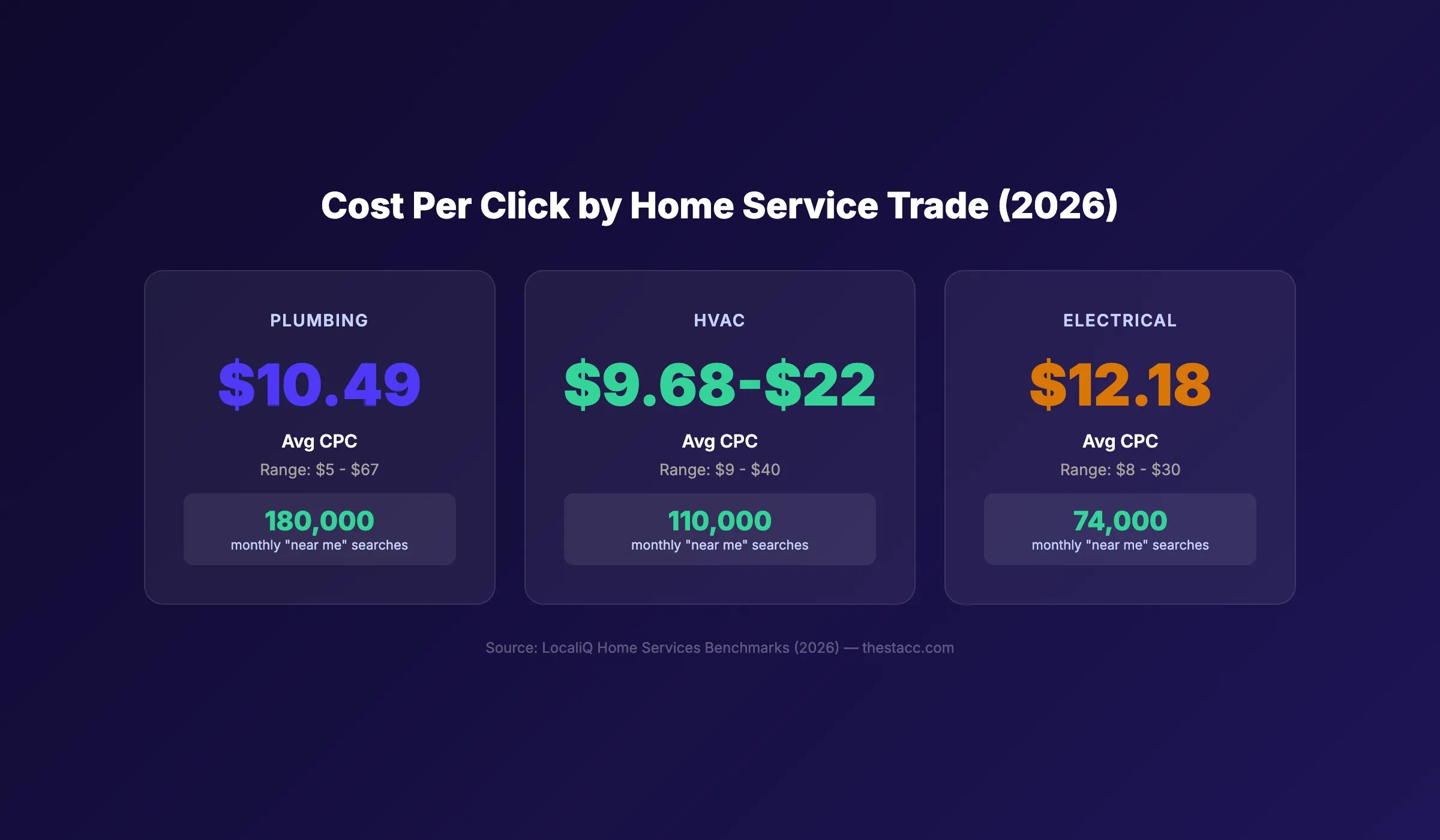
The cost of ignoring organic search grows every quarter. Average cost per click in home services rose 10 to 25% in 2026 alone. Plumbing keywords average $10.49 per click. HVAC keywords range from $9.68 to $22. Electrical keywords sit at $12.18. Multiply that by hundreds of monthly clicks and paid ads drain budgets fast.
This guide covers all 3 major trades in one place. You will get trade-specific keyword tables, Google Business Profile checklists, seasonal content calendars, and a clear cost breakdown. We publish 3,500+ blogs across 70+ industries at Stacc, and local SEO for contractors is one of our most active verticals.
Here is what you will learn:
- Why organic search delivers $7.48 for every $1 spent
- Exact keyword lists for plumbers, electricians, and HVAC companies
- How to optimize your Google Business Profile for the local pack
- On-page SEO tactics for service area pages
- A review generation system that builds trust at scale
- Month-by-month content calendars by trade and season
- Link building strategies specific to contractors
- Technical SEO essentials for mobile-first home services sites
- What home services SEO costs and what ROI to expect
Chapter 1: Why Home Services SEO Matters More Than Paid Ads
76% of local smartphone searches result in a business visit within 24 hours (Google). For plumbers, electricians, and HVAC companies, that visit is a booked job. Organic search captures these high-intent leads without charging per click.
The math is simple. SEO delivers $7.48 for every $1 spent according to Backlinko. Compare that to average cost per lead in home services of $90.92 (LocaliQ). Over 12 months, SEO compounds while paid ads reset to zero the moment you pause spending.
The CPC Problem by Trade
Paid search costs vary dramatically across trades. Here is what contractors pay per click in 2026:
| Trade | Avg CPC | CPC Range | Monthly “Near Me” Volume |
|---|---|---|---|
| Plumbing | $10.49 | $5 - $67 | ~180,000 |
| HVAC | $9.68 - $22 | $9 - $40 | ~110,000 |
| Electrical | $12.18 | $8 - $30 | ~74,000 |
Source: LocaliQ Home Services Benchmarks
“Plumber near me” in Austin, TX costs $62.67 per click. A single organic ranking for that term replaces thousands of dollars in monthly ad spend. The top 3 Google positions generate 5x more calls than all of page 2 combined (Comrade Web).
SEO vs PPC: The 12-Month Comparison
| Factor | SEO (Organic) | PPC (Google Ads) |
|---|---|---|
| Month 1-3 ROI | Low (building) | Immediate |
| Month 6-12 ROI | 300-500% | Flat |
| Cost per lead trend | Decreasing | Increasing (10-25%/yr) |
| Lead flow when paused | Continues | Stops instantly |
| Trust signal | High (earned rank) | Lower (ad label) |
| Average ROI per $1 | $7.48 | $2-3 |
Source: Coal March Marketing ROI Guide
The U.S. home services market is worth $650 to $750 billion annually. 28% of local searches lead directly to a service booking (Google). Every month without an SEO strategy hands those bookings to competitors who have one.
If you want to understand how organic rankings work at a fundamental level, read our guide on how to rank higher on Google.
Chapter 2: Keyword Research for Plumbers, Electricians, and HVAC Companies
“Near me” searches surged over 400% in 2 years (Google). Home service keywords split into 2 categories: money keywords that drive bookings and blog keywords that build topical authority. You need both.
Keywords by Trade
Every trade has distinct search patterns. The tables below separate high-intent service keywords from informational blog topics.
Plumbing Keywords
| Money Keywords | Monthly Volume | Blog Keywords | Monthly Volume |
|---|---|---|---|
| plumber near me | 180,000 | how to unclog a drain | 33,000 |
| emergency plumber | 40,500 | water heater not working | 18,000 |
| drain cleaning service | 22,200 | how to fix a leaky faucet | 14,800 |
| water heater installation | 14,800 | signs of a slab leak | 8,100 |
| sewer line repair | 9,900 | tankless vs tank water heater | 6,600 |
78% of plumbing leads come from organic search and Google Maps (Bullseye Marketing). Plumbing has the highest “near me” volume of any home service trade.
HVAC Keywords
| Money Keywords | Monthly Volume | Blog Keywords | Monthly Volume |
|---|---|---|---|
| hvac repair near me | 110,000 | ac not blowing cold air | 49,500 |
| ac installation | 27,100 | best thermostat settings | 22,200 |
| furnace repair | 22,200 | hvac maintenance checklist | 12,100 |
| duct cleaning service | 18,100 | heat pump vs furnace | 9,900 |
| hvac tune up | 14,800 | when to replace your ac | 8,100 |
HVAC search volume swings 300 to 500% between seasons (WebFX). Timing your content to match these swings is critical. More on that in Chapter 6.
Electrical Keywords
| Money Keywords | Monthly Volume | Blog Keywords | Monthly Volume |
|---|---|---|---|
| electrician near me | 74,000 | how to reset a breaker | 27,100 |
| electrical panel upgrade | 18,100 | signs of faulty wiring | 14,800 |
| ev charger installation | 14,800 | led vs fluorescent | 9,900 |
| generator installation | 12,100 | whole house surge protector | 8,100 |
| outdoor lighting install | 8,100 | smart home wiring guide | 6,600 |
Electrical services have only 20 to 34% search volume variance year-round (WebFX). That makes electrician SEO more predictable but also more competitive.
Search Intent Categories
Every keyword falls into 1 of 4 intent buckets:
- Emergency (“emergency plumber,” “ac stopped working”): Highest conversion rate. Needs fast-loading pages.
- Transactional (“water heater installation cost,” “hvac tune up near me”): Ready to book. Service pages must answer price questions.
- Informational (“how to fix a running toilet”): Blog content. Builds trust and authority.
- Comparison (“tankless vs tank water heater”): Decision-stage. Great for long-form content.
Map every keyword to a specific page type. Money keywords go to service pages. Blog keywords go to articles. Read our full keyword research for blog posts guide for the complete process.
Tools for Keyword Research
You do not need expensive enterprise software. Start with these:
- Google Search Console for existing keyword data
- Google Keyword Planner for volume and CPC estimates
- Google autocomplete and People Also Ask for long-tail ideas
- Competitor analysis using any keyword research tool
Focus on keywords with local intent modifiers: “near me,” city names, zip codes, and neighborhood terms. A plumber in Dallas should target “plumber in Frisco TX” alongside “plumber near me.”
Stop paying $10 to $62 per click. Stacc publishes SEO-optimized blog content for plumbers, electricians, and HVAC companies starting at $99 per month. Start for $1 →
Chapter 3: Google Business Profile Optimization for Contractors
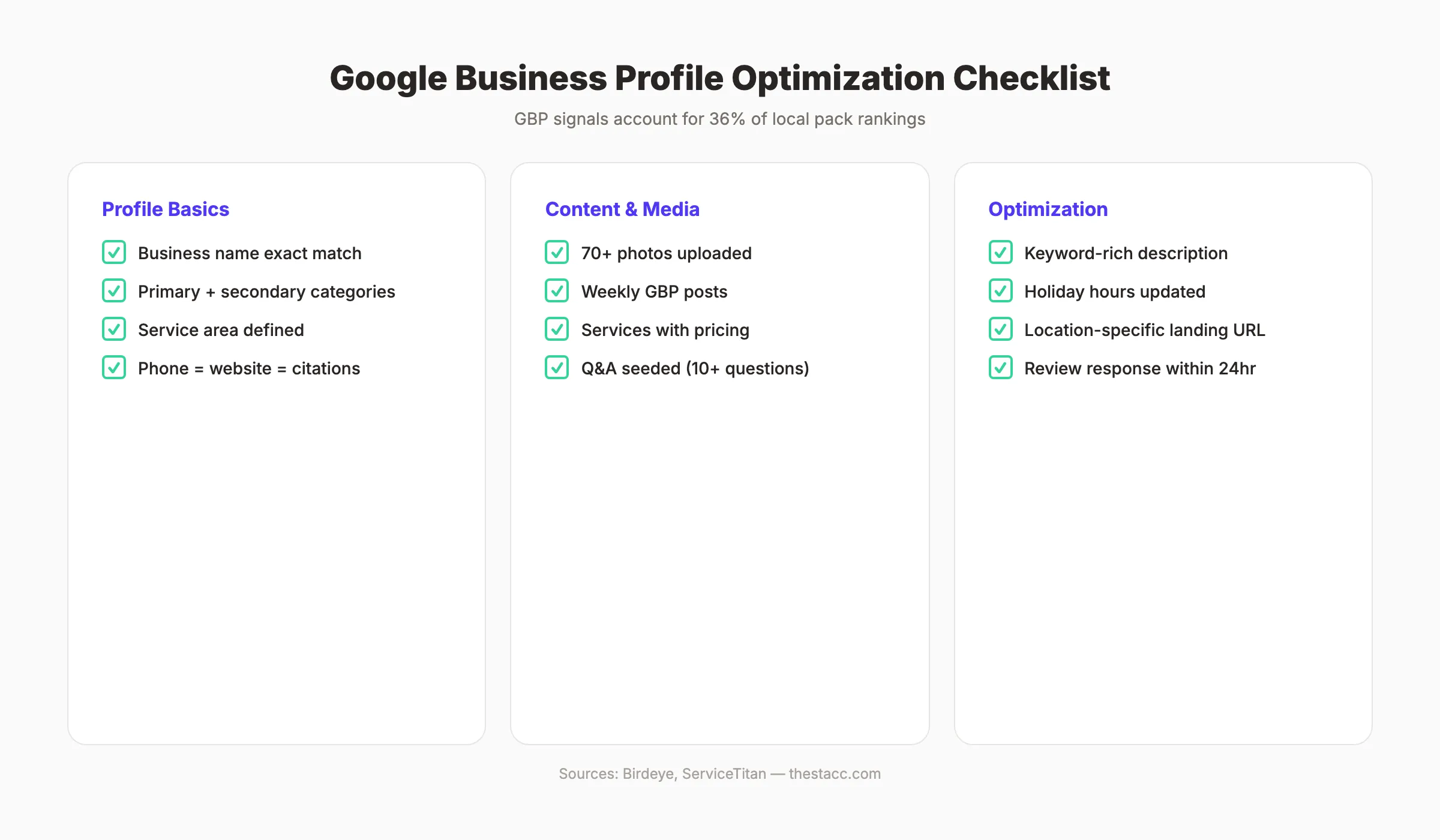
Google Business Profile signals account for 36% of local SEO pack rankings (ServiceTitan). Your GBP is the single most important ranking factor for the map pack. A fully optimized profile appears 80% more often in local search results (Birdeye).
Verified Google Business Profiles receive 595 calls annually on average (WebFX). Optimized profiles generate 4x more website visits and 12% more phone calls than incomplete ones (Birdeye).
The Complete GBP Checklist
Use this checklist to audit your profile. Every field matters for ranking.
- Business name matches your legal name exactly
- Primary category is the most specific option available
- Full street address or service area defined
- Phone number matches your website and all citations
- Website URL points to a location-specific landing page
- Business hours updated (including holiday hours)
- Business description uses primary keywords naturally (750 chars max)
- At least 70 photos uploaded (industry average for home services)
- Services listed with descriptions and pricing
- Q&A section seeded with 10+ common questions
- Posts published weekly
For a deeper walkthrough, read our guide on how to optimize your Google Business Profile.
Choosing the Right Categories by Trade
Your primary category determines which searches trigger your listing. Secondary categories expand reach.
| Trade | Primary Category | Secondary Categories |
|---|---|---|
| Plumbing | Plumber | Water Heater Installation Service, Drain Cleaning Service, Septic System Service |
| HVAC | HVAC Contractor | Air Conditioning Contractor, Heating Contractor, Duct Cleaning Service |
| Electrical | Electrician | Lighting Contractor, EV Charging Station Contractor, Generator Installation Service |
Choose up to 9 secondary categories. Each one opens new keyword visibility in the map pack.
GBP Posts and Photos That Drive Calls
Home services businesses post the highest average photo volume of any industry at 70 photos per profile (Birdeye). Photos of completed work, team members, and branded trucks build trust before a customer ever visits your website.
GBP posts work like mini blog updates. Publish weekly. Use our GBP Post Generator to create them quickly. Effective post types include:
- Before/after photos of completed jobs
- Seasonal offers (AC tune-up specials, winterization deals)
- Tips and advice (how to prevent frozen pipes)
- New service announcements (EV charger installation)
Every post should include a call-to-action button. “Call now” and “Book online” drive the most conversions for contractors.
Chapter 4: On-Page SEO for Service Pages
Service pages are the revenue engine of any contractor website. Each service you offer needs its own dedicated page optimized for a specific keyword. “Plumbing services” is too broad. “Water heater installation in Phoenix AZ” converts.
Service Area Pages That Rank
Most home service businesses cover multiple cities. The wrong approach is duplicating the same page with a different city name swapped in. Google filters thin duplicate content.
The right approach:
- Create 1 page per service per city (e.g., “AC Repair in Scottsdale AZ”)
- Write 500+ unique words per page with location-specific details
- Include local landmarks, neighborhoods, and service radius
- Add unique customer testimonials from that area
- Embed a Google Map centered on the service area
Title tag formula: [Service] in [City, State] | [Brand Name]
Example: “Drain Cleaning in Plano TX | ABC Plumbing”
Keep titles under 60 characters. Write meta descriptions between 145 and 155 characters that include a call to action.
Location Pages Without Duplicate Content
Each location page needs these unique elements:
| Element | What to Include | Why It Matters |
|---|---|---|
| H1 | Service + City name | Primary ranking signal |
| Intro paragraph | Local stats, service area details | Unique content signal |
| Service details | Specific offerings for that area | Relevance |
| Testimonials | Reviews from customers in that city | Trust + uniqueness |
| Driving directions | From local landmarks | Local relevance |
| Team bios | Technicians who serve that area | E-E-A-T signal |
Learn more about on-page SEO signals that affect rankings and how to apply E-E-A-T to your service pages.
Schema Markup for Home Services
Schema markup tells Google exactly what your business does. Home service companies should implement these schema types:
- LocalBusiness (or more specific: Plumber, Electrician, HVACBusiness)
- Service for each offering with area served
- Review for customer testimonials
- FAQ for common questions on service pages
- BreadcrumbList for site navigation
Use our free Schema Markup Generator to create valid JSON-LD. For a full walkthrough, read schema markup for blog posts.
Your service pages deserve proper SEO. Stacc builds topical authority for contractors with 30 to 80 blog posts per month, all optimized for local search. Start for $1 →
Chapter 5: Reviews and Reputation Management
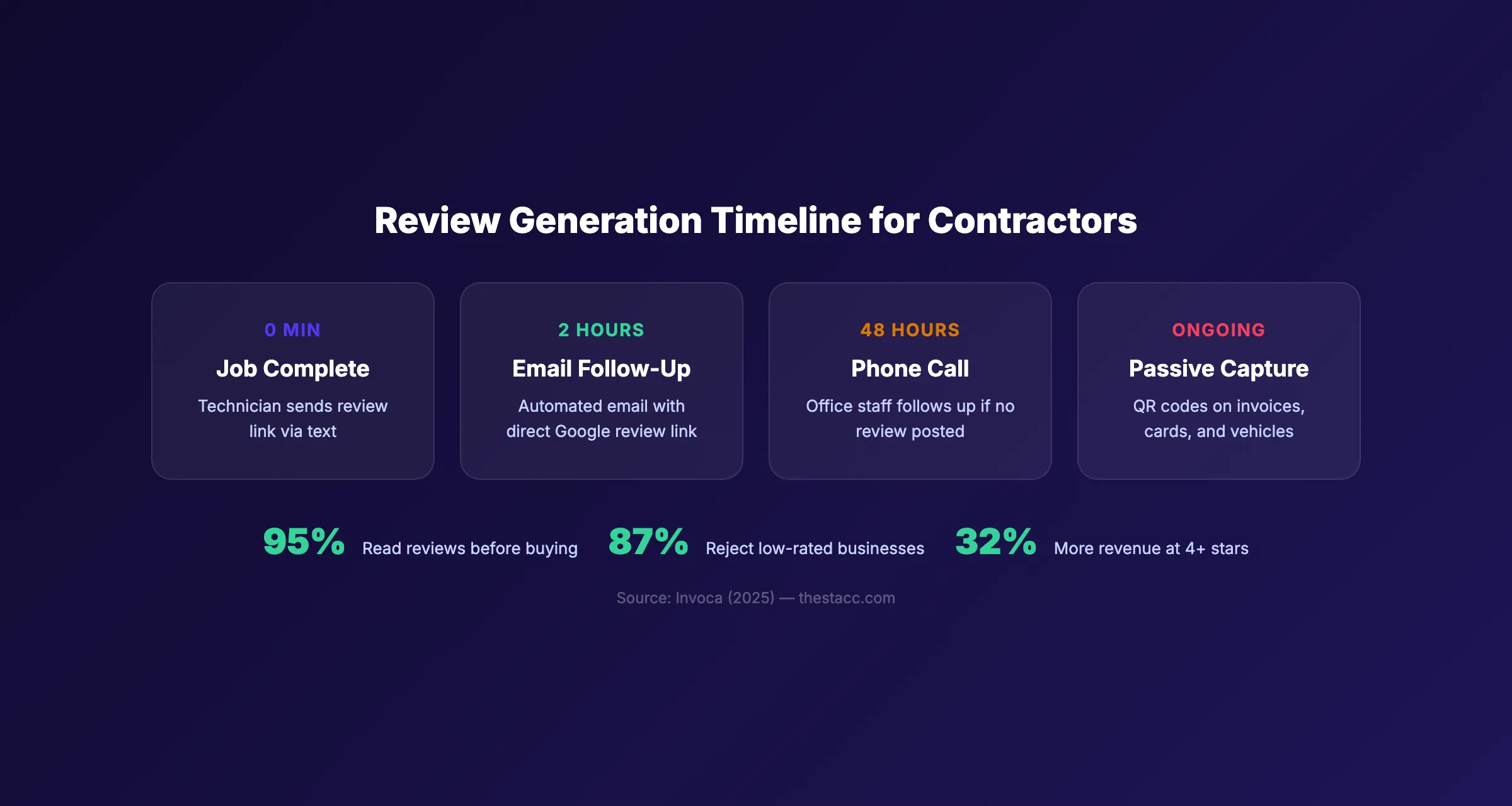
95% of consumers read online reviews before purchasing a service (Invoca). For home services, reviews are not optional. They are the #1 trust signal that separates a booked job from a lost lead.
Why Reviews Are the #1 Trust Signal
The data is clear:
- 87% of consumers will not consider a business with low ratings (Invoca)
- Businesses with 4+ stars earn 32% more revenue
- Google reviews directly influence local pack rankings
- Review quantity and velocity are ranking signals
A plumbing company with 200 reviews and a 4.7 rating will outrank a competitor with 15 reviews and a 5.0 rating in almost every case. Volume matters more than perfection.
How to Build a Review Generation System
Timing is everything. Ask for a review within 2 hours of completing the job. The customer still remembers the experience and feels the relief of a solved problem.
Build a repeatable system:
- Technician sends a review link via text immediately after the job
- Follow-up email goes out 2 hours later with a direct Google review link
- Office staff follows up by phone after 48 hours if no review posted
- QR codes on invoices, business cards, and vehicle wraps
Use our Review Response Generator to draft replies quickly. Read our full guide on 21 ways to get more Google reviews for additional tactics.
Responding to Every Review (Templates)
Reply to every review within 24 hours. Positive and negative. Google confirms that responses signal active management and influence rankings.
Positive review response template:
“Thank you [Name]. We appreciate you choosing [Company] for your [service type]. Our team takes pride in [specific detail from review]. We look forward to helping you again.”
Negative review response template:
“[Name], thank you for sharing this feedback. We take every concern seriously. Please contact our office at [phone] so we can resolve this directly. Your satisfaction is our priority.”
Never argue. Never make excuses. Address the issue and move the conversation offline.
Chapter 6: Content Strategy by Season
HVAC search volume swings 300 to 500% between seasons (WebFX). “AC repair” searches increase 266% in July. “Frozen pipe repair” surges 609% in January. A static content strategy ignores these patterns. A seasonal strategy exploits them.
The Seasonal Content Calendar for Home Services
Publish content 6 to 8 weeks before seasonal peaks. Google needs time to index and rank new pages. An AC maintenance article published in April ranks by the time June searches spike.
| Month | Plumbing Topics | HVAC Topics | Electrical Topics |
|---|---|---|---|
| January | Frozen pipe prevention, water heater maintenance | Furnace repair tips, heating efficiency | Generator maintenance, space heater safety |
| February | Sump pump prep, pipe insulation | Heat pump troubleshooting | Whole-home surge protection |
| March | Spring plumbing inspection, outdoor faucet prep | AC tune-up reminders, filter replacement | Outdoor lighting installation |
| April | Drain cleaning season, water softener tips | AC maintenance checklist | Ceiling fan installation, EV charger guide |
| May | Sprinkler system startup, garbage disposal care | AC buying guide, ductwork inspection | Pool electrical safety |
| June | Sewer line maintenance, tankless water heaters | AC not cooling troubleshooting | Lightning protection systems |
| July | Water conservation tips, emergency plumber guide | AC repair FAQ, thermostat optimization | Smart home wiring |
| August | Back-to-school plumbing tips, water heater flush | Duct cleaning guide, energy savings | Back-to-school electrical safety |
| September | Fall plumbing prep, hose bib winterization | Furnace tune-up checklist, fall HVAC prep | Landscape lighting design |
| October | Water heater replacement guide, pipe inspection | Heating system comparison, furnace buying | Halloween lighting, generator sizing |
| November | Holiday plumbing tips, drain prep for guests | Furnace troubleshooting, insulation tips | Holiday lighting safety |
| December | Frozen pipe emergency guide, winter water heater care | Emergency heating guide, carbon monoxide safety | Generator readiness, electrical panel check |
Electrical services have the most stable search volume with only 20 to 34% variance year-round. That means electricians can publish on a consistent schedule without seasonal pressure.
Publishing Frequency That Builds Authority
Google rewards consistent publishing. The Content Compound Effect means each new article strengthens your entire domain. Here are frequency benchmarks by business size:
| Business Size | Blog Posts/Month | GBP Posts/Month | Expected Results Timeline |
|---|---|---|---|
| Solo operator | 4-8 | 4-8 | 6-9 months |
| Small team (2-5) | 8-16 | 8-12 | 4-6 months |
| Multi-location | 16-30+ | 12-30 | 3-4 months |
Use our guide to create a content calendar for SEO to plan 3 months ahead. Build a topical map that covers every service, every location, and every season.
Blog Topics by Trade and Season
The strongest home services blogs mix 3 content types:
- How-to guides that capture informational searches (“how to prevent frozen pipes”)
- Cost guides that capture comparison searches (“water heater installation cost”)
- Emergency guides that capture urgent searches (“ac stopped working at night”)
Emergency home service searches peak between 6 PM and midnight (Comrade Web). Publish emergency content optimized for mobile. These pages must load in under 2 seconds.
Read our guide on SEO content writing for formatting and optimization best practices. For scaling content production across multiple trades and locations, see how to scale blog content with AI.
Publish seasonal content on autopilot. Stacc delivers 30 to 80 SEO blog posts per month tailored to your trade and service area. Start for $1 →
Chapter 7: Link Building for Contractors
Link building for home service businesses is different from other industries. You do not need backlinks from tech blogs. You need links from local directories, trade associations, suppliers, and community organizations.
Citations and Local Directories
A citation is any online mention of your business name, address, and phone number (NAP). Consistent citations across major directories strengthen local rankings.
Submit to these directories first:
- Google Business Profile
- Yelp
- Angi (formerly Angie’s List)
- HomeAdvisor
- BBB (Better Business Bureau)
- Nextdoor
- Facebook Business
- Apple Maps
- Bing Places
- Thumbtack
Use the best local SEO tools to manage citations across platforms. Accuracy matters more than quantity. One wrong phone number can split your ranking signals.
Trade-Specific Link Opportunities
Each trade has unique link sources that competitors often miss:
Plumbers:
- Supplier websites (Ferguson, Roto-Rooter franchise directories)
- Plumbing trade associations (PHCC, UA)
- Home warranty company partner pages
- Real estate agent referral lists
HVAC:
- Manufacturer dealer locators (Carrier, Trane, Lennox)
- Energy efficiency certification directories
- Utility company rebate partner pages
- Home energy audit referral networks
Electricians:
- Electrical contractor licensing board directories
- EV charger manufacturer partner pages (ChargePoint, Tesla)
- Home builder preferred vendor lists
- Solar installation partner directories
NAP Consistency Across 20+ Platforms
NAP stands for Name, Address, Phone. Every listing must match exactly. “123 Main St” and “123 Main Street” count as different entries to Google.
Audit your NAP across all platforms quarterly. Use a tool from our best local SEO tools for small business list to automate monitoring.
Common NAP errors that hurt rankings:
- Old phone numbers on forgotten directory listings
- Suite or unit number inconsistencies
- Business name variations (Inc, LLC, abbreviations)
- Address format differences across platforms
Fix these first. Then pursue new link opportunities. Clean foundations matter more than new links built on messy data.
Chapter 8: Technical SEO for Home Services Websites
70% of home service inquiries come from mobile devices (Hook Agency). A homeowner searching “emergency plumber” at 10 PM is on their phone. If your site takes 5 seconds to load, they hit the back button and call someone else.
Mobile Speed Is Not Optional (70% of Inquiries)
A 1-second delay in load time reduces conversions by 20%. For a contractor getting 500 monthly website visitors, that is 100 lost leads per month.
Speed priorities for contractor websites:
- Compress all images below 100 KB
- Use WebP format for photos of completed work
- Minimize JavaScript and CSS files
- Enable browser caching
- Use a CDN for faster delivery
- Remove unused plugins and tracking scripts
Test your site speed with Google PageSpeed Insights. Aim for a mobile score above 80. Read our detailed guide on improving Core Web Vitals for step-by-step instructions.
Core Web Vitals for Contractor Websites
Core Web Vitals are Google’s 3 performance metrics that affect rankings:
| Metric | What It Measures | Target |
|---|---|---|
| Largest Contentful Paint (LCP) | Loading speed | Under 2.5 seconds |
| Interaction to Next Paint (INP) | Responsiveness | Under 200 milliseconds |
| Cumulative Layout Shift (CLS) | Visual stability | Under 0.1 |
Most contractor websites fail on LCP because of unoptimized hero images. A single 2 MB photo of a completed bathroom remodel can tank your mobile score.
The Technical SEO Checklist
Run through this list every quarter. Use our free SEO Audit Tool to identify issues quickly.
- SSL certificate active (HTTPS on all pages)
- Mobile-responsive design on all pages
- XML sitemap submitted to Google Search Console
- Robots.txt configured correctly
- No broken links (check with our broken link guide)
- Canonical tags on duplicate content
- 301 redirects for any moved pages
- Structured data validated with Google Rich Results Test
- No orphaned pages (every page linked from at least 1 other page)
- Internal linking connects service pages, location pages, and blog posts
A full SEO audit should happen at least twice a year. Technical issues compound silently. A single noindex tag on your highest-traffic service page can cost thousands in lost revenue.
Technical SEO problems are invisible until they cost you money. Run a free audit with our SEO Audit Tool and fix issues today. Start for $1 →
Chapter 9: How Much Does Home Services SEO Cost
Home services SEO costs range from $0 to $5,000+ per month depending on the approach. The right investment depends on your market size, competition level, and growth goals. Average digital marketing ROI for contractors is 300 to 500% within 12 months (Coal March).
| Approach | Monthly Cost | What You Get | Best For |
|---|---|---|---|
| DIY | $0-$50 | GBP optimization, basic blog posts, manual directory submissions | Solo operators with time |
| Automated service (Stacc) | $99-$199 | 30-80 blog posts, SEO optimization, consistent publishing | Small to mid-size contractors |
| Freelancer | $500-$2,000 | Custom content, link building, monthly reporting | Growing businesses |
| Agency | $2,000-$5,000+ | Full-service SEO, PPC, web design, analytics | Multi-location companies |
The average cost per lead in home services is $90.92 (LocaliQ). A blog post that ranks for 2 years and generates 10 leads per month costs effectively $0.50 per lead after the initial investment. That is 180x cheaper than paid ads.
ROI Timeline
- Month 1-3: Foundation work. GBP optimization, technical fixes, first blog posts published. Minimal traffic gains.
- Month 4-6: Early rankings appear. Long-tail keywords start driving traffic. Review velocity increases.
- Month 7-12: Compounding effect. Money keywords enter top 10. Organic leads increase 50-200%. ROI turns positive.
- Month 12+: Dominant positions established. Lead cost approaches $0. 300-500% ROI.
The home services market is projected to grow from $90.63 billion to $181.64 billion by 2034 (Comrade Web). Early investment in organic rankings compounds as the market expands.
For contractors who want to skip the DIY learning curve, Stacc publishes blog SEO content at $99 per month for 30 articles. That covers keyword research, writing, optimization, and publishing. Explore our Blog SEO Module or Local SEO Module for GBP posting.
Frequently Asked Questions
How long does home services SEO take to show results?
Most plumbing, HVAC, and electrical companies see measurable organic traffic increases within 4 to 6 months. Competitive markets like large metro areas may take 6 to 9 months. Long-tail keywords with local modifiers often rank within 2 to 3 months. Consistency is the deciding factor.
What is the most important ranking factor for local home service businesses?
Google Business Profile optimization is the top factor, accounting for 36% of local pack ranking signals. After GBP, reviews (quantity, velocity, and ratings) and on-page relevance (service pages optimized for specific keywords) have the most direct impact on where you appear in map results.
Should plumbers, HVAC, and electricians focus on different SEO strategies?
The core framework is the same: GBP optimization, service pages, reviews, and content. The difference is keyword targeting and seasonal timing. HVAC companies must plan content around 300 to 500% seasonal search swings. Plumbing has the highest “near me” volume at 180,000 monthly searches. Electrical services are the most consistent year-round.
How many reviews do I need to rank in the local pack?
There is no fixed number, but volume matters more than a perfect 5.0 rating. A business with 150 reviews at 4.6 stars typically outranks a business with 20 reviews at 5.0 stars. Aim for at least 50 reviews in your first year and 10+ new reviews per month after that.
Can I do home services SEO myself or do I need to hire someone?
You can handle GBP optimization, review generation, and basic directory submissions yourself. Content creation at the volume needed for ranking (8 to 30 posts per month) is where most contractors need help. Writing, optimizing, and publishing consistent blog content takes 20+ hours per month that most business owners do not have. Services like Stacc automate this for $99 per month.
How does AI search (SGE/AI Overviews) affect home services SEO?
AI Overviews pull from the same organic ranking signals. Businesses that rank in the top 3 organically are most likely to appear in AI-generated answers. The fundamentals do not change: optimize your GBP, build review volume, publish quality content, and maintain strong technical SEO. Read our generative engine optimization guide for specific tactics.
Your competitors are already investing in SEO. Join 3,500+ businesses that trust Stacc to publish optimized content every month. Start for $1 →
Related Tools & Resources
Free SEO Tools:
Best Lists:

Written by
Siddharth GangalSiddharth is the founder of theStacc and Arka360, and a graduate of IIT Mandi. He spent years watching great businesses lose organic traffic to competitors who simply published more. So he built a system to fix that. He writes about SEO, content at scale, and the tactics that actually move rankings.
Automate your Google Business Profile content
30 GBP posts, local SEO articles, and review responses. Published every month automatically.
30-day trial · Cancel anytime
theStacc
Stop writing SEO content manually
30 blog articles, 30 GBP posts, and social media content. Published every month. Automatically.
Start Your $1 Trial$1 for 3 days · Cancel anytime