How local businesses earn press, backlinks, and trust signals with digital PR. 7-step framework, real examples, cost data, and tools — updated May 2026.
Most local business owners hear "digital PR" and think it is something only national brands can afford. That is the wrong assumption, and it is costing them rankings, referrals, and revenue.
Digital PR for a local business is not a $15,000 monthly retainer with a New York agency. It is a repeatable process that earns mentions in local news outlets, neighborhood blogs, industry podcasts, and the local sections of national publications. Each mention drops a verified backlink and a brand mention into Google's understanding of your business. Both signals feed directly into local search rankings.
The problem is that 90 percent of local owners do not have a process for this. They run an ad, sponsor a little league team, send one press release, and call it PR. None of those activities produce the digital signals that matter in 2026.
We publish 3,500 plus blog posts every month for local businesses across 70 plus industries. Our average SEO score is 92 percent. We have watched local operators in plumbing, dentistry, law, real estate, and home services build six-figure traffic from digital PR programs that cost less than a single staff hire. The pattern is consistent across every vertical.
This guide covers the exact playbook. You will learn what digital PR actually is for a local business, how it differs from traditional PR, the 7-step framework we use, real examples from operators winning at this strategy, the costs you should plan for, and the tools that make execution possible without a full-time PR person.
Here is what you will learn:
- The definition of digital PR for a local business, and how it differs from traditional PR
- Why digital PR has become a top-3 ranking signal for the Google Map Pack
- 12 real examples of digital PR campaigns local businesses are running right now
- The 7-step framework for building a repeatable program in-house
- How to identify, contact, and convert local journalists
- Realistic monthly cost tiers for different business sizes
- The tools and software that replace a $5,000 retainer
- KPIs and tracking dashboards that prove ROI
- The 6 most common mistakes that waste budget
What Digital PR Means for a Local Business
Digital PR is the practice of earning online media coverage, backlinks, and brand mentions that improve search visibility and customer trust. For a local business, the focus is geographic. Coverage in your city, region, and industry publications matters more than a feature in The New York Times.
The output of a digital PR campaign is not impressions or "buzz." It is concrete digital assets:
- Verified backlinks from authoritative local domains
- Brand mentions Google can crawl and attribute to your business
- Citations in local directories and industry registries
- Quotes in articles that show up when prospects search your name
- Reviews and testimonials in third-party publications
These assets compound. A single feature in your local business journal can rank for searches about your service for the next 5 years. A traditional ad runs once and disappears.
Digital PR vs Public Relations vs Marketing
People confuse these terms constantly. Here is the simple separation:
- Marketing drives a transaction. The asset is an ad, a landing page, or a campaign.
- Public relations shapes reputation. The asset is a relationship with a journalist or community.
- Digital PR combines both. The asset is online coverage that produces SEO signals and lead flow.
A local business needs all three. Digital PR is the underinvested one for most operators because it sits at the seam between marketing and PR, and nobody on the team owns it.
Quick Definition Block
What is digital PR for a local business? A repeatable process of earning online mentions, backlinks, and citations from local media, industry publications, and community sites that improves local search rankings and brand trust.
What does it produce? Backlinks, brand mentions, citations, reviews, and quotes that Google attributes to the business for ranking purposes.
Who runs it? Either an in-house owner-operator with 4 to 6 hours per week, a part-time PR specialist, or an external service like theStacc.
Digital PR vs Traditional PR for Local Operators
Traditional PR works on a press release model. You write a release, distribute it through a wire service, and hope a journalist picks it up. The metric is media impressions, which are mostly vanity.
Digital PR works on a relationship and content model. You build relationships with specific local journalists, pitch them stories tied to their beat, and produce content (data, opinion, expert commentary) they cannot easily get elsewhere. The metric is verified backlinks, branded search lift, and ranking improvements.
For a local business, the difference matters because traditional PR rarely produces digital signals. A press release distributed through PRWeb might get 200 impressions and zero backlinks Google considers valuable. The same effort directed at three local outlet relationships produces 3 to 8 backlinks per quarter.
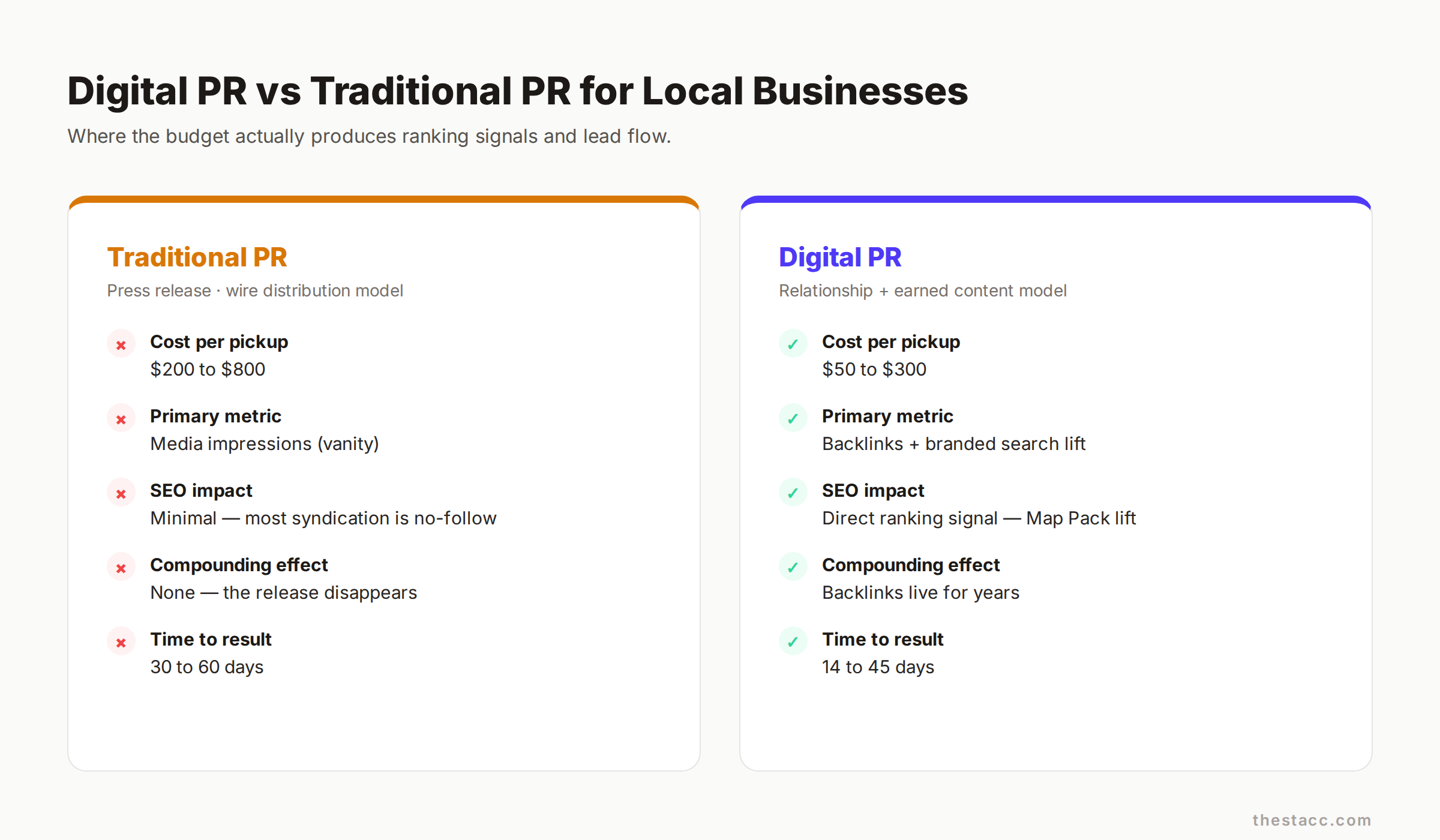
| Dimension | Traditional PR | Digital PR |
|---|---|---|
| Primary asset | Press release | Earned online article + backlink |
| Distribution | Wire service | Direct journalist outreach |
| Measurement | Media impressions | Backlinks, branded search, rankings |
| Cost per result | $200 to $800 per pickup | $50 to $300 per pickup |
| SEO impact | Minimal | Direct ranking signal |
| Time to result | 30 to 60 days | 14 to 45 days |
| Geographic fit for local | Broad national wire | Targeted local outlets |
| Compounding effect | None | Backlinks live for years |
The economics of digital PR favor local operators heavily. A traditional press release distribution costs $400 to $800 and produces a handful of syndicated pickups on low-authority news sites. A targeted outreach campaign to 12 local journalists costs $50 to $200 in software and 4 hours of time, and produces 2 to 5 backlinks from outlets that Google ranks as authoritative for your city.
Why Local Businesses Need Digital PR in 2026
Three forces have pushed digital PR from "nice to have" to "must have" for local operators in 2026. None of them are reversing.
Force 1: Google's Prominence Pillar Rewards Brand Signals
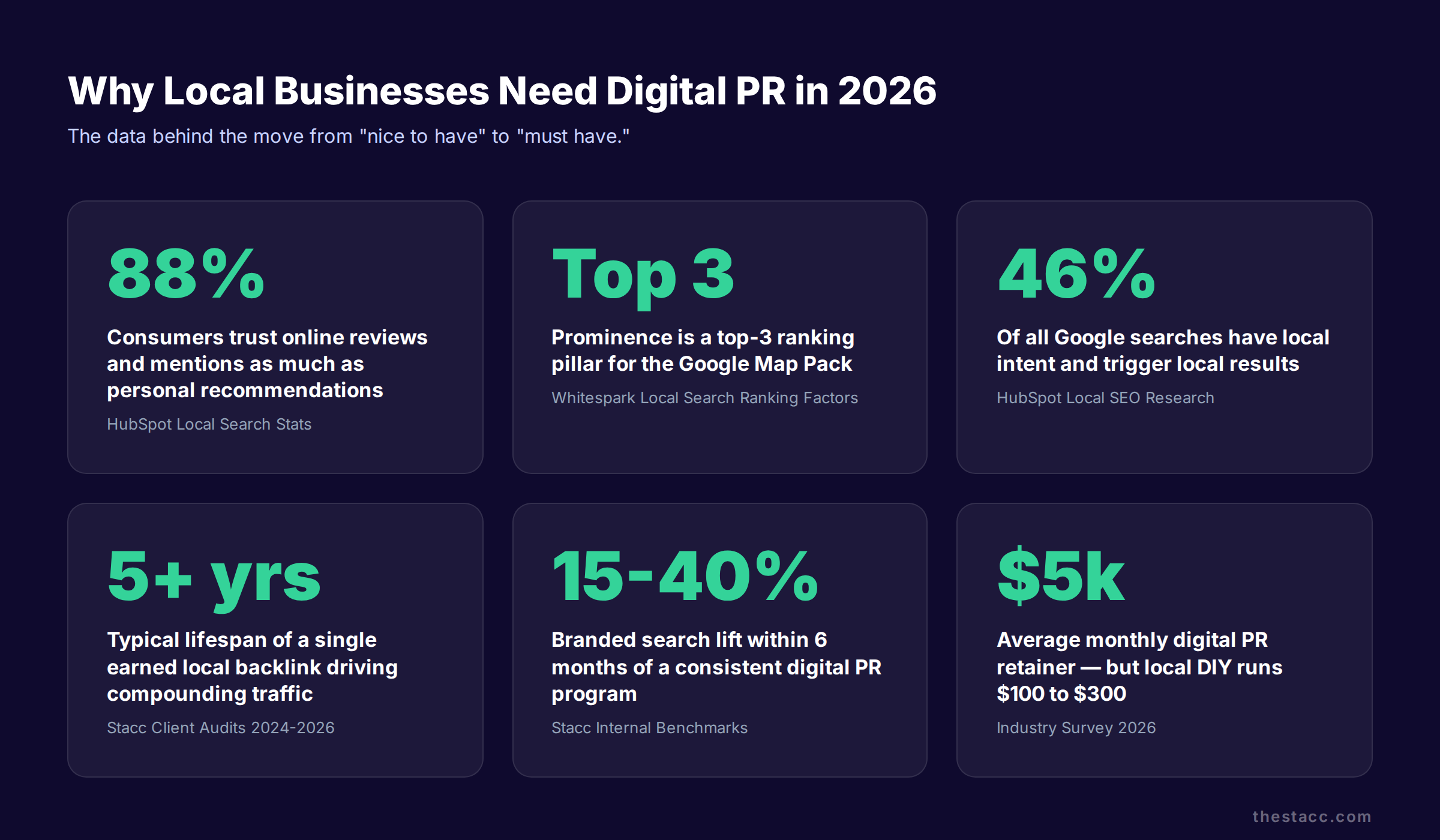
Local search ranking factors studied by Whitespark consistently rank "prominence" as a top-3 driver of Map Pack rankings. Prominence is Google's measurement of how well-known and trusted your business is across the web.
The signals that feed prominence include:
- Backlinks from authoritative local domains
- Brand mentions across news sites, blogs, and forums
- Citation count and consistency in directories
- Review volume and rating
- Engagement signals (clicks, calls, direction requests)
Backlinks and brand mentions are the two prominence signals you can scale through digital PR. The others are operational. We cover the full ranking framework in our local SEO guide, but digital PR is the dominant lever for moving prominence in 2026.
Force 2: AI Search Cites Trusted Sources
ChatGPT, Perplexity, Google AI Overviews, and Gemini all answer local search queries by citing third-party sources. If a user asks "best plumber in Austin," the AI does not list your website first. It lists the local blog post, news article, or directory that mentioned your business.
This means your visibility in AI search depends on whether other authoritative sites mention you. Digital PR is the only scalable way to create those mentions on purpose. We cover the broader AI shift in our AI search statistics post, but the implication for local operators is simple: every digital PR placement is an AI search placement too.
Force 3: Local Review and Trust Signals Compound
88 percent of consumers trust online reviews as much as personal recommendations, and the publications you appear in act as third-party validation. A quote in your city's business journal or a feature in a neighborhood blog functions as a review at scale.
Customers searching your business name find these mentions in the first page of branded search. Each one reduces friction in the buying decision. Each one also feeds Google's understanding of your reputation. The compounding effect is real, and it gets stronger every year.
Real Examples of Digital PR for Local Businesses
Theory is useful. Examples are better. Here are 12 real campaign types local operators are running right now, broken down by industry.
Home Services and Trades
Example 1: Seasonal Data Story. A Phoenix HVAC operator publishes a study every May on average AC replacement costs across 14 zip codes, with brand mentions and a downloadable report. Local TV stations and the Arizona Republic pick it up every year. 7 backlinks per campaign, costs $300 in research time.
Example 2: Emergency Response Heat Map. A Chicago roofing company tracks storm damage callouts and publishes a quarterly heat map. The local NBC affiliate runs the data after every major storm. 3 to 5 backlinks per storm season.
Example 3: Cost Calculator Press. A Boston plumber built a free water heater replacement cost calculator. Boston Globe linked to it in a home maintenance feature. The single link drives 800 monthly referral visits.
Healthcare and Dental
Example 4: Local Health Trends Report. A Denver dental group publishes annual data on procedure trends across their 4 offices. Westword and 5280 magazine cover it. 12 backlinks across 5 years.
Example 5: Expert Commentary Through HARO. A San Diego pediatrician answers 2 reporter queries per week through Connectively (formerly HARO). 18 quotes in national publications in 2025, all crawled and indexed.
Example 6: Community Health Sponsorship Coverage. A Tampa OB-GYN sponsors a maternal health walk. The local news angle is the medical perspective on prenatal care, not the sponsorship itself. 4 outlets cover the practitioner as the expert source.
Legal and Professional Services
Example 7: Court Filing Analysis. A Miami personal injury firm publishes quarterly analysis of accident filing trends in Dade County. The Miami Herald cites the firm 6 times per year as the data source.
Example 8: Compliance Explainers. A Seattle employment lawyer writes monthly explainers on state law changes. KING 5 and Seattle Times link to them every legislative session. The lawyer also handles a weekly local podcast spot.
Example 9: Local Business Survey. A Charlotte accountant surveys 200 small businesses every January on tax confusion. Charlotte Business Journal covers it. 3 backlinks per release, plus speaking invitations.
Hospitality and Local Retail
Example 10: Neighborhood Guide Authorship. A Brooklyn cafe owner writes monthly neighborhood food guides for Bklyner. Cross-promotion drives 1,200 monthly site visits and gets the cafe cited in larger publications as a local food expert.
Example 11: Sustainability Story. A Portland zero-waste store publishes their actual diversion metrics. Local food blogs and OPB cover the data. 9 backlinks, all from .org or local news domains.
Example 12: Founder Origin Story. A Nashville furniture maker partners with a journalist on a 2,000-word feature in The Tennessean about veteran-owned manufacturing. One feature, 4 reprints, 6 backlinks.
The shared pattern across these examples is data, opinion, or expertise the business already owns. None required a fabricated campaign. Each surfaced something the operator was already doing or already knew, and packaged it for media use.
The 7-Step Digital PR Framework for Local Owners
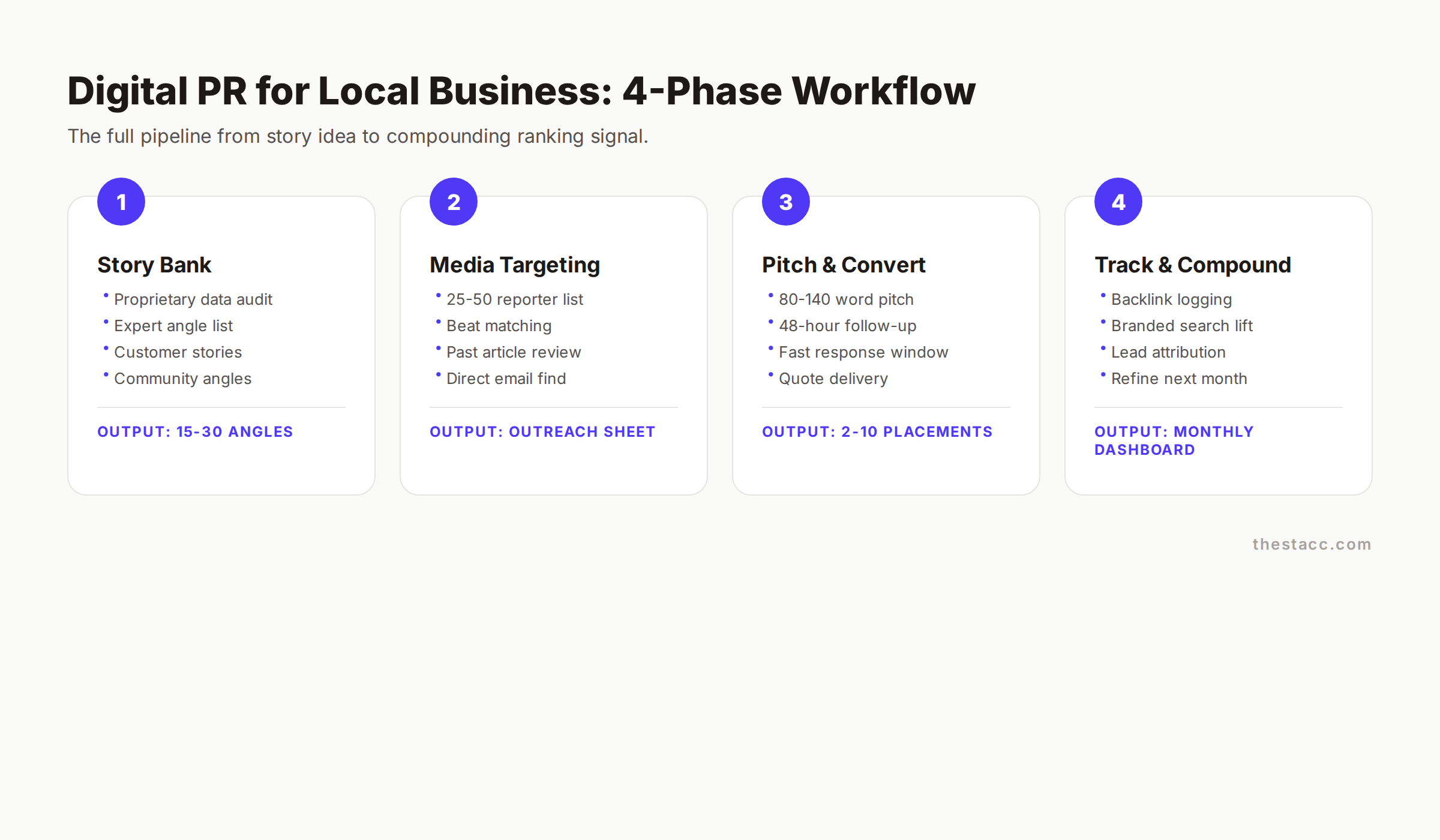
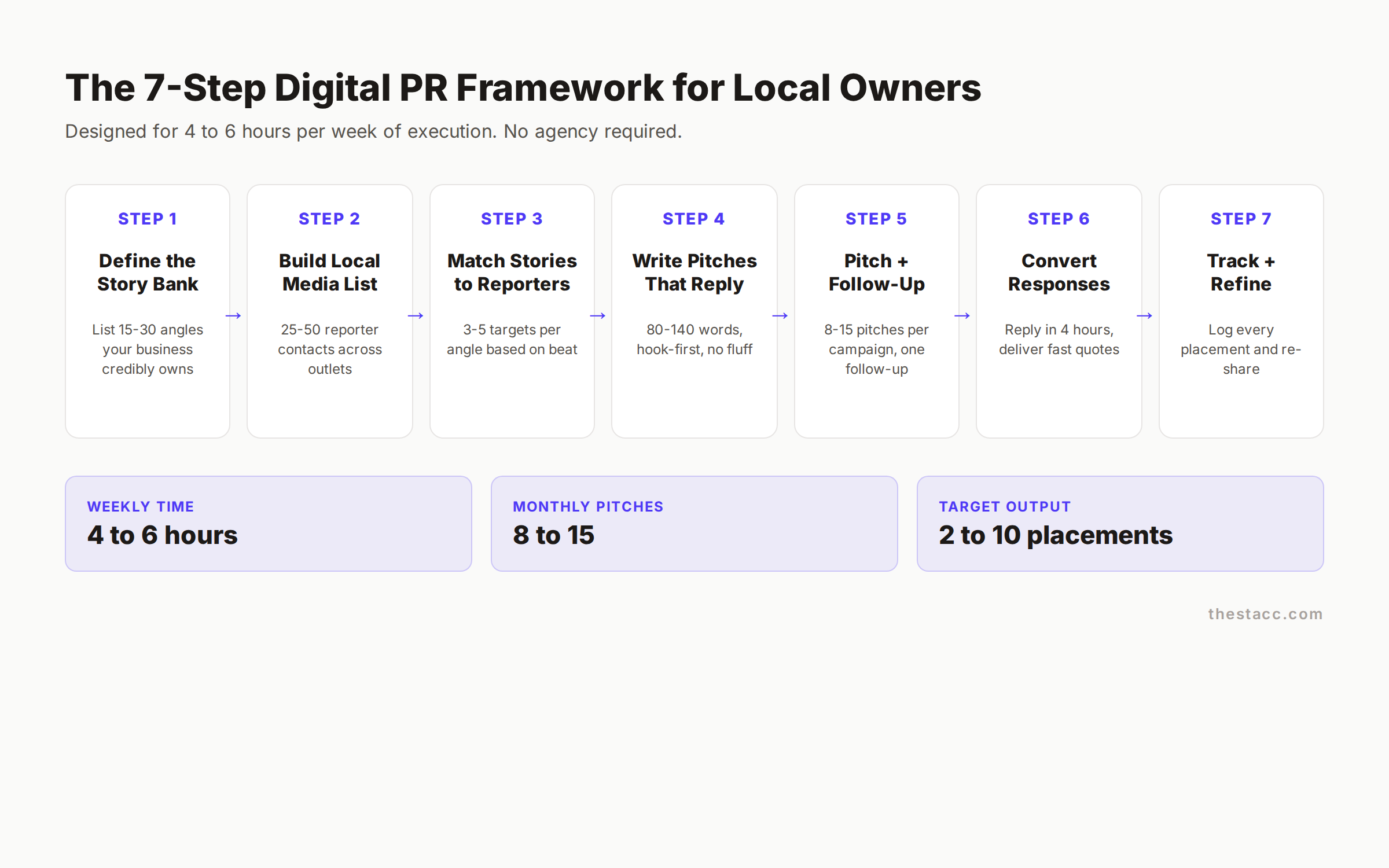
The framework below is what we run internally for clients and what owner-operators can run themselves in 4 to 6 hours per week. It compresses the agency playbook into a system any local business can repeat.
Step 1: Define the Story Bank
Before any outreach, list every story your business can credibly tell. The categories that work for local businesses:
- Proprietary data from your operations (job counts, pricing, response times, seasonal patterns)
- Expert commentary on industry news (regulatory changes, weather events, court rulings)
- Customer transformation stories (with permission)
- Local community involvement (with a substantive angle, not just a check)
- Founder or team milestones (anniversaries, expansions, hires)
- Original research surveys you can fund cheaply
Most local businesses have 15 to 30 story angles available. The exercise is not invention, it is inventory. Write them down in a spreadsheet with three columns: story angle, target outlet, status.
Step 2: Build the Local Media List
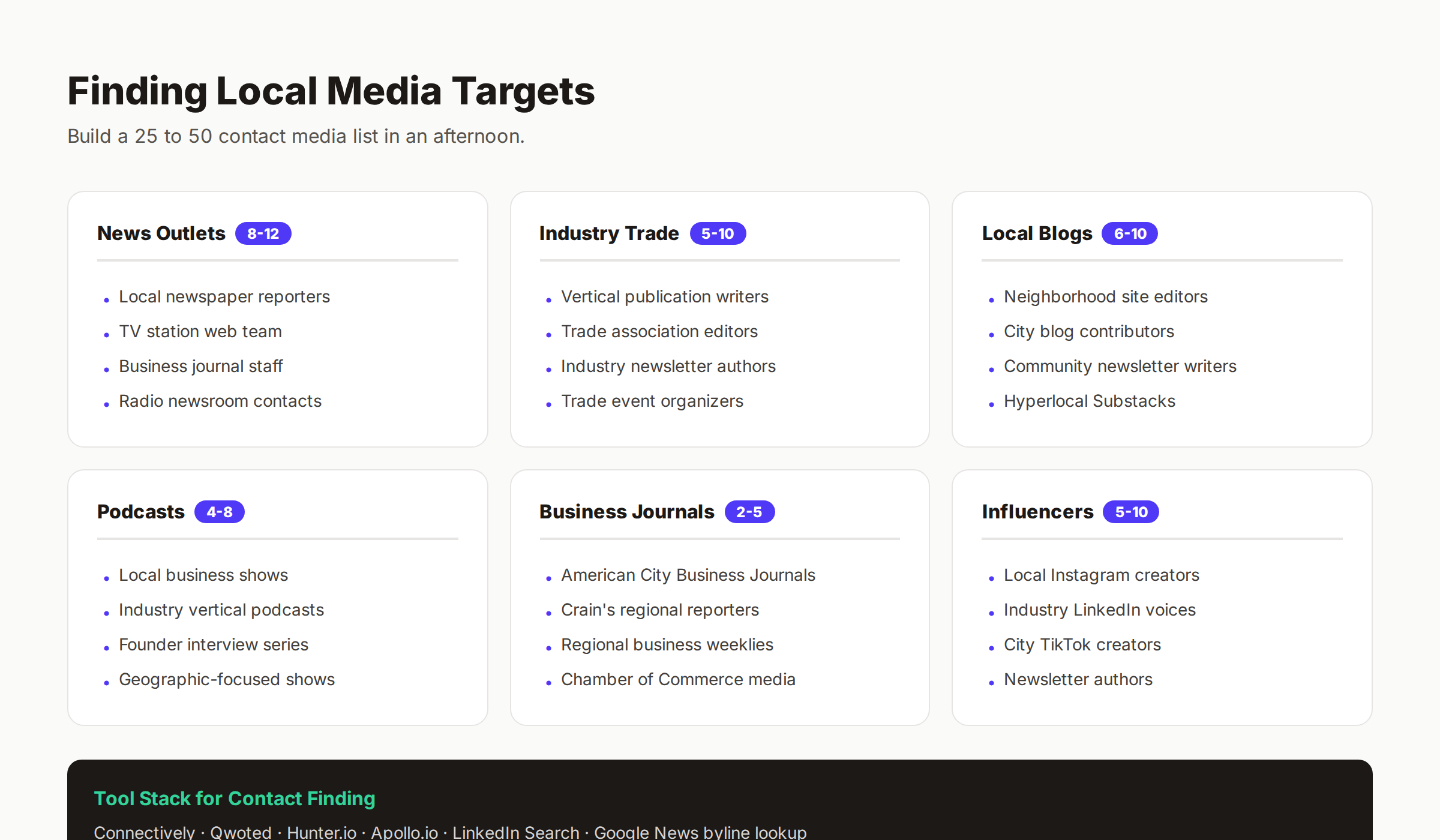
You need 25 to 50 contacts to run a serious local digital PR program. The breakdown that works:
- 8 to 12 local news outlet reporters (newspapers, TV station web teams)
- 5 to 10 industry trade publication writers in your vertical
- 6 to 10 neighborhood or city blog writers
- 4 to 8 podcast hosts who cover your geography or industry
- 2 to 5 local business journal reporters
- 5 to 10 local influencers or community newsletter writers
For each contact, record name, outlet, beat, email, social profile, and 2 to 3 recent articles. This list becomes the foundation of every campaign. We document the full media research workflow in our build online presence guide.
Step 3: Match Stories to Reporters
Most outreach fails because the pitch goes to the wrong reporter. A health reporter does not write about restaurant openings. A local business reporter does not write about traffic accidents.
For every story in your bank, match 3 to 5 reporters whose past work proves they cover that topic. The match is not "they write for the local paper." The match is "they wrote 4 articles on home maintenance costs in the last 6 months." The latter is a real signal that they will respond to a pitch about HVAC pricing data.
Step 4: Write Pitches That Get Replies
A pitch email has 4 parts:
- Subject line: 6 to 8 words that name the angle, not the company
- Hook: 1 to 2 sentences explaining why the story matters now
- Substance: 2 to 3 sentences of the actual data or insight
- Ask: 1 sentence inviting a quote, interview, or data exchange
The whole email is 80 to 140 words. Anything longer gets deleted. Anything shorter gets ignored.
Example subject lines that work for local digital PR:
- "Phoenix AC repair costs jumped 14% this year — data"
- "5 minutes — comment on the new Texas plumbing code?"
- "Brooklyn coffee scene data, December edition"
Skip flowery language. Skip "I hope this finds you well." Reporters delete those emails in 2 seconds.
Step 5: Pitch and Follow Up
Send 8 to 15 pitches per campaign. Wait 48 hours. Send one follow-up to non-responders. Stop.
Most pitches get ignored. That is normal. A 12 percent response rate is good for cold outreach. A 25 percent response rate from warm contacts is excellent.
The compounding happens after 6 to 12 months. The reporters who replied once become repeat sources. The relationships you build in month 1 produce backlinks in month 18 without any new outreach effort.
Step 6: Convert Responses Into Published Coverage
When a reporter replies, respond within 4 hours during business hours. Reporters work on tight deadlines. The expert who responds first usually gets the quote.
Provide what they ask for in the format they ask for. If they want a 2-sentence quote, send 2 sentences. If they want a 30-minute interview, schedule it that day. Do not pad your responses with marketing language. Reporters cut everything but the substantive lines.
Step 7: Track, Measure, Refine
Every published piece needs three data points captured:
- URL of the article
- Date published
- Backlink status (do-follow, no-follow, brand mention only)
Add the article to a tracker. Re-share the article across your owned channels (social, email, GBP). Send a brief thank-you to the reporter. The thank-you is the seed of the next pitch.
Want digital PR signals without doing the outreach yourself? We publish 30 SEO articles a month that create the brand mentions and backlinks Google needs to rank you locally. Cancel anytime.
How to Find Local Media and Journalist Targets
Building the media list is the bottleneck for most owner-operators. The good news is that the tools to do this in 2026 are cheap or free.
Free Sources for Media Contacts
Google News by topic and location. Search "[your city] [your industry]" in Google News. Click through to articles. Note the byline. Visit the reporter's bio page. Copy the email. Repeat for 50 articles.
LinkedIn Sales Navigator (or basic search). Filter for "reporter," "journalist," or "editor" in your city. The free version handles enough volume to build a 30-contact list in an afternoon.
Local outlet staff pages. Most local newspapers and TV station websites list reporters with email addresses. The pages are usually buried under "Contact" or "Newsroom."
Twitter/X bios. Search "[city] reporter" or "[industry] writer" on X. Bios usually include the outlet and a contact form or email.
Substack and local newsletters. Many local journalists run independent newsletters with public contact info. These contacts are often more responsive than traditional outlet emails.
Paid Tools for Faster Targeting
Connectively (formerly HARO). $19 to $149 per month. Reporters post queries looking for sources. You reply with a quote. Used to be free; the paid model is now standard.
Qwoted. Similar to Connectively, with stronger local journalism coverage. $200 per month for the paid tier, free tier available with limits.
Muck Rack. $5,000 plus per year. Best for agencies and businesses with $50k plus PR budgets. Probably overkill for a single-location local operator.
Help A B2B Writer. Free tier with B2B-focused reporter queries. Useful if your business sells to other businesses locally.
Featured. Free for sources. Reporters submit questions and select responses to quote.
For local digital PR, Connectively and Qwoted are the two paid tools that pay for themselves within 60 days for any operator running 2 plus campaigns per month.
Building the Outreach Spreadsheet
Use a single spreadsheet for everything. The columns we recommend:
- Name
- Outlet
- Beat (1 to 3 topics they cover)
- LinkedIn URL
- Twitter handle
- Last 3 article URLs
- Last contact date
- Status (cold, warm, responded, declined)
- Notes
This sheet becomes your most valuable PR asset within 6 months. Treat it the way you treat your customer CRM. Every interaction goes in.
How Much Does Digital PR Cost for Local Businesses?
Digital PR pricing varies more than almost any other marketing channel. The same outcome (5 local backlinks per month) can cost $200 if you do it yourself and $5,000 if you hire a national agency.
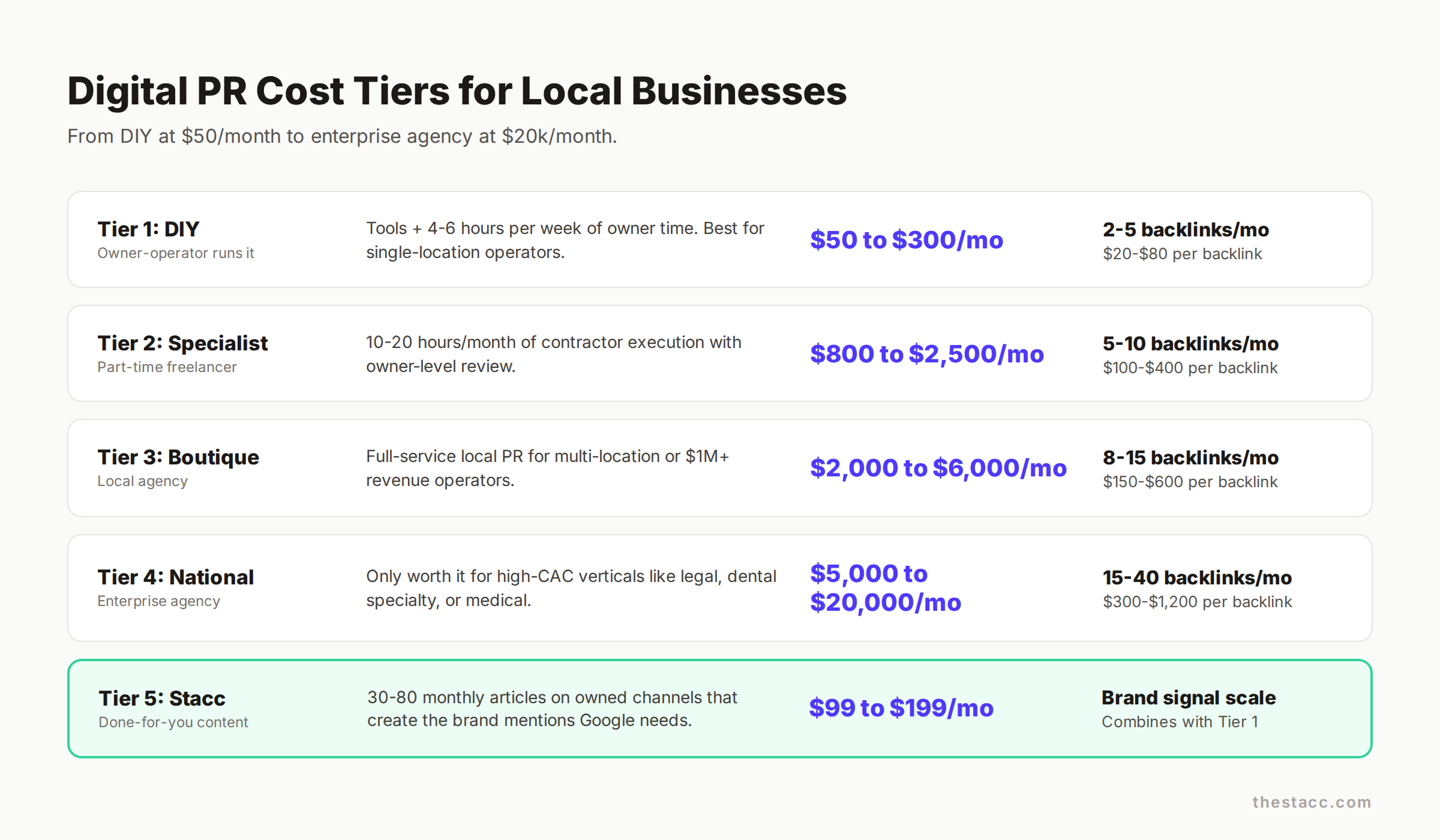
Cost Tier 1: Owner-Operator DIY ($50 to $300 per Month)
You handle everything yourself: media research, pitching, follow-up, and tracking. Costs are limited to tools:
- Connectively subscription: $19 to $149 per month
- Qwoted subscription: $0 to $200 per month
- Email finder tool: $30 to $50 per month
- Spreadsheet tracking: $0
Time investment: 4 to 6 hours per week. Output: 2 to 5 backlinks per month after month 3. Cost per backlink: $20 to $80.
This tier works for owners who genuinely enjoy writing and outreach. It does not work for owners who plan to "delegate it to the receptionist." Quality outreach requires owner-level voice.
Cost Tier 2: Part-Time Specialist ($800 to $2,500 per Month)
You hire a part-time freelancer or contractor (10 to 20 hours per month) to handle execution. The owner reviews pitches, signs off on stories, and provides quotes when needed.
This tier produces 5 to 10 backlinks per month after month 3. Cost per backlink: $100 to $400.
Best for businesses doing $500k plus in revenue where the owner's time is the bottleneck. The specialist should have local market knowledge.
Cost Tier 3: Local Boutique Agency ($2,000 to $6,000 per Month)
A boutique agency in your city handles strategy, outreach, and reporting. Most contracts run 6 to 12 months minimum.
Output: 8 to 15 backlinks per month after month 3. Cost per backlink: $150 to $600.
Best for multi-location operators or businesses with $1M plus in annual revenue. The agency relationships and local network compress your time-to-result.
Cost Tier 4: National Digital PR Agency ($5,000 to $20,000 per Month)
The big agencies (5W, Power Digital, Go Fish) charge enterprise rates. Most local businesses do not need this tier, but multi-state operators or franchise systems sometimes do.
Output: 15 to 40 backlinks per month, including national publications. Cost per backlink: $300 to $1,200.
The rule of thumb: if your customer acquisition cost is below $200, this tier rarely pencils for a local business. If your CAC is above $500 (legal, dental, specialty medical), it can make sense.
Cost Tier 5: Done-For-You Content Services ($99 to $199 per Month)
This is the tier we built theStacc to fill. Instead of pitching journalists, we publish 30 SEO articles a month on owned channels (blog, GBP, social) that create the brand mentions and backlinks Google needs. The output overlaps with digital PR on the SEO ranking side without requiring journalist relationships.
Output: 30 indexed pages a month, brand mentions across owned channels. Cost per indexed page: $1 to $7.
The combination of Tier 1 (owner-led pitches for the big stories) plus Tier 5 (done-for-you ongoing content) is the lowest-cost path to local search dominance we have measured. We document the math in our local business marketing plan framework.
| Tier | Monthly Cost | Backlinks per Month (Month 6+) | Best For |
|---|---|---|---|
| DIY | $50 to $300 | 2 to 5 | Single-location, owner with time |
| Part-Time Specialist | $800 to $2,500 | 5 to 10 | $500k+ revenue businesses |
| Local Boutique | $2,000 to $6,000 | 8 to 15 | Multi-location or $1M+ revenue |
| National Agency | $5,000 to $20,000 | 15 to 40 | High CAC verticals only |
| theStacc Content Service | $99 to $199 | Brand signals (not direct PR) | Combine with DIY tier |
Tools and Software for Local Digital PR
The toolset for running digital PR in 2026 has gotten much better and much cheaper than it was 5 years ago. Most local operators can run a serious program on under $200 per month in tools.
Media Research and Contact Finding
- Connectively ($19 to $149 per month): Reporter queries, source responses, basic tracking
- Qwoted ($0 to $200 per month): Reporter database, query alerts, response tools
- Hunter.io ($49 to $149 per month): Email finder for any domain
- Apollo.io ($0 to $79 per month): Contact database with email and phone
- LinkedIn Sales Navigator ($99 per month): Filtered search for journalists
Outreach and Email Management
- Mailshake ($59 to $99 per user per month): Cold outreach sequences with tracking
- Lemlist ($59 to $99 per user per month): Personalized outreach at scale
- Pitchbox ($550 plus per month): Agency-grade outreach platform (overkill for most local operators)
- Gmail with Mixmax ($24 to $69 per user per month): Lighter cold outreach for small lists
Tracking and Reporting
- Ahrefs Backlink Checker ($129 plus per month): Track new backlinks from your campaigns
- Semrush Position Tracking ($139 plus per month): Monitor rankings tied to PR placements
- Google Search Console (free): Basic backlink and impressions tracking
- BrightLocal ($39 to $79 per month): Local citation and review tracking
- theStacc Local SEO Module ($49 per month): GBP posts and citations on autopilot, see /modules/local-seo
Press Release Distribution (Only Useful for Big Announcements)
- PRWeb ($99 to $389 per release): Basic wire distribution
- PR Newswire ($805 plus per release): Enterprise wire distribution
- EIN Presswire ($99 to $499 per release): Cheaper alternative
Most local digital PR programs do not need wire distribution. The exception is one or two announcement-grade events per year (acquisition, major hire, anniversary). For ongoing PR, direct outreach beats wire every time.
The Minimum Viable Toolset
For a local owner-operator running digital PR themselves, the minimum viable stack is:
- Connectively or Qwoted: $19 to $200 per month
- Hunter.io free tier or Apollo free tier: $0
- Google Search Console: free
- A spreadsheet: free
- theStacc Local SEO Module for ongoing GBP signal automation: $49 per month
Total cost: $68 to $249 per month for tools. The biggest investment is owner time, not software.
Measuring Digital PR Results for a Local Business
PR has historically been measured in vanity metrics: media impressions, share of voice, audience reach. None of these connect to revenue. Digital PR for a local business needs harder metrics.
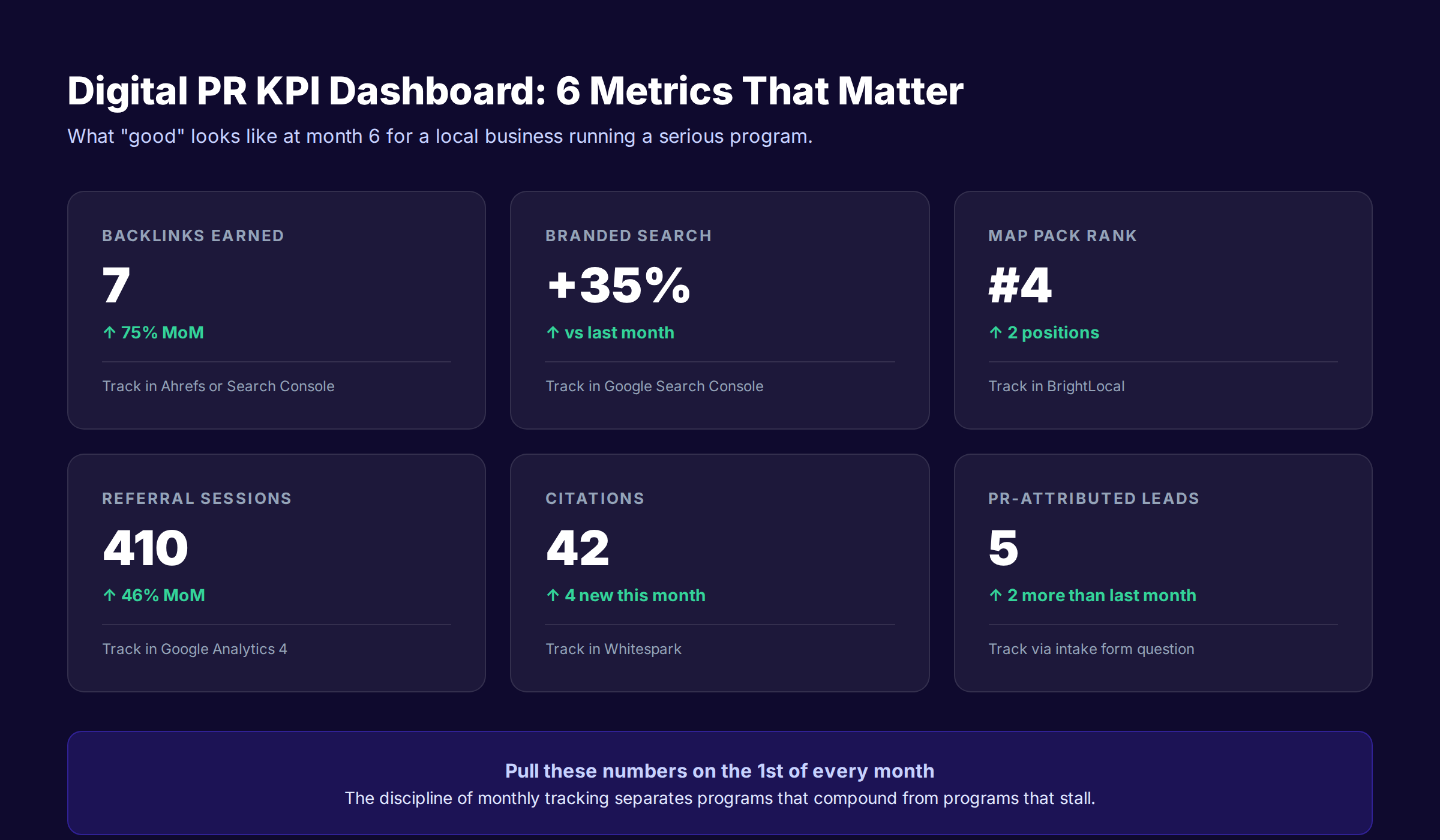
The 6 Metrics That Matter
Backlinks earned. Count of new backlinks per month attributed to PR work. Track in Ahrefs, Semrush, or Search Console. Aim for 2 to 10 per month depending on tier.
Branded search volume. Searches for your business name per month. Track in Google Search Console. PR coverage typically lifts branded search 15 to 40 percent within 6 months.
Local pack rankings. Position in the Map Pack for your target keywords. Track in BrightLocal or local rank trackers. Digital PR moves rankings within 60 to 120 days.
Referral traffic. Sessions arriving from publications that covered you. Track in Google Analytics 4. Quality coverage drives 50 to 500 referral visits per article.
Citation count and consistency. Mentions of your business name, address, and phone across the web. Track in Whitespark or BrightLocal. Each PR placement usually creates 1 to 3 new citations.
Lead attribution. Leads or customers who mention specific articles or publications. Track manually through intake forms. Within 12 months, 5 to 15 percent of leads typically cite PR exposure.
Building the Monthly Dashboard
A simple monthly dashboard fits on one page:
| Metric | Last Month | This Month | Change |
|---|---|---|---|
| Backlinks earned | 4 | 7 | +75% |
| Branded search clicks | 124 | 168 | +35% |
| Local pack ranking (target keyword) | 6 | 4 | +2 |
| Referral sessions (PR sources) | 280 | 410 | +46% |
| Citation count | 38 | 42 | +4 |
| PR-attributed leads | 3 | 5 | +2 |
Pull these numbers on the first of every month. Review them. Adjust the next month's outreach mix based on what produced the most movement. The discipline of monthly tracking is what separates PR programs that compound from PR programs that stall.
What "Good" Looks Like
For a single-location local business running an active digital PR program, the 12-month targets we see most often:
- 35 to 80 new backlinks per year (from 2 to 7 monthly)
- 50 percent plus lift in branded search clicks
- 2 to 5 positions improvement in Map Pack ranking for primary keyword
- 1,500 to 5,000 monthly referral sessions from PR sources by month 12
- 15 to 30 new high-authority citations
These numbers are achievable on DIY ($100 to $300 per month) or part-time specialist ($800 to $2,500 per month) tiers. Hitting them requires consistent execution, not heavy spending.
Common Local Digital PR Mistakes
The 6 mistakes below account for 80 percent of failed digital PR programs we audit. None of them are technical. All are editorial or process errors.
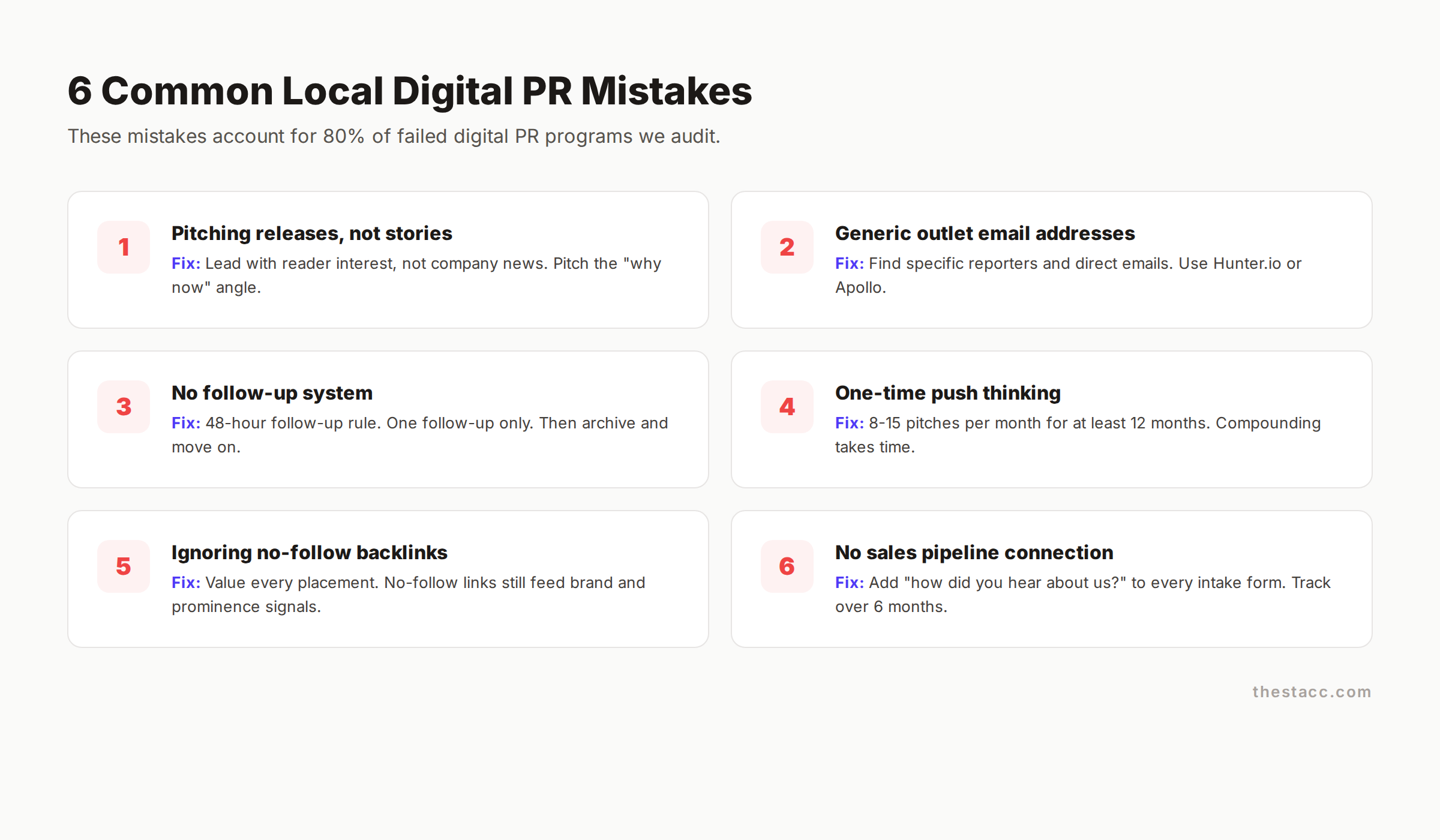
Mistake 1: Pitching Press Releases Instead of Stories
A press release announces something happening at your company. A story explains why a reader should care. Reporters need stories, not announcements.
The fix is to lead with the reader's interest, not the company's news. Instead of "Smith Plumbing celebrates 25 years in business," pitch "What 25 years of Atlanta plumbing data reveals about home aging trends."
Mistake 2: Generic Outreach to Outlet Email Addresses
"Tips@" and "newsroom@" inboxes get hundreds of emails per day. Most go unread. Direct emails to specific reporters get opened.
The fix is to take the extra 15 minutes per pitch to find the right reporter and their direct email. Hunter.io and Apollo make this trivial.
Mistake 3: No Follow-Up System
Most pitches need 1 to 2 follow-ups to convert. Most operators send the initial pitch and never follow up because they assume silence means rejection.
The fix is a 48-hour follow-up rule. Send a single follow-up exactly 48 hours after the initial pitch. Wait 5 days. If no response, archive and move on.
Mistake 4: Treating PR as a One-Time Push
A digital PR "campaign" that runs for 30 days and then stops produces no compounding effect. The backlinks stay live, but the relationships go cold.
The fix is consistent monthly outreach. 8 to 15 pitches per month, every month, for at least 12 months before evaluating ROI seriously.
Mistake 5: Ignoring No-Follow Backlinks
Many local news sites use no-follow attributes on outbound links. SEO purists dismiss no-follow links as worthless. They are wrong for local PR.
Google uses no-follow links for context and brand signals even when they do not pass direct ranking authority. A no-follow link from your city's business journal still feeds the prominence pillar through brand mentions and citation signals.
The fix is to value every placement, not just do-follow ones. Each piece of coverage compounds. We cover this nuance in our backlink audit guide.
Mistake 6: No Connection to Sales Pipeline
PR teams report backlinks. Sales teams report leads. The two never connect because no one tracks PR-attributed pipeline.
The fix is a single intake question: "How did you hear about us?" Train front desk staff to ask. Record answers. Within 6 months, you will have data showing which publications drive actual customers, not just backlinks.
What practitioners are saying on X
AI search advice ages quickly. Here is high-signal public discussion from SEO and growth operators — context for your roadmap, not a substitute for primary data.
- @noelcetaSEO (Sep 2025): Local SEO playbook still centers complete GBP, NAP consistency, quality citations, local keywords, location content, review velocity, and local links. See the post on X.
- @irentdumpsters (Jan 2026): Most businesses have a GBP; few fully optimize every ranking-relevant section for Map Pack visibility. See the post on X.
- @EldarCohenSEO (Jul 2026): 2026 WhiteSpark-oriented reminder: primary Google Business category is a top Map Pack ranking factor — wrong primary category can erase visibility for money queries. See the post on X.
Grok, AI Overviews, and multi-engine visibility
Local topics like “digital pr local business” get cited when GBP, NAP, reviews, and service-area steps are concrete. Grok mixes those web facts with Map Pack operator advice circulating on X.
- Google AI Overviews: Use passage-ready answers, tables, and FAQ schema where relevant.
- ChatGPT / Perplexity: Cite named sources next to key claims.
- Grok: Maintain accurate entity facts on-site and in high-signal X posts.
Rank higher in the Map Pack without a full-time local SEO hire. theStacc’s Local SEO module handles daily GBP posts, review reply workflows, and local visibility tracking — built for service businesses that need calls, not vanity rankings.
FAQ: Digital PR for Local Businesses
The most common examples are local news coverage, industry publication features, podcast appearances, neighborhood blog mentions, expert quotes through HARO or Connectively, original data studies, founder interviews, and sponsored content with editorial value. Each example produces a backlink or brand mention Google can crawl. The pattern across them is that the business provides genuine value (data, expertise, or perspective) the publication cannot get elsewhere.
Yes, if the business has any of three assets: proprietary operational data, owner expertise worth quoting, or a customer story worth telling. The cost can be as low as $100 per month in tools and 4 hours per week in owner time. The output compounds because backlinks live for years. For most local businesses, the ROI math breaks even within 6 to 9 months and becomes the highest-ROI marketing channel by year 2.
The honest range is $100 to $20,000 per month. DIY with tools runs $100 to $300. A part-time freelancer runs $800 to $2,500. A local boutique agency runs $2,000 to $6,000. National agencies run $5,000 to $20,000. Most local businesses get the best ROI in the $100 to $2,500 range. Going above $5,000 per month rarely pencils unless customer acquisition costs exceed $500 per lead.
Plan for 60 to 120 days before the first measurable lift in branded search and rankings. Plan for 6 to 9 months before PR-attributed leads become meaningful. The compounding effect strengthens every quarter after month 6. The biggest mistake is evaluating ROI at the 90-day mark and quitting before the curve bends.
Link building is a tactic. Digital PR is a strategy that produces backlinks as one output among several. Pure link building optimizes for quantity and anchor text. Digital PR optimizes for editorial coverage, brand mentions, and audience trust. Backlinks from digital PR usually rank higher in Google's quality signals because they come from genuine editorial content. We cover the link-building side specifically in our build backlinks for blog post.
Yes. The 7-step framework in this guide is designed for owner-operators. Plan for 4 to 6 hours per week of consistent execution. The framework works because the relationships and stories are owner-specific. An agency can speed up execution, but the credibility of an owner quote or owner-led pitch outperforms agency outreach in local markets.
No. Most local reporters prefer direct contact with the business owner over going through a PR firm. The owner can speak to operational details a PR firm cannot. The owner also responds faster. For local outlets specifically, direct outreach by the owner converts at a higher rate than agency outreach.
Yes, directly. AI search tools (ChatGPT, Perplexity, Google AI Overviews) cite third-party sources when answering local queries. Every digital PR placement is also an AI search placement because the AI crawls and ranks the same content humans do. Businesses with strong digital PR profiles get cited more often in AI responses to local queries.
How to Start a Digital PR Program This Month
Digital PR is a compounding channel that rewards consistency and punishes one-off pushes. Start small, run the system every week, and the backlinks accumulate. The local businesses winning at this strategy in 2026 are not the ones with the biggest PR budgets. They are the ones with the longest streaks of consistent monthly outreach.
If you have 4 to 6 hours per week and $100 to $300 per month in tools, you can run a serious program in-house. If you do not have the time or you want to focus the owner hours on customer-facing work, our content service handles the ongoing brand signal production at $99 to $199 per month. Combine the two and the local search results stop being competitive within 12 months.
The first step is the easiest one: open a spreadsheet today, list 10 local reporters whose work you have seen in the last 30 days, and send one pitch. The system starts there.
Sources & references
- [1] Princeton / Georgia Tech et al. — GEO research (arXiv:2311.09735)
- [2] @noelcetaSEO on X — Local SEO playbook still centers complete GBP, NAP consistency, quality citations, local keywords, location content, rev
- [3] @irentdumpsters on X — Most businesses have a GBP; few fully optimize every ranking-relevant section for Map Pack visibility.
- [4] @EldarCohenSEO on X — 2026 WhiteSpark-oriented reminder: primary Google Business category is a top Map Pack ranking factor — wrong primary cat
- [5] Referenced source — whitespark.ca

Manage Google Business Profile posts, review replies, and local rank tracking.
Weekly local SEO teardowns
One practical email a week. Map Pack, GBP, AI Overviews — no fluff. Unsubscribe anytime.