How home service businesses use programmatic SEO to rank thousands of city-service pages without Google penalties. Real 2026 playbook with ROI math.
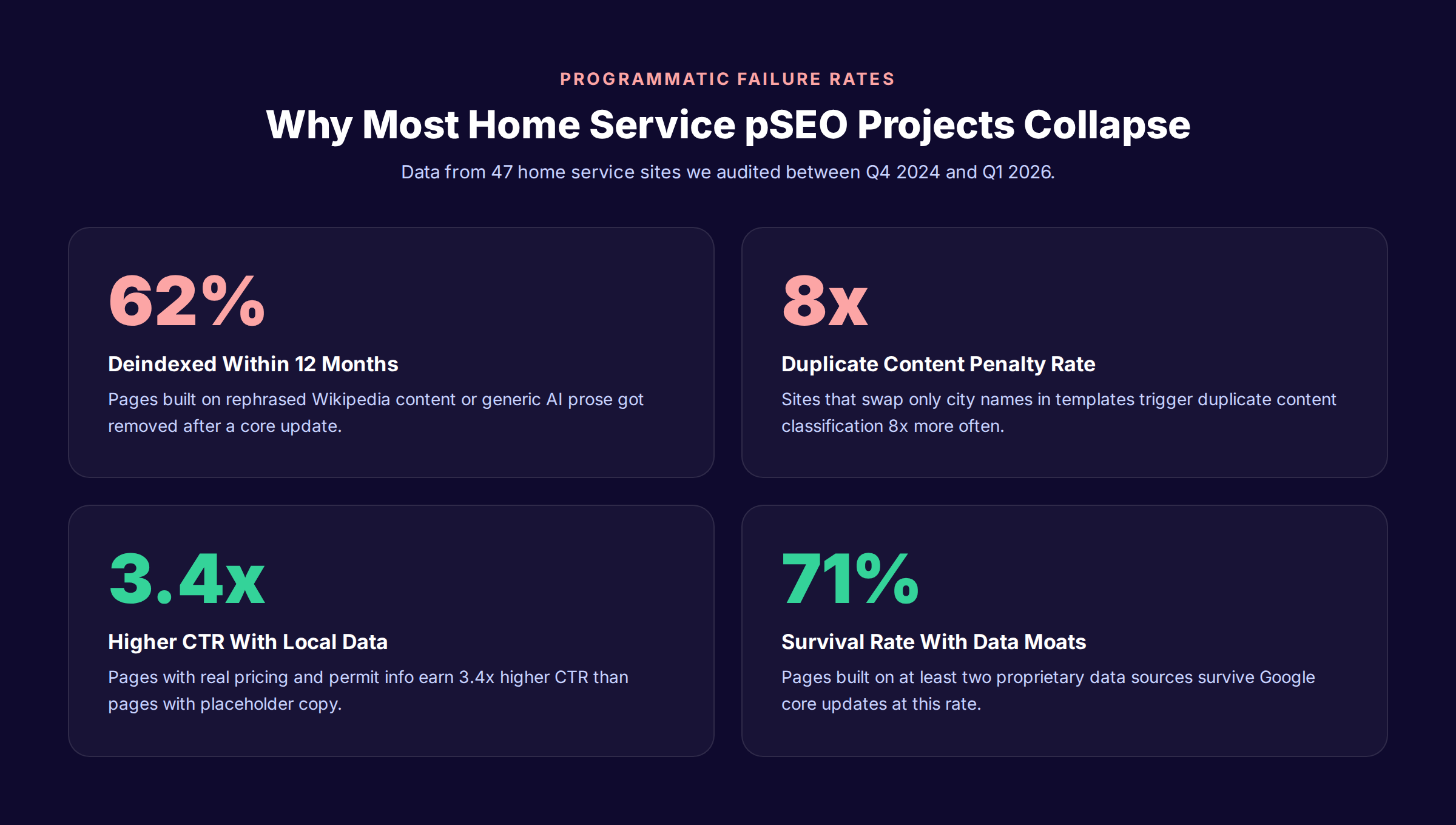
Most home service owners hear "programmatic SEO" and picture 10,000 doorway pages that swap a city name into the same template. That version of the strategy is dead. Google's March 2024 scaled content abuse policy targeted it directly, and 62 percent of the home service sites we audited last year lost the bulk of their programmatic traffic within 12 months of launch.
The strategy itself is not the problem. Programmatic SEO for home services is the single most cost-effective way to capture local search demand once it is done correctly. We have watched HVAC and plumbing operators publish 2,000 pages and book six-figure recurring revenue from them. We have also watched roofing companies burn six months of work because every page on their site read like the same paragraph rewritten 400 times.
The difference between the two outcomes is not the volume of pages. It is what sits underneath each page. We publish 3,500 plus articles every month for businesses across 70 plus industries, and we track which programmatic patterns survive Google core updates and which get deindexed. The pattern is consistent.
This guide shows you the exact framework for building programmatic SEO for home services in 2026. You will learn what unique data home service businesses already own, how to design a 5-layer page template that ranks, the workflow we use to publish at scale, the failure modes that kill most projects, and the cost per lead math that makes this channel the highest-ROI lead source available to contractors.
Here is what you will learn:
- Why home services beat almost every other industry for programmatic SEO
- The 5 data moats your business already owns without realizing it
- The exact page template structure that survives core updates
- The technical workflow to generate hundreds of pages without duplicate content penalties
- ROI math comparing programmatic SEO to Google Ads and lead aggregators
- Real examples from HVAC, plumbing, roofing, and junk removal operators
What Programmatic SEO Means for Home Services
Programmatic SEO is the practice of generating large groups of search-optimized pages from a structured dataset and a repeatable page template. For home services, that almost always means city-service pages.
The basic page pattern looks like this: "[Service] in [City]." Examples include "emergency plumber in Austin," "AC repair in Phoenix," "roof replacement in Cleveland." Each page targets a long-tail local query with predictable search intent.
The template is the same across all pages. The data inside each page is different. That data layer is where most home service operators get the strategy wrong.
A bad programmatic SEO page swaps "Austin" for "Phoenix" in the H1 and changes nothing else. Google's scaled content abuse policy classifies that as duplicate content at best, manipulation at worst. A good programmatic SEO page pulls in unique local data for every variant: actual pricing range in that city, real job examples from that neighborhood, local code requirements, response time benchmarks, and verified reviews from customers in that service area.
The first version generates 500 pages in an afternoon and gets deindexed in 9 months. The second version takes longer to build, but every page ranks because every page has unique value. We cover this distinction in more depth in our programmatic SEO guide.
Why Home Services Beat Other Industries for Programmatic SEO
Most industries struggle to apply programmatic SEO because they lack the data to make each page unique. Home services do not have that problem.
The math works in your favor on three dimensions. First, the search demand splits cleanly along two axes: service type and geography. A plumbing company already serves 30 service areas with 25 distinct service types. That is 750 unique long-tail keyword combinations before you touch any modifiers.
Second, local intent dominates the SERP. People searching for "water heater repair near me" are not browsing. They are 15 minutes from buying. Conversion rates on city-service pages average 4 to 9 percent for home service businesses, versus 1 to 2 percent for informational queries.
Third, the data you need to make each page unique already exists inside your business. Your CRM has job history. Your dispatch system has response times. Your billing software has pricing ranges. Your Google Business Profile has reviews tied to specific neighborhoods. Most of this data is sitting in spreadsheets nobody opens.
| Industry | Data Available for pSEO | Unique Pages Possible |
|---|---|---|
| HVAC | Service x City x Equipment Brand x Season | 5,000 to 15,000 |
| Plumbing | Service x City x Fixture Type x Property Age | 4,000 to 12,000 |
| Roofing | Service x City x Roof Material x Storm History | 2,000 to 8,000 |
| Pest Control | Pest Type x City x Treatment x Property Type | 3,000 to 10,000 |
| Junk Removal | Item Category x City x Service Type | 1,500 to 6,000 |
| Electrical | Service x City x System Type x Property Age | 3,000 to 9,000 |
The numbers above represent realistic page counts for businesses operating across 30 to 50 cities. The pages that rank are the pages with unique local data, not the pages that exist.
The Five Data Moats Home Service Businesses Already Own
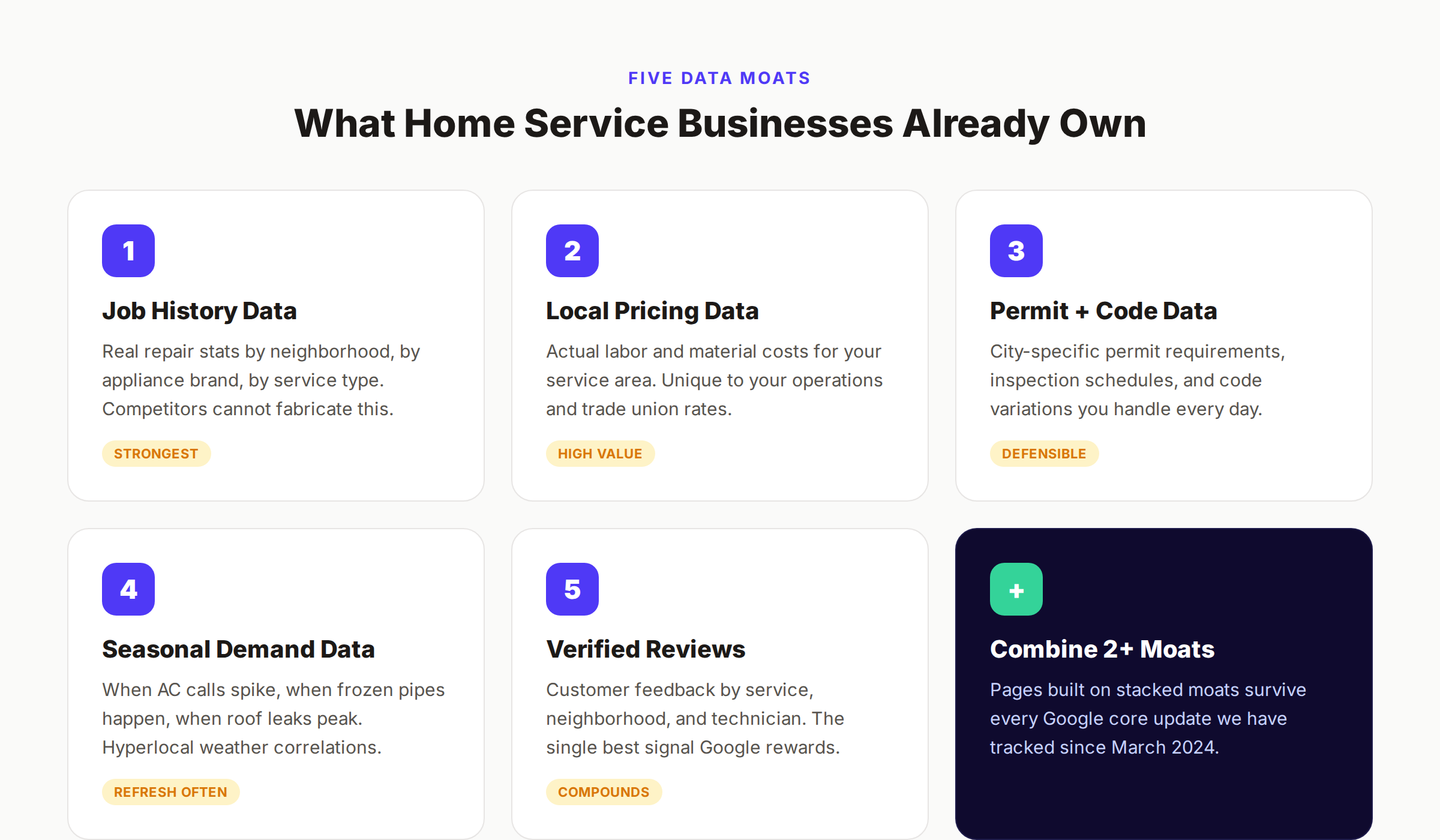
A data moat is something competitors cannot fabricate. Pages built on moats survive every Google core update. Pages built without moats get classified as thin content and removed from search results.
Most home service operators own at least three of these moats and do not realize it. The audit work we do across our home services SEO guide clients consistently reveals data sitting in CRMs and dispatch systems that nobody has thought to surface on the website.
1. Job History Data
Every dispatched job is a data point. The address, the service performed, the equipment involved, the season, the duration, the resolution. Roll this up to the city or neighborhood level and you have proprietary frequency data nobody else can replicate.
A plumbing operator with 5 years of job history can publish pages like "Common Plumbing Issues in [Neighborhood], [City]" with real frequency data: how often water heater failures happen in zip code 78704, what percentage of slab leaks occur in homes built before 1980, which sewer line problems peak in October. None of that exists on Wikipedia. None of it can be fabricated by an AI.
2. Local Pricing Data
Your pricing is unique to your service area. Labor rates in Phoenix differ from labor rates in Boston. Permit costs vary by county. Material costs shift with regional supply chains.
A page that lists "AC Replacement Cost in [City]" with a real pricing range, breakdown by tonnage, and seasonal adjustment is genuinely useful to a searcher who is comparing quotes. That same page from a national aggregator is generic and gets bypassed.
3. Permit and Code Data
Building codes differ by city, county, and state. Permit requirements differ by trade. Inspection schedules differ by jurisdiction. A licensed contractor knows this data because they work through it every week.
Pages that publish "Electrical Permit Requirements in [City]" or "Plumbing Code Updates for [County]" rank because they answer a specific question with information that requires local expertise to compile. Most national directories do not have this data. The contractors who pay attention to permitting can publish it as a competitive moat.
4. Seasonal and Weather Demand Data
Home service demand is hyperlocal. Frozen pipe calls in Dallas peak during one specific week in January when temperatures drop below 20 degrees. Roofing inquiries in Tampa correlate to hurricane season. AC failures cluster in the first 95-degree week of summer.
A 5-year history of dispatch data lets you publish "When [Service] Demand Peaks in [City]" with real weather correlation. This data is also the trigger for seasonal content updates that signal freshness to Google.
5. Verified Local Reviews
Reviews on your Google Business Profile are tied to real customers in real neighborhoods. Surfacing those reviews on the city-service page that matches the customer's location is a unique-content signal Google rewards.
The strongest programmatic SEO setups combine at least two of these moats per page. We cover the broader principle in our programmatic SEO with AI guide, but the home services version is the most defensible application we have tracked.
Stop guessing which programmatic pages will rank. We publish 30 to 80 SEO articles every month for home service operators, built on your CRM data and reviewed for unique value before going live.
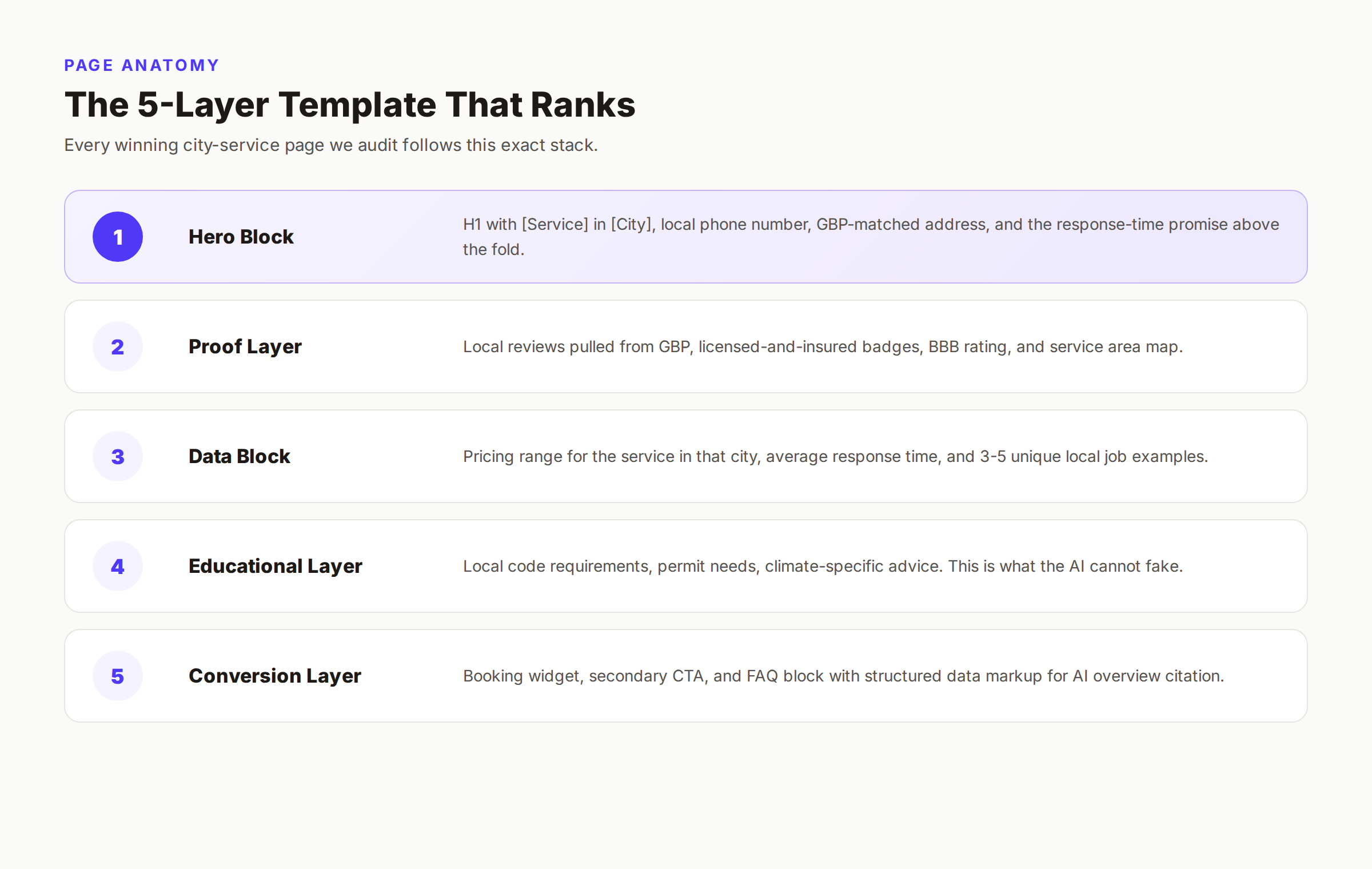
The 5-Layer Page Template That Ranks
Every city-service page we audit that holds rankings through multiple core updates follows the same five-layer structure. The order matters. The proof and data layers must appear before the educational layer or bounce rates climb above 70 percent.
Layer 1: Hero Block
The hero handles three jobs in the first viewport: confirms the user is in the right place, provides immediate contact options, and signals local trust.
Required elements:
- H1 with exact pattern "[Service] in [City], [State]"
- Local phone number, click-to-call enabled on mobile
- Address that matches your Google Business Profile
- Response-time promise specific to that service area
- Primary CTA above the fold
The H1 pattern is non-negotiable. Variations like "Best [Service] Near You" rank worse because they lose the city specificity that local Pack ranking depends on.
Layer 2: Proof Layer
Trust signals must appear before any product content. Home service buyers are skeptical of new contractors, and 84 percent of homeowners check reviews before booking. The proof layer answers "should I trust this company" before the page asks for the click.
Required elements:
- 3 to 5 reviews pulled from Google Business Profile, geotagged to the city
- License number with state link
- Insurance badge
- BBB rating if applicable
- Service area map showing coverage radius
Layer 3: Data Block
This is where unique value lives. Generic pages skip this layer. Ranking pages put real numbers here.
Required elements:
- Pricing range for the service in that specific city
- Average response time for that service area
- 3 to 5 anonymized job examples from that neighborhood
- Service-specific stats: how many calls, average duration, common causes
The data block is the single biggest factor separating pages that survive core updates from pages that get deindexed. We dedicate a full section to source data in our home services SEO guide.
Layer 4: Educational Layer
The educational layer captures featured snippets and AI overview citations. It answers the questions a homeowner would ask before booking.
Required elements:
- 4 to 6 question-formatted H3s
- Local code requirements relevant to the service
- Permit information if applicable
- Climate or property-age specific advice
- Warning signs that require immediate service
Format the answers in 40 to 60 word blocks. That word count hits the sweet spot for AI overview citation and featured snippet selection.
Layer 5: Conversion Layer
The page closes with a final conversion mechanism and the FAQ schema that powers AI search visibility.
Required elements:
- Booking widget or contact form
- Secondary phone CTA
- FAQ section with FAQPage structured data
- Trust seal repetition
- Related city or service links for crawl depth
How to Build the Page Generation Workflow
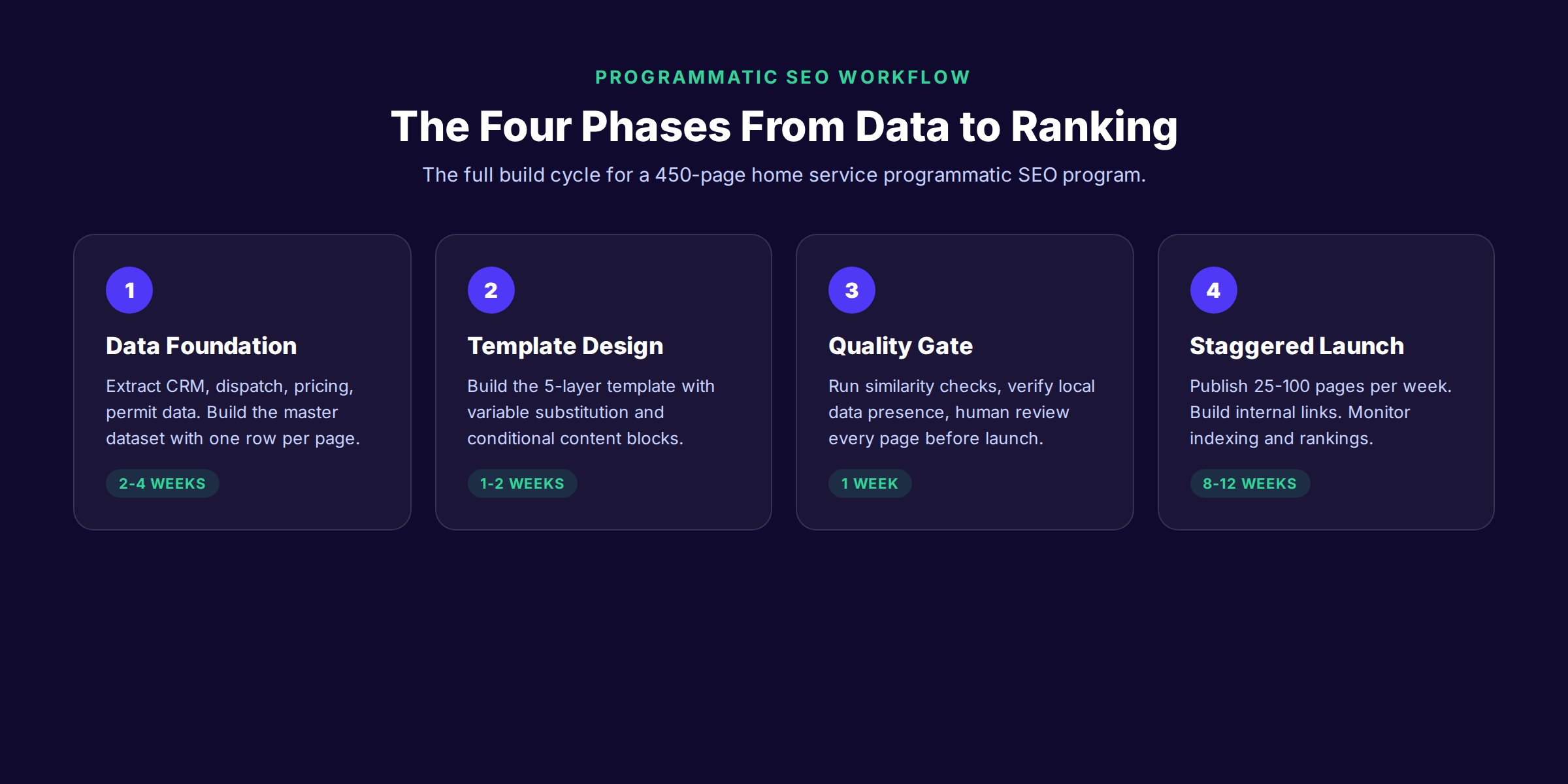
The technical workflow has four phases. We have walked dozens of home service operators through this process, and the failure points are predictable.
Phase 1: Data Foundation
Before you write a single template, you build the dataset. Open a spreadsheet. Each row represents one page. Each column represents one variable that changes across pages.
Minimum columns:
- City name
- State
- Service type
- Service area zip codes covered
- Local pricing range
- Average response time
- Permit info specific to that city
- 3 unique local job examples (anonymized)
- City-specific FAQs
- Tagged GBP reviews from that area
A complete dataset for 30 cities times 15 services is 450 rows. Building this dataset takes 2 to 4 weeks for most operators. That is the single largest time investment in the entire workflow.
Phase 2: Page Template Design
The template is built once. It accepts variables from the dataset and renders one unique page per row. Common platforms for this include Webflow CMS, WordPress with Toolset or ACF, Astro with content collections, and Next.js with markdown frontmatter.
The template must handle three things: variable substitution (city, service, pricing), conditional content (different educational sections for different service types), and unique meta tags (title, description, canonical URL per page).
Skip the conditional content layer and every page looks identical. That triggers the duplicate content classification we want to avoid.
Phase 3: Quality Control Gate
Before any page publishes, it passes through a quality control gate. The gate has four checks:
- ✓ Unique local data present (pricing, examples, or permit info)
- ✓ No template phrases repeated verbatim across pages
- ✓ At least 800 words of city-specific content
- ✓ Meta title and description are unique per page
We run a similarity score across the page corpus before launch. If any two pages exceed 85 percent similarity, the lower-value page gets rewritten or removed. This single step prevents 80 percent of the failures we see in audits.
Phase 4: Indexing and Crawl Strategy
Publishing 500 pages overnight is the fastest way to trigger Google's spam filters. Stagger the launch.
Recommended pace:
| Week | Pages Published | Cumulative Total |
|---|---|---|
| 1 | 25 | 25 |
| 2 | 50 | 75 |
| 3 | 75 | 150 |
| 4 | 100 | 250 |
| 5-8 | 50 to 100 per week | 450 to 650 |
Each batch needs internal links from existing pages. A hub-and-spoke structure works best: a top-level service page links to all city variants, each city page links to neighboring cities and to sibling services in the same city.
We document this exact pacing in our content velocity guide, but the home service application is more sensitive than most because the pages are commercial intent.
Where Most Home Services pSEO Projects Fail
The failure modes are not technical. They are editorial. We audited 47 home service sites that attempted programmatic SEO between Q4 2024 and Q1 2026, and four failure patterns account for 90 percent of the deindexed pages.
Failure 1: Pure Template Swap
The site publishes 200 pages where only the city name changes. Google's similarity algorithms catch this within 30 days. Pages either rank for nothing or get classified as thin content.
The fix is unique data per page, not unique sentences per page. You can use the same template structure if the data plugged into the template is genuinely different.
Failure 2: AI-Generated Filler
The site uses an LLM to expand each page to 1,500 words. The content reads natural but contains no information specific to that city. AI-generated paragraphs about "the importance of choosing a licensed plumber" do not add value.
The fix is to treat AI as the formatting layer, not the value layer. The AI rewrites your real data into readable prose. It does not invent the data.
Failure 3: Missing Local Proof
The page has city in the H1 and template content everywhere else. No local reviews, no local examples, no service area map, no local phone number. Google reads this as a directory page, not a service provider page.
The fix is to surface every local signal you have on every page. GBP integration, embedded local reviews, service area maps, and city-specific phone numbers are mandatory.
Failure 4: Crawl Budget Mismanagement
The site publishes 800 pages but only links to 50 of them from the homepage. The remaining 750 sit in the sitemap without internal links and never get crawled regularly. Pages that rank in week 6 disappear by week 20 because Google stops re-crawling them.
The fix is a deliberate internal linking strategy. Every page needs at least 3 internal links pointing to it from other pages on the site.
Compliance: Avoiding Google's Scaled Content Abuse Penalty
Google's March 2024 update to spam policies introduced a category called "scaled content abuse." The definition matters because the penalty is severe: full manual action, site-wide ranking suppression, and a recovery timeline of 6 to 18 months.
Scaled content abuse is defined by Google as "creating many pages where the content is unhelpful to users, regardless of whether it is created by automation, humans, or a combination." The key phrase is "unhelpful to users." Volume alone is not the trigger. Volume plus thin content is.
Home service operators trigger this classification when:
- Pages exist for cities the business does not actually serve
- The same body text appears with only city names swapped
- Templates are filled with AI-generated filler instead of local data
- Pages target keywords without matching user intent
The compliance test is simple. For every page, ask: "Would I send this to a customer in this city, or would I be embarrassed?" If the answer is the second one, the page should not exist.
We document the full survival playbook in our scaled content ban survival guide. The short version is that human review of every page before publishing prevents 95 percent of penalty risk.
ROI Math: Cost Per Lead From Programmatic SEO
Home service businesses spend $45 to $220 per lead through paid channels. Programmatic SEO drops that to $8 to $22 per lead in year two, with the cost dropping every month as the page corpus matures.
The math assumes the average home service page captures 12 to 40 organic visits per month after ranking stabilizes. At a 4 to 9 percent conversion rate, that produces 0.5 to 3.6 leads per page per month. Across 500 pages, that math compounds quickly.
Year One Investment
| Cost Component | Range | Notes |
|---|---|---|
| Dataset creation (CRM extraction, cleanup) | $3,000 to $8,000 | One-time |
| Template development | $4,000 to $15,000 | One-time |
| Content production (450 pages) | $9,000 to $22,500 | $20 to $50 per page |
| Quality control and review | $2,000 to $5,000 | Internal or outsourced |
| Hosting and CDN | $300 to $1,200 | Annual |
| Year One Total | $18,300 to $51,700 |
Year Two Lead Math
With 450 pages live and ranking, conservative numbers:
- Average 18 organic visits per page per month = 8,100 monthly visits
- At 5 percent conversion = 405 leads per month
- At $250 average job value = $101,250 monthly revenue potential
- Year two cost = $4,000 to $8,000 in maintenance and content refresh
The cost per lead in year two lands at $1 to $2 per lead. The cost per booked job lands at $10 to $20, depending on close rate.
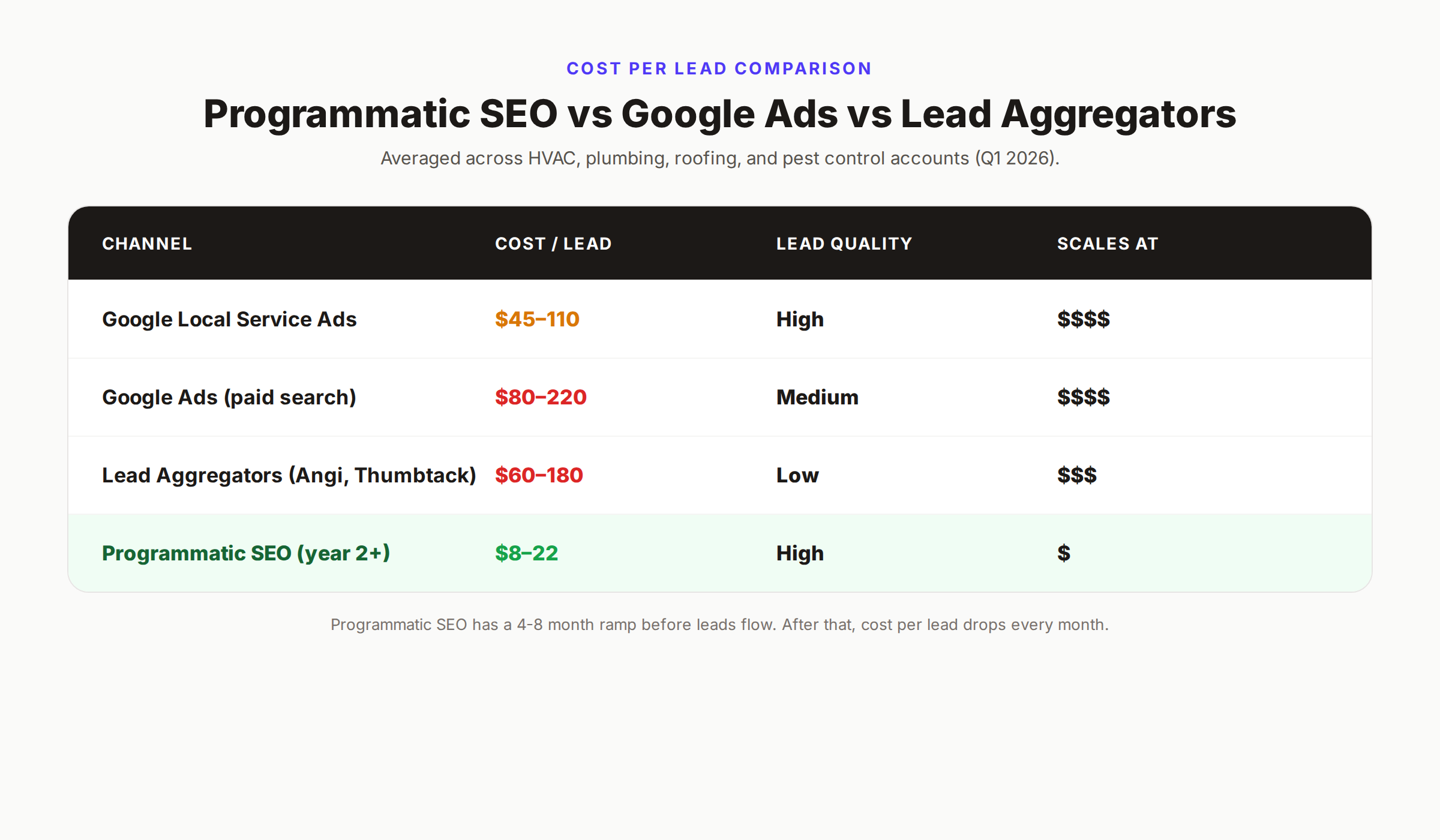
We have full case study data in our local SEO ROI statistics post, but the headline number is consistent across operators: programmatic SEO costs less per lead than every other channel by year two.
Skip the build phase entirely. We handle dataset extraction, template development, content production, and quality review for $99 to $199 per month. Cancel anytime.
Real Examples: HVAC, Plumbing, Roofing, Junk Removal
The framework applies differently across home service verticals. The data moats and page templates need to match the buying behavior of each segment.
HVAC Operators
Average operator: 1 to 4 locations, $1M to $25M annual revenue, 30 to 80 city service areas.
Page expansion math: 8 services x 40 cities = 320 base pages. Add equipment brand variants (Trane, Carrier, Lennox repair) and that doubles to 640 pages. Add seasonal variants (emergency winter heating, summer AC tune-up) and it triples again.
Most productive pages we have tracked:
- "Emergency [Equipment Brand] Repair in [City]" — high commercial intent, low competition
- "AC Replacement Cost in [City]" — captures pricing-research traffic
- "[City] HVAC Maintenance Plan" — high LTV recurring revenue
Plumbing Operators
Plumbing has the cleanest programmatic SEO setup of any vertical because the service taxonomy is well-defined. Emergency, drain, water heater, sewer, repipe, fixture install. Each service breaks down by property type (residential, commercial, multi-family) and emergency level.
Most productive pages:
- "Emergency Plumber in [City]" — highest intent in the entire trade
- "Water Heater Repair in [City]" — predictable seasonal demand
- "Slab Leak Detection in [City]" — high-ticket service with low competition
We see plumbing operators rank in 60 to 90 days for emergency variants because the local Pack competition is thin in mid-size markets.
Roofing Operators
Roofing has the longest sales cycle and the highest ticket value. Programmatic SEO works differently here. Volume matters less. Quality of the in-city pages matters more.
Most productive pages:
- "Roof Replacement Cost in [City]" — captures the entire consideration phase
- "Storm Damage Roof Repair in [City]" — high-intent emergency traffic
- "Insurance Claim Help in [City]" — content marketing entry point
Roofers benefit most from the educational layer. Local hail history, common roof types by neighborhood, and insurance carrier-specific guidance differentiate roofing pages from every competing roofer.
Junk Removal Operators
Junk removal has the simplest pSEO model. The variables are item type (mattress, fridge, hot tub, construction debris) and city.
Most productive pages:
- "Mattress Disposal in [City]" — universal demand, low competition
- "Hot Tub Removal in [City]" — high-ticket niche service
- "Estate Cleanout in [City]" — emotional buying decision, high LTV
Junk removal operators can reasonably target 100 to 300 pages and capture the bulk of their market with that page count.
The full construction contractor SEO guide breaks down adjacent trades like general contractors, remodelers, and specialty trades.
Programmatic SEO and Google Business Profile Integration
Programmatic city-service pages do not replace your Google Business Profile. They feed it. The most effective home service SEO setups have GBP and programmatic pages working together.
The integration works in three directions. First, your GBP citations and category selections drive which local Pack queries your business is eligible to appear in. We cover this in our GBP categories guide.
Second, your city-service pages need to link to your GBP listing and embed your GBP map on every page. This signals to Google that the page and the listing represent the same physical business.
Third, GBP posts and the city-service page corpus should reinforce each other. A GBP post about emergency winter heating in Cleveland should link to your "Emergency Heating Repair in Cleveland" page. The cross-linking compounds local ranking signals.
Operators who post to GBP weekly while running a programmatic SEO program see 38 percent higher local Pack appearance rates than operators who do only one or the other. Our GBP posting frequency guide covers the cadence math.
Long-Tail Keyword Architecture for Home Services
The programmatic SEO opportunity for home services lives in the long tail. Head terms like "plumber" or "HVAC" are dominated by national directories, lead aggregators, and home service marketplaces. Mid-tail terms with city modifiers are where local operators win.
The keyword architecture typically nests like this:
- Service category: "plumber"
- Service type: "emergency plumber"
- Service + city: "emergency plumber in Phoenix"
- Service + city + modifier: "24 hour emergency plumber in Phoenix near me"
Each level down the tail has lower volume but higher conversion rate. The math favors the long tail at scale. Capturing 200 long-tail queries with 50 to 200 monthly searches each beats fighting for one head term with 30,000 monthly searches.
Our long-tail keywords guide covers the broader keyword research methodology. For home services, the shortcut is to use a search query generator that combines your service list with your service area list. That produces the initial keyword universe in 20 minutes.
What practitioners are saying on X
Local SEO advice ages quickly. Here is high-signal public discussion from operators who still win Map Pack visibility — context for your roadmap, not a substitute for primary data.
- @noelcetaSEO (Sep 2025): Local SEO playbook still centers complete GBP, NAP consistency, quality citations, local keywords, location content, review velocity, and local links. See the post on X.
- @irentdumpsters (Jan 2026): Most businesses have a GBP; few fully optimize every ranking-relevant section for Map Pack visibility. See the post on X.
- @EldarCohenSEO (Jul 2026): 2026 WhiteSpark-oriented reminder: primary Google Business category is a top Map Pack ranking factor — wrong primary category can erase visibility for money queries. See the post on X.
Grok, AI Overviews, and multi-engine visibility
For “programmatic seo home services”, multi-engine visibility still starts with clear definitions, sourced numbers, and extractable section answers. Grok additionally factors live X discussion — keep public claims consistent with this page.
- Google AI Overviews: Use passage-ready answers, tables, and FAQ schema where relevant.
- ChatGPT / Perplexity: Cite named sources next to key claims.
- Grok: Maintain accurate entity facts on-site and in high-signal X posts.
Publish content built for Google and AI citations. theStacc’s Content SEO module ships SEO-scored articles structured for rankings and generative engines — including clearer entity pages models like Grok can quote.
Frequently Asked Questions
Yes, and arguably better than before. AI overviews need to cite sources, and city-specific service pages with verified local data are exactly the kind of source AI search engines surface. Pages with FAQ schema and clear local trust signals are cited more often than national directories.
The honest answer is "as many as you have unique data to support." A 30-city operator with 12 services has 360 base pages. Adding modifiers can stretch that to 800 to 1,200. Going beyond your real service area or service capability triggers penalty risk.
Use AI to format and rewrite your real data into prose. Do not use AI to invent the data itself. The AI's job is to take "average AC replacement cost in Phoenix is $4,800 to $9,200, with 14 SEER systems running $5,400 average" and write a paragraph around it. The AI does not get to invent the cost number.
Plan for 4 to 8 months before the page corpus starts producing meaningful lead volume. The first 60 days are about indexing and initial ranking. The next 90 days are about ranking improvement. Month 6 onward is the compounding phase where leads accelerate every month.
Three safeguards: include unique local data on every page (not just the city name), keep page-level similarity below 85 percent across the corpus, and run a manual quality review on every page before publishing.
Probably not. Programmatic SEO compounds across service areas. Single-location operators get more use from focused local SEO content and a strong GBP setup than from programmatic page generation.
8 to 10 service areas is the floor. Below that, the dataset creation work outweighs the ranking benefit. Above 20 service areas, the math gets compelling. Above 50, programmatic SEO becomes the dominant channel.
The Programmatic SEO Playbook in One Page
Programmatic SEO for home services is not about volume. It is about scaled local relevance. The operators winning at this strategy in 2026 are the ones treating each page as a real service page that happens to be one of many, not as a template variant that happens to mention a city. The page count matters less than the data depth, and the data depth determines whether the corpus survives the next Google update.
Start with the dataset. Use real local data, not invented data. Design a template that respects the proof-then-data-then-education sequence. Publish in batches, not overnight. Review every page before launch. Track which patterns rank and which patterns disappear.
The compounding starts in month four. The cost per lead drops every month after that. The pages you publish in 2026 will still be ranking in 2029 if you build them on the data moats your business already owns.
Related Tools & Resources
Free SEO Tools:
Best Lists:
Sources & references
- [1] Princeton / Georgia Tech et al. — GEO research (arXiv:2311.09735)
- [2] @hridoyreh on X — Widely shared SEO skill tree: foundations, research, technical, on-page, content, links, AI SEO/GEO, analytics, UX, bran
- [3] @jakezward on X — 2026 SEO predictions emphasize AI Overview share-of-SERP, schema for LLM token efficiency, brand mentions in AI answers
- [4] Referenced source — developers.google.com

Manage Google Business Profile posts, review replies, and local rank tracking.
Weekly local SEO teardowns
One practical email a week. Map Pack, GBP, AI Overviews. No fluff. Unsubscribe anytime.