How to combine programmatic SEO with AI to create pages that survive Google updates. Data moats, quality framework, case studies. Updated May 2026.
Short answer: Most programmatic SEO projects collapse within twelve months because the pages offered nothing a reader could not find faster elsewhere. You can generate 10,000 pages in a weekend; you cannot make them worth ranking unless each solves a specific job with data only you hold.
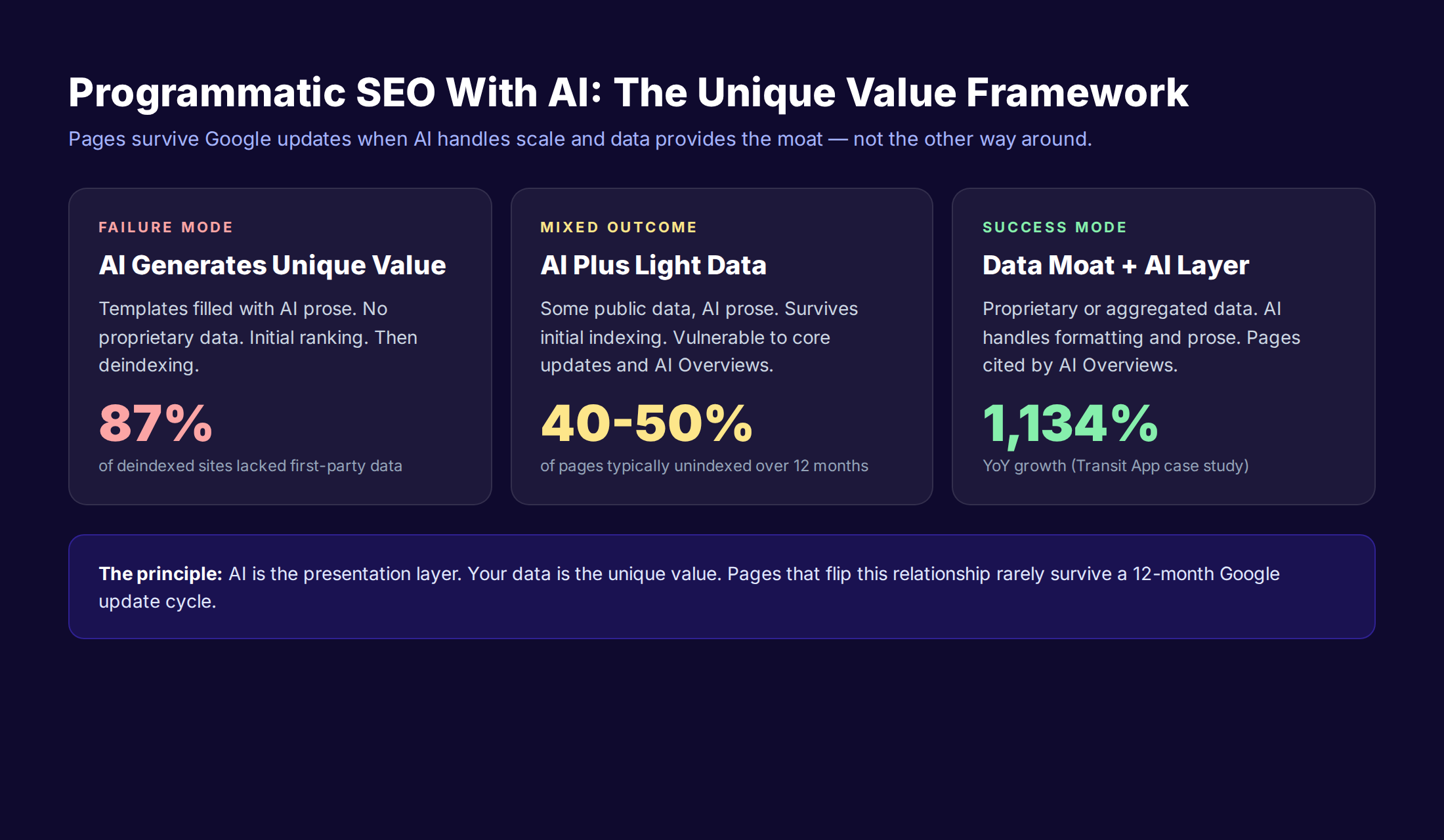
Most programmatic SEO projects collapse within 12 months of launch. The pages get indexed, traffic climbs for a quarter, and then Google quietly removes 40 to 50 percent of the URLs from search results. The reason is rarely the automation itself. The reason is that the pages offered nothing a human could not find faster elsewhere.
That gap between scale and unique value is the central problem of programmatic SEO with AI. You can spin up 10,000 pages in a weekend. You cannot make 10,000 pages worth ranking unless each one solves a specific job for a specific reader.
We publish 3,500 plus articles every month for businesses across 70 plus industries. We watch which programmatic patterns survive Google core updates and which patterns get deindexed. The pattern is consistent: pages with proprietary data win, pages with templated rephrasing of public information lose.
This guide shows you how to combine programmatic SEO with AI to create pages that actually rank. You will learn how unique value is defined in 2026, which data moats survive AI overviews, how to build a quality control system, and where the line sits between scalable content and what Google calls scaled content abuse.
Here is what you will learn:
- What unique value means for programmatic SEO in the AI era
- The five data moats that protect programmatic pages from deindexing
- A four-layer quality control framework for AI-generated pages
- Real case studies of programmatic SEO done right and wrong
- The exact workflow we use to scale content without triggering Google penalties
What Programmatic SEO Actually Means in 2026
Programmatic SEO is the practice of building large groups of search-optimized pages from a structured dataset and a repeatable page template. Each page targets a specific long-tail query like "best vegan restaurants in Austin" or "USD to EUR conversion rate" or "Python tutorial for beginners."
The strategy is decades old. TripAdvisor uses it for 8 million plus location pages. Zillow uses it for 110 million property pages. Wise dominates currency conversion search by publishing thousands of templated pages with live exchange rates.
The new variable is AI. Large language models now generate the prose that fills the templates. A single dataset and a single page structure can produce 50,000 pages of natural-sounding text overnight. The barrier to entry collapsed.
So did the quality floor. Google's March 2024 spam policy update specifically targeted "scaled content abuse," defined as content generated at scale to manipulate search rankings without providing value to users. Sites that crossed the line saw 60 to 100 percent traffic losses within 30 days.
The question is no longer "can AI write programmatic content?" The question is "what makes one programmatic page worth indexing while another gets removed?"
The answer is unique value. And unique value has a specific definition Google uses internally.
How Google Defines Unique Value for Programmatic Pages
Google's quality rater guidelines define unique value through four tests. Every programmatic page passes or fails on these four criteria.
| Test | Question Google Asks | Failure Mode |
|---|---|---|
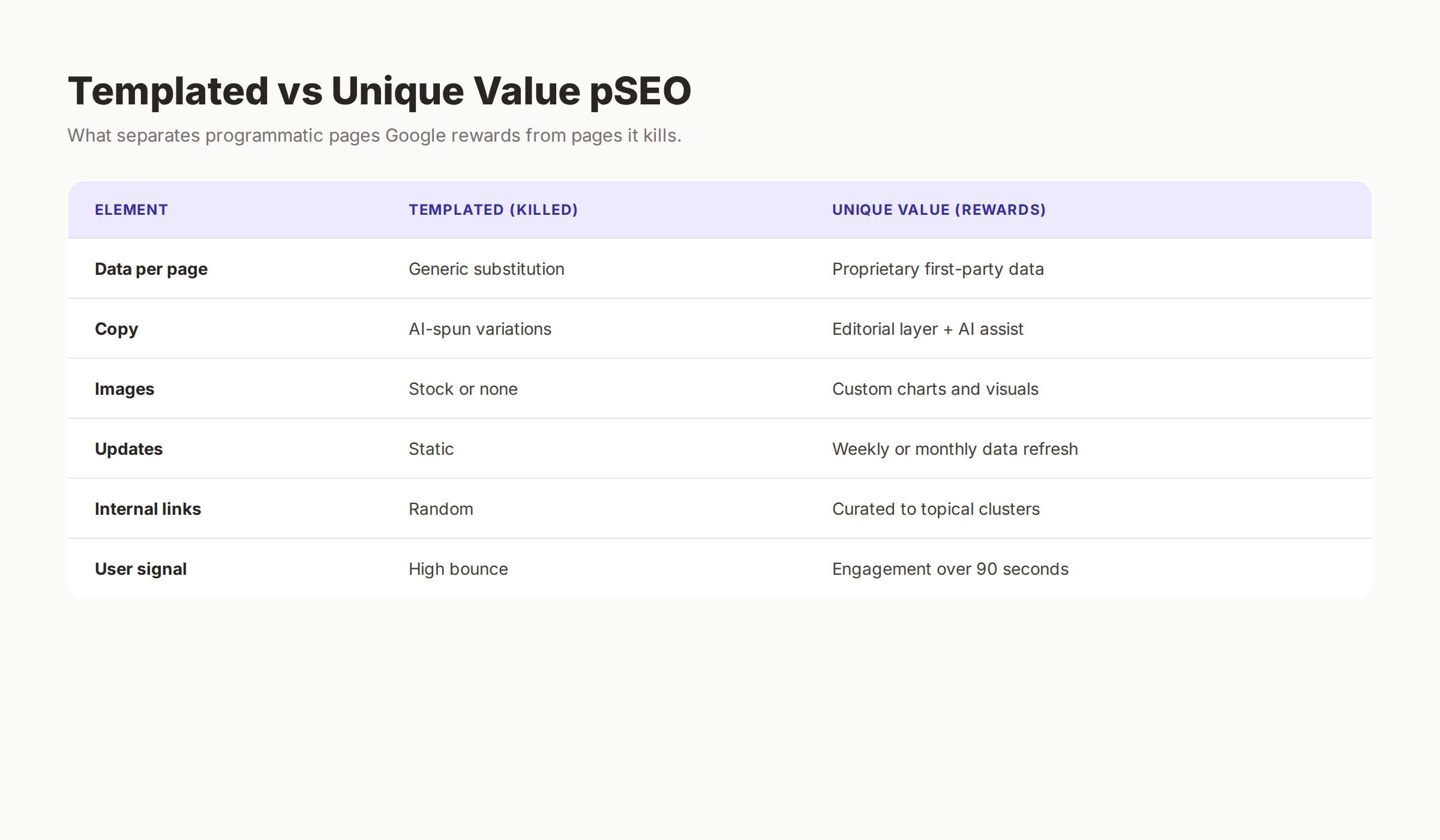
| Original information | Does this page contain data, analysis, or examples not found elsewhere? | Rephrased Wikipedia paragraphs |
| Original analysis | Does the page interpret the data with insight? | Generic AI-written summaries |
| Substantial value-add | Beyond raw data, what does the page contribute? | Tables without context |
| User intent match | Does the page solve the searcher's actual job? | Pages that target keywords without serving the intent |
Pages that fail one test can still rank. Pages that fail two or more rarely survive a core update. Pages that fail all four enter Google's scaled content abuse classification, which carries manual action risk.
The implication for AI-generated programmatic pages is direct: the AI's contribution must be additive, not replicative. If the AI is the unique value, the page fails. If the AI is the formatting and presentation layer on top of proprietary data, the page survives.
Tired of guessing which pages will rank? theStacc publishes 30 SEO articles every month, built around your data and reviewed for unique value before going live.
The Five Data Moats That Make Programmatic SEO Survive
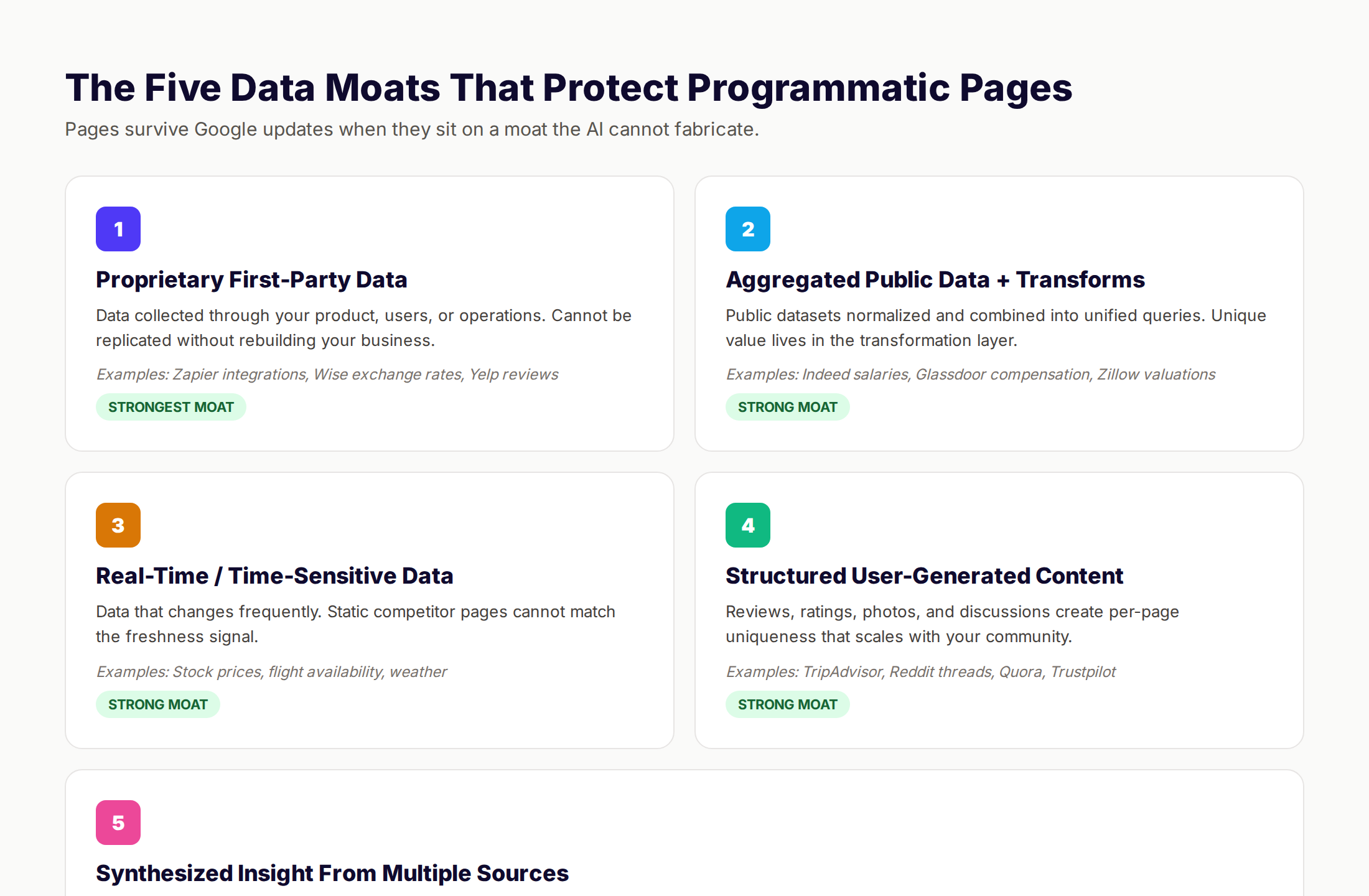
Pages survive Google updates when they sit on a data moat the AI cannot fabricate. Without a moat, you are publishing the same paraphrased web content as your competitors. With a moat, your pages contain information that does not exist anywhere else on the indexed web.
We track five categories of data moats across the programmatic SEO sites we audit.
1. Proprietary First-Party Data
This is the strongest moat. You collect data through your product, your users, your operations, or your tools. Nobody else has access to it.
Examples:
- Zapier publishes 70,000 plus integration pages based on real connector data they own
- Wise publishes currency pages with live exchange rate data from their own treasury
- Yelp publishes 200 million plus review-driven pages from user-generated content
- G2 publishes review pages from verified buyer accounts
The test is simple. If a competitor cannot replicate your dataset without rebuilding your product, you have a real moat.
2. Aggregated Public Data With Transformations
Public datasets become unique through aggregation, normalization, and transformation. The data is technically available to anyone. The work of cleaning and combining it is not.
Examples:
- Indeed aggregates job postings from millions of sources into a unified salary database
- Glassdoor combines public job postings with private salary submissions
- Zillow combines public property records, MLS data, and proprietary algorithms
The page's unique value comes from the transformation layer, not the underlying data points.
3. Real-Time or Time-Sensitive Data
Data that changes frequently creates a moat through freshness. Static pages cannot compete with pages updated hourly or daily.
Examples:
- Stock price pages on Yahoo Finance
- Flight availability pages on Kayak or Google Flights
- Weather pages on Weather.com
- Currency conversion pages on Wise or XE
The AI never writes the unique value. The unique value comes from the live data feed. The AI writes the surrounding context.
4. Structured User-Generated Content
Reviews, ratings, questions, answers, photos, and forum threads create per-page uniqueness that scales with your community.
Examples:
- TripAdvisor location pages built around guest reviews
- Reddit thread pages with discussion content
- Quora pages with answers from experts
- Trustpilot company pages with review streams
Each page is unique because the people contributing to it are unique. The AI's role is summarization and presentation, not content generation.
5. Synthesized Insight From Multiple Sources
Pages can earn unique value by synthesizing scattered information into a single useful answer. This moat is weaker than the others because the synthesis itself can be copied. It still works when the synthesis is rigorous, frequently updated, and built by domain experts.
Examples:
- Investopedia pages combining definitions, examples, and use cases
- Healthline articles combining clinical sources into patient-friendly explainers
- HubSpot tutorials combining research, screenshots, and step-by-step workflows
AI can assist but cannot lead. The unique value depends on editorial judgment about what matters and what does not.
Why Pure AI Programmatic SEO Fails
Pages that rely on the AI to generate the unique value almost always fail. The reasons are technical, not philosophical.
Large language models compress the public internet into a probability distribution over tokens. When asked to write about a topic, they produce statistically average prose based on what already exists. The output is by definition not unique. It is the most likely sequence of words given the prompt.
Google's helpful content classifier was trained to detect this pattern. The signals it watches include:
- Sentences that paraphrase common knowledge without adding new framing
- Definitions that match training data almost verbatim
- Lists that repeat the same structure across pages with different topics
- Conclusions that say nothing the introduction did not already say
- Absence of personal experience markers like "we tested," "we measured," "we tracked"
A study by Originality.ai in early 2026 examined 2,600 programmatic sites that lost more than 50 percent of their traffic in the August 2025 core update. The shared trait was that 87 percent of their pages contained no first-party data, no proprietary research, and no information that could not be found through a basic web search.
The pages were grammatically perfect. They ranked briefly. Then they vanished.
The Four-Layer Quality Framework
Quality control for programmatic SEO with AI cannot be a single check at the end. It must run as four layers, each catching different failure modes.
| Layer | When It Runs | What It Catches |
|---|---|---|
| Pre-generation | Before the AI writes | Bad data, missing fields, intent mismatch |
| In-generation | During the AI writes | Hallucinations, prompt drift, factual errors |
| Post-generation | After the AI writes | Thin content, duplication, brand voice misses |
| Continuous | After publishing | Ranking decay, indexing loss, engagement drops |
Layer 1: Pre-Generation Validation
Before the AI generates anything, validate the input data. Most programmatic SEO failures trace back to dirty data being amplified by AI fluency.
The checklist:
- ✓ Every data row has values for all required fields
- ✓ Numeric values fall within expected ranges
- ✓ Categorical values match the allowed set
- ✓ Geographic data uses standard identifiers (zip codes, ISO country codes)
- ✓ Timestamps are valid and recent enough to be useful
- ✓ At least one field per row provides unique information
If a row fails validation, do not generate a page. Empty pages with confident AI prose are the fastest path to the deindex bucket.
Layer 2: In-Generation Controls
The AI itself needs guardrails during generation. The most effective patterns:
Retrieval-augmented generation. Instead of letting the model recall facts from training, force it to read your dataset row and only write about what the data shows. This eliminates the most common hallucination mode where models invent statistics that sound right.
Structured output schemas. Tell the model exactly what fields to fill rather than asking for free-form content. A schema with title, intro, three benefits, two limitations, and a conclusion is harder to mess up than "write a 1,000 word article."
Per-section prompts. Instead of one mega-prompt for the whole page, run separate prompts for each section. The intro prompt sees only intro context. The comparison table prompt sees only comparison data. This reduces drift across long generations.
Temperature settings. For factual content, run the model at temperature 0.2 to 0.4. Higher temperatures generate creative variations that often introduce errors. Save creative settings for headlines and opening hooks where novelty matters.
Layer 3: Post-Generation Audit
After the AI writes, audit the output before publishing. The audit catches what slipped through earlier layers.
The checklist:
- ✓ Word count meets the minimum threshold for the page type
- ✓ At least one data point not available elsewhere appears in the body
- ✓ No paragraph is more than 70 percent similar to another paragraph on a sibling page
- ✓ No factual claim contradicts the underlying dataset
- ✓ Brand voice markers match the style guide
- ✓ Internal links connect to relevant siblings and parent pages
- ✓ Schema markup is valid and matches the page type
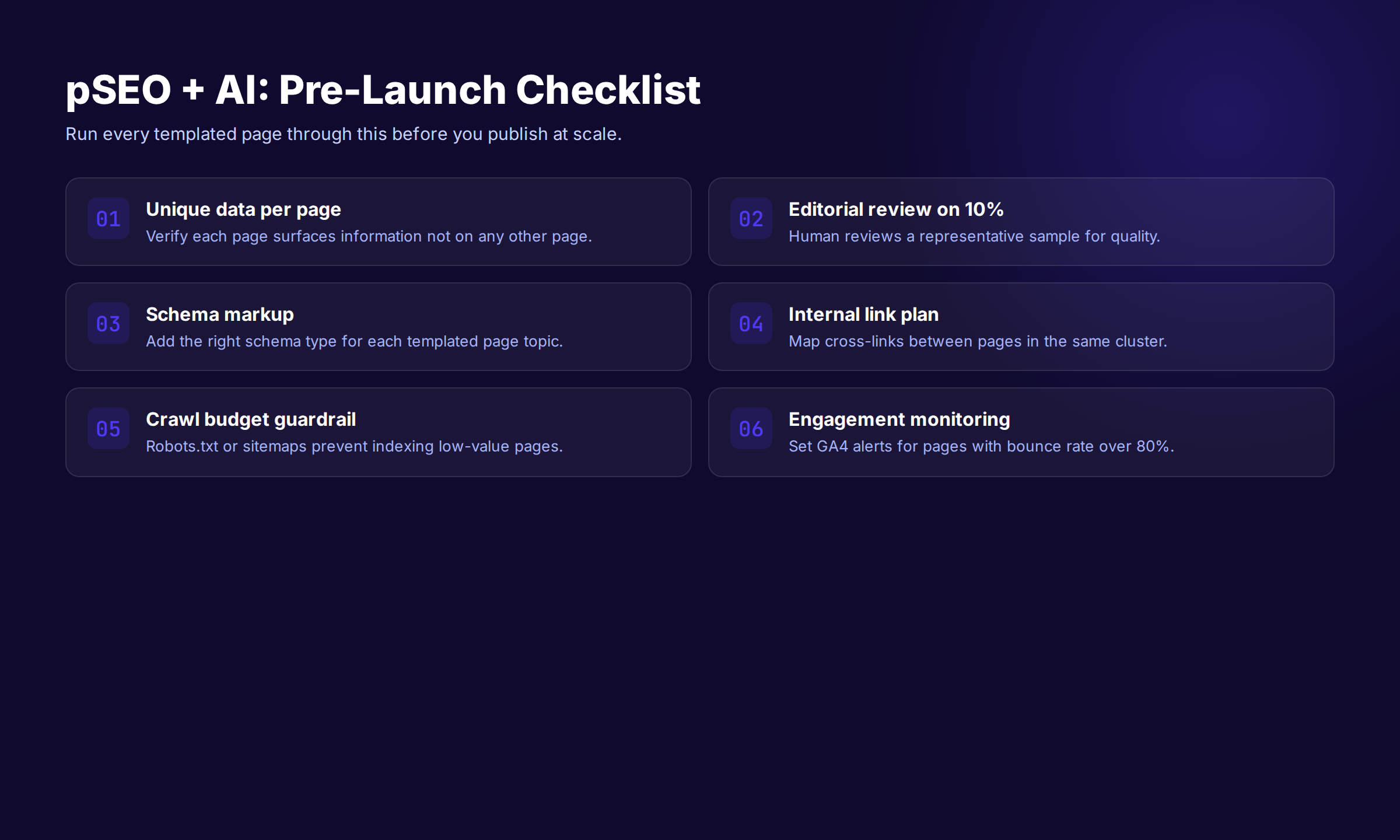
Tools that automate the audit include Surfer SEO for content scoring, Copyscape or Originality for similarity, and custom scripts for data validation. Manual sampling of 5 percent of generated pages catches patterns the automated tools miss.
Layer 4: Continuous Monitoring
After pages go live, monitor them for performance degradation. Programmatic pages decay slowly, then collapse suddenly. Catch the slow decay before the collapse.
The signals to track per page or per page cluster:
- Impressions trend in Google Search Console
- Average position trend
- Click-through rate trend
- Indexing status (indexed, crawled but not indexed, discovered but not crawled)
- User engagement metrics (time on page, bounce rate, return visitors)
When a cluster shows two consecutive months of declining impressions, audit a sample of pages. Common fixes include refreshing the underlying data, expanding the content depth, consolidating thin pages, or removing pages that no longer serve a query.
The four-layer system sounds like a lot. It is. We run it for every customer, every month, so the work happens before your pages ever go live. See how it works for $1 →
Case Studies of Programmatic SEO Done Right
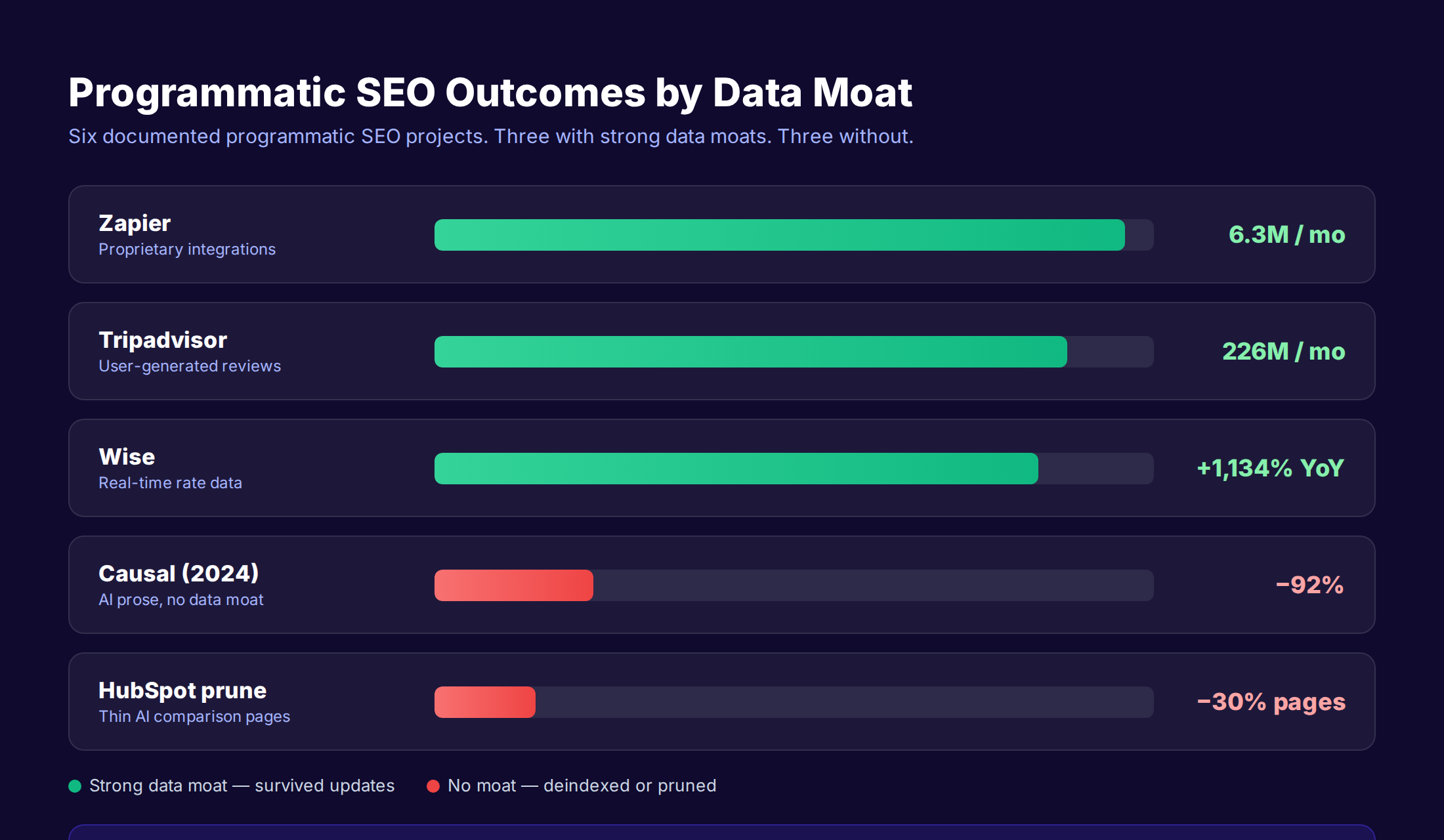
The pattern across winners is consistent: real data, AI-assisted presentation, continuous refresh, and aggressive pruning of low-performers.
Zapier: 70,000 Plus Integration Pages
Zapier publishes a page for every connection between two apps in their ecosystem. The unique value comes from the actual integration mechanics, supported triggers and actions, and example workflows that only Zapier knows because they built the connection.
The pages drive 6.3 million monthly organic visits. Their content is templated, but the data feeding the template is proprietary. AI assists with formatting and prose generation. AI does not generate the integration details.
Wise: Currency Conversion Pages
Wise publishes thousands of pages for currency pairs like "USD to EUR" and "GBP to JPY." The unique value is the live mid-market exchange rate from their treasury operations.
Templated prose surrounds the rate. The rate is the moat. Competitors using static or daily-updated rates lose to Wise's real-time data on every conversion query.
Tripadvisor: 8 Million Plus Location Pages
Tripadvisor publishes pages for restaurants, hotels, and attractions worldwide. Each page surfaces guest reviews, photos, ratings, and booking availability. The user-generated content creates per-page uniqueness that scales with the community.
AI plays a small role in summarizing review sentiment and translating content. The unique value comes from millions of real travelers contributing reviews.
Omnius: 67 to 2,100 Signups in 10 Months
A documented case study from Omnius in 2026 showed an AI startup grow from 67 to 2,100 monthly signups using programmatic SEO. The pages combined a structured AI tool dataset with original use case writeups for each tool. The unique value was the use case framing, not the tool data itself.
The takeaway across cases is the same. The data is the moat. AI handles scale. Editorial judgment connects them.
Case Studies of Programmatic SEO Done Wrong
The failures share a pattern too. Pages built on commodity data, populated by AI prose alone, scaled fast and removed faster.
The Causal AI Penalty
A widely cited example is the 2024 case of Causal, an analytics company that published 1,800 AI-generated comparison pages targeting "X vs Y" queries for software tools. The pages ranked initially and drove a wave of traffic. Within six months, Google's helpful content classifier flagged the pages and traffic collapsed by 92 percent.
Post-mortem analysis showed the pages contained no proprietary data, no testing methodology, and no information that could not be assembled from each tool's marketing site. The pages were unique strings of text without unique content.
The HubSpot Pruning
In late 2024, HubSpot quietly removed 30 percent of its blog content after a core update demoted thousands of pages. Many of the removed pages were templated comparison articles and definition pages with thin AI-assisted content. The remaining pages held position. The removed pages were not contributing unique value Google could verify.
Mass Deindexing Patterns
Research from Search Engine Journal in 2025 examined 49,000 plus sites affected by the March 2024 core update. The 837 sites that were completely deindexed shared three traits: heavy AI content, templated structures, and no unique data feeding the templates.
The lesson is that AI is not the cause of the failure. AI without a data moat is the cause.
The Workflow We Use for Programmatic SEO With AI
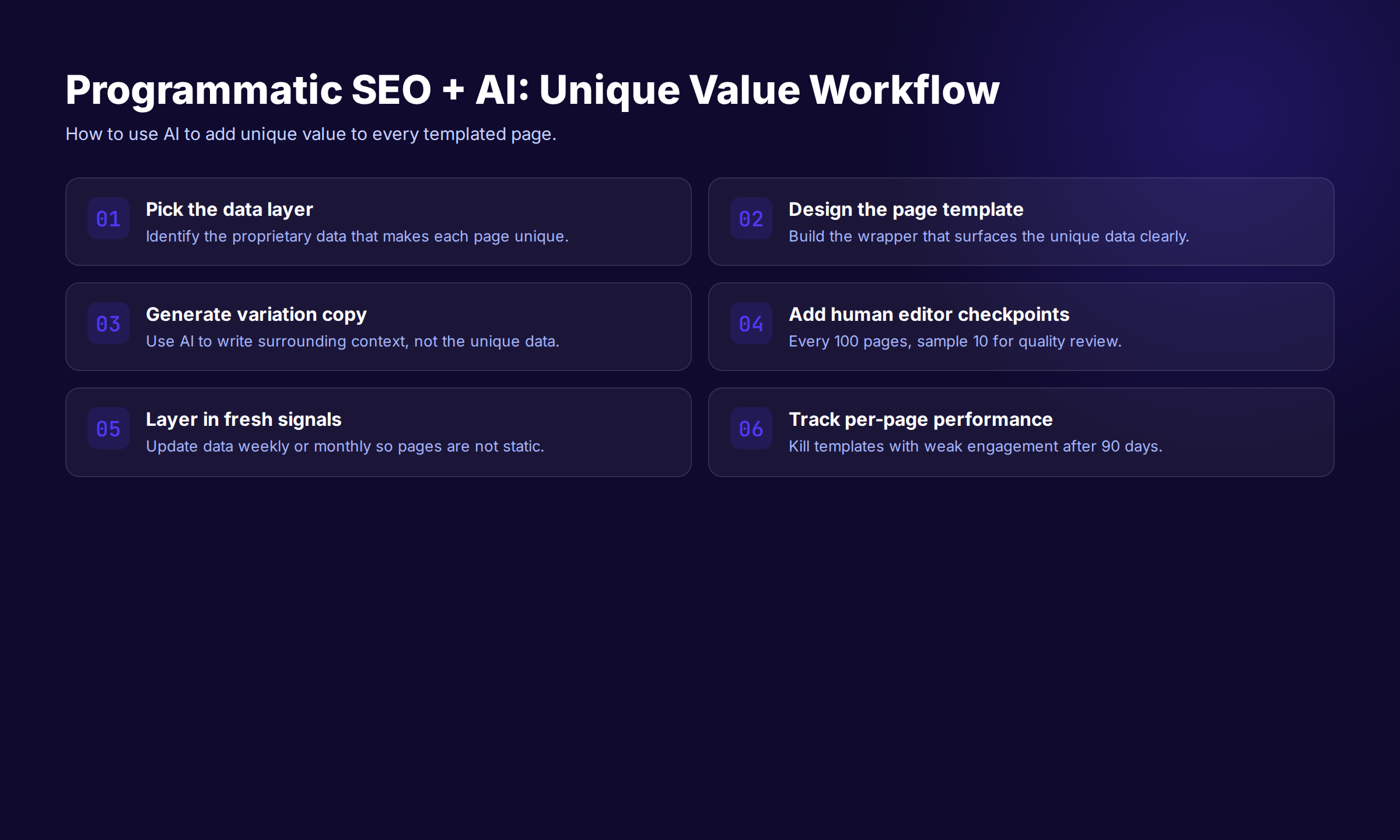
We run programmatic SEO across hundreds of customer sites every month. The workflow is the same regardless of vertical. The data changes. The framework does not.
Step 1: Define the Job
Every programmatic page must serve a specific job for a specific reader. "Information about X" is not a job. "Decide whether X is the right pricing option for me" is a job.
Write the job statement before you write the template. If you cannot articulate the job in one sentence, the page will not rank.
Step 2: Audit Your Data
List every data source available to you. Tag each source by:
- Uniqueness: How hard is this for a competitor to obtain
- Freshness: How often does this data change
- Volume: How many rows or records exist
- Structure: How clean and queryable is the dataset
The intersection of unique, fresh, voluminous, and structured data is where programmatic SEO works. If you do not have data in that intersection, programmatic SEO is not the right channel.
Step 3: Map Data to Queries
For every keyword cluster you want to target, identify which data fields answer the query. The match matters more than the keyword volume.
"USD to EUR exchange rate" maps to current rate, historical chart, and conversion tool. "Best Italian restaurants in Austin" maps to ratings, reviews, photos, and reservation availability. "Python tutorial for beginners" maps to skill level, prerequisites, and lesson sequence.
If you cannot map the query to data fields you own, the page will rely on AI prose alone. Skip it.
Step 4: Design the Template
The template is the part of the page that repeats across all instances. The data is the part that varies.
A good template:
- Places the unique data prominently above the fold
- Provides context for what the data means
- Surfaces related pages through internal links
- Includes structured data markup for the page type
- Loads fast on mobile
A bad template:
- Buries the unique data below 500 words of generic intro
- Uses the same opening paragraph across every page
- Contains AI-generated content that varies only by entity name
Step 5: Generate With Guardrails
Use the four-layer framework above. Validate inputs, control generation, audit outputs, monitor continuously.
Start with a small batch of 50 to 200 pages. Watch performance for 60 to 90 days. Scale only after the small batch proves it ranks and holds.
Step 6: Prune Continuously
Programmatic SEO is not a build-and-leave channel. Pages that fail to rank within 90 days should be reviewed. Pages that lose 50 percent of impressions over a quarter should be audited or removed.
Pruning underperformers improves the average quality of your remaining pages, which improves how Google evaluates your domain as a whole.
How to Combine AI With Human Oversight
The hybrid model is now the consensus best practice across programmatic SEO operators. The split usually breaks like this.
| Task | AI Handles | Humans Handle |
|---|---|---|
| Strategy | Pattern detection from data | Channel selection and target audience |
| Template design | Generates variations | Approves final structure |
| Initial draft | Writes prose around data | Reviews for accuracy and tone |
| Data validation | Flags anomalies | Decides what to fix |
| Quality scoring | Runs automated checks | Audits flagged pages |
| Editorial calls | Suggests options | Makes final decisions |
| Pruning | Identifies underperformers | Approves removals |
The mistake we see most often is asking AI to make decisions humans should make. AI is good at generation, classification, and pattern matching. AI is weak at judgment, prioritization, and accountability.
The other common mistake is asking humans to do work AI handles faster. Reviewing every word of 10,000 AI-generated pages is not feasible. Sampling 5 percent of pages plus reviewing 100 percent of flagged pages is feasible.
What About AI Overviews and SGE?
Google's AI Overviews now appear in roughly 13 percent of searches and are growing 70 plus percent quarter over quarter. The natural question is whether programmatic SEO still works when AI summarizes the page for the user.
The short answer is yes, with adjustments.
AI Overviews need source material. Pages with proprietary data, clear definitions, and structured information feed AI Overviews more often than pages with generic prose. The pages get cited even when the click-through rate drops.
The adjustments:
- Use structured data markup so AI systems parse the page reliably
- Write a clear definition or answer in the first 50 words
- Include data tables that can be extracted and cited
- Use FAQ sections that match conversational queries
- Build entity authority around the topic, not just keyword density
We have seen client pages lose 30 percent of click traffic to AI Overviews and gain 40 percent in brand mentions through AI citations. The total business impact often improves, even when the click-through rate drops.
The Cost Math of Programmatic SEO With AI
The economics shifted in 2024 when AI generation costs collapsed. A 2,000-word programmatic page that cost 60 dollars to write by a freelancer in 2022 now costs 0.40 cents in API fees. The constraint moved from cost per page to quality per page.
Here is how the numbers compare for a 5,000-page programmatic SEO build.
| Approach | Cost per Page | Total Cost | Production Time | Quality Risk |
|---|---|---|---|---|
| Human writers | $80-$250 | $400,000-$1,250,000 | 12-24 months | Low if vetted |
| Pure AI generation | $0.20-$2 | $1,000-$10,000 | 1-4 weeks | Very high without controls |
| AI plus four-layer review | $3-$8 | $15,000-$40,000 | 2-3 months | Low with controls |
| theStacc managed service | Included | $99/month | Ongoing | Low |
The pure AI approach looks cheap until you measure the loss from deindexing, rebuild costs, and the opportunity cost of pages that never ranked. The AI plus review approach lands in a sweet spot for medium-volume builds. Managed services make sense when you want predictable output without building the in-house workflow.
Internal Linking Strategy for Programmatic Pages
Programmatic page clusters need their own internal linking strategy. Without one, you produce orphaned pages that Google cannot crawl effectively.
The pattern that works:
- Hub page at the top of the cluster, listing all pages in the group
- Sibling links at the bottom of each programmatic page to 5 to 10 related pages
- Category links to parent topic pages
- Cross-cluster links when pages in different clusters serve related jobs
- Editorial content links from blog posts to programmatic pages where contextually relevant
Avoid the pattern of linking every page to every page. This creates link dilution and signals manipulation to Google. Selective, contextual linking signals organic structure.
We cover this in more depth in our programmatic SEO guide and our piece on scaling blog content with AI.
When Programmatic SEO With AI Is Not the Right Channel
Not every business should do programmatic SEO. The channel only works under specific conditions.
The conditions:
- You have proprietary, structured data or can build it
- The data maps to real search queries with measurable volume
- You can produce at least 200 to 500 pages of unique value
- You can commit to ongoing quality control and pruning
- Your business model rewards organic search traffic
If you sell three services to a local market, you do not need programmatic SEO. You need 20 strong pages. If you sell software to 50 industries with 100 use cases each, you might need 5,000 pages.
The honest test is whether the pages would still be valuable if Google did not exist. If they would, the pages will probably rank. If they only exist for ranking, they will probably get removed.
What practitioners are saying on X
AI search advice ages quickly. Here is high-signal public discussion from SEO and growth operators — context for your roadmap, not a substitute for primary data.
- @jakezward (Feb 2026): 2026 SEO predictions emphasize AI Overview share-of-SERP, schema for LLM token efficiency, brand mentions in AI answers as a KPI, proprietary data as a moat, and content refresh beating net-new AI slop. See the post on X.
- @alexgroberman (Jul 2026): Case narrative: organic value plus multi-engine citations (ChatGPT, Perplexity, Grok) from knowledge-hub pages, category authority links, commercial intent content, and tight internal linking — not thin product copy. See the post on X.
- @varunram (Jul 2026): Critique of GEO slopfarm products that combine SEO clickbait with unresearched content marketing — quality and research still separate winners from farms. See the post on X.
Grok, AI Overviews, and multi-engine visibility
AI/search topics like “programmatic seo ai unique value” need multi-engine notes: AI Overviews, ChatGPT/Perplexity, and Grok. Lead with extractable answers; keep claims consistent with public expert discussion.
- Google AI Overviews: Use passage-ready answers, tables, and FAQ schema where relevant.
- ChatGPT / Perplexity: Cite named sources next to key claims.
- Grok: Maintain accurate entity facts on-site and in high-signal X posts.
Frequently Asked Questions
Google does not set a percentage limit. The signal Google watches is whether the content provides unique value, not how it was created. AI-generated content can rank well when it sits on proprietary data and passes quality controls. AI-generated content without unique data tends to fail. The rule is "useful, not how it was made."
Only when the AI is doing all the work. Google's scaled content abuse policy targets content generated at scale to manipulate search rankings without providing value. Pages with real data, useful structure, and unique insights pass the policy. Pages with templated AI prose alone do not.
In programmatic SEO, 80 percent of the traffic typically comes from 20 percent of the pages. Focus quality investment on the high-traffic 20 percent. Maintain or prune the rest. This is why continuous monitoring and pruning matter as much as initial generation.
Ask three questions. Can a competitor produce this same page from public information in under an hour? Does the page contain at least one data point that does not exist elsewhere on the indexed web? Would the page be useful to a reader who could not find it through search? If all three answers are yes, you have unique value.
Yes, with adjustments. Pages with structured data, clear answers, and proprietary information get cited by AI Overviews even when click-through rates drop. The total business value often holds or improves. Pages that rely on generic prose tend to lose visibility when AI Overviews appear.
Start with 50 to 200 pages in a single cluster. Watch performance for 60 to 90 days. Scale only after the small batch proves it ranks and holds. Large initial launches multiply risk without multiplying learning.
Programmatic SEO uses templates and automation to publish pages backed by real data that serves real user jobs. AI spam uses AI to generate large volumes of low-value content for ranking purposes only. The line is whether the page provides unique value beyond what AI alone can produce.
The Path Forward
Programmatic SEO with AI works when AI is the formatting and presentation layer on top of data only you have. It fails when AI is the unique value itself. The line is the same line it has always been: pages must serve users, not search engines.
The companies winning in 2026 are not the ones generating the most pages. They are the ones with the strongest data moats and the most disciplined quality controls. Scale follows quality. Quality does not follow scale.
If you want this workflow running for your business without building it in-house, theStacc handles the full programmatic and editorial pipeline for 99 dollars per month. Thirty articles, every month, built on your data and reviewed for unique value before publishing.
Related reading: The complete programmatic SEO guide, How to scale blog content with AI, Surviving Google's scaled content ban, AI vs human ranking study, and Content velocity and SEO.
Related Tools & Resources
Free SEO Tools:
Best Lists:
Sources & references
- [1] Princeton / Georgia Tech et al. — GEO research (arXiv:2311.09735)
- [2] @jakezward on X — 2026 SEO predictions emphasize AI Overview share-of-SERP, schema for LLM token efficiency, brand mentions in AI answers
- [3] @alexgroberman on X — Case narrative: organic value plus multi-engine citations (ChatGPT, Perplexity, Grok) from knowledge-hub pages, category
- [4] @varunram on X — Critique of GEO slopfarm products that combine SEO clickbait with unresearched content marketing — quality and research
- [5] Referenced source — developers.google.com

Plan topics, review article drafts, and publish to a connected CMS.
Weekly local SEO teardowns
One practical email a week. Map Pack, GBP, AI Overviews. No fluff. Unsubscribe anytime.