Master the Amazon A10 algorithm with this 2026 guide covering ranking factors, listing optimization, external traffic, and conversion tactics that drive sales.
Amazon A10 ranks a listing on how reliably it converts a shopper, not on how many times a keyword appears. Sales velocity, click-through rate, review quality, and off-Amazon traffic now carry more weight than title stuffing, and sponsored placements no longer lift organic rank the way they did under A9.
Most Amazon sellers are still optimizing for the wrong algorithm. The Amazon SEO A10 algorithm replaced A9 back in 2020, and by 2026 it has evolved into a customer-centric ranking engine that punishes the keyword-stuffing tactics sellers learned five years ago. Sponsored placements no longer drag organic rank up the way they used to. Sales velocity alone does not buy the top of page one.
The cost of running an outdated playbook is brutal. Sellers who keep treating Amazon search like a 2018 keyword game watch their best products slide from position 4 to page 3 in a single quarter. Conversion velocity, external traffic quality, return rate, and seller authority now drive most of the lift, and the merchants who adapt first capture the rank everyone else loses.
This Amazon SEO guide breaks down the exact playbook we use at theStacc. We publish 3,500+ blog posts across 70+ industries, and we have watched the same Amazon listing principles compound rank for ecommerce brands of every size. The A10 algorithm rewards a different set of signals than its predecessor, and the sellers who understand the shift win the buy box, the rank, and the sales.
Here is what you will learn:
- How the Amazon A10 algorithm works in 2026 and what it actually measures
- The 9 ranking factors that matter most, ordered by weight
- Why conversion rate now beats every other signal on the page
- How to write listing titles, bullets, and descriptions that A10 rewards
- The image and video stack that lifts click through rate on mobile
- How external traffic from blogs and social drives organic rank
- Seller authority signals that protect rank during peak season
- The role of reviews, Q&A, and return rate inside the algorithm
- How Amazon Rufus, AI Overviews, and agentic search change the game
Chapter 1: What the Amazon A10 Algorithm Actually Is
The A10 algorithm is the system Amazon uses to rank products inside its own search engine. It replaced A9 in 2020 and has been refined every quarter since. By 2026, A10 is less a keyword matcher and more a customer satisfaction predictor. Amazon measures every interaction a shopper has with a listing and feeds that data back into rank.
A10 cares about one thing above all else: does this product make Amazon money while keeping the customer happy. Every signal the algorithm tracks rolls up to that question. A listing that converts at 10% and has a 2% return rate beats a listing that converts at 6% with a 9% return rate, even if the second listing has more sales.
The reason this matters for sellers is simple. The tactics that worked under A9 actively hurt you under A10. Repeating keywords in titles drops your click through rate. Buying PPC traffic that does not convert tells A10 your listing is not relevant. Driving low-quality external traffic from cheap social ads creates negative ranking signals.
How A10 Differs From A9
A9 ranked products based on sales velocity, keyword relevance, and PPC performance. A10 still uses those signals but weights them differently. The biggest shift is the rise of customer-centric metrics. Conversion rate, return rate, seller feedback, and review velocity now sit at the top of the ranking weight stack.
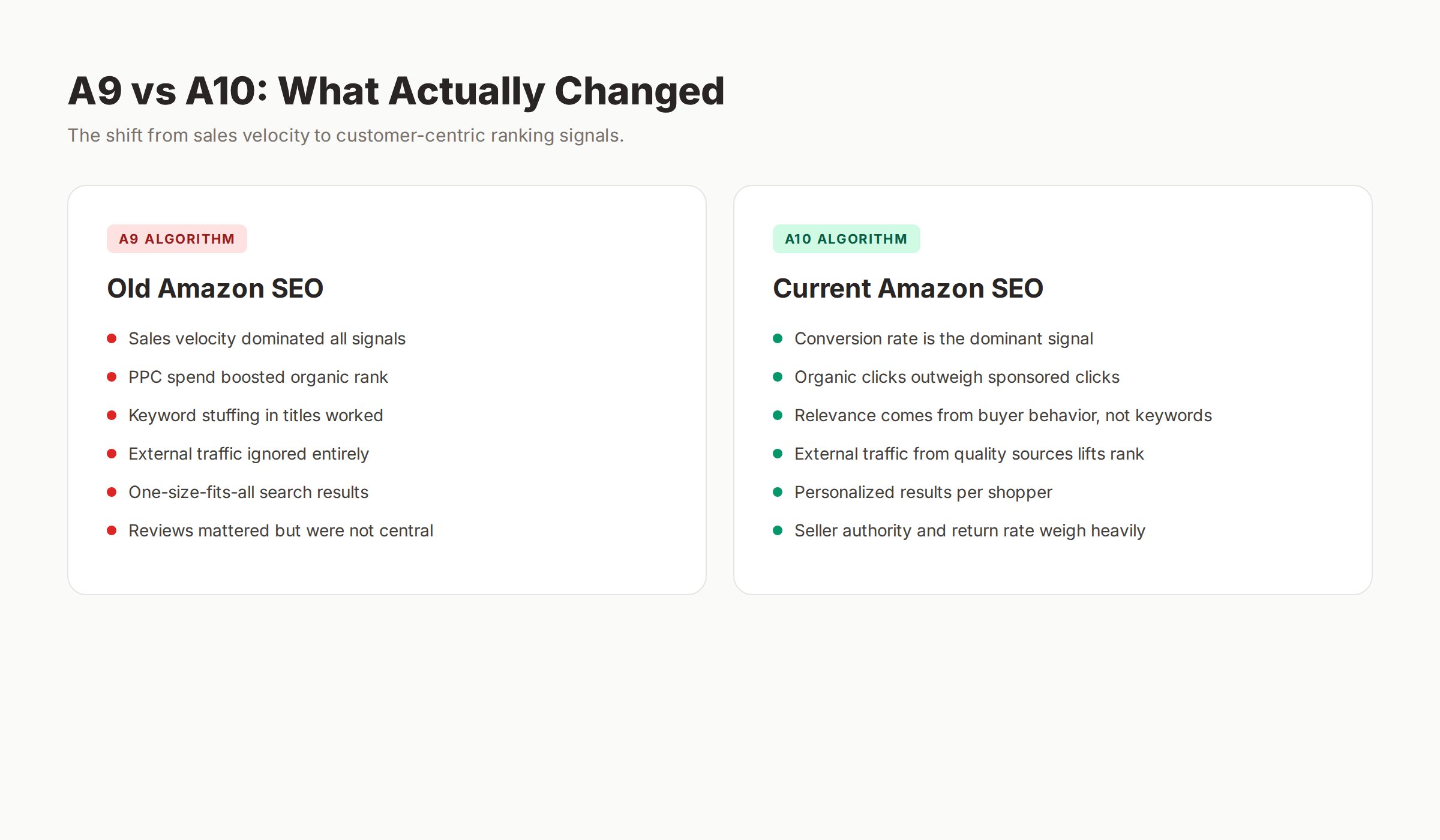
Sponsored clicks used to pull organic rank up alongside paid placement. Under A10, sponsored conversions still count toward velocity, but the lift is smaller and slower. Buyers who arrive through PPC convert at lower rates than buyers from organic search, and A10 reads that gap as a relevance signal.
External traffic is the second major shift. Under A9, sending traffic from a blog or a creator partnership had zero impact on rank. Under A10, a buyer who arrives at your listing from a high-intent source and converts triggers a ranking boost that compounds over weeks.
Why Amazon Built A10 This Way
Amazon ran the numbers on A9 and found a problem. Sellers were gaming sales velocity with deeply discounted launches that produced one-time spikes and zero retention. A10 was designed to surface products that hold rank because customers genuinely want them, not because a launch team threw $20,000 at week one.
This explains why return rate carries so much weight in 2026. A listing that converts at 12% but returns 15% of orders tells Amazon the listing is misleading. Returns cost Amazon money on shipping, restocking, and refunds, so A10 buries listings that drive them up.
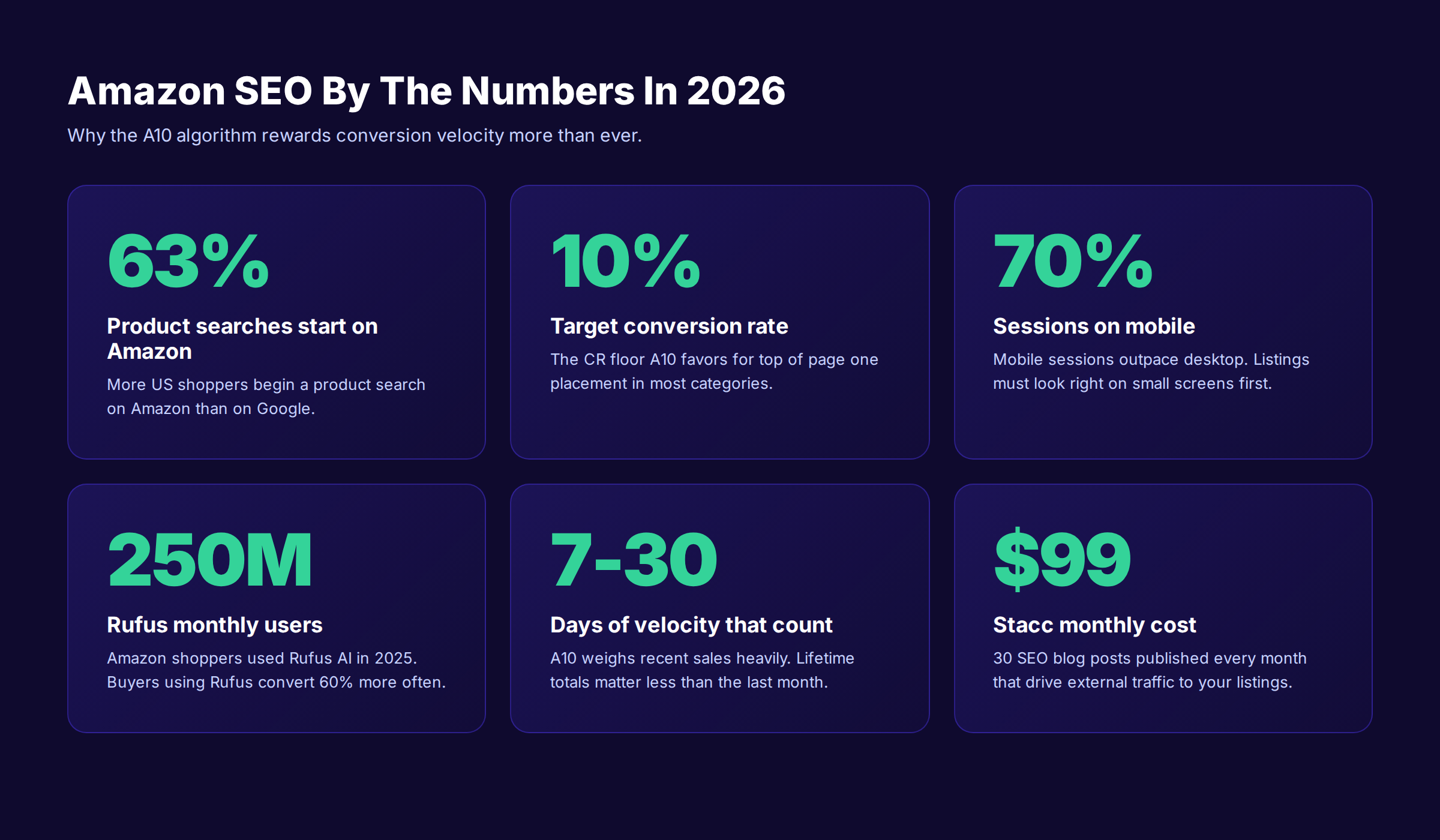
The shift toward customer signals also reflects Rufus, Amazon's AI shopping assistant. In 2025, 250 million Amazon shoppers used Rufus, and interactions were up 210% year over year according to Amazon's earnings disclosure. Rufus needs to recommend products that actually satisfy buyers, and A10 feeds it the data to do that. Conversion rate, review quality, and return rate are the inputs Rufus reads before it points a shopper at your listing.
Chapter 2: The 9 Ranking Factors That Drive A10
A10 weights signals differently from A9, and the order of importance matters when you allocate your optimization budget. We grouped the 9 factors into high, medium, and lower impact bands based on patterns we see across our ecommerce clients and what top Amazon SEO research firms like SellerLabs and Signalytics publish.
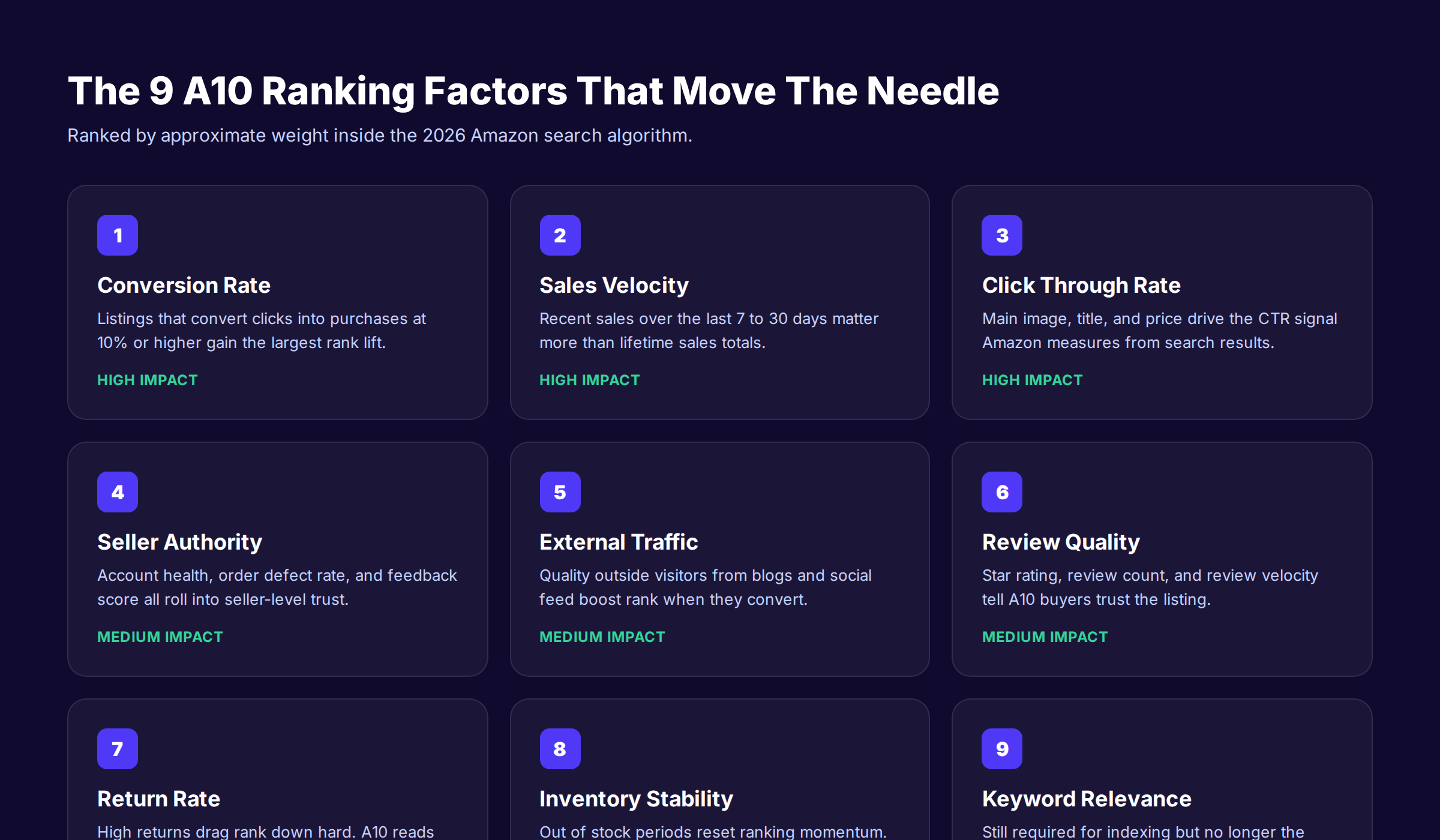
The 9 Factors Ranked By Weight
| Rank | Factor | Weight | What It Measures |
|---|---|---|---|
| 1 | Conversion Rate | High | Percentage of clicks that become orders |
| 2 | Sales Velocity | High | Recent unit sales over 7 to 30 days |
| 3 | Click Through Rate | High | Clicks divided by impressions from search |
| 4 | Seller Authority | Medium | Account health, feedback, and order defects |
| 5 | External Traffic | Medium | Quality buyers arriving from off-Amazon |
| 6 | Review Quality | Medium | Star rating, count, and recency |
| 7 | Return Rate | Medium | Orders returned divided by orders placed |
| 8 | Inventory Stability | Lower | Stock continuity over time |
| 9 | Keyword Relevance | Lower | Index match between query and listing |
The takeaway is that 3 signals carry most of the weight, and all 3 are downstream of how shoppers actually behave on your listing page. You cannot fake conversion rate, click through rate, or sales velocity. Either buyers want the product or they do not.
Why Conversion Rate Sits at the Top
Amazon's algorithm treats conversion rate as the paramount ranking factor because it directly correlates with platform revenue. A product that converts at 5% generates more income per impression than one converting at 2%, so A10 keeps surfacing the higher converter to maximize Amazon's take.
The benchmark conversion rate inside most product categories is 10% to 15%. Listings that beat that range hit the top of page one quickly. Listings under 5% rarely escape page 3, even with strong reviews and a clean title.
This single metric is why the rest of the guide focuses so heavily on listing optimization, image quality, and pricing. Every change you make either pushes conversion rate up or pulls it down. There is no neutral tweak.
The Velocity Window That Matters
A10 measures sales velocity inside a rolling 7 to 30 day window. Lifetime sales totals barely register. A listing that sold 50,000 units over 4 years but only 20 units last month ranks below a 6-month-old listing that sold 200 units in the last 7 days.
This rolling window punishes coasting sellers. A product that hits page one and stays there needs continuous sales pressure. The moment velocity drops, the rank starts sliding within days.
The window also rewards new launches. A 30 day old listing with strong velocity outranks competitors that are slowing down. This is why launch playbooks built around the first 30 days work so well on A10.
Chapter 3: The Conversion Rate Playbook For A10
Conversion rate is the most important signal A10 reads. Every other tactic in this guide is in service of getting your CR above the category benchmark. Here is the playbook we use to push conversion rate from 4% to 12% on Amazon listings.
Pricing That Converts
Price is the single biggest CR lever on Amazon. Buyers comparison shop inside the search results, and a listing priced 20% above the page one median converts at half the rate.
| Pricing Position | Typical Conversion Rate | Rank Impact |
|---|---|---|
| 30% below median | 14% to 18% | Top of page one |
| At the median | 9% to 12% | Page one |
| 20% above median | 4% to 6% | Page two or three |
| 50% above median | Under 3% | Page four and beyond |
The fix is not always to drop price. The fix is to either match price and win on listing quality, or to charge a premium and prove it through video, A+ content, and reviews. The middle ground is where listings die.
The Image Stack That Lifts CR
A10 reads main image click through rate as a leading signal for conversion rate. If your main image gets clicks at 0.5% from search results, A10 does not bother pushing it higher. Mobile shoppers see your main image at thumbnail size, and 70% of Amazon sessions happen on mobile.
Your image stack needs to cover 6 to 9 angles per listing:
- Main image: Pure white background, product fills 85% of frame, no text overlays. This is the only image that must comply with Amazon's main image policy.
- Infographic: Key benefits and dimensions labeled with callouts. This is the highest-converting secondary slot.
- Lifestyle: Product in use by a realistic customer in a realistic environment.
- Comparison chart: Side-by-side with the cheaper alternative, or with your other SKUs.
- Scale shot: Product held by a hand, on a desk, or next to a known object so size is obvious.
- Detail shot: Close-up of the feature that justifies the price premium.
- Packaging: Especially important for gift purchases and Subscribe and Save items.
- Video: 30 to 60 seconds, captioned for sound-off viewing.
The Bullet Point Framework
Bullets are the fastest CR lever on the listing because they sit above the fold on desktop and load before the description on mobile. The mistake most sellers make is writing bullets as feature lists. A feature list does not convert. A benefit framework does.
Use the Benefit + Proof + Use Case structure for every bullet:
- Bullet 1: Lead benefit. Why does this product exist?
- Bullet 2: Differentiating feature. What makes it different from the cheaper option?
- Bullet 3: Quality or durability proof. How long will it last?
- Bullet 4: Use case specificity. Who is this for and when do they use it?
- Bullet 5: Guarantee or trust signal. What happens if it does not work?
For a deeper breakdown of writing copy that converts on a product page, our On-Page SEO Guide covers the same principles applied to your own website.
Want 30 SEO blog posts published every month that drive external traffic to your Amazon listings? theStacc handles the writing, publishing, and internal linking for $99. No writers to manage, no agency retainer.
Chapter 4: Listing Title and Bullet Optimization
The Amazon listing title is the single highest-traffic piece of copy on the entire platform. It appears in search results, on the product page, on Rufus answers, and inside Google search snippets that pull from Amazon. Get it wrong and every downstream metric suffers.
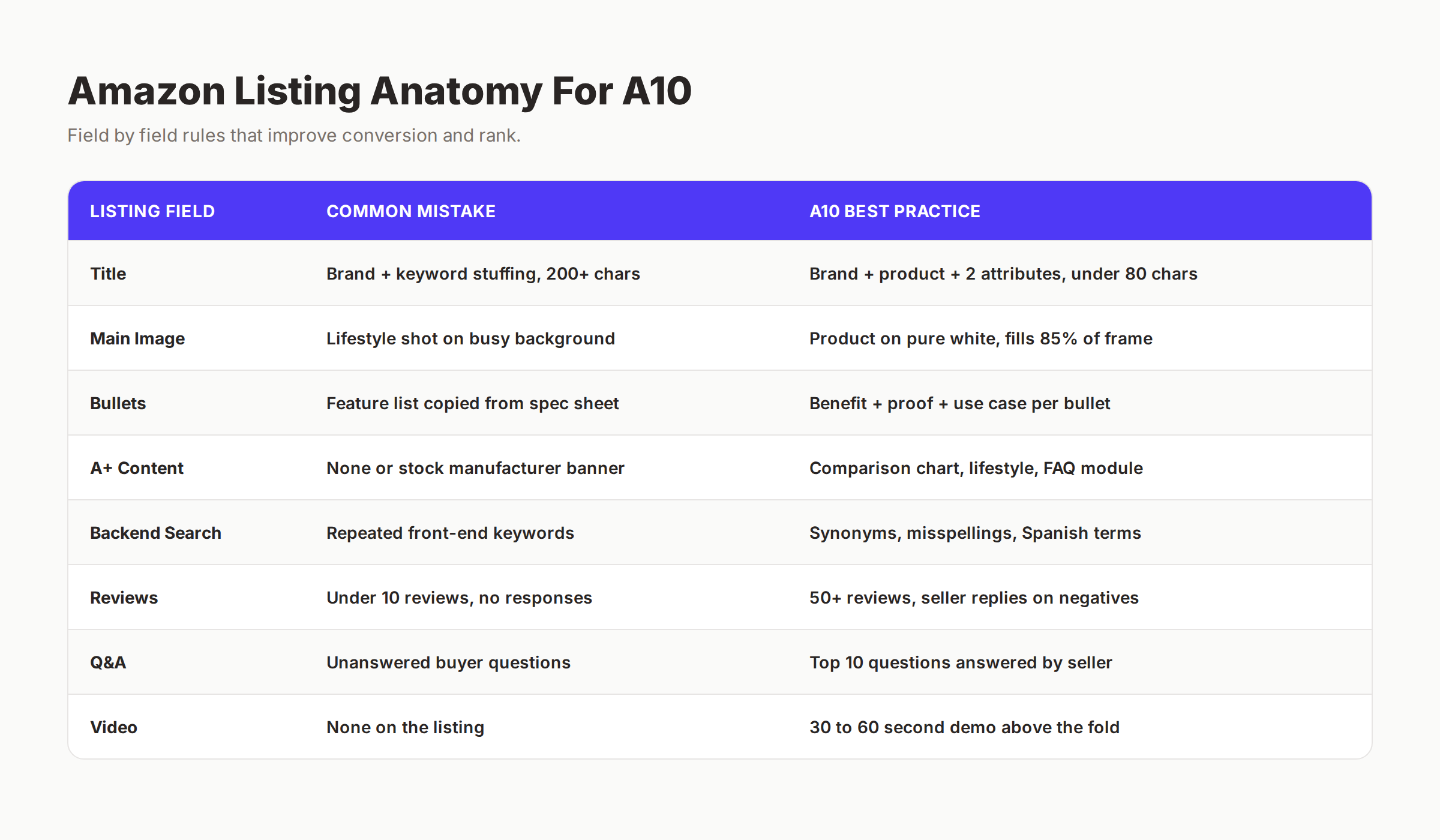
The 2026 Title Formula
A9 rewarded keyword-stuffed titles. A10 punishes them. The 200-character titles that ranked in 2019 now drop click through rate by 30% to 40% because shoppers on mobile cannot read them in the search results.
The current best-practice title formula is:
Brand + Product Type + 2 Key Attributes + VariationKeep it under 80 characters when possible, never over 150. Example:
- Bad (A9 style): "OXO Good Grips Stainless Steel Coffee Grinder Burr Mill Adjustable Settings 15 Grind Options for French Press Espresso Drip Pour Over Cold Brew Kitchen Appliance"
- Good (A10 style): "OXO Good Grips Burr Coffee Grinder, 15 Grind Settings, Stainless Steel"
The second title indexes for the same core keywords, reads in the search results, and converts because shoppers can scan it on a phone.
Bullet Points That A10 Rewards
Amazon allows 5 bullet points up to 1,000 characters each. Filling all 5 to the max almost always hurts conversion rate. Mobile shoppers see only the first 2 to 3 bullets above the fold, and walls of text drop CR fast.
Target 150 to 250 characters per bullet. Lead with the benefit, support with the proof, and write in plain language.
Backend Search Terms Done Right
The backend search terms field allows 249 bytes of keywords that index your listing without appearing on the page. Most sellers fill this with repeats of front-end keywords. That is wasted real estate.
A10 reads backend search terms only once. Repeating "coffee grinder" 12 times gives you zero additional lift. Filling the field with synonyms, common misspellings, Spanish-language equivalents, and adjacent use cases gives you incremental impressions you cannot capture from the title alone.
For a coffee grinder, useful backend terms include: burr grinder, espresso grinder, electric grinder, kitchen grinder, molinillo de cafe, gift for coffee lover, replacement parts, OXO replacement, coffee maker accessory.
The A+ Content Mistake
A+ Content lives below the bullets and replaces the standard product description. Brand Registered sellers can use A+ to add comparison charts, lifestyle photography, brand stories, and FAQ modules. The mistake we see most often is sellers treating A+ as decoration.
A+ Content lifts conversion rate by 5% to 10% on average. The version of A+ that actually works includes:
- Comparison chart: Your full product line side by side, with check marks for which SKU has which feature.
- Lifestyle module: Photography that shows the product in 3 to 4 use cases.
- FAQ module: The top 5 questions buyers ask, answered with specifics.
- Brand story: A short paragraph about why the product exists. Brand story modules convert when they are honest, not when they are corporate.
For a related framework on writing product content that ranks both on Amazon and on your own store, see our Product Page Schema Guide.
Chapter 5: External Traffic and How A10 Reads It
External traffic is the second-most-debated A10 signal after PPC. The short version: yes, it matters, but only when the traffic converts. Low-quality traffic from cheap clickbait social ads can actively hurt rank because it tanks your conversion rate.
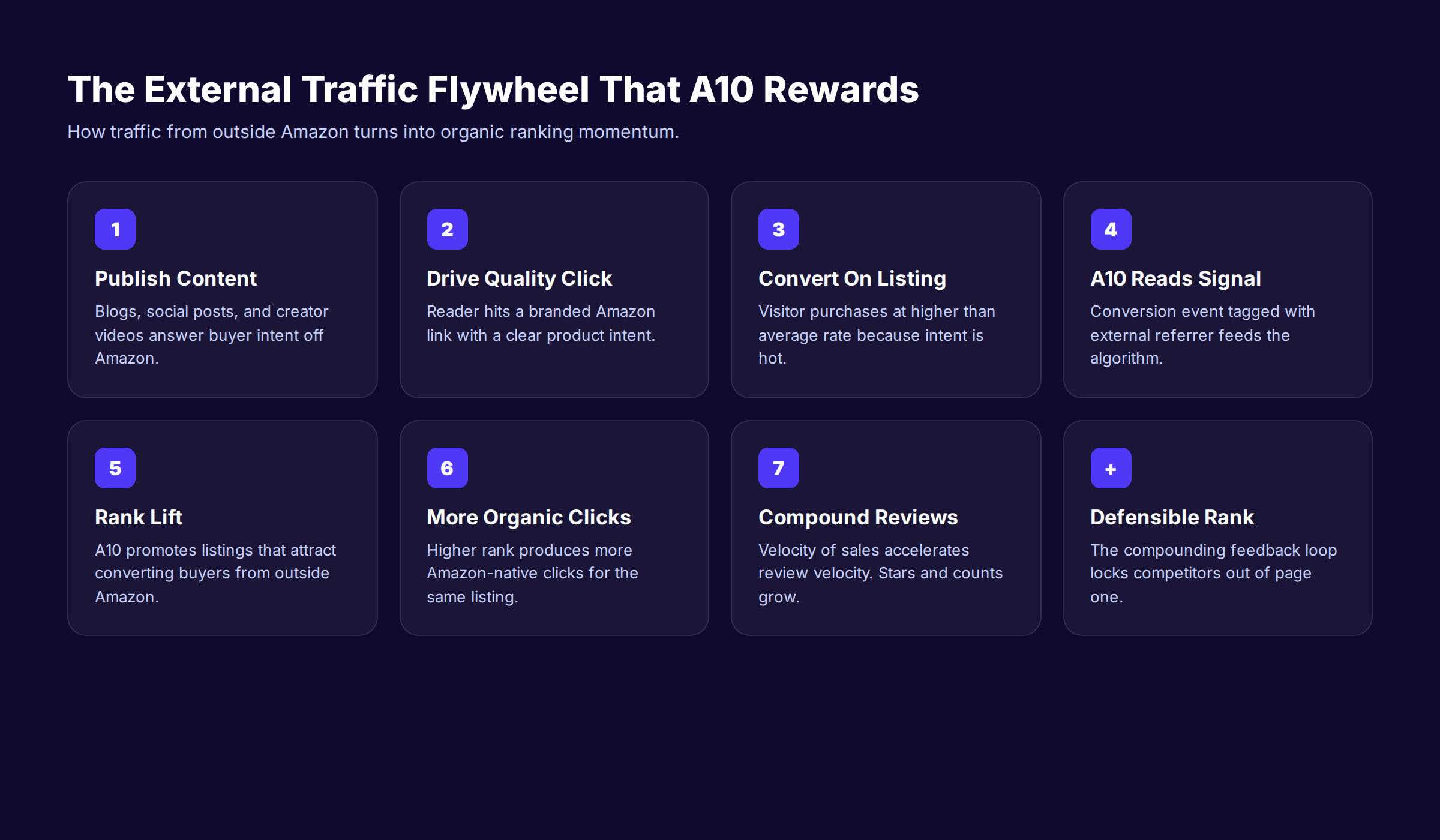
Why External Traffic Lifts A10 Rank
A10 measures conversion rate as orders divided by clicks. A buyer who arrives from an Amazon search converts at one rate. A buyer who arrives from a high-intent blog post or a creator video converts at a higher rate, because they already decided what they want.
When A10 sees a sustained pattern of converting external clicks, the algorithm reads it as proof that demand exists for the product. Rank lifts within 2 to 4 weeks. The lift compounds because the higher rank produces more Amazon-native clicks, which produces more reviews, which produces more rank.
Amazon evaluates external traffic quality by measuring engagement rate and conversion, not just volume. 100 clicks from a targeted email list that converts at 15% boosts your ranking far more than 1,000 random social clicks that bounce.
Which External Sources Actually Work
Not every external traffic source produces the same lift. Here is what works in 2026 ranked by ROI:
| Source | Quality | Best For |
|---|---|---|
| SEO blog posts | Very high | Compound traffic, long tail keywords |
| Email newsletter | Very high | Repeat buyers, list-warm offers |
| Creator partnerships | High | Visual products, social proof |
| High | Home, kitchen, fashion, decor | |
| YouTube reviews | High | Tech, tools, premium goods |
| Reddit AMAs and posts | Medium | Niche communities only |
| TikTok organic | Medium | Impulse purchases, viral SKUs |
| Facebook ads | Low | Burns budget without rank lift |
| Instagram boosted posts | Low | Bot traffic risk |
The pattern is clear. Channels that attract buyers with active intent convert better and lift A10 rank more efficiently. Channels that interrupt scrollers with cheap creative usually cost more than they return.
The Amazon Attribution Setup
Amazon Attribution is the tool that lets you track which external sources convert on your listings. It is free for sellers in Seller Central and Vendor Central. The setup takes about an hour and the data it produces is the only way to know which channels are paying off.
Set up Amazon Attribution this way:
- ✓ Enable Amazon Attribution in Seller Central under Brands
- ✓ Create a unique tag for each external channel (blog, email, Pinterest, YouTube)
- ✓ Wrap every external Amazon link with the matching attribution tag
- ✓ Track conversion rate per channel inside the Attribution dashboard
- ✓ Cut spend on any channel converting under 3%
- ✓ Double down on any channel converting over 8%
Why Blogs Beat Social for Amazon SEO
Social posts disappear from feeds within 24 hours. Blog posts compound traffic for years. A single blog post ranking for a buying-intent keyword sends qualified clicks to your Amazon listing month after month with zero additional spend.
This is The Content Compound Effect applied to Amazon. A store with 50 supporting blog posts has 50 entry points that funnel toward the Amazon listing. Paid social gives you one campaign that ends the moment budget runs out.
Brands that want both the SEO benefit and the Amazon rank lift run a content engine that publishes 3 to 8 posts per month. At theStacc, we publish 30 SEO articles per month for $99, which is the most efficient external traffic engine on the market. For sellers comparing the cost of in-house writers versus outsourced content, our breakdown of In-House vs Outsource Content Teams covers the math.
Chapter 6: Reviews, Q&A, and Customer Signals
Reviews are the most visible A10 signal and the one buyers cite most often when explaining why they picked a product. The algorithm reads more than just star rating. Review velocity, recency, response patterns, and verified purchase ratio all flow into rank.
What A10 Reads Inside Reviews
Five things drive review-based rank lift:
- Average star rating. 4.3 is the floor for top of page one in most categories. 4.5 plus is the sweet spot.
- Review count. 50 reviews is the threshold where A10 starts treating a listing as established. 200+ reviews signal mass acceptance.
- Review velocity. Listings gaining 1 to 2 reviews per day outrank static listings with higher totals.
- Verified purchase ratio. A higher share of verified reviews tells A10 the reviews are authentic.
- Seller response pattern. Sellers who respond to 1 to 3 star reviews within 48 hours see retention rank gains.
How To Drive Review Velocity
Amazon Vine is the most reliable way to add reviews quickly. Vine costs $200 per ASIN and produces up to 30 verified reviews from Vine Voices. The reviews are honest, which means quality products win and weak products get exposed early. We recommend Vine for every product under 50 reviews.
Outside Vine, the Request a Review button in Seller Central is the only fully compliant way to ask for reviews. It sends a single, Amazon-controlled email at the right time after delivery. Sellers who click Request a Review on every order convert about 5% of buyers into reviewers.
Avoid every third-party review service that promises reviews in exchange for product or payment. These services trigger Section 3 suspensions and the loss of selling privileges. For more on review compliance and the FTC implications, see our breakdown of the AI Generated Reviews FTC Fine.
Q&A As A Ranking Signal
The Q&A section sits between the bullets and the reviews on every listing. A10 reads questions and answers as relevance signals. Listings with 10 or more answered questions outrank listings with empty Q&A sections.
Seed your Q&A section by asking 5 to 10 of your own questions through your seller account and answering them with full, honest detail. Then monitor the section weekly for buyer questions and respond within 24 hours.
Top 10 questions to seed on every new listing:
- What is the exact size and weight?
- Is this compatible with [common adjacent product]?
- How long does it last with normal use?
- What materials is it made from?
- Where is it manufactured?
- Does it work for [specific use case]?
- What is included in the box?
- How do I clean or maintain it?
- Does it come with a warranty?
- What is the return policy if it does not fit?
Return Rate As A Rank Killer
Return rate is the A10 signal that catches most sellers by surprise. Amazon does not display your return rate publicly, but the algorithm reads it on every order. Listings with return rates above 10% lose rank quickly. Listings under 4% gain rank momentum.
Lower return rate by:
- Writing honest descriptions that match what buyers receive
- Showing scale and dimension in 2 to 3 images
- Including sizing charts for apparel and accessories
- Adding video that shows the product working in real conditions
- Answering size and fit questions in the Q&A and FAQ modules
Chapter 7: Seller Authority and Account Health
Seller authority sits in the middle of the A10 ranking weight stack, but it acts like a multiplier. A strong seller account amplifies every other ranking signal. A weak account drags every other signal down.
What Amazon Means By Seller Authority
A10 reads at least 5 signals at the account level:
- Order defect rate. Under 1% to stay healthy.
- Late shipment rate. Under 4% to avoid penalties.
- Pre-fulfillment cancel rate. Under 2.5%.
- Valid tracking rate. Above 95% for self-fulfilled orders.
- Feedback score. 4.5 stars or higher across last 90 days.
Sellers who hold all 5 metrics inside the green range gain a quiet rank lift across every ASIN they sell. Sellers who slip into the yellow on 2 or more metrics see rank slides across the entire catalog, not just the affected products.
The Inventory Stability Signal
A10 punishes out-of-stock periods harder than it used to. A product that sells out for 7 days loses meaningful rank momentum, and rebuilding takes 4 to 8 weeks even after restock.
Inventory Performance Index (IPI) is the score Amazon publishes for each FBA seller. The score combines excess inventory, sell-through rate, stranded inventory, and in-stock rate. Sellers with IPI scores above 600 get expanded storage and stronger rank stability. Sellers under 400 get storage limits and rank penalties.
Keep IPI healthy by:
- Forecasting demand 8 to 12 weeks ahead using rolling 30-day sales data
- Sending replenishment shipments at the 6-week mark, not when stock runs low
- Removing or liquidating any SKU that sits for over 90 days
- Resolving stranded inventory within 7 days of an alert
Brand Registry As An Amplifier
Amazon Brand Registry is the program that gives trademarked brands access to A+ Content, Brand Stores, Sponsored Brands ads, and Brand Protection tools. Registry status is itself a small rank signal, but the features it unlocks are major ones.
Brand Registry takes 2 to 4 weeks to approve and requires an active USPTO trademark. The ROI is immediate. Brand-Registered listings convert 5% to 10% higher than unregistered listings because of A+ Content alone.
For sellers comparing the long game of brand building versus pure performance plays, the SaaS SEO Guide covers a similar dynamic for software brands.
Chapter 8: Amazon SEO For Rufus and AI Search
Amazon Rufus is the conversational AI shopping assistant Amazon launched in 2024 and scaled across the US, UK, India, and Brazil in 2025. By 2026, Rufus handles 250 million monthly users and answers questions before buyers ever scroll through traditional search results.
How Rufus Reads Listings
Rufus pulls answers from 4 sources inside Amazon:
- Listing title, bullets, description, A+ Content
- Verified customer reviews
- Q&A section content
- Product specifications and structured data
When a shopper asks Rufus "what is the quietest electric coffee grinder under $100," Rufus does not run a traditional keyword search. It reads the language across thousands of listings, reviews, and Q&A sections to surface the products that genuinely match the intent.
Listings that rank in Rufus answers share 3 traits:
- Honest, specific language in titles and bullets that matches how buyers actually talk
- Long-tail Q&A content that answers buying questions in plain English
- Strong reviews that mention specific use cases, not just star ratings
Buyers who use Rufus during a shopping journey are 60% more likely to buy a product, according to Amazon's own data. That means Rufus visibility now matters as much as page one organic rank.
Optimizing For Rufus Answers
Three changes lift Rufus visibility:
- Rewrite bullets in natural buyer language. Instead of "Adjustable burr settings with 15 grind options," write "Adjusts from coarse for French press to fine for espresso with 15 settings."
- Seed the Q&A section with buyer-intent questions. Use real questions from Google's People Also Ask and from Reddit threads about your category. For more on this technique, see our guide on Optimize People Also Ask.
- Solicit specific reviews. Buyers who write specific reviews ("works great with French press, not loud enough to wake my kids") help Rufus match the listing to specific shopper intent.
AI Overviews and Google Search
Amazon listings now appear inside Google's AI Overviews when shoppers ask product-buying questions in Google. The same factors that lift Rufus visibility lift AI Overview citations: honest copy, specific reviews, and structured data.
For brands building both Amazon and direct-to-consumer presence, our breakdown of Get Cited In AI Search covers the broader strategy for AI citation across platforms.
Chapter 9: The Amazon A10 Optimization Checklist
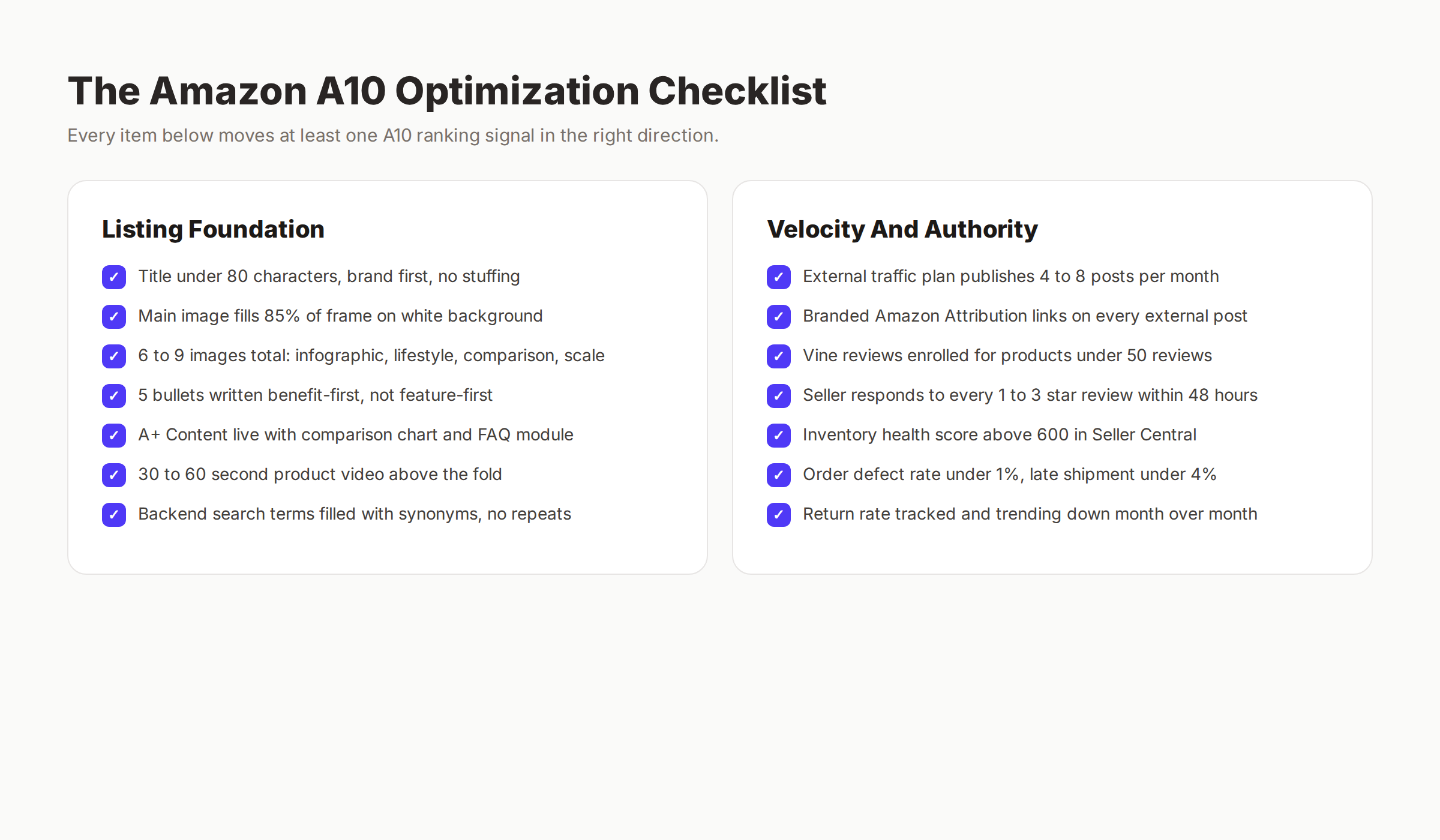
The full A10 optimization checklist below covers every move that improves at least one ranking signal. Work through it on every new launch and revisit quarterly on every active SKU.
Listing Foundation
- ✓ Title under 80 characters with brand first and 2 key attributes
- ✓ Main image fills 85% of frame on pure white background
- ✓ 6 to 9 images total including infographic, lifestyle, comparison, and scale
- ✓ 5 bullet points written in Benefit + Proof + Use Case format
- ✓ A+ Content with comparison chart, lifestyle module, and FAQ
- ✓ 30 to 60 second product video above the fold
- ✓ Backend search terms filled with synonyms and misspellings, not repeats
- ✓ Variation parent set up correctly with all child SKUs linked
- ✓ Pricing within 15% of category median, or premium justified by content
Velocity And External Traffic
- ✓ Amazon Attribution tags set up for every external channel
- ✓ 4 to 8 SEO blog posts per month driving qualified external traffic
- ✓ Email list segmented for product-specific launches and offers
- ✓ Pinterest, YouTube, or Reddit channel matched to product category
- ✓ PPC campaigns tuned for conversion, not just impressions
- ✓ Amazon Vine enrolled for every product under 50 reviews
Authority and Compliance
- ✓ Brand Registry approved with active USPTO trademark
- ✓ Account health metrics all in the green band
- ✓ IPI score above 600 to protect storage and rank
- ✓ Inventory replenishment scheduled at 6-week intervals
- ✓ Return rate tracked and trending below 5% per SKU
- ✓ Seller responses to all 1 to 3 star reviews within 48 hours
Rufus and AI Visibility
- ✓ Bullets written in natural buyer language that matches shopper questions
- ✓ Q&A section seeded with 10 buyer-intent questions
- ✓ Reviews include specific use cases, not just generic praise
- ✓ Structured data complete for category-specific attributes
- ✓ A+ Content includes FAQ module with conversational answers
Chapter 10: Common Amazon SEO Mistakes To Avoid
The same 7 mistakes show up on every underperforming Amazon listing we audit. Each one tanks at least one A10 signal.
Mistake 1: Keyword Stuffing The Title
A 200-character title packed with synonyms looked smart under A9. Under A10 it drops click through rate by 30% to 40% because shoppers on mobile cannot read it. The fix is a brand-first, under-80-character title.
Mistake 2: Optimizing For Desktop
70% of Amazon sessions happen on mobile. Listings that look good on a 27-inch monitor often fall apart on a 6-inch phone. Preview every change in the mobile app, not the desktop browser.
Mistake 3: Treating Bullets As A Spec Sheet
A spec sheet does not convert. A benefit framework does. Lead each bullet with the customer outcome, support with the technical detail.
Mistake 4: Driving Junk External Traffic
Cheap Facebook clicks that bounce hurt rank under A10. Quality external traffic that converts lifts rank. The math is in the conversion rate, not the click volume.
Mistake 5: Skipping Vine On New Launches
A new launch with 0 reviews competes against incumbents with 500 reviews. Vine closes the gap fast. $200 per ASIN for up to 30 verified reviews is the highest-ROI launch spend on Amazon.
Mistake 6: Ignoring Return Rate
A 12% conversion rate paired with a 15% return rate looks great on the dashboard and dies on A10. Returns are a customer dissatisfaction signal. Lower them with honest copy, scale shots, and video.
Mistake 7: Treating Q&A Like A Help Desk
Most sellers ignore the Q&A section entirely. A10 reads it as a relevance signal. Listings with 10+ answered questions outrank listings with empty Q&A every time.
What practitioners are saying on X
Fundamentals plus AI-search measurement remain the dual stack operators describe on X.
- @jakezward (Feb 2026): 2026 SEO predictions emphasize AI Overview share-of-SERP, schema for LLM token efficiency, brand mentions in AI answers as a KPI, proprietary data as a moat, and content refresh beating net-new AI slop. See the post on X.
- @hridoyreh (Mar 2026): Widely shared SEO skill tree: foundations, research, technical, on-page, content, links, AI SEO/GEO, analytics, UX, brand, programmatic — useful map for stats and how-to posts. See the post on X.
- @ConnorGillivan (Jul 2026): 2026 SEO stack favorite list: Semrush/Ahrefs, GSC, Surfer, KeywordInsights, ChatGPT, SEOwind, Screaming Frog, ClearScope, GA4, Notion/Airtable — tools amplify systems, they don’t replace them. See the post on X.
Grok, AI Overviews, and multi-engine visibility
For “amazon seo guide”, multi-engine visibility still starts with clear definitions, sourced numbers, and extractable section answers. Grok additionally factors live X discussion — keep public claims consistent with this page.
- Google AI Overviews: Use passage-ready answers, tables, and FAQ schema where relevant.
- ChatGPT / Perplexity: Cite named sources next to key claims.
- Grok: Maintain accurate entity facts on-site and in high-signal X posts.
Publish content built for Google and AI citations. theStacc’s Content SEO module ships SEO-scored articles structured for rankings and generative engines — including clearer entity pages models like Grok can quote.
Frequently Asked Questions
The Amazon A10 algorithm is the system Amazon uses to rank products inside its own search engine. It replaced A9 in 2020 and now weighs conversion rate, sales velocity, click through rate, seller authority, and external traffic more heavily than the keyword-driven signals A9 prioritized. By 2026 the A10 algorithm is a customer-satisfaction predictor that surfaces products buyers actually want, not just products with high PPC spend.
A9 ranked products mostly on sales velocity and keyword match, and it pushed sponsored placements heavily. A10 still uses those signals but now weights conversion rate, customer reviews, return rate, and seller authority as primary ranking factors. External traffic from outside Amazon now influences rank under A10, while PPC carries less organic lift than it did under A9.
Yes, external traffic still lifts A10 rank, but only when the traffic converts. Quality buyers from blog posts, email lists, and creator partnerships push conversion rate up, and A10 reads that as proof that demand exists. Low-quality social traffic that bounces hurts rank because it tanks conversion rate. Amazon Attribution is the free tool that tracks which external sources actually pay off.
The benchmark conversion rate inside most product categories is 10% to 15%. Listings that beat that range tend to hit the top of page one within weeks. Listings under 5% rarely escape page 3, even with strong reviews and a clean title. Pricing position, main image quality, and bullet copy are the 3 biggest CR levers.
Optimize for Rufus by rewriting bullets in natural buyer language, seeding the Q&A section with 10 buyer-intent questions, and soliciting reviews that mention specific use cases instead of generic praise. Rufus reads listings, reviews, and Q&A to answer shopper questions, so listings that match how real buyers talk get cited more often. Buyers who use Rufus convert at 60% higher rates, which makes Rufus visibility worth as much as traditional page one rank.
A new Amazon listing takes 4 to 12 weeks to reach page one for a moderately competitive keyword. Launch playbooks built around the first 30 days of conversion velocity tend to compound rank gains faster. Listings with strong external traffic from SEO blog posts or email lists often hit page one within 8 weeks because the traffic feeds both conversion rate and review velocity at the same time.
Sponsored clicks count toward sales velocity, but the organic rank lift from PPC is smaller and slower than it was under A9. PPC buyers convert at lower rates than organic buyers, and A10 reads that gap as a relevance signal. The most efficient PPC strategy is to tune campaigns for conversion rate first, impressions second.
The Bottom Line On Amazon SEO And The A10 Algorithm
The Amazon A10 algorithm rewards listings that buyers actually love. Conversion rate, return rate, review quality, and seller authority now drive most of the rank lift, and the sellers who keep optimizing for A9-era keyword stuffing watch their rank slide every quarter. The playbook in 2026 is to write honest listings, capture conversion velocity from quality external traffic, and protect seller authority through clean account health.
If you want the external traffic engine that lifts A10 rank without the cost of an in-house content team, theStacc publishes 30 SEO blog posts per month that drive qualified buyers to your Amazon listings. We have done this for ecommerce brands across 70+ industries, and the cost is $99 per month, not the $3,000 to $10,000 an agency charges.
The brands winning Amazon search in 2026 treat their listings as products customers love and their content engine as the flywheel that brings new buyers in. Both halves compound. The sooner you start, the sooner A10 starts working for you instead of against you.
This article was researched and published by theStacc. We publish SEO content for ecommerce brands, local businesses, and SaaS companies across 70+ industries. Amazon ranking factor data was verified against public sources from SellerLabs, Signalytics, MyAmazonGuy, and Amazon Seller Central as of May 2026.
Related Reading
- Ecommerce SEO Guide
- Marketplace SEO Guide
- Keyword Research For Ecommerce
- Product Page Schema Guide
- On-Page SEO Guide
- Shopify AI Shopping Agents
Related Tools & Resources
Free SEO Tools:
Best Lists:
Sources & references
- [1] Princeton / Georgia Tech et al. — GEO research (arXiv:2311.09735)
- [2] @hridoyreh on X — Widely shared SEO skill tree: foundations, research, technical, on-page, content, links, AI SEO/GEO, analytics, UX, bran
- [3] @jakezward on X — 2026 SEO predictions emphasize AI Overview share-of-SERP, schema for LLM token efficiency, brand mentions in AI answers
- [4] Referenced source — aboutamazon.com

Plan topics, review article drafts, and publish to a connected CMS.
Weekly local SEO teardowns
One practical email a week. Map Pack, GBP, AI Overviews. No fluff. Unsubscribe anytime.