The 2026 CRO SEO guide. Combine conversion rate optimization and search engine optimization to turn rankings into revenue. Frameworks, tests, data.
You rank on page one. Traffic is up 40 percent. Revenue is flat. That gap between visitors and customers is the single most expensive problem in modern SEO, and most teams attack it from the wrong direction. They double their content output instead of doubling their conversion rate.
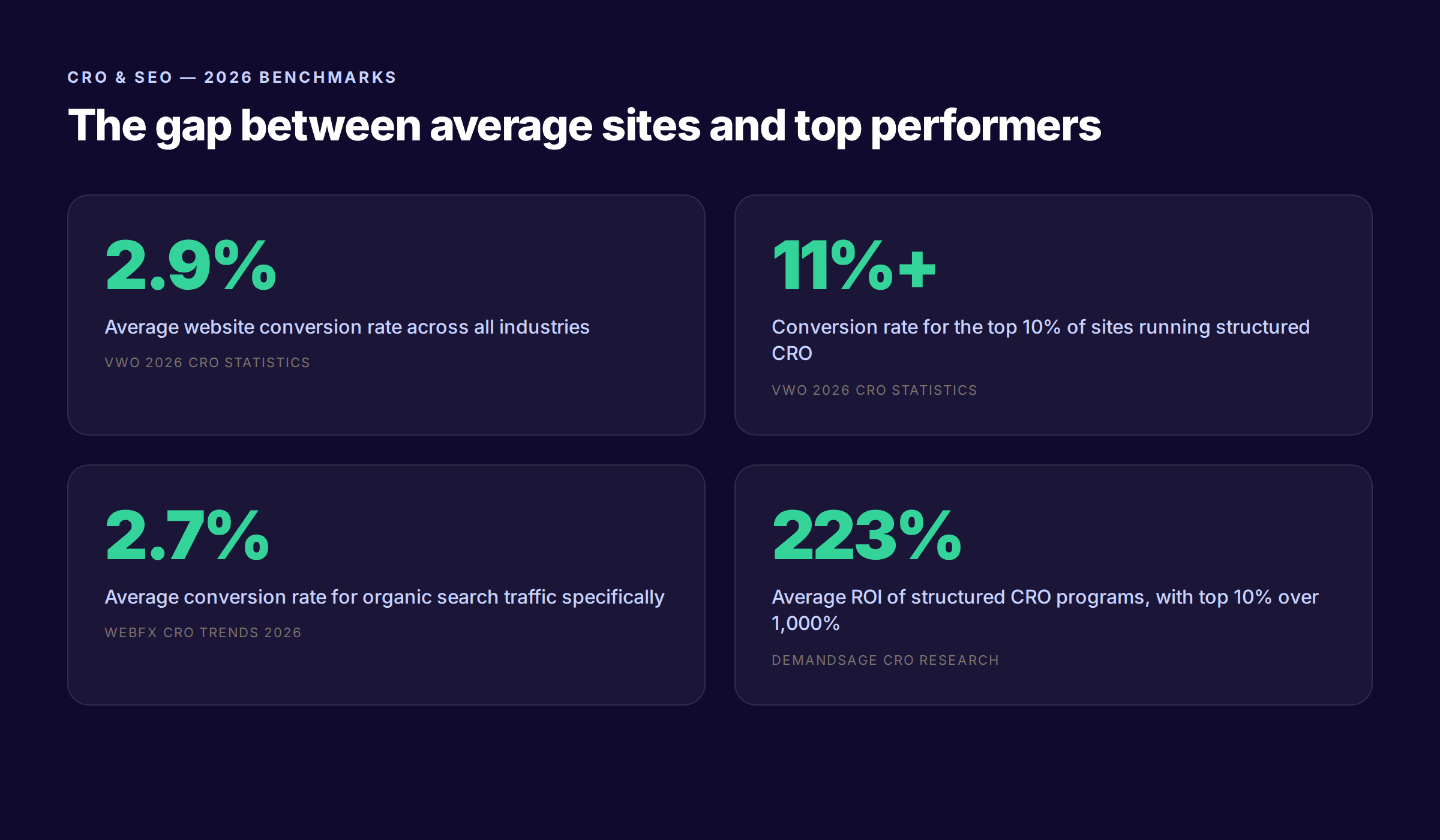
The cost is real. The average website converts at 2.9 percent. The top 10 percent of sites convert at 11 percent or higher. If you sit at the average and your competitor sits at the top, you are giving away 73 percent of every visitor your SEO team works to earn. Six months of content debt does not fix that. Better conversion math does.
This guide fixes the gap. You will learn how CRO and SEO actually compound when paired correctly, the 2026 data behind the integration, the search intent framework that aligns both disciplines, the on-page tests that move both rankings and revenue, and the exact CRO experiments we run on client sites every week.
We publish 3,500+ blogs across 70+ industries every month, and the highest-performing accounts are the ones that built a CRO layer on top of their SEO output. The playbook below is what they did.
Here is what you will learn:
- Why SEO without CRO leaks 73 percent of qualified traffic
- The 2026 data on combined CRO and SEO performance
- The 5-stage funnel where rankings turn into revenue
- The search intent framework that aligns both disciplines
- The 9 highest-impact tests for organic landing pages
- How to use heatmaps, recordings, and analytics together
- The mistakes that break SEO when you optimize for conversions
What CRO and SEO Actually Do Together
CRO stands for conversion rate optimization. It is the process of testing and refining the elements on a page so that more visitors take a desired action. SEO stands for search engine optimization. It is the process of earning organic traffic from search engines. The two disciplines used to live in separate departments. In 2026, that separation is what kills growth.
Think of the relationship as a pipeline. SEO controls the inflow. CRO controls the outflow. If your SEO team triples organic sessions but your conversion rate stays at 1.5 percent, you produced volume without value. If your CRO team doubles conversion rate on a page that gets 200 visits per month, you celebrated a metric that did not move revenue. The winning teams treat both as a single system with shared KPIs.
According to a Semrush analysis on SEO and CRO integration, companies that align both disciplines see compounding gains across qualified traffic and conversion rate at the same time. The pattern is consistent. SEO pulls in the right user. CRO closes them.
The 2026 conversion rate baseline
Before you build a strategy, you need to know what you are working against. These are the numbers we benchmark every client account against.
| Metric | Average | Top 10% | Source |
|---|---|---|---|
| Website conversion rate | 2.9% | 11%+ | VWO 2026 |
| Desktop conversion rate | 5.06% | 13.2% | DesignRush 2026 |
| Mobile conversion rate | 2.49% | 8.4% | DesignRush 2026 |
| Organic search conversion rate | 2.7% | 9.1% | WebFX 2026 |
| Email conversion rate | 19.3% | 31% | DesignRush 2026 |
| CRO program ROI | 223% | 1,000%+ | DemandSage 2026 |
Three numbers matter most in this table. First, mobile converts at half the rate of desktop, which is where most SEO traffic now lands. Second, organic search converts at 2.7 percent, which is below the cross-channel average. Third, the top 10 percent of sites convert at nearly 4x the average. The gap between average and excellent is not luck. It is the result of structured CRO programs running on top of strong SEO foundations.
Why the two disciplines compound
The compounding effect runs in both directions. CRO improves SEO through user signals. SEO improves CRO through traffic quality.
CRO improves SEO when better page layouts increase dwell time, decrease pogo-stick behavior, and earn higher engagement rates. Google does not directly rank on conversion rate, but it does rank on user satisfaction. A page that holds visitors and answers their intent earns more rankings over time. Read our Google ranking factors guide for the complete picture of how user signals shape SERPs.
SEO improves CRO when better keyword targeting brings in users with stronger purchase intent. Ranking for "best running shoes for flat feet" delivers a buyer. Ranking for "what are flat feet" delivers a researcher. The first keyword has lower volume but a 10x higher conversion rate. CRO efforts collapse when you target the wrong intent. We cover this in our search intent guide, which is required reading before any CRO program begins.
The Compound Math: Why You Cannot Pick One
Most marketing teams split their budget between SEO and CRO as if they are alternatives. They are not. They multiply.
Imagine a site that earns 10,000 organic visits per month at a 2 percent conversion rate. That is 200 conversions. Now imagine the SEO team doubles traffic to 20,000 visits. Conversions become 400. A 100 percent gain.
Now imagine the same site keeps traffic flat at 10,000 visits but the CRO team doubles conversion rate to 4 percent. Conversions become 400. Identical gain. Now imagine both teams hit their numbers in parallel. Traffic at 20,000. Conversion rate at 4 percent. Conversions become 800. A 300 percent gain on the same starting point.
This is the compound math. The teams that grow fastest are the teams that run both programs at the same time, with shared dashboards, shared goals, and shared content briefs. The teams that fall behind are the ones who treat SEO and CRO as quarterly initiatives that hand off to each other.
theStacc runs both layers as a single service. We publish 30 SEO-optimized blog posts per month and build them with CRO best practices baked in. No handoffs. No conversion leakage.
The 5-Stage Funnel Where Rankings Turn Into Revenue
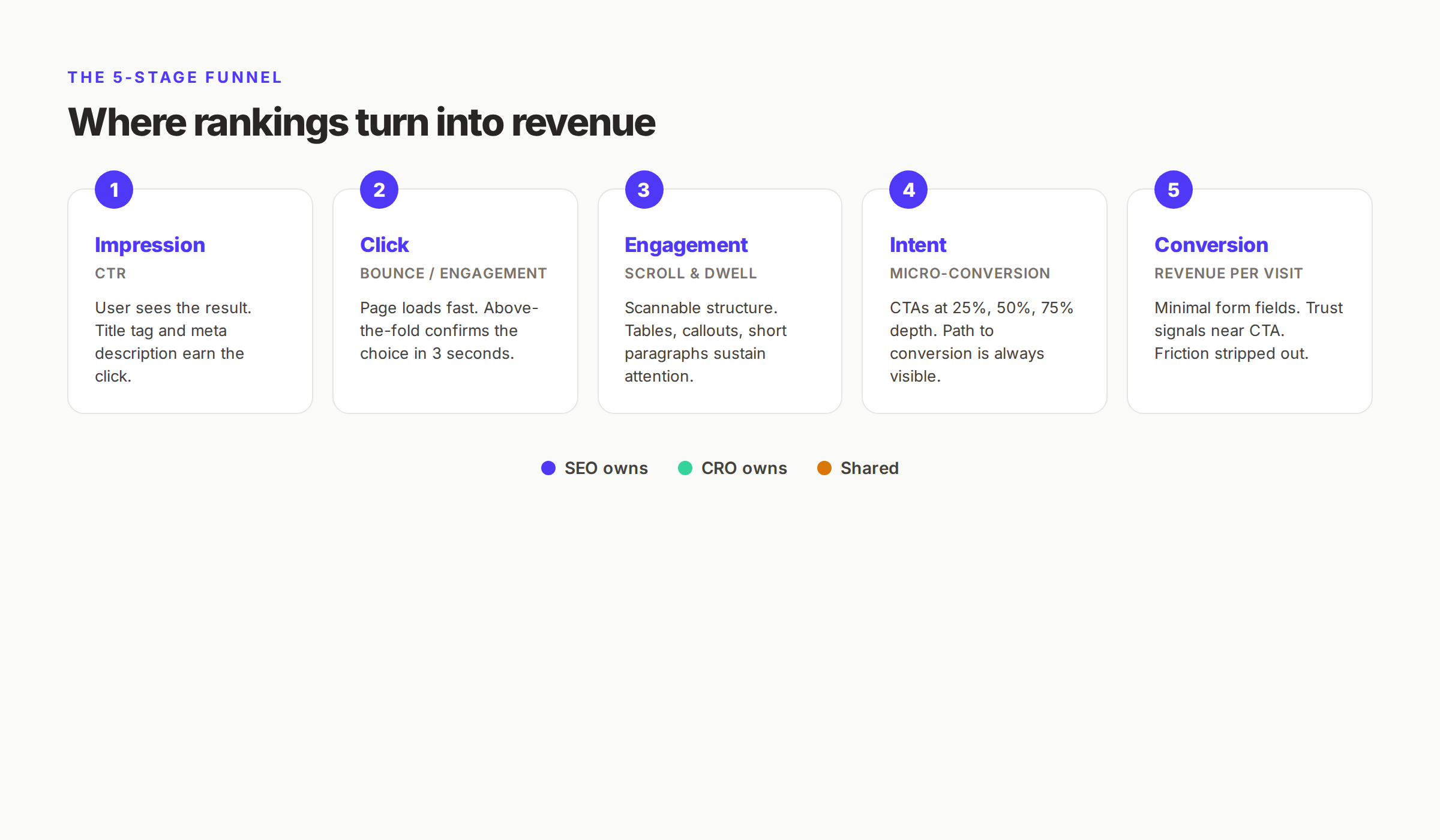
CRO and SEO collaborate across five funnel stages. Each stage has a different goal, a different metric, and a different test surface. Skipping a stage breaks the entire system.
Stage 1: Impression
The user sees your search result in Google. The SEO job is to rank. The CRO job is to earn the click.
The crossover metric is click-through rate. CTR is partly an SEO signal and partly a conversion event. A title tag is a conversion asset disguised as an SEO field. Optimize it the way you would optimize a CTA button.
Test inputs to move CTR:
- ✓ Add a benefit or outcome to the title tag
- ✓ Place the year in the title tag for time-sensitive queries
- ✓ Write a meta description that answers the question, then promises more
- ✓ Add structured data to earn rich results (review stars, FAQ, breadcrumb)
- ✓ Use brackets or parentheses to break visual monotony
A 1 percent increase in CTR on a page that ranks at position 3 can produce a 15 to 20 percent traffic increase without any ranking change. That is pure CRO money on top of fixed SEO inventory.
Stage 2: Click
The user clicks the result and lands on your page. The SEO job is to load fast. The CRO job is to confirm they made the right choice in the first 3 seconds.
The crossover metric is bounce rate, or more precisely, the inverse of engagement rate. A user who lands and leaves did not find what they came for. The fix is page load speed, above-the-fold relevance, and visual proof.
According to data summarized by Greenlane Marketing, pages that load within 1 second convert up to 3x better than pages that take 5 seconds. The data is consistent across industries. If you have not run a Core Web Vitals audit in the last 90 days, that is your first CRO action. Our Core Web Vitals guide and page speed optimization post cover the technical work.
Stage 3: Engagement
The user scrolls. They read. They get value. The SEO job is depth. The CRO job is to maintain attention and reduce cognitive load.
The crossover metric is scroll depth and time on page. Both correlate with rankings, and both correlate with conversion. The best content in 2026 is structured for fast consumption with deep payoff. Long blocks of text die. Scannable sections, tables, callouts, and short paragraphs survive.
Test inputs for engagement:
- Add a table of contents on posts over 1,500 words
- Use H3 subheads every 200 to 300 words
- Break paragraphs to 2 to 3 sentences maximum
- Add 1 visual asset per 500 words
- Include data tables to anchor scan-readers
Stage 4: Intent
The user is convinced. They want what you offer. The SEO job stopped at stage 1. The CRO job is at peak intensity.
The crossover metric is micro-conversion rate. Newsletter signups, content downloads, demo requests, and pricing page views are all micro-conversions that signal commercial intent. They also feed retargeting pools and remarketing lists.
Place CTAs at scroll depth checkpoints: 25 percent, 50 percent, 75 percent, and end of page. Do not save your offer for the closing paragraph. A reader who hit 50 percent and decided to convert needs the path available right there.
Stage 5: Conversion
The user clicks the button. They fill the form. They check out. The CRO job is to remove every remaining friction point in the final 30 seconds.
The crossover metric is conversion rate, which sits as the headline KPI for the entire system. Every prior stage feeds this number.
Test inputs for the final stage:
- Reduce form fields to the minimum required
- Add trust signals near the submit button (reviews, badges, testimonials)
- Show progress indicators on multi-step flows
- Pre-fill where you have data
- Test single-column versus multi-column form layouts
A 2026 WebFX trends analysis reported that trust badges placed near submit buttons and forms produced the strongest CRO lifts of any single element tested across mid-market sites. The lesson: the last 200 pixels of the conversion path matter more than the first 2,000.
Search Intent: The Bridge Between SEO and CRO
Search intent is the why behind a query. It is also the single most important concept in combined CRO and SEO. Get it right, and both disciplines work in unison. Get it wrong, and you waste budget on both sides.
The 4 intent categories
Google classifies search queries into four intent types. Each requires a different page type and a different conversion goal.
| Intent | Example Query | Page Type | Conversion Goal |
|---|---|---|---|
| Informational | "what is cro" | Educational article | Email signup, related content |
| Navigational | "stacc pricing" | Brand-specific page | Direct navigation, low-friction next step |
| Commercial | "best cro tools" | Comparison or list post | Demo request, free trial |
| Transactional | "buy cro software" | Product or pricing page | Checkout, paid signup |
If a user searches "what is conversion rate optimization" and lands on a sales page demanding a credit card, they bounce. If a user searches "buy cro software" and lands on a 4,000-word definition article, they bounce harder. The page must match the intent, and the CTA must match the intent.
How to audit intent across your funnel
Run this audit on your top 20 organic pages every quarter.
- ✓ Pull the top keyword for each page from Google Search Console
- ✓ Search the keyword in an incognito window
- ✓ Check the top 10 ranking pages and identify the dominant page type
- ✓ Match your page type to the SERP majority
- ✓ Confirm your primary CTA matches the intent stage
Most pages fail the audit on the CTA. They target a research keyword and ask for a sale. Move the heavy-conversion CTA further down the funnel. Use newsletter signups or related content links as the upper-funnel call.
The 9 Highest-Impact CRO Tests for Organic Landing Pages
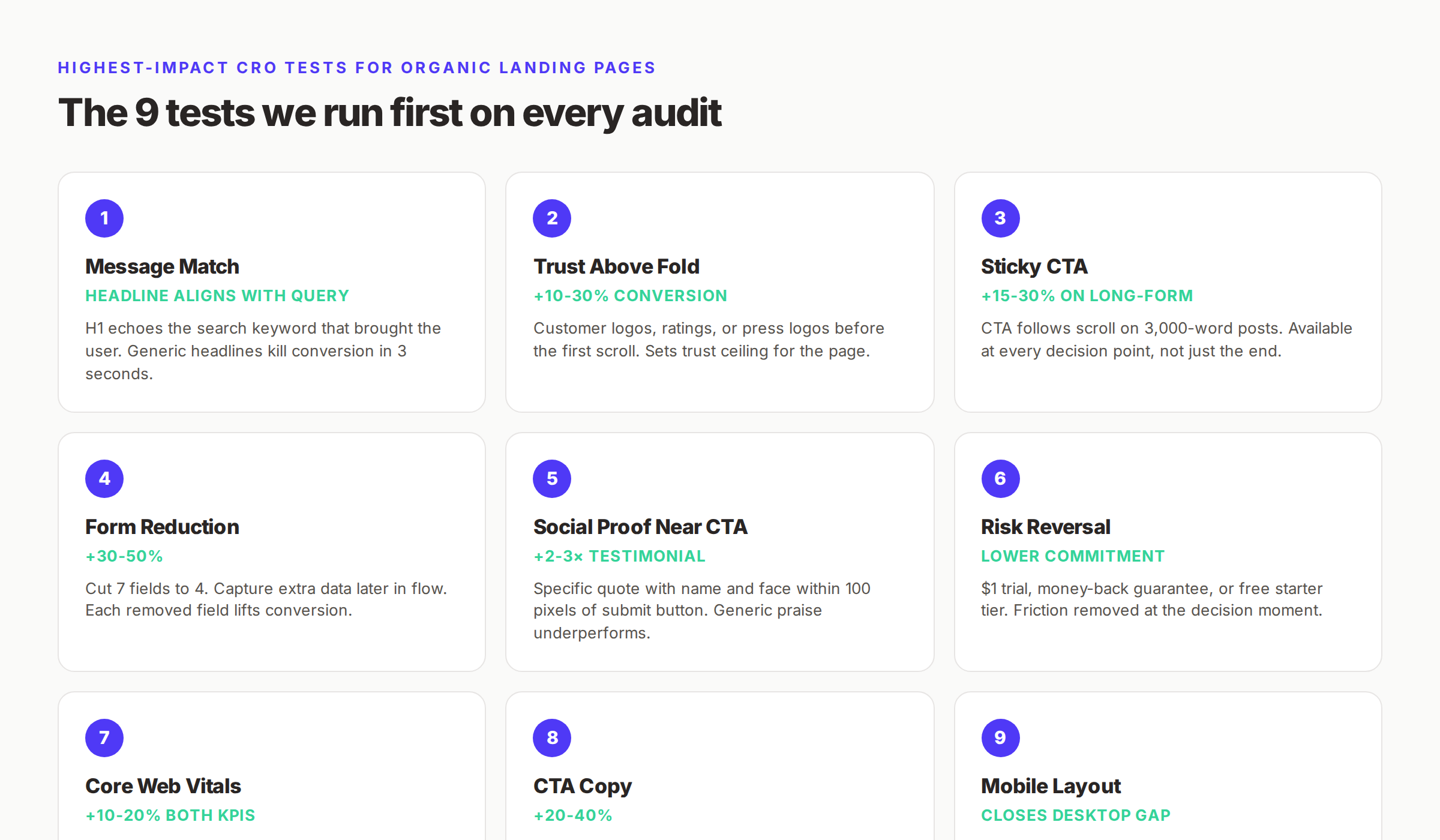
These are the tests we run first when we audit a client account. They produce results faster than any other category of optimization, and they all preserve SEO equity.
Test 1: Above-the-fold message match
The headline a user sees in the first 3 seconds must echo the search query that brought them. If they searched "ecommerce CRO services," the H1 should reference ecommerce CRO services. Generic headlines like "Welcome to our blog" or "Marketing solutions for modern brands" kill the conversion before the page finishes loading.
Test the H1 against the top 5 organic keywords driving traffic to the page. Adjust copy until the match is direct.
Test 2: Trust signals above the fold
The first viewport sets the trust ceiling for the rest of the page. Place at least one trust signal before the user scrolls.
Strong above-the-fold trust signals:
- Customer logos (B2B)
- Star ratings with review count (ecommerce)
- Number of users or customers served
- Industry certifications or compliance badges
- Press logos ("As featured in")
Test 3: Sticky CTA on long-form content
Long-form SEO content benefits from a CTA that follows the user as they scroll. A sticky sidebar or footer CTA on a 3,000-word post can lift conversion by 15 to 30 percent versus the same post with CTAs only at fixed positions.
The test is binary. Add the sticky CTA. Measure conversion before and after over a 30-day window. Keep it if the lift holds.
Test 4: Form field reduction
Each form field reduces conversion rate. The math is harsh. According to multiple A/B testing studies summarized by WiserNotify research, reducing a 7-field form to 4 fields commonly produces 30 to 50 percent conversion lift.
Audit every form on your top 10 organic landing pages. Cut fields you do not absolutely need for the next sales step. Capture extra data later in the flow.
Test 5: Social proof near the CTA
The single highest-impact location for a testimonial or review is within 100 pixels of the conversion button. This is the moment of decision. A specific quote with a name and a face produces 2 to 3x more conversions than the same testimonial buried in a "What customers say" carousel.
Pick the testimonial that names a specific outcome ("We grew organic traffic by 240 percent in 6 months"). Generic praise underperforms.
Test 6: Risk reversal language
Risk reversal is the practice of removing perceived downside from the purchase decision. The most common form is a guarantee. The most underused form is a low-commitment trial.
theStacc runs a Free 3-day trial trial. The dollar is not the revenue play. The trial is the friction remover. New users who would not commit to $99 will commit to $1. Once they see the work, conversion to paid happens through the product, not the page.
If you do not have a trial, add a money-back guarantee in clear language near the CTA. Test it for 30 days.
Test 7: Page speed and Core Web Vitals
Page speed sits at the intersection of SEO and CRO. A slow page costs you both rankings and conversions. The 2026 Core Web Vitals thresholds are:
- LCP (Largest Contentful Paint) under 2.5 seconds
- INP (Interaction to Next Paint) under 200 ms
- CLS (Cumulative Layout Shift) under 0.1
Run a Core Web Vitals audit every 90 days. Fix the largest offenders first. A page that improves from 4 seconds LCP to 2 seconds LCP often gains 10 to 20 percent in both organic traffic and conversion rate, with no other changes.
Test 8: CTA copy specificity
"Submit" is the worst CTA copy in the English language. It is generic. It sounds like a chore. It describes the user's action, not the user's outcome.
Replace "Submit" with the outcome the user wants. "Get my SEO audit." "Start my free trial." "Show me the pricing." Specificity converts. Generic does not.
Test 3 CTA variants on each conversion page. The winner often beats the original by 20 to 40 percent.
Test 9: Mobile-first checkout and form layout
Mobile delivers more than half of all organic traffic. It converts at half the rate of desktop. The gap is mostly form usability.
On mobile, audit:
- Single-column layouts (never two columns on a phone)
- Tap targets at 44px minimum
- Autocomplete enabled on every field
- Keyboard types correct for each field (numeric for phone, email for email)
- No popup forms that block 80 percent of the screen
Fix these five items first. The lift is real, repeatable, and often double-digit.
Want this work done for you? theStacc bundles CRO-optimized content publishing with structured SEO into one $99 to $199 per month service. No agency hourly fees. No conversion leakage. See pricing →
How to Use Heatmaps, Session Recordings, and Analytics Together
Most CRO programs fail because they test without data. They guess at problems, build variants, and ship them. The win rate is low. The right sequence is data, hypothesis, test, ship.
The 3-tool CRO data stack
Three categories of tool give you the data you need to form winning hypotheses. Each tool answers a different question.
| Tool Category | Question Answered | Examples |
|---|---|---|
| Analytics | What happened, at what scale | GA4, Mixpanel |
| Heatmaps | Where users click, scroll, hover | Hotjar, Microsoft Clarity, Crazy Egg |
| Session recordings | Why users did what they did | FullStory, LogRocket, Hotjar |
Run all three on your top 10 organic landing pages. Read the data for 14 days before forming a hypothesis. The patterns will be obvious. Users who hover on a button without clicking are confused. Users who scroll past your CTA without stopping did not see it as a CTA. Users who rage-click are blocked.
Our Google Analytics 4 setup guide covers the analytics foundation. Layer heatmaps and recordings on top once the basic events are firing correctly.
The hypothesis format
Once you see a pattern, write the hypothesis in this format:
We observed that [behavior].
We believe this happens because [reason].
We will test [change].
We will measure [metric].
We expect [outcome] within [timeframe].
Example:
We observed that 73% of mobile visitors scroll past the pricing CTA without clicking.
We believe this happens because the CTA blends into the body text.
We will test a sticky button with a contrasting color.
We will measure mobile click-through to the pricing page.
We expect a 25% lift over 30 days.
The hypothesis format forces clarity. Bad CRO programs run tests without it and cannot tell whether they won, lost, or measured noise.
Common CRO Mistakes That Break SEO
Some CRO tactics improve conversion rate at the cost of organic visibility. The cost shows up 60 to 90 days after the change, when traffic erodes and the test "winner" turns into a long-term loser. Avoid these mistakes.
Mistake 1: Hiding content behind pop-ups on entry
Entry pop-ups that block content lift email signups in the short term and crater SEO in the medium term. Google labels them intrusive interstitials, and pages with them get suppressed in mobile rankings. The 2024 Google intrusive interstitial guidelines still apply in 2026.
Use exit-intent pop-ups instead. They fire as the user leaves, not when they arrive. SEO unaffected, conversion preserved.
Mistake 2: Removing word count to improve clarity
A common CRO instinct is to cut words from a page. The instinct is correct on landing pages. The instinct is wrong on SEO content pages. A 3,000-word guide that ranks at position 2 will lose rankings if you cut it to 800 words. The depth signals to Google that you cover the topic. Cut the words, lose the rank.
The right move is to keep the depth, restructure for scan-readers, and add CTAs at scroll checkpoints. See our blog post length and SEO analysis for the full data.
Mistake 3: A/B testing two URLs without canonical tags
If you run an A/B test that creates a second URL for the variant, you can create duplicate content issues. Google may index both URLs. Some tools handle this automatically with rel=canonical. Most third-party CRO tools do not.
Always set the variant URL to canonical the control URL. Confirm in Search Console after launch. Better: use a CRO tool that runs server-side or client-side without spawning new indexable URLs.
Mistake 4: Removing internal links to reduce distraction
CRO sometimes recommends removing internal links from a page to focus attention on the CTA. On a transactional page, the advice is correct. On an SEO content page, the advice is destructive.
Internal links spread PageRank, signal topical authority, and help Google understand your site structure. Removing them weakens the entire content cluster. On a content page, the answer is not fewer links, it is better link placement and CTA hierarchy.
Mistake 5: Optimizing for the wrong conversion event
A 2x lift on a tiny conversion event can be worse than a 10 percent lift on a meaningful one. If a team measures "scroll to 50 percent" as the win event, they will optimize content for scroll, not revenue. Pick a conversion event that connects to dollars. Pipeline value matters more than activity.
How theStacc Builds CRO Into SEO Content
We publish 3,500+ blogs per month for clients across 70+ industries. Every post goes through a CRO review before it ships. These are the standards we enforce on every piece.
The 7-checkpoint CRO content review
Every theStacc post passes 7 CRO checkpoints before publication.
- ✓ Above-the-fold message matches the target keyword
- ✓ Primary CTA appears within the first 1,000 words
- ✓ At least 1 trust signal before the first CTA
- ✓ CTAs appear at 25%, 50%, and 75% scroll depth
- ✓ At least 1 visual asset per 500 words
- ✓ Mobile scroll experience tested before publish
- ✓ Conversion event tagged in GA4 with named goal
This is the same process that produced an average SEO score of 92 across the last 3,500 posts we published. CRO is not an extra step. It is a quality gate.
Where the theStacc Stack Method fits
We call the combined system the theStacc Stack Method. Blog SEO drives top-of-funnel inflow. Local SEO drives bottom-of-funnel proximity intent. Social media drives brand affinity. Every layer is built with CRO at the page level and analytics tracking at the event level.
The compound result: clients average 240 percent organic traffic growth in 6 months alongside conversion rate lift of 30 to 50 percent on top landing pages. Neither number happens without the other.
If you want to skip the build and run the system, theStacc pricing starts at $99 per month with a free trial.
What practitioners are saying on X
AI search advice ages quickly. Here is high-signal public discussion from SEO and growth operators — context for your roadmap, not a substitute for primary data.
- @hridoyreh (Mar 2026): Widely shared SEO skill tree: foundations, research, technical, on-page, content, links, AI SEO/GEO, analytics, UX, brand, programmatic — useful map for stats and how-to posts. See the post on X.
- @jakezward (Feb 2026): 2026 SEO predictions emphasize AI Overview share-of-SERP, schema for LLM token efficiency, brand mentions in AI answers as a KPI, proprietary data as a moat, and content refresh beating net-new AI slop. See the post on X.
Grok, AI Overviews, and multi-engine visibility
For “cro seo guide”, multi-engine visibility still starts with clear definitions, sourced numbers, and extractable section answers. Grok additionally factors live X discussion — keep public claims consistent with this page.
- Google AI Overviews: Use passage-ready answers, tables, and FAQ schema where relevant.
- ChatGPT / Perplexity: Cite named sources next to key claims.
- Grok: Maintain accurate entity facts on-site and in high-signal X posts.
Publish content built for Google and AI citations. theStacc’s Content SEO module ships SEO-scored articles structured for rankings and generative engines — including clearer entity pages models like Grok can quote.
FAQ: CRO and SEO Combined
They can, but only when teams optimize in isolation. A CRO team that cuts word count on a ranking blog post breaks SEO. An SEO team that publishes thin pages with no CTAs breaks CRO. The fix is shared dashboards, shared KPIs, and one team accountable for both organic traffic and revenue per visitor.
The cross-industry average for organic search is 2.7 percent. Top performers convert at 9 percent or higher. Target a 50 percent lift over your current baseline within 6 months. Beyond that, the next 50 percent gets harder. Diminishing returns are real.
Run tests to statistical significance at 95 percent confidence. For most mid-traffic pages, that requires 14 to 30 days of data and at least 200 conversion events per variant. Stopping early because one version is "winning" after 3 days is the most common CRO mistake.
Not directly. Google does not rank on conversion rate. CRO indirectly helps SEO when better page layouts increase dwell time, scroll depth, and engagement rate. These user signals feed Google's quality systems and can lift rankings over time.
Microsoft Clarity is free and gives you heatmaps and session recordings in one product. Pair it with GA4 for conversion tracking. Add a paid A/B testing tool like VWO or Optimizely once you have a tested hypothesis and at least 500 weekly conversions on the target page.
Pull the top 20 organic landing pages by traffic. Multiply traffic by 1 minus current conversion rate. The pages with the highest gap value are the highest-priority CRO targets. Fix the leaks where the water is rushing through, not where the bucket is empty.
The Closing Frame
The next 12 months will reward the teams that treat CRO and SEO as one system, not two departments. The 8x ranking gap between human-led and generic content keeps widening. The 4x conversion gap between average sites and top performers keeps widening. Both gaps come from the same root cause: structured operating systems versus ad-hoc effort.
Build the system. Run the tests. Measure the right events. The compound math takes care of the rest.
Related Tools & Resources
Free SEO Tools:
Best Lists:
Sources & references
- [1] Princeton / Georgia Tech et al. — GEO research (arXiv:2311.09735)
- [2] @hridoyreh on X — Widely shared SEO skill tree: foundations, research, technical, on-page, content, links, AI SEO/GEO, analytics, UX, bran
- [3] @jakezward on X — 2026 SEO predictions emphasize AI Overview share-of-SERP, schema for LLM token efficiency, brand mentions in AI answers
- [4] Referenced source — www.semrush.com
Plan topics, review article drafts, and publish to a connected CMS.
Weekly local SEO teardowns
One practical email a week. Map Pack, GBP, AI Overviews. No fluff. Unsubscribe anytime.