
Google Ranking Factors (2026): Confirmed Signals + API Leak Data
Every confirmed Google ranking factor with data: the API leak signals, official Google systems, weighted influence, and common SEO myths debunked with evidence.
Google uses over 200 signals to rank web pages. That number has been repeated so often it feels like fact. But here is what most “ranking factors” guides do not tell you: Google has only confirmed 7 of those factors publicly. The 2024 API leak revealed 14,000+ ranking attributes. And most lists still include debunked myths alongside real signals.
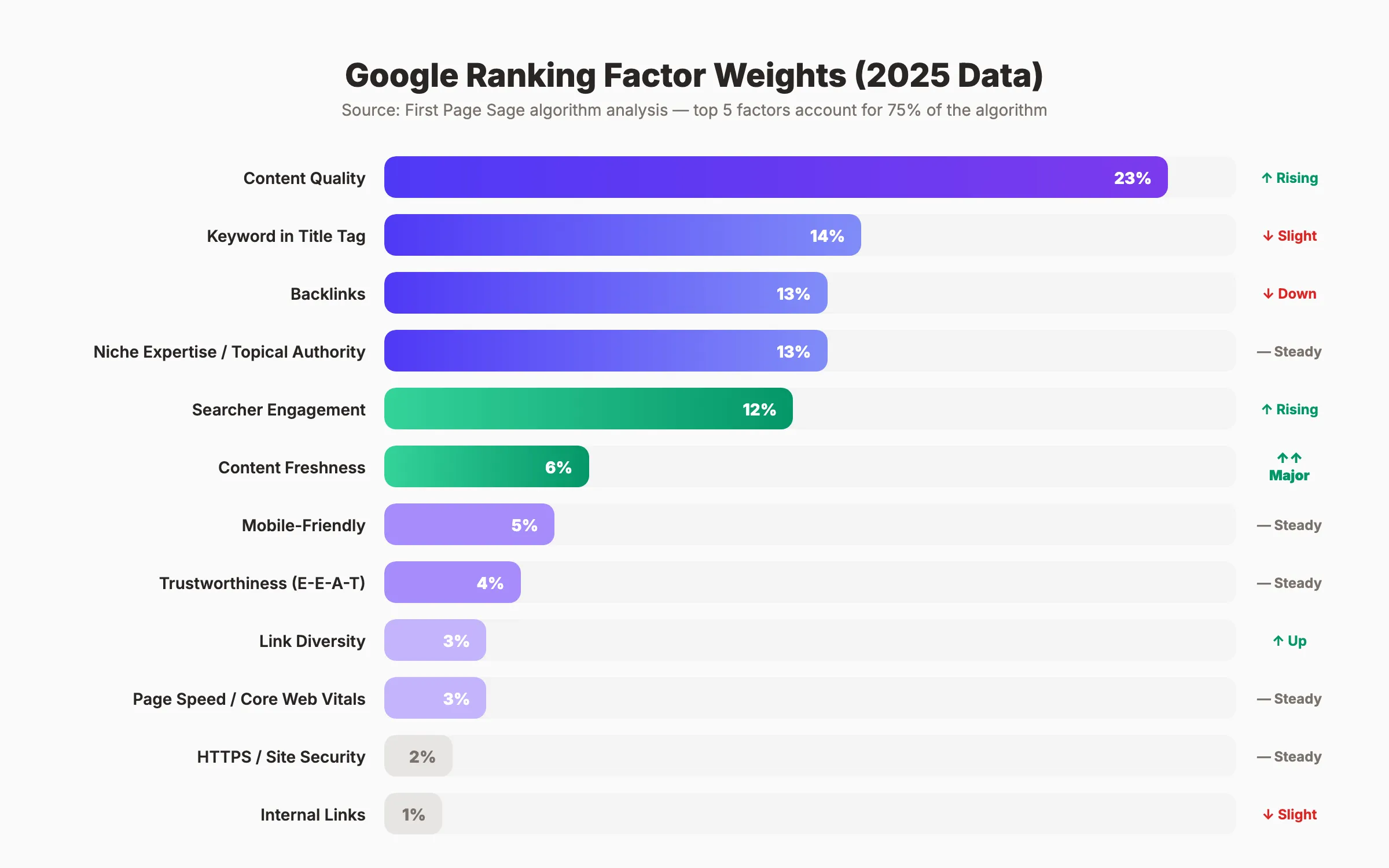
Understanding google ranking factors is the difference between optimizing for signals that move rankings and wasting months on tactics that do nothing. First Page Sage’s data shows that content quality alone accounts for 23% of the algorithm. Backlinks dropped from 15% to 13% in just 2 years. The signals that matter are shifting, and most guides have not caught up.
We have published 3,500+ blog posts across 70+ industries and tracked their ranking performance over time. The patterns are consistent: a small number of factors drive most ranking changes. Everything else is noise.
Here is what you will learn in this guide:
- The 7 factors Google has officially confirmed
- What the 2024 API leak revealed about real ranking signals
- Data-backed percentage weights for each factor category
- How Google’s 15+ active ranking systems work together
- 10 ranking factor myths still circulating in 2026
- A prioritization framework for where to spend your SEO time
- How AI search is creating new ranking considerations
How Google Actually Ranks Pages
Google does not use a single algorithm. It runs 15+ active ranking systems that evaluate different aspects of a page and query. Each system feeds signals into the overall ranking calculation.
The process works in stages:
Stage 1. Crawling. Googlebot discovers and fetches your pages. If it cannot crawl your site, nothing else matters. Technical SEO ensures this stage works.
Stage 2. Indexing. Google processes the page content, understands its topic, and adds it to the index. Pages with thin content, duplicate content, or noindex tags get filtered here.
Stage 3. Ranking. Multiple systems evaluate the indexed page against a query. Each system scores different signals: relevance, quality, authority, freshness, user experience, and more.
Stage 4. Serving. The final result set is assembled, personalized slightly for location and device, and displayed. AI Overviews, featured snippets, and other SERP features get layered on top.
Google documents its active ranking systems publicly in the Search Central ranking systems guide. Here are the ones that matter most:
| System | What It Does | Impact |
|---|---|---|
| RankBrain | AI-based query understanding | High (core system since 2015) |
| BERT | Understands word context and intent | High (affects most queries) |
| MUM | Multimodal, multilingual understanding | Medium (complex queries) |
| PageRank / Link Analysis | Evaluates link relationships and authority | High (foundational) |
| Passage Ranking | Identifies relevant sections within pages | Medium (long-form content) |
| Freshness Systems | Surfaces newer content for time-sensitive queries | Medium to High |
| Reviews System | Rewards high-quality product/service reviews | Medium (review content) |
| Original Content Systems | Elevates original reporting over aggregation | Medium |
| Site Diversity System | Limits same-site dominance in results | Low (structural) |
| Neural Matching | Matches conceptual representations to queries | Medium |
The Helpful Content System, which launched in 2022, was folded into the core ranking algorithm in 2024. It no longer operates as a separate system. Its quality evaluation is now embedded across all ranking signals.
The 7 Confirmed Google Ranking Factors
Ahrefs documented the only 7 factors that Google has explicitly confirmed through official statements or documentation. Everything else is inferred from studies, patents, or the API leak.
1. Backlinks
Google confirmed backlinks as a top 3 ranking factor in 2016 through Andrey Lipattsev, a Senior Search Quality Strategist. Backlinko’s study of 11.8 million results found that the number 1 result has 3.8x more backlinks than positions 2 through 10 (Backlinko).
Backlinks still matter. But their relative weight has decreased. First Page Sage data shows backlinks dropped from 15% to 13% of the algorithm between 2023 and 2025. Quality and relevance of links matter more than raw quantity. Learn how to build backlinks for your blog the right way.
2. Content Quality and Relevance
Google’s documentation on creating helpful content makes this the most documented ranking factor. Content must demonstrate E-E-A-T: Experience, Expertise, Authoritativeness, and Trustworthiness.
Content quality now carries the heaviest weight at 23% of the algorithm, according to First Page Sage. That number has been rising for 3 consecutive years. Read our E-E-A-T guide for the full framework.
3. HTTPS / Site Security
Google confirmed HTTPS as a ranking signal in August 2014. It is a lightweight signal. The difference between HTTP and HTTPS alone will not move you from page 5 to page 1. But it removes a negative signal that could hold you back.
4. Page Speed / Core Web Vitals
Google has confirmed page speed as a ranking factor since 2010 (desktop) and 2018 (mobile). In March 2024, INP (Interaction to Next Paint) replaced FID as the responsiveness metric (Google).
The current Core Web Vitals thresholds:
| Metric | Good | Needs Improvement | Poor |
|---|---|---|---|
| LCP (Largest Contentful Paint) | Under 2.5s | 2.5s to 4.0s | Over 4.0s |
| INP (Interaction to Next Paint) | Under 200ms | 200ms to 500ms | Over 500ms |
| CLS (Cumulative Layout Shift) | Under 0.1 | 0.1 to 0.25 | Over 0.25 |
Pages in position 1 show a 10% higher Core Web Vitals pass rate than pages in position 9. Follow our guide to improve Core Web Vitals for step-by-step fixes.
5. Mobile-Friendliness
Google adopted mobile-first indexing for all sites in 2019. The mobile version of your page is the primary version Google evaluates. Over 60% of searches happen on mobile devices. A site that works poorly on mobile ranks poorly everywhere.
6. Content Freshness
Google’s freshness systems surface newer content for queries where recency matters. This does not mean every page needs constant updates. But for topics like “best SEO tools 2026” or “Google algorithm update,” fresh content ranks higher. First Page Sage shows freshness jumped from less than 1% to 6% of the algorithm in just 2 years. That is the largest single-factor increase.
7. Page Experience Signals
Page experience combines Core Web Vitals, HTTPS, mobile-friendliness, and the absence of intrusive interstitials. Google treats these as a collective signal rather than individual ranking factors.
Stop writing. Start ranking. Stacc publishes 30 SEO-optimized articles per month for $99. Every post targets the ranking factors that actually move the needle. Start for $1 →
What the 2024 Google API Leak Revealed
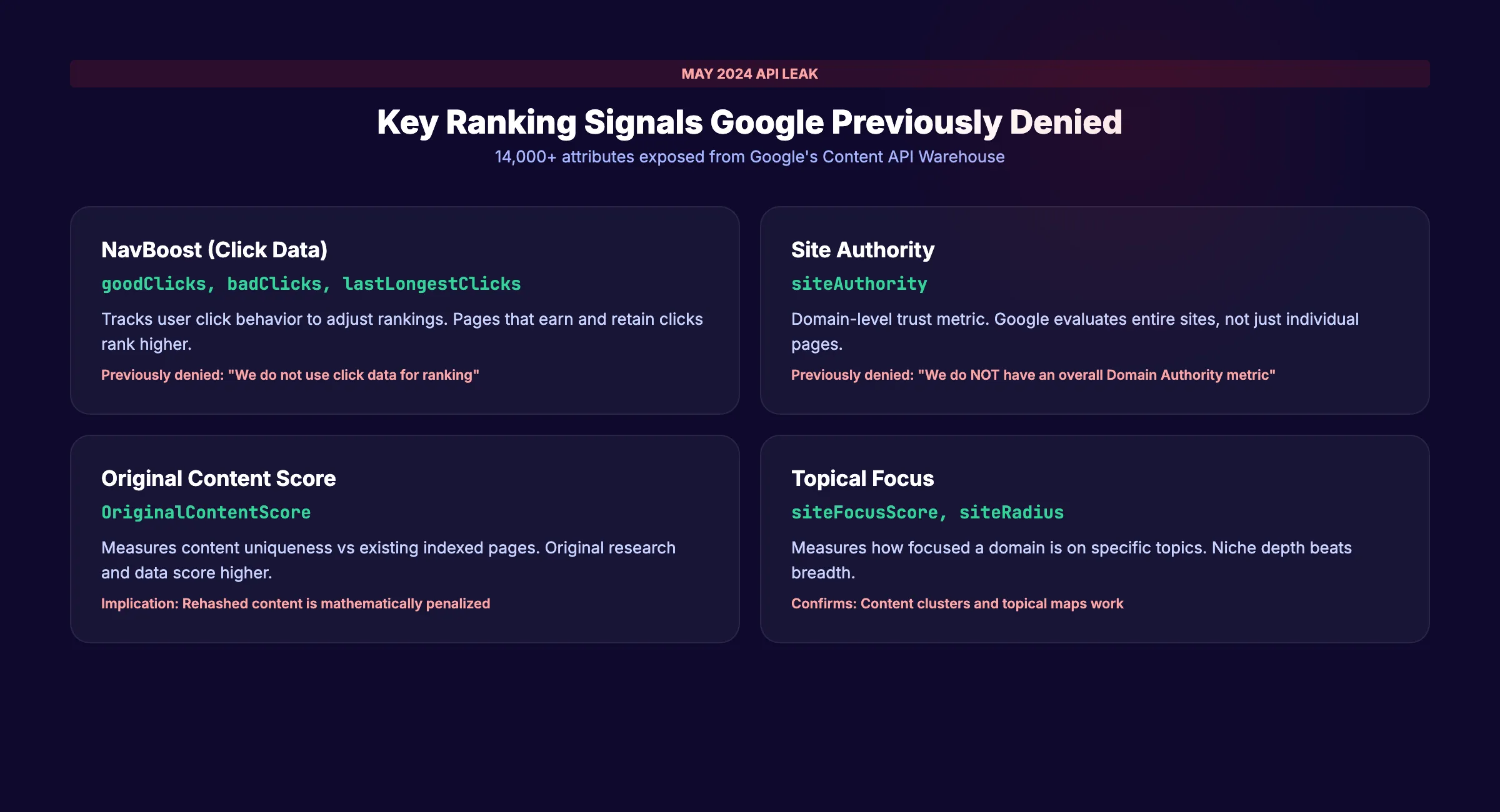
In May 2024, over 14,000 ranking attributes from Google’s internal Content API Warehouse were accidentally exposed (Search Engine Land). The leak confirmed several signals Google had previously denied or avoided discussing.
NavBoost: Click Data as a Ranking Signal
The leak confirmed NavBoost, a system that uses click data to adjust rankings. It tracks “goodClicks,” “badClicks,” and “lastLongestClicks.” Google had consistently downplayed the role of click-through rate in rankings. The API leak proved otherwise.
NavBoost means searcher behavior directly influences your rankings. Pages that earn clicks and keep users engaged rank higher. Pages with high bounce rates and short dwell times get demoted. This aligns with First Page Sage showing “Searcher Engagement” at 12% of the algorithm and rising.
Site Authority Exists
Google’s Gary Illyes said in 2016: “We do NOT have an overall Domain Authority metric.” The API leak revealed a siteAuthority attribute. Google evaluates entire domains, not individual pages alone.
This does not mean domain authority as measured by Ahrefs or Moz is what Google uses. Google’s internal siteAuthority likely works differently. But the concept of site-level trust exists in Google’s system.
OriginalContentScore
The leak revealed OriginalContentScore, a metric that evaluates how unique your content is compared to existing indexed pages. Original research, unique data, and first-hand experience score higher. Rehashed content from other sources scores lower.
This explains why building topical authority through original content works better than rewriting competitor articles.
Topical Focus Signals
The leak exposed siteFocusScore and siteRadius attributes. These measure how focused a domain is on specific topics. A site covering one topic deeply scores higher for that topic than a site covering everything broadly.
This confirms what SEO practitioners have observed for years. Content clusters and topical maps work because Google mathematically measures topical focus.
Chrome Browser Data
The leak confirmed that Chrome data feeds into ranking. Time on page, scroll depth, and interaction patterns from Chrome users influence how Google evaluates pages. This is separate from the Search Console data Google provides to webmasters.
Google Ranking Factors by Weight
First Page Sage publishes the most data-driven breakdown of ranking factor weights. Their methodology tracks ranking changes across thousands of sites and correlates them with specific optimization changes.
| Factor | Weight (2025) | Trend |
|---|---|---|
| Consistent Publication of Quality Content | 23% | Rising |
| Keyword in Meta Title Tag | 14% | Slightly down |
| Backlinks | 13% | Down (was 15%) |
| Niche Expertise / Topical Authority | 13% | Steady |
| Searcher Engagement (clicks, dwell time) | 12% | Rising |
| Content Freshness | 6% | Major jump (was less than 1%) |
| Mobile-Friendly / Mobile-First | 5% | Steady |
| Trustworthiness (E-E-A-T) | 4% | Steady |
| Link Distribution Diversity | 3% | Up |
| Page Speed / Core Web Vitals | 3% | Steady |
| Site Security / HTTPS | 2% | Steady |
| Internal Links | 1% | Slightly down |
What These Weights Mean for Your Strategy
The top 5 factors account for 75% of the algorithm. Everything below that combined makes up 25%. This is why prioritization matters. You could spend months perfecting your Core Web Vitals (3%) while ignoring content quality (23%) and lose.
Priority 1. Content (23% + 13% niche expertise = 36%): Publish consistent, expert-level content on your core topics. Build content clusters with pillar pages and supporting articles. This is the single highest-impact activity.
Priority 2. On-Page Optimization (14%): Put your target keyword in the title tag. Use proper header hierarchy. Write meta descriptions that earn clicks. Follow our on-page SEO guide for the full checklist.
Priority 3. Backlinks (13% + 3% diversity = 16%): Build high-quality backlinks from relevant sites. Focus on diversity of referring domains, not raw link count. The backlink audit guide shows how to clean up toxic links.
Priority 4. User Engagement (12%): Write content that satisfies search intent. Match the format users expect. Keep them on the page. This factor is rising faster than any other.
Priority 5. Freshness (6%): Update your most important content regularly. Add new data, remove outdated information, and refresh publication dates. Build a content refresh strategy into your editorial calendar.
Your SEO team. $99 per month. 30 optimized articles targeting the ranking factors that actually drive results. Published automatically. Start for $1 →
10 Google Ranking Factor Myths
These myths persist in SEO circles despite being debunked by Google employees, studies, or the API leak itself.
Myth 1: Google Uses Exactly 200 Ranking Factors
The “200 factors” number came from a 2009 Google statement and has been repeated ever since. The API leak revealed 14,000+ attributes. The actual number is either far more than 200 (if you count every attribute) or far fewer (if you count confirmed systems). The number 200 is marketing, not engineering.
Myth 2: Bounce Rate Is a Ranking Factor
Google has never confirmed bounce rate as a ranking signal. John Mueller has stated that Google does not use Google Analytics data for ranking. The API leak confirmed that click behavior matters (NavBoost), but that is different from bounce rate as measured in analytics tools.
Myth 3: Domain Age Helps You Rank
John Mueller has explicitly denied that domain age is a ranking factor. The API leak revealed a hostAge attribute, but its function appears related to spam detection (new domains spamming), not as a positive ranking signal for older domains.
Myth 4: Social Signals Affect Rankings
Google has consistently denied that social media signals (likes, shares, followers) are ranking factors. Correlation studies that show social shares correlating with rankings confuse cause and effect. Popular content gets both social shares and backlinks. The backlinks drive rankings, not the shares.
Myth 5: Word Count Is a Ranking Factor
No evidence supports word count as a direct ranking factor. Backlinko’s study found the average first-page result is 1,447 words. But longer content ranks better because it tends to be more thorough and earns more backlinks. Word count itself is not the signal.
Myth 6: Google Analytics Usage Affects Rankings
Matt Cutts debunked this years ago. Using or not using Google Analytics has zero impact on your rankings. Google does not use Analytics data in its search algorithm.
Myth 7: XML Sitemaps Boost Rankings
An XML sitemap helps Google discover and crawl your pages faster. It does not give those pages a ranking boost. A well-structured sitemap is important for crawlability, not for ranking.
Myth 8: Keyword Density Has an Optimal Percentage
There is no magic keyword density number (1%, 2%, 3%). Google uses semantic understanding (BERT, MUM) to evaluate topic coverage. Natural language that covers a topic thoroughly outperforms keyword-stuffed content every time.
Myth 9: Meta Descriptions Are a Ranking Factor
Meta descriptions are not a direct ranking factor. Google has confirmed this. However, a well-written meta description improves click-through rate, which does influence rankings through engagement signals (NavBoost).
Myth 10: You Need to Submit Your Site to Google
Google discovers sites through crawling links. Manual submission through Search Console speeds up initial discovery but is not required and has no ranking benefit. If your site has backlinks, Googlebot will find it.
On-Page Ranking Factors That Move the Needle
On-page factors are the signals you control directly on each page. They account for roughly 15 to 20% of the algorithm when combined.
Title Tags
The keyword in your meta title tag carries 14% of the algorithm weight. This is the second most important factor after content quality. Place your primary keyword near the beginning of the title. Keep it under 60 characters.
Header Hierarchy (H1 through H4)
Google uses header tags to understand page structure and topic coverage. One H1 per page (your title). Multiple H2s for major sections. H3s for subsections. Proper blog post structure signals organized, thorough content.
Internal Links
Internal linking helps Google understand your site structure, distributes page authority, and guides users to related content. While internal links carry only 1% weight as an isolated factor, they amplify the effect of content quality and topical authority signals.
Schema Markup
Structured data helps Google understand your content type, author, dates, and data structure. While not a direct ranking factor for organic results, schema markup earns rich results (stars, FAQs, how-to snippets) that increase CTR. Higher CTR feeds NavBoost engagement signals.
Image Optimization
Alt text, file names, image compression, and proper formatting help Google understand visual content. Image SEO contributes to overall page quality signals and enables Google Image search traffic.
3,500+ blogs published. 92% average SEO score. See what Stacc can do for your site. Every post targets the factors that matter. Start for $1 →
Off-Page Ranking Factors
Off-page factors are signals that come from outside your website. They account for roughly 25 to 30% of the algorithm.
Backlink Quality and Relevance
A single backlink from an authoritative, relevant site outweighs hundreds of links from low-quality directories. Google evaluates the authority of the linking page, the relevance of the linking site to your topic, and the anchor text used.
Referring Domain Diversity
Links from 50 different domains outperform 500 links from 1 domain. Link distribution diversity now carries 3% of the algorithm weight and is rising. Diversify your link building approach across guest posts, digital PR, resource pages, and earned media.
Brand Signals and Entity Recognition
The API leak confirmed Google tracks brand entities. Branded search volume, mentions on authoritative sites, and consistent NAP (Name, Address, Phone) data across the web all contribute to how Google understands and trusts your brand.
Online Reputation
Google’s quality rater guidelines explicitly instruct evaluators to research site reputation. Reviews, press coverage, industry awards, and expert recognition all feed into trust signals. This is especially important for YMYL (Your Money or Your Life) topics.
The AI Search Factor: Ranking Beyond Google
Google ranking factors govern traditional search. But AI search is changing SEO in ways that create entirely new optimization considerations.
Google AI Overviews now appear in a growing percentage of search results. Content that earns a position in AI Overviews gets visibility above position 1. Optimizing for AI Overviews requires structured, direct answers with cited sources. Read our guide on optimizing for Google AI Overviews.
Beyond Google, platforms like Perplexity, ChatGPT, and Gemini are becoming alternative search channels. Each has its own citation criteria. Generative engine optimization (GEO) is the practice of optimizing for these AI search platforms alongside traditional Google SEO.
The ranking factors for AI search overlap with Google’s confirmed factors: content quality, E-E-A-T signals, structured data, and freshness. But AI search adds new requirements: direct answers in the first 100 words, structured formatting for machine extraction, and cited statistics from primary sources.
A Prioritization Framework for 2026
Not all ranking factors deserve equal attention. Here is a priority matrix based on the data:
| Priority | Factor Category | Weight | Time Investment | Impact Timeline |
|---|---|---|---|---|
| 1 | Content quality and depth | 23% | Ongoing | 30 to 90 days |
| 2 | On-page optimization (titles, headers) | 14% | Per page | 7 to 30 days |
| 3 | Topical authority (clusters, pillars) | 13% | 3 to 6 months to build | 60 to 180 days |
| 4 | Backlink building | 13% | Ongoing | 30 to 120 days |
| 5 | User engagement optimization | 12% | Per page | 14 to 60 days |
| 6 | Content freshness | 6% | Monthly updates | 7 to 30 days |
| 7 | Technical SEO (speed, mobile, HTTPS) | 10% | One-time + monitoring | 7 to 90 days |
| 8 | AI search optimization (GEO) | Emerging | Per page | Varies |
For new websites: Start with technical SEO (remove barriers), then publish quality content consistently, then build backlinks.
For established websites: Audit existing content with our SEO audit tool, optimize top pages for on-page factors, build topical authority through content clusters, and start freshness updates on high-value pages.
For local businesses: Add local SEO ranking factors to this framework. Google Business Profile optimization, local citations, and review management are critical for map pack visibility.
FAQ
How many ranking factors does Google use?
Google has never given a precise, current number. The commonly cited “200 factors” comes from a 2009 statement. The 2024 API leak revealed 14,000+ ranking attributes. Only 7 factors have been explicitly confirmed by Google. The real answer is: Google uses hundreds of signals organized across 15+ ranking systems, but a small number of factors drive most ranking changes.
What are the most important Google ranking factors in 2026?
Based on First Page Sage data, the top 5 are: content quality (23%), keyword in title tag (14%), backlinks (13%), niche expertise (13%), and searcher engagement (12%). These 5 factors account for 75% of the algorithm. Content quality has been the number 1 factor for 3 consecutive years.
Do backlinks still matter for Google rankings?
Yes. Google confirmed backlinks as a top ranking factor in 2016. Backlinko’s study of 11.8 million results shows position 1 has 3.8x more backlinks than positions 2 through 10. However, backlink weight has decreased from 15% to 13% in the last 2 years. Quality and relevance matter more than volume.
Is domain authority a Google ranking factor?
Google denied having an overall domain authority metric. But the 2024 API leak revealed a siteAuthority attribute. Google does evaluate sites at the domain level. However, the “Domain Authority” score from tools like Moz or Ahrefs is a third-party metric. It correlates with rankings but is not what Google uses internally.
Does Google penalize AI-generated content?
No. Google’s official guidance states that AI-generated content is acceptable if it is helpful and demonstrates E-E-A-T. Google evaluates content quality, not production method. Low-quality AI content fails for the same reasons low-quality human content fails: thin information, no expertise, and no original value.
What changed after the Google API leak?
The May 2024 leak confirmed several previously denied signals: NavBoost (click data influences rankings), siteAuthority (domain-level trust exists), OriginalContentScore (content uniqueness is measured), and Chrome data usage (browsing behavior feeds ranking). The leak did not reveal the weights of these signals, but it confirmed their existence.
Google ranking factors are not a mystery. Google publishes its ranking systems. Studies quantify the weights. The API leak confirmed the mechanisms. The challenge is not knowing what matters. It is doing the work. Consistent content, proper optimization, genuine authority, and technical accessibility. Focus on the factors that carry the most weight and let the small signals take care of themselves.

Written by
Siddharth GangalSiddharth is the founder of theStacc and Arka360, and a graduate of IIT Mandi. He spent years watching great businesses lose organic traffic to competitors who simply published more. So he built a system to fix that. He writes about SEO, content at scale, and the tactics that actually move rankings.
30 SEO blog articles published every month
Keyword-optimized, scheduled, and live on your site. Automatically.
30-day trial · Cancel anytime
theStacc
Stop writing SEO content manually
30 blog articles, 30 GBP posts, and social media content. Published every month. Automatically.
Try for free$1 for 3 days · Cancel anytime