
Content Refresh Strategy (2026): Strategies, Tactics & Examples
content refresh strategy guide for 2026: strategies, tactics, real examples, and implementation steps to get results faster.
Most websites lose 20 to 30 percent of their organic clicks every 6 months. Not from algorithm penalties. Not from competitor attacks. From content decay.
The pages that ranked last year slowly fade. Stats go stale. Search intent shifts. Fresher competitors take their place.
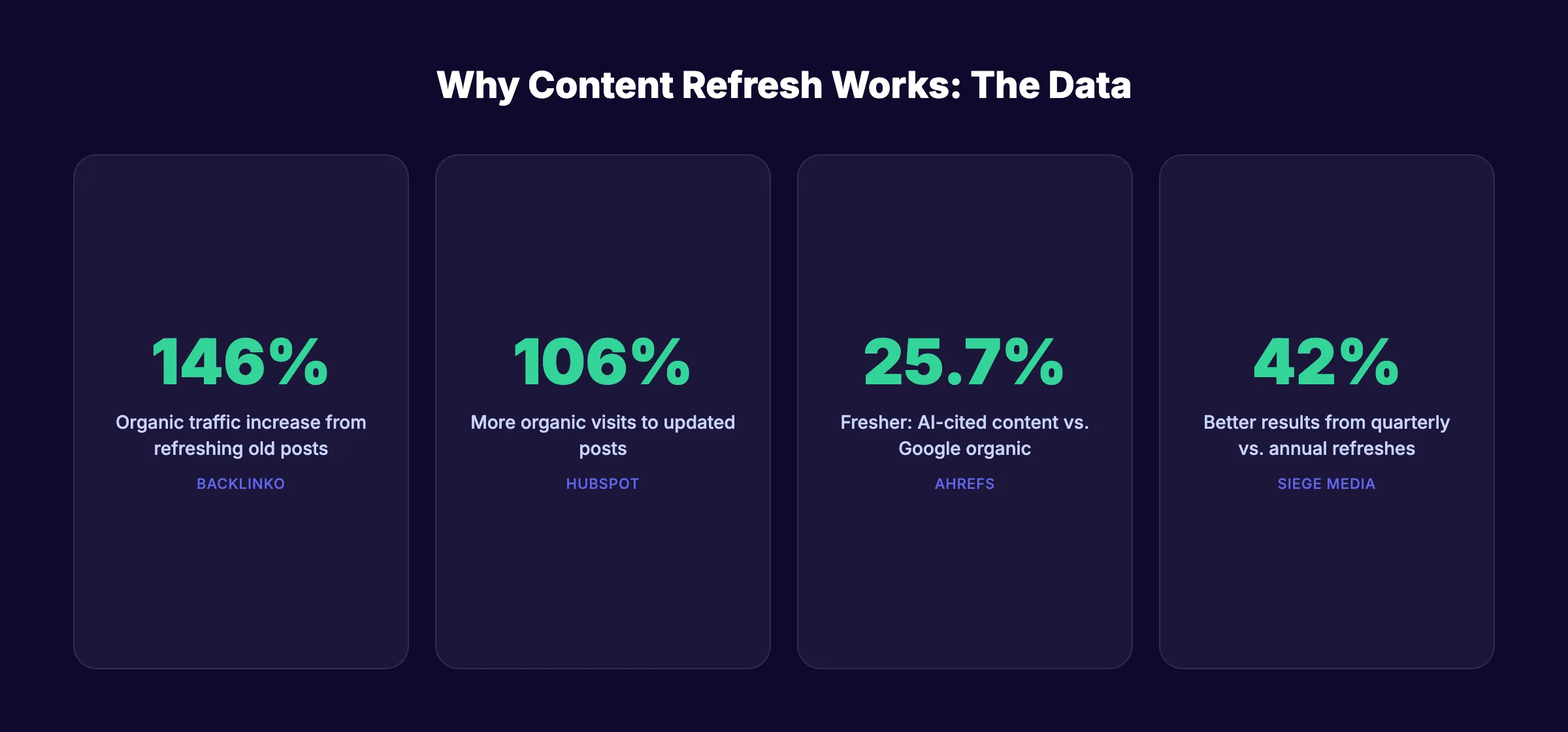
Here is what makes this worse in 2026: AI search engines now favor recently updated content by a measurable margin. An Ahrefs study of 17 million AI citations found that AI-cited content is 25.7 percent fresher than traditional Google results. ChatGPT cites URLs that are 393 to 458 days newer than what ranks organically.
A content refresh strategy fixes this. It is the systematic process of auditing, updating, and republishing your existing content to recover lost rankings, attract AI citations, and compound your SEO investment over time.
We have published 3,500+ blog posts across 70+ industries. The pattern is consistent: refreshing existing content delivers faster ranking improvements than publishing new pages from scratch.
Here is what you will learn in this guide:
- How to identify which pages need a refresh (and which to leave alone)
- The decision framework for refresh vs. rewrite vs. consolidate vs. delete
- Exactly how to update content for both Google and AI search engines
- How often to refresh each content type
- How to measure ROI from your refresh efforts
- The 10 most common refresh mistakes that hurt rankings
Chapter 1: What Is a Content Refresh Strategy?
A content refresh strategy is a repeatable system for identifying underperforming content, updating it with current information, and republishing it to recover or improve rankings.
It is not the same as a content rewrite. A refresh preserves the existing URL, page authority, and backlink equity. A rewrite starts from scratch.
Content Refresh vs. Content Rewrite
| Factor | Content Refresh | Content Rewrite |
|---|---|---|
| Scope | Update stats, links, sections | Complete overhaul |
| Time required | 1 to 3 hours | 4 to 8+ hours |
| URL change | Never | Sometimes |
| Risk level | Low | Medium to high |
| Best for | Pages ranking positions 5 to 20 | Pages ranking below 50 or off-topic |
| Backlink equity | Preserved | Preserved if URL stays, lost if URL changes |
Why Content Refresh Matters More in 2026
Three forces make a content refresh strategy essential right now.
1. Content decay accelerates. The average page-one result was last updated 730 days ago, according to Siege Media’s study of 17,805 keywords. Pages that ranked 2 years ago with 2024 data now compete against pages with 2026 data. Google’s freshness signals directly influence ranking for time-sensitive queries.
2. AI search rewards freshness. AI referrals to top websites surged 357 percent year over year between June 2024 and June 2025. Content updated in the past 3 months averages 6 AI citations versus 3.6 for outdated pages. If your content is stale, AI models skip it entirely.
3. Refreshing delivers faster ROI than new content. HubSpot’s content refresh program increased monthly organic search visits to old posts by 106 percent and doubled monthly leads. One case study from thruuu documented a page moving from position 35 to number 1 in just 4 weeks after a strategic refresh.
Understanding content decay is the first step. But recognizing it is not enough. You need a system to act on it.
Chapter 2: How to Identify Which Content to Refresh
Not every page needs a refresh. The goal is to find pages where a targeted update will produce the biggest ranking improvement with the least effort.
Step 1: Pull Your Performance Data
Open Google Search Console and export the last 12 months of data for all pages. Focus on three metrics:
- Clicks (trending down = decay signal)
- Average position (positions 5 to 20 = highest refresh ROI)
- Impressions (high impressions + low clicks = CTR problem)
Pages ranking in positions 5 to 20 are your highest-priority refresh targets. They already have enough authority to rank. A content update can push them into the top 3.
Step 2: Identify Decay Patterns
Compare the last 3 months to the previous 3 months. Flag any page with:
- 15 percent or greater drop in clicks
- 3 or more position decline in average ranking
- Declining impressions despite stable keyword volume
These are your content decay signals.
Step 3: Run a Content Audit
A full content audit reveals pages you might miss by looking at GSC alone. Check each page for:
- Outdated statistics (anything older than 18 months)
- Broken external links (sources that moved or disappeared)
- Missing internal links (new pages published since the original)
- Stale screenshots or examples (outdated product UIs)
- Misaligned search intent (check what currently ranks for your target keyword)
Step 4: Prioritize With a Scoring System
Score each page on a 1 to 5 scale across three factors:
| Factor | What to Score |
|---|---|
| Traffic potential | Current impressions + keyword volume |
| Refresh effort | How much work the update requires |
| Business value | Does this page drive leads or revenue? |
Multiply the three scores. Pages scoring 60 or above go into your immediate refresh queue. Pages scoring 30 to 59 go into next quarter. Below 30, skip or consolidate.
A content scoring system helps automate this prioritization over time.
Your SEO team. $99 per month. Stacc publishes 30 optimized articles every month so your content never goes stale. Start for $1 →
Chapter 3: The Refresh Decision Framework
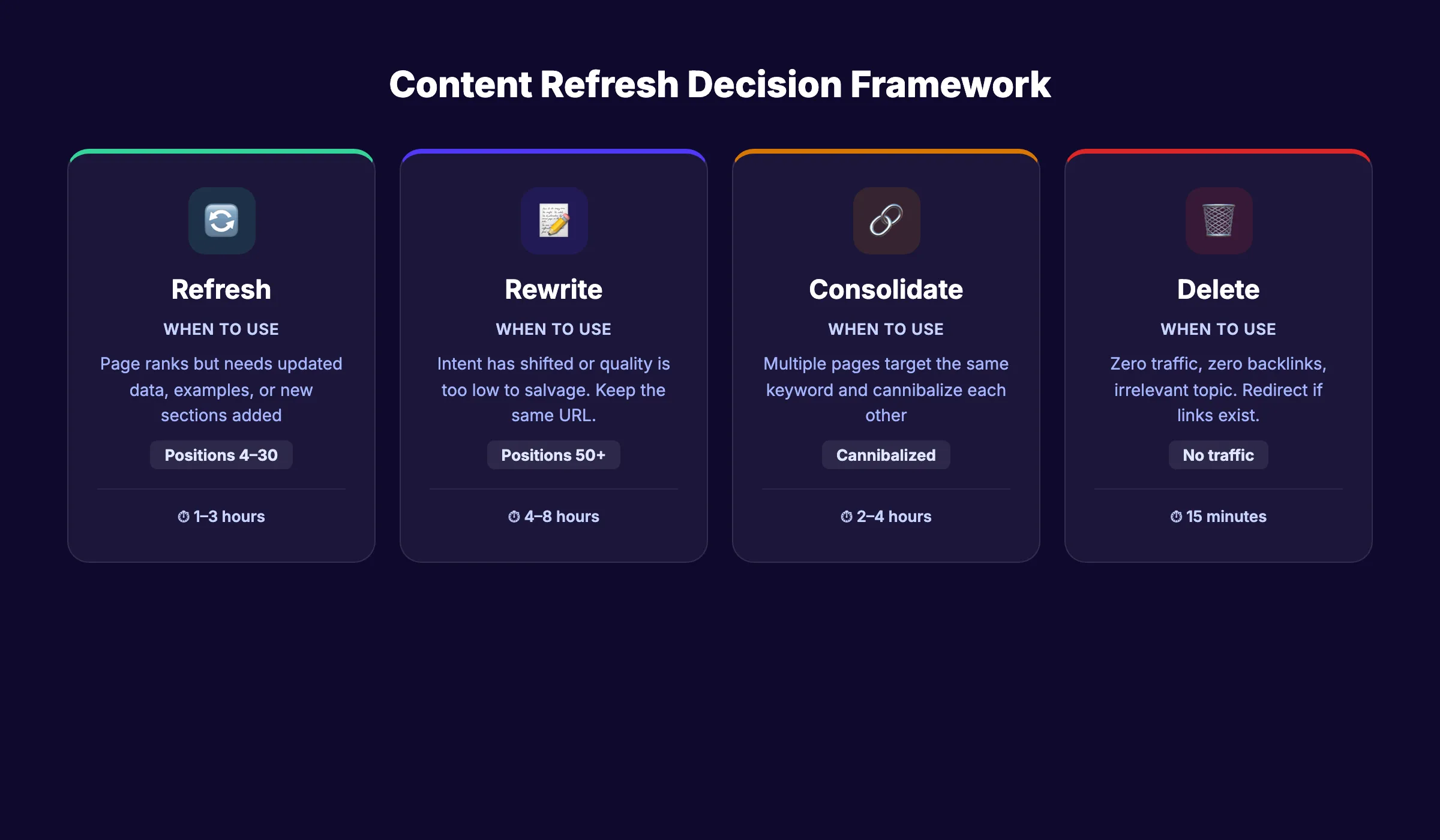
Every underperforming page falls into one of four categories. Choosing the wrong action wastes time and can hurt rankings.
Refresh: Update the Existing Page
When to use: The page ranks (positions 4 to 30), the core topic is still relevant, and the content needs updated data, examples, or sections.
What to do:
- Update statistics and year references
- Add 2 to 3 new sections based on current search intent
- Refresh internal links to newer content
- Update the meta description and title tag if CTR is low
- Add new images or replace outdated screenshots
Timeline: 1 to 3 hours per page.
Rewrite: Start Over on the Same URL
When to use: The page ranks below position 50, search intent has completely shifted, or the content quality is too low to salvage.
What to do:
- Keep the same URL (never change it during a rewrite)
- Research what currently ranks for the target keyword
- Write new content from scratch following current blog post structure best practices
- Preserve any backlinks by keeping the URL identical
Timeline: 4 to 8 hours per page.
Consolidate: Merge Multiple Pages Into One
When to use: Two or more pages target the same keyword and cause keyword cannibalization. Neither page ranks well because they compete with each other.
What to do:
- Pick the strongest URL (most backlinks, best ranking)
- Merge the best content from all pages into that URL
- Set up 301 redirects from the retired URLs
- Update all internal links pointing to retired pages
Timeline: 2 to 4 hours per merge.
Delete: Remove and Redirect
When to use: The page gets zero traffic, has zero backlinks, targets a keyword you no longer care about, or is thin content with no way to improve it.
What to do:
- Check for any backlinks (if so, redirect rather than delete)
- Remove the page
- Set up a 301 redirect to the most relevant remaining page
- Update your sitemap
This is content pruning. Done correctly, it concentrates your site’s authority on fewer, stronger pages.
The Decision Flowchart
| Question | If Yes | If No |
|---|---|---|
| Does the page get any organic traffic? | Consider refresh or rewrite | Consider delete or consolidate |
| Does it rank in positions 4 to 30? | Refresh | Move to next question |
| Has search intent shifted completely? | Rewrite | Refresh |
| Do 2+ pages target the same keyword? | Consolidate | Move to next question |
| Does it have backlinks? | Redirect, do not delete | Safe to delete |
Chapter 4: How to Refresh Content for SEO Rankings
This is the tactical chapter. Follow these steps in order for each page in your refresh queue.
Update Outdated Statistics and Data
This is the single highest-impact refresh action. Replacing “2024 data” with current 2026 statistics signals freshness to both Google and readers.
Where to find updated stats:
- Industry reports from Ahrefs, Semrush, HubSpot, and Statista
- Google’s own blogs and documentation
- Academic studies indexed on Google Scholar
- Company earnings reports and press releases
Every statistic should include a source link. Unsourced claims damage E-E-A-T signals.
Realign With Current Search Intent
Search intent shifts over time. A keyword that triggered informational results in 2024 might now trigger commercial results.
Search your target keyword. Analyze the top 5 results:
- What format dominates? (listicle, guide, comparison, tool)
- What angle do they take? (beginner vs. advanced, overview vs. deep dive)
- What questions do they answer?
If your page format does not match current intent, restructure it. A how-to guide competing against a ranked list will lose every time, regardless of content quality. Understanding search intent is non-negotiable.
Add New Sections and Depth
Top-ranking articles in 2026 average 14 monthly content changes versus 5 for lower-ranked articles. Adding sections is how you stay ahead.
Check for:
- Subtopics your competitors cover that you do not
- New developments since your original publish date
- Questions from People Also Ask that you have not answered
- Content gaps your page does not address
Add 2 to 4 new H2 or H3 sections. Each should be 150 to 300 words with a unique angle or data point.
Optimize On-Page SEO Elements
Run through this checklist during every refresh:
- Title tag includes the primary keyword (under 60 characters)
- Meta description is compelling and current (145 to 155 characters)
- H2 headings include secondary keywords naturally
- Image alt text is descriptive and keyword-relevant
- URL remains unchanged (critical)
- Schema markup is accurate and up to date
Use the on-page SEO checker to verify each element.
Refresh Internal Links
Every time you publish new content, your older pages miss potential internal link opportunities. During a refresh:
- Add links to relevant pages published since the original
- Remove links to pages you have deleted or redirected
- Update anchor text to be more descriptive
- Verify every internal link still works
A strong internal linking strategy compounds the value of every refresh.
Update Images and Media
Posts with updated images get 650 percent more engagement than text-only updates. Replace:
- Screenshots showing outdated product interfaces
- Charts with old data
- Stock photos with custom graphics or diagrams
- Low-resolution images with optimized versions
Follow image SEO best practices: descriptive file names, compressed file sizes, and keyword-rich alt text.
3,500+ blogs published. 92 percent average SEO score. See what Stacc can do for your site. Start for $1 →
Chapter 5: How to Refresh Content for AI Search Visibility
Traditional SEO refresh tactics are necessary but no longer sufficient. AI search engines process and cite content differently than Google’s traditional algorithm.
Why AI Search Demands Fresher Content
The data is clear. AI-cited content is 25.7 percent more recent than what ranks in traditional organic results. ChatGPT specifically favors URLs that are 393 to 458 days newer.
Only 30 percent of brands maintain visibility from one AI answer to the next. And 40 to 60 percent of cited sources change month to month for the same query. If you do not refresh, AI models will replace you with someone who does.
Structure Content for Passage-Level Retrieval
AI models do not read entire pages. They extract specific passages. Structure your content so each section stands alone as a citable answer:
- One clear claim per paragraph. AI models pull discrete statements.
- Lead with the answer. Put the key fact in the first sentence of each section.
- Use specific numbers. “146 percent increase” is more citable than “significant improvement.”
- Define terms explicitly. “Content decay is the gradual loss of organic traffic over time” gives AI models a quotable definition.
For a deeper dive, see our guide to getting cited by AI search engines.
Verify Entity Accuracy
AI models cross-reference facts across multiple sources. If your page states something that conflicts with the consensus, AI systems will skip your content or flag it as unreliable.
During every refresh:
- Verify all named entities (companies, people, products) are current
- Confirm statistics match their original sources
- Update any claims that have been superseded by newer research
- Remove references to products, features, or companies that no longer exist
Update Schema Markup
Schema markup helps both Google and AI systems understand your content structure. During a refresh:
- Update the
dateModifiedfield to today’s date - Verify
authorinformation is accurate - Add FAQ schema for any new FAQ sections
- Ensure HowTo schema steps match your current content
Learn how to optimize your content for generative engine optimization to maximize AI visibility.
Chapter 6: Content Refresh Frequency by Content Type
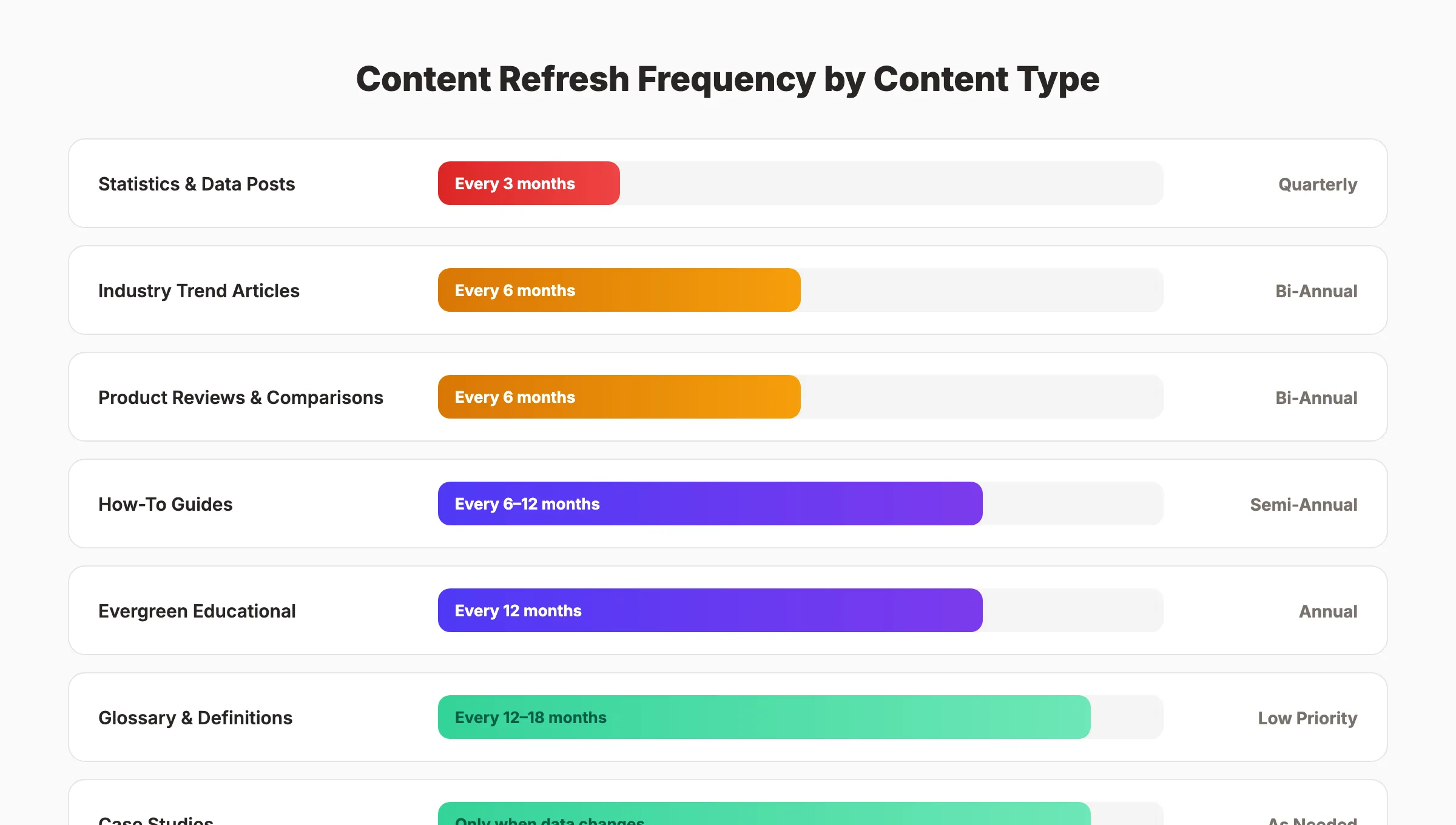
Not all content decays at the same rate. News articles go stale in days. Evergreen content lasts months or years. Your refresh cadence should match the content type.
Recommended Refresh Frequency
| Content Type | Refresh Frequency | Why |
|---|---|---|
| Statistics and data posts | Every 3 months | Numbers go stale fastest |
| Industry trend articles | Every 6 months | Trends shift with each quarter |
| How-to guides | Every 6 to 12 months | Steps and tools change |
| Product comparisons and reviews | Every 6 months | Pricing and features update constantly |
| Evergreen educational content | Every 12 months | Core concepts stay stable |
| Glossary and definition pages | Every 12 to 18 months | Definitions rarely change |
| Case studies | Only when data changes | Results are historical |
Build a Quarterly Refresh Cycle
The most effective cadence is quarterly. Siege Media’s data confirms that quarterly refreshes yield 42 percent better results than annual refreshes.
Q1 (January to March): Refresh all “year” posts (annual guides, trend articles, statistics roundups). Update year references from the previous year.
Q2 (April to June): Refresh top-traffic pages. Pull GSC data. Update any page that lost 15 percent or more traffic since Q1.
Q3 (July to September): Refresh product-focused content (reviews, comparisons, best-of lists). Products release mid-year updates.
Q4 (October to December): Consolidation quarter. Merge cannibalizing pages. Prune zero-traffic content. Prep “year” posts for January refresh.
Build this into your content calendar as recurring tasks. A refresh is not a one-time project. It is an ongoing system.
The 70/30 Rule
Allocate 70 percent of your content resources to new content and 30 percent to refreshing existing content. This ratio maximizes both growth (new keywords) and retention (existing rankings).
For sites with 200+ published pages, consider shifting to 60/40. Larger content libraries decay faster and need more maintenance.
Stop writing. Start ranking. Stacc publishes 30 SEO articles per month for $99. Your content stays fresh without lifting a finger. Start for $1 →
Chapter 7: How to Measure Content Refresh Results
A refresh without measurement is a guess. Track these metrics to prove ROI and optimize your process.
Key Metrics to Track
| Metric | Tool | What It Tells You |
|---|---|---|
| Organic traffic | Google Analytics | Did visits increase after the refresh? |
| Average position | Google Search Console | Did rankings improve? |
| Click-through rate | Google Search Console | Did the title/description update work? |
| Impressions | Google Search Console | Is Google showing the page for more queries? |
| Bounce rate | Google Analytics | Is the updated content more engaging? |
| Conversions | Google Analytics + CRM | Did the refresh drive business results? |
| AI citations | Manual tracking | Is AI search citing your updated page? |
Set a Baseline Before Every Refresh
Before you change anything, record:
- Current organic traffic (last 30 days)
- Current average position for the target keyword
- Current CTR
- Current number of ranking keywords
Without a baseline, you cannot measure improvement.
Timeline Expectations
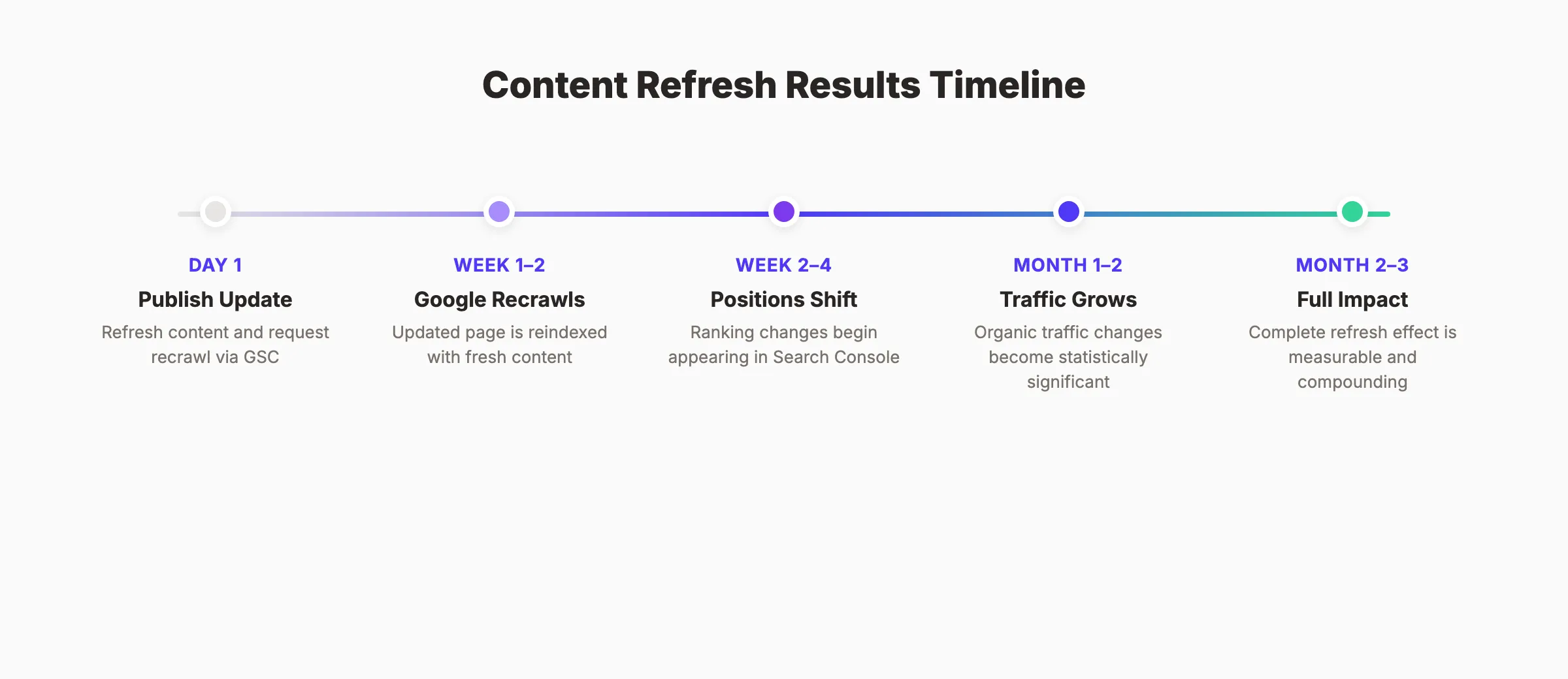
Do not expect overnight results. Here is a realistic timeline:
- Week 1 to 2: Google recrawls the updated page.
- Week 2 to 4: Position changes begin appearing in GSC.
- Month 1 to 2: Traffic changes become statistically significant.
- Month 2 to 3: Full impact of the refresh is measurable.
Request a recrawl via Google Search Console’s URL Inspection tool to accelerate this timeline.
Calculate Refresh ROI
Here is a simple ROI formula:
Refresh ROI = (Additional monthly traffic x conversion rate x customer value) / refresh cost
Example: A page refresh takes 2 hours ($100 in labor). It recovers 500 monthly visits. At a 2 percent conversion rate and $50 average order value, that is $500 per month in recovered revenue. ROI: 400 percent in month one alone.
Compare this to the cost of ranking a new page from scratch. Content refreshes almost always deliver faster, cheaper results per dollar spent.
Chapter 8: 10 Common Content Refresh Mistakes
Every mistake below has cost real businesses real rankings. Avoid all of them.
1. Just changing the publish date. Google distinguishes between cosmetic date changes and substantive updates. A date swap with no real changes can actually hurt trust. Change the date only after making meaningful updates.
2. Changing the URL. This is the most destructive refresh mistake. Changing a URL resets page authority and breaks every backlink pointing to the original. Always keep the same URL during a refresh.
3. Over-optimizing for keywords. Adding your target keyword 15 more times does not help. It triggers over-optimization signals. Write for readers first. Use the keyword naturally.
4. Ignoring search intent shifts. If the SERP for your keyword now shows product comparisons instead of educational guides, updating your guide is pointless. Match the current intent or target a different keyword.
5. Trying to refresh everything at once. Spreading effort across 50 pages produces 50 mediocre updates. Focus on 5 to 10 high-priority pages per quarter. Depth beats breadth.
6. Not updating screenshots and examples. A 2024 screenshot of a tool that redesigned its UI in 2025 signals neglect. Readers notice. So does Google.
7. Forgetting to update internal links. If you have published 30 new articles since the original, you are missing 30 potential internal linking opportunities. Every refresh should add links to newer content.
8. Not re-promoting refreshed content. An update without distribution is a tree falling in an empty forest. Share refreshed content on social media, in newsletters, and through content distribution channels.
9. Removing content that has backlinks. Before deleting any page, check for backlinks using Ahrefs, Semrush, or Google Search Console. If the page has links, redirect it. Do not delete it.
10. Not setting up redirects when consolidating. Merging two pages without 301 redirects from the retired URL loses all the equity that URL earned. Always redirect.
FAQ
What is a content refresh strategy?
A content refresh strategy is a systematic process for identifying, updating, and republishing existing content to improve search rankings and recover lost traffic. It includes auditing your content library, prioritizing pages by potential impact, updating outdated information, and tracking results. Unlike creating new content, a refresh builds on existing page authority and backlink equity.
How often should you refresh content?
It depends on the content type. Statistics posts need updates every 3 months. How-to guides and product reviews every 6 to 12 months. Evergreen educational content every 12 months. The most effective overall cadence is quarterly, which delivers 42 percent better results than annual refreshes according to industry research.
Is it better to refresh old content or create new pages?
Both are necessary, but refreshing delivers faster ROI. Content marketers who update old posts are 2.8 times more likely to report strong results. The recommended split is 70 percent new content and 30 percent refreshes. For sites with 200+ pages, shift to 60/40 in favor of more refreshes.
How do you refresh content without losing rankings?
Never change the URL. Keep the core topic and target keyword the same. Add new sections rather than removing existing ones. Update statistics with current data. Refresh internal and external links. Request a recrawl via Google Search Console after publishing updates. These steps preserve your existing authority while signaling freshness.
How long does it take for refreshed content to rank?
Expect 2 to 4 weeks for initial position changes and 1 to 3 months for the full impact to become measurable. Request a recrawl through Google Search Console to speed up the process. Pages with existing authority typically see faster results than new pages targeting the same keywords.
Can a content refresh help with AI search visibility?
Yes. AI-cited content is 25.7 percent fresher than traditional organic results. Refreshing your content with current data, clear passage-level structure, and verified facts increases the likelihood of AI citation. Update schema markup and ensure your content provides direct, quotable answers to common questions.
A content refresh strategy is not optional in 2026. It is the difference between a content library that compounds and one that decays.
Start with your highest-traffic pages. Use the decision framework to choose the right action for each. Refresh quarterly. Measure everything.
The sites that maintain their rankings are not the ones publishing the most new content. They are the ones maintaining what they already have.
Rank everywhere. Do nothing. Stacc handles Blog SEO, Local SEO, and Social on autopilot. 30 articles per month, always fresh. Start for $1 →
Related Tools & Resources
Free SEO Tools:
Best Lists:

Written by
Siddharth GangalSiddharth is the founder of theStacc and Arka360, and a graduate of IIT Mandi. He spent years watching great businesses lose organic traffic to competitors who simply published more. So he built a system to fix that. He writes about SEO, content at scale, and the tactics that actually move rankings.
30 SEO blog articles published every month
Keyword-optimized, scheduled, and live on your site. Automatically.
30-day trial · Cancel anytime
theStacc
Stop writing SEO content manually
30 blog articles, 30 GBP posts, and social media content. Published every month. Automatically.
Start Your $1 Trial$1 for 3 days · Cancel anytime