
E-E-A-T: Google's Quality Framework Explained
What is E-E-A-T? Learn how Google's Experience, Expertise, Authoritativeness, and Trustworthiness framework affects rankings. Updated March 2026.
Google does not rank content based on word count or keyword density alone. It evaluates whether the people behind the content actually know what they are talking about.
E-E-A-T is the framework Google uses to assess content quality. It stands for Experience, Expertise, Authoritativeness, and Trustworthiness. Since December 2025, Google applies E-E-A-T standards to virtually all competitive queries. Not just health and finance. Every niche.
Most SEO advice treats E-E-A-T as a vague concept. “Just be trustworthy.” That is not actionable. This guide breaks down exactly what each pillar means, how Google’s quality raters evaluate it, and the specific signals you can build into your content and website.
We have published 3,500+ blog posts across 70+ industries. Every post we write follows E-E-A-T principles. This guide covers everything we know about building content that Google trusts.
Here is what you will learn:
- What E-E-A-T actually is and how it differs from the old E-A-T framework
- Why Trust is the most important pillar and what signals support it
- How to demonstrate Experience, Expertise, and Authority on your website
- Which content types Google holds to the highest E-E-A-T standards
- The specific on-page signals quality raters look for
- How to audit your existing content for E-E-A-T gaps
What Is E-E-A-T and Where Did It Come From
E-E-A-T is a quality evaluation framework from Google’s Search Quality Rater Guidelines. Google employs thousands of human quality raters who review search results. They use E-E-A-T to judge whether a page deserves to rank.
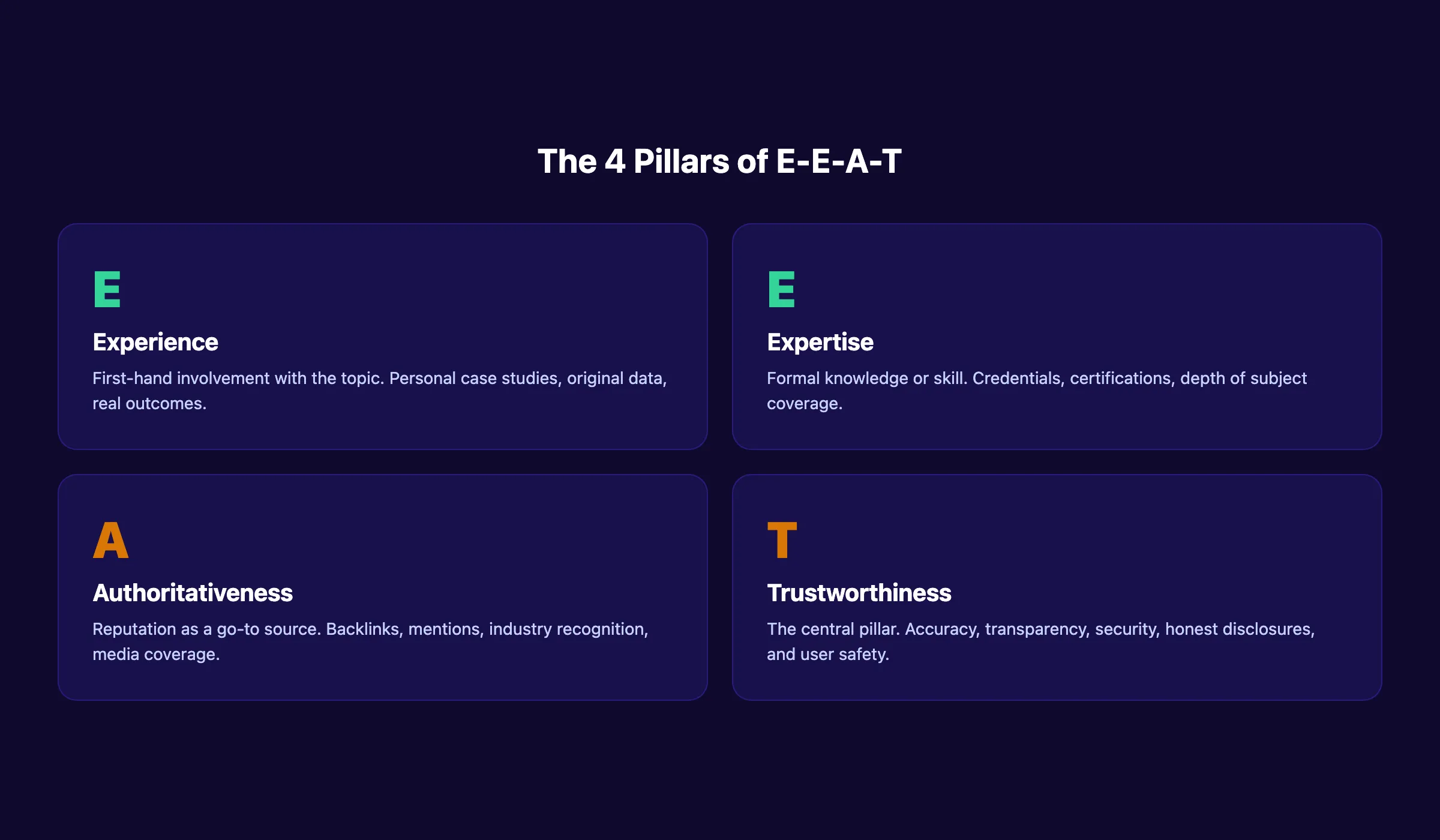
The framework has 4 pillars:
- Experience: Does the content creator have first-hand involvement with the topic?
- Expertise: Does the creator have the knowledge, skills, or credentials to cover it accurately?
- Authoritativeness: Is the creator or website recognized as a go-to source on the topic?
- Trustworthiness: Can users rely on the content, the website, and the business behind it?
E-E-A-T is not a direct ranking factor like page speed or backlinks. Google does not assign an “E-E-A-T score.” Instead, Google’s algorithms detect signals that correlate with high E-E-A-T. The quality raters validate whether the algorithms are working correctly.
The Evolution from E-A-T to E-E-A-T
Before December 2022, the framework was E-A-T: Expertise, Authoritativeness, and Trustworthiness. Google added the first “E” for Experience because credentials alone do not guarantee useful content.
A nutritionist with a PhD can write about meal planning. But a parent who has actually meal-prepped for a family of 5 for 3 years brings something credentials cannot. That is Experience.
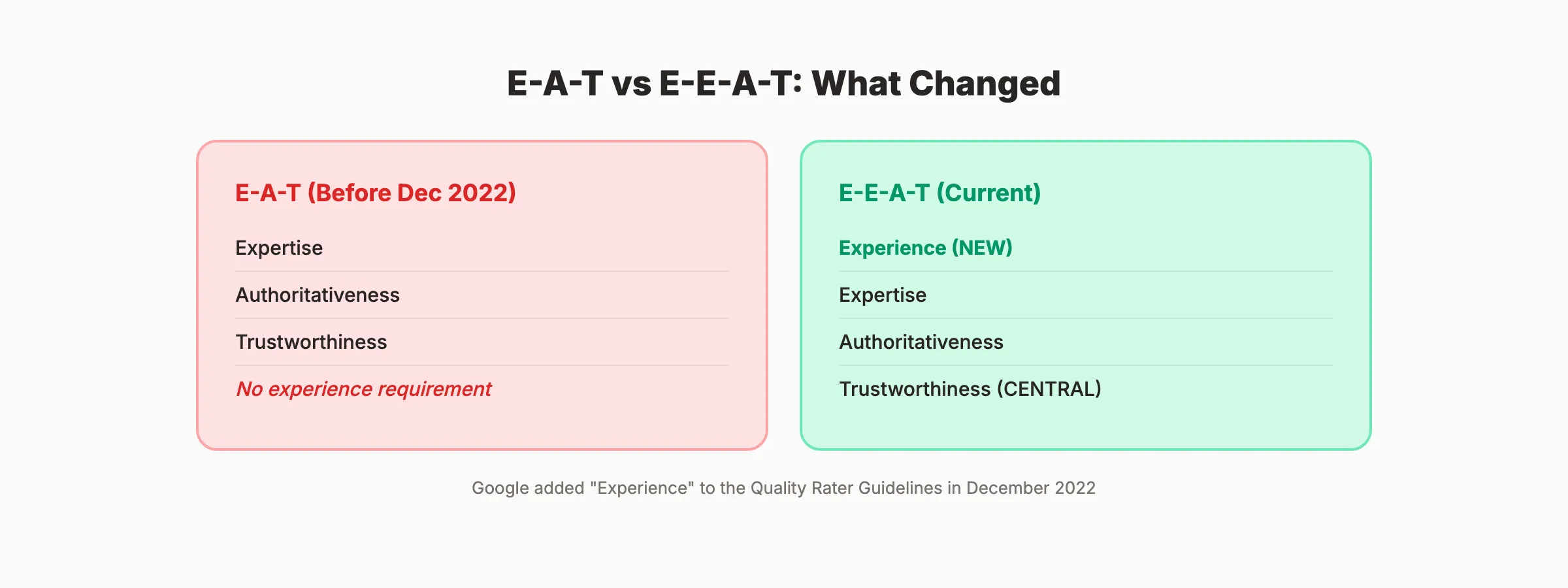
The December 2025 core update amplified this further. Google now aggressively favors content that demonstrates real-world, first-hand knowledge. A travel guide written by someone who visited the destination outranks one compiled from other articles. A product review from someone who tested the product for 6 months outranks a summary of spec sheets.
Trust: The Most Important Pillar
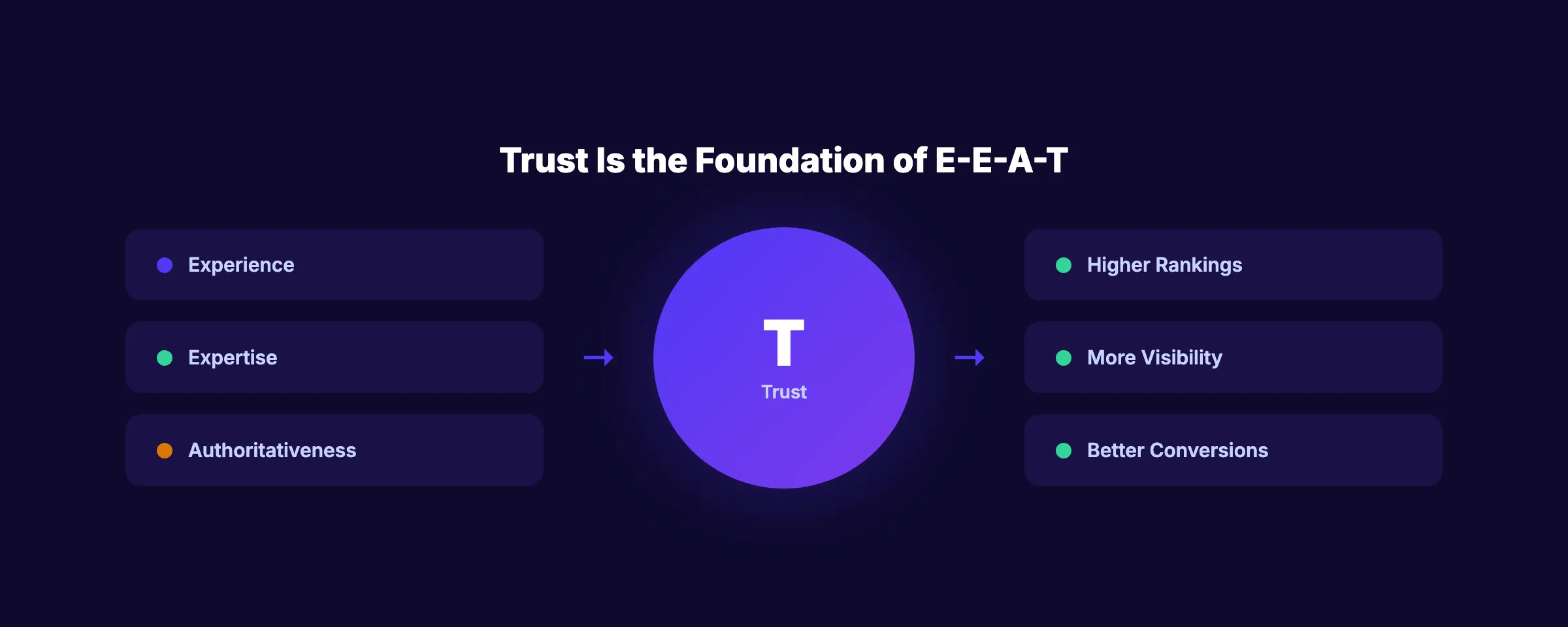
Of the 4 pillars, Trust is the most important. Google’s own quality rater guidelines state this explicitly. Experience, Expertise, and Authoritativeness all feed into Trust. Without Trust, the other 3 do not matter.
A website can have expert authors and authoritative backlinks. If the site runs deceptive ads, hides contact information, or publishes inaccurate claims, quality raters flag it as low-trust. Low trust overrides everything else.
How Google Evaluates Trust
Quality raters assess trust through specific signals:
Website transparency:
- Clear “About Us” page with real team members
- Physical address and contact information
- Privacy policy and terms of service
- Named authors with bios on content pages
Content accuracy:
- Claims supported by cited sources
- Statistics with dates and attribution
- No misleading headlines or clickbait
- Regular updates to keep information current
User experience:
- HTTPS security certificate
- No deceptive pop-ups or dark patterns
- Clear distinction between ads and content
- Fast, mobile-friendly website
Reputation signals:
- Positive reviews on Google, Trustpilot, or industry sites
- Mentions and citations from other trusted sources
- No history of scams, lawsuits, or ethical violations
For a deeper look at building trust through reviews, read our guide to getting more Google reviews.
Stop writing. Start ranking. Stacc publishes 30 SEO articles per month that follow E-E-A-T principles. Automatically. Start for $1 →
Experience: The Newest and Most Powerful Signal
Experience is the pillar Google added most recently, and it has quickly become one of the strongest differentiators in search results.
Experience asks: has the content creator actually done the thing they are writing about?
What Counts as Experience
- A software review written by someone who used the product for 90 days
- A recipe post from someone who cooked and photographed the dish
- A fitness guide from a trainer who has coached 200 clients
- A travel article from someone who spent 2 weeks at the destination
- A business guide from someone who actually runs a business
What Does Not Count
- Summarizing other articles without personal involvement
- Writing about products you have never tested
- Compiling advice from search results without original insight
- Using stock photos instead of original images
How to Demonstrate Experience on Your Website
Use first-person accounts. “We tested 12 SEO tools over 6 months” is stronger than “These are the top SEO tools.”
Include original photos and screenshots. Real photos of your work, your results, or your process prove you were there. Stock images prove nothing.
Share specific results with numbers. “Our client’s organic traffic increased 147% in 4 months” demonstrates experience. “SEO can improve traffic” does not.
Write case studies. Detailed accounts of projects you completed, challenges you solved, and results you achieved are the strongest Experience signals. Read our guide to writing case studies for the full process.
Add timestamps and context. “We published this analysis after reviewing 3,500 blog posts across 70 industries over 24 months” tells quality raters exactly how much experience backs the content.
Expertise: Proving You Know Your Subject
Expertise is about depth of knowledge. Quality raters ask whether the content creator has the education, training, or demonstrated skill to cover the topic accurately.
For YMYL topics (health, finance, legal), formal credentials matter most. For other topics, demonstrated skill through content quality can establish expertise.
How to Build Expertise Signals
Author pages with credentials. Every piece of content should credit a named author. The author page should list their qualifications, years of experience, published work, and areas of specialization.
Depth over breadth. Cover topics thoroughly. A 3,000-word guide that addresses every angle of a subject demonstrates more expertise than a 500-word overview that skims the surface.
Cite primary sources. Link to original research, official documentation, and peer-reviewed studies. Secondary sources weaken perceived expertise. For SEO content, link to Google’s official documentation, Ahrefs or Semrush studies, and industry research.
Maintain accuracy. Outdated statistics, incorrect claims, or factual errors destroy expertise signals. Audit content quarterly and update anything that has changed. Read our content audit guide for a systematic process.
Build topical authority. Publishing 20 related articles on a single topic signals deeper expertise than publishing 20 articles on 20 unrelated topics. Google rewards sites that go deep on specific subjects.
Expertise for Different Content Types
The level of expertise required depends on the topic. Google distinguishes between “everyday expertise” and “formal expertise.”
Formal expertise required: Medical advice, legal guidance, financial planning, and tax information. These topics demand credentialed authors. A blog post about medication interactions needs a pharmacist or physician as the attributed author.
Everyday expertise sufficient: Product reviews, recipe blogs, hobby content, and lifestyle advice. A home cook with 10 years of experience writing about pasta recipes has sufficient expertise. No culinary degree required.
Most business content falls somewhere in between. A marketing guide needs demonstrated marketing experience and results, but not a PhD. A blog post about SEO needs an author who has actually ranked content, not just someone who read about it.
The key distinction is whether the author can demonstrate their expertise through either credentials or verifiable outcomes. Both are valid.
Authoritativeness: Becoming the Go-To Source
Authoritativeness is about recognition. Do other experts, websites, and organizations consider you a trusted source on your topic?
Expertise is what you know. Authoritativeness is what others say about what you know.
How to Build Authority
Earn backlinks from respected sites. When high-authority websites link to your content, Google interprets that as a vote of confidence. One link from an industry publication carries more weight than 50 links from random blogs. Read our backlink building guide for tactics.
Get mentioned and cited. Brand mentions across the web signal authority even without links. Write original research that others reference. Publish data that journalists cite.
Contribute to industry discussions. Guest posts on respected publications, podcast appearances, speaking engagements, and conference presentations build your authority profile.
Publish consistently. A website that publishes 4 to 8 high-quality articles per month on a focused topic builds authority faster than one that publishes sporadically. Read our SEO content writing guide for writing standards.
Maintain an active online presence. Complete profiles on LinkedIn, industry directories, and professional associations connect your personal authority to your website.
The Authority Gap Most Businesses Miss
Most small businesses have more authority than they realize. They just do not signal it online.
If your CEO speaks at conferences, that builds authority. But only if you list those appearances on your website. If your team has been published in trade magazines, link to those features from your About page. If industry associations endorse your work, display those credentials prominently.
Google cannot read your resume from a filing cabinet. Every authority signal needs to exist online, linked to your website, and visible to both quality raters and algorithms. Use schema markup to structure your organization and author information so Google understands exactly who you are.
Your SEO team. $99 per month. 30 optimized articles published automatically every month. Built with E-E-A-T in mind. Start for $1 →
YMYL and Where E-E-A-T Matters Most
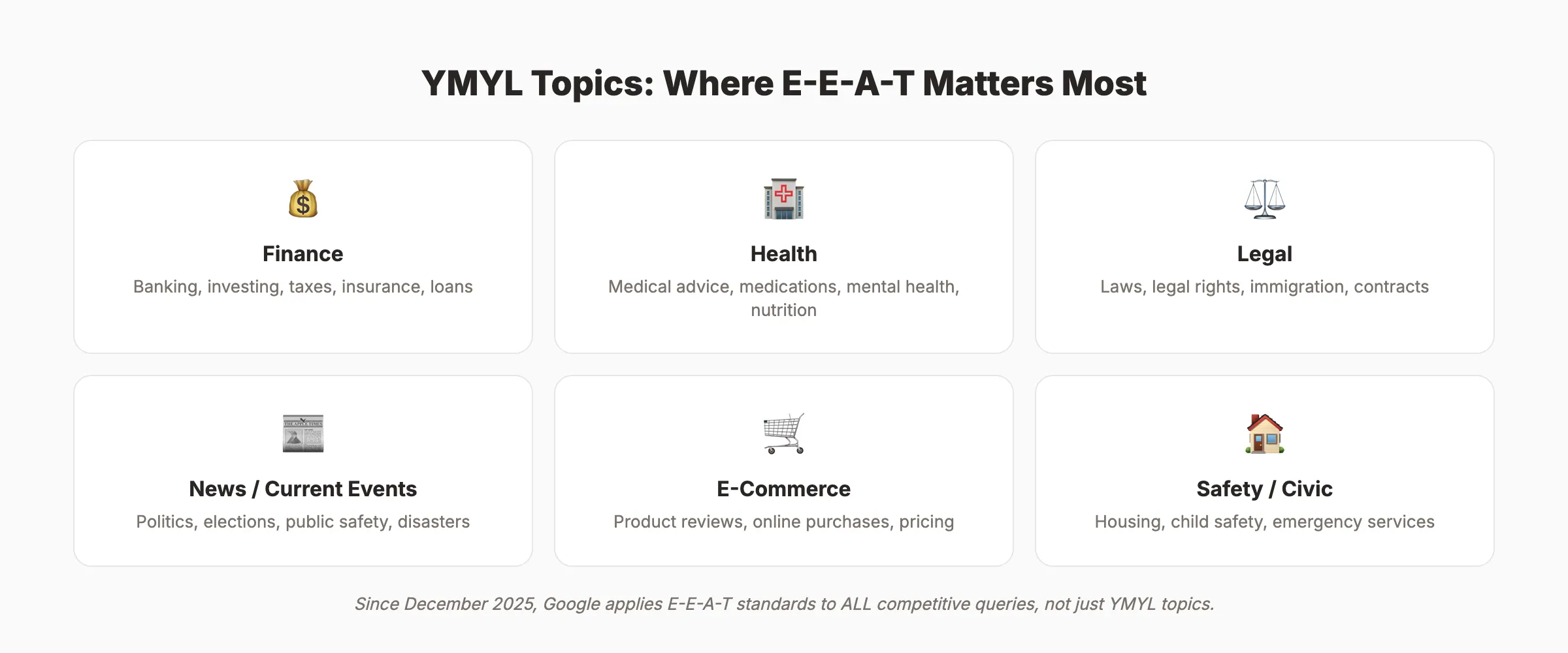
YMYL stands for Your Money or Your Life. These are topics where inaccurate information can directly harm the reader. Google holds YMYL content to the highest E-E-A-T standards.
Traditional YMYL Categories
- Health and medical: Symptoms, treatments, medications, mental health
- Finance: Investing, taxes, insurance, banking, retirement planning
- Legal: Laws, legal rights, immigration, contracts
- Safety: Emergency preparedness, product safety, child welfare
- News and current events: Politics, elections, public policy
The December 2025 Expansion
Google’s December 2025 core update extended E-E-A-T requirements beyond traditional YMYL topics. The update applies E-E-A-T to practically all competitive searches, including:
- E-commerce product reviews
- SaaS software comparisons
- How-to guides and tutorials
- Travel recommendations
- Recipe and food content
This means every website publishing content in a competitive niche needs E-E-A-T signals. The days of ranking thin, anonymous content on any topic are over.
What This Means for Your Content Strategy
If you publish content in any competitive niche, treat every page as if it requires E-E-A-T. Name your authors. Cite your sources. Share real experience. Build trust signals on every page.
For a full content quality checklist, follow our on-page SEO guide.
How to Audit Your Website for E-E-A-T
Most websites have E-E-A-T gaps they do not know about. A systematic audit reveals what to fix.
E-E-A-T Audit Checklist
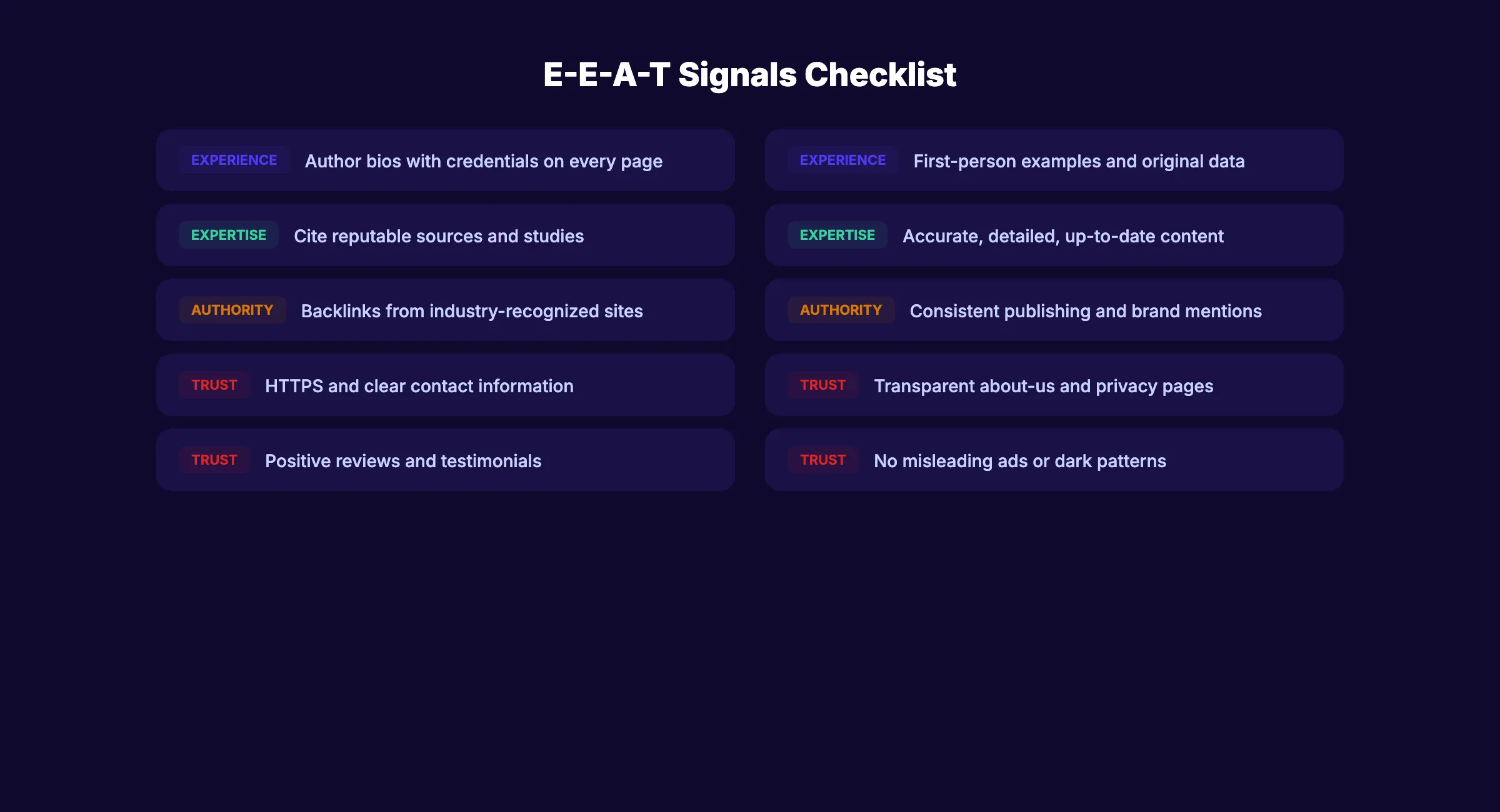
Experience signals:
- Content includes first-person accounts or original examples
- Original photos, screenshots, or data (not stock images)
- Specific results with numbers and timeframes
- Case studies or detailed project descriptions
Expertise signals:
- Named authors on every content page
- Author bio pages with credentials and experience
- Content cites primary sources and original research
- Information is accurate and up to date
- Deep topical coverage (10+ articles per topic cluster)
Authority signals:
- Backlinks from respected industry websites
- Brand mentions across the web
- Active profiles on industry directories and platforms
- Guest contributions on respected publications
- Consistent publishing schedule
Trust signals:
- HTTPS security certificate active
- Clear “About Us” page with real team information
- Physical address and contact information visible
- Privacy policy and terms of service published
- Positive reviews on Google and industry platforms
- No misleading ads, pop-ups, or dark patterns
- Content clearly distinguishes ads from editorial
Run this audit on your top 20 pages by traffic. Fix the gaps on your highest-traffic pages first. Then work through the rest of your site systematically.
For technical issues beyond E-E-A-T, run a full SEO audit to catch everything.
E-E-A-T and AI-Generated Content
AI-generated content is one of the most debated topics in SEO. Google’s stance is clear. AI content is not automatically penalized. But AI content that lacks E-E-A-T signals is.
The problem with most AI content is not that a machine wrote it. The problem is that nobody with experience, expertise, or authority reviewed, edited, or added to it.
How to Use AI Content Without Hurting E-E-A-T
Add human experience. Use AI for drafts. Add your own examples, case studies, and first-hand observations before publishing. The AI provides structure. You provide experience.
Fact-check everything. AI models generate plausible but sometimes inaccurate information. Verify every claim, statistic, and recommendation. Cite sources for anything factual.
Name a real author. Attribute the content to a real person with real credentials. That person should review and approve the content before publication.
Include original visuals. Replace stock photos with original screenshots, data visualizations, or photos from your own work. AI-generated text plus stock photos is the lowest-E-E-A-T combination possible.
For a full guide on making AI content more human, read our humanize AI content guide.
3,500+ blogs published. 92% average SEO score. Every article built with E-E-A-T principles. Start for $1 →
Common E-E-A-T Mistakes to Avoid
Most websites fail at E-E-A-T not because they lack expertise but because they do not signal it properly.
No author attribution. Content published under “Admin” or with no author name tells Google nothing about who created it. Add real names and bio pages.
No “About Us” page. Quality raters specifically check for an About page. A missing or thin About page is a trust red flag.
Outdated content. Statistics from 2021 on a page claiming to be a “2026 guide” destroys trust. Review and update content at least annually.
No sources cited. Making claims without linking to supporting evidence weakens expertise signals. Cite your sources for any factual statement.
Thin content across the site. A blog with 50 pages of 300-word articles signals low expertise. Fewer, deeper articles perform better for E-E-A-T.
Fake or purchased reviews. Google’s quality raters and algorithms detect review manipulation. Focus on earning genuine reviews from real customers.
Ignoring negative feedback. Not responding to negative reviews or criticism signals low trustworthiness. Address concerns transparently.
FAQ
Is E-E-A-T a Google ranking factor?
E-E-A-T is not a direct ranking factor in the same way page speed or backlinks are. Google does not assign an E-E-A-T score. It is a framework that human quality raters use to evaluate search results. Google’s algorithms detect signals that correlate with high E-E-A-T and use those signals in ranking decisions.
What is the difference between E-A-T and E-E-A-T?
E-A-T included Expertise, Authoritativeness, and Trustworthiness. Google added Experience as a fourth pillar in December 2022. Experience evaluates whether the content creator has first-hand involvement with the topic. This rewards practitioners and doers over researchers who compile information secondhand.
Which E-E-A-T pillar is most important?
Trust is the most important pillar. Google’s quality rater guidelines state this explicitly. Experience, Expertise, and Authoritativeness all contribute to building Trust. A page can have strong expertise but low trust (due to deceptive practices) and still rank poorly.
Does E-E-A-T apply to all websites?
Since Google’s December 2025 core update, E-E-A-T standards apply to practically all competitive search queries. YMYL (Your Money or Your Life) topics like health and finance are held to the highest standards. But even non-YMYL content in competitive niches needs E-E-A-T signals to rank well.
How do I improve E-E-A-T for my website?
Start with trust: add HTTPS, an About page, contact information, and privacy policy. Then build expertise by adding author bios and citing sources. Demonstrate experience through case studies, original data, and first-person accounts. Build authority through consistent publishing and earning backlinks from respected sites.
Can AI-generated content have good E-E-A-T?
AI content can meet E-E-A-T standards if a qualified human reviews, edits, and adds original experience to it. The key is human oversight. AI drafts plus human expertise, original examples, and proper fact-checking create content that satisfies E-E-A-T requirements.
E-E-A-T is not a checkbox exercise. It is a signal of genuine quality. The websites that rank highest are the ones run by real people with real experience, sharing accurate information that readers can trust.
Start with Trust. Add author bios and contact information. Then demonstrate Experience through original examples and case studies. Build Expertise by going deep on your core topics. Earn Authority by publishing consistently and attracting backlinks from respected sources.
Build E-E-A-T into every page you publish. The compounding effect of trust, expertise, and authority is the strongest ranking advantage any website can have. It is also the hardest for competitors to replicate.

Written by
Siddharth GangalSiddharth is the founder of theStacc and Arka360, and a graduate of IIT Mandi. He spent years watching great businesses lose organic traffic to competitors who simply published more. So he built a system to fix that. He writes about SEO, content at scale, and the tactics that actually move rankings.
30 SEO blog articles published every month
Keyword-optimized, scheduled, and live on your site. Automatically.
30-day trial · Cancel anytime
theStacc
Stop writing SEO content manually
30 blog articles, 30 GBP posts, and social media content. Published every month. Automatically.
Start Your $1 Trial$1 for 3 days · Cancel anytime