
How to Write Case Studies That Convert (7 Steps)
Learn how to write case studies that convert prospects into customers. 7 steps with templates, examples, and SEO tips. Updated March 2026.
77% of B2B buyers rate case studies as the most effective content type for making purchase decisions. Yet most companies either do not write case studies at all or write ones that read like press releases nobody finishes.
The cost of bad case studies is invisible. Prospects visit your site, scan a generic “we helped Company X” page, and leave. No trust built. No conversion. Meanwhile, a competitor with 3 well-structured case studies closes the deal because they showed proof instead of making promises.
This guide walks through 7 steps to write case studies that actually convert. Not academic case studies. Not fluffy testimonials. Real customer success stories structured to move prospects from “interested” to “sold.”
We publish 3,500+ blogs across 70+ industries with a 92% average SEO score. Case studies are part of every content strategy we build. The framework below is what we use and what we recommend to every client.
Here is what you will learn:
- How to pick the right customer story for maximum impact
- The exact structure that keeps readers engaged through the full case study
- How to extract compelling data from customer interviews
- Where to place CTAs for conversion without feeling pushy
- How to optimize case studies for SEO so they attract organic traffic
- The 5 mistakes that kill case study conversions
Time required: 4 to 8 hours per case study (including interview and writing)
Difficulty: Intermediate
What you need: A willing customer, interview questions, data on results, and a CMS to publish
Step 1: Choose the Right Customer Story
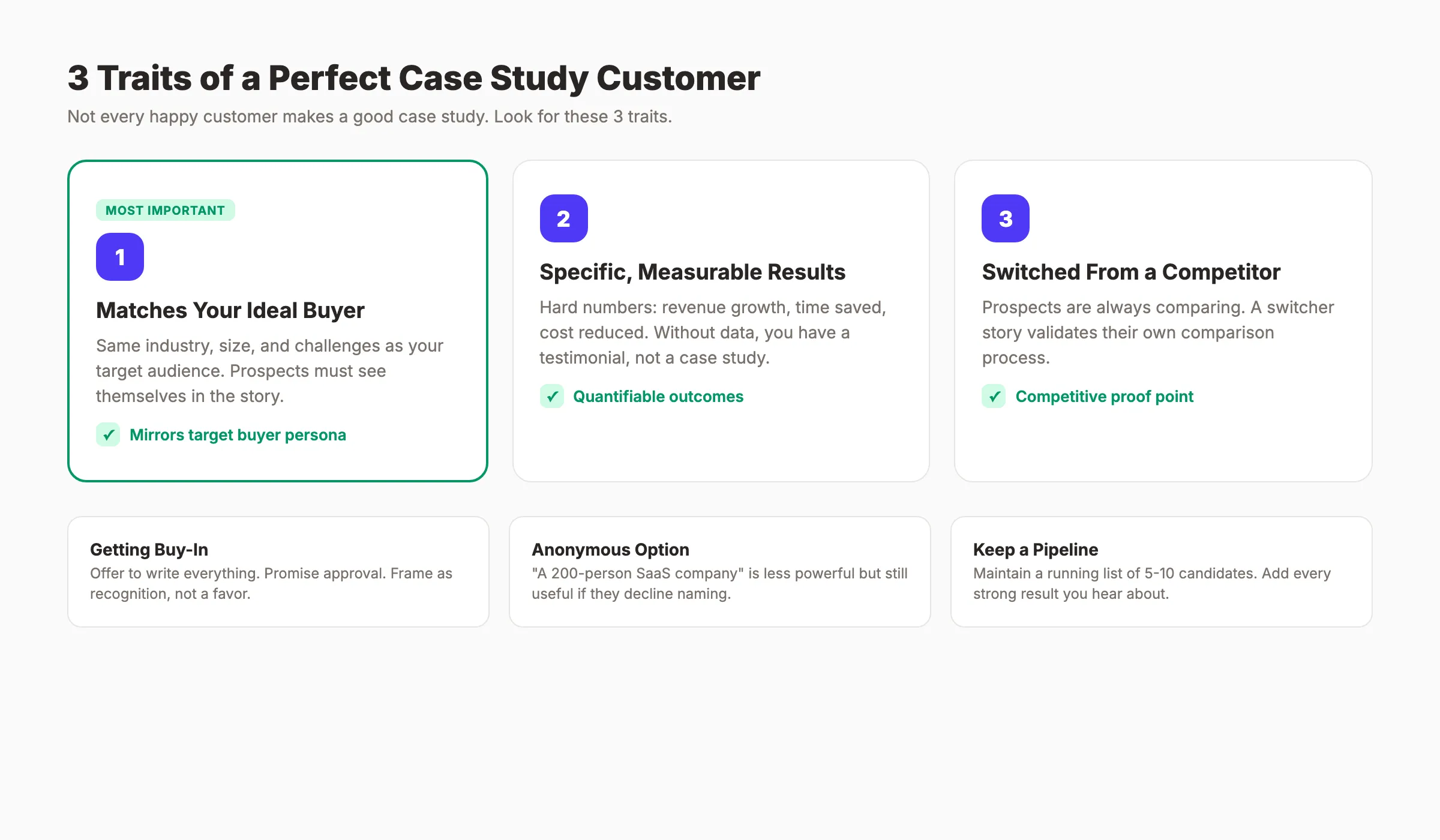
Not every happy customer makes a good case study. The best case studies share 3 traits.
The customer matches your ideal buyer. If you sell to mid-size SaaS companies, a case study about an enterprise client does not resonate. Your prospect needs to see themselves in the story. Pick a customer whose industry, size, and challenges mirror your target audience.
The results are specific and measurable. “They loved our service” is not a case study. “Organic traffic increased 340% in 6 months” is. You need hard numbers. Revenue growth. Time saved. Cost reduced. Percentage improvements. Without data, you have a testimonial, not a case study.
The customer switched from a competitor or alternative. Prospects considering your product are almost always comparing options. A case study featuring a customer who switched from a well-known competitor carries more weight than one about a customer who had nothing before.
How to Get Customer Buy-In
Most customers say yes when you make it easy for them. Offer to write everything. Promise they approve the final draft. Give them a timeline. Frame it as recognition, not a favor. “We want to feature your success” works better than “Can we use you in our marketing?”
If a customer declines to be named, you can still use the story with anonymized details. “A 200-person SaaS company in the fintech space” is less powerful than a named brand but still useful.
Why this step matters: A poorly chosen customer story wastes 4 to 8 hours of work and produces a case study nobody relates to. The right story sells itself.
Pro tip: Start a running list of potential case study candidates. Every time a customer shares a strong result, add them. You should always have 5 to 10 candidates ready.
Step 2: Prepare Your Interview Questions
The interview determines whether your case study has depth or reads like a press release. Generic questions produce generic answers.
Structure your questions around 4 phases:
Before (The Problem)
- What was the biggest challenge you faced before working with us?
- How long had this problem existed?
- What did it cost you in time, money, or missed opportunities?
- What other approaches did you try that did not work?
During (The Decision)
- What made you decide to look for a new approach?
- How did you find us? What alternatives did you evaluate?
- What was the deciding factor in choosing us over other options?
- What concerns did you have before getting started?
After (The Results)
- What specific results have you seen since working with us?
- Can you share any numbers? Revenue, traffic, time saved, cost reduction?
- How long did it take to see the first results?
- What surprised you most about the experience?
Ongoing (The Relationship)
- How has your workflow changed since implementation?
- Would you recommend us? What would you tell someone considering it?
- What is one thing we do that you value most?
Record the interview with permission. Real quotes from customers are more credible than anything you write yourself. A 30-minute call gives you enough material for a full case study.
Your SEO content writing skills apply here too. Listen for phrases and language your prospect audience would use. Those become headlines and pull quotes.
Why this step matters: Bad questions produce bad stories. A structured interview extracts the emotional journey and the hard data you need to write something that converts.
Step 3: Structure the Case Study for Conversion
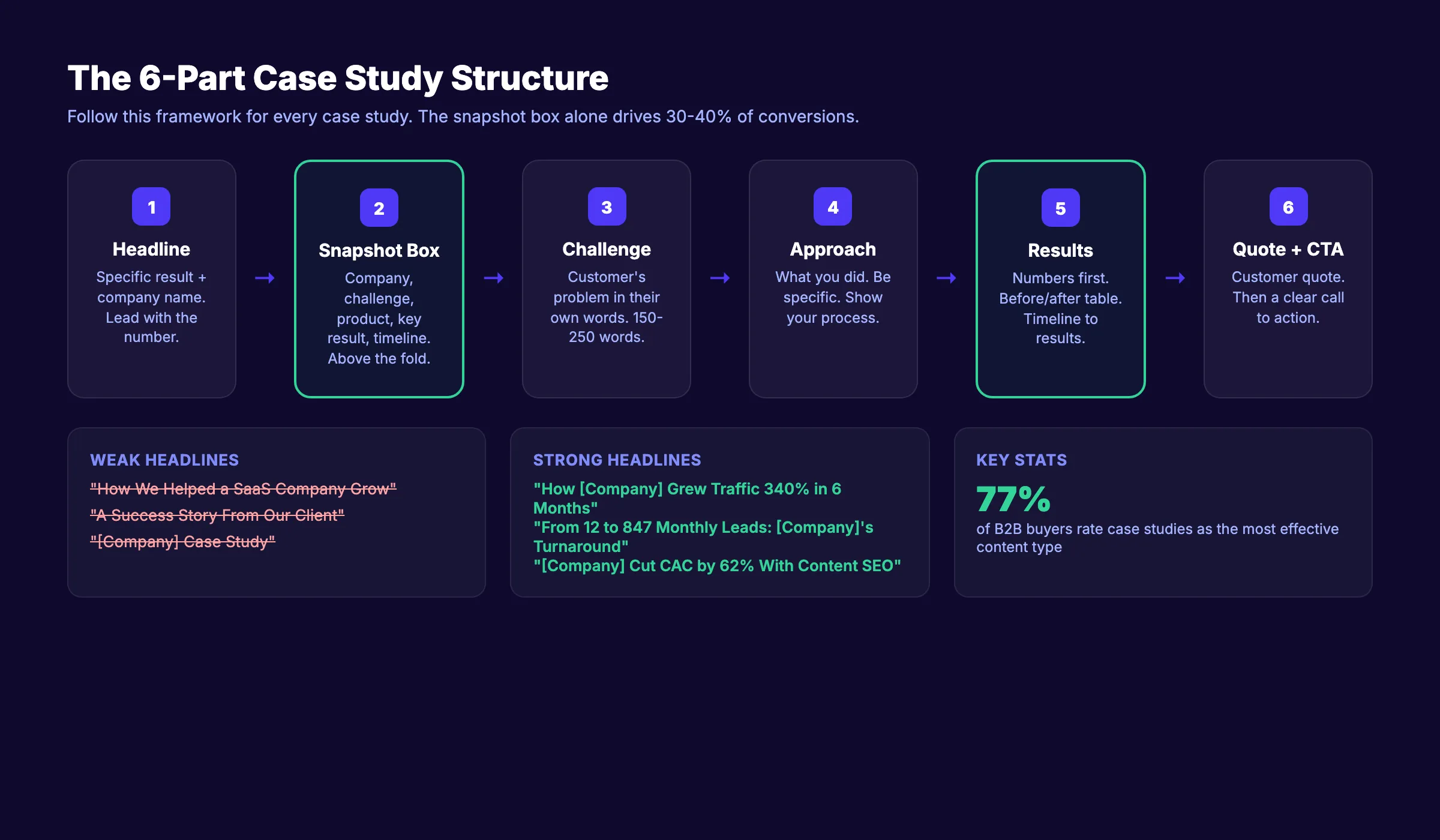
The structure of your case study determines whether people read it or bounce. Follow this 6-part framework.
Part 1: Headline With a Specific Result
Your headline does 80% of the work. A vague headline kills the case study before it starts.
| Weak Headline | Strong Headline |
|---|---|
| ”How We Helped a SaaS Company Grow" | "How [Company] Grew Organic Traffic 340% in 6 Months" |
| "A Success Story From Our Client" | "From 12 to 847 Monthly Leads: [Company]‘s SEO Turnaround" |
| "[Company] Case Study" | "[Company] Cut Customer Acquisition Cost by 62% With Content SEO” |
Lead with the number. Name the company if possible. Make the result impossible to ignore.
Part 2: Snapshot Box
Place a summary box at the top of every case study. Readers scan before they commit.
Include:
- Company: Name, industry, size
- Challenge: One-sentence problem
- Product/Service used: What you provided
- Key result: The headline number
- Timeline: How long to achieve results
Part 3: The Challenge
Describe the customer’s situation before they found you. Use their own words from the interview. Pain points are what your prospect identifies with. Spend 150 to 250 words here.
Part 4: The Approach
Explain what you did. Be specific. If you built a topical map, say so. If you published 30 articles per month, show it. This section proves your expertise and gives prospects a preview of what working with you looks like.
Part 5: The Results
This is the most important section. Lead with numbers. Use a data table or bold callout stats. Compare before and after. Show the timeline.
| Metric | Before | After | Change |
|---|---|---|---|
| Monthly organic traffic | 2,400 | 18,200 | +658% |
| Leads per month | 12 | 147 | +1,125% |
| Cost per lead | $340 | $52 | -85% |
Part 6: Customer Quote and CTA
End with a direct quote from the customer. Then place your call to action. Not “Contact us.” Something specific: “See how we can do the same for your business” with a link to your pricing or consultation page.
Why this step matters: Structure is the difference between a case study that converts and one that collects dust. Prospects scan. If they do not find proof in the first 10 seconds, they leave.
Pro tip: The snapshot box alone drives 30 to 40% of conversions on case study pages. Never skip it.
Step 4: Write the First Draft With Story, Not Jargon
75% of B2B marketers use case studies in their content strategy. The ones that convert treat the customer as the hero of the story. Not your company.
Most case studies fail because they read like product descriptions. “Our platform delivered best-in-class results through our proprietary methodology.” That tells the reader nothing. It builds no connection.
Write the case study as a narrative. The customer had a problem. The problem was costing them something real. They tried other approaches that did not work. They found your service. Here is what happened. Here are the numbers.
Writing Rules for Case Studies
Use the customer’s language. If they said “we were drowning in manual work,” write that. Do not translate it into corporate speak.
Quantify everything. “Significant improvement” means nothing. “47% increase in 90 days” means everything. Numbers build trust.
Keep paragraphs short. Max 3 sentences. Case study readers are decision-makers with limited time. Walls of text kill engagement.
Include direct quotes. Pull 2 to 3 strong quotes from your interview. Place them as blockquotes between sections. Real voices build credibility that no amount of marketing copy can match.
“We went from spending 20 hours a week on content to zero. Stacc handles everything. Our traffic doubled in 4 months.”
Name the alternatives. If the customer switched from a competitor, mention it. “Before working with us, they used [Competitor X] for 2 years with declining results.” This validates the prospect’s own comparison process.
Good blog post structure principles apply to case studies too. Clear headings. Short sections. Scannable formatting.
Why this step matters: Prospects read case studies to see themselves in the story. Jargon-filled corporate language creates distance. Real stories create connection. Connection creates conversions.
Stop writing. Start ranking. Stacc publishes 30 SEO-optimized articles per month for $99. Case studies, blog posts, and content strategy on autopilot. Start for $1 →
Step 5: Optimize the Case Study for SEO
Most case studies sit on a hidden page that nobody finds through search. That is wasted potential. An SEO-optimized case study ranks for commercial and informational keywords and drives organic traffic to your highest-converting content.
Keyword Targeting for Case Studies
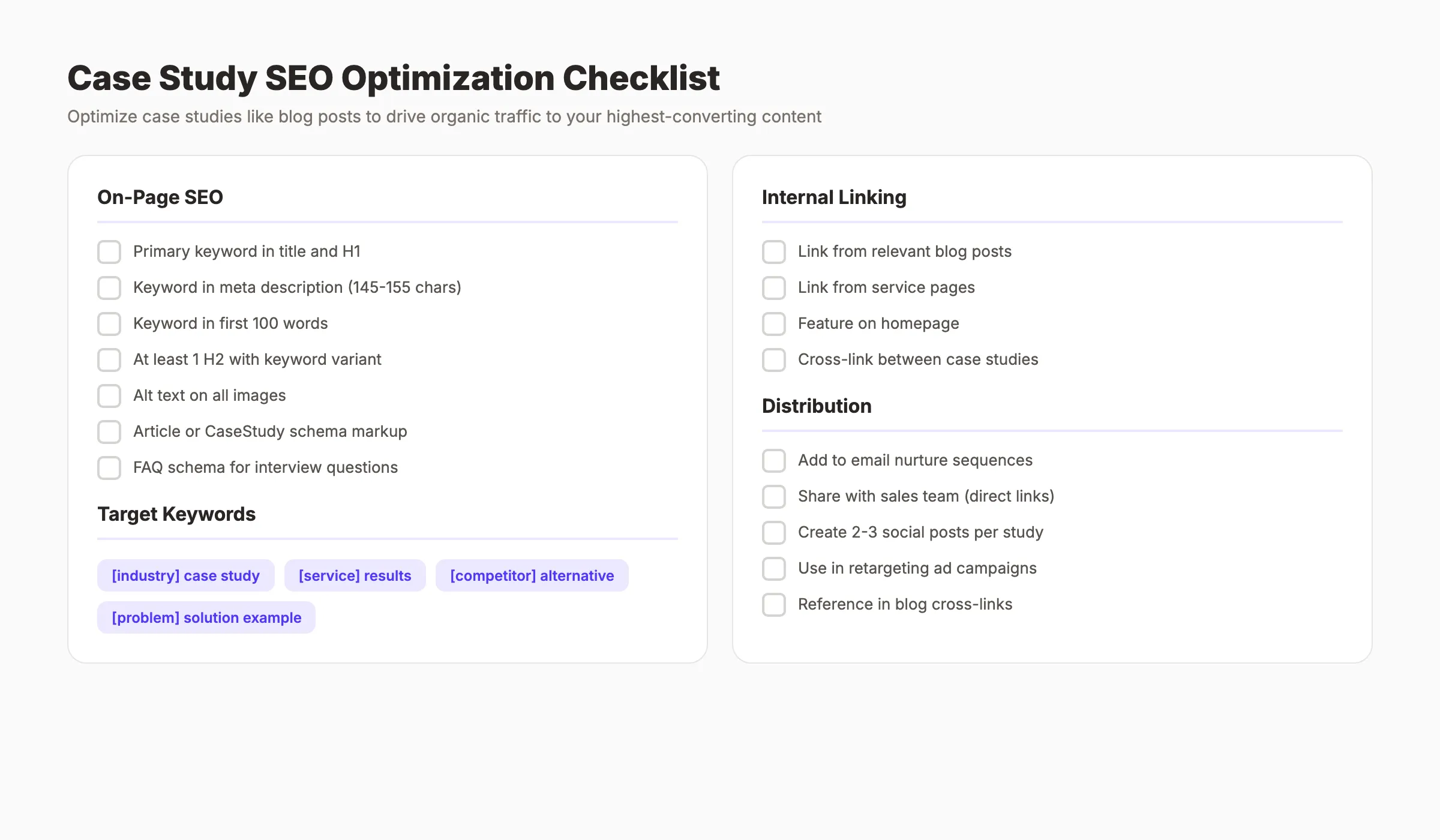
Target keywords that signal buying intent:
- “[your industry] case study” (e.g., “SEO agency case study”)
- “[competitor name] alternative results”
- “[problem] solution example” (e.g., “low organic traffic solution”)
- “[your service] results” (e.g., “content marketing results”)
Research these with the same process you use for keyword research for blog posts. Long-tail keywords with commercial intent are ideal.
On-Page SEO Checklist for Case Studies
- Primary keyword in the title and H1
- Keyword in the meta description (145 to 155 characters)
- Keyword in the first 100 words of the body
- At least 1 H2 containing the keyword or close variant
- Alt text on all images with relevant keywords
- Internal links to related blog posts and service pages
- External links to authoritative sources for any cited statistics
- Schema markup (Article or CaseStudy schema)
Internal Linking Strategy
Link your case studies from:
- Relevant blog posts (when mentioning results or proof)
- Service pages (as social proof)
- The homepage (if it is a flagship story)
- Other case studies (cross-linking builds authority)
Strong internal linking makes case studies discoverable by both search engines and visitors already on your site.
Why this step matters: A case study that ranks on Google brings qualified traffic directly to your highest-converting content. Most case studies get zero organic traffic because nobody optimizes them.
Pro tip: Add FAQ schema to your case study with 3 to 4 questions pulled from your customer interview. This increases your chances of appearing in featured snippets and AI Overviews.
Step 6: Add Conversion Elements That Drive Action
A case study without a CTA is a story without a purpose. You need conversion elements woven throughout, not just a “Contact us” button at the bottom.
Where to Place CTAs
| Location | CTA Type | Example |
|---|---|---|
| Snapshot box | Soft CTA | ”Want similar results? [See how →]“ |
| After the Results section | Primary CTA | ”Get a free consultation” or “Start for $1” |
| Sidebar (on desktop) | Persistent CTA | Sticky button that follows as they scroll |
| Bottom of page | Final CTA | ”Ready to see these results for your business?” |
Social Proof Elements
Add these to boost credibility:
- Customer logo prominently displayed
- Star rating or NPS score if available
- Industry badge (“Trusted by 200+ SaaS companies”)
- Related case studies linked at the bottom (“See more success stories”)
Distribution Plan
Publishing is not enough. Distribute every case study across:
- Email sequences (add to your nurture flow)
- Sales enablement (arm your sales team with direct links)
- Social media (pull 2 to 3 stat-driven posts from each case study)
- Blog cross-links (reference case studies in relevant blog posts)
- Paid ads (case studies make high-performing retargeting content)
Use your content calendar to schedule case study promotion alongside regular blog content.
Why this step matters: Case studies with strategic CTAs convert 3 to 5 times better than those with a single bottom-of-page link. Every section is an opportunity to move the reader closer to action.
Step 7: Measure Performance and Iterate
You cannot improve what you do not measure. Track these metrics for every case study.
Key Metrics to Track
- Page views. How much traffic does the case study receive?
- Time on page. Are readers engaging with the full story?
- Scroll depth. How far do readers get before leaving?
- CTA click rate. Which CTAs drive the most clicks?
- Conversion rate. How many readers take the next step (demo, consultation, signup)?
- Assisted conversions. Does the case study appear in the conversion path even if it is not the last touch?
How to Improve Underperforming Case Studies
If a case study gets traffic but low conversions:
- Test a stronger headline with a bigger number
- Add a snapshot box if one is missing
- Move the primary CTA higher on the page
- Add more specific data points and quotes
If a case study gets low traffic:
- Improve the SEO (title, meta, keywords, internal links)
- Promote through email and social channels
- Cross-link from your highest-traffic blog posts
- Update with fresh data if the original results have improved
Run a quarterly content audit on your case studies. Refresh data. Update quotes. Add new results. A case study from 2 years ago with outdated numbers hurts credibility.
To increase organic traffic to your case studies, treat them like blog posts. Optimize, promote, and update regularly.
Why this step matters: Most companies publish a case study and forget it. The ones that convert regularly review performance and iterate. A case study that converts at 2% can reach 6% with the right adjustments.
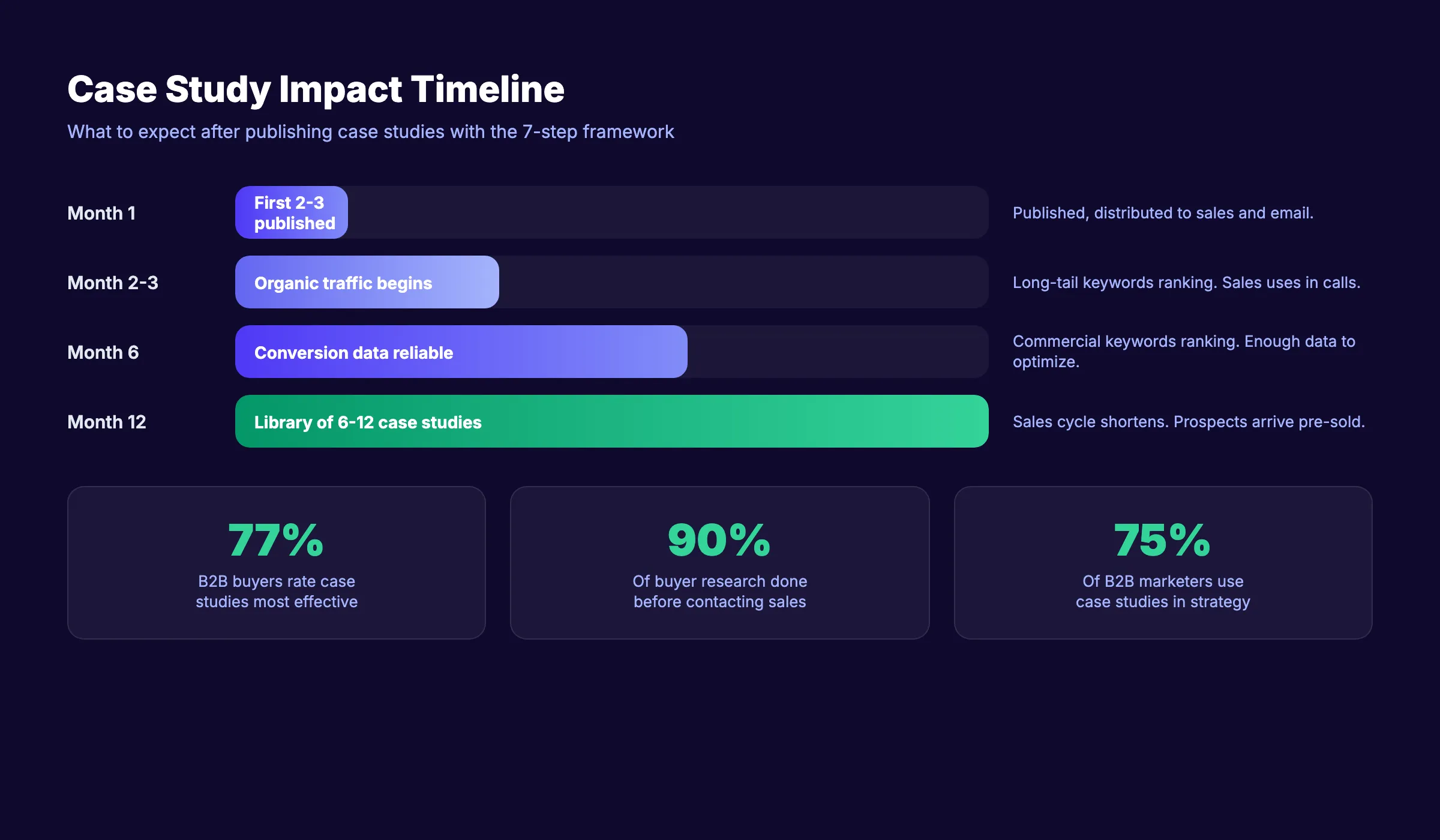
Results: What to Expect
Case studies take more effort per piece than a standard blog post. But the return is disproportionately higher.
Month 1: First 2 to 3 case studies published and optimized. Initial distribution through email and sales team.
Month 2 to 3: Organic traffic begins for long-tail keywords. Sales team reports using case studies in conversations. Early conversion data available.
Month 6: Case studies rank for commercial keywords. Prospects reference case studies during sales calls. Conversion rate data is reliable enough to optimize.
Month 12: Library of 6 to 12 case studies covering key industries and use cases. Organic traffic compounds. Sales cycle shortens because prospects arrive pre-sold.
B2B buyers complete 90% of their research before talking to sales. Case studies are the content they read during that research phase. Every case study you publish removes one more objection from the buyer’s mind.
Troubleshooting: 5 Common Case Study Mistakes
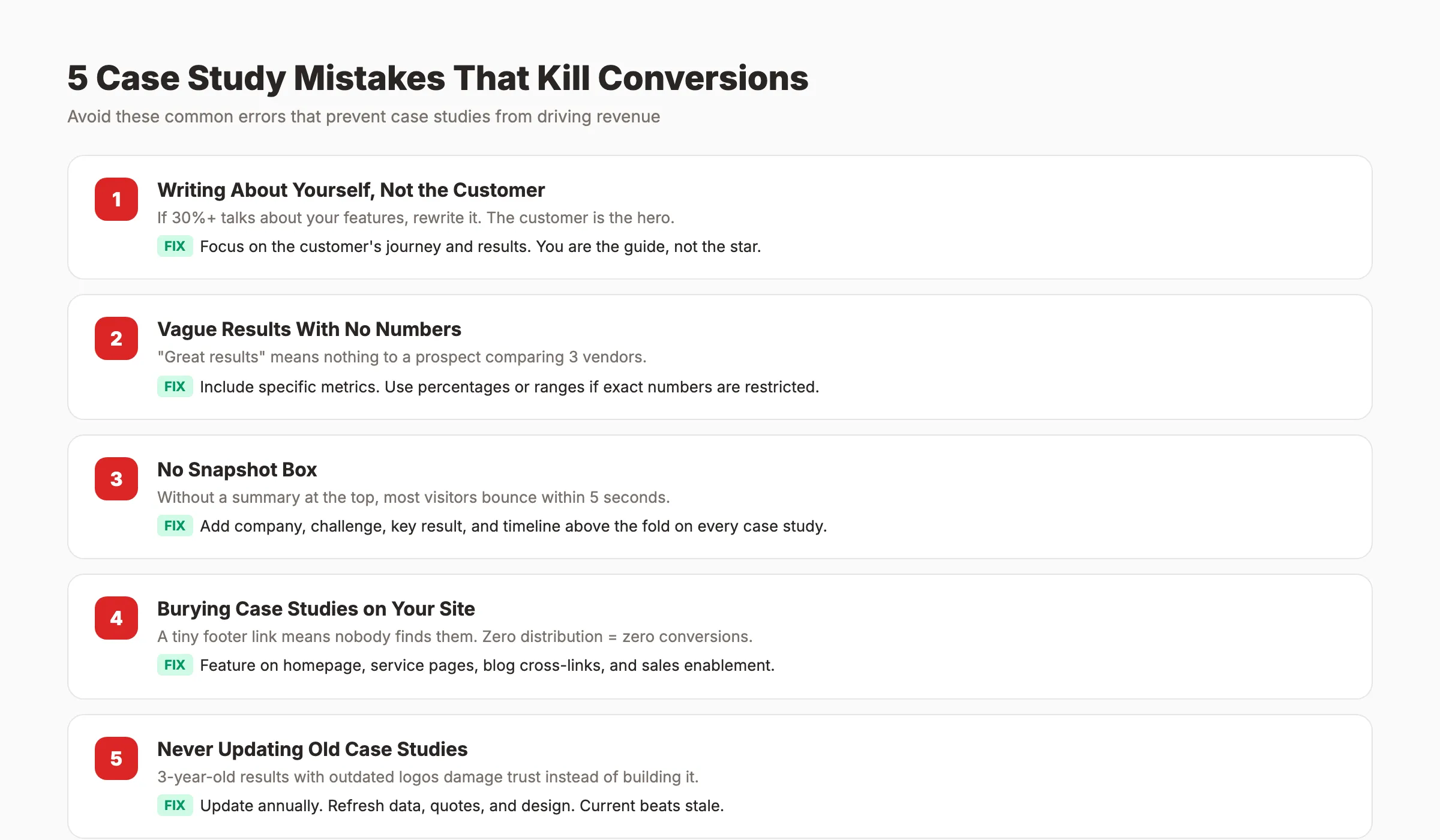
Mistake 1: Writing about yourself instead of the customer. The customer is the hero. Your company is the guide. If more than 30% of the case study talks about your product features, rewrite it. Focus on the customer’s journey and results.
Mistake 2: Vague results with no numbers. “Great results” means nothing to a prospect comparing 3 vendors. Include specific metrics. If the customer cannot share exact numbers, use percentages or ranges. “Reduced costs by 40 to 50%” is still compelling.
Mistake 3: No snapshot box. Decision-makers scan before they read. Without a snapshot box showing the company, challenge, and key result at the top, most visitors bounce within 5 seconds.
Mistake 4: Burying the case study on your site. If the only path to your case studies is a tiny link in the footer, nobody finds them. Feature case studies on your homepage, service pages, and in your blog internal linking strategy.
Mistake 5: Never updating old case studies. Results from 3 years ago with a former logo and outdated metrics damage trust. Update annually. Add new data points. Refresh the design. A current case study outperforms an old one by a wide margin.
3,500+ blogs published. 92% average SEO score. See what Stacc can do for your content strategy. Start for $1 →
FAQ
How long should a case study be?
Most effective B2B case studies run 800 to 1,500 words for the web version. That is long enough to tell the full story with data but short enough to hold attention. Supplement with a 1-page PDF for sales teams and a 60 to 90 second video for social media. The web version should prioritize scannability with bold stats, pull quotes, and a snapshot box.
Do case studies really help with conversions?
Yes. 77% of B2B buyers rate case studies as the most effective content type for purchase decisions. Case studies build trust by showing real results from real customers. They work especially well in the middle and bottom of the funnel where prospects compare options and seek proof. Companies with 6 or more published case studies report shorter sales cycles and higher close rates.
How do I get customers to agree to a case study?
Make it easy. Offer to write everything. Promise approval before publishing. Frame it as recognition of their success. Most customers agree when you position it as a spotlight on their achievement rather than a marketing exercise. If they decline to be named, offer to anonymize the details. An anonymous case study is still more powerful than no case study at all.
Should case studies be gated behind a form?
No. Gating case studies behind a lead capture form reduces readership by 80% or more. Case studies are trust-building content. Restricting access defeats their purpose. Publish them openly on your website. If you want to capture leads, add a CTA within the case study that offers something additional, like a consultation or audit. For tips on building trust content, read our guide on how to optimize content for SEO.
How many case studies should a B2B company have?
Aim for 1 case study per major industry or use case you serve. A minimum of 3 to 5 gives you enough variety for different buyer personas. Build toward 10 to 12 over time. Organize them with filters by industry, company size, and product so prospects can find the most relevant story. Quality matters more than quantity. Three detailed case studies with strong data outperform 20 thin ones with vague results.
Can I write case studies for SEO?
Absolutely. Case studies rank well for commercial keywords like “[industry] case study” and “[service] results.” Optimize them the same way you optimize blog posts. Include target keywords in the title, meta description, and headings. Add schema markup for better search visibility. Internal link from relevant blog content. A well-optimized case study brings qualified traffic directly to your highest-converting page.
Case studies are the most underused conversion asset in B2B marketing. Every company has customer success stories. Most never tell them. The 7 steps above give you a repeatable system to turn wins into content that drives revenue. Start with your strongest customer result and work through the framework. The first case study is the hardest. The rest get easier.

Written by
Siddharth GangalSiddharth is the founder of theStacc and Arka360, and a graduate of IIT Mandi. He spent years watching great businesses lose organic traffic to competitors who simply published more. So he built a system to fix that. He writes about SEO, content at scale, and the tactics that actually move rankings.
30 SEO blog articles published every month
Keyword-optimized, scheduled, and live on your site. Automatically.
30-day trial · Cancel anytime
theStacc
Stop writing SEO content manually
30 blog articles, 30 GBP posts, and social media content. Published every month. Automatically.
Start Your $1 Trial$1 for 3 days · Cancel anytime