
Content Distribution (2026): Strategies, Tactics & Examples
Step-by-step content distribution guide guide for 2026: proven tactics, real examples, common mistakes to avoid, and implementation tips.
45% of all online content goes unseen. 2.8 million blog posts go live every day, and roughly 800,000 of them never reach their target audience.
The problem is not content creation. Most businesses produce enough content. The problem is content distribution. Publishing a blog post and waiting for traffic is not a strategy.
This guide covers every channel, framework, and tactic you need to get your content in front of the right people. Not theory. Actionable distribution systems you can run this week.
We have published 3,500+ blogs across 70+ industries. Distribution is the difference between a blog post that ranks and one that collects dust.
Here is what you will learn:
- The owned, earned, and paid framework for content distribution
- Which channels deliver the highest ROI for each content type
- A step-by-step distribution plan you can build in one afternoon
- How to repurpose one piece of content into 10+ distribution assets
- Measurement frameworks that connect distribution to revenue
- Common mistakes that waste budget and kill organic reach
Chapter 1: What Is Content Distribution and Why It Matters
Content distribution is the process of publishing and promoting content through various channels to reach your target audience. It covers every action taken after a piece of content is created.
The Creation vs. Distribution Imbalance
Most marketing teams spend 80% of their time creating content and 20% distributing it. The ratio should be reversed. A single well-distributed article outperforms 10 articles that nobody sees.
Content marketing generates 3x more leads at 62% less cost than outbound marketing, according to research compiled by Genesys Growth. But that ROI only materializes when content reaches the right audience.
The Three Distribution Channels
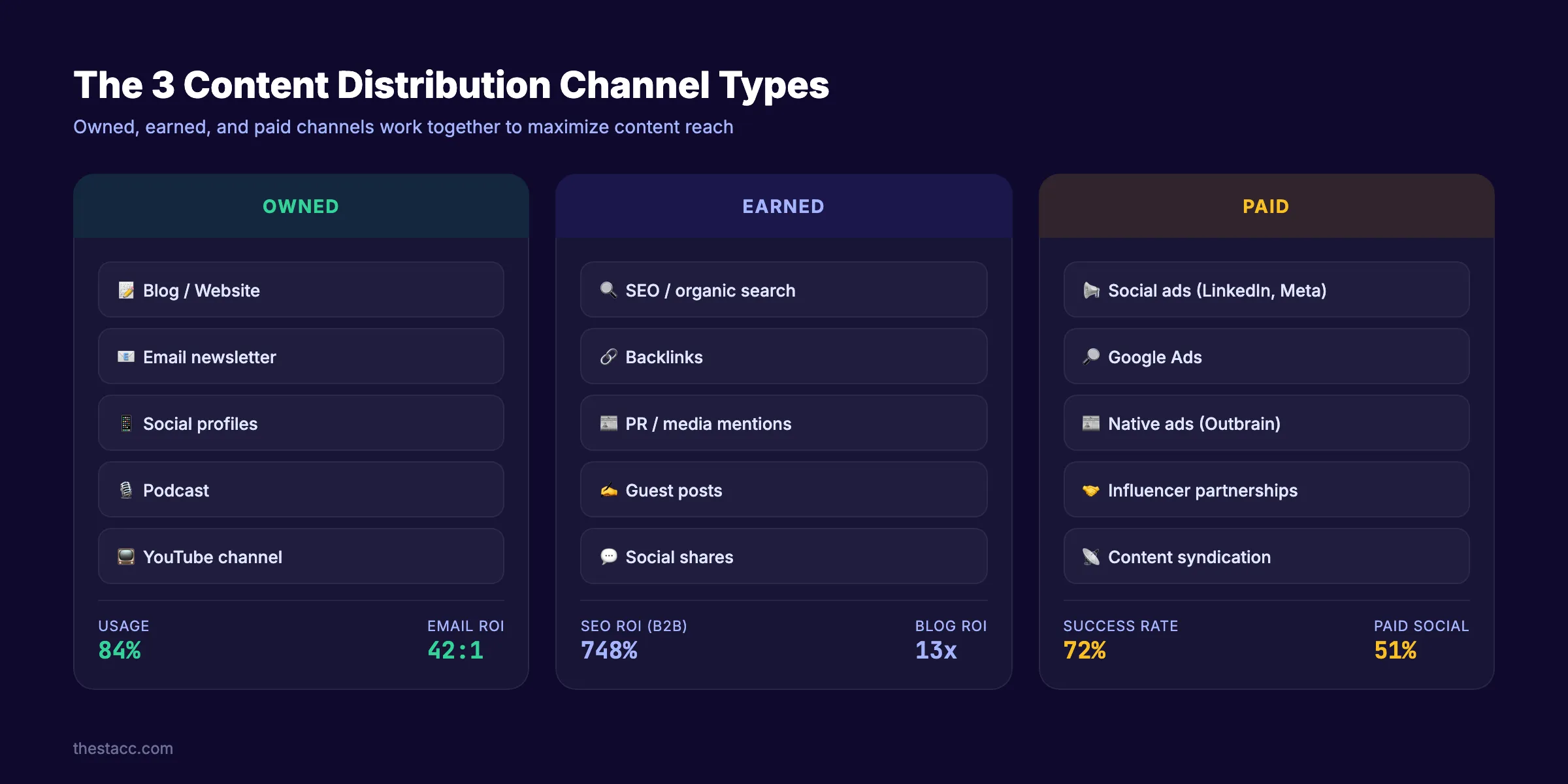
Every content distribution strategy operates across three channel types:
| Channel Type | Definition | Examples |
|---|---|---|
| Owned | Properties you control | Website, blog, email list, social profiles, podcast |
| Earned | Organic exposure from third parties | PR mentions, backlinks, social shares, reviews, guest posts |
| Paid | Channels where you pay for visibility | Google Ads, social ads, sponsored content, native ads |
The most effective strategies use all three in concert. Create on owned channels. Amplify with paid. Earn organic mentions as content gains traction.
72% of the most successful companies invest in paid distribution alongside their organic efforts. Companies that rely on organic alone grow slower and miss cold audiences entirely.
Chapter 2: Owned Distribution Channels
Owned channels are the foundation. They cost nothing per impression and compound in value over time.
Your Blog and Website
Your blog is the anchor of every distribution strategy. It is where content lives permanently, earns organic traffic through SEO, and captures leads.
84% of B2B marketers rely on blogs as their primary distribution channel. The reason is simple: blog content ranks in search engines for months or years after publication. A social media post disappears in hours.
Optimize every blog post for search. Use keyword research to target the terms your audience searches for. Build topical authority by publishing clusters of related content around core topics.
Email Newsletters
Email marketing delivers $42 in ROI for every $1 spent. No other channel comes close.
60% of companies distribute content through their email lists. Newsletters turn one-time visitors into recurring readers. They reach audiences directly without algorithm interference.
Build your email list from day one. Add signup forms to every blog post, landing page, and checkout flow. Segment your list by topic interest so every email feels relevant.
For deeper guidance, see our email marketing guide.
Social Media Profiles
71% of companies use social media for content distribution. Each platform serves a different purpose:
| Platform | Best Content Type | Audience | Organic Reach Trend |
|---|---|---|---|
| B2B articles, thought leadership, carousels | Professionals, decision-makers | Declining but still strong | |
| X (Twitter) | Short insights, threads, news commentary | Tech, media, marketing | Volatile |
| Visual content, reels, stories, carousels | Consumer brands, lifestyle | Reels favored heavily | |
| Community content, video, groups | Broad demographics, local businesses | Very low organic reach | |
| TikTok | Short video, educational clips | Younger demographics | Still high for new accounts |
Do not try to be everywhere. Pick 2-3 platforms where your audience already spends time. Post consistently on those platforms and ignore the rest.
Podcasts and Video
89% of businesses use video as a marketing tool. 72% of podcast listeners visit advertiser websites after hearing a brand mentioned on a show.
A podcast episode or YouTube video can reach audiences that never read blogs. Distribute audio and video content through the same owned channels: your website, email list, and social profiles.
Stop writing. Start ranking. Stacc publishes 30 optimized articles per month for $99. Start for $1 →
Chapter 3: Earned Distribution Channels
Earned distribution builds trust faster than any other channel. Someone else vouches for your content without being paid.
SEO and Organic Search
SEO delivers 748% ROI for B2B companies. Organic search is the highest-ROI earned distribution channel because it compounds. Every blog post optimized for search earns traffic for months or years.
The work happens upfront. Write SEO-optimized blog posts. Build internal links between related articles. Publish consistently to signal freshness and authority to Google.
Businesses that blog consistently see 13x more positive ROI than those that do not.
Social Shares and Word of Mouth
When readers share your content, it reaches audiences you could never target with ads. Social shares act as endorsements. The person sharing your article tells their network: “This is worth reading.”
Create content worth sharing. That means original research, strong opinions backed by data, and practical frameworks people want to save and reference.
Guest Posts and Syndication
50% of B2B marketers use guest posts for distribution. A guest post puts your content on someone else’s platform, exposing it to their established audience.
Target publications your audience already reads. Write genuinely useful content for that audience. Include one contextual link back to a relevant page on your own site.
Content syndication takes this further. Republish your blog posts on Medium, LinkedIn articles, or industry platforms. Use canonical tags to avoid duplicate content issues. Syndication extends the reach of content you have already created.
Digital PR and Media Mentions
Pitch journalists and editors with newsworthy angles from your content. Data studies, trend reports, and expert surveys all make strong PR pitches.
Digital PR earns editorial links from high-authority publications. These links boost your domain authority and send qualified referral traffic.
Chapter 4: Paid Distribution Channels
Paid distribution delivers immediate reach. It is the fastest way to get content in front of cold audiences who have never heard of your brand.
Paid Social Media
51% of successful companies use paid social for content distribution. The major platforms:
LinkedIn Ads work best for B2B content. Target by job title, company size, industry, and seniority. Costs run higher ($5-15 per click) but lead quality is strong for professional audiences.
Meta Ads (Facebook/Instagram) offer the best targeting at scale. Use lookalike audiences based on your email list or website visitors. Cost per click is lower ($1-5) but lead quality varies.
X Ads suit timely content and news-driven campaigns. Costs are moderate. Reach is smaller but engagement can be high in niche topics.
Content Discovery Platforms
Outbrain and Taboola place your content as recommended articles on major publisher sites. Users see your content alongside editorial content from CNN, Forbes, and similar publications.
These platforms work best for top-of-funnel content (guides, reports, quizzes) that hooks readers before asking for anything. Avoid using them for hard sales pitches.
Influencer Partnerships
30.5% of successful companies use influencer marketing for distribution. Partner with niche influencers who have genuine authority with your target audience.
Micro-influencers (5,000-50,000 followers) typically deliver better ROI than celebrity influencers because their audiences are more targeted and engaged.
Google Ads for Content
Use Google Ads to promote content that targets high-intent keywords. Someone searching “how to improve local SEO” is actively looking for the answer. A promoted blog post meets them at the exact moment of need.
This approach works especially well for long-form guides and tools that capture leads while delivering value.
Your SEO team. $99 per month. 30 optimized articles, published automatically. Start for $1 →
Chapter 5: Build a Content Distribution Plan in 6 Steps
A distribution plan turns random posting into a repeatable system. Follow these 6 steps.
Step 1: Define Your Goals
Every distribution effort needs a measurable objective. Common goals:
- Increase organic traffic by X% in 90 days
- Generate X email subscribers per month
- Drive X qualified leads from content
- Earn X backlinks to cornerstone content
- Grow social following by X% on [specific platform]
Use the SMART framework: specific, measurable, achievable, relevant, time-bound. “Get more traffic” is not a goal. “Increase organic blog traffic by 30% in Q3” is.
Step 2: Map Your Audience to Channels
Your audience is not everywhere. They cluster on specific platforms. B2B buyers live on LinkedIn and read industry newsletters. Consumer buyers scroll Instagram and TikTok.
Survey your existing customers. Ask where they consume content. Check your analytics for referral traffic sources. The data tells you exactly where to focus.
Step 3: Create a Distribution Calendar
Plan distribution before you publish. Use a content calendar that includes:
- Publication date and time for each channel
- Content format per channel (full post, excerpt, visual, video clip)
- Who is responsible for each distribution action
- Follow-up distribution dates (re-share at day 7, day 30, day 90)
Step 4: Repurpose Every Piece of Content
One blog post should become at least 8-10 distribution assets:
| Original Asset | Repurposed Formats |
|---|---|
| Blog post (2,000+ words) | LinkedIn article, X thread, email newsletter, infographic, short video, podcast talking point, carousel, quote graphics |
| Podcast episode | Blog summary, audiogram clips, quote cards, newsletter feature |
| Video | Short clips for reels/TikTok, blog transcript, GIF highlights |
| Data study | Press release, stat graphics, social cards, email series |
Repurposing blog content for social media is the fastest way to multiply your distribution without creating new material.
Step 5: Automate What You Can
Use scheduling tools to automate repetitive distribution. Social media scheduling tools let you batch-schedule posts for the week in one sitting.
Email automation sends the right content to the right segment at the right time. Marketing automation platforms handle drip sequences, welcome emails, and content-triggered sends.
Automate distribution. Never automate engagement. Replies, comments, and community interactions require a human.
Step 6: Review and Optimize Monthly
Check distribution performance every 30 days. Kill channels that waste time. Double down on channels that drive results.
Track: impressions, click-through rates, time on page from each source, conversion rate by channel, and cost per lead for paid channels.
Chapter 6: Content Atomization Framework
Content atomization breaks one pillar piece into dozens of smaller assets. It is the most efficient distribution method.
The Pillar-to-Pieces Method
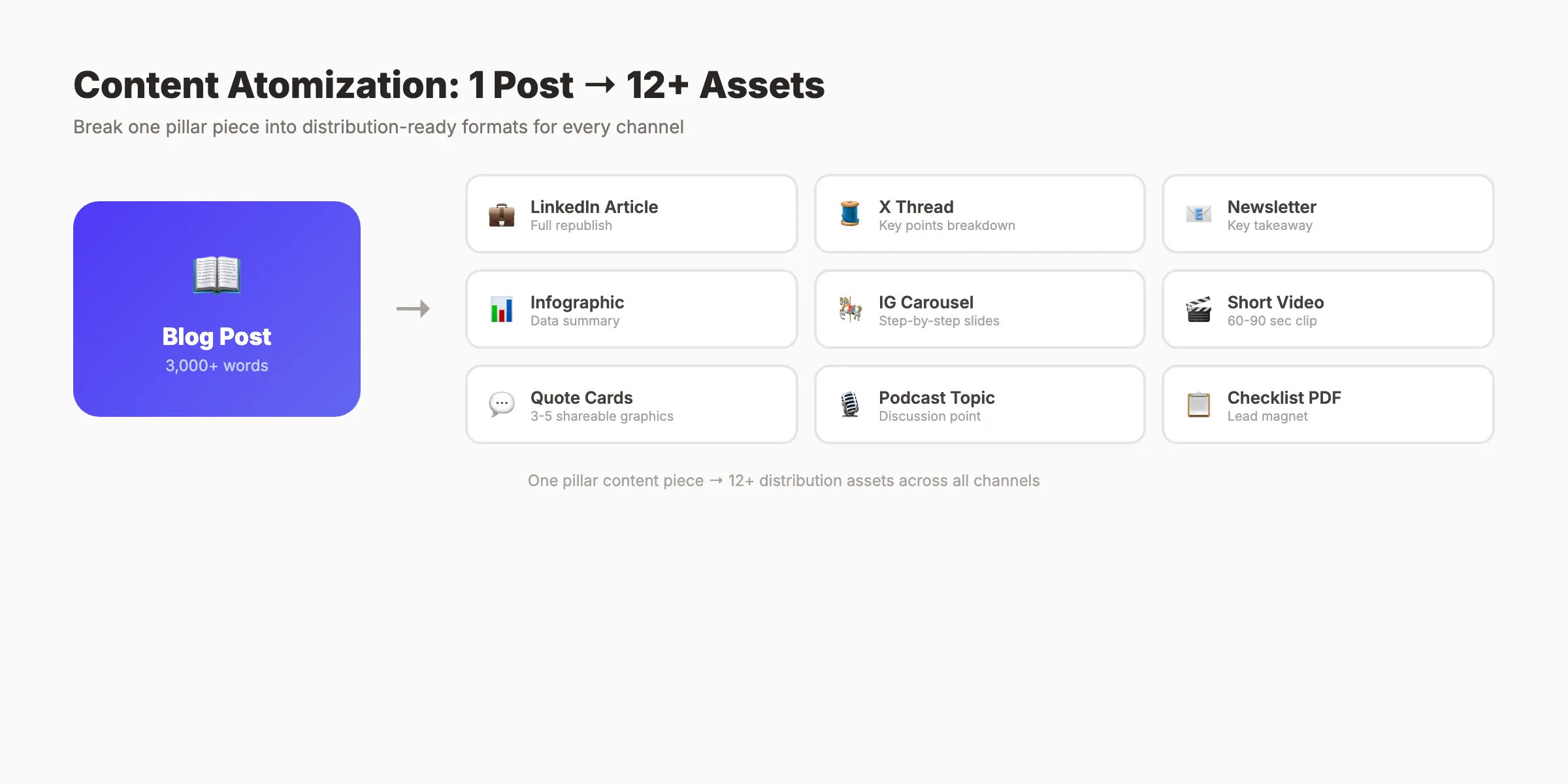
Start with one substantial content asset (a 3,000+ word guide, a research report, or a video interview). Then extract every possible distribution piece from it.
From a single blog post, create:
- 3-5 social media posts (pull different insights from different sections)
- 1 email newsletter featuring the key takeaway
- 1 infographic summarizing the data or framework
- 3-5 quote graphics from standout sentences
- 1 X thread breaking down the main points
- 1 LinkedIn carousel with the step-by-step process
- 1 short video (60-90 seconds) covering the core argument
- 1 podcast segment discussing the topic
That is 12-18 distribution assets from one blog post. Each one links back to the original. Each one reaches audiences on different platforms.
Adapt the Format to the Platform
A LinkedIn carousel is not a blog excerpt pasted into slides. Each platform has its own format requirements:
- LinkedIn: Professional tone, data-driven, first line must hook (no “I am excited to share…”)
- X: Punchy, opinionated, threads work for step-by-step content
- Instagram: Visual-first, carousel education posts perform best, use text overlays
- Email: Personal tone, one clear CTA, mobile-optimized formatting
Adapt the message. Do not copy-paste.
3,500+ blogs published. 92% average SEO score. See what Stacc can do for your site. Start for $1 →
Chapter 7: Measuring Content Distribution Success
Only 36% of marketers can accurately measure content marketing ROI. The other 64% distribute blind.
The Metrics That Matter
| Metric | What It Measures | Tool |
|---|---|---|
| Organic traffic by source | Which channels drive visitors | Google Analytics |
| Click-through rate (CTR) | How compelling your distribution message is | Platform analytics |
| Time on page | Whether the content satisfies the visitor | Google Analytics |
| Conversion rate by channel | Which channels drive leads or sales | GA4 + CRM |
| Cost per lead (paid) | Efficiency of paid distribution | Ad platform + CRM |
| Social shares | Earned distribution momentum | BuzzSumo, native analytics |
| Backlinks earned | SEO value of distribution | Ahrefs, Semrush |
| Email open/click rates | Newsletter distribution effectiveness | Email platform |
| Revenue attributed to content | Bottom-line ROI | GA4 ecommerce tracking |
Connect Distribution to Revenue
Customer acquisition costs drop 55% with content marketing. But you can only prove that if you track the full funnel.
Set up UTM parameters for every distribution link. Tag by channel, campaign, and content piece. This lets you trace a lead from a LinkedIn post all the way to a closed deal.
The formula: (Revenue from content-attributed customers / Total content + distribution spend) = Content ROI.
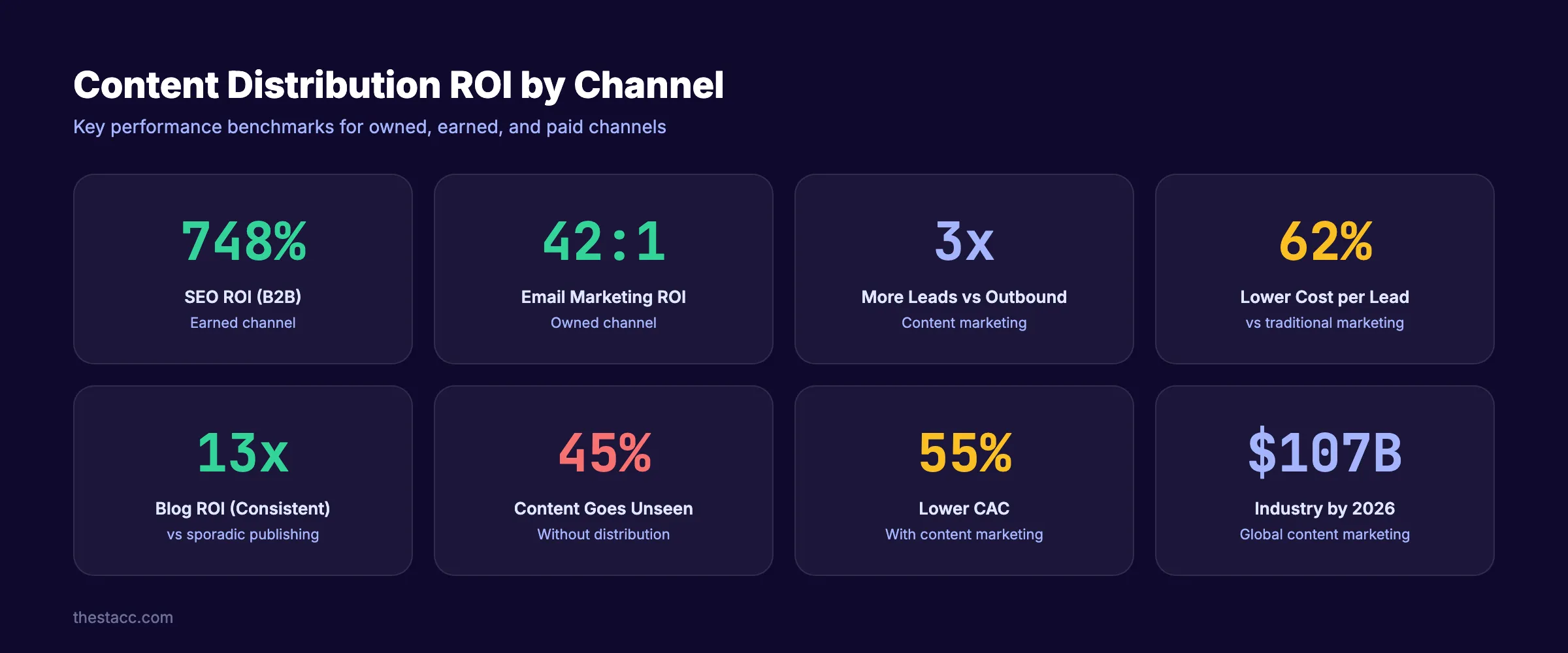
SEO delivers 748% ROI for B2B companies. Email delivers 42:1. Knowing which channels perform best lets you allocate budget where it counts.
Review Cadence
- Weekly: Check social media metrics and email performance
- Monthly: Review organic traffic trends, paid ad performance, conversion rates
- Quarterly: Full content distribution audit. Kill underperforming channels. Reallocate budget.
Chapter 8: Content Distribution Mistakes to Avoid
These mistakes waste budget and kill distribution momentum.
Mistake 1: Publishing Without a Distribution Plan
“Publish and pray” is not a strategy. 45% of content goes unseen because nobody planned how to distribute it before it went live.
Write the distribution plan before the content. Know which channels, formats, and timelines you will use before the blog post is finished.
Mistake 2: Spreading Too Thin Across Platforms
Being on 8 platforms means being great on none. Small teams should focus on 2-3 channels where their audience is most active. Master those before expanding.
Mistake 3: Copy-Pasting the Same Message Everywhere
Posting the same text on LinkedIn, X, Instagram, and Facebook is lazy distribution. Each platform has different format requirements, audience expectations, and algorithm preferences.
Adapt the content for each platform. The core message stays the same. The format, tone, and structure change.
Mistake 4: Ignoring Email as a Distribution Channel
Email marketing delivers $42 ROI per $1 spent. Yet 40% of companies do not consistently distribute content through their email list.
Every blog post should trigger a newsletter send or drip email. Your email subscribers already want to hear from you. Use that permission.
Mistake 5: Not Tracking Results by Channel
If you do not know which channels drive leads, you cannot optimize your distribution. 64% of marketers cannot accurately measure content ROI.
Set up UTM parameters. Track conversions by source. Review monthly. Cut what does not work.
Mistake 6: Distributing Once and Moving On
Content distribution is not a single event. A blog post should be distributed on day 1, re-shared at day 7, repurposed at day 14, and redistributed to new segments at day 30 and 90.
Evergreen content can be redistributed indefinitely. Update the stats. Refresh the examples. Re-share to new audiences. One piece of content should work for you for months or years.
FAQ
What are the 3 types of content distribution?
The 3 types are owned (channels you control like your blog and email list), earned (organic exposure like social shares and backlinks), and paid (channels where you pay for visibility like social ads and sponsored content). The most effective strategies use all 3 together.
What is the 80/20 rule in content distribution?
The 80/20 rule suggests spending 20% of your time creating content and 80% distributing it. Most teams do the opposite. They create constantly but barely promote. Flipping this ratio dramatically increases the ROI of every piece of content you produce.
What are the best content distribution channels?
It depends on your audience. For B2B, LinkedIn organic posts and email newsletters deliver the highest ROI. For consumer brands, Instagram, TikTok, and email perform best. SEO is the highest-ROI channel long term for any business, delivering 748% ROI for B2B.
How do you measure content distribution success?
Track organic traffic by source, click-through rates, conversion rates by channel, cost per lead for paid channels, and revenue attributed to content. Use UTM parameters on every distribution link. Review monthly and cut channels that do not drive results.
How often should you distribute content?
Distribute on publish day, re-share at day 7, repurpose into new formats at day 14, and redistribute to new audience segments at day 30 and 90. Evergreen content should be redistributed quarterly with updated data and examples.
Does Stacc help with content distribution?
Stacc publishes 30 SEO-optimized blog posts per month and distributes them through your connected platforms. The Blog SEO module handles organic search distribution. The Social Media module distributes content across LinkedIn, Instagram, X, and Facebook. Combined, they automate the two highest-ROI distribution channels.
Content distribution separates the blogs that grow from the blogs that stall. The content itself is only half the equation. How you distribute it determines whether anyone reads it.
Pick 2-3 channels. Build a repeatable system. Measure everything. The businesses that win are not the ones creating the most content. They are the ones distributing it best.
Rank everywhere. Do nothing. Blog SEO, Local SEO, and Social on autopilot. Start for $1 →
Related Tools & Resources
Free SEO Tools:
Best Lists:

Written by
Siddharth GangalSiddharth is the founder of theStacc and Arka360, and a graduate of IIT Mandi. He spent years watching great businesses lose organic traffic to competitors who simply published more. So he built a system to fix that. He writes about SEO, content at scale, and the tactics that actually move rankings.
30 SEO blog articles published every month
Keyword-optimized, scheduled, and live on your site. Automatically.
30-day trial · Cancel anytime
theStacc
Stop writing SEO content manually
30 blog articles, 30 GBP posts, and social media content. Published every month. Automatically.
Start Your $1 Trial$1 for 3 days · Cancel anytime