
Email Marketing for Local Businesses (2026): Guide
email marketing local businesses strategies for 2026: proven tactics, real case studies, tools, and metrics to drive growth and ROI.
Most local businesses spend hours on social media and get 2% organic reach. Their posts disappear in 24 hours. Their followers never convert.
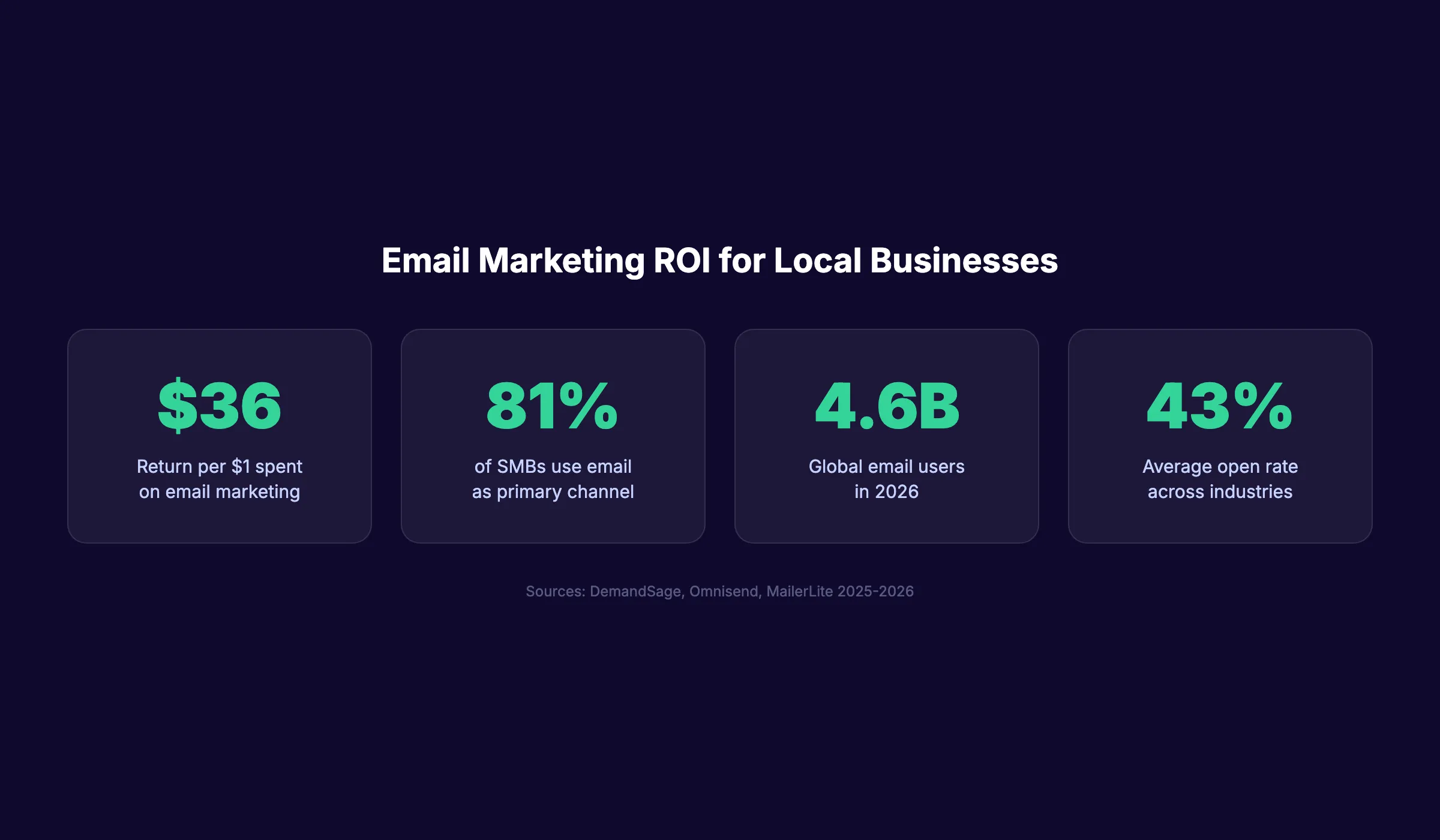
Email marketing for local businesses returns $36 for every $1 spent. That is not a typo. That is 3,600% ROI, according to DemandSage’s 2026 email marketing report. No other marketing channel comes close for a business that serves a specific geographic area.
The difference is ownership. You own your email list. You do not own your Instagram followers, your Google ranking, or your Facebook page reach. Algorithms change. Email stays.
We publish 3,500+ blogs across 70+ industries and work with local businesses every day. This guide covers everything we know about building an email marketing system that drives foot traffic, repeat customers, and referrals.
Here is what you will learn:
- Why email outperforms social media and paid ads for local businesses
- How to build a local email list from zero subscribers
- The 6 campaign types every local business needs
- Which email marketing tools work best (and cost the least)
- How to set up automations that run without daily effort
- How to write emails that local subscribers actually open
- Which metrics matter and how to track them
- The 8 most common mistakes that kill email performance
Chapter 1: Why Email Marketing Works for Local Businesses
81% of small and medium businesses use email as their primary marketing channel. That number keeps climbing, even as new platforms emerge. The reason is simple: email converts better than every alternative.
The ROI Advantage
Email marketing generates $36 for every $1 invested. Compare that to paid search ($2 return per $1), social media ($2.80 return per $1), or direct mail ($7 return per $1). For a local business operating on thin margins, the difference is massive.
A dentist spending $50 per month on an email tool and sending 4 campaigns generates an average of $1,800 in booked appointments. A restaurant sending a weekly special to 500 subscribers fills 15-20 extra seats per week. The math works at every scale.
You Own the Channel
Social media algorithms decide who sees your content. Google can change ranking factors overnight. Your local SEO strategy is essential, but it takes months to build. Email is the only channel where you control the delivery, the timing, and the message.
According to Constant Contact’s 2026 benchmarks, 99% of email users check their inbox daily. Your message lands directly in front of your customer. No algorithm stands between you and them.
Local Beats National
Local email lists outperform national lists on every metric. Open rates for geographically targeted lists run between 40% and 50%, compared to the 20-25% average for broad national lists. Click-through rates hit 2-5% for local businesses, double the national average.
The reason is relevance. A subscriber who lives 3 miles from your store cares about your Tuesday lunch special. A subscriber in another state does not. Local email marketing thrives on proximity. People who signed up because they visited your shop, attended your event, or found your Google Business Profile are pre-qualified leads.
Email and Local SEO Work Together
Email drives traffic to your website. Website traffic signals relevance to Google. Google ranks you higher in local search. Higher rankings bring more email subscribers. This is the compound effect in action.
Send a monthly email linking to your latest blog post. Those clicks generate direct traffic that improves your online presence. Embed a link to your Google review page in every email. More reviews boost your local SEO statistics and map pack rankings.
Email marketing returns 36x what you spend. Pair it with local SEO and the results compound. We handle the SEO side automatically. Start for $1 →
Chapter 2: How to Build a Local Email List From Scratch
A local email list does not need 10,000 subscribers to be effective. A dentist with 200 active local subscribers will outperform a national brand with 50,000 disengaged contacts. Quality beats quantity for every local business.
In-Store and On-Site Collection
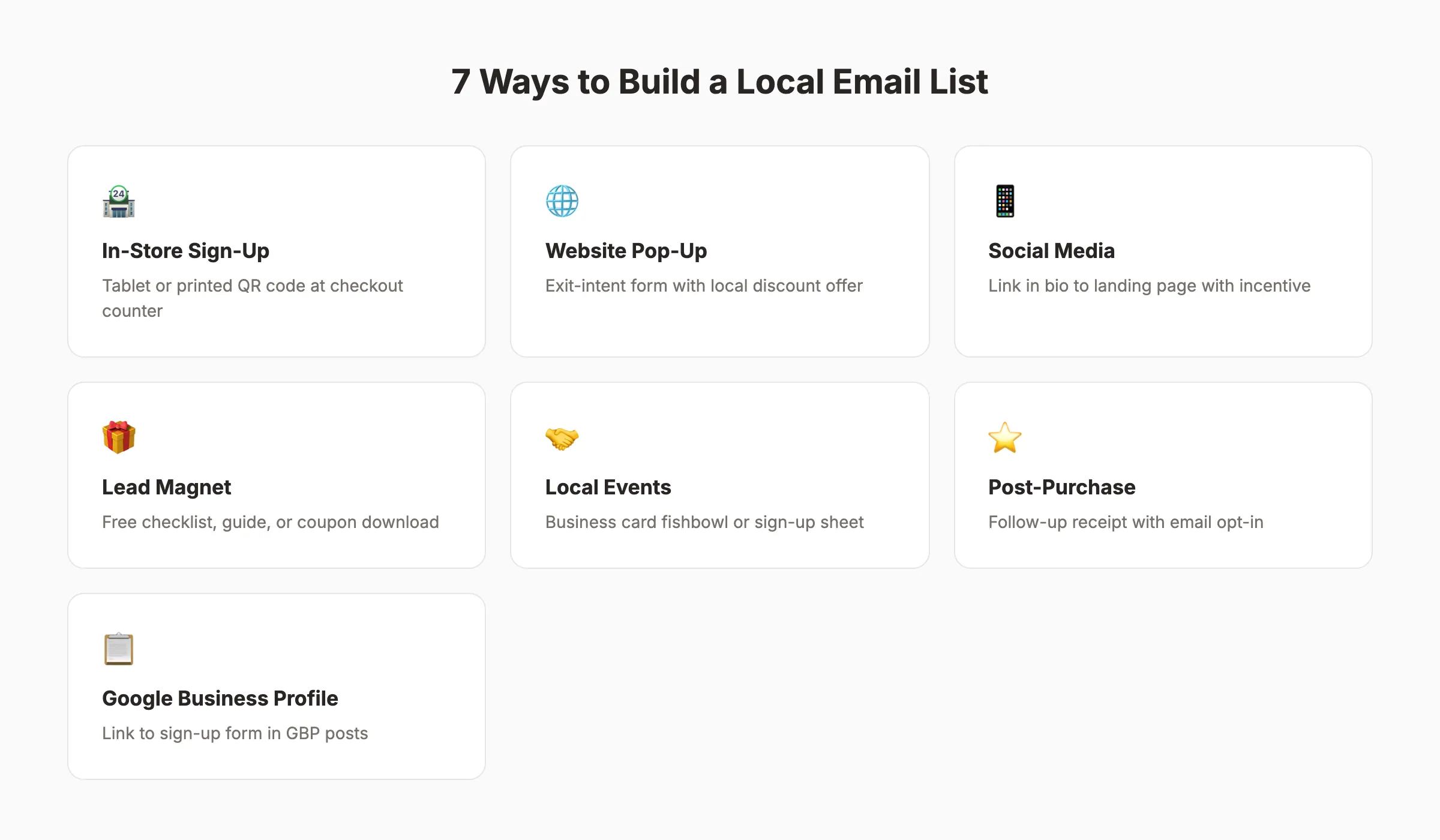
Your physical location is your best list-building asset. Place a tablet at your checkout counter with a simple sign-up form. Print a QR code that links to your email opt-in page. Train your front-desk staff to ask every customer: “Would you like to receive our weekly specials by email?”
A coffee shop in Austin added a QR code to their receipts and collected 340 new subscribers in 60 days. The total cost was $0 beyond the email tool they already paid for.
Website Opt-In Forms
Your website needs at least 2 email capture points. Place one in your header or navigation bar. Add a second as an exit-intent pop-up that triggers when a visitor moves to leave the page.
Offer something specific. “Get 10% off your first visit” works better than “Subscribe to our newsletter.” Local businesses see 3-5% conversion rates on pop-ups that include a tangible incentive. Make sure every form connects to your content calendar so new subscribers receive consistent communication.
Social Media Cross-Promotion
Your social media marketing efforts should funnel followers into your email list. Add a sign-up link in your Instagram bio. Pin a sign-up post to the top of your Facebook page. Run a monthly giveaway that requires an email address to enter.
The goal is migration. Social followers are rented. Email subscribers are owned. Every social post should move people one step closer to your inbox.
Google Business Profile Posts
Your Google Business Profile reaches people who are actively searching for local services. Add a call-to-action in your GBP posts that links to your email sign-up page. Something like “Join 500+ locals who get our weekly deals” creates social proof and urgency.
Local Events and Partnerships
Farmers markets, community fairs, and chamber of commerce events provide face-to-face list-building opportunities. Bring a clipboard or tablet. Offer a free sample, discount card, or raffle entry in exchange for an email address.
Partner with complementary local businesses. A gym and a nutritionist can cross-promote each other’s email lists. A real estate agent and a moving company can share audiences. These partnerships cost nothing and double your reach.
Lead Magnets That Work Locally
A lead magnet is a free resource offered in exchange for an email address. For local businesses, the best lead magnets are hyper-specific to the area.
| Business Type | Lead Magnet Example | Expected Conversion |
|---|---|---|
| Restaurant | ”Top 10 Date Night Spots in [City]” PDF | 8-12% |
| Dentist | ”New Patient Checklist + $50 Off First Visit” | 10-15% |
| HVAC Company | ”Seasonal Home Maintenance Calendar” | 5-8% |
| Real Estate Agent | ”2026 [City] Housing Market Report” | 12-18% |
| Gym | ”Free 7-Day Workout Plan for Beginners” | 8-10% |
Permission and Compliance
Never add someone to your email list without their explicit consent. The CAN-SPAM Act requires every marketing email to include an unsubscribe link, a physical mailing address, and honest subject lines. Violating these rules carries fines up to $51,744 per email.
Double opt-in (where subscribers confirm via a confirmation email) reduces spam complaints and improves deliverability. Every reputable email tool supports this feature.
Chapter 3: 6 Email Campaign Types Every Local Business Needs
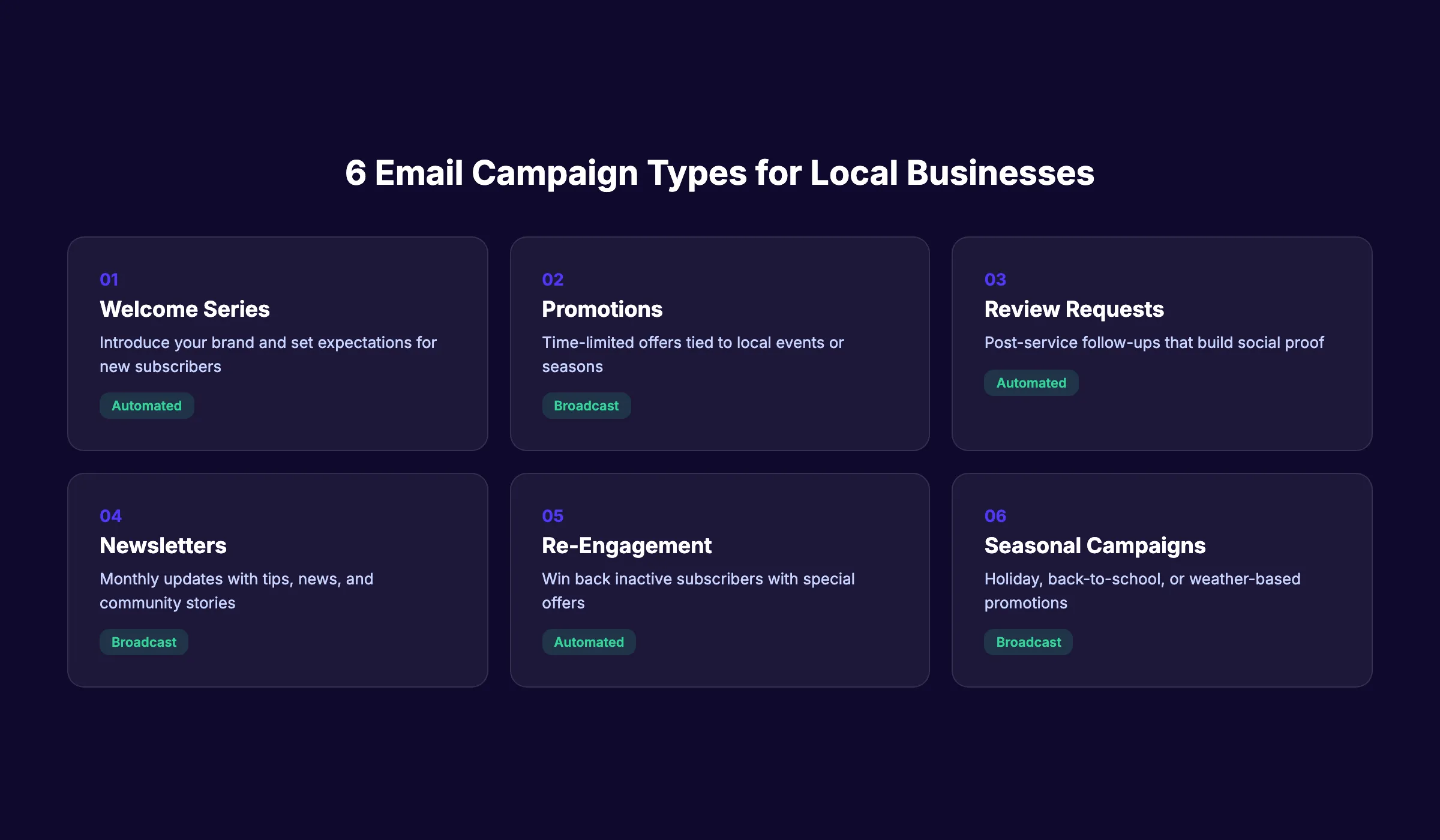
Not every email serves the same purpose. A promotional blast works differently than a review request. Local businesses need a mix of campaign types to cover every stage of the customer relationship.
1. Welcome Series
A welcome email is the single highest-performing email you will ever send. Welcome emails average 50-60% open rates, compared to 20-40% for regular campaigns. This is the moment a subscriber is most engaged with your brand.
Send 3-5 emails over 10-14 days. Email 1 arrives immediately with a thank-you and your best offer. Email 2 shares your story and what makes your business different. Email 3 includes customer reviews and testimonials. Email 4 delivers a time-sensitive promotion.
Set this up once. It runs on autopilot for every new subscriber forever.
2. Promotional Campaigns
These are your revenue drivers. A promotional email announces a sale, discount, new product, or limited-time offer. For local businesses, tie promotions to local events, weather, or seasons.
“It is going to hit 95 degrees this Saturday. Come in for half-price iced drinks.” That type of context-driven promotion outperforms generic “20% off everything” blasts every time.
Send promotional emails 2-4 times per month. More than that risks fatigue. Less than that means leaving money on the table.
3. Review Request Emails
Online reviews are the single most important trust signal for local businesses. 93% of consumers read reviews before choosing a local service. Yet most businesses never ask for them systematically.
Send a review request email 24-48 hours after a service is completed. Include a direct link to your Google review page. Keep the email short. One sentence explaining why reviews matter, one button to leave a review.
Automate this sequence and you will generate 5-10 new reviews per month without lifting a finger. That directly impacts your local search rankings, as review signals account for 17% of local pack ranking factors.
4. Monthly Newsletters
A newsletter keeps your business top-of-mind between purchases. For local businesses, the best newsletters include a mix of useful content, community updates, and one promotional item.
Structure each newsletter the same way:
- 1 local tip or educational piece
- 1 community event or neighborhood spotlight
- 1 promotion or special offer
- 1 call-to-action (book, visit, call)
Keep it under 500 words. Most readers spend 10-15 seconds scanning an email. Brevity wins.
5. Re-Engagement Campaigns
Every email list has inactive subscribers. People who have not opened an email in 90+ days. A re-engagement campaign targets these contacts with a specific message: “We miss you. Here is a reason to come back.”
Offer an exclusive discount. Ask if they still want to receive emails. If they do not respond after 2-3 re-engagement attempts, remove them from your list. A smaller, engaged list outperforms a large, dead one.
6. Seasonal and Event-Based Campaigns
Local businesses have a natural advantage here. You know the local calendar. Back-to-school, holiday shopping, spring cleaning, tax season, local festivals. Build an email around each event that matters to your customers.
Plan these campaigns 30 days in advance. Create a content calendar that maps every seasonal email to a specific date, offer, and audience segment.
Growing your local business takes consistent marketing. We publish SEO content on autopilot so you can focus on campaigns that convert. Start for $1 →
Chapter 4: How to Choose the Right Email Marketing Tool
The best email marketing tool for a local business is the one you will actually use. Avoid enterprise platforms with features you do not need. Focus on deliverability, ease of use, automation, and price.
Mailchimp
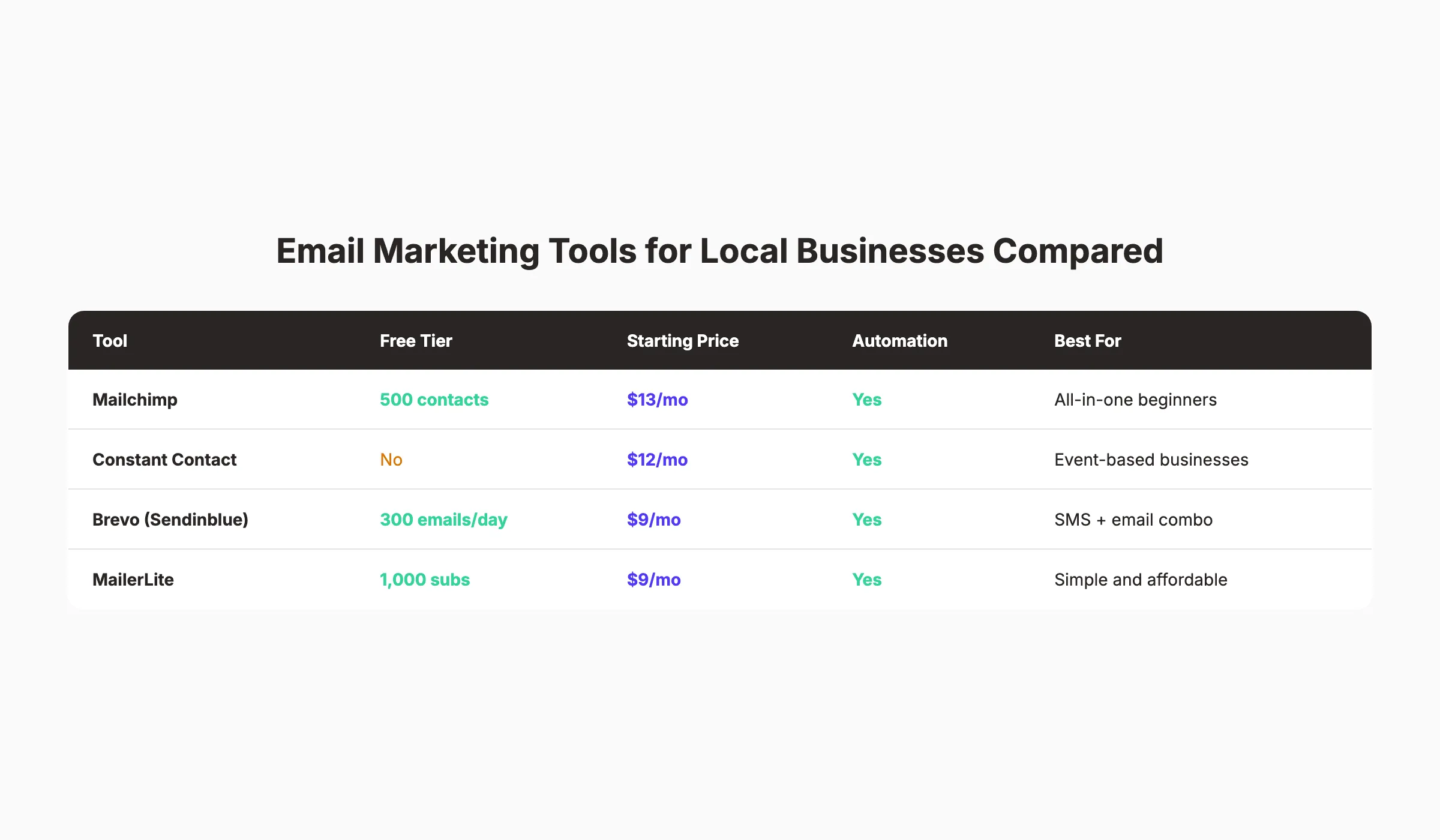
Mailchimp is the default choice for most small businesses. The free tier supports up to 500 contacts. The interface is intuitive enough that a business owner with zero marketing experience can send a campaign in under 30 minutes.
Paid plans start at $13 per month. Mailchimp includes landing pages, basic automation, and email templates designed for small businesses. The downside is pricing. Once your list passes 2,500 contacts, costs escalate quickly.
Constant Contact
Constant Contact has served small businesses since 1997. It is particularly strong for event-based businesses. If you host classes, workshops, or community events, the built-in event management tools save time.
Plans start at $12 per month. The template library is large. Customer support is phone-based, which matters for business owners who prefer talking to a person over filing a support ticket.
Brevo (Formerly Sendinblue)
Brevo stands out for local businesses that want email and SMS in one platform. The free tier allows 300 emails per day. Paid plans start at $9 per month with unlimited contacts.
The SMS feature is a differentiator. Sending a text message reminder 2 hours before an appointment, paired with an email confirmation the day before, reduces no-shows by 20-30%. For service businesses like salons, clinics, and repair shops, that combination pays for itself.
MailerLite
MailerLite offers the best value for businesses that need simplicity. The free tier supports 1,000 subscribers. Paid plans start at $9 per month. The drag-and-drop editor is one of the fastest to learn.
MailerLite achieves 92% inbox placement rates, among the highest in the industry. For a local business where every email matters, deliverability is the metric that counts most.
Which Tool Should You Pick?
| Your Priority | Best Tool |
|---|---|
| Easiest to learn | MailerLite |
| Most features | Mailchimp |
| Email + SMS | Brevo |
| Event management | Constant Contact |
| Tightest budget | Brevo (300 emails/day free) |
Pick one. Sign up today. Send your first email this week. The tool matters less than the action of starting.
Chapter 5: Automation Sequences That Run on Autopilot
Automation is what separates email marketing that scales from email marketing that burns you out. Set up these sequences once, and they generate revenue every month without manual effort.
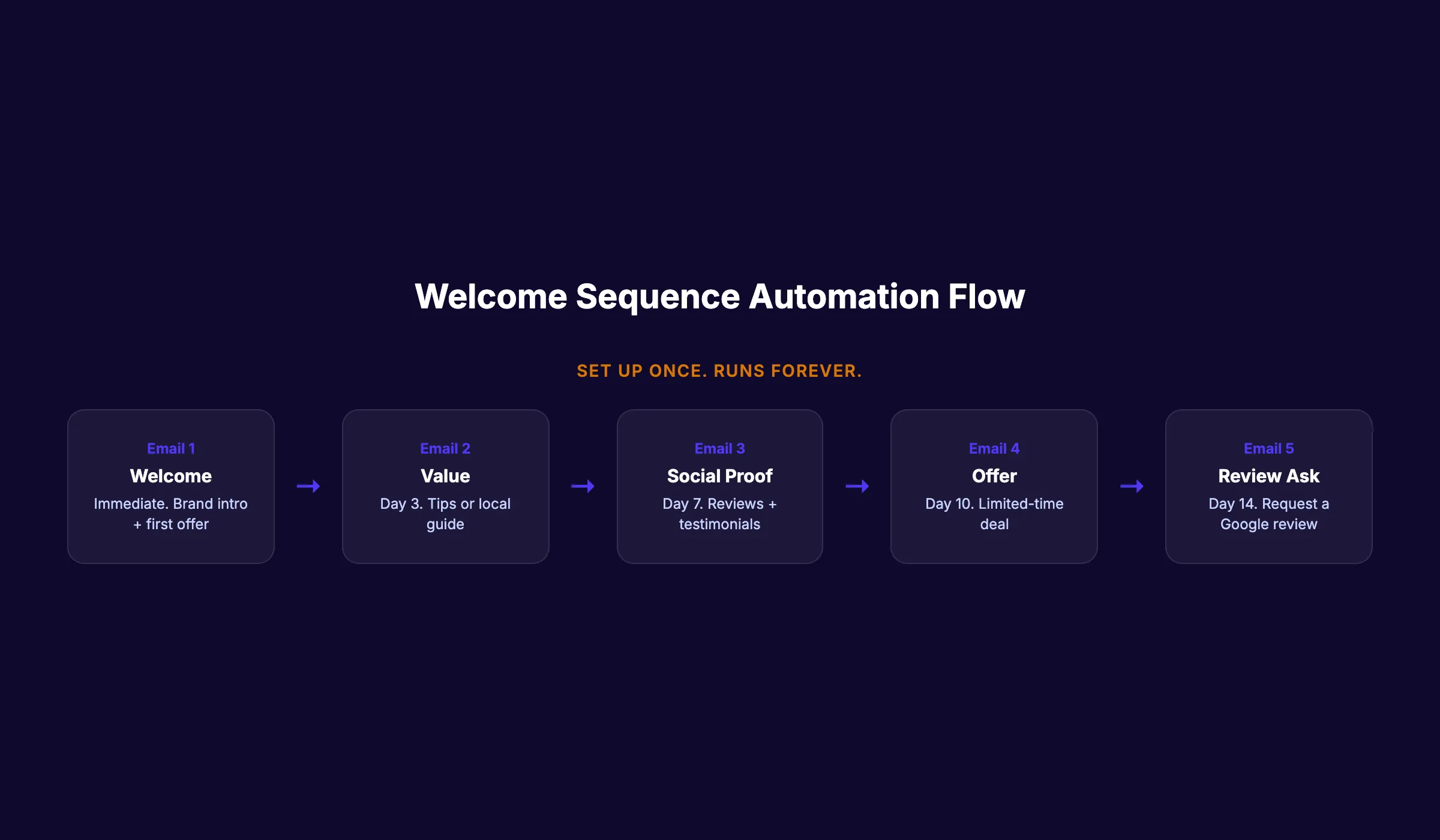
The Welcome Sequence (5 Emails, 14 Days)
This is the most important automation for any local business. Every new subscriber enters this sequence automatically.
Email 1 (Immediate): Thank them for subscribing. Deliver the promised incentive. Introduce your business in 2-3 sentences.
Email 2 (Day 3): Share a helpful tip related to your service. A plumber might send “3 Signs Your Water Heater Needs Attention.” A restaurant might send “How to Pair Wine With Our Most Popular Dishes.”
Email 3 (Day 7): Social proof. Share 2-3 customer reviews or a brief case study. Link to your Google reviews page.
Email 4 (Day 10): Limited-time offer. Create urgency. “This offer expires Friday” works. Make it specific to first-time customers.
Email 5 (Day 14): Ask for a review or referral. “If you have visited us, we would love your feedback on Google.” Include a direct link.
The Post-Purchase Sequence
Trigger this sequence after every transaction, appointment, or service completion.
- Email 1 (24 hours later): Thank them. Ask if they have questions.
- Email 2 (3 days later): Request a Google review. One-click link.
- Email 3 (14 days later): Related service suggestion or upsell.
- Email 4 (30 days later): Rebooking reminder.
The Re-Engagement Sequence
Target subscribers who have not opened an email in 90 days.
- Email 1: “We have not heard from you.” Include a special offer.
- Email 2 (7 days later): “Last chance” with a different angle.
- Email 3 (14 days later): “Should we remove you from our list?” Subscribers who respond stay. Those who do not get removed.
This keeps your list clean and your deliverability high.
Birthday and Anniversary Automations
If you collect birth dates during sign-up, send an automated birthday email with a personal offer. Birthday emails generate 342% higher revenue per email than standard promotional emails, according to Omnisend research.
Service anniversaries work the same way. “It has been 1 year since your first visit. Here is 20% off your next appointment.”
The key to all marketing automation for local businesses is this: build it once, let it run, and review the numbers monthly.
Automation makes marketing scale without adding headcount. Stacc handles your SEO content the same way. Set it and let it run. Start for $1 →
Chapter 6: How to Write Emails That Local Subscribers Open
Open rates determine whether your email marketing works or fails. A perfectly crafted offer inside an unopened email generates $0. Subject lines, preview text, and send timing decide whether subscribers read or delete.
Subject Line Rules for Local Businesses
Keep subject lines under 40 characters. Mobile inboxes cut off anything longer. Use the subscriber’s first name when possible. Personalized subject lines increase open rates by 29%.
Include local references. “New menu items at [Your City] location” performs better than “Check out our new menu.” The city name triggers relevance.
| Subject Line Type | Example | Avg Open Rate |
|---|---|---|
| Urgency | ”Ends tonight: 25% off all services” | 45-55% |
| Local reference | ”Best [City] weekend plans + our deal” | 40-50% |
| Personalized | ”[Name], your appointment reminder” | 50-60% |
| Question | ”Ready for summer? We are.” | 35-45% |
| Curiosity | ”We have never offered this before” | 38-48% |
Preview Text Optimization
Preview text is the 40-90 characters that appear after the subject line on mobile. Most local businesses leave this blank, which means their email tool fills it with “View this email in your browser” or other generic text.
Write custom preview text for every email. Use it to expand on the subject line. Subject: “Friday special inside.” Preview: “Our chef created something new. First 50 orders get free dessert.”
Send Time and Frequency
For local businesses, the best send times are Tuesday through Thursday between 9:00 AM and 11:00 AM local time. Avoid Monday mornings (inbox overload) and Friday afternoons (weekend mode).
Send frequency depends on your business type:
- Restaurants: 2-3 times per week (menus change often)
- Service businesses: 2-4 times per month
- Retail: Weekly
- Professional services: Monthly or bi-weekly
Test different days and times over 4-6 weeks. Your audience may differ from the average. Let the data guide you, not assumptions.
Content Structure
Every email needs 3 elements:
- A hook in the first line (stat, question, or bold statement)
- The body with one clear message (not three)
- One CTA (one button, one action, one outcome)
Do not cram multiple offers into a single email. An email about a holiday special should not also promote your referral program, announce a new hire, and share a blog post. Pick one message. Send a separate email for the rest.
Chapter 7: How to Measure Email Marketing Results
You cannot improve what you do not measure. Track these 6 metrics monthly to understand whether your email marketing is working and where to focus next.
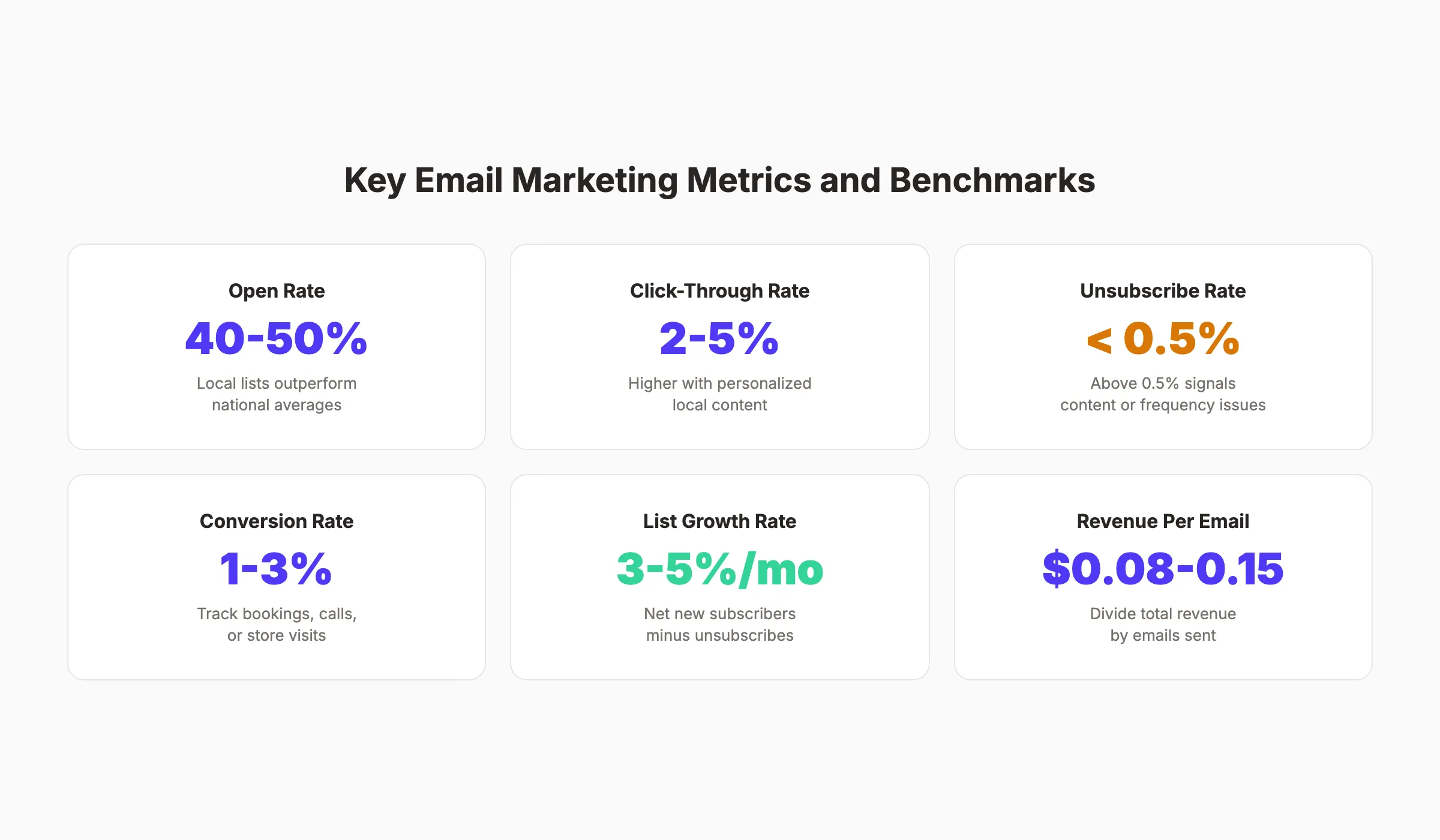
The 6 Metrics That Matter
1. Open Rate The percentage of subscribers who open your email. For local businesses, aim for 40-50%. If you are below 30%, your subject lines need work or your list needs cleaning.
Note that Apple Mail Privacy Protection inflates open rates by pre-loading tracking pixels. Focus on trends over time rather than absolute numbers.
2. Click-Through Rate (CTR) The percentage of subscribers who click a link. Aim for 2-5%. This is a better indicator of engagement than open rate because it measures real action.
3. Conversion Rate The percentage of clickers who take your desired action: booking an appointment, making a purchase, or calling your business. Track this in your email tool or Google Analytics.
4. Unsubscribe Rate Keep this below 0.5% per send. Higher rates signal content mismatch, too-frequent sending, or list quality issues. If a single email triggers a spike in unsubscribes, analyze what went wrong.
5. List Growth Rate Calculate monthly: (new subscribers minus unsubscribes) divided by total list size. Aim for 3-5% monthly growth. If your list is shrinking, your acquisition efforts need attention.
6. Revenue Per Email Divide total revenue attributed to email by total emails sent. This is the metric that connects email marketing to your bottom line. Track it over 90-day rolling windows to smooth out seasonal variation.
How to Track Revenue Attribution
Most email tools integrate with Google Analytics. Set up UTM parameters on every link in your emails. This lets you track which emails drive website visits, form submissions, and calls.
For offline conversions (foot traffic), use unique coupon codes in each email. “Show this email for 15% off” with a code like TUES15 tells you exactly which campaign drove the visit.
Review your content marketing ROI alongside email performance. The two channels reinforce each other when you repurpose blog content into email content.
Monthly Reporting Checklist
- Record open rate, CTR, and unsubscribe rate for each campaign
- Calculate revenue attributed to email (online + coupon codes)
- Compare performance month-over-month
- Identify top-performing subject lines and content types
- Clean inactive subscribers (90+ days, no opens)
- Review list growth rate
Chapter 8: Common Email Marketing Mistakes Local Businesses Make
Knowing what to do matters. Knowing what to avoid saves you months of wasted effort. These are the 8 mistakes we see most often among local businesses.
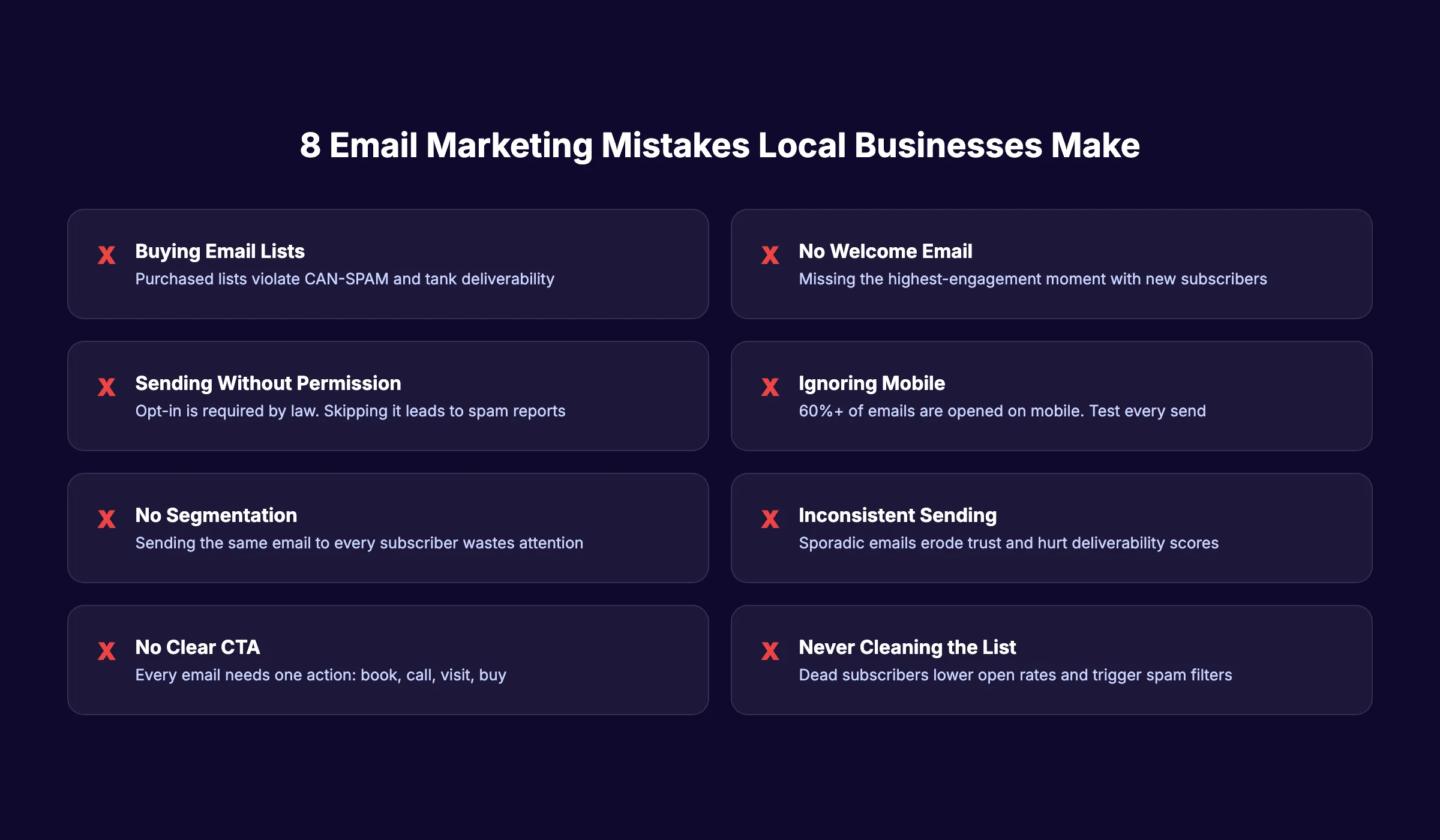
1. Buying Email Lists
Purchased email lists are the fastest way to destroy your sender reputation. The contacts did not opt in. They will mark you as spam. Your email service provider will flag your account. Your deliverability drops across all future emails, including the ones sent to people who actually want to hear from you.
Build your list organically. It takes longer, but every subscriber is a real person who chose to receive your emails.
2. Skipping the Welcome Email
A subscriber signs up and hears nothing for 2 weeks. By the time your first email arrives, they have forgotten who you are. Welcome emails are not optional. They are the foundation of every email relationship.
3. Sending Without Segmentation
A 25-year-old first-time customer and a 55-year-old repeat customer should not receive identical emails. Segment your list by purchase history, location, sign-up source, or service type. Even 2-3 segments dramatically improve engagement.
Segmented campaigns drive 30% more opens and 50% more clicks than unsegmented sends, according to MailerLite’s 2025 benchmark report.
4. Ignoring Mobile Design
Over 60% of emails are opened on mobile devices. If your email looks broken on a phone, subscribers delete it in under 2 seconds. Use your email tool’s mobile preview feature before every send. Keep buttons large enough to tap with a thumb. Use single-column layouts.
5. Sending Too Often (or Not Enough)
Sending daily emails to a local audience of 300 will burn your list fast. Sending once a quarter means subscribers forget you exist. Find the right frequency for your business type and stick to it.
6. No Clear Call-to-Action
Every email needs one primary action. Call us. Book online. Visit this week. Use this coupon. When you include 5 links pointing to 5 different pages, subscribers choose none of them.
One email. One goal. One button.
7. Never Cleaning Your List
Remove subscribers who have not engaged in 90-120 days (after running a re-engagement sequence). A clean list of 300 active subscribers outperforms a bloated list of 2,000 inactive ones. Clean lists earn higher deliverability scores, which means more of your emails reach the inbox.
8. Treating Email as a Solo Channel
Email works best when it supports your other marketing. Mention your email list on social media. Link to your blog in every newsletter. Ask for Google reviews in your post-purchase sequence. Promote your email sign-up on your Google Business Profile.
The businesses that win at local marketing treat every channel as connected. Email is the hub that ties them together.
Local SEO and email marketing compound when they work together. We handle the SEO side. You handle the inbox. Start for $1 →
Frequently Asked Questions
How often should a local business send marketing emails?
Most local businesses perform best with 2-4 emails per month. Restaurants and food businesses can send 2-3 times per week because menus and specials change frequently. Professional services like accountants or lawyers should send monthly or bi-weekly. Test different frequencies and track unsubscribe rates to find the sweet spot.
What is a good open rate for local email marketing?
Local email lists typically achieve 40-50% open rates, which is significantly above the national average of 20-25%. If your open rate falls below 30%, review your subject lines, send timing, and list quality. Keep in mind that Apple Mail Privacy Protection may inflate open rates artificially.
How many subscribers does a local business need for email marketing to work?
Email marketing becomes effective with as few as 100 engaged local subscribers. A dental office with 200 subscribers who live within 10 miles will generate more revenue than a national brand with 50,000 disengaged contacts. Focus on building a quality list rather than chasing a specific number.
Is email marketing worth it for a small local business?
Email marketing returns $36 for every $1 spent, making it the highest-ROI marketing channel available. For a local business spending $9-13 per month on an email tool, even 1-2 additional bookings per month covers the cost many times over. The question is not whether email marketing is worth it. The question is why you have not started yet.
Can I use email marketing without a website?
Yes, but your results will be limited. Email tools like Mailchimp and MailerLite include built-in landing pages. You can collect subscribers and send emails without a website. However, a website gives you more conversion paths, better tracking, and a place to build SEO content that drives organic traffic month after month.
What should my first email campaign be about?
Your first campaign should be a welcome email to your existing customers and contacts. Introduce your email program, explain what subscribers will receive, and include a strong offer (discount, freebie, or exclusive access). This sets expectations and generates immediate engagement.
Start Building Your Email List Today
Email marketing for local businesses is not complicated. It is consistent. Pick a tool, build a sign-up form, write a welcome sequence, and send your first campaign this week.
The businesses that win are not the ones with the biggest budgets. They are the ones that show up in the inbox every week while competitors stay silent.
Pair your email efforts with a local SEO strategy that brings new subscribers to your list through organic search. The two channels compound. Every blog post drives traffic. Every email drives conversions. Every review strengthens your rankings.
Ready to automate your local marketing? Stacc publishes SEO content and GBP posts on autopilot. You focus on running your business. Start for $1 →
Related Tools & Resources
Free SEO Tools:
Best Lists:

Written by
Siddharth GangalSiddharth is the founder of theStacc and Arka360, and a graduate of IIT Mandi. He spent years watching great businesses lose organic traffic to competitors who simply published more. So he built a system to fix that. He writes about SEO, content at scale, and the tactics that actually move rankings.
Automate your Google Business Profile content
30 GBP posts, local SEO articles, and review responses. Published every month automatically.
30-day trial · Cancel anytime
theStacc
Stop writing SEO content manually
30 blog articles, 30 GBP posts, and social media content. Published every month. Automatically.
Start Your $1 Trial$1 for 3 days · Cancel anytime