
Social Media Marketing for Local Businesses (2026): Guide
social media marketing local businesses strategies for 2026: proven tactics, real case studies, tools, and metrics to drive growth and ROI.
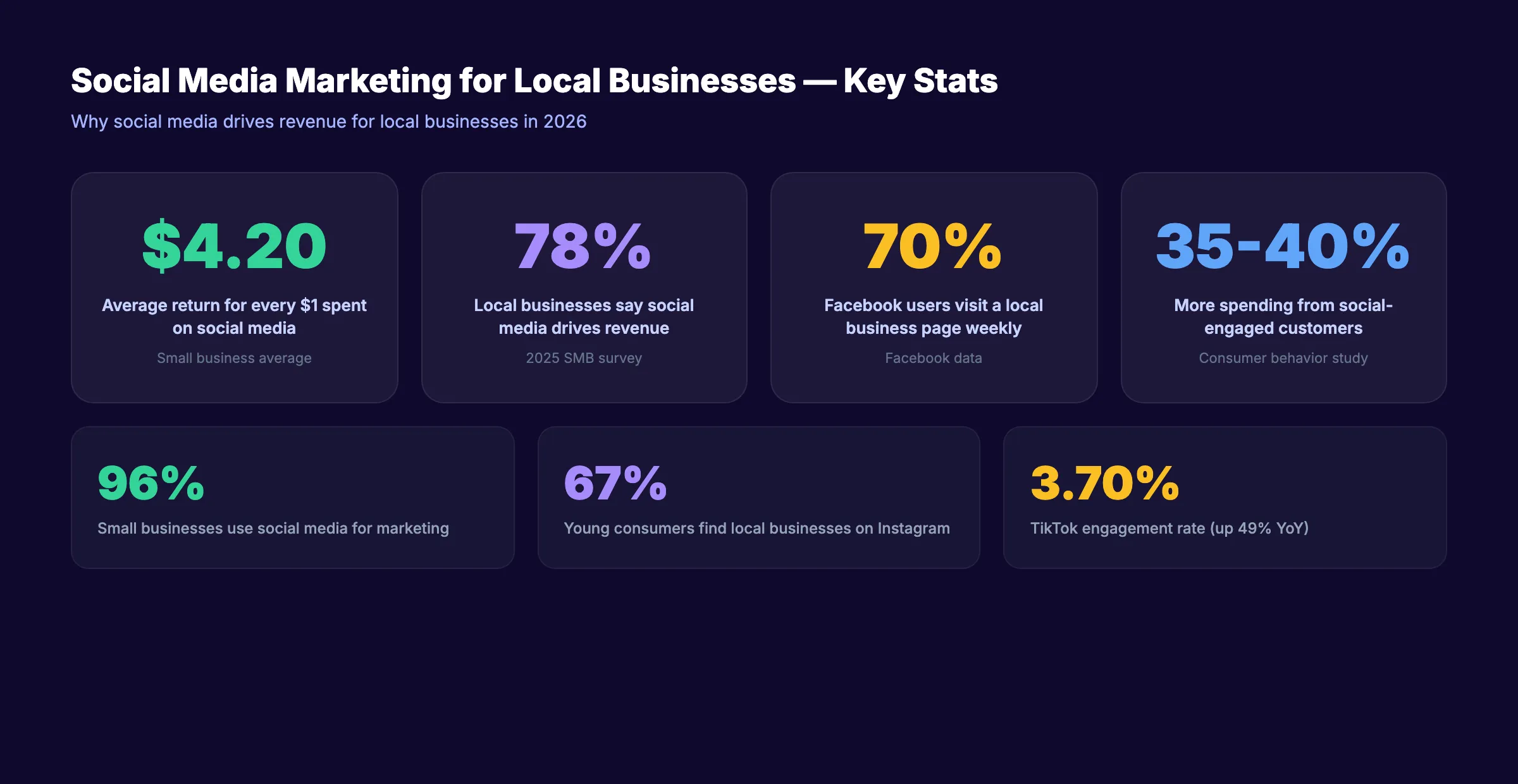
96% of small businesses use social media for marketing. Most of them see no measurable return.
The problem is not the platforms. The problem is that local businesses treat social media marketing the same way national brands do. They copy content formulas built for companies with 6-figure ad budgets and full-time social teams. A dentist in Phoenix does not need the same strategy as Nike.
This guide covers social media marketing for local businesses specifically. Not generic advice. Not enterprise playbooks scaled down. Every recommendation here comes from publishing content for businesses across 70+ industries and watching what actually drives foot traffic, phone calls, and bookings.
Here is what you will learn:
- Which platforms actually matter for local businesses (and which to skip)
- The content mix that generates engagement without constant effort
- How to turn social posts into phone calls, bookings, and store visits
- A realistic timeline for results at every budget level
- How to measure ROI when you do not have an analytics team
- The connection between social media and local SEO that most guides ignore
Chapter 1: Why Social Media Works Differently for Local Businesses
National brands use social media for awareness. Local businesses need it for action. A restaurant does not need 100,000 followers. It needs 500 nearby people who check the menu, share a photo, and book a table.
The Local Discovery Shift
1 in 3 consumers now starts their search on TikTok, Instagram, or YouTube instead of Google. For younger consumers aged 18-34, Instagram ranks second only to Google for finding local businesses. 67% of them use Instagram to discover local shops and services. 62% use TikTok.
This is not a prediction. It is already happening.
Social Media Drives Revenue for Local Businesses
The numbers back this up. Social media marketing generates an average return of $4.20 for every $1 spent by small businesses. 78% of local businesses say social media drives revenue. Customers who engage with a business on social media spend 35-40% more with that brand.
The catch: these results come from businesses with a strategy. Posting randomly 3 times per week and hoping for leads is not a strategy.
The Local Advantage
Local businesses have something national brands spend millions trying to fake: authenticity. You know your customers by name. You sponsor the little league team. You are part of the community. That personal connection outperforms polished corporate content every time.
Chapter 2: How to Choose the Right Platforms
The biggest mistake local businesses make is trying to be everywhere. A plumber does not need a TikTok account. A boutique clothing store does not need LinkedIn. Pick 2-3 platforms and do them well.
Platform Selection by Business Type
| Business Type | Primary Platform | Secondary | Optional |
|---|---|---|---|
| Restaurants and cafes | TikTok | ||
| Service businesses (plumbing, HVAC, electrical) | Google Business Profile | ||
| Retail stores | TikTok | ||
| Professional services (law, accounting, consulting) | |||
| Fitness and wellness | TikTok | YouTube | |
| Real estate | YouTube | ||
| Salons and spas | TikTok | ||
| Home services (cleaning, landscaping) | Nextdoor |
Platform Performance Data
Not all platforms deliver equal results for local businesses.
Facebook remains the dominant platform for local business marketing. 70% of Facebook users visit a local business page at least once per week. The platform excels at community building, event promotion, and paid local targeting. Best for audiences aged 30+.
Instagram drives discovery. 40% of social users find new products on Instagram. The visual format works for any business with something to show: food, interiors, before-and-after results, products. Reels currently get the highest organic reach.
TikTok has the highest engagement rate at 3.70% (up 49% year over year). 45% of small businesses credit TikTok for meaningful business results. The platform rewards raw, authentic video over polished production.
LinkedIn works for B2B local businesses: accountants, lawyers, IT consultants, staffing firms. Follower growth is slower but lead quality is higher.
Google Business Profile is not technically social media. But it connects directly to local search rankings and now allows social profile links. Every local business needs an active GBP regardless of which social platforms they choose. GBP posts drive local SEO signals that feed back into social discovery.
The 2-Platform Rule
Start with 2 platforms. Master them. Add a third only after you are posting consistently and seeing engagement on the first two. Spreading across 5 platforms with inconsistent posting produces worse results than dominating 2.
Your social media team. $49/month. theStacc creates and publishes 30 original social posts per month across Instagram, LinkedIn, X, and Facebook. No content creation needed. Start for $1 →
Chapter 3: The Content Strategy That Actually Works
Most local business social media fails because every post is a promotion. “20% off this week!” “New service available!” “Call us today!” Followers tune out promotional feeds within weeks.
The 70-20-10 Content Rule
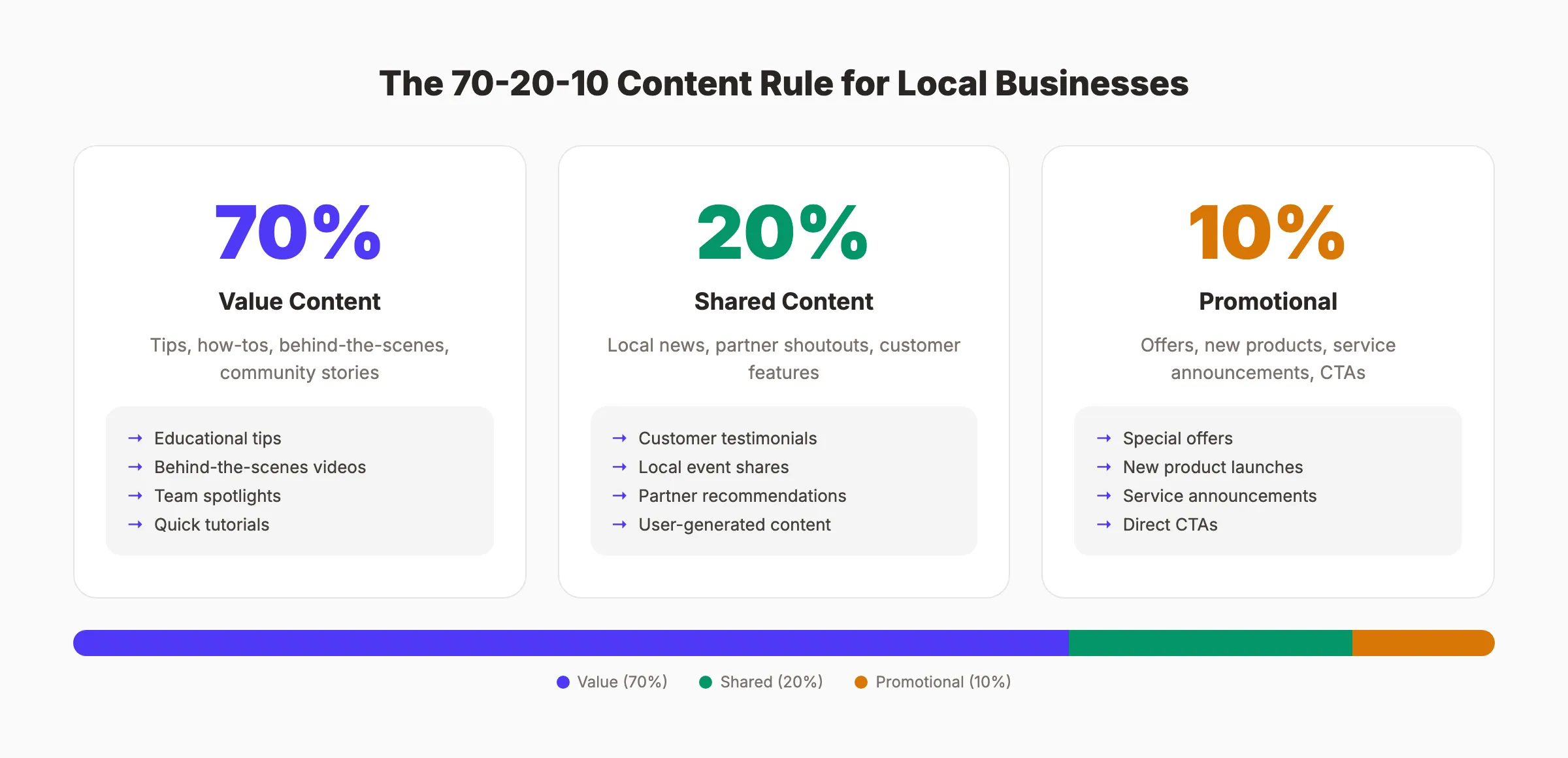
The most effective content mix for local businesses follows this ratio:
- 70% value content. Tips, how-tos, behind-the-scenes, community stories, educational posts
- 20% shared and curated content. Local news, partner shoutouts, customer features, industry insights
- 10% promotional content. Offers, new products, service announcements, direct CTAs
A dentist following this rule posts 7 educational tips about oral health, 2 community event shoutouts, and 1 promotional post about teeth whitening for every 10 posts. The audience stays engaged because 9 out of 10 posts give them something useful.
Top-Performing Content Types for Local Businesses
Short-form video (Reels, TikTok, Shorts) generates the highest reach and discovery. A 30-second behind-the-scenes video of a kitchen, workshop, or salon outperforms a polished graphic by 3-5x in organic reach.
Behind-the-scenes content humanizes the brand. Show the morning prep, the team meeting, the making of a product. Local audiences connect with the people behind the business.
User-generated content receives 8.7x higher engagement than branded content. Encourage customers to tag your business. Repost their photos and videos. Create a branded hashtag.
Customer testimonials as social posts convert better than any other content type. A screenshot of a 5-star Google review with a thank-you caption builds trust faster than any ad.
Community event posts show local investment. Sponsor a charity run? Post about it. Local festival this weekend? Share it. This content gets shared by local accounts and reaches new audiences organically.
Posting Frequency That Works
| Platform | Recommended Frequency | Why |
|---|---|---|
| 3-5 posts per week | More than daily posting shows diminishing returns for small pages | |
| Instagram feed | 3-5 posts per week | Consistency matters more than volume |
| Instagram Stories | 3-7 per week | Low-effort, high-visibility format |
| TikTok | 3-5 per week | Algorithm rewards consistency over bursts |
| 2-3 per week | Higher quality expectations per post | |
| Google Business Profile | 1-2 per week | Signals freshness for local search rankings |
Research from Buffer’s analysis of 52 million posts shows that posting 2-5 times per week outperforms daily posting for small businesses. Consistency over volume. Every time.
Chapter 4: How to Create Content Without a Marketing Team
The number-one reason local businesses abandon social media is time. The owner runs the business, handles operations, manages staff, and somehow needs to create 15 social posts per week. It does not work.
The Batch Content Method
Set aside 2 hours every 2 weeks. Create all your content in one session.
Week 1 session (2 hours):
- Shoot 5-10 short videos on your phone (behind-the-scenes, tips, product showcases)
- Write captions for each video
- Pull 3-5 customer reviews to turn into graphic posts
- Schedule everything using a social media scheduling tool
Week 2: Use the content you batch-created. Spend 10 minutes per day responding to comments and DMs. That is it.
Content Ideas That Require Zero Design Skills
- “Day in the life” video. Walk through your morning routine at the business. Film on your phone.
- Before-and-after photos. Works for any transformation business (cleaning, landscaping, salons, fitness, home renovation).
- Customer shoutout. Screenshot a Google review. Post it with a thank-you message.
- Quick tip. Share one piece of expert advice related to your industry. 30-60 seconds on camera.
- Team introduction. Photo of a staff member with 3 fun facts. Humanizes the business.
- Local recommendation. Recommend another local business. They will often return the favor.
- This or that poll , “Coffee or tea?” “Morning workout or evening?” Easy engagement.
- Throwback post. Show the business 5 years ago versus now.
AI Tools for Content Creation
For businesses that need help with captions, content ideas, and scheduling, several tools cut the creation time dramatically. Social media automation tools handle scheduling and analytics. AI caption generators draft post copy in seconds.
The fastest approach: let someone else handle it entirely. theStacc creates and publishes 30 original social posts per month across your chosen platforms for $49/month. Zero content creation on your end.
Chapter 5: Paid Social Media Advertising for Local Businesses
Organic reach is declining across every platform. Facebook organic reach for business pages averages 5.2%. Instagram sits around 9%. If you want guaranteed visibility, paid advertising fills the gap.
The good news: local businesses can run effective paid campaigns on budgets that would be meaningless for national brands.
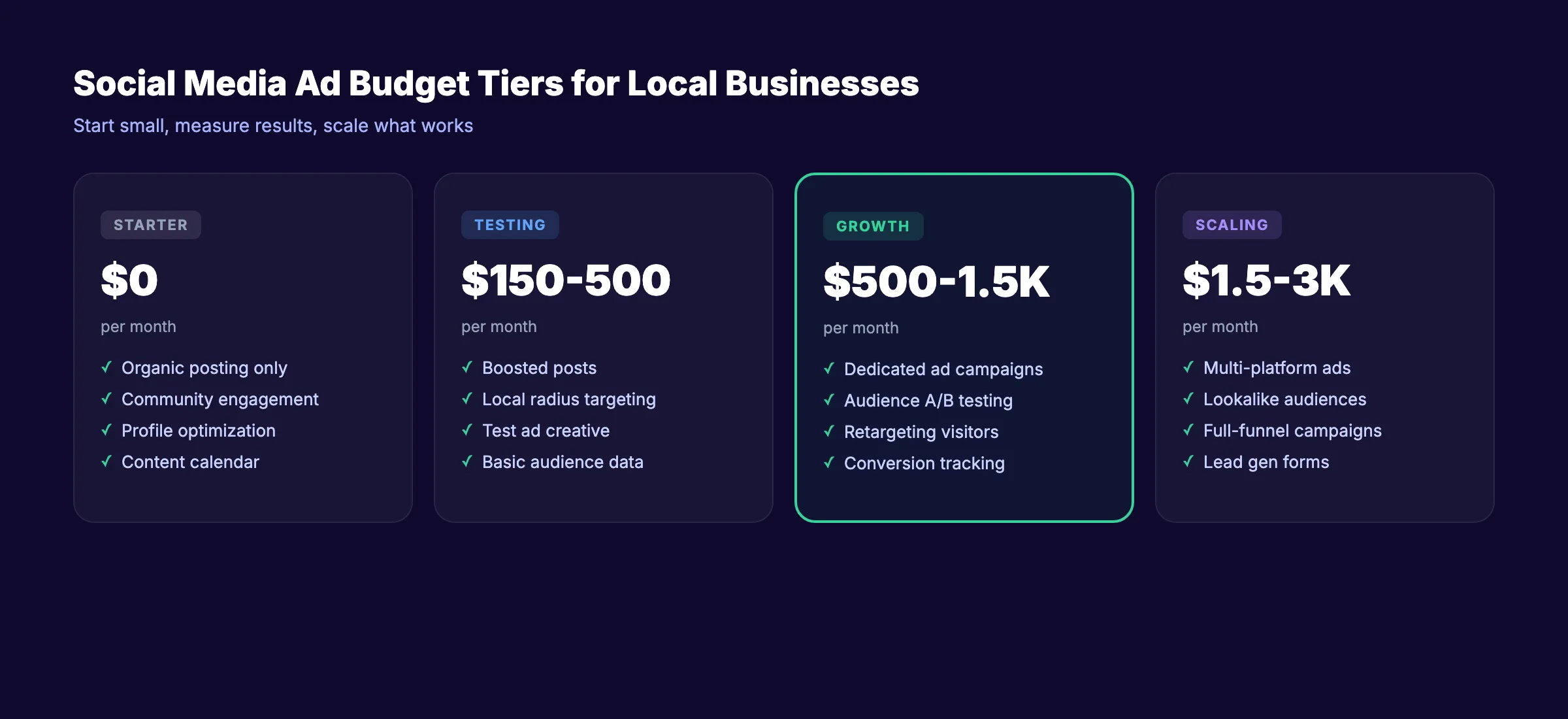
Ad Budget Tiers for Local Businesses
| Budget | Monthly Spend | What You Get |
|---|---|---|
| Starter | $0 | Organic only. Content, community, engagement. No paid reach. |
| Testing | $150-500 | Boosted posts and basic Facebook local targeting. Test what resonates. |
| Growth | $500-1,500 | Dedicated ad campaigns. Audience testing. Retargeting website visitors. |
| Scaling | $1,500-3,000 | Multi-platform ads. Lookalike audiences. Conversion tracking. Lead gen. |
Where to Start With $300/Month
For most local businesses, the first paid dollar should go to Facebook and Instagram ads. Here is why:
Facebook local targeting lets you reach people within a specific radius of your business. A restaurant can target everyone within 5 miles who is interested in dining out. A plumber can target homeowners within 15 miles. No other platform offers this geographic precision at this price point.
Cost benchmarks:
- Average cost per click: $0.30-$4.00
- Average CPM (cost per 1,000 impressions): $10-$15
- Average ROI for small business Facebook ads: 9.21% based on 1.2 million campaigns analyzed
- Instagram shopping posts generate 3x higher ROI than standard posts
The Local Ad Formula
The best-performing local business ads follow this pattern:
- Hook. Address a local pain point in the first 3 seconds (“Tired of waiting 3 weeks for a plumber?”)
- Proof. Show results, reviews, or before-and-after photos
- Offer. Give a reason to act now (free estimate, first-visit discount, limited availability)
- CTA. Clear next step (call, book online, visit the store, send a DM)
81% of small businesses planned to increase paid social investment in 2025. The ones who did it early captured cheaper ad inventory before competition drove prices up.
3,500+ blogs published. 92% average SEO score. theStacc handles Blog SEO, Local SEO, and Social Media on autopilot. See what it can do for your business. Start for $1 →
Chapter 6: How to Measure Social Media ROI
“Is social media actually working?” Every local business owner asks this question. Most never answer it because they track the wrong metrics.
Vanity Metrics vs. Business Metrics
Vanity metrics (stop obsessing over these):
- Follower count
- Likes per post
- Impressions
- Reach
Business metrics (track these instead):
- Website clicks from social profiles
- Phone calls from social CTAs
- Direction requests from Google Business Profile
- DMs that turn into bookings
- Coupon code redemptions from social-only offers
- Revenue attributed to social media customers
The Local Business ROI Framework
Track ROI in 3 layers:
Layer 1: Awareness (Month 1-3)
- Profile visits trending up week over week
- Reach expanding beyond current followers
- Website referral traffic from social growing
Layer 2: Engagement (Month 3-6)
- Comments and DMs increasing
- Saves and shares growing (the real engagement signals)
- User-generated content appearing
Layer 3: Revenue (Month 6+)
- Track customers who mention “found you on Instagram/Facebook”
- Use unique promo codes for social-only offers
- Monitor booking/call volume on days after high-performing posts
- Compare revenue before and after social media investment
Free Tools to Track Performance
You do not need expensive software to measure social media results.
- Platform native analytics. Facebook Insights, Instagram Insights, and TikTok Analytics are built in and free
- Google Analytics 4. Track website traffic from social referrals
- Google Business Profile Insights. See how many people found you through search versus social
- UTM parameters. Add tracking codes to every link you share on social to see exactly which posts drive clicks
Realistic Timeline for Results
| Timeframe | What to Expect |
|---|---|
| Month 1-2 | Building content library. Establishing posting rhythm. Low engagement is normal. |
| Month 3-4 | Engagement picks up. Algorithm starts favoring your content. First DMs and inquiries from social. |
| Month 5-6 | Consistent referral traffic from social. Measurable bookings or calls from social channels. |
| Month 7-12 | Compound effect kicks in. Social becomes a reliable lead source. Paid ads amplify organic momentum. |
Businesses that maintain a regular social media presence for 6-12 months see significantly better results than those who evaluate after 30 days. Social media compounds. The first 90 days feel like nothing is working. Months 6-12 are where the returns appear.
Chapter 7: The GBP and Social Media Connection
Most social media guides ignore this entirely. Your Google Business Profile and social media accounts are not separate channels. They feed each other.
How Social Media Impacts Local SEO
Google now allows you to add social profile links directly to your Google Business Profile. This creates a verified connection between your social presence and your local search listing. Consistent activity across social platforms signals to Google that your business is active and legitimate.
According to local SEO research, businesses with active social profiles and consistent NAP (name, address, phone number) across platforms rank higher in local pack results.
The Social-to-GBP Content Loop
- Post a customer testimonial on Instagram
- Share the same testimonial as a Google Business Profile post
- The GBP post signals freshness to Google’s local algorithm
- The Instagram post drives engagement and profile visits
- Both channels reinforce the same message to overlapping audiences
GBP Posts Are Free Social Media
Google Business Profile posts are visible directly in Google Search and Maps results. They cost nothing. They take 5 minutes to create. And they directly influence your local ranking.
Post on GBP at least once per week. Use the same content you create for social media. A photo from your Instagram feed, repurposed as a GBP post with a CTA, takes 2 minutes and gives you local SEO value that no other social platform provides.
For restaurants, dental practices, and other local businesses, the GBP-social connection is one of the highest-return activities available.
Chapter 8: Common Mistakes That Kill Local Social Media
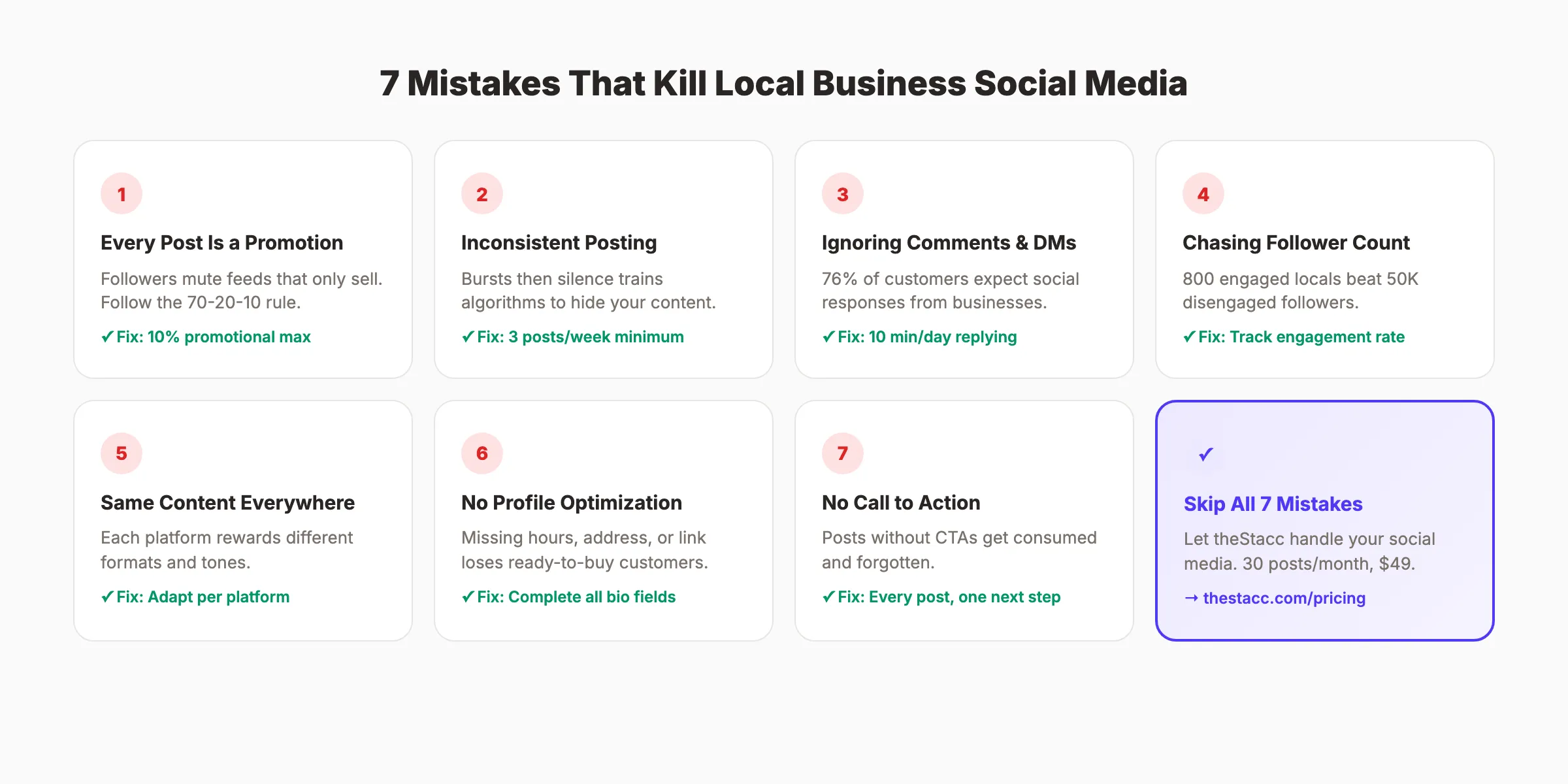
Every failing local business social media account makes the same mistakes. Avoid these and you are already ahead of 80% of your local competitors.
Mistake 1: Every Post Is a Promotion
When every post screams “BUY NOW,” followers mute you. Follow the 70-20-10 rule. Promotional content should be 10% of your total output.
Mistake 2: Inconsistent Posting
Posting 5 times in one week, then going silent for 3 weeks, trains the algorithm to deprioritize your content. A consistent 3 posts per week outperforms sporadic bursts of 10.
Mistake 3: Ignoring Comments and DMs
76% of customers expect businesses to respond on social media. Ignoring a comment is the same as ignoring a phone call. Set aside 10 minutes per day to reply. Every interaction signals engagement to the algorithm and builds trust with the audience.
Mistake 4: Chasing Follower Count
A local bakery with 800 engaged followers who visit the store weekly is more valuable than one with 50,000 followers who never buy anything. Focus on engagement rate and conversion actions, not the follower number.
Mistake 5: Same Content on Every Platform
Instagram rewards visual storytelling. LinkedIn rewards professional insight. TikTok rewards raw authenticity. Posting the exact same content across all platforms means you are optimized for none of them. Adapt the format even if the core message stays the same.
Mistake 6: No Profile Optimization
Your social profiles are landing pages. If the bio does not include your location, hours, phone number, and a link to your website or booking page, you are losing customers who found you on social but could not figure out how to visit or call.
- Business name matches across all platforms
- Address and phone number visible in bio or about section
- Website or booking link in the link-in-bio
- Business hours listed where the platform allows
- Profile photo is your logo or storefront (consistent across platforms)
- Cover photo shows your business, team, or products
Mistake 7: No Call to Action
Every post should give the viewer a next step. “Comment your favorite below.” “DM us to book.” “Tap the link in bio.” “Share this with a friend who needs this.” Posts without CTAs get consumed and forgotten. Posts with CTAs drive action.
Chapter 9: The Social Media Content Calendar for Local Businesses
A content calendar removes the daily stress of “what should I post today?” Build it once per month. Execute daily.
Monthly Calendar Template
| Week | Monday | Wednesday | Friday |
|---|---|---|---|
| Week 1 | Educational tip (video) | Customer testimonial | Behind-the-scenes |
| Week 2 | Industry how-to | Community/local event | Team spotlight |
| Week 3 | Before-and-after | User-generated content repost | Quick tip (carousel or video) |
| Week 4 | Promotional offer (10% of content) | Local recommendation | Weekend recap or poll |
Seasonal Content Planning
Local businesses are seasonal. Plan content around what drives your business.
Restaurants: Seasonal menu launches, holiday specials, event nights, food festival participation.
Home services: Spring cleaning, summer maintenance, fall prep, winter emergency readiness.
Retail: Back-to-school, holiday gift guides, seasonal collections, local market appearances.
Professional services: Tax season reminders, end-of-year planning, New Year goal-setting content.
Build a 12-month content skeleton at the start of each year. Fill in specific posts monthly. This approach prevents the “content blank” that leads to posting silence.
Using Scheduling Tools
Manual posting wastes time. Social media scheduling tools let you batch-create content in one session and schedule it across all platforms. Buffer, Later, and Metricool all offer free plans that work for small businesses.
For businesses that want the entire process handled, social media posting tools and done-for-you services eliminate the content creation step entirely.
Rank everywhere. Do nothing. Blog SEO, Local SEO, and Social Media on autopilot. theStacc starts at $49/mo with a $1 trial. Start for $1 →
FAQ
Does social media marketing actually work for local businesses?
Yes. 78% of local businesses report that social media drives revenue. The average ROI is $4.20 for every $1 spent. The key is consistency: businesses that maintain regular posting for 6-12 months see significantly better results than those who evaluate after 30 days.
Which social media platform is best for a local business?
Facebook is the most effective overall platform for local businesses. 70% of users visit a local business page at least weekly. Instagram is the strongest for visual businesses (restaurants, retail, salons). TikTok delivers the highest engagement rate at 3.70% and works well for businesses targeting audiences under 40.
How often should a local business post on social media?
3-5 posts per week on your primary platform. Buffer’s analysis of 52 million posts shows that posting 2-5 times per week outperforms daily posting for small businesses. Consistency matters more than volume. 3 posts every week beats 10 posts one week and zero the next.
How much should a local business spend on social media ads?
Start with $150-500 per month on Facebook and Instagram ads. Average cost per click runs $0.30-$4.00. At $10-15 per day, you can test ad creative, target local audiences within a specific radius, and measure results within 30 days. Scale only after you see positive ROI on initial spend.
How do I measure social media ROI for my local business?
Track business metrics, not vanity metrics. Monitor website clicks from social profiles, phone calls, direction requests, DM inquiries that turn into bookings, and coupon redemptions from social-only offers. Use Google Analytics 4 to track referral traffic and UTM parameters to attribute clicks to specific posts.
How long does it take to see results from social media marketing?
Expect minimal results in months 1-2 while you build a content library and establish rhythm. Engagement picks up in months 3-4. Measurable bookings and leads typically appear in months 5-6. The compound effect kicks in around month 7-12 when social becomes a reliable lead channel.
The Bottom Line
Social media marketing for local businesses works. Not because of any single viral post or clever ad. It works because consistent presence builds trust with the people who live and shop near you.
Pick 2 platforms. Follow the 70-20-10 content rule. Post 3-5 times per week. Respond to every comment and DM. Track business metrics, not vanity metrics. Give it 6 months before judging results.
If creating 15+ posts per month sounds like too much work on top of running your business, that is exactly the problem theStacc solves. 30 original social posts created and published every month, across your chosen platforms, for $49.
Start for $1 → See the difference in 3 days
Related Tools & Resources
Free SEO Tools:
Best Lists:

Written by
Siddharth GangalSiddharth is the founder of theStacc and Arka360, and a graduate of IIT Mandi. He spent years watching great businesses lose organic traffic to competitors who simply published more. So he built a system to fix that. He writes about SEO, content at scale, and the tactics that actually move rankings.
Automate your Google Business Profile content
30 GBP posts, local SEO articles, and review responses. Published every month automatically.
30-day trial · Cancel anytime
theStacc
Stop writing SEO content manually
30 blog articles, 30 GBP posts, and social media content. Published every month. Automatically.
Start Your $1 Trial$1 for 3 days · Cancel anytime