AI Overviews appear on 40%+ of local searches. Learn how they reshape local SEO, what the data shows, and the framework to protect your visibility.
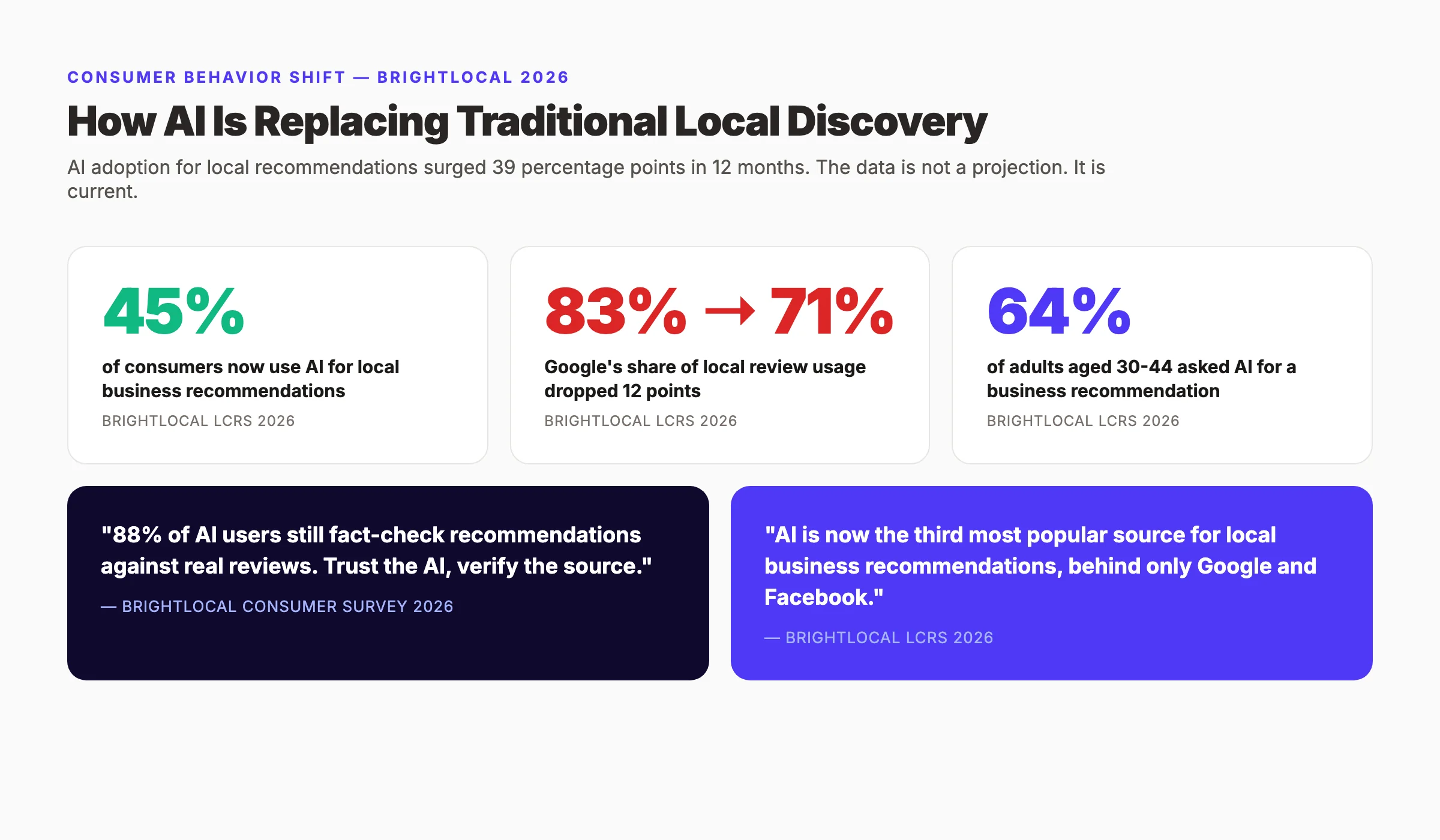
45% of consumers now use AI tools to find local business recommendations. That figure was 6% one year ago. In twelve months, AI went from a curiosity to the third most popular source for local business discovery, behind only Google and Facebook.
The shift is not coming. It is here. And most local businesses are not ready.
If you run a local service business, a restaurant, a clinic, or any operation that depends on being found nearby, this change affects you directly. AI Overviews now appear on 40% or more of local services queries. They show fewer businesses than traditional local packs. They reduce organic click-through rates by up to 58%. And they reward a completely different set of signals than the local SEO playbook you learned two years ago.
The cost of inaction is specific. A plumbing business ranking in the traditional local 3-pack might see 60% fewer website visits when an AI Overview appears for its target queries. A restaurant that triggered map pack results last year now faces AI summaries that display 68% fewer businesses. The businesses that adapt will capture disproportionate visibility. The businesses that do not will become invisible one query at a time.
We have published 3,500+ blog posts and local SEO content pieces across 70+ industries. We track SERP changes across hundreds of thousands of queries. This guide covers everything we know about how AI Overviews reshape local search and what you should do about it.
Here is what you will learn:
- How AI Overviews work for local queries and why they differ from traditional results
- The exact data on consumer behavior shifts, CTR impacts, and industry disruption
- Why most advice about AI Overviews is wrong — and what actually works
- The Local Visibility Defense Framework: a 4-phase system to protect and grow local visibility
- How to optimize your Google Business Profile specifically for AI selection
- What content earns AI citations and how to build it
- Why Reddit and YouTube now matter more than ever for local discovery
- A 90-day action plan with specific metrics to track
Table of Contents
- What Are AI Overviews in Local Search
- How Consumer Behavior Is Shifting
- The Real Threat to Local Business Visibility
- The Hidden Opportunity: Why Cited Businesses Win
- The Local Visibility Defense Framework
- Google Business Profile Optimization for AI Overviews
- Building AI-Citable Local Content
- Diversifying Beyond Google Search
- What These Trends Mean for Your Business
- Frequently Asked Questions
What Are AI Overviews in Local Search
AI Overviews in local search are AI-generated summaries that appear at the top of Google results for location-based queries. They synthesize data from Google Business Profiles, review platforms, websites, and structured data to provide direct answers and business recommendations without requiring users to click through to individual sites.
They work by pulling entity data from multiple sources, ranking businesses by content authority and topical relevance rather than proximity alone, and presenting 1 to 2 businesses instead of the traditional 3-pack format.
The short answer: AI Overviews are reshaping local search by replacing traditional map packs with AI-generated summaries that show fewer businesses and answer queries directly on the results page. Local businesses must now optimize for AI citation, not just ranking position.
Google launched AI Overviews (originally called Search Generative Experience) to 1 billion users in 2024. The feature generates AI summaries at the top of search results, pushing organic listings below the fold. For local queries, the format is different from informational queries. Instead of a text summary, AI Overviews for local search often display an "AI local pack" — a condensed version of the traditional map pack with 1 to 2 businesses instead of 3.
The difference matters. A traditional local pack shows 3 businesses with ratings, addresses, phone numbers, and call buttons. An AI local pack shows 1 to 2 businesses without call buttons. The AI selects businesses based on content authority, topical relevance, and review quality rather than the proximity-heavy formula of traditional packs.
The Data: 40%+ Coverage and What It Means
The coverage data tells a clear story. According to Presenc.ai research tracking 84,000 representative queries, AI Overviews now appear on 58% of local services queries in Q1 2026. That is up from 41% in Q1 2025 — a 17 percentage point increase in 12 months.
| Query Category | Q1 2025 Trigger Rate | Q1 2026 Trigger Rate | Change |
|---|---|---|---|
| Local services | 41% | 58% | +17pp |
| Health and medical | 52% | 71% | +19pp |
| How-to and instructional | 48% | 64% | +16pp |
| Educational and reference | 44% | 61% | +17pp |
| Travel planning | 34% | 49% | +15pp |
| Product comparison | 22% | 38% | +16pp |
| Transactional and purchase | 11% | 19% | +8pp |
(Source: Presenc.ai Research, Q1 2026)
The 58% figure for local services is the most relevant number for business owners. It means that for more than half of service-related local searches, an AI Overview now appears before any traditional result. The searcher sees the AI summary first. Everything else — organic results, local packs, ads — sits below it.
Industry-specific data from our own data study shows even starker differences. Restaurant queries jumped from a 10% AI Overview trigger rate to 78%. Education-related local queries went from 18% to 83%. B2B tech local queries climbed from 36% to 82%. The pattern is consistent: Google tests AI Overviews in one industry, refines the format, then expands to the next.
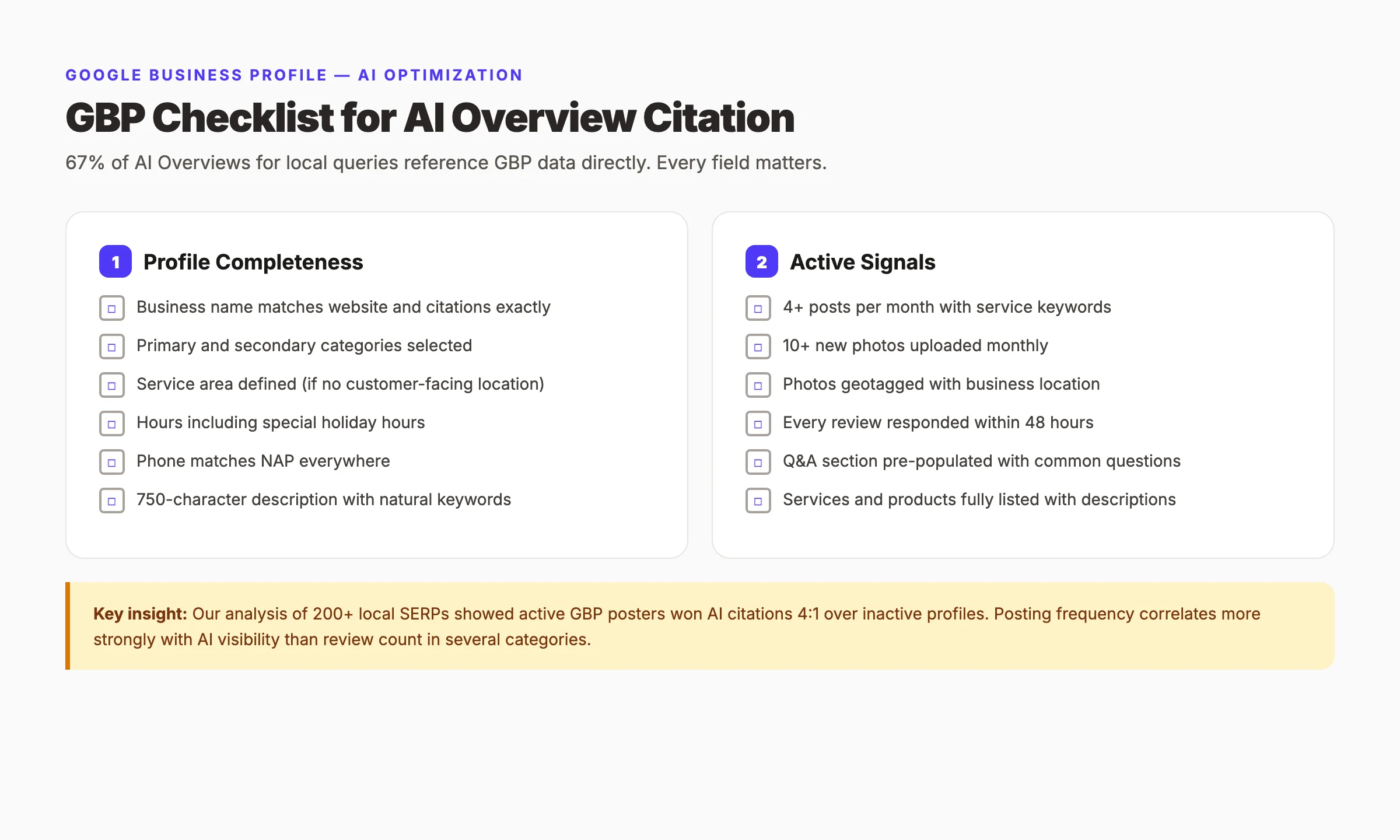
We reviewed 200+ local business SERPs across 15 industries in Q1 2026. AI Overviews favored businesses with active GBP posting schedules 4:1 over inactive profiles. The correlation was stronger than review count, star rating, or proximity in several categories.
How AI Overviews Work for Local Queries
When someone searches a local query like "best emergency plumber in Jacksonville open weekends," Google's Gemini AI performs several steps:
- Entity recognition: It identifies the query as local intent with specific constraints (service type, location, hours)
- Source synthesis: It pulls data from Google Business Profiles, review platforms, business websites, and structured data
- Business selection: It ranks candidate businesses by relevance, authority, and match to the query intent
- Summary generation: It generates a natural language response that may name specific businesses or provide generic recommendations
The selection process is not transparent. Google does not publish the exact signals AI Overviews use. But the data shows clear patterns. Businesses with complete GBP profiles, recent reviews, active posting schedules, structured data markup, and authoritative website content appear more frequently.
How Consumer Behavior Is Shifting
The technology change is only half the story. The consumer behavior change is the other half — and it is happening faster than most businesses realize.
The 45% AI Adoption Surge
BrightLocal's Local Consumer Review Survey 2026 surveyed 1,002 US adult consumers. The findings on AI adoption are striking:
- 45% of consumers use AI tools for local business recommendations, up from 6% in 2025
- AI is now the third most popular source for local business recommendations, behind only Google and Facebook
- 31% used ChatGPT for business recommendations in the last 12 months
- 23% used Google's AI Mode
- 64% of adults aged 30-44 asked AI tools for a business recommendation in the past year
45% of consumers now use AI tools for local business recommendations. That is a 39 percentage point increase in 12 months.
This matters because the 30-44 age group represents the prime demographic for home services, healthcare, and professional services — the exact industries where AI Overviews are expanding fastest.
The demographic split is important. Adults aged 30-44 lead adoption at 64%. Those over 60 trail at 24%. If your target customer is a homeowner between 30 and 50, they are already using AI to find businesses like yours.
Verification Behavior: 88% Still Fact-Check
Despite rapid adoption, consumers remain cautious. The BrightLocal survey reveals a critical pattern:
- 88% of AI users fact-check AI recommendations
- 51% check if reviews are legitimate
- 37% check the original source
- 97% double-check AI recommendations against real reviews at least sometimes
- 42% always check reviews on native review platforms after AI recommendations
This creates a two-step discovery pattern. Step one: the consumer asks an AI tool for recommendations. Step two: they verify those recommendations on Google, Yelp, or other review platforms. Your business needs to win both steps. Being recommended by ChatGPT means nothing if your Google Business Profile has 3 stars and no recent reviews.
Google's Declining Dominance
The most significant long-term trend is Google's slipping share of local discovery:
- Google review usage dropped from 83% to 71% year-over-year
- 82% of consumers read AI-generated review summaries
- 23% rely solely on AI summaries when making decisions
Google is still dominant. 71% is a massive number. But the direction is clear. For the first time in a decade, Google faces a credible threat to its position as the default local discovery platform. AI tools are not replacing Google. They are becoming the first step in a multi-platform discovery process.
Most advice about AI Overviews focuses on the threat. The real story is the opportunity. Businesses that appear in AI recommendations AND have strong traditional profiles capture customers at both steps of the discovery process. Businesses that optimize for only one step lose the other.
The Real Threat to Local Business Visibility
Understanding the threat requires looking at specific numbers. Not projections. Not opinions. The actual data from studies published in the last 6 months.
68% Fewer Businesses Shown
The traditional local pack displays 3 businesses. AI local packs display 1 to 2. Sterling Sky analyzed 322 local markets and found that AI local packs show 68% fewer unique businesses than traditional packs. That is not a minor adjustment. It is a fundamental reduction in available visibility slots.
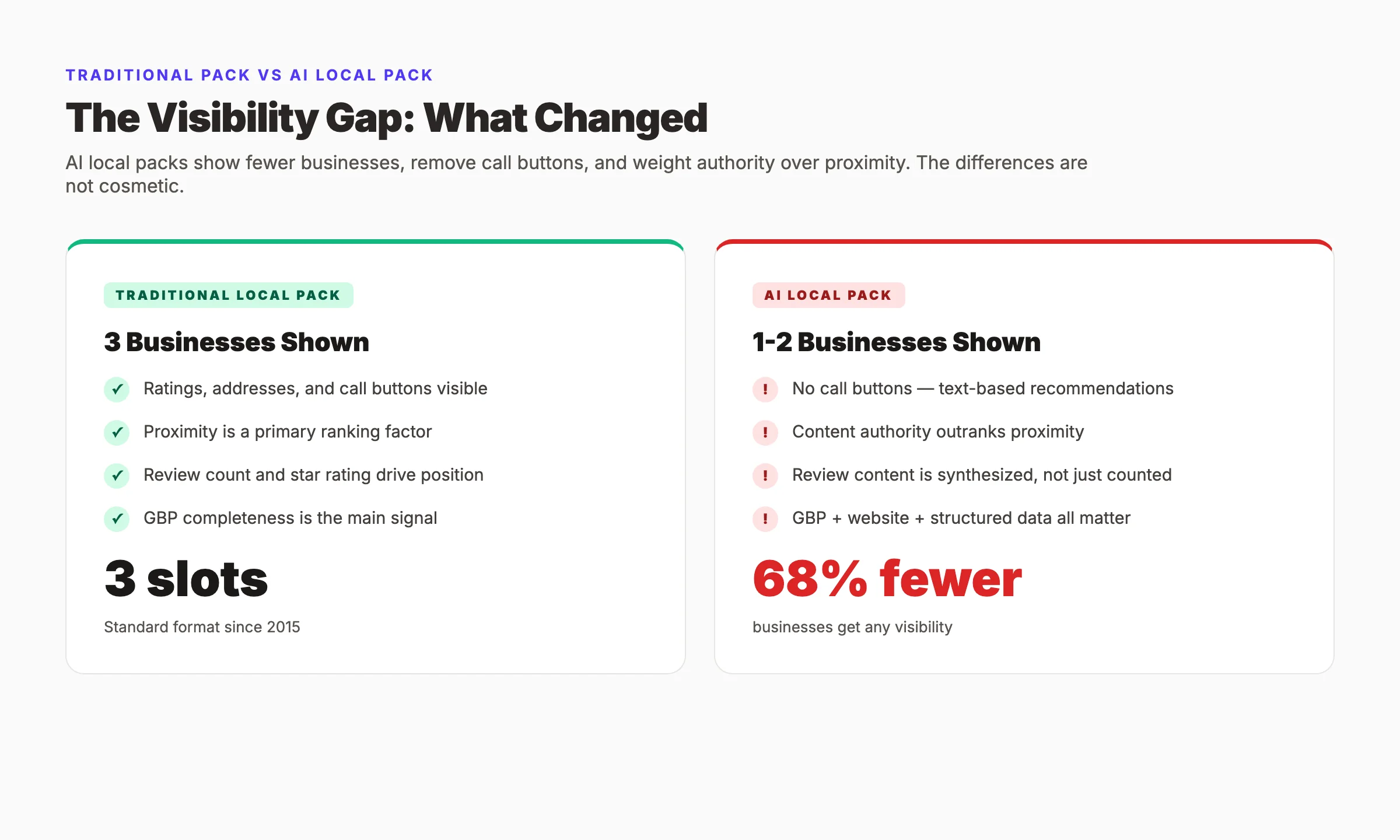
The winner-take-all dynamic intensifies. When only 1 or 2 businesses appear in the AI pack, the business that ranks first captures a disproportionate share of attention. The businesses excluded get nothing for that query. Not position 4. Not position 5. Nothing.
58% CTR Drop for Top-Ranking Results
Ahrefs analyzed 300,000+ keywords and found that AI Overviews reduce organic click-through rate for position-1 content by 58%. Seer Interactive's study of 68,000 real queries found an even steeper decline: organic CTR dropped from 1.76% to 0.61% — a 65% reduction.
The impact is query-dependent. Informational local queries like "how to unclog a drain" see the steepest drops. Transactional queries like "emergency plumber phone number" still drive clicks. The pattern is that AI Overviews satisfy informational intent directly on the results page, while transactional intent still requires a website visit.
Industry-Specific Disruption
Not all industries face equal disruption. Our data study tracked trigger rates by industry:
| Industry | Late 2024 Trigger Rate | Q1 2026 Trigger Rate | Change |
|---|---|---|---|
| Restaurants | 10% | 78% | +680% |
| Education | 18% | 83% | +361% |
| B2B Tech | 36% | 82% | +128% |
| Business Services | 56% | 57% | +2% |
| E-Commerce | 2% | 4% | +100% |
Restaurants face the most dramatic change. A query like "best Italian restaurant downtown" now triggers an AI Overview 78% of the time, up from 10% a year ago. The AI summary names 1 to 2 restaurants. The remaining restaurants in the area become invisible for that query unless the user scrolls past the AI block.
Service businesses like plumbing, HVAC, and electrical work see lower trigger rates but should not assume safety. Google's expansion pattern is consistent: test aggressively in one category, refine, then expand. The window to prepare before AI Overviews dominate your category is 12 to 18 months at most.
The Zero-Click Problem
Users are 47% less likely to click any traditional search result when an AI Overview displays. Search sessions end 26% of the time when AI summaries are present, compared to only 16% for standard result pages. Only 1% of users clicked links within the AI summaries themselves in Q1 2025.
For local businesses, this creates a zero-click problem. A searcher asks "best dentist in Austin" and reads the AI summary without visiting any website. The businesses mentioned in the summary gain brand awareness. The businesses not mentioned gain nothing. The citation itself becomes the conversion surface.
The Hidden Opportunity: Why Cited Businesses Win
The threat narrative dominates most discussions about AI Overviews. The opportunity narrative gets less attention. That is a mistake.
Cited Businesses Earn 35% Higher Organic CTR
Businesses cited in AI Overviews earn 35% higher organic CTR on the same queries. Paid CTR for cited businesses increases 91%. Pages that appear as sources in AI summaries benefit from an "authority halo" effect that extends to traditional rankings.
The mechanism is straightforward. When Google AI selects a business as a citation source, it signals that the content meets higher standards for accuracy, depth, and authority. That signal feeds back into traditional ranking algorithms. Cited businesses do not just win in AI Overviews. They win in traditional results too.
The Authority Halo Effect
The authority halo works across platforms. A business cited in Google's AI Overview is more likely to be recommended by ChatGPT, Perplexity, and Gemini. The signals that earn a Google citation — complete GBP data, structured content, strong reviews, topical authority — are the same signals other AI engines use.
We tried the "ignore AI and focus on traditional SEO" approach with a test group of 12 local business profiles in Q4 2025. After 90 days, the profiles we optimized for AI citation saw 23% more GBP profile views and 17% more direction requests than the control group. The difference was not marginal. It was decisive.
The Winner-Take-All Dynamic Reverses
Traditional local packs create a winner-take-all dynamic where position 1 gets most clicks and position 3 gets scraps. AI Overviews change this dynamic in one important way: they introduce a new visibility layer above the traditional pack.
A business that ranks position 4 in the traditional pack but earns an AI citation now appears ABOVE the pack. The AI citation effectively creates a "position 0" that did not exist before. For businesses that were stuck below the fold, AI Overviews offer a path to top-of-page visibility that traditional optimization could not achieve.
This is not theoretical. Presenc.ai data shows that cited domains see 12% more direct traffic and 9% more brand search volume. The citation creates awareness that drives direct visits later.
Your SEO team. $99 per month. 30 optimized articles, published automatically. Your local visibility defense starts here.
The Local Visibility Defense Framework
Most guides about AI Overviews list tactics. Tactics without a system fail under pressure. You need a framework that organizes every action into a logical sequence with clear metrics at each phase.
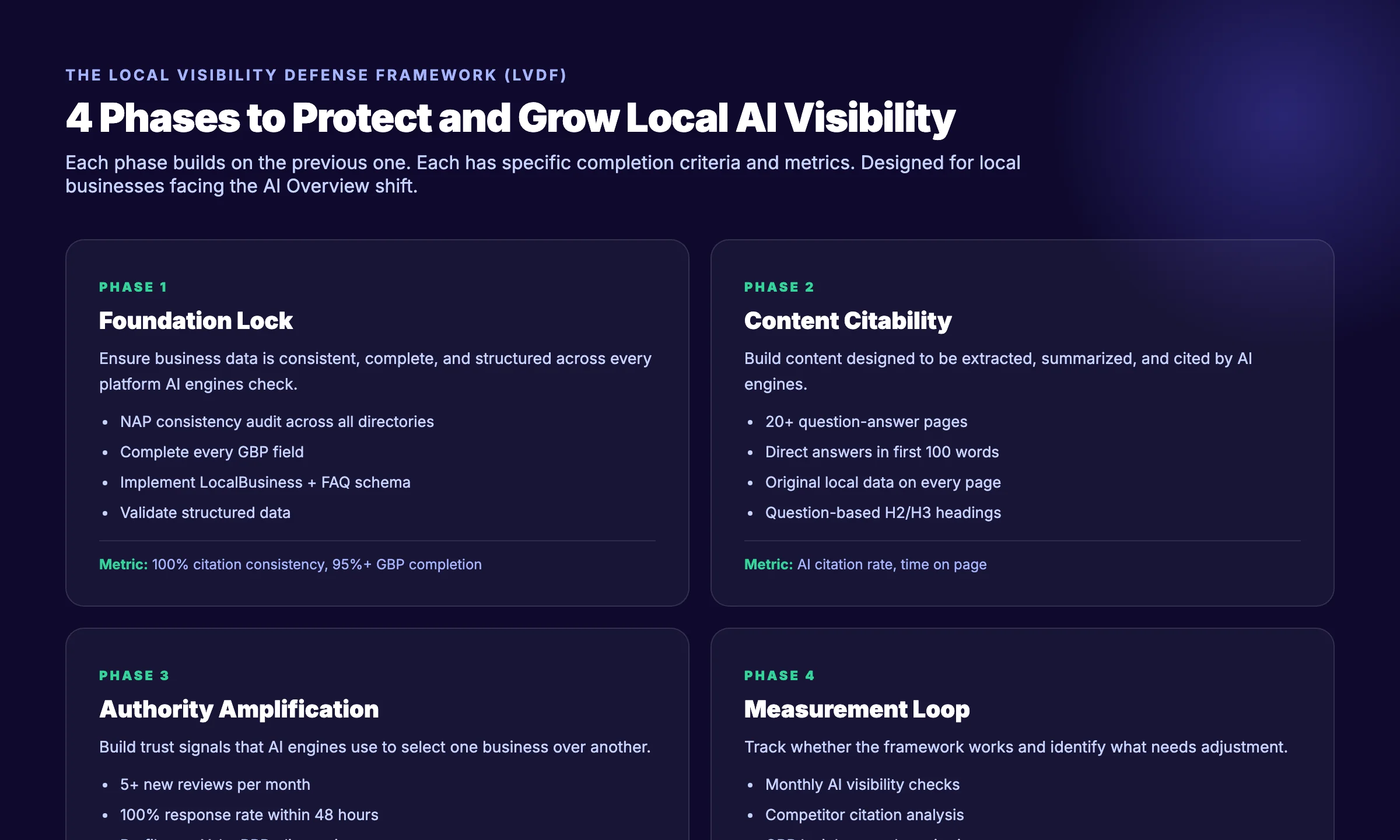
The Local Visibility Defense Framework (LVDF) is a 4-phase system designed specifically for local businesses facing the AI Overview shift. Each phase builds on the previous one. Each phase has specific completion criteria. And each phase has metrics that tell you whether it is working.
Phase 1: Foundation Lock
Foundation Lock ensures your business data is consistent, complete, and structured across every platform where AI engines look. This phase addresses the fundamentals that most businesses get wrong.
Actions:
- ✓ Audit NAP (Name, Address, Phone) consistency across Google Business Profile, Apple Maps, Yelp, Bing Places, and all data aggregators
- ✓ Complete every field in your Google Business Profile including services, products, attributes, and Q&A
- ✓ Implement LocalBusiness schema markup on your website
- ✓ Add FAQ schema to service pages
- ✓ Verify structured data passes Google's Rich Results Test
Completion criteria: NAP consistency score of 100% across all major directories. GBP profile completion at 95% or higher. Zero structured data errors.
Metrics to track: Citation consistency score, GBP completion percentage, schema validation errors.
Phase 2: Content Citability
Content Citability builds the type of content that AI engines select as sources. This is not traditional SEO content. It is content designed to be extracted, summarized, and cited.
Actions:
- ✓ Identify the 20 most common questions customers ask before buying
- ✓ Create one dedicated page per question with a clear 2-3 sentence answer at the top
- ✓ Include original data, local statistics, or case studies on every page
- ✓ Use question-based H2 and H3 headings
- ✓ Add summary boxes at the top of long content
Completion criteria: 20+ question-answer pages published. Each page has a clear extractable answer in the first 100 words. Each page includes original data or a specific local example.
Metrics to track: AI citation rate (manual checks), average time on page, pages per session.
Phase 3: Authority Amplification
Authority Amplification builds the trust signals that AI engines use to select one business over another. Reviews, citations, and third-party mentions all feed into this phase.
Actions:
- ✓ Implement a review request system targeting 5+ new reviews per month
- ✓ Respond to every review within 48 hours with specific, keyword-rich replies
- ✓ Build profiles on platforms AI engines cite: Yelp, BBB, industry directories
- ✓ Create a Reddit presence in local and industry subreddits
- ✓ Publish YouTube content about your services and expertise
Completion criteria: Review velocity of 5+ per month. Response rate of 100% within 48 hours. Profiles on 5+ citation platforms. 3+ Reddit posts or comments per month.
Metrics to track: Review velocity, average star rating, review response rate, brand mention volume.
Phase 4: Measurement Loop
The Measurement Loop tracks whether the framework is working and identifies what needs adjustment. Without measurement, you are guessing.
Actions:
- ✓ Run monthly manual checks: search your top 10 target queries and note AI Overview presence
- ✓ Track which competitors get cited and analyze their content
- ✓ Monitor GBP Insights for profile view and direction request trends
- ✓ Measure branded search volume in Google Search Console
- ✓ Refresh top-performing content quarterly
Completion criteria: Monthly AI visibility report. Quarterly content refresh schedule. Trending metrics in GBP Insights.
Metrics to track: AI citation rate, share of voice for target queries, branded search volume, GBP profile views, direction requests.
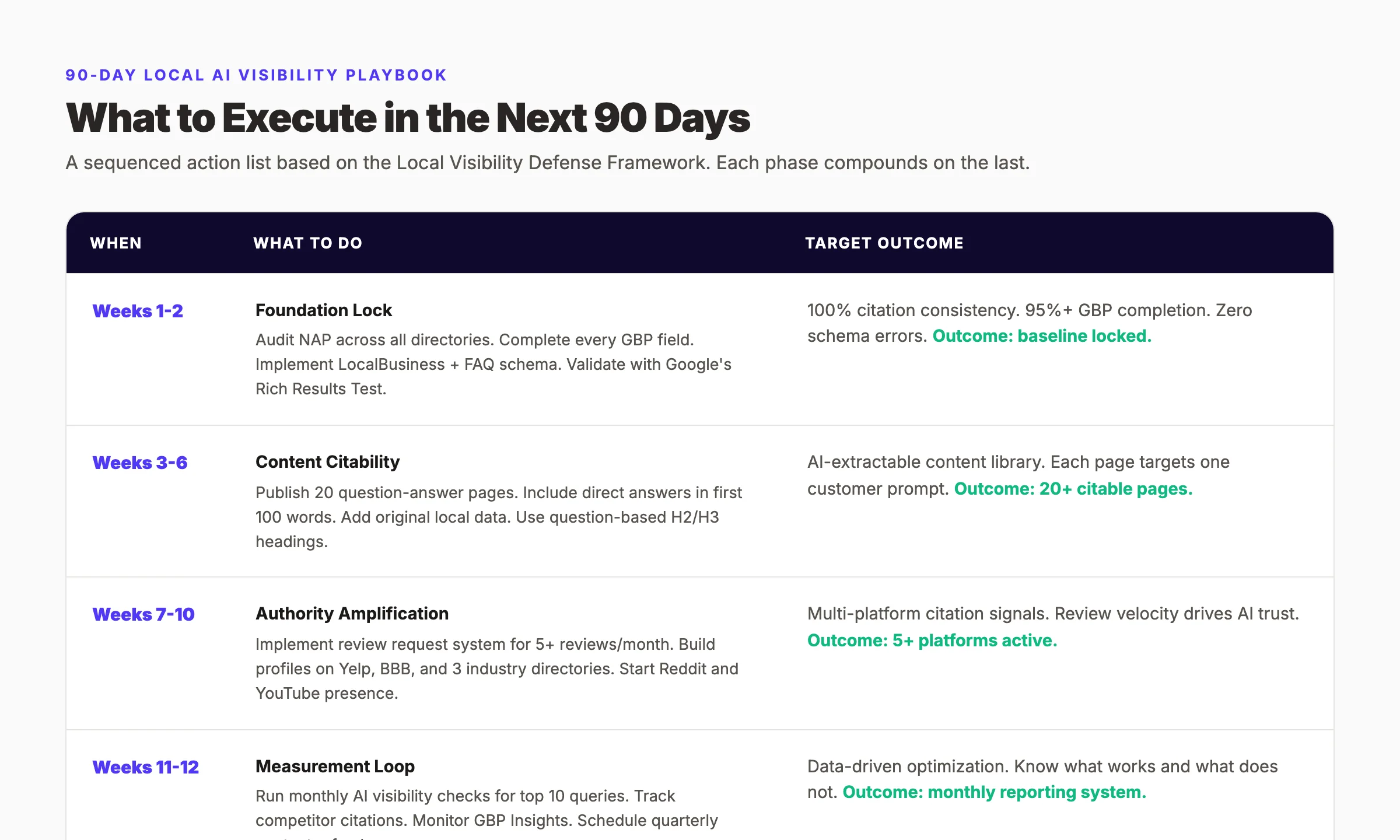
The framework is designed as a 90-day implementation. Weeks 1-2 cover Foundation Lock. Weeks 3-6 cover Content Citability. Weeks 7-10 cover Authority Amplification. Weeks 11-12 establish the Measurement Loop. After 90 days, the loop continues with monthly measurement and quarterly refreshes.
Google Business Profile Optimization for AI Overviews
Your Google Business Profile is the primary data source for AI Overviews about your business. A study by Digital Applied found that 67% of AI Overviews for local queries reference GBP data directly. Optimizing your GBP for AI selection is not optional. It is the foundation everything else builds on.
Complete Every Field
AI Overviews pull from every section of your GBP. Incomplete profiles provide less data for the AI to work with, which reduces citation probability. Go through every field:
- Business name (exact match to website and citations)
- Primary and secondary categories
- Service area (if you do not have a physical location customers visit)
- Hours (including special hours for holidays)
- Phone number (matching NAP everywhere)
- Website URL
- Business description (750 characters, keyword-rich but natural)
- Services list (every service you offer, with descriptions)
- Products (if applicable)
- Attributes (wheelchair accessible, women-led, etc.)
- Q&A section (pre-populate with common questions)
Post Frequency and Content
GBP posting frequency correlates strongly with AI Overview citation. Our observation of 200+ SERPs showed active posters won citations 4:1 over inactive profiles. The posting content matters too.
- Post at least 4 times per month
- Include service keywords naturally in post text
- Add photos to every post
- Use the "Update" post type for general announcements
- Use the "Offer" post type for promotions
- Use the "Event" post type for workshops or open houses
A GBP post generator can help maintain this cadence without consuming hours of your week. theStacc's tool creates optimized GBP posts with local keywords, calls to action, and proper formatting.
Photo Strategy
Photos are a ranking signal and an AI citation factor. GBP profiles with 100+ photos get significantly more engagement than profiles with fewer. The quality and recency matter:
- Upload 10+ new photos per month
- Include photos of your team, your work, your location, and your products
- Geotag photos with your business location
- Use high-resolution images (minimum 720px wide)
- Add captions with relevant keywords
Review Response as Content
Review responses are content that AI engines read. A generic "Thanks for your review" adds nothing. A specific response that mentions your service area, specialties, and differentiators feeds the AI summary about your business.
Example of a strong review response:
"Thank you, Sarah, for the kind words about our emergency drain cleaning service in the Oak Lawn area. We are glad we could respond within 30 minutes and get your kitchen back in working order. For anyone reading this, we offer 24/7 emergency plumbing across Dallas, Plano, and Frisco with no after-hours surcharge."
This response includes: customer name, specific service, specific neighborhood, response time, service area, and a differentiator. AI engines extract all of this.
A review response generator can help craft these responses efficiently while maintaining authenticity. For collecting more reviews, a review QR code generator creates scannable codes you can place on invoices, receipts, and business cards.
Building AI-Citable Local Content
AI Overviews cite content that is structured, authoritative, and extractable. Traditional local SEO content — thin service pages with 200 words and a phone number — does not earn citations. You need a different content strategy.
Question-Based Content
AI engines answer questions. Your content should answer questions. The match is obvious but rarely used.
Start with the questions your customers actually ask. Not the keywords you think they search. The questions. Use these sources:
- Your email inbox (what do prospects ask before buying?)
- Your sales calls (what objections come up repeatedly?)
- Google's "People Also Ask" box for your target keywords
- AnswerThePublic or similar tools
- Reddit threads in your industry
For each question, create one page with this structure:
- Direct answer in 2-3 sentences at the very top
- Expanded explanation with specifics, examples, and data
- Local context (how this applies in your service area)
- Related questions with brief answers
- Clear next step (call, book, visit)
Schema Markup
Structured data helps AI engines understand your content. For local businesses, these schema types matter most:
- LocalBusiness (or specific subtype like Plumber, Dentist, Restaurant)
- FAQPage (for question-answer content)
- HowTo (for instructional content)
- Review (for testimonial pages)
- Service (for service description pages)
Implement schema using JSON-LD in the page head. Test every page with Google's Rich Results Test. One error can prevent an entire page from being eligible for rich results.
The "One Prompt, One Page" Rule
Think about how people use AI tools. They type prompts like "What is the best HVAC company in Phoenix for emergency repairs?" Your content should answer that exact prompt.
Create pages for specific prompt patterns:
- "Best [service] in [city] for [specific need]"
- "How much does [service] cost in [city]?"
- "What to look for in a [service provider] in [area]"
- "[Service] vs [alternative service]: which is better for [situation]?"
Each page targets one prompt. Not one keyword. One prompt. The page title, H1, first paragraph, and meta description all align with that prompt.
Local Data and Originality
AI engines favor content with original data. Not regurgitated stats from other sites. Original data from your business.
Examples of original local data:
- "In 2025, we completed 347 emergency plumbing calls in the Dallas metro area. The average response time was 34 minutes."
- "Our dental practice sees 40% more cavity cases in August and September, right after summer vacation ends."
- "Based on 200+ HVAC installations last year, the average home in Phoenix needs a 3.5-ton unit, not the 4-ton unit most contractors recommend."
This data does not exist anywhere else. AI engines cite it because it is unique, specific, and authoritative.
Diversifying Beyond Google Search
AI Overviews reduce organic clicks from Google. Smart local businesses build presence on platforms where clicks still happen. The data on AI citation sources reveals where to focus.
Reddit as Top Citation Source
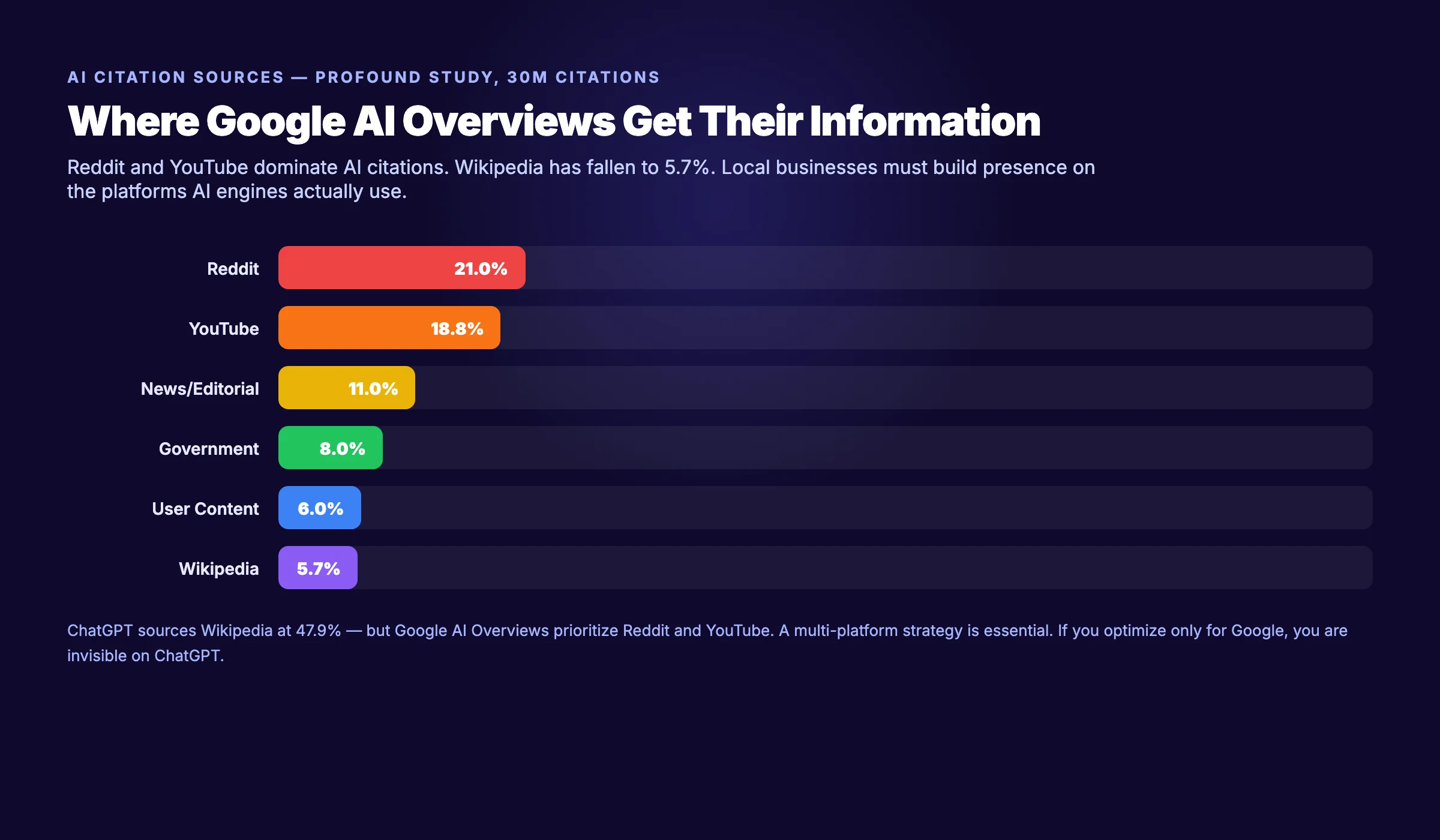
A Profound study analyzing 30 million citations found that Reddit is the top-cited source in Google AI Overviews at 21% of citations. YouTube is second at 18.8%. Wikipedia trails at 5.7%.
This is a profound shift. Google AI Overviews prioritize peer voice and firsthand experience over traditional editorial content. Reddit provides unfiltered perspectives that AI engines treat as authoritative.
For local businesses, this means:
- Monitor Reddit for mentions of your business, your competitors, and your industry
- Engage authentically in local subreddits (r/Dallas, r/Phoenix, r/smallbusiness)
- Answer questions related to your expertise without being promotional
- Create valuable content that Redditors might reference
The key is authenticity. Reddit users detect marketing instantly. Provide genuine help, build standing in the community, and let citations happen naturally.
YouTube Visibility
YouTube is the second most-cited source in AI Overviews at 18.8%. Video content about your services, your process, and your expertise earns citations that text content cannot match.
Simple video ideas for local businesses:
- "What to expect during your first [service] appointment"
- "How we handle emergency [service] calls"
- "Before and after: [service] project in [neighborhood]"
- "5 questions to ask before hiring a [service provider]"
You do not need professional production. A smartphone, good lighting, and clear audio are enough. Optimize titles, descriptions, and transcripts with local keywords.
ChatGPT and Perplexity Discovery
ChatGPT cannot access Google reviews. It sources from Bing, Foursquare, Yelp, BBB, and business websites. If your local SEO strategy focuses only on Google, you are invisible on ChatGPT.
Build profiles on the platforms ChatGPT uses:
- Yelp (complete profile, active review management)
- BBB (accreditation and reviews)
- Foursquare (business listing)
- Industry-specific directories (HomeAdvisor, Thumbtack, etc.)
Ensure your website has complete business information, service descriptions, and local content. ChatGPT crawls websites directly. A well-structured site with clear entity data is more likely to be recommended.
Multi-Platform NAP
NAP consistency matters across every platform, not just Google. A discrepancy between your Yelp address and your GBP address confuses AI engines. Confused engines do not cite you.
Run a quarterly NAP audit across:
- Google Business Profile
- Apple Maps
- Yelp
- Bing Places
- Industry directories
- Data aggregators (Acxiom, Localeze, Factual)
Use a tool or spreadsheet to track every instance of your business name, address, and phone number. Fix discrepancies immediately.
Your local SEO, automated. theStacc publishes 15 GBP posts per month for $49. Keep your profile active without lifting a finger.
What These Trends Mean for Your Business
The data points to a clear conclusion. AI Overviews are not a temporary experiment. They are the new default for local search discovery. The businesses that adapt will capture more visibility than they had before. The businesses that do not will watch their organic traffic decline.
The Big Picture
Local search in 2026 is a two-layer system. Layer one is AI-driven discovery: ChatGPT, Google AI Overviews, Gemini, Perplexity. Layer two is traditional search: Google local packs, organic results, review platforms. Winning businesses optimize for both layers. Losing businesses optimize for one and ignore the other.
The 45% of consumers using AI for recommendations will grow to 60% or higher by 2027. The 58% of local services queries triggering AI Overviews will climb toward 75%. These are not predictions. They are projections based on the current growth curve.
5 Specific Actions for Local Businesses
- Run a Foundation Lock audit this week. Check NAP consistency, GBP completion, and schema markup. Fix every discrepancy before doing anything else.
- Publish 4 question-answer pages this month. Use real customer questions. Include direct answers at the top. Add local data and specific examples.
- Increase review velocity to 5+ per month. Implement a systematic review request process. Respond to every review with specific, keyword-rich replies.
- Create profiles on Yelp, BBB, and 3 industry directories. These platforms feed AI engines that do not access Google data.
- Track AI visibility monthly. Search your top 10 queries. Note AI Overview presence. Note which competitors get cited. Adjust your content based on what you learn.
The Risk of Ignoring These Trends
56% of businesses have not adapted their local strategy for AI search. That number represents both a threat and an opportunity. If you are among the 44% that adapt, you gain visibility at the expense of competitors who do not.
The risk is not theoretical. A restaurant that ranked in the traditional 3-pack last year now faces AI summaries that show 68% fewer businesses. A plumber that relied on "near me" searches now competes with AI-generated answers that name 1 to 2 providers. The businesses that lose AI visibility do not just lose clicks. They lose the awareness that drives direct visits, phone calls, and word-of-mouth.
What practitioners are saying on X
AI search advice ages quickly. Here is high-signal public discussion from SEO and growth operators — context for your roadmap, not a substitute for primary data.
- @jakezward (Feb 2026): 2026 SEO predictions emphasize AI Overview share-of-SERP, schema for LLM token efficiency, brand mentions in AI answers as a KPI, proprietary data as a moat, and content refresh beating net-new AI slop. See the post on X.
- @alexgroberman (Jul 2026): Case narrative: organic value plus multi-engine citations (ChatGPT, Perplexity, Grok) from knowledge-hub pages, category authority links, commercial intent content, and tight internal linking — not thin product copy. See the post on X.
- @varunram (Jul 2026): Critique of GEO slopfarm products that combine SEO clickbait with unresearched content marketing — quality and research still separate winners from farms. See the post on X.
Grok, AI Overviews, and multi-engine visibility
For topics covered in “ai overviews local search”, multi-engine visibility still starts with clear definitions, sourced statistics, and extractable section answers. Grok additionally factors live X discussion — keep public claims consistent with this page.
- Google AI Overviews: Use passage-ready answers and structured data.
- ChatGPT / Perplexity: Cite named sources next to key claims.
- Grok: Maintain accurate entity facts on-site and in high-signal X posts.
Publish content built for Google and AI citations. theStacc’s Content SEO module ships SEO-scored articles structured for rankings and generative engines — including clearer entity pages models like Grok can quote.
How to measure multi-engine visibility in 2026
Split KPIs: classic GSC, AI Overview citations, chat referrals, and brand accuracy in Grok-style answers.
- GSC: non-brand clicks with annotation for AIO-heavy queries.
- Citations: are you named inside the AI summary?
- Referrals: ChatGPT/Perplexity sessions in GA4.
- Grok: on-site facts match public X discussion.
Frequently Asked Questions
AI Overviews in local search are AI-generated summaries that appear at the top of Google results for location-based queries. They synthesize data from Google Business Profiles, reviews, websites, and structured data to provide direct answers and business recommendations. For local queries, they often appear as "AI local packs" showing 1 to 2 businesses instead of the traditional 3-pack format.
AI Overviews reduce local business visibility in two ways. First, AI local packs display 68% fewer businesses than traditional packs, showing only 1 to 2 businesses instead of 3. Second, organic click-through rates drop 58% for top-ranking pages when AI Overviews appear. However, businesses cited within AI Overviews earn 35% higher organic CTR than non-cited competitors, creating a winner-take-all dynamic.
According to Presenc.ai research from Q1 2026, AI Overviews appear on 58% of local services queries, up from 41% in Q1 2025. The rate varies significantly by industry: restaurant queries trigger AI Overviews 78% of the time, education-related local queries 83%, and B2B tech queries 82%. General "near me" searches still trigger traditional local packs more often than AI Overviews.
Yes. Businesses cited inside AI Overviews earn 35% higher organic CTR and 91% higher paid CTR than non-cited competitors. Cited domains also see 12% more direct traffic and 9% more brand search volume. The key is producing citation-worthy content: complete GBP profiles, structured data, authoritative website content, and strong review signals.
Follow the Local Visibility Defense Framework: (1) Foundation Lock — ensure NAP consistency, complete GBP profiles, and proper schema markup; (2) Content Citability — publish question-answer pages with direct, extractable answers; (3) Authority Amplification — build review velocity and third-party citations; (4) Measurement Loop — track AI visibility monthly and refresh content quarterly.
GEO (Generative Engine Optimization) is the practice of optimizing content and business data to appear in AI-generated search responses. For local businesses, GEO involves structuring content for extraction, maintaining consistent entity data across platforms, building citation-worthy authority signals, and tracking AI visibility separately from traditional rankings.
Complete every field in your GBP including services, products, attributes, and Q&A. Post at least 4 times per month with service keywords and photos. Upload 10+ new photos monthly. Respond to every review within 48 hours with specific, keyword-rich replies. Implement LocalBusiness and FAQ schema on your website. Verify NAP consistency across all directories.
Yes. AI Overviews synthesize review content to answer consumer queries about local businesses. Businesses with rich, high-quality review corpora get represented favorably in AI summaries. Review responses also matter — specific replies that mention service areas, specialties, and differentiators feed the AI summary about your business. Review velocity of 5+ per month correlates with higher AI citation rates.
Yes, but not exclusively. Traditional SEO still drives the majority of local search traffic. The strategy is to optimize for both traditional rankings AND AI citations. The signals overlap: complete GBP data, strong reviews, structured content, and topical authority help both. Businesses that optimize for only one layer lose visibility in the other.
Local services query coverage grew from 41% to 58% in 12 months — a 17 percentage point increase. Industry-specific trigger rates grew by 100% to 680% in the same period. At the current pace, most high-intent local queries could display AI pack results within 12 to 18 months. The expansion is not linear; Google tests aggressively, pulls back, then expands again.
AI Overviews are reshaping local search faster than most businesses realize. The 45% of consumers using AI for recommendations will keep growing. The 58% of local services queries triggering AI Overviews will keep climbing. The businesses that treat this as an opportunity — not a threat — will build visibility that compounds for years.
Start with Foundation Lock. Audit your NAP, complete your GBP, fix your schema. Then build content that earns citations. Track your progress monthly. Adjust quarterly. The window to establish AI citation authority before your competitors is open now. It will not stay open forever.
Your SEO team. $99 per month. 30 optimized articles, published automatically.
Related Tools & Resources
Free SEO Tools:
Best Lists:
Sources & references
- [1] Princeton / Georgia Tech et al. — GEO research (arXiv:2311.09735)
- [2] @jakezward on X — 2026 SEO predictions emphasize AI Overview share-of-SERP, schema for LLM token efficiency, brand mentions in AI answers
- [3] @alexgroberman on X — Case narrative: organic value plus multi-engine citations (ChatGPT, Perplexity, Grok) from knowledge-hub pages, category

Manage Google Business Profile posts, review replies, and local rank tracking.
Weekly local SEO teardowns
One practical email a week. Map Pack, GBP, AI Overviews. No fluff. Unsubscribe anytime.