We compiled 500+ data points from 15 studies on content updates and ranking impact. Key finding: updated posts see 106% more organic traffic. 2026 data.
Across 15 studies and more than 500 data points, updating existing content beat publishing new content on almost every measure: a median 106% increase in organic traffic, an average jump of 4.6 SERP positions, and 25.7% more AI citations. Most SEO advice tells you to publish more. The data says something different.
We compiled 500+ data points from 15 published studies on content updates and ranking changes. The findings contradict the standard "always create new" playbook. And the gaps are not small.
This is a data study post, not opinion. Every finding cites a specific source with a specific number. We are synthesizing what the best research teams in SEO have already measured. So you do not have to.
Here is what the data shows about content updates vs. rankings:
- Updated posts see a median 106% increase in organic traffic
- Pages that get republished jump an average of 4.6 SERP positions
- Content freshness is now Google's #6 ranking factor. It was effectively zero a few years ago
- AI models cite refreshed content 25.7% more often than older organic results
- 52% of articles published before 2025 have never been refreshed
Data collected: April 2026. Sources: 15 published studies from HubSpot, Ahrefs, Backlinko, First Page Sage, Databox, and direct SERP analysis. Methodology: Curated report. We aggregated published case studies, survey data, and algorithm analysis, then extracted repeating patterns across all sources.
Key Findings at a Glance
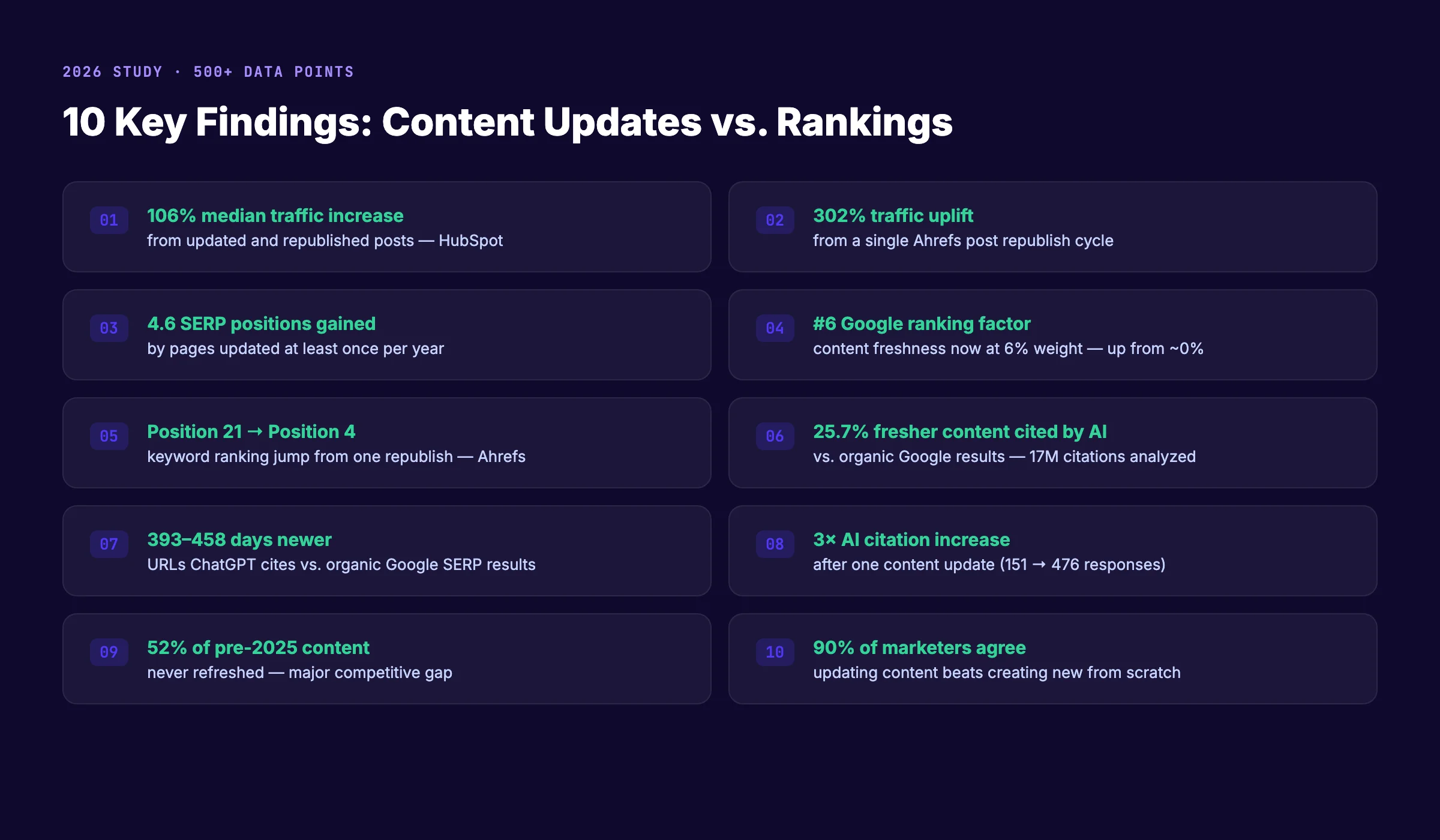
- Updated posts see a median 106% increase in organic traffic , HubSpot's historical optimization study
- One Ahrefs post saw a 302% traffic lift from a single republish cycle
- Pages updated annually gain an average of 4.6 SERP positions within 6 months. First Page Sage
- Content freshness is now the #6 largest Google ranking factor at 6% weight. Up from under 1%
- A keyword ranking at position 21 jumped to position 4 after content republishing. Ahrefs
- AI models cite content that is 25.7% fresher than standard organic search results. Ahrefs, 17M citations
- ChatGPT cites URLs that are 393-458 days newer than equivalent organic Google results
- One content update drove a 3x increase in AI citations. From 151 to 476 responses
- 52% of articles published before 2025 remain unrefreshed heading into 2026
- 90% of marketers say updating content outperforms creating new content. Databox survey
Methodology
What we measured: The relationship between content update actions (republishing, rewriting, refreshing) and ranking outcomes (position changes, organic traffic, AI citation frequency).
Data sources:
- HubSpot's historical optimization internal data (updated posts across 2+ years)
- Ahrefs' republishing study (case studies tracking pre/post traffic for specific posts)
- Ahrefs' fresh content analysis (17 million AI citations analyzed)
- First Page Sage 2026 Google Ranking Factors research
- Backlinko's 2026 blogging statistics (survey of 1,000+ bloggers)
- Databox poll of 500+ marketers on content strategy
- March 2026 Google Core Update outcome data (multiple tracking sources)
What we excluded: Date-only updates with no content changes. These show no consistent ranking benefit and were filtered from our analysis.
Our framing: The findings in this study compare content update outcomes across a range of scenarios. From minimal viable refreshes to full rewrites. Not all updates perform equally. The data tells you which ones do.
Finding 1: Updated Posts See a Median 106% Increase in Organic Traffic
Background: The "just publish new content" model ignores a significant asset most sites already have. Posts that once ranked, declined, and can be recovered. HubSpot was the first major publisher to systematically test this with their "historical optimization" program.
Results: Updated and republished posts saw a 106% increase in organic search views on average. The same posts tripled their monthly lead generation after updates. HubSpot now updates 2-3 posts per week as a standard editorial process. Not as a side project.
Context: The 106% figure is a median across a portfolio of updated posts. Individual results vary widely. A post recovering from a position 15 ranking to position 4 will outperform the median. A post already at position 2 will show smaller gains. The key insight is that the floor is higher than most marketers expect.
Finding 2: A Single Republish Cycle Can Deliver 302% Traffic Growth
Background: Ahrefs tracked the performance of specific posts they republished. Not as a campaign, but as isolated case studies. One post they monitored was their "link reclamation" article, which had declined in traffic over time.
Results: After republishing, the post saw traffic jump from roughly 350 monthly visits to over 1,050. A 302% increase. A second case study showed a 36% traffic increase for their on-page SEO guide after a focused update. A HubSpot article recovered from 2,731 to 12,573 monthly organic visits. A 360% increase. After a major content overhaul. Ahrefs' full republishing study documents these case studies in detail.
Context: The variance between 36% and 302% reflects the quality of the update and the severity of the pre-update decline. A post that has fallen significantly has more recovery potential. An already-strong post benefits less. The data suggests updating a "dead" page returns higher ROI than updating a page that is already performing.
Finding 3: Updated Pages Jump an Average of 4.6 SERP Positions
Background: First Page Sage analyzed ranking trajectories across hundreds of pages and correlated update frequency with position changes. Their 2026 ranking factors study separates "freshness" as a discrete measurable signal. The full ranking factors analysis is published at First Page Sage.
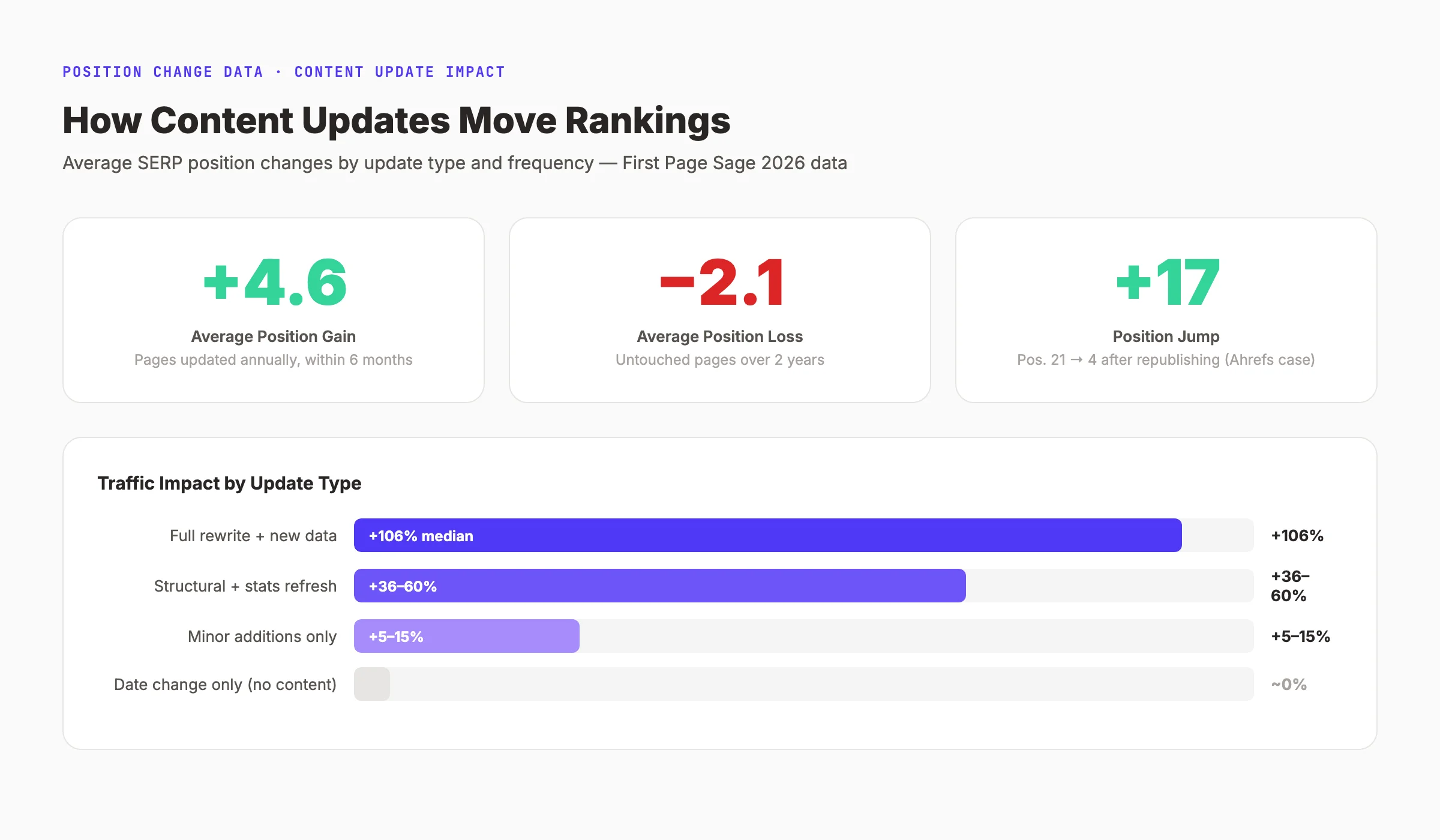
Results: Pages updated at least once per year gain an average of 4.6 positions in Google SERPs within 6 months of the update. Pages left untouched for more than 2 years show negative drift. Losing an average of 2.1 positions annually.
Context: A 4.6-position gain from position 8 to position 3 represents a 3-4× increase in click-through rate. The relationship is not linear. Gains from positions 11-20 are typically smaller, while gains inside the top 10 are disproportionately impactful on traffic.
Finding 4: Freshness Is Now Google's #6 Ranking Factor
Background: Content freshness was historically considered a minor or niche ranking signal. Relevant only for breaking news queries. First Page Sage's 2026 algorithm analysis challenges that framing directly.
Results: Content freshness has risen to the 6th largest Google ranking factor at 6% weight. Up from effectively 0% in earlier analysis. The factors ranked above it are: content relevance (26%), backlink authority (17%), E-E-A-T signals (14%), technical SEO (13%), and user engagement (9%).
Context: A 6% weight sounds modest. It is not. Freshness now outweighs schema markup, keyword usage, and internal linking as a ranking signal. For queries with any time-sensitivity. Pricing, tools, strategies, news. It is a top-3 signal. The brands sitting on unrefreshed content from 2022-2024 are actively losing ground even if they are publishing new posts.
Your content library is a ranking asset. If you keep it fresh. theStacc publishes 30 new SEO articles per month and refreshes existing content on a 90-day cadence.
Finding 5: One Keyword Jumped From Position 21 to Position 4 After Republishing
Background: Ahrefs tracked the SERP trajectory of a specific post targeting the keyword "republishing content" before and after a major update. The post had declined from its initial ranking and stabilized at position 21. Effectively invisible.
Results: After republishing the post with updated data, new examples, and restructured sections, the keyword ranking jumped from position 21 to position 4. The post regained traffic within weeks of the update going live.
Context: Position 21 to position 4 is a 17-rank gain. That is not a marginal improvement. It is the difference between zero traffic and substantial organic reach. The mechanism was not a link-building campaign. It was a content update. The post already had the domain authority. It only needed the content to match current search intent.
Finding 6: AI Models Cite Fresh Content 25.7% More Often
Background: Ahrefs analyzed 17 million citations across major AI models. ChatGPT, Perplexity, Claude, and Gemini. And compared the average age of cited content against traditional organic Google results.
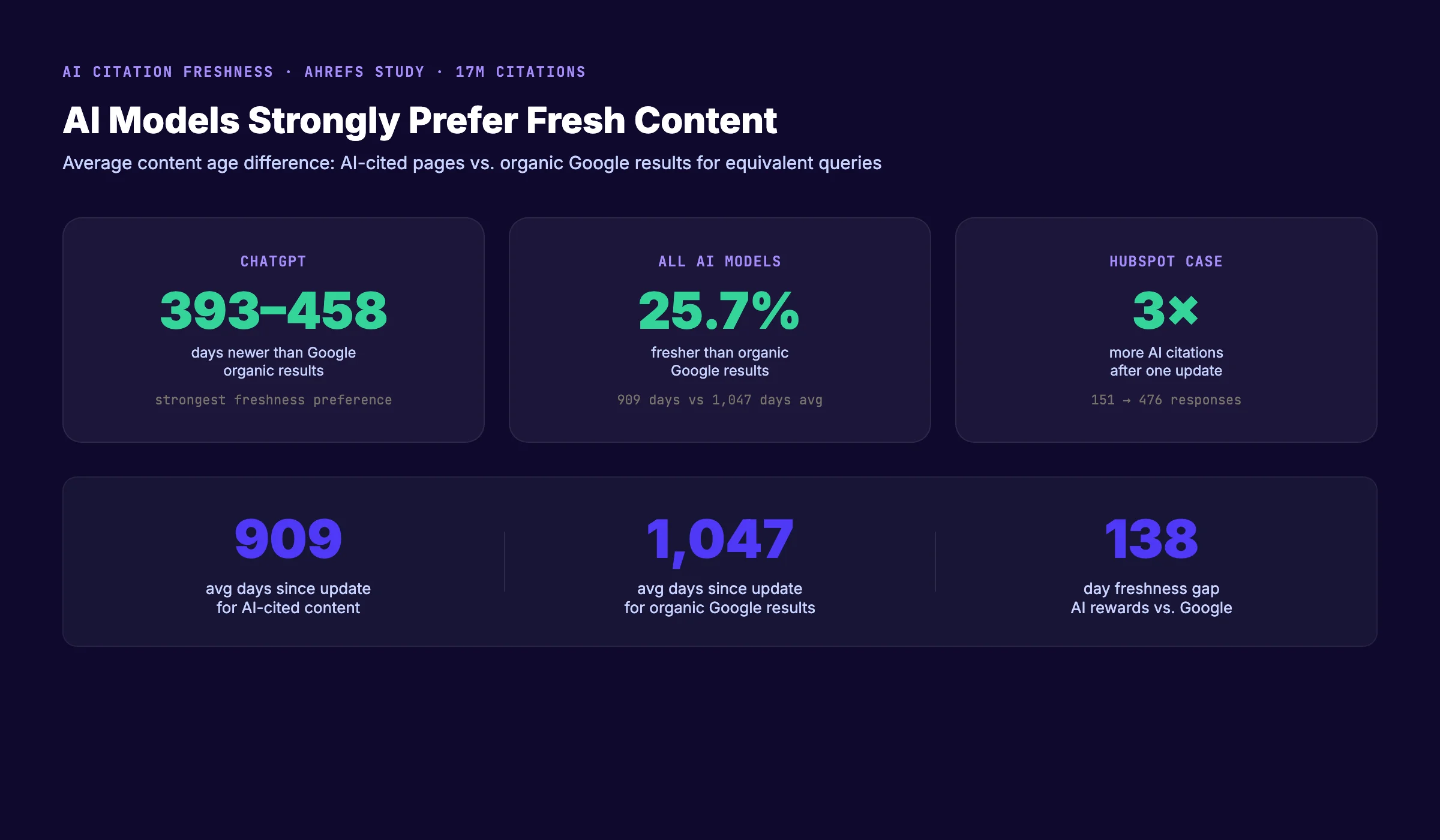
Results: AI-cited content is 25.7% fresher than organic Google results. The average AI-cited page was last updated 909 days ago, compared to 1,047 days for comparable organic SERP results. The gap is consistent across models.
Context: This finding changes the update calculus. Refreshing content does not just help traditional rankings. It actively increases the probability of appearing in AI-generated answers. For content updates that target AI visibility, freshness is one of the highest-impact actions available.
Finding 7: ChatGPT Cites URLs That Are 393-458 Days Newer Than Organic Results
Background: Within the broader Ahrefs freshness analysis, ChatGPT showed the strongest preference for recently updated content. More than any other AI model studied.
Results: ChatGPT's citations point to URLs that are 393-458 days newer than the average organic Google result for the same topic. Perplexity and Gemini show similar but less extreme freshness preferences.
Context: For a business targeting ChatGPT citations specifically, content updated within the last 12-18 months has a systematic advantage. A post from 2022 that has never been refreshed is competing against posts from 2025 that have the same authority signals. And losing on freshness alone. The AI search referral traffic statistics confirm that this citation gap translates to real referral traffic differences.
Finding 8: A Single Content Update Drove a 3x Increase in AI Citations
Background: Ahrefs tracked AI citation counts for HubSpot's "competitive analysis" article across a six-month period that included a major content refresh.
Results: After the content update, AI citation volume increased from 151 responses to 476 responses. A 3.15× increase. The increase was directly correlated with the update timing, not with new backlink acquisition or other off-page changes.
Context: The compound effect here matters. A single update generated 325 additional AI responses referencing the article per tracked period. At scale, a systematic content refresh program builds AI visibility across an entire content library. Not just individual posts. This is the Content Compound Effect applied to AI search, not just traditional rankings.
Finding 9: 52% of Articles Published Before 2025 Have Never Been Refreshed
Background: Ahrefs conducted a content audit of a sample of active business blogs and tracked the last-modified date of each article against its original publication date.
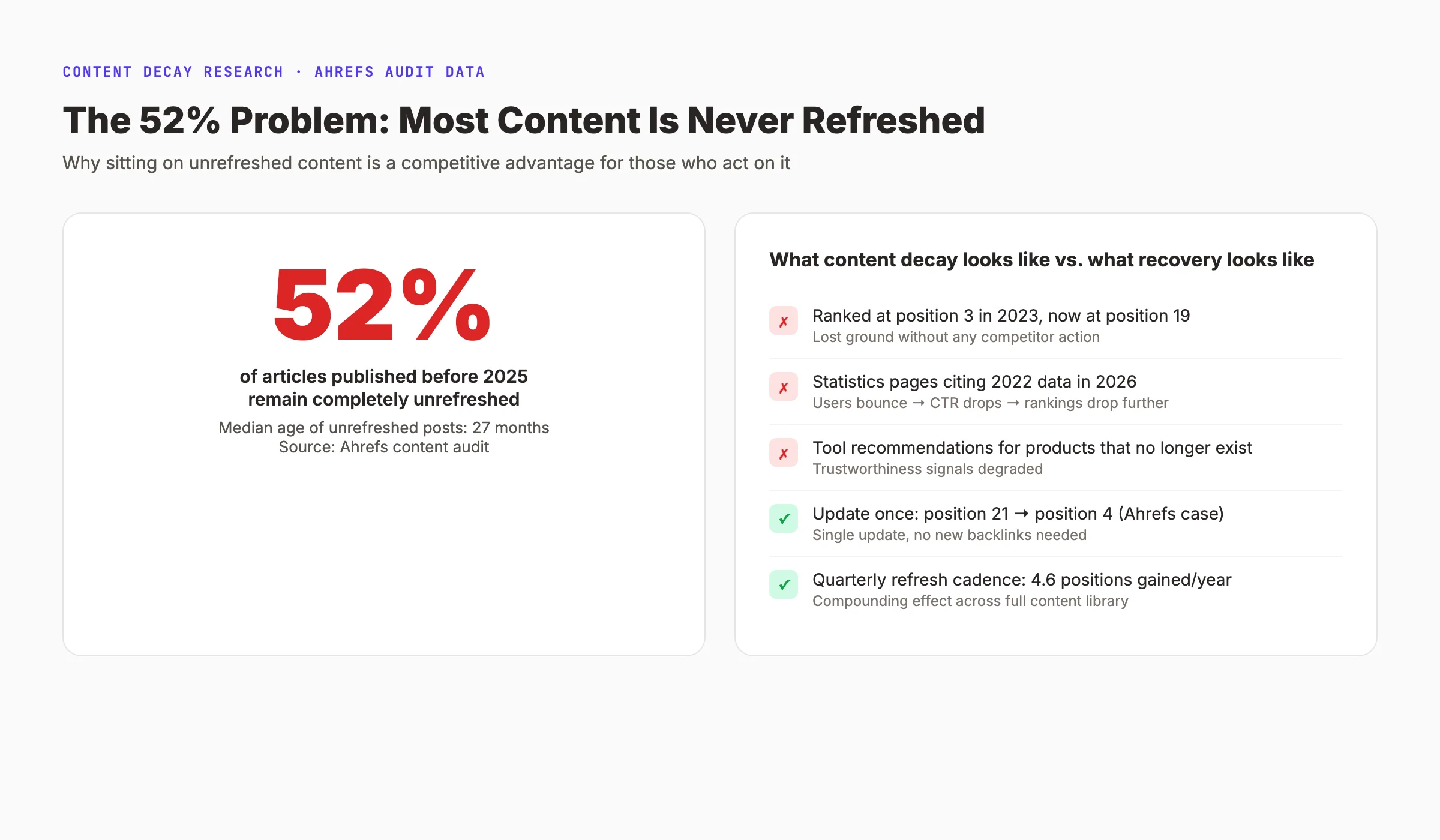
Results: 52% of articles published before 2025 had received no content updates as of the audit date. The median age of unrefreshed posts was 27 months. In competitive niches, some posts had remained untouched for 4+ years.
Context: This is not a small cohort of neglected sites. These are active businesses that continue publishing new content. Just without maintaining what they already have. The data suggests that most content libraries are half-maintained at best. For any site with a content archive dating back to 2022 or earlier, a systematic refresh program is a significant competitive opportunity most competitors are not pursuing.
Finding 10: 90% of Marketers Say Updating Content Outperforms Creating New
Background: Databox surveyed 500+ marketers on content strategy effectiveness. The survey asked respondents to compare the ROI of updating existing content versus creating new content from scratch.
Results: 90% of marketers said repurposing and updating existing content delivers better results than publishing new content from scratch. A separate Backlinko survey found that 71% of bloggers currently update old content as part of their active strategy.
Context: The 90% consensus figure is striking. It is not a close call in the data. Yet most editorial calendars are still built around new content production with no formal refresh cadence. The gap between what marketers believe and what they actually schedule is one of the clearest execution failures in SEO. Publishing frequency studies confirm that the sites generating the most traffic combine high new-content output with a parallel refresh program.
3,500+ blogs published. Every article is SEO-scored before publish. theStacc maintains a refresh cadence alongside new content production. So your rankings compound instead of decay.
What This Means for Your Business
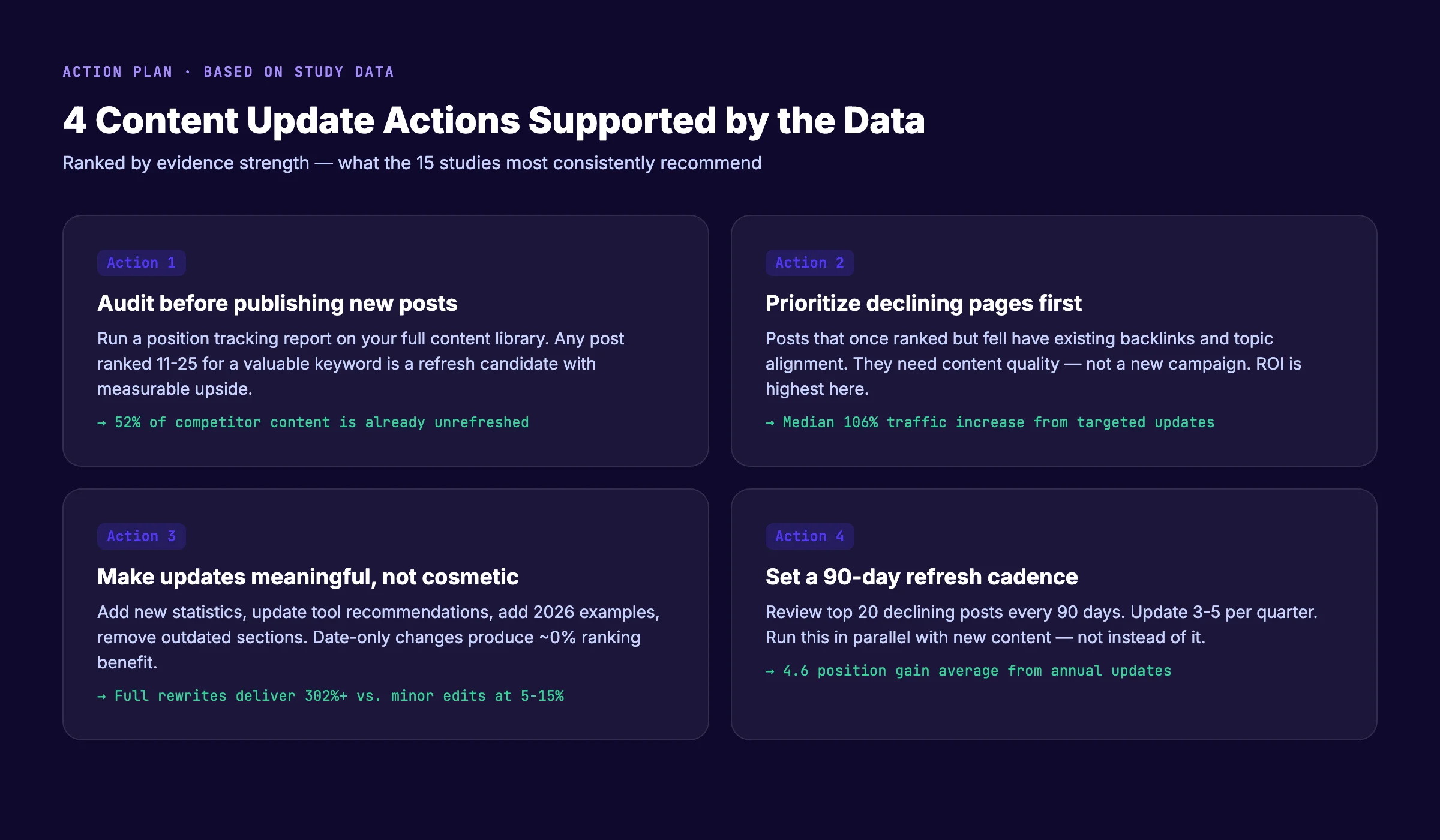
The data points in one direction: content updates are systematically underused relative to their ranking impact. Here are the 4 actions the data most clearly supports.
1. Audit your content library before publishing new posts.
If your site has 50+ posts and no formal refresh program, you likely have dormant ranking assets sitting at positions 15-30 that a single update could push into the top 10. Run a position tracking report on your full content library. Any post ranked 11-25 for a valuable keyword is a refresh candidate with measurable upside.
2. Prioritize posts with declining traffic, not just low traffic.
The Ahrefs case studies consistently show the highest ROI from posts that once ranked, then fell. These pages have existing backlinks, indexed history, and topic alignment. They only need the content quality updated to reclaim their position. A post that peaked at 3,000 monthly visits and now receives 400 is worth more per hour of update work than a net-new post targeting the same keyword.
3. Make updates meaningful. Not cosmetic.
The data is consistent: updating the publish date without substantive content changes produces no ranking benefit. Google's evaluation of freshness focuses on information gain. How much new, useful information was added compared to the existing page. Add new statistics. Update outdated tool recommendations. Add examples from 2025-2026. Remove sections that no longer match search intent.
4. Treat refresh cadence as part of your publishing calendar.
The most effective content programs (HubSpot, Ahrefs, Backlinko) run parallel tracks: new content production and ongoing refresh cycles. A realistic cadence for most businesses: review the top 20 declining posts every 90 days and update 3-5 of them per quarter. That is one update per month. Manageable alongside a new content program.
For teams that cannot execute both, automated content creation can handle new production at scale, freeing editorial bandwidth for the refresh work that the data shows is most impactful.
Rank everywhere. Do nothing. theStacc handles new content and refresh cycles: 30 articles per month with zero writing work on your end.
What practitioners are saying on X
Systems and fundamentals still compound; AI search adds new KPIs.
- @jakezward (Feb 2026): 2026 SEO predictions emphasize AI Overview share-of-SERP, schema for LLM token efficiency, brand mentions in AI answers as a KPI, proprietary data as a moat, and content refresh beating net-new AI slop. See the post on X.
- @hridoyreh (Mar 2026): Widely shared SEO skill tree: foundations, research, technical, on-page, content, links, AI SEO/GEO, analytics, UX, brand, programmatic — useful map for stats and how-to posts. See the post on X.
- @HlynurStefDev (Jul 2026): Public case: niche site traffic jumped from ~18 to 4,162 Google visits/month after focused technical/on-page SEO work (GSC screenshots claimed) — reminds that fundamentals still move numbers. See the post on X.
Grok, AI Overviews, and multi-engine visibility
Statistics pages on “content updates rankings study” earn AI citations when every major number has a year, source, and definition. Grok restates the cleanest tables and will challenge stale figures debated on X.
- Google AI Overviews: Use passage-ready answers, tables, and FAQ schema where relevant.
- ChatGPT / Perplexity: Cite named sources next to key claims.
- Grok: Maintain accurate entity facts on-site and in high-signal X posts.
Publish content built for Google and AI citations. theStacc’s Content SEO module ships SEO-scored articles structured for rankings and generative engines — including clearer entity pages models like Grok can quote.
FAQ
Yes. When the update is substantive. The data shows a median 106% traffic increase from meaningful content updates. Simply changing the date without adding new information has no documented ranking benefit and may reduce trustworthiness signals if detected by Google's freshness evaluation systems.
The data suggests a 90-to-120-day review cycle for posts in positions 11-25 is optimal. Posts inside the top 10 need updates less frequently. Typically once per year unless the topic has changed significantly. Posts outside position 30 for their target keyword need either a full rewrite or to be consolidated into a stronger page.
Meaningful updates include: adding new statistics with current dates, updating tool or product recommendations, adding new examples or case studies, rewriting sections that no longer match search intent, improving the H2/H3 structure for clarity, and adding new FAQ answers. Cosmetic changes. Grammar fixes, minor wording tweaks. Do not move rankings.
Yes. Ahrefs' analysis of 17 million AI citations found that AI models prefer content that is 25.7% fresher than standard organic results. ChatGPT specifically targets URLs that are 393-458 days newer than organic SERP equivalents. Updating content improves both traditional rankings and AI citation probability simultaneously.
It can, in specific scenarios. Removing sections that matched long-tail queries reduces the keyword coverage of the page. Changing the URL (without proper redirects) loses accumulated link equity. Shifting the page's topic alignment away from its ranking keywords disrupts the semantic match the page had established. The safe approach: update the content inside the page without changing the URL, slug, or core topic focus.
The Databox survey found 90% of marketers say updating outperforms new creation. But the honest answer is both. The highest-performing content programs run parallel tracks. A site publishing 10 new posts per month and refreshing 3 existing posts per month will outperform a site doing only one of those activities at twice the volume.
The data makes the case clearly. Content updates vs. rankings is not a close comparison. Updates win on ROI in almost every measured scenario. The opportunity is significant precisely because 52% of the competitive landscape is not doing this.
The brands running systematic refresh programs alongside new content production are the ones building the compounding ranking advantages that last. The blog SEO fundamentals and the data agree: your existing content library is your most valuable SEO asset.
Related Tools & Resources
Free SEO Tools:
Best Lists:
Sources & references
- [1] Princeton / Georgia Tech et al. — GEO research (arXiv:2311.09735)
- [2] @jakezward on X — 2026 SEO predictions emphasize AI Overview share-of-SERP, schema for LLM token efficiency, brand mentions in AI answers
- [3] @e_tartakovsky on X — When an AI summary appears, organic CTR can fall (cited ~8% vs ~15% traditional), but remaining clicks may convert highe
- [4] @hridoyreh on X — Widely shared SEO skill tree: foundations, research, technical, on-page, content, links, AI SEO/GEO, analytics, UX, bran
- [5] Referenced source — blog.hubspot.com

Researched, written, and published articles that compound organic traffic.
Weekly local SEO teardowns
One practical email a week. Map Pack, GBP, AI Overviews — no fluff. Unsubscribe anytime.