The 2026 guide to the digital marketing agency business model. Compare pricing structures, revenue streams, profit benchmarks, and scaling mistakes.
Most agency owners pick a digital marketing agency business model by accident. They land one client, then copy that pricing setup into the next proposal. Two years later they have five different contracts, mismatched margins, and no way to forecast revenue.
That approach costs you money. It also costs you sleep. Agencies with a clear, intentional business model post 25 to 40 percent net margins. Agencies without one post 6 to 12 percent, and 21.5 percent of them are actively losing money as of the 2026 Planable benchmark report.
This guide fixes that. We publish 3,500+ blogs every month across 70+ industries, and we have watched the inside of hundreds of agency finances. Here is what you will learn:
- The 8 digital marketing agency business models, with real price ranges
- How to match a pricing structure to your service line and client size
- The 6 revenue streams most agencies ignore
- Profit margin benchmarks by agency type and maturity
- The pricing mistakes that quietly kill agency margins
- A decision framework for picking the right model this quarter
Table of Contents
- Chapter 1: What is a digital marketing agency business model?
- Chapter 2: The 8 types of agency business models
- Chapter 3: How agencies price their services
- Chapter 4: Revenue streams beyond core services
- Chapter 5: How to choose the right model
- Chapter 6: Common business model mistakes
- Chapter 7: Profit margin benchmarks and metrics
- FAQ
Chapter 1: What is a digital marketing agency business model?
A digital marketing agency business model is the complete system you use to deliver services, price them, and turn them into predictable profit. It covers four pieces.
Service mix. Which services you sell: SEO, paid media, content, social, email, web design, or a combination.
Pricing structure. How you charge for those services: retainer, project, performance, hourly, or hybrid.
Delivery model. Who does the work: in-house team, freelancers, white-label partners, or automated platforms.
Client profile. Who you serve: local service businesses, mid-market B2B, ecommerce brands, or enterprise.
Those four pieces interact. A retainer fee model works with local service clients and a small in-house team. Performance pricing works with ecommerce brands and paid-media specialists. The wrong combination produces thin margins and constant scope fights.
The global digital marketing industry will reach 786 billion dollars in 2026, per Statista. That money does not spread evenly. Niche specialists charge 40 to 60 percent more than generalists, according to 2026 agency compensation data. The business model you pick decides which side of that line you end up on.
Why business models matter more in 2026
Three forces changed the math this year.
AI Overviews. Google shows AI Overviews in 60 percent of searches. Clients see fewer clicks from old content strategies. They want agencies that can produce at volume and adapt to answer-engine optimization.
Client budget compression. Mid-market marketing budgets dropped 9 percent year over year. Agencies that compete on hourly rates feel the pressure first. Retainers and productized services hold up better.
Specialization premium. Generalist agencies average 15 to 20 percent net margin. Specialists hit 25 to 40 percent. A focused business model is the single biggest lever on profit today.
The two hidden parts most owners miss
Service mix, pricing, delivery, and client profile are the visible layers. Two hidden layers decide whether the business model actually works.
Cash conversion cycle. Agencies bill monthly but pay people weekly. If clients take 45 days to pay, you finance their marketing with your own cash. Shift to annual prepay or 14-day terms and watch margins recover without changing a line of work.
Client acquisition cost to lifetime value ratio. A retainer model with a 9-month average lifespan is worth 3 times a project client. But if you spend 12 months of retainer fees to acquire one client, the model breaks. Measure CAC and LTV every quarter.
Chapter 2: The 8 types of agency business models
There are eight primary models. Most agencies use a hybrid of two or three. We will walk each one.
1. Retainer model
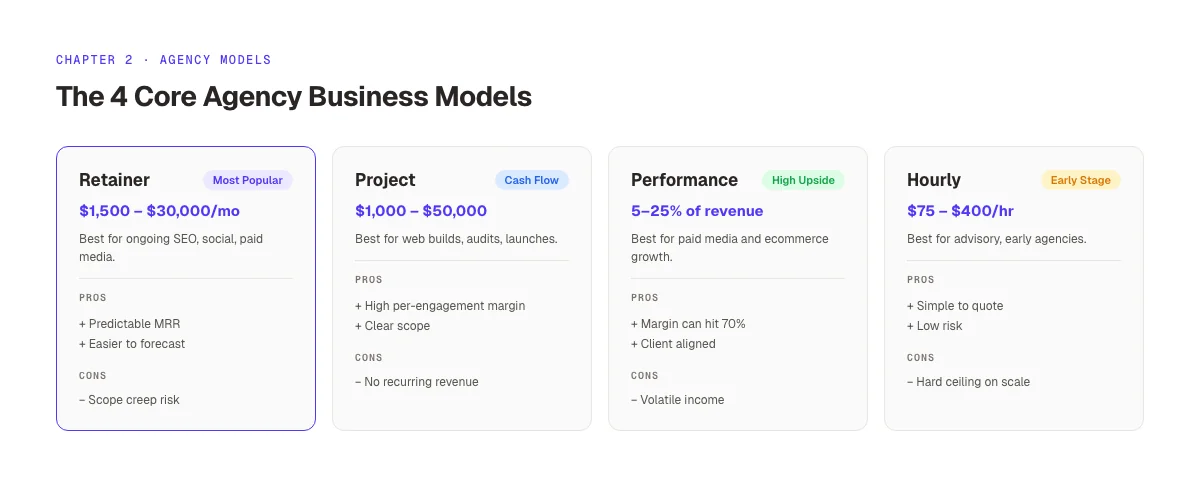
The retainer is a recurring monthly fee for a defined scope of ongoing work. The client pays the same amount every month. You deliver the same bucket of services every month.
Typical range: 1,500 to 30,000 dollars per month. Best for: SEO, content, social media, ongoing paid media management. Profit profile: 25 to 40 percent margin when scope is tight. 5 to 15 percent when scope creeps.
A 2026 Influencer Marketing Hub survey found 78 percent of agencies now use retainers as the primary model, up from 64 percent in 2023. The reason is simple. Retainers produce monthly recurring revenue, which makes hiring, forecasting, and valuation easier.
The catch is scope creep. Agencies on retainers over-deliver by 50 to 100 percent on average. That over-delivery hides inside margin and quietly bleeds the business.
2. Project-based model
One-time work priced as a single deliverable. Website build, brand strategy sprint, SEO audit, launch campaign.
Typical range: 1,000 to 50,000 dollars per project. Best for: Web design, audits, launches, one-off campaigns. Profit profile: 30 to 50 percent margin when scoped correctly.
Projects are great for cash flow and first client relationships. They are terrible for predictable revenue. A pure project model forces you to constantly refill the pipeline.
3. Hourly rate model
Billing clients for time spent. Common with consultants, boutique shops, and new agencies.
Typical range: 75 to 400 dollars per hour. Best for: Strategy sessions, flexible advisory work, legal and regulated industries. Profit profile: Capped. You cannot scale beyond billable hours.
Hourly pricing is the fastest way to stay small. The faster you work, the less you earn. Using AI tools punishes you. Most mature agencies move away from hourly within three years.
4. Performance-based model
Payment tied to client outcomes. Revenue share, cost per lead, cost per acquisition, or ranking-based bonuses.
Typical range: 5 to 25 percent of new revenue, or 100 to 500 dollars per lead. Best for: Paid media, affiliate, ecommerce growth. Profit profile: 40 to 70 percent margin in good months. Negative in bad months.
Performance pricing only works when you control the variable. If the client has a broken sales process, your results suffer. Most pure performance shops burn out in 18 months.
5. Commission-based model
A percentage of the media spend or ad budget you manage.
Typical range: 10 to 20 percent of ad spend. Best for: Paid media agencies managing large budgets. Profit profile: Predictable but squeezed. Ad platforms have pushed this down over time.
This model used to be the paid-media standard. It still works for agencies managing 100K plus in monthly spend per client, but less well for smaller budgets.
6. Productized service model
Clearly defined packages with fixed pricing and fixed scope. No custom quotes. No scope negotiation.
Typical range: 99 to 2,999 dollars per month per package. Best for: SEO, content, social, local SEO, link building. Profit profile: 40 to 60 percent margin with high automation.
Productized is the fastest-growing model in 2026. It works because every service becomes a SKU. You optimize delivery once and sell it 100 times. theStacc uses this model, pricing blog SEO at 99 dollars per month for 30 articles. Our pricing page shows the full structure.
7. Value-based model
Pricing tied to the business impact of the work rather than the hours or deliverables. Common in strategy and B2B.
Typical range: 5,000 to 100,000+ dollars per engagement. Best for: Senior strategy, B2B demand generation, established agencies. Profit profile: 50 to 70 percent margin. Very hard to close new clients.
Value pricing requires proven case studies. Agencies under three years old rarely make it work.
8. Hybrid model
A deliberate mix of two or three models. Retainer plus performance bonus. Productized core plus value-based strategy. Project plus retainer upsell.
Typical range: Varies. Best for: Mature agencies with clear service tiers. Profit profile: 25 to 50 percent margin depending on the mix.
Hybrid is what most 1M plus agencies actually run. They just do not call it that.
Here is the quick comparison:
| Model | Revenue Predictability | Margin Potential | Scale Ceiling |
|---|---|---|---|
| Retainer | High | 25-40% | High |
| Project | Low | 30-50% | Medium |
| Hourly | Low | 15-25% | Very Low |
| Performance | Volatile | 40-70% | Medium |
| Commission | Medium | 15-25% | High |
| Productized | Very High | 40-60% | Very High |
| Value-based | Medium | 50-70% | Low |
| Hybrid | High | 25-50% | High |
Tired of running the content side of your agency? We handle it for you. theStacc publishes 30 SEO articles per month, per client, starting at 99 dollars. White-label available.
Chapter 3: How digital marketing agencies price their services
Picking a model is half the work. Setting actual prices is the other half. Here is how pricing works across the main service lines in 2026.
SEO pricing
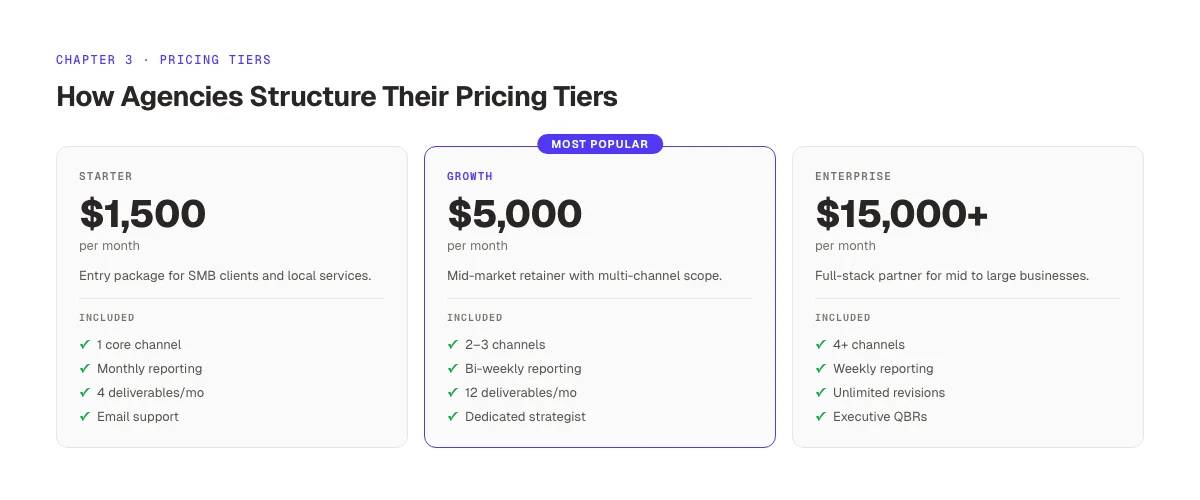
SEO retainers average 1,500 to 5,000 dollars per month for small business work. Mid-market SEO runs 5,000 to 15,000 dollars per month. Enterprise SEO starts at 15,000 and goes to 50,000 plus. Our SEO cost breakdown covers the full picture.
Productized SEO is eating the low end of this market. Packages like 30 articles for 99 dollars a month or managed GBP posts for 49 dollars a month have pulled thousands of small businesses out of traditional agency retainers.
Paid media pricing
Three common structures.
- Management fee: 500 to 5,000 dollars per month flat, independent of spend.
- Percentage of spend: 10 to 20 percent of monthly ad budget.
- Hybrid: Flat fee plus percentage, often 1,000 dollars plus 10 percent.
Below 5,000 dollars in monthly ad spend, flat fees win. Above 25,000, percentage works better.
Content marketing pricing
Content ranges from 500 dollars per month for basic blog work to 25,000 for full content programs. Per-article pricing sits between 150 and 1,500 dollars, depending on research depth and length.
Freelance writers charge 80 to 250 dollars per article. Agencies mark that up 2 to 4 times. Done-for-you platforms deliver the same volume for a fraction of the cost. The done-for-you versus agency comparison has the full math.
Social media pricing
Social retainers run 1,000 to 10,000 dollars per month. Pricing depends on platforms managed, post volume, and whether paid social is included. Three platforms plus 30 posts per month typically runs 2,500 to 4,000 dollars at an agency, or 49 dollars at a productized service.
Web design pricing
Project-based, almost always. Small business sites run 2,500 to 10,000. Mid-market sites run 15,000 to 50,000. Enterprise custom work starts at 75,000.
The pricing anchor rule
Whatever model you pick, anchor your price to a clear result, not hours. "We publish 30 articles per month that average 92 SEO score" is stronger than "We work 20 hours per month on your SEO."
Results anchor to value. Hours anchor to cost. Value wins every pricing negotiation.
The 3 x 3 pricing test
Every price point should pass three tests at three levels.
Tier test. Can you offer a good, better, best version of the service? If the best tier is not 3 to 5 times the price of the starter tier, you have not priced the anchor high enough.
Margin test. Can you deliver at 50 percent gross margin after real delivery costs, not aspirational ones? Include platform fees, subcontractor costs, and revision time.
Close test. Can at least 25 percent of qualified leads accept the price without a discount request? If every deal comes with a counteroffer, the price is right. If every deal closes at full price, the price is too low.
A price that fails any of these three tests is a price that is leaking margin somewhere.
Chapter 4: Revenue streams beyond core services
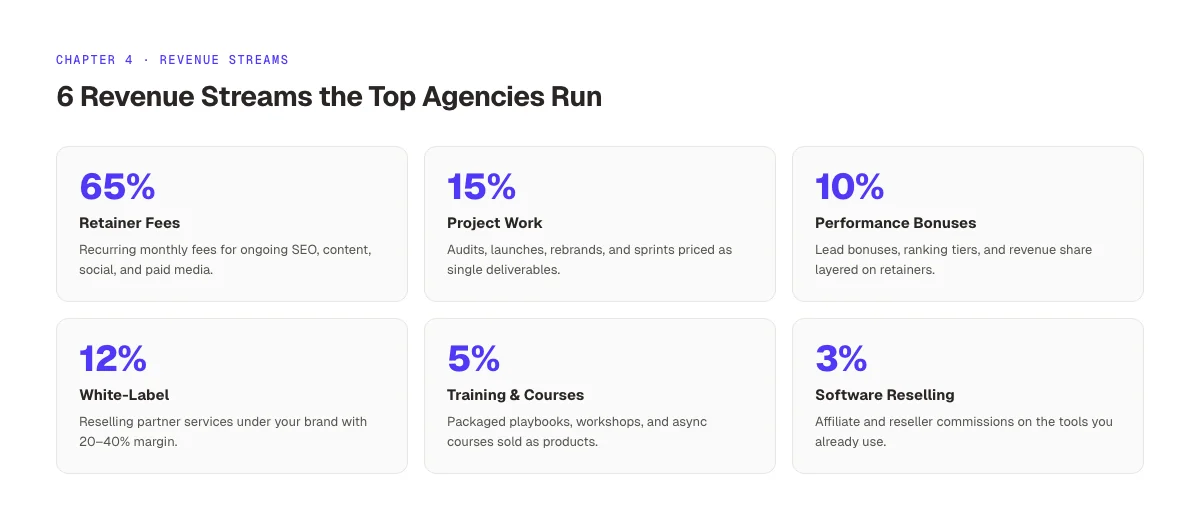
The most profitable agencies run 4 to 6 revenue streams, not one. The 2026 Vendasta agency benchmark shows the top quartile of agencies have at least three income sources.
1. Retainer service fees
Your primary line. This is the stable base. Target 60 to 70 percent of total revenue here.
2. Project and sprint fees
One-time work. Audits, launches, rebrands. Target 10 to 20 percent of revenue. Use projects as entry points to retainer relationships.
3. Performance bonuses
Pay-for-results clauses layered on top of retainers. Lead bonuses, ranking bonuses, revenue share. Target 5 to 10 percent of revenue. Pure upside without much cost.
4. White-label reselling
You sell another agency's work as yours. Popular for SEO content, link building, and technical SEO. Our white-label content overview explains how this works.
Margins are 20 to 40 percent. Lower than direct work, but zero delivery cost. Target 10 to 20 percent of revenue.
5. Training, courses, and productized IP
Package your process into a course, workshop, or playbook. One agency we track sells a local SEO playbook for 499 dollars. They sell 40 copies per month. That is 20K per month of near-pure margin on work they already did.
6. Software reselling and affiliate income
Every tool you use for clients has an affiliate program. Google Workspace, Semrush, Ahrefs, Webflow, hosting companies, and SEO platforms all pay 20 to 40 percent recurring commissions.
Agencies that set this up systematically add 5K to 50K per month without any new delivery work.
7. Subscription SaaS products
The most ambitious play. Build software from your internal process and sell it. This is how HubSpot started. Low success rate, huge upside when it works.
Revenue mix targets
A healthy diversified agency looks like this:
- Retainer fees: 60 to 70 percent
- Projects: 10 to 20 percent
- White-label: 5 to 15 percent
- Performance bonuses: 5 to 10 percent
- Training and IP: 3 to 8 percent
- Affiliate and SaaS: 2 to 5 percent
Single-stream agencies are fragile. A diversified agency survives losing a client. A single-stream agency does not.
Add a recurring revenue stream without hiring. Resell theStacc as a white-label service under your agency brand. 30 articles, 15 GBP posts, 30 social posts per client, per month. See pricing →
Chapter 5: How to choose the right model for your agency
The right model is a function of three inputs. Your service mix, your client size, and your stage of maturity. Walk this decision tree.
Step 1: Define your core service
Pick one service that drives 60 percent or more of revenue. Generalist agencies compress margins. Specialists expand them.
If your core is SEO or content, lean retainer or productized. If your core is paid media, lean hybrid retainer plus percentage. If your core is web design, lean project plus optional maintenance retainer. If your core is strategy, lean value-based.
Step 2: Define your client ICP
Ideal client profile changes the math.
| Client Type | Best Model |
|---|---|
| Local service business (1-20 employees) | Productized |
| SMB (20-200 employees) | Retainer |
| Mid-market B2B (200-1,000 employees) | Retainer + performance |
| Enterprise (1,000+ employees) | Value-based |
| Ecommerce brand | Performance or hybrid |
Step 3: Match your maturity
Agency age matters more than founders admit.
- Year 0 to 2: Project-based and hourly, building case studies.
- Year 2 to 4: Transition to retainer, add productized tiers.
- Year 4 to 8: Move the top tier to value-based, keep retainer base.
- Year 8+: Hybrid with strong recurring revenue and diversified streams.
Trying to jump two stages at once is where agencies die.
Step 4: Set your delivery model
Your pricing model constrains your delivery model. Retainer work needs consistent team capacity. Productized needs automation and SOPs. Value-based needs senior talent. Performance needs specialists in a single channel.
Our done-for-you content overview breaks down automated delivery options.
Step 5: Test one transition per quarter
Do not change everything at once. Pick one client, one service, and one new model. Run it for 90 days. Measure margin and scope creep. Then expand or kill.
A quick decision checklist
- ✓ Have you picked one core service?
- ✓ Do you know the average deal size of your ICP?
- ✓ Is your model matched to your agency age?
- ✓ Can you deliver this model without burning out your team?
- ✓ Does your margin forecast hit 25 percent or higher?
If any answer is no, your model is wrong. Fix it before you scale.
Chapter 6: Common business model mistakes
Here are the pricing and model mistakes we see kill agency margins most often. Each one is fixable.
Mistake 1: Undercharging to win deals
The most common killer. New agencies discount 30 to 50 percent off target pricing to win the first clients. Then they never raise prices. Five years later they have a roster of clients they cannot afford to serve.
Fix: Raise prices on renewal. Run annual reviews. Replace the bottom 20 percent of clients every year.
Mistake 2: Relying on hourly pricing past year 2
Hourly caps your business. You cannot scale past your billable hours without hiring. AI tools punish hourly work because faster work means less revenue.
Fix: Move to retainer or productized within 18 months.
Mistake 3: Over-delivering on retainers
Agencies on retainers consistently deliver 150 to 200 percent of contracted scope. That over-delivery does not buy loyalty. It just trains clients to expect more.
Fix: Set clear deliverable caps. Use a scope tracker. Bill overages or say no.
Mistake 4: Charging different rates by employee type
Quoting junior rates for juniors and senior rates for seniors invites the client into your resource planning. They start arguing about who does their work.
Fix: Use a single blended rate or switch to outcome pricing entirely.
Mistake 5: Lacking pricing transparency
Hiding prices behind custom quotes feels premium. It actually reduces qualified inbound. Buyers self-select out when they cannot see pricing.
Fix: Publish starting prices. Our pricing page is a simple model you can copy.
Mistake 6: Not adjusting strategy as the agency matures
Most agencies lock in the pricing they set in year one and never change it. Your pricing should change as your agency gains case studies, talent, and operational efficiency.
Fix: Run a pricing audit every 12 months. Raise rates on renewals by 10 to 15 percent minimum.
Mistake 7: Refusing to niche down
Generalists compete on price. Specialists compete on expertise. Niche agencies post net margins 10 to 20 points higher than generalists.
Fix: Pick a vertical. Industry, service, or client size. Niche beats generalist every time in 2026.
Mistake 8: Ignoring AI and automation in the cost base
Competitors are using AI to cut delivery costs by 40 to 70 percent on content, reporting, and research. Agencies that refuse to adopt those tools lose the margin war. Our breakdown of AI versus agency delivery shows the numbers.
Fix: Run a delivery audit. Find the three biggest manual tasks. Automate or outsource them this quarter.
Chapter 7: Profit margin benchmarks and metrics
If you do not track these numbers monthly, your model is running blind.
Net profit margin
The single most important number.
- Generalist agencies: 15 to 20 percent
- Specialist agencies: 25 to 40 percent
- Losing money: 21.5 percent of all agencies (up from 13 percent the prior year)
Target 20 percent minimum. If you are below 10, your model is broken.
Gross margin
Revenue minus cost of delivery. Target 50 percent or higher. Below 45 percent means you are underpricing, overdelivering, or both.
Utilization rate
Billable hours as a percentage of available hours. Target 65 to 80 percent. Above 85 percent produces burnout and margin leak from overtime. Below 60 means you are overstaffed.
Monthly recurring revenue (MRR)
The percentage of revenue that repeats monthly. Target 70 percent or higher. Agencies with high MRR sell for 6 to 10 times EBITDA. Agencies without MRR sell for 2 to 4 times.
Client concentration
No single client should be more than 20 percent of revenue. Above 25 percent you are one phone call from a crisis.
Revenue per employee
Target 150K to 250K per employee for generalist shops. 250K to 500K for productized and specialized shops.
A quick scorecard
| Metric | Red | Yellow | Green |
|---|---|---|---|
| Net margin | Under 10% | 10-20% | 20%+ |
| Gross margin | Under 45% | 45-55% | 55%+ |
| Utilization | Under 55% or over 85% | 55-65% or 80-85% | 65-80% |
| MRR share | Under 40% | 40-70% | 70%+ |
| Client concentration | Over 30% | 20-30% | Under 20% |
Run this every month. One red for two months in a row is a signal to change the model.
Want the easy button for the content side of your agency? theStacc publishes 3,500+ blogs per month, under your brand, on your clients' sites. Starts at 99 dollars per client.
What practitioners are saying on X
Agency and white-label models evolve fast. Here is operator signal from X on tooling and service delivery.
- @syedbalkhi (Sep 2024): White-label pro services can add multi-six-figure revenue without building an in-house services org — partner delivery behind the brand. See the post on X.
- @ConnorGillivan (Jul 2026): 2026 SEO stack favorite list: Semrush/Ahrefs, GSC, Surfer, KeywordInsights, ChatGPT, SEOwind, Screaming Frog, ClearScope, GA4, Notion/Airtable — tools amplify systems, they don’t replace them. See the post on X.
- @jakezward (Feb 2026): 2026 SEO predictions emphasize AI Overview share-of-SERP, schema for LLM token efficiency, brand mentions in AI answers as a KPI, proprietary data as a moat, and content refresh beating net-new AI slop. See the post on X.
Grok, AI Overviews, and multi-engine visibility
For “digital marketing agency business model”, multi-engine visibility still starts with clear definitions, sourced numbers, and extractable section answers. Grok additionally factors live X discussion — keep public claims consistent with this page.
- Google AI Overviews: Use passage-ready answers, tables, and FAQ schema where relevant.
- ChatGPT / Perplexity: Cite named sources next to key claims.
- Grok: Maintain accurate entity facts on-site and in high-signal X posts.
FAQ
Productized services and specialized retainers produce the highest net margins, ranging from 40 to 60 percent. Pure hourly and pure commission models produce the lowest, often under 20 percent.
Most revenue comes from monthly retainers for ongoing services. The 2026 Influencer Marketing Hub data shows 78 percent of agencies run retainers as their primary income source, typically in the 1,500 to 30,000 dollar per month range per client.
Target 25 percent net margin. Healthy agencies hit 20 to 40 percent. Generalists average 15 to 20 percent. Specialists average 25 to 40 percent. Anything under 10 percent signals a broken model.
Start with projects to build case studies, then transition to retainers by year two or three. Pure retainer works poorly in year one because you do not yet have the proof to justify recurring pricing.
Most agencies bill 75 to 400 dollars per hour. Specialists can charge more. The bigger question is whether hourly is the right model at all. Most mature agencies move off hourly entirely because it caps scale.
Yes, and faster than any other model. Productized services remove scope negotiation, reduce delivery variance, and unlock automation. Done-for-you platforms like theStacc prove the model at 3,500-plus blogs per month in throughput.
Add three streams in order: white-label reselling, affiliate income from tools you already use, and productized IP like courses or playbooks. Together these can add 20 to 40 percent to total revenue without hiring.
Target 70 percent monthly recurring revenue. Agencies below 40 percent MRR are project shops and sell for 2 to 4 times EBITDA. Agencies above 70 percent MRR sell for 6 to 10 times EBITDA.
Closing
Your digital marketing agency business model is the single biggest lever on your margin, your hiring plan, and your exit value. Pick it with intent. Review it every quarter. Kill the parts that do not work.
If content is a service you sell, stop building it by hand. We publish at scale so you can focus on strategy, growth, and client relationships.
Sources & references
- [1] Princeton / Georgia Tech et al. — GEO research (arXiv:2311.09735)
- [2] @hridoyreh on X — Widely shared SEO skill tree: foundations, research, technical, on-page, content, links, AI SEO/GEO, analytics, UX, bran
- [3] @jakezward on X — 2026 SEO predictions emphasize AI Overview share-of-SERP, schema for LLM token efficiency, brand mentions in AI answers

Researched, written, and published articles that compound organic traffic.
Weekly local SEO teardowns
One practical email a week. Map Pack, GBP, AI Overviews — no fluff. Unsubscribe anytime.