SaaS content writing guide: how to build briefs, structure posts for skimming, tie every article to a product use case, and distribute after publish.
SaaS content writing is writing that moves a reader from a search query toward a product decision, not just to a pageview. It works when every article starts from a brief with one job, is structured for skimming, is tied to a real product use case, and gets distributed deliberately after publish.
Most SaaS companies publish blog posts and wonder why nobody signs up. The posts rank. Traffic arrives. Conversions do not follow.
The content is not broken. The strategy is.
SaaS content writing is not general content writing with a product mentioned at the end. It requires a fundamentally different approach: specific buyer targeting, precise funnel mapping, and a clear line between every piece of content and the revenue outcome it is supposed to generate.
Content marketing generates 3 times more leads than outbound marketing at 62% lower cost. But only when the content is built around actual buyer intent. Generic, awareness-only publishing rarely crosses the line into conversion.
We have published 3,500+ blogs across 70+ industries, including dozens of B2B SaaS companies. This guide covers everything we know about building a SaaS content operation that drives signups, not just pageviews.
In this guide, you will learn:
- What makes SaaS content writing structurally different from general content
- How to define your audience before writing a single word
- How to map content to every stage of the buyer journey
- The 5 content types that drive the most trial signups
- The exact writing process from brief to published post
- Writing rules that every SaaS content writer must follow
- How to measure performance beyond organic traffic
- When to hire, when to freelance, and when to automate
Chapter 1: What Makes SaaS Content Writing Different
SaaS content writing is the process of creating articles, guides, and web pages that explain, teach, and demonstrate how a software product solves real problems. The goal is not education for its own sake. The goal is moving readers through a decision process that ends with a trial signup, demo request, or purchase.
Three structural differences separate SaaS content from general content writing.
Products Are Abstract
A physical product is tangible. A plumber can show you the burst pipe. A SaaS product solves something invisible. Messy handoffs, slow approvals, data scattered across five different tools.
Readers cannot touch the problem. SaaS writers must translate abstract product value into concrete, felt frustration.
"Our platform centralizes your team's project data" means nothing. "Your team is using email, Slack, a spreadsheet, and two separate apps to manage one project. And nobody knows what is done and what is blocked" lands with real buyers.
The writer's job is to make invisible problems visible, then position the product as the obvious fix.
Buyers Research Before They Buy
B2B SaaS buyers do serious independent research before contacting sales. Buyers spend only 17% of their purchase journey talking to vendors. The remaining 83% is self-directed. Reading comparison pages, watching demos, checking review sites, and consuming content.
Your content is competing in that research phase. Every piece either earns trust or loses it. Buyers who read three pieces of genuine, specific, helpful content from your brand before they sign up convert at higher rates and churn at lower rates than buyers who found you through ads.
Every Content Type Has a Different Job
An article about "common project management challenges" does not have the same conversion role as a page titled "Asana vs Monday.com." One introduces a problem category. The other closes an evaluation.
SaaS companies that treat all content the same. Publishing only awareness-level educational posts. Build traffic that never converts. Each content type must be assigned to a specific buyer stage and measured against the right outcome for that stage.
This distinction is the foundation of a content operation that generates revenue, not just rankings.
Chapter 2: Define Your Audience Before Writing Anything
The most common SaaS content failure is writing for "B2B decision makers." That is not an audience. That is a category.
Effective SaaS content is written for one specific person. With a specific role, a specific workflow that is broken, and a specific reason they are searching for a solution right now.
Build Your Ideal Customer Profile
Your buyer persona defines who your content is for. For SaaS companies, the ICP goes beyond demographics. It includes:
- Company size, industry, and current tech stack
- The role making the purchase decision versus the role using the product daily
- The specific trigger that sends them to Google. What just broke or what deadline just moved
- The objections that delay or block a purchase
- The three alternatives they are currently evaluating
These details drive every content decision: which keywords to target, which examples resonate, which objections to preempt, and what tone earns trust. Our guide on buyer persona for SEO covers how to build an ICP specifically for organic content targeting.
Interview Your Customers for Their Exact Language
The fastest path to accurate audience understanding is 10 customer interviews. Ask each customer three questions:
- What were you using before this product?
- What specific problem made you start looking for something different?
- What did you actually type into Google when you first started searching?
Their answers become your content strategy. If five customers describe the same symptom in the same phrase, that phrase belongs in your headline.
Buyer language beats assumed marketing language every time.
Filter Topic Ideas Through Your ICP
Not every keyword with search volume is worth targeting. A project management SaaS does not need a guide on "the history of Agile methodology". Even if it attracts 3,000 monthly searches.
Run every topic idea through this filter: Does the person searching this keyword have a problem our product solves? Could this reader become a customer within 90 days?
If not, skip it regardless of volume. Traffic from buyers converts. Traffic from everyone else does not.
Chapter 3: Map Your Content to the Buyer Journey
Most SaaS content targets the wrong stage of the buyer journey. Companies publish educational blog posts, then measure them against trial conversions. The content was never designed to convert. The measurement is wrong.
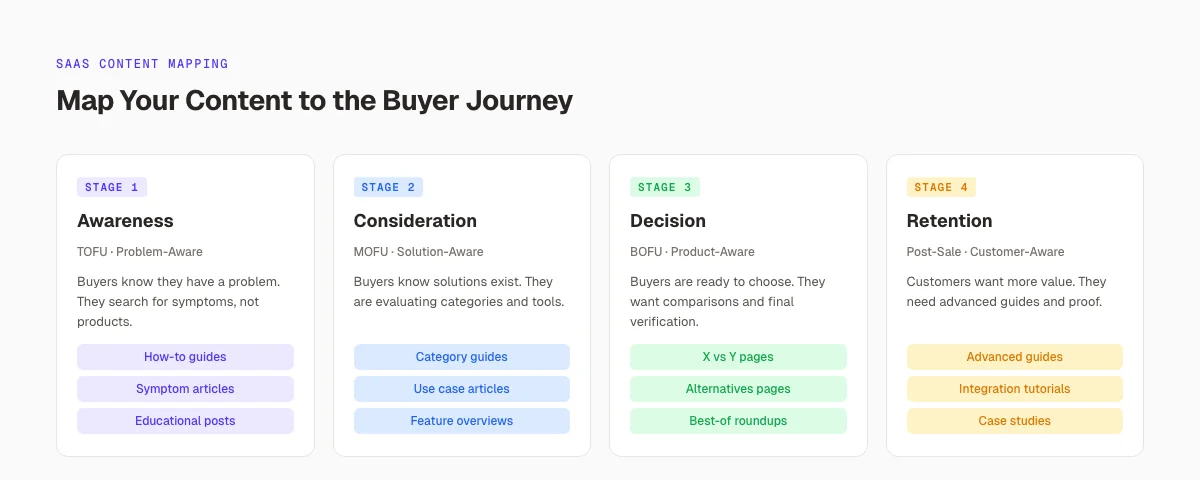
SaaS content maps to four stages: Awareness, Consideration, Decision, and Retention.
Stage 1: Awareness (TOFU)
At the awareness stage, buyers know they have a problem but do not know solutions exist. They search for symptoms, not product categories.
A finance director does not search "expense management software" on day one. She searches "how to reduce finance team manual work" or "employees submitting wrong expense reports." Your top-of-funnel content answers those symptom queries.
Awareness content builds brand recognition and organic authority. It rarely converts immediately. And it is not supposed to. Its job is to introduce your brand at the moment the buyer first realizes the problem is solvable.
Stage 2: Consideration (MOFU)
At the consideration stage, buyers know solutions exist and are evaluating categories. They search "project management software for remote teams" or "alternatives to managing inventory in Excel."
MOFU content types include:
- Product category guides ("what is construction management software")
- Use case articles ("how staffing agencies manage candidate pipelines")
- Feature comparison overviews
- Integration guides for specific workflows
Product mentions belong here. Not heavy-handed, but natural. "Here is how a platform like [Product] handles this workflow" earns trust without reading like a sales page. Publishing systematically across MOFU topics is how you build topical authority that compounds over time.
Stage 3: Decision (BOFU)
Decision-stage content targets buyers who are ready to choose a product. Bottom-of-funnel content drives 10 to 25 times more conversions than top-of-funnel content.
BOFU content types:
- "[Product] vs [Competitor]" comparison pages
- "[Competitor] alternatives" pages
- "Best [category] software" roundups
- Pricing and ROI calculator pages
- Use case landing pages for specific industries
Most SaaS companies underinvest here. They write awareness content and expect it to convert. Writing BOFU pages first. Before you have significant organic authority. Is the fastest way to generate content-driven revenue.
Stage 4: Retention
Retention content reduces churn by helping existing users get more value from your product. Most companies ignore this stage entirely, which is a significant missed opportunity.
Retention content types:
- Advanced how-to guides for specific features
- Integration setup tutorials
- Product update articles with workflow context
- Customer success stories that show advanced use cases
According to SaaS content marketing research, 70% of B2B marketers believe case studies are the best format for converting leads. The same proof works for retaining customers by showing them what success looks like at the next level.
Your SEO team. $99/month. theStacc publishes 30 SEO-optimized articles across every funnel stage. Without you lifting a finger.
Chapter 4: The 5 Content Types That Drive SaaS Signups
Not all content drives signups. These five types do. Consistently, regardless of product category or company size.
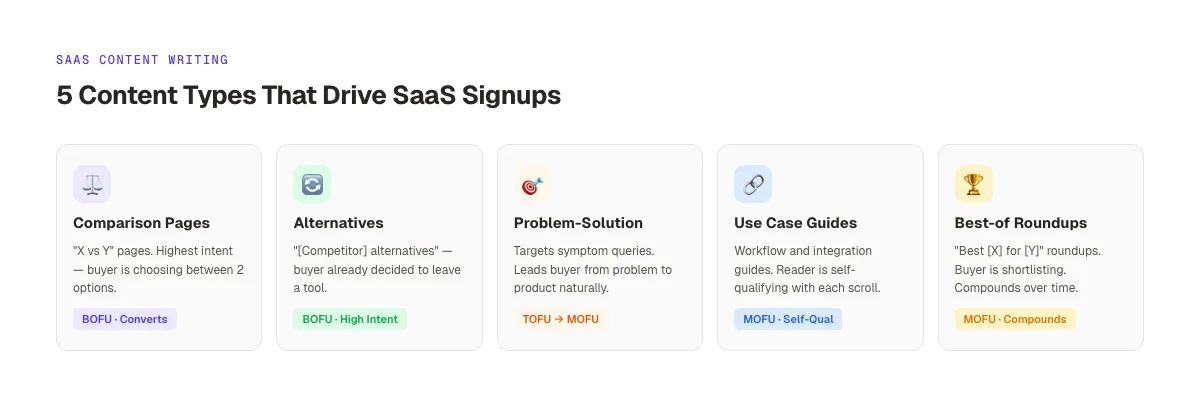
1. Comparison Pages
"[Product A] vs [Product B]" is one of the highest-intent search queries in SaaS. The reader has already narrowed their shortlist to two options. They need a final verdict.
Write these pages for every major competitor pairing relevant to your product. Be direct about where you win. Acknowledge where competitors are stronger. Buyers trust honest comparisons and distrust obvious bias.
Structure: short intro → side-by-side feature table → section-by-section analysis → verdict → CTA. A comparison page that takes a clear editorial position. Instead of "both tools have their merits". Converts at significantly higher rates.
2. Alternatives Pages
"[Competitor] alternatives" captures buyers who have already decided to leave a competitor. They have the budget and the urgency. They are actively looking for something better.
These pages rank well because the search intent is highly specific and the competition is often lower than for direct brand terms. Writing 10 alternatives pages puts your product in front of ready-to-switch buyers at exactly the right moment.
Run a thorough competitor content analysis to identify which competitors have the highest alternatives search volume. Those are your highest-priority pages.
3. Problem-Solution Content
Problem-solution content targets symptom keywords buyers search at the awareness stage, then walks them toward your product as the category solution.
Formula: Name the specific problem → show the real cost of the problem → introduce the category solution → demonstrate how your product delivers it.
This is not a product page. It is an educational article that earns trust through specificity, then introduces the product after the reader is already engaged. The product mention arrives when the reader is nodding. Not in the first paragraph.
4. Use Case and Integration Guides
"How to use [Product] for [specific workflow]" and "How [Product] connects with [integration]" target buyers evaluating whether your product fits their stack.
These articles rank for specific long-tail keywords and convert at high rates because the reader is already self-qualifying. Someone who found your article by searching "how to sync [Product] with HubSpot" is a HubSpot user actively evaluating whether your product belongs in their setup.
Write these for every major integration, workflow type, and industry vertical where your product fits. Specificity is what makes these pages valuable.
5. Best-of Roundups
"Best [category] software for [use case]" roundups attract buyers building a shortlist at the consideration stage. They know the category. They are narrowing options.
Include your product in these roundups when it genuinely fits. When it fits well, these pages consistently drive qualified trial traffic over long time horizons. Our best AI blog writing tools roundup demonstrates how this format works in practice.
Best-of posts compound over time. A post ranking for "best project management software for agencies" generates qualified traffic for years with minimal maintenance.
Chapter 5: The SaaS Content Writing Process
Quality SaaS content does not start with writing. It starts with a brief, a keyword target, and a clear definition of what the piece is designed to accomplish.
Step 1: Start With Keyword Research
Every SaaS content piece targets a specific search query. Start with the buyer stage you are targeting, then find keywords that match that stage's intent.
Keyword research tools show volume and keyword difficulty. But intent matters more than volume. A 200-search keyword with high purchase intent outperforms a 10,000-search keyword where the searcher has no intention to buy.
Evaluate every keyword on three dimensions: search volume, keyword difficulty, and conversion likelihood based on the intent behind the query.
Step 2: Build a Content Brief Before Anyone Writes Anything
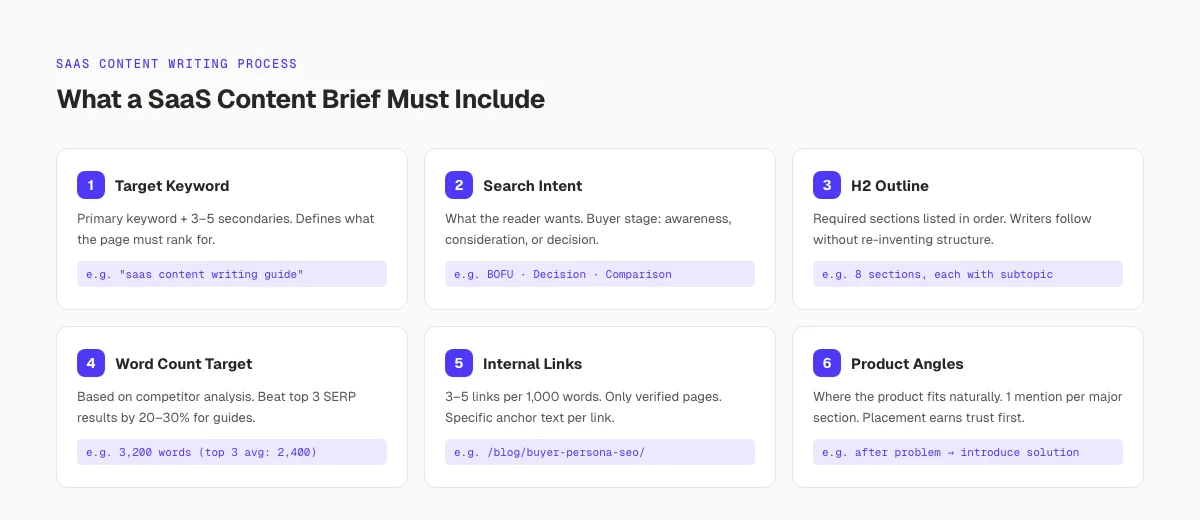
A content brief documents everything a writer needs to produce the right piece without repeated back-and-forth. A strong SaaS content brief includes:
- Target keyword and 3-5 secondary keywords
- Search intent and buyer journey stage
- Required H2 sections (the structural outline)
- Target word count
- Internal links to include
- Competitor articles to beat
- Product angles to weave in naturally
Without a brief, writers default to general advice that could apply to any company in any industry. The brief is what transforms a generic article into a piece specific enough to convert buyers in your exact market. Use our content brief template as a starting point.
Step 3: Write the Body First, Introduction Last
Most writers start with the introduction and lose momentum before reaching the sections where value lives. Professional SaaS content writers build the body sections first.
Once the article is complete, write the introduction last. A strong SaaS introduction does three things in 50 words: names the reader's specific problem, signals that this article solves it, and tells them exactly what they will learn.
The primary keyword belongs in the first 100 words. Not forced, but woven into the context of the problem being addressed.
Step 4: Place Product Mentions at the Right Moments
Product placement in SaaS content is a calibration problem. Too little, and you publish educational content that generates zero commercial return. Too much, and the piece reads like a sales brochure and readers abandon it.
The right calibration: introduce your product when it directly solves a specific problem you just described. Link to the relevant feature or landing page. Move on.
One natural product mention per major section is the right range. Product mentions earn their place by arriving after the content has demonstrated why the problem matters.
Step 5: Edit for the Reader, Not the Word Count
After writing, read every sentence through one question: "Would my buyer already know this?"
Delete the obvious. Shorten the complex. Remove anything that does not serve the reader's goal. Good blog post structure for SEO is as important as the content itself. Scannable articles with clear headings retain readers longer, which signals quality to search ranking systems.
Short paragraphs, descriptive subheadings, and specific language over vague assertions are the three editing principles that separate converting SaaS content from generic blog posts.
Chapter 6: Writing Rules Every SaaS Content Writer Must Follow
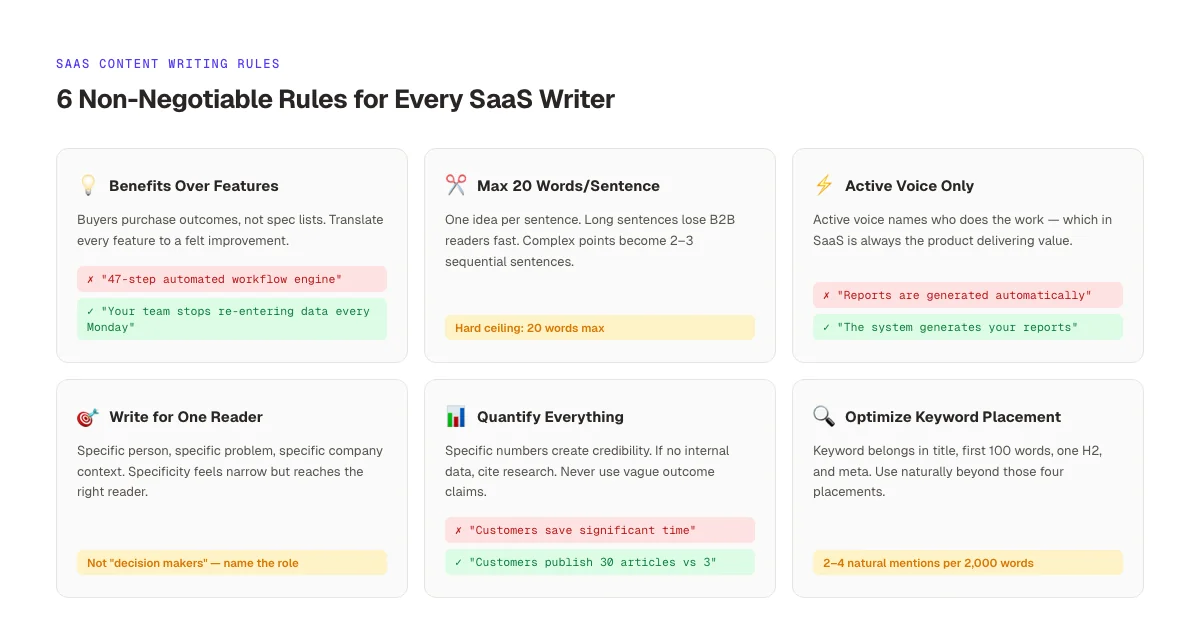
Great SaaS content follows a small set of non-negotiable rules. Violate them and even well-researched content underperforms.
Benefits Over Features
"We have a 47-step automated workflow engine with full API integration" is a feature list. "Your team stops re-entering the same data into three different systems every Monday morning" is a benefit.
Buyers do not purchase features. They purchase outcomes. Every feature claim in your content must translate to a specific, felt improvement in the reader's workday.
The translation rule: complete the sentence "This feature means buyers can ___". And that blank becomes your content sentence.
Short Sentences Win
Long sentences read as bureaucratic filler and lose B2B readers fast. Maximum 20 words per sentence is a hard ceiling. One idea per sentence. Complex points become two or three sequential sentences.
"Our platform uses machine learning algorithms to analyze behavioral patterns across your customer engagement data, enabling teams to surface actionable retention insights in real-time dashboards." That is 31 words, buried jargon, zero conviction.
Rewritten: "The platform scans customer behavior daily. It flags accounts at churn risk before they cancel. Your team acts before the problem becomes irreversible." Shorter, clearer, more confident.
Active Voice Throughout
Passive voice removes the subject of the action. Which in SaaS content is always the product doing something valuable for the buyer. "Reports are generated automatically" does not communicate who does the work. "The system generates your reports automatically" does.
Search every "was," "were," "has been," and "is being" construction in your draft. Convert each one to an active sentence. The draft sharpens in every instance.
Write for a Specific Reader, Not a General Audience
"Project management is an important challenge for businesses of all sizes" is not SaaS writing. It is content that could appear in any article about any business topic in any year.
Your reader is a specific person with a specific problem in a specific company context. Write to that person. Reference their industry. Use their terminology. Acknowledge their constraints.
Your brand voice guidelines should document the specific vocabulary, tone, and persona that all content must match across your publishing operation.
Quantify Everything
"Our customers save significant time" means nothing. "Our customers publish 30 articles per month instead of 3" is a claim a reader can evaluate, verify, and remember.
Quantify every outcome claim. Specific numbers create credibility and help readers visualize the before-and-after. If you lack internal data, cite external research. If you cannot cite a specific number, rewrite the claim as a specific, observable behavior.
Optimize Keyword Placement Without Forcing It
The primary keyword belongs in the title, the first 100 words, at least one H2 heading, and the meta description. Beyond those four placements, use the keyword where it reads naturally.
Two to four natural keyword mentions in a 2,000-word article is the right range. Our On-Page SEO Checker identifies where keyword placement and on-page optimization need attention before publishing.
For a broader technical optimization checklist, our blog SEO guide covers every on-page element that affects how SaaS content ranks.
3,500+ blogs published. Every article is SEO-scored before publish. See what a managed content operation looks like for your SaaS.
Chapter 7: How to Measure SaaS Content Performance
Most SaaS companies measure content by organic traffic. Traffic is a leading indicator. Signups are the goal.
Measuring traffic without connecting it to revenue is how companies invest in content for years without knowing whether the channel actually works.
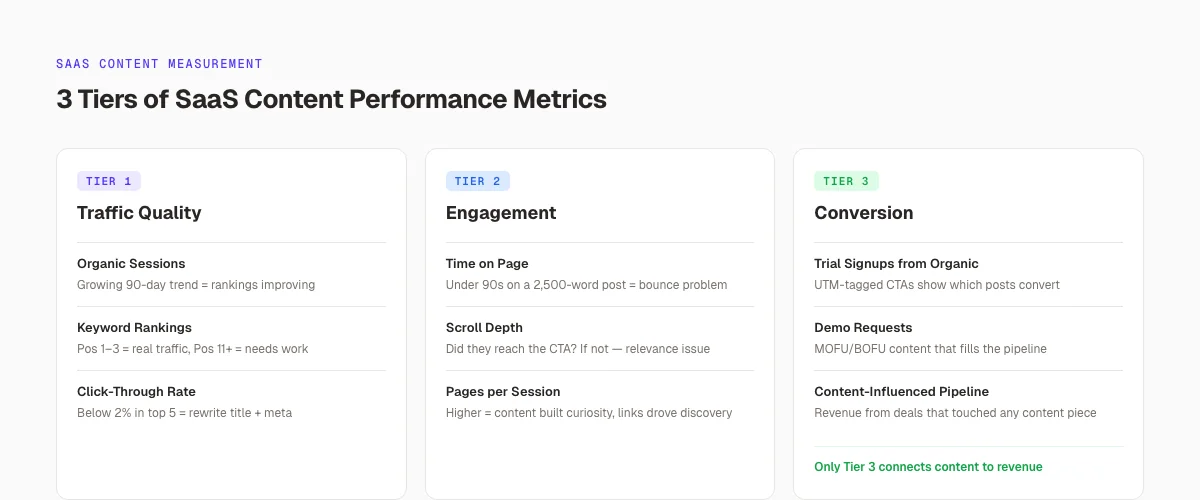
Tier 1: Traffic Quality Metrics
Organic sessions by page: Track total visitors for each content piece from search engines. A growing trend over 90 days means rankings are improving. A flat or declining trend means the content needs a refresh or the keyword needs attention.
Keyword ranking position: Track the exact keyword each page targets. Positions 1-3 drive meaningful traffic. Positions 4-10 represent ranking opportunity with further optimization. Positions 11-20 need significant improvement before traffic becomes significant.
Click-through rate from SERP: The percentage of people who see your listing and click. A CTR below 2% for a page in positions 1-5 means the title tag or meta description needs rewriting. Our blog headlines guide covers the principles that move CTR up.
Tier 2: Engagement Metrics
Time on page: Readers who stay longer engage with the full content. A session under 90 seconds on a 2,500-word article means the headline promised something the content did not deliver.
Scroll depth: Did readers reach your CTA? If 70% of visitors exit in the first third of the page, the article has a relevance problem. The opening is not convincing them to continue.
Pages per session: After reading an article, do readers explore the site? More pages per session indicates the content built curiosity and the internal linking drove discovery.
Tier 3: Conversion Metrics
These are the metrics that connect content to actual revenue:
Trial signups from organic content: Tag every CTA link with UTM parameters so you know exactly which articles generate free trial starts. A single article producing five signups per month typically covers its production cost within weeks.
Demo requests from content: Track which MOFU and BOFU articles generate demo form submissions. These pages directly accelerate the sales pipeline.
Content-influenced pipeline: Calculate revenue from deals where buyers touched at least one content piece before the close. This is the true ROI metric for a content operation.
Set up UTM parameters on every internal CTA. Track events in Google Analytics or a product analytics tool. Run a monthly review of which pieces produce commercial outcomes. Not just which pages get the most sessions.
What to Do When Content Underperforms
A page with significant traffic but zero conversions has a targeting problem. The keyword attracts readers who are not buyers. Either redirect the piece toward higher-intent keywords or accept it as brand-awareness content and stop expecting conversion.
A page with strong conversion intent but no traffic has a distribution problem. Improve the title tag, build internal links from high-authority pages to it, and pursue external backlinks. For SaaS companies, link building for SaaS covers the acquisition strategies that move rankings fastest.
Chapter 8: Scaling Your SaaS Content Operation
Content compounds. One article ranked and generating three signups per month creates ongoing return with zero incremental cost. Thirty articles ranked simultaneously multiplies that effect by an order of magnitude.
The challenge is maintaining quality as volume increases. Volume without quality creates traffic without conversion. And that compounds in the wrong direction.
Option 1: Build an In-House Team
Hiring writers with genuine SaaS expertise takes time and money. A strong B2B SaaS content writer understands product marketing, keyword strategy, and conversion writing. And commands $70,000-95,000 in annual compensation.
For early-stage SaaS, this is difficult to justify before product-market fit. In-house teams work best at Series A and beyond, when content is an established revenue channel and product positioning is stable.
Option 2: Work With Specialized Freelancers
Freelance SaaS content writers charge $150-400 per article for quality work. At 30 articles per month, that is $4,500-12,000 per month in writing costs alone. Before editing, SEO optimization, publishing management, and internal oversight.
The management burden is significant. Someone on your team must create briefs, review drafts, manage revisions, handle publishing, and track performance. Freelancers scale the writing but not the process.
Option 3: Automate at Scale
Automated content creation has matured significantly. Done-for-you services now publish 30 SEO-optimized articles per month for $99. This includes research, writing, optimization, and publishing directly to your site.
The ROI calculation is straightforward: one trial signup per month from a single article typically covers the production cost. At 30 articles, the economics become significantly more favorable.
The critical distinction: automation works when the system is built around genuine search intent, specific buyer targeting, and editorial review before publishing. Our comparison of AI vs human content writers covers how to evaluate whether automated output meets quality thresholds for your audience and your category.
Option 4: The Hybrid Model
The hybrid approach pairs human strategy with automated production volume:
- A content strategist defines keywords, content briefs, buyer stage targets, and quality standards
- Automated systems produce articles at scale
- A human editor reviews and approves before publishing
This model provides the quality control of an in-house operation with the cost efficiency and volume of automation. For SaaS companies publishing 20-80 articles per month, the Content SEO module handles the full production, optimization, and publishing pipeline automatically.
At any scale, the content calendar is the operational tool that keeps publishing consistent. Consistent weekly or daily publishing compounds faster than periodic bursts followed by gaps.
The SaaS companies that dominate organic search in their categories share one trait: they published more than competitors, at higher quality, for a longer period of time. That compounding advantage is real. The question is how to reach 30 articles per month without burning out your team or your budget.
For a broader look at building the full content engine, our SaaS content strategy guide covers keyword clustering, topic authority, and the publishing cadence that drives category domination.
Skip the agency. Keep the results. theStacc starts at $99/mo: 30 SEO articles, published for your SaaS every month.
What practitioners are saying on X
AI search advice ages quickly. Here is high-signal public discussion from SEO and growth operators — context for your roadmap, not a substitute for primary data.
- @varunram (Jul 2026): Critique of GEO slopfarm products that combine SEO clickbait with unresearched content marketing — quality and research still separate winners from farms. See the post on X.
- @jakezward (Feb 2026): 2026 SEO predictions emphasize AI Overview share-of-SERP, schema for LLM token efficiency, brand mentions in AI answers as a KPI, proprietary data as a moat, and content refresh beating net-new AI slop. See the post on X.
- @HlynurStefDev (Jul 2026): Public case: niche site traffic jumped from ~18 to 4,162 Google visits/month after focused technical/on-page SEO work (GSC screenshots claimed) — reminds that fundamentals still move numbers. See the post on X.
Grok, AI Overviews, and multi-engine visibility
Content topics like “saas content writing guide” get AI citations when process steps, quality bars, and examples are concrete. Operator consensus on X is clear: research-backed pages beat unedited bulk generation — reflect that honestly.
- Google AI Overviews: Use passage-ready answers, tables, and FAQ schema where relevant.
- ChatGPT / Perplexity: Cite named sources next to key claims.
- Grok: Maintain accurate entity facts on-site and in high-signal X posts.
Publish content built for Google and AI citations. theStacc’s Content SEO module ships SEO-scored articles structured for rankings and generative engines — including clearer entity pages models like Grok can quote.
FAQ
SaaS content writing is the process of creating articles, guides, landing pages, and other written content that helps software companies attract organic search traffic, educate buyers at each stage of the buyer journey, and convert visitors into trial signups, demo requests, or paying customers. It differs from general content writing in its tight connection to product positioning, buyer stage targeting, and measurable conversion outcomes.
SaaS content is more conversion-focused, more buyer-stage-aware, and more directly tied to specific revenue outcomes than general content writing. Every piece has a defined job: attract a specific buyer at a specific stage, answer their specific question, and move them toward a specific action. General content often skips this level of intent alignment and publishes for traffic rather than conversion.
Bottom-of-funnel content consistently outperforms top-of-funnel content for driving signups. Comparison pages, alternatives pages, and best-of roundups drive 10 to 25 times more conversions than awareness-level educational posts. Most SaaS companies underinvest in BOFU content and overinvest in TOFU awareness content. Write BOFU pages first, before anything else.
Length depends on the content type and buyer stage. BOFU comparison pages need 1,500-2,500 words to compare products thoroughly. Long-form guides and category education pages need 3,000+ words to rank for competitive informational keywords. Our blog post length for SEO guide covers the word count research behind these benchmarks by content type and buyer stage.
The companies that consistently dominate organic search in their SaaS category publish 20-30 articles per month. Most SaaS companies publish 1-4. The publishing volume gap creates the ranking gap. Quality matters. But quality at volume compounds into category authority that individual articles cannot build alone.
Yes. With the right system and quality standards in place. Automation works when it is built around genuine keyword research, specific buyer personas, and editorial review before publishing. Done-for-you services publish 30 optimized articles per month at a fraction of the cost of freelancers or an in-house team. Our SaaS SEO guide covers how automation fits into a broader organic growth strategy.
Track three tiers: traffic quality (organic sessions, keyword rankings, click-through rate), engagement (time on page, scroll depth, pages per session), and conversion (trial signups from organic, demo requests, content-influenced pipeline). The conversion tier is the only one that directly connects content to revenue. And most SaaS companies never set it up.
SaaS content is one of the highest-ROI channels a software company can build. It generates leads while your team sleeps, compounds in value over time, and builds category authority that paid acquisition cannot replicate.
The companies winning organic search in their SaaS category started earlier, published more consistently, and built their content operation around buyer intent rather than keyword volume. Start with the buyer. Map the journey. Write what converts. Then scale the process before it stalls.
Related Tools & Resources
Free SEO Tools:
Best Lists:
Sources & references
- [1] Princeton / Georgia Tech et al. — GEO research (arXiv:2311.09735)
- [2] @varunram on X — Critique of GEO slopfarm products that combine SEO clickbait with unresearched content marketing — quality and research
- [3] @jakezward on X — 2026 SEO predictions emphasize AI Overview share-of-SERP, schema for LLM token efficiency, brand mentions in AI answers
- [4] @HlynurStefDev on X — Public case: niche site traffic jumped from ~18 to 4,162 Google visits/month after focused technical/on-page SEO work (G
- [5] Referenced source — www.semrush.com

Researched, written, and published articles that compound organic traffic.
Weekly local SEO teardowns
One practical email a week. Map Pack, GBP, AI Overviews — no fluff. Unsubscribe anytime.
Explore this topic: Top 10 Best SEO Content Writing Software (2026).