A complete SaaS SEO guide: keyword research, page types, product-led content, technical fixes, and how to measure results against pipeline.
Short answer: 66% of B2B SaaS buyers use search engines to research products before purchasing, so a software company that does not rank hands that demand to competitors. This guide covers keyword research, page types, product-led content, technical fixes and measuring organic work against pipeline rather than sessions.
66% of B2B SaaS buyers use search engines to research products before purchasing. If your software company does not rank for those searches, your competitors capture the demand you created.
That is the SaaS SEO problem. You spend months building a product, ship it, and then watch competitors outrank you for your own category terms. Paid ads fill the gap, but customer acquisition costs keep climbing. The average SaaS company now spends more acquiring a customer than that customer pays in the first year.
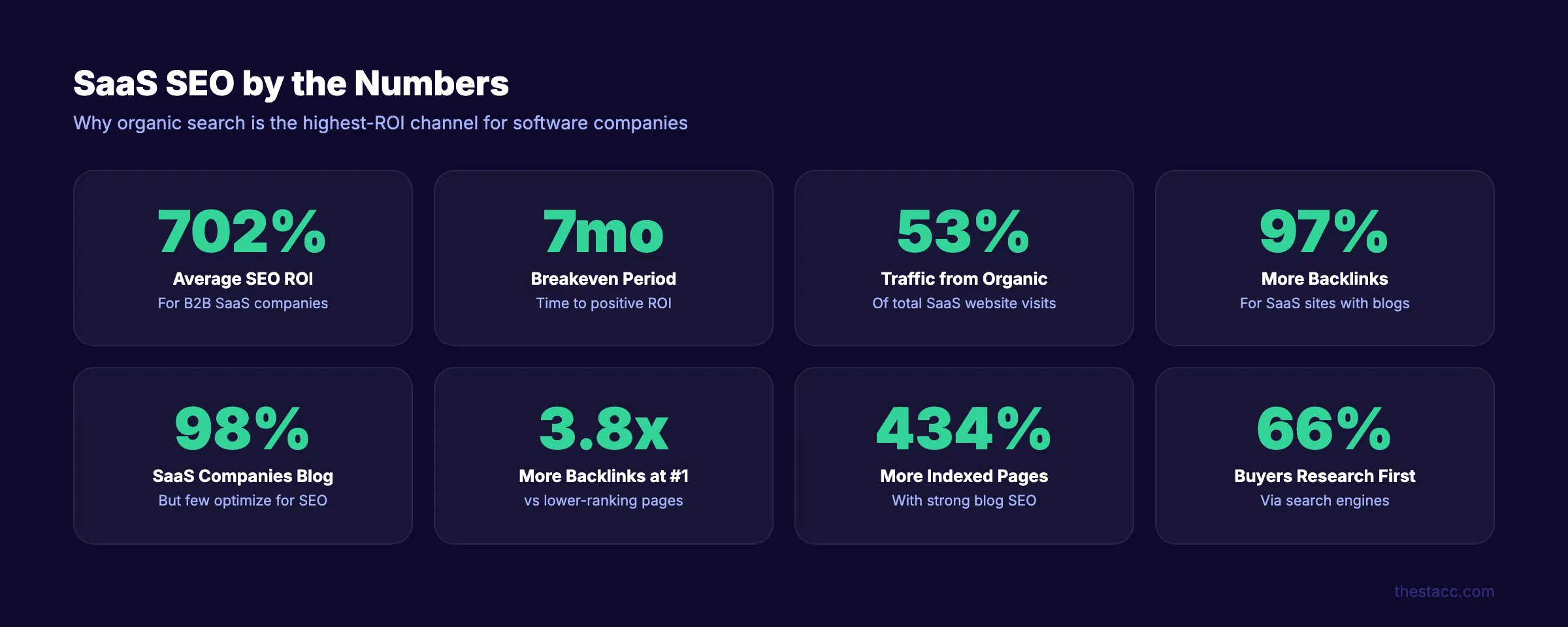
SEO changes that math. According to Mailmodo's analysis of SaaS SEO data, B2B SaaS companies achieve an SEO ROI of 702%, with a breakeven period of 7 months. Organic search drives 53% of total SaaS website visits. And SaaS websites with active blogs acquire 97% more backlinks than those without.
We have published 3,500+ blogs across 70+ industries, including dozens of SaaS companies. This guide covers the complete SaaS SEO strategy from keyword research through measurement.
Here is what you will learn:
- How SaaS SEO differs from traditional SEO and why it matters
- The keyword strategy that prioritizes revenue over traffic volume
- How to build a content engine that drives demos and signups
- Technical SEO fixes specific to SaaS platforms
- Link building tactics that work for software companies
- How to measure SEO ROI and tie organic traffic to pipeline
Chapter 1: What SaaS SEO Is and How It Differs
SaaS SEO is the process of optimizing a software company's website, blog, and online presence to rank in organic search results and drive trial signups, demo requests, or subscriptions.
The fundamentals are the same as any SEO strategy. You research keywords, create content, optimize pages, build links, and measure results. But SaaS SEO has specific differences that change how you prioritize and execute.
How SaaS SEO Differs from Traditional SEO
| Factor | Traditional SEO | SaaS SEO |
|---|---|---|
| Revenue model | One-time purchase | Recurring subscription (MRR/ARR) |
| Conversion goal | Sale or lead form | Free trial, demo, or signup |
| Customer lifetime value | Fixed | Grows with retention |
| Content focus | Product/category pages | Educational + product-led content |
| Keyword strategy | Category terms | Problem-aware + solution-aware terms |
| Competition | Industry peers | Category leaders + aggregator sites (G2, Capterra) |
| Link building | Industry directories | Original research, integrations, thought leadership |
The most important difference is the business model. A SaaS company earns revenue over time, not in a single transaction. That means a customer acquired through SEO today generates revenue for months or years. The compounding effect makes SEO the highest-ROI channel for SaaS.
Why SaaS Companies Need SEO
The numbers are clear:
- 91% of SaaS businesses saw performance improvements through SEO
- 70% of SaaS consumers say SEO delivers better results than PPC
- Organic search drives 53% of total SaaS website traffic
- SEO-generated leads convert at higher rates than paid leads because buyers arrive with existing intent
Paid acquisition gets more expensive every year. According to LinkQuest's SaaS SEO analysis, SaaS companies increased SEO budgets by 7.2% in 2025 as Google Ads CPCs for SaaS terms regularly exceed $10 to $15 per click. SEO delivers the same traffic without per-click costs. After the initial investment period, every organic visitor is effectively free.
Chapter 2: SaaS Keyword Strategy
Most SaaS keyword strategies fail because they chase volume. Targeting "project management" or "CRM software" sounds logical but puts you against Asana, Monday.com, and Salesforce. You will not win those terms for years.
The right approach starts with buyer intent, not search volume.
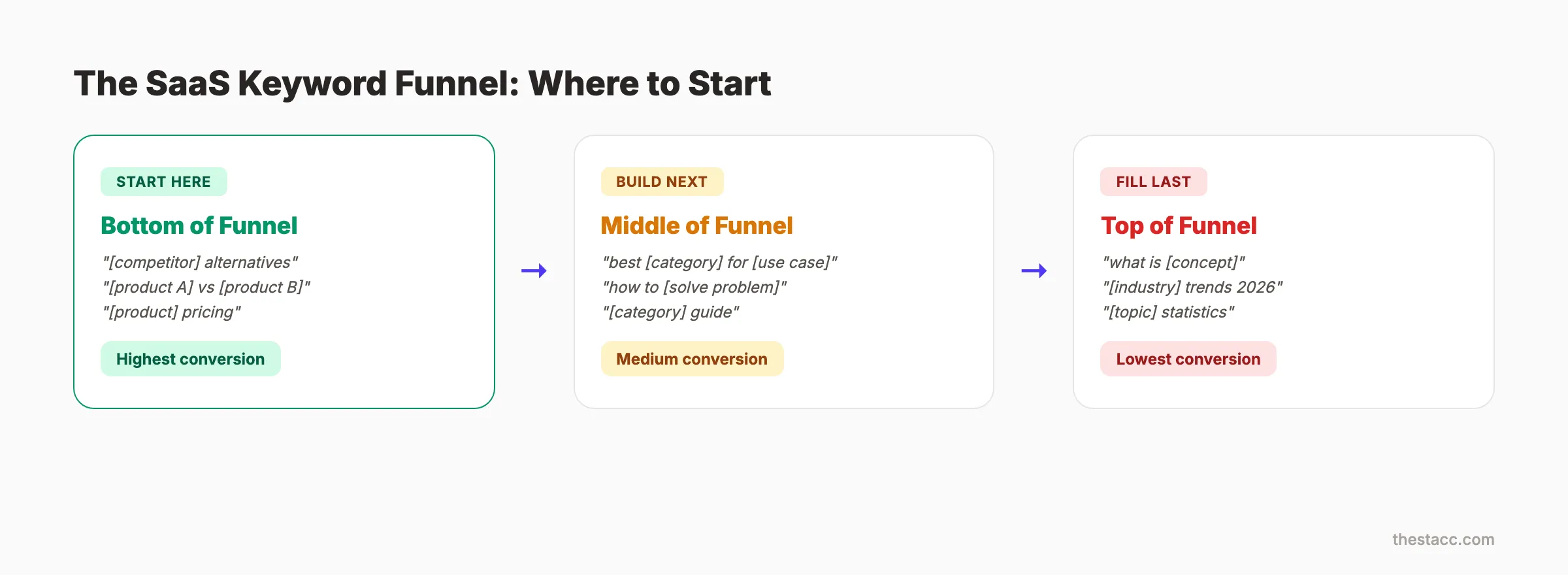
The Keyword Funnel for SaaS
| Funnel Stage | Keyword Type | Example | Conversion Rate |
|---|---|---|---|
| Bottom (BoFu) | Alternatives, vs, pricing | "[competitor] alternatives" | Highest |
| Middle (MoFu) | How-to, best tools, guides | "best [category] for [use case]" | Medium |
| Top (ToFu) | What is, trends, tips | "what is [concept]" | Lowest |
Start at the bottom. BoFu keywords convert at dramatically higher rates. "Asana alternatives" or "Monday.com vs ClickUp" targets buyers who already know they need a tool and are comparing options. These pages drive 40 to 60% of organic SaaS conversions.
Build the middle next. "How to manage remote teams" or "best project management tools for startups" targets buyers with a problem but no specific product in mind. These pages build topical authority and create entry points for prospects.
Fill the top last. ToFu content ("what is agile project management") attracts high-volume, low-intent traffic. It builds authority and backlinks but converts poorly. Only invest here after BoFu and MoFu content is producing results.
How to Find SaaS Keywords
Start with your product's core problems. What does your software solve? Every answer becomes a keyword cluster.
- List 10 problems your product solves
- Search each problem on Google and note the autocomplete suggestions
- Check People Also Ask results for each search
- Run competitor domains through keyword research tools to find their top-performing pages
- Analyze competitor keywords to find gaps they rank for but you do not
Filter aggressively. One practitioner shared that filtering 8,879 initial keywords to only those with difficulty under 30 and phrases of 3+ words reduced the list to 305 actionable targets. Fewer, better keywords beat a massive unfocused list.
Product-Led SEO
Product-led SEO uses your product's data or functionality to generate SEO-worthy pages. Zapier does this with integration pages. Each "Connect [App A] + [App B]" page targets a specific long-tail keyword and is generated from their integration database.
If your SaaS has templates, integrations, a directory, or user-generated content, you can apply programmatic SEO to scale pages without writing each one manually.
Stop writing. Start ranking. theStacc publishes 30 SEO-optimized articles per month for SaaS companies. No writers. No briefs. No agency fees.
Chapter 3: Content Strategy for SaaS SEO
98% of SaaS companies have blogs. That is not a competitive advantage. The advantage comes from publishing the right content in the right order with the right structure.
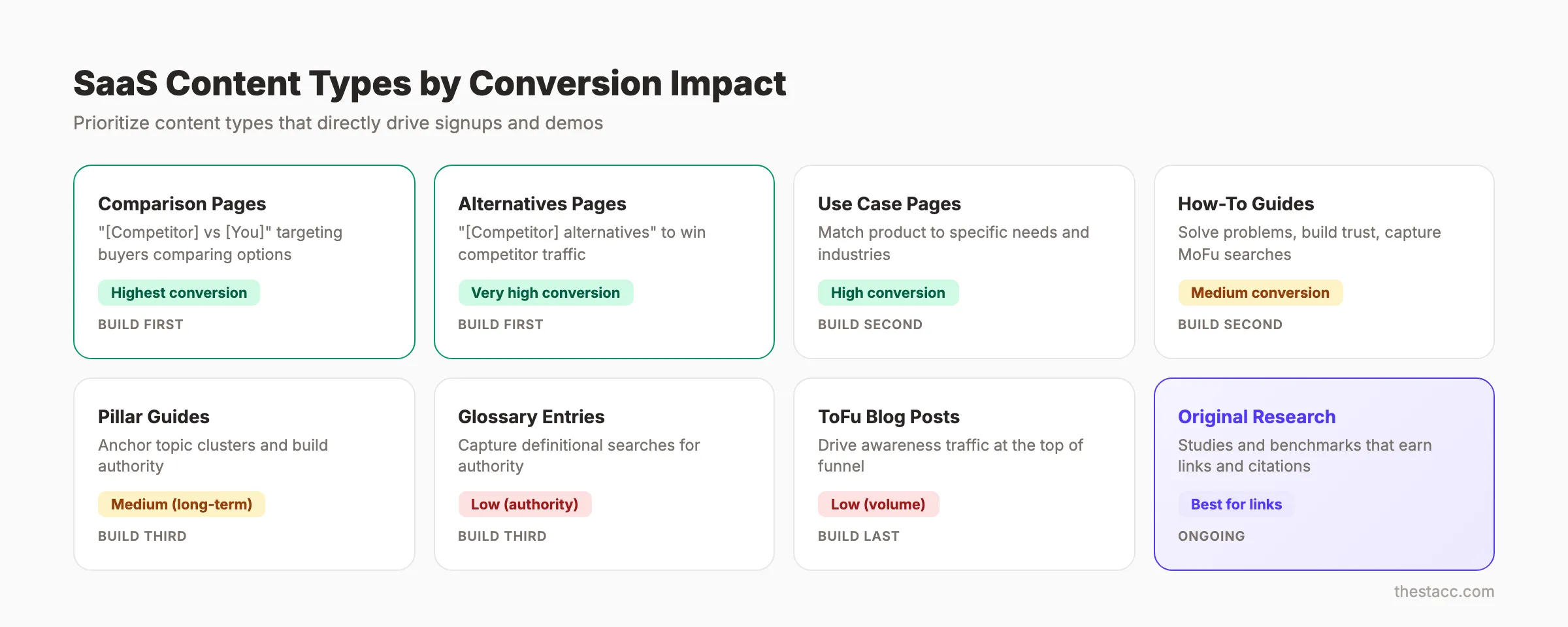
Content Types That Drive SaaS Growth
| Content Type | Purpose | Conversion Impact |
|---|---|---|
| Comparison pages (vs) | Capture bottom-funnel buyers | Highest |
| Alternatives pages | Win competitor's audience | Very high |
| Use case pages | Match product to specific needs | High |
| How-to guides | Solve problems, build trust | Medium |
| Pillar guides | Anchor topic clusters | Medium (long-term) |
| Glossary entries | Capture definitional searches | Low (authority building) |
| Blog posts (ToFu) | Drive top-funnel awareness | Low (volume building) |
Prioritize comparison and alternatives pages first. These are the pages that directly drive revenue. A "[Competitor] vs [Your Product]" page targets a buyer who is already comparing options. Build these for every major competitor in your space.
Building Topic Clusters
A topic cluster is a group of related pages organized around a pillar page. For SaaS, each product feature or problem category becomes a cluster.
Example cluster for a project management SaaS:
- Pillar: "Project Management: The Complete Guide"
- Cluster pages: "How to Create a Project Timeline," "Project Management Templates," "Agile vs Waterfall," "Best Project Management Tools for Small Teams"
- Glossary: "What Is a Gantt Chart," "What Is Sprint Planning"
Each cluster page links back to the pillar. The pillar links to each cluster page. This topical map structure signals to Google that your site is the authority on the topic.
Publishing Frequency
SaaS blogs that publish 6 to 8 SEO-optimized posts per month build effective topic clusters within 6 to 12 months. That pace compounds. SaaS blogs with strong SEO generate 434% more indexed pages and 97% more indexed links.
The key phrase is "SEO-optimized." Publishing 20 posts per month with no keyword targeting wastes budget. Publishing 6 targeted posts per month on a structured content calendar builds authority faster than volume alone.
Content That Ranks But Does Not Convert
This is the most common mistake in SaaS content marketing. A blog post ranks well for a high-volume keyword, generates thousands of visits, and produces zero signups. The traffic has no relationship to the product.
Avoid this by asking one question before creating any content: "Would someone searching this keyword ever buy our product?" If the answer is no, skip it. Volume without relevance is vanity.
Chapter 4: On-Page SEO for SaaS Websites
On-page SEO determines whether Google understands what your pages are about. For SaaS sites, the most critical pages are your homepage, feature pages, pricing page, and comparison pages. These are the pages that convert visitors into users.
Homepage Optimization
Most SaaS homepages optimize for brand, not for search. Your homepage should target your primary category keyword.
- H1 should include your category term ("Project Management Software" not "Welcome to ProductName")
- Meta description should explain what the product does and who it is for
- Include clear navigation to feature pages, pricing, and use case pages
- Add schema markup (SoftwareApplication, Organization, FAQ)
Feature and Product Pages
Each major feature deserves its own page targeting a specific keyword. "Time Tracking Software" and "Resource Management Tool" are separate pages, not sections of a single features page.
For each feature page:
- ✓ Unique title tag with the feature keyword (under 60 characters)
- ✓ Meta description with the benefit, not just the feature name
- ✓ H1 matches the primary keyword
- ✓ Body content explains the problem the feature solves (not just what it does)
- ✓ Screenshots or demo videos showing the feature in action
- ✓ CTA to start a free trial or request a demo
- ✓ Internal links to related blog posts and use case pages
Pricing Page SEO
Your pricing page is one of your highest-intent pages. People searching "[Product] pricing" are close to a decision. Optimize it.
- Title tag: "[Product] Pricing - Plans Starting at $✓ /mo"
- Include a FAQ section answering common pricing questions
- Add comparison tables showing plan differences
- Include social proof (customer logos, review scores, testimonials)
Learn how to write meta descriptions that drive clicks on these high-intent pages.
Chapter 5: Technical SEO for SaaS
SaaS websites have unique technical challenges. Single-page applications, dynamic content, authentication walls, and JavaScript rendering all affect how Google crawls and indexes your site.
Common SaaS Technical Issues
JavaScript rendering: If your site is built with React, Angular, or Vue and relies on client-side rendering, Google may not see your content. Use server-side rendering (SSR) or static site generation (SSG) for all pages you want indexed.
Authentication walls: Content behind login screens is invisible to Google. If you have a knowledge base, help docs, or community forum, make them publicly accessible. These pages build authority and target long-tail keywords.
Duplicate content: SaaS products often have similar feature descriptions across multiple pages. Use canonical tags to tell Google which version to index. Read more in our SEO audit guide.
Page speed: SaaS homepages load heavy images, animations, and tracking scripts. Every additional second of load time reduces conversions. Check your Core Web Vitals and prioritize LCP, INP, and CLS improvements.
Technical SEO Checklist for SaaS
- ✓ XML sitemap submitted to Google Search Console
- ✓
robots.txtallows crawling of all public pages - ✓ Server-side rendering enabled for content pages
- ✓ Canonical tags on all pages with similar content
- ✓ HTTPS across the entire site (no mixed content)
- ✓ Mobile-responsive design on all pages
- ✓ Core Web Vitals passing (LCP under 2.5s, INP under 200ms, CLS under 0.1)
- ✓ Structured data for Organization, SoftwareApplication, FAQ, and Article
- ✓ No orphan pages (every page is linked from at least one other page)
- ✓ 404 errors monitored and redirected
Your SEO team. $99 per month. 30 optimized articles for your SaaS company, published automatically.
Chapter 6: Link Building for SaaS Companies
SaaS websites ranking first have 3.8 times more backlinks than lower-ranking pages. Links are not optional. They are the primary signal that separates page-one results from page-two obscurity.
Link Building Tactics That Work for SaaS
| Tactic | Effort | Link Quality | Scalability |
|---|---|---|---|
| Original research and data studies | High | Very high | Medium |
| Integration partner pages | Medium | High | High |
| Guest posting on industry blogs | Medium | Medium to high | Medium |
| HARO / journalist outreach | Medium | High | Low |
| Resource page link building | Low | Medium | High |
| Podcast appearances | Medium | Medium | Medium |
| Review site optimization (G2, Capterra) | Low | High | Low |
Original Research Is Your Best Link Magnet
Publishing studies, surveys, and benchmarks generates more links than any other tactic. When a blogger writes about SaaS trends, they link to the source of the data. Be the source.
Ideas for SaaS original research:
- Annual industry benchmark report using anonymized customer data
- Survey of 100+ professionals in your target market
- Analysis of public data (job listings, funding rounds, technology trends)
- Product usage statistics that reveal industry patterns
Personalized outreach emails increase backlink CTR by 28.57%. Send your research to journalists, bloggers, and newsletter creators who cover your industry.
Integration Partner Links
If your SaaS integrates with other tools, create dedicated integration pages. Each page targets "[Your Product] + [Partner] integration" and earns a natural link when the partner links to the integration from their own site.
Zapier built an entire SEO strategy around this. Each integration page targets a unique keyword pair and generates organic traffic for both products.
Building Links Through Content
Every blog post you publish creates a potential link target. But not all content attracts links equally. Data-driven posts, original frameworks, and free tools generate the most backlinks. Opinion pieces and basic how-to guides generate the fewest.
For the full strategy, read our guide on building backlinks for your blog.
Chapter 7: SaaS Content for AI Search
AI search is reshaping how SaaS buyers find products. Google AI Overviews, ChatGPT, and Perplexity now answer product questions directly. AI-generated summaries are expected to cover 70 to 80% of informational SaaS queries within the next 2 years.
How to Get Cited by AI Models
AI models cite content that is structured, factual, and authoritative. Optimizing for AI citations is different from traditional SEO.
Structure content for extraction. AI models pull specific passages. Write clear, concise definitions and explanations. Use question-and-answer patterns. Start FAQ answers with a direct response, then elaborate.
Include original data. AI models prioritize sources with unique statistics. If your content cites other sources, AI will cite those original sources instead of you. Publish your own data whenever possible.
Build entity authority. AI models develop internal maps of authoritative sources per topic. Consistently publishing expert content on a specific topic builds your entity signal. Read our guide on optimizing for Google AI Overviews for the full strategy.
Reddit and Community SEO
Reddit is now the second most-visited site via Google search traffic, with 600+ million Google searches per month ending on Reddit. SaaS companies that participate authentically in subreddits related to their industry gain two benefits: direct referral traffic and increased brand recognition in AI training data.
The approach is simple but requires discipline. Answer questions genuinely. Share expertise without promoting your product. Over time, your brand becomes associated with expertise in your category.
Review Site Optimization
G2, Capterra, and TrustRadius pages often rank above your own website for branded searches. Optimize your profiles:
- Complete every field with keyword-rich descriptions
- Actively collect reviews from customers
- Respond to every review (positive and negative)
- Add screenshots, videos, and comparison data
These review site profiles also influence AI models. When ChatGPT or Perplexity answers "best [category] tools," they heavily weight G2 and Capterra data.
Chapter 8: Measuring SaaS SEO ROI
SEO without measurement is a cost center. With measurement, it is the highest-ROI channel in your marketing stack.
Key Metrics for SaaS SEO
| Metric | Tool | What It Tells You |
|---|---|---|
| Organic traffic | Google Analytics 4 | Total visitors from search |
| Organic signups | GA4 key events | Trial signups from organic |
| Organic pipeline | CRM (HubSpot, Salesforce) | Revenue influenced by organic |
| Keyword rankings | GSC or Ahrefs | Position movement for targets |
| Domain authority | Ahrefs or Moz | Overall backlink authority |
| Content ROI | Custom attribution | Revenue per content piece |
| CAC from organic | Manual calculation | Acquisition cost from SEO |
Calculate Your SaaS SEO ROI
Formula: SEO ROI = (Revenue from organic - SEO costs) / SEO costs x 100
Example calculation:
- Monthly SEO spend: $5,000 (content + tools + links)
- After 12 months: organic channel generates 200 trial signups per month
- Trial-to-paid conversion rate: 15% = 30 new customers per month
- Average contract value: $200/month = $6,000 per customer over 30 months
- Monthly revenue from organic customers: 30 x $200 = $6,000
- Annual revenue from organic: $72,000
- Annual SEO cost: $60,000
- Year 1 ROI: 20%
But SaaS revenue compounds. Those 360 customers acquired in year 1 continue paying in year 2 while new organic customers keep arriving. By year 2, the same $60,000 investment is generating $144,000+ in annual revenue. ROI jumps to 140%+.
This compound effect is why B2B SaaS companies achieve an average SEO ROI of 702%, according to data compiled by First Page Sage.
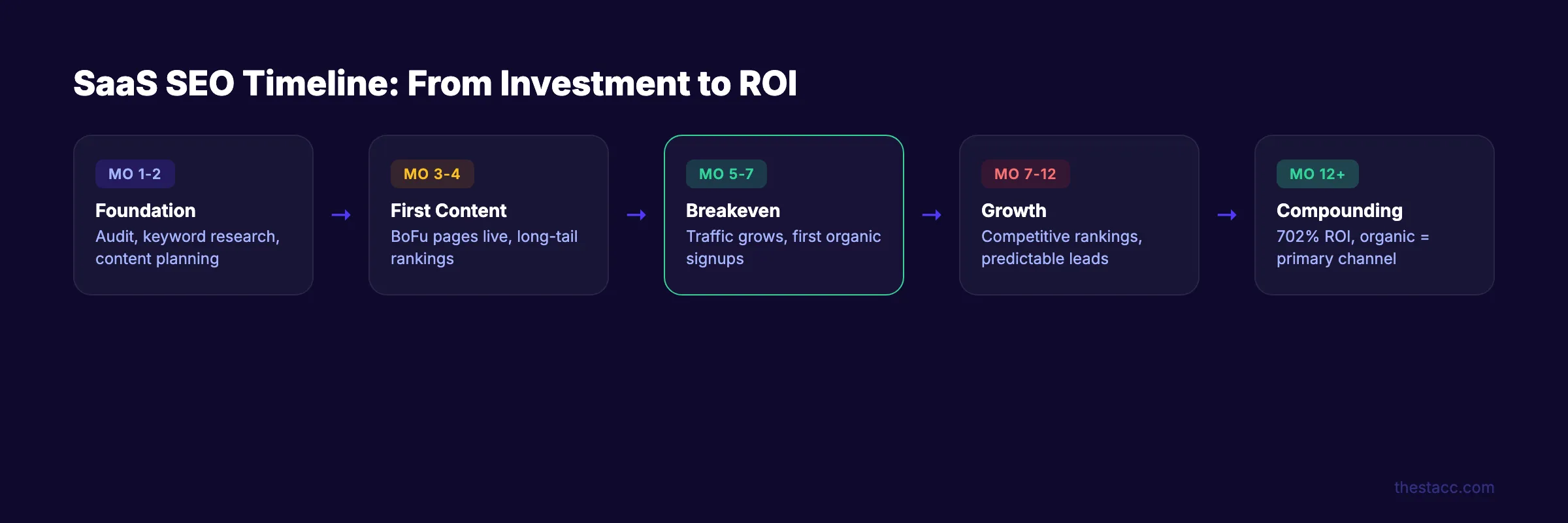
Timeline for SaaS SEO Results
- Month 1 to 2: Technical audit, keyword research, content planning. Fix crawl errors and site speed.
- Month 3 to 4: First content published. BoFu pages (comparisons, alternatives) go live. Initial rankings appear for long-tail keywords.
- Month 5 to 7: Breakeven point. Organic traffic increases measurably. First organic signups from content.
- Month 7 to 12: Competitive keywords start ranking. Organic becomes a predictable lead channel.
- Month 12+: SEO compounds. Content published months ago continues generating traffic and signups without additional investment.
The 7-month breakeven is faster than most marketing channels. But it requires consistent execution. Companies that publish for 3 months, see slow results, and stop miss the compounding effect entirely.
3,500+ blogs published. Every article is SEO-scored before publish. theStacc handles content publishing for SaaS companies across every vertical.
Chapter 9: SaaS SEO by Company Stage
There is no single SaaS SEO playbook. What works for a Series B company with 50 employees does not work for a pre-revenue startup with 2 founders.
Pre-Revenue to $1M ARR
Priority: Validate demand and capture existing searches.
- Build comparison pages for every competitor in your space
- Create a pricing page optimized for "[Product] pricing"
- Write 3 to 5 use case pages targeting "[problem] + [solution type]"
- Optimize your G2 and Capterra profiles
- Start a blog with 2 to 4 posts per month focused on BoFu and MoFu keywords
At this stage, SEO is about capturing demand that already exists. Do not invest in ToFu awareness content yet. Every page should have a direct path to signup or demo.
$1M to $10M ARR
Priority: Build the content engine and establish authority.
- Hire or contract a dedicated content person (or use a service like theStacc)
- Publish 6 to 8 SEO posts per month on a structured content calendar
- Build topic clusters around 3 to 5 core product areas
- Launch pillar pages for each cluster
- Invest in original research for link building
- Start building topical authority across your category
At this stage, you are building the organic infrastructure that scales. The content you publish now will drive traffic for years.
$10M+ ARR
Priority: Scale, defend, and expand into new categories.
- Run a full content team or agency managing 15+ posts per month
- Apply programmatic SEO for template-based pages
- Expand internationally with hreflang and localized content
- Invest in retention-focused SEO (help docs, knowledge base, tutorials)
- Monitor and defend branded SERPs from competitor comparison pages
- Optimize for AI search citations and featured snippets
At this stage, SEO is not just about growth. It is about protecting the organic traffic you have while expanding into adjacent keyword categories.
Chapter 10: Common SaaS SEO Mistakes
These mistakes cost SaaS companies rankings, traffic, and revenue. Avoid all of them.
1. Chasing volume over relevance. Ranking for "what is project management" generates traffic that never converts. Every keyword must have a product connection.
2. Starting with ToFu content. Most SaaS blogs fill up with awareness content first. Start with BoFu (comparisons, alternatives) and MoFu (best tools, how-to guides). These drive revenue faster.
3. Ignoring link building. Content alone does not rank in competitive categories. Pages ranking first have 3.8 times more backlinks. Treat links as a required input, not an afterthought.
4. Building on client-side JavaScript only. React and Vue apps that rely on client-side rendering are invisible to Google without SSR. Fix rendering before investing in content.
5. Neglecting page speed. SaaS homepages load heavy assets. Slow pages reduce conversions and rankings simultaneously. Run a Core Web Vitals check quarterly.
6. Publishing without a keyword target. Every page needs a primary keyword. If you cannot name the keyword a page targets, it probably will not rank for anything.
7. Not tracking conversions from organic. Organic traffic without conversion tracking is a vanity metric. Set up trial signup and demo request tracking in GA4 before launching any SEO initiative.
8. Skipping review site optimization. G2 and Capterra pages often outrank your own site for branded terms. Treat these profiles as extensions of your SEO strategy, not afterthoughts.
Skip the agency. Keep the results. theStacc starts at $99 per month. 30 SEO articles published automatically for your SaaS business.
What practitioners are saying on X
AI search advice ages quickly. Here is high-signal public discussion from SEO and growth operators — context for your roadmap, not a substitute for primary data.
- @hridoyreh (Mar 2026): Widely shared SEO skill tree: foundations, research, technical, on-page, content, links, AI SEO/GEO, analytics, UX, brand, programmatic — useful map for stats and how-to posts. See the post on X.
- @jakezward (Feb 2026): 2026 SEO predictions emphasize AI Overview share-of-SERP, schema for LLM token efficiency, brand mentions in AI answers as a KPI, proprietary data as a moat, and content refresh beating net-new AI slop. See the post on X.
Grok, AI Overviews, and multi-engine visibility
For “saas seo guide”, multi-engine visibility still starts with clear definitions, sourced numbers, and extractable section answers. Grok additionally factors live X discussion — keep public claims consistent with this page.
- Google AI Overviews: Use passage-ready answers, tables, and FAQ schema where relevant.
- ChatGPT / Perplexity: Cite named sources next to key claims.
- Grok: Maintain accurate entity facts on-site and in high-signal X posts.
Publish content built for Google and AI citations. theStacc’s Content SEO module ships SEO-scored articles structured for rankings and generative engines — including clearer entity pages models like Grok can quote.
FAQ
SaaS SEO is the process of optimizing a software company's website and content to rank in organic search results. It drives free trial signups, demo requests, and subscriptions by targeting keywords that SaaS buyers search throughout their evaluation process. The strategy differs from traditional SEO because SaaS revenue is recurring, making the lifetime value of each organic customer significantly higher.
Expect 3 to 4 months for initial rankings on long-tail keywords. The breakeven point for most B2B SaaS companies is 7 months. Competitive category terms take 9 to 12 months. The timeline depends on domain authority, content quality, backlink velocity, and competition level.
Options range from $99 per month for automated content publishing (like theStacc) to $5,000 to $15,000 per month for a full-service agency. Building an in-house SEO team costs over $405,000 per year. Most early-stage SaaS companies start with a content service and add resources as organic revenue grows.
Bottom-of-funnel keywords convert best. "[Competitor] alternatives," "[Product A] vs [Product B]," and "best [category] for [use case]" target buyers ready to decide. Long-tail keywords with 3+ words and difficulty under 30 offer the best balance of volume and winnability for newer SaaS sites.
Both have a role. Paid ads deliver immediate results and are essential for testing messaging and landing pages. SEO delivers 702% ROI on average and compounds over time. Most successful SaaS companies run paid ads for short-term demand capture while investing in SEO for long-term organic growth.
Product-led SEO uses a SaaS product's data, features, or user-generated content to create pages that rank organically. Zapier creates integration pages from its product database. Canva creates template landing pages. This approach scales content production through product functionality rather than manual writing.
SaaS SEO is the highest-ROI acquisition channel available to software companies. The companies that start now build a compounding advantage that paid ads cannot replicate. Start with bottom-funnel content, build topic clusters, earn links through original research, and measure everything against pipeline and revenue.
Related Tools & Resources
Free SEO Tools:
Best Lists:
Sources & references
- [1] Princeton / Georgia Tech et al. — GEO research (arXiv:2311.09735)
- [2] @hridoyreh on X — Widely shared SEO skill tree: foundations, research, technical, on-page, content, links, AI SEO/GEO, analytics, UX, bran
- [3] @jakezward on X — 2026 SEO predictions emphasize AI Overview share-of-SERP, schema for LLM token efficiency, brand mentions in AI answers
- [4] Referenced source — www.mailmodo.com

Plan topics, review article drafts, and publish to a connected CMS.
Weekly local SEO teardowns
One practical email a week. Map Pack, GBP, AI Overviews — no fluff. Unsubscribe anytime.
Explore this topic: SEO for early-stage SaaS with an empty blog and nobody to write it..