AI writers win on speed and cost per post. Human writers win on original insight, interviews, and judgment. For SEO the hybrid model beats either alone: AI drafts from a researched brief, then a human edits for accuracy, voice, and first-hand detail. Pure AI output tends to rank shallowly and decay fast.
Most businesses face the same question right now. Should they hire human writers or use AI?
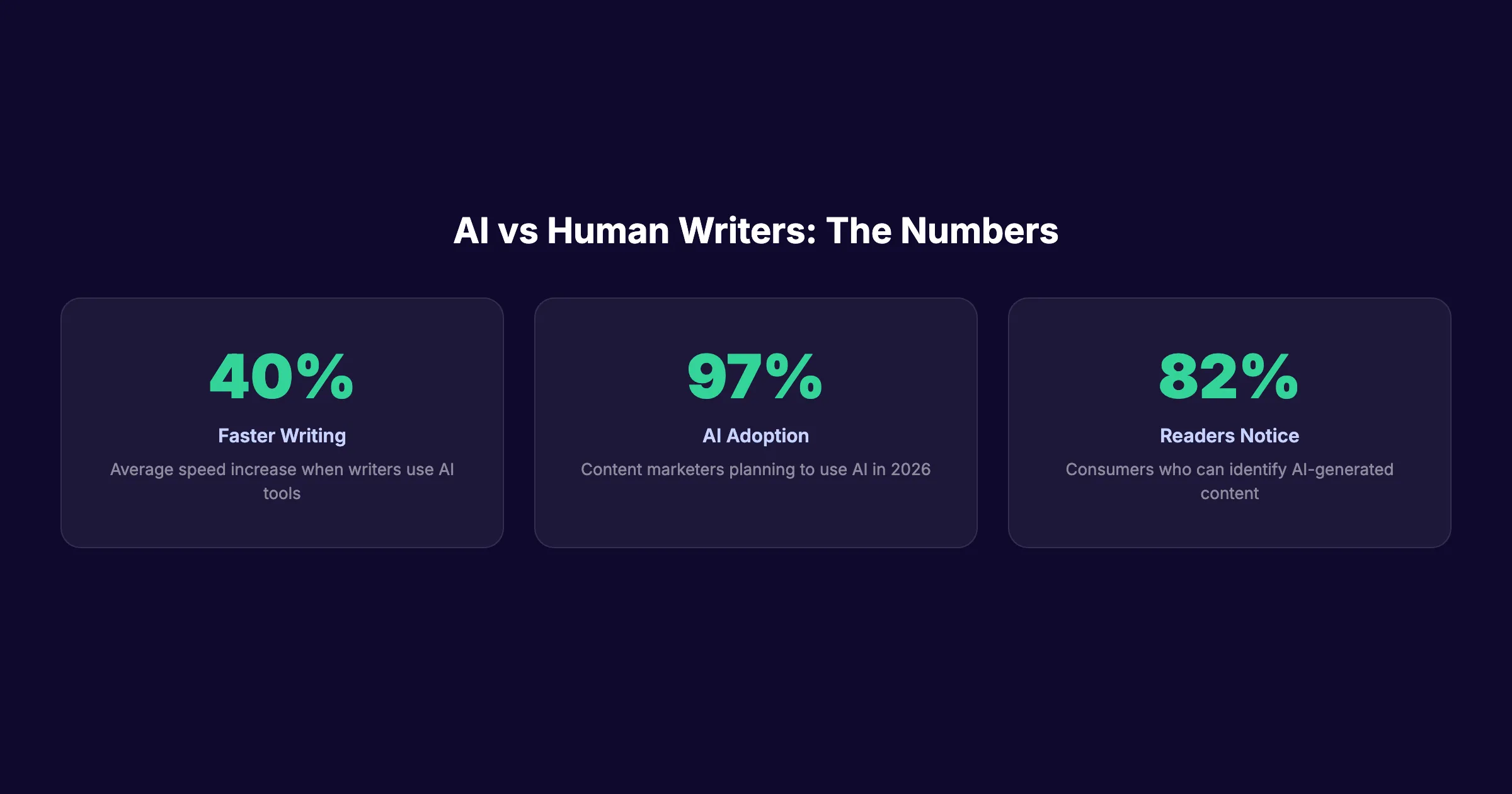
The wrong answer costs real money. Hiring writers for content you could automate wastes budget. Using AI for content that demands expertise damages trust. A 2026 study from Siege Media found that 97% of content marketers plan to use AI this year. But only 1% let AI handle everything.
That gap tells the real story about ai vs human writers. The answer is not one or the other. It depends on the content type, the audience, and the stakes.
We publish 3,500+ blog posts across 70+ industries. Some are AI-assisted. All are human-reviewed. This comparison draws from that experience and the latest ranking data.
Here is what you will learn:
- Where AI writers outperform humans (and the data behind it)
- Where human writers still dominate
- A head-to-head comparison across 10 factors
- The cost and speed breakdown
- When to use each approach
- The hybrid workflow that ranks
Quick Verdict
Best for speed and scale: AI writers
Best for trust and expertise: Human writers
Best for SEO results: AI-assisted, human-edited content
The data supports a hybrid model. AI-assisted content ranks within 4% of purely human content. Pure AI content without editing ranks 23% lower. The winning strategy is clear. Use AI for speed. Use humans for quality control.
What AI Writers Do Well
AI writing tools produce content fast. A 1,500-word article takes 30 seconds. The same article takes a human writer 3 to 5 hours.
Speed is not the only advantage. AI writers also deliver:
- Consistency. AI maintains the same tone and structure across 100 articles. Human output varies by day, mood, and writer.
- SEO structure. AI tools build keyword density, heading hierarchy, and meta data into every draft automatically. Learn more about using AI to write blog posts.
- Cost efficiency. A single AI-generated article costs $3 to $15. A freelance writer charges $80 to $500 for the same length.
- Volume. AI can produce 30 articles per month without fatigue. This kind of content velocity is impossible for a solo writer.
The AI content statistics for 2026 confirm this trend. Content teams using AI tools write 40% faster on average.
AI also handles repetitive formats well. Product descriptions, FAQ pages, social media variations, and data summaries all fall within its strength zone.
What Human Writers Do Well
Human writers bring something AI cannot replicate. Experience.
Google values E-E-A-T signals more than ever. The first E stands for "Experience." AI has no lived experience. It has never run a business, managed a patient, or fixed a roof.
Human writers excel at:
- Original insights. A human can identify a trend before the data confirms it. AI only remixes existing patterns.
- Emotional resonance. Humans understand grief, humor, frustration, and hope. They write content that connects on a visceral level.
- Nuance and context. Sarcasm, cultural references, and industry-specific jargon require human judgment.
- Trustworthiness. Readers trust content from named authors with credentials. This matters especially for YMYL topics like health, finance, and legal advice.
- Brand voice. A skilled writer captures a brand's personality. AI produces a generic version that often reads flat.
The exception is worth noting. AI brand voice training has improved. But it still cannot match a writer who has worked with a brand for months.
Human writers also catch factual errors that AI misses. AI hallucination remains a documented problem. Readers rarely forgive a factual mistake, and detecting AI-generated content has become easier for both consumers and search engines.
AI vs Human Writers: Head-to-Head Comparison
This table compares AI and human writers across the 10 factors that matter most for content marketing.
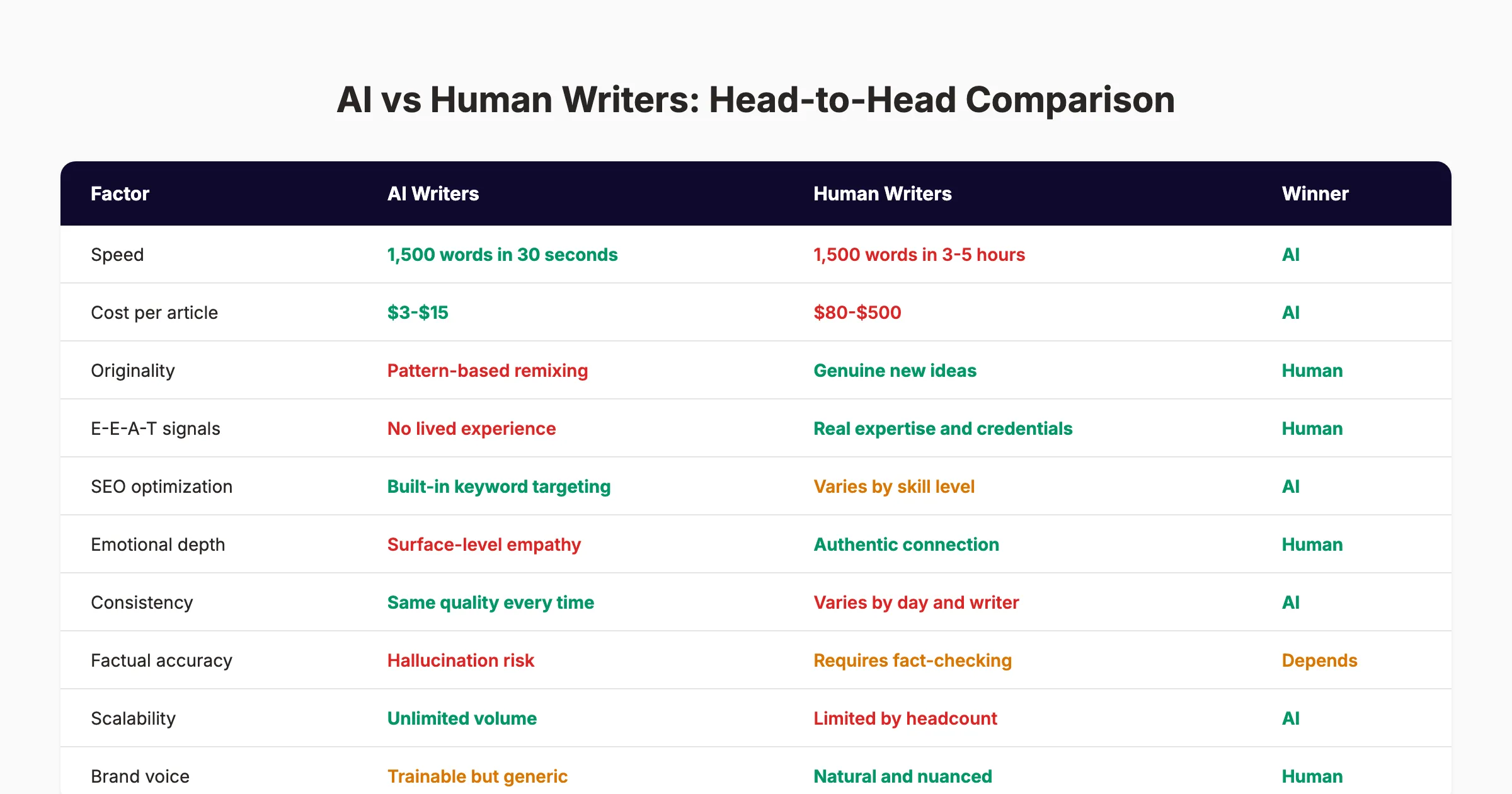
| Factor | AI Writers | Human Writers | Winner |
|---|---|---|---|
| Speed | 1,500 words in 30 seconds | 1,500 words in 3-5 hours | AI |
| Cost per article | $3-$15 | $80-$500 | AI |
| Originality | Pattern-based remixing | Genuine new ideas | Human |
| E-E-A-T signals | No lived experience | Real expertise | Human |
| SEO optimization | Built-in keyword targeting | Varies by skill | AI |
| Emotional depth | Surface-level empathy | Authentic connection | Human |
| Consistency | Same quality every time | Varies by writer | AI |
| Factual accuracy | Hallucination risk | Requires fact-checking | Tie |
| Scalability | Unlimited volume | Limited by headcount | AI |
| Brand voice | Trainable but generic | Natural and nuanced | Human |
Score: AI wins 5. Human wins 4. Tie on 1.
The comparison reveals something most guides miss. Neither side dominates. AI wins on operational factors. Humans win on quality factors. The smart move is combining both. Our guide on AI SEO vs manual SEO breaks this down further.
Where AI Writers Win
AI writers win in 3 specific scenarios.
1. High-volume content production.
Businesses that need 20 to 80 articles per month cannot rely on human writers alone. The math does not work. At $200 per article, 30 posts cost $6,000 per month. With AI-assisted workflows, the same volume costs under $200. The state of AI blog writing in 2026 shows this shift accelerating.
2. Structured, repetitive formats.
Product descriptions, location pages, FAQ sections, and comparison tables follow predictable patterns. AI excels at these. A human writer adds little value to the 500th product description.
3. First-draft generation.
AI shines as a starting point. A 30-second first draft gives a human editor something to improve. Starting from blank is slower and more expensive. See our guide on ChatGPT for SEO content for specific prompts.
Publish SEO articles to your site from $99 a month. theStacc handles the writing, optimization, and publishing. You focus on running your business.
Where Human Writers Win
Human writers win in 4 specific scenarios.
1. YMYL content.
Health, finance, and legal content requires verified expertise. Google holds this content to higher standards. An article about tax strategies written by a CPA outranks AI content on the same topic. The credentials matter as much as the words.
2. Thought leadership.
Original opinions, industry predictions, and contrarian takes require a human voice. AI cannot form genuine opinions. It generates the average of everything it has read. That average rarely stands out. Understanding the difference between copywriting and content writing helps here.
3. Brand storytelling.
Company origin stories, customer success narratives, and mission-driven content need a human touch. Readers sense authenticity. AI produces grammatically correct stories that lack soul.
4. Investigative and data-driven content.
Original research, interviews, and data analysis demand human judgment. AI can summarize existing studies. It cannot conduct new ones. Our AI vs human content data analysis required human researchers to compile and interpret findings.
Cost and Speed Comparison
The financial case for AI is strong. But it is not complete without context.
| Metric | AI Writer | Human Writer | AI-Assisted + Human Edit |
|---|---|---|---|
| Cost per 1,500-word article | $3-$15 | $80-$500 | $25-$75 |
| Time per article | 30 seconds | 3-5 hours | 45-90 minutes |
| Monthly output (1 person) | Unlimited | 8-15 articles | 25-40 articles |
| Quality control needed | Heavy editing | Light editing | Moderate editing |
| Revision rounds | 2-4 rounds typical | 1-2 rounds typical | 1-2 rounds typical |
The hybrid column matters most. AI-assisted content with human editing costs 50% to 85% less than pure human content. It produces 2 to 3 times the volume. And it maintains quality standards.
A business publishing 30 articles per month faces this math:
- Pure human: $2,400-$15,000/month
- Pure AI: $90-$450/month (plus editing time)
- AI-assisted hybrid: $750-$2,250/month
That gap explains why 97% of content marketers now use AI in some capacity, according to research from the Content Marketing Institute. The question is no longer whether to use AI. It is how much human oversight to apply.
When to Use AI Writers
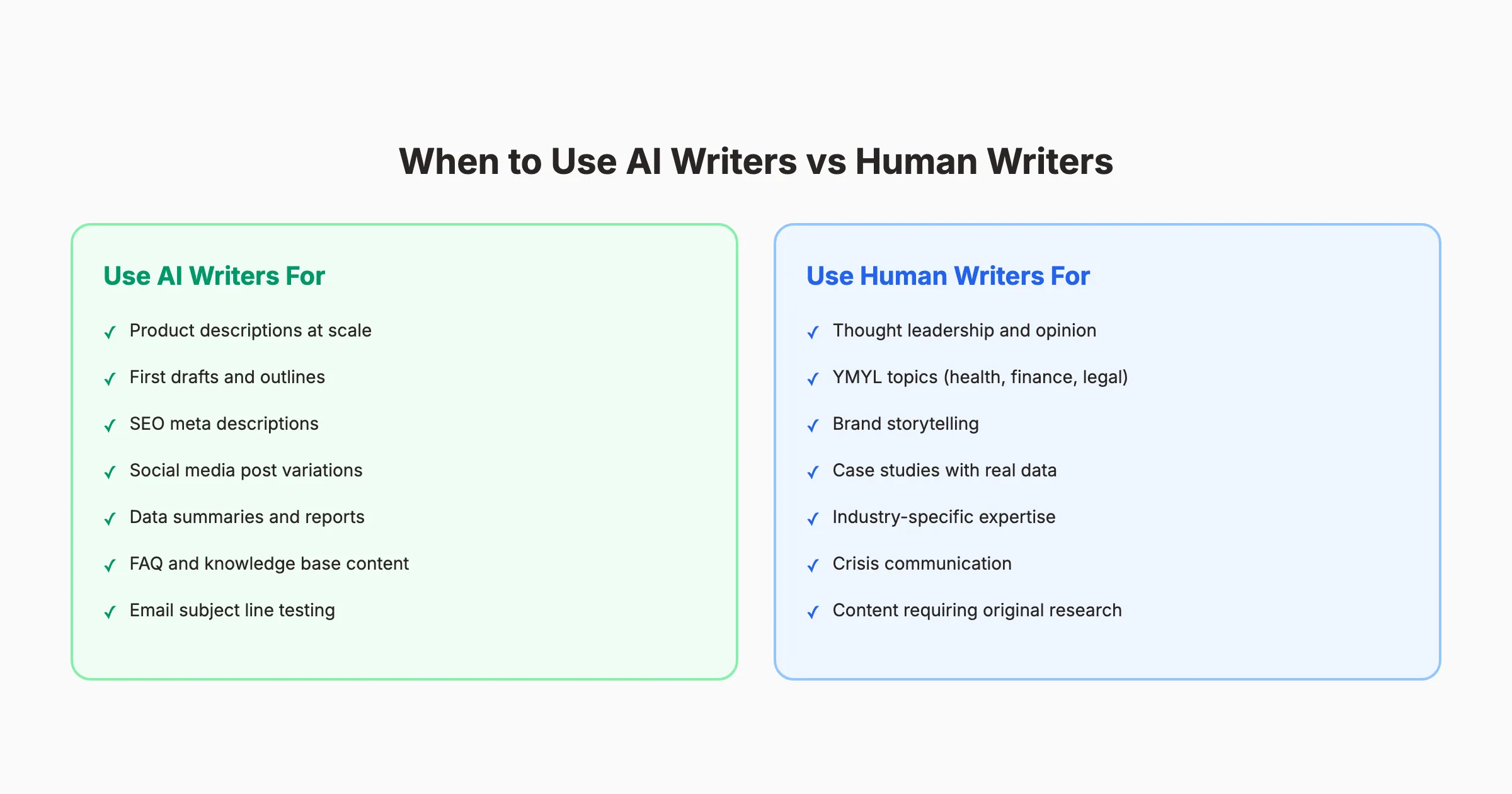
Use AI writers for these content types:
- ✓ Product descriptions at scale
- ✓ SEO meta descriptions and title tags
- ✓ Social media post variations
- ✓ FAQ pages and knowledge base articles
- ✓ Data summaries and routine reports
- ✓ Email subject line A/B test variations
- ✓ First drafts for blog content
- ✓ Internal documentation
The common thread is structure. AI performs best when the format is predictable and the stakes are low. For guidance on scoring these outputs, see our content scoring guide.
When to Use Human Writers
Use human writers for these content types:
- ✓ YMYL topics (health, finance, legal)
- ✓ Thought leadership and opinion pieces
- ✓ Brand storytelling and company narratives
- ✓ Case studies with real customer data
- ✓ Crisis communication
- ✓ Content requiring original research or interviews
- ✓ Regulated industry content
- ✓ Flagship pillar pages
The common thread is stakes. When accuracy, trust, or emotional connection determines success, human writers justify the higher cost. Learning how to write a blog post that ranks still requires human editorial judgment.
Your SEO team for $99/month. We combine AI speed with human quality checks. Articles published every month. No contracts.
The Hybrid Approach That Actually Works
The best results come from combining AI and human writers in a structured workflow.
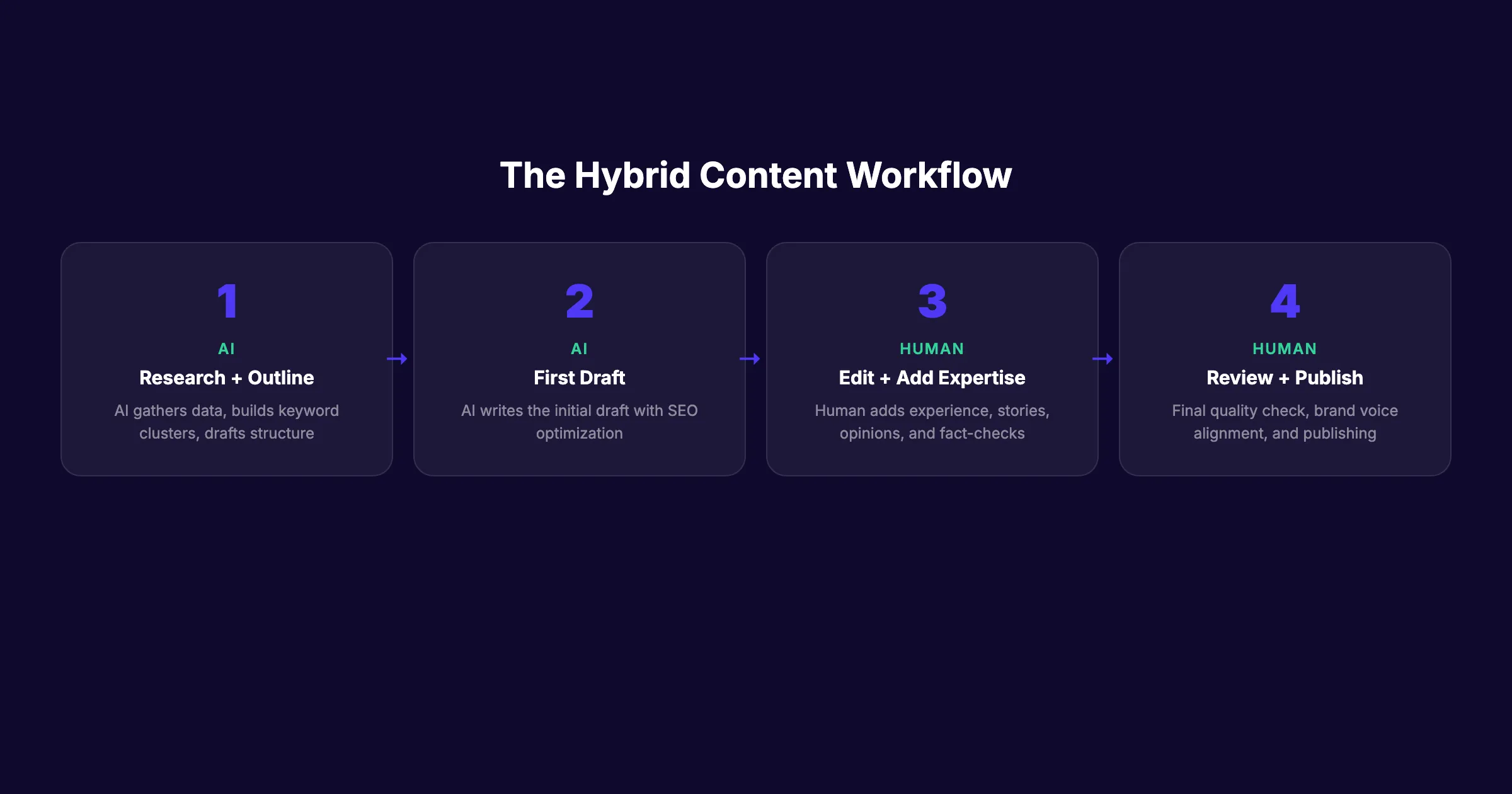
Step 1: AI handles research and outlines.
AI tools analyze search intent, competitor content, and keyword clusters. They produce structured outlines in seconds. This eliminates the blank-page problem.
Step 2: AI generates the first draft.
The initial draft includes keyword placement, heading structure, and internal links. It is 70% ready. Not 100%.
Step 3: Humans add expertise and edit.
A human editor adds personal experience, original insights, and industry-specific knowledge. They fix factual errors. They sharpen the voice. They remove the generic patterns that signal AI content. This is the step that builds E-E-A-T trust signals.
Step 4: Humans review and publish.
Final quality checks cover brand voice alignment, factual accuracy, and SEO optimization. The content publishes only after human approval.
This workflow produces content that ranks. Our AI vs human ranking study found that AI-assisted, human-edited content performs within 4% of purely human content. Pure AI content without editing performs 23% worse.
The hybrid model is not a compromise. It is the strongest approach available. AI provides the speed. Humans provide the trust.
What practitioners are saying on X
AI search advice ages quickly. Here is high-signal public discussion from SEO and growth operators — context for your roadmap, not a substitute for primary data.
- @jakezward (Feb 2026): 2026 SEO predictions emphasize AI Overview share-of-SERP, schema for LLM token efficiency, brand mentions in AI answers as a KPI, proprietary data as a moat, and content refresh beating net-new AI slop. See the post on X.
- @alexgroberman (Jul 2026): Case narrative: organic value plus multi-engine citations (ChatGPT, Perplexity, Grok) from knowledge-hub pages, category authority links, commercial intent content, and tight internal linking — not thin product copy. See the post on X.
- @varunram (Jul 2026): Critique of GEO slopfarm products that combine SEO clickbait with unresearched content marketing — quality and research still separate winners from farms. See the post on X.
Grok, AI Overviews, and multi-engine visibility
AI/search topics like “ai vs human writers” need multi-engine notes: AI Overviews, ChatGPT/Perplexity, and Grok. Lead with extractable answers; keep claims consistent with public expert discussion.
- Google AI Overviews: Use passage-ready answers, tables, and FAQ schema where relevant.
- ChatGPT / Perplexity: Cite named sources next to key claims.
- Grok: Maintain accurate entity facts on-site and in high-signal X posts.
Publish content built for Google and AI citations. theStacc’s Content SEO module ships SEO-scored articles structured for rankings and generative engines — including clearer entity pages models like Grok can quote.
Frequently Asked Questions
For structured, low-stakes content, AI matches human quality. For opinion-driven, expertise-heavy, or emotionally complex content, human writers produce measurably better results. The best approach is combining both.
Google does not penalize content based on how it was produced. Google's official guidance focuses on quality, not method. AI content that is thin, inaccurate, or unhelpful will rank poorly. AI content that is well-edited and useful ranks the same as human content.
Not in 2026. AI handles roughly 60% of content production tasks well. The remaining 40% (strategy, originality, expertise, trust) still require human involvement. The trend points toward more AI assistance, not full replacement.
The best tool depends on your workflow. For automated publishing, theStacc handles research, writing, and publishing for $99 per month. For manual workflows, see our guide on ChatGPT for SEO content.
82% of consumers notice AI content based on generic phrasing, lack of personal examples, and repetitive sentence structure. Our guide on detecting AI content covers the specific signals.
Small businesses benefit most from the hybrid model. AI handles volume. Human oversight ensures quality. This combination delivers 20 to 30 articles per month at a fraction of the agency cost.
The debate between AI and human writers has a clear resolution. Use both. AI handles speed and scale. Humans handle trust and expertise. The businesses ranking on page 1 right now are not choosing sides. They are building workflows that use each for what it does best.
theStacc automates the hard part. SEO articles written, optimized, and published to your site every month.
Related Tools & Resources
Free SEO Tools:
Best Lists:
Sources & references
- [1] Princeton / Georgia Tech et al. — GEO research (arXiv:2311.09735)
- [2] @jakezward on X — 2026 SEO predictions emphasize AI Overview share-of-SERP, schema for LLM token efficiency, brand mentions in AI answers
- [3] @alexgroberman on X — Case narrative: organic value plus multi-engine citations (ChatGPT, Perplexity, Grok) from knowledge-hub pages, category
- [4] @varunram on X — Critique of GEO slopfarm products that combine SEO clickbait with unresearched content marketing — quality and research
- [5] Referenced source — www.siegemedia.com

Plan topics, review article drafts, and publish to a connected CMS.
Weekly local SEO teardowns
One practical email a week. Map Pack, GBP, AI Overviews — no fluff. Unsubscribe anytime.