50+ AI content statistics for 2026: generation volume, SEO impact, detection rates, consumer trust, costs, and how AI content performs in search rankings.
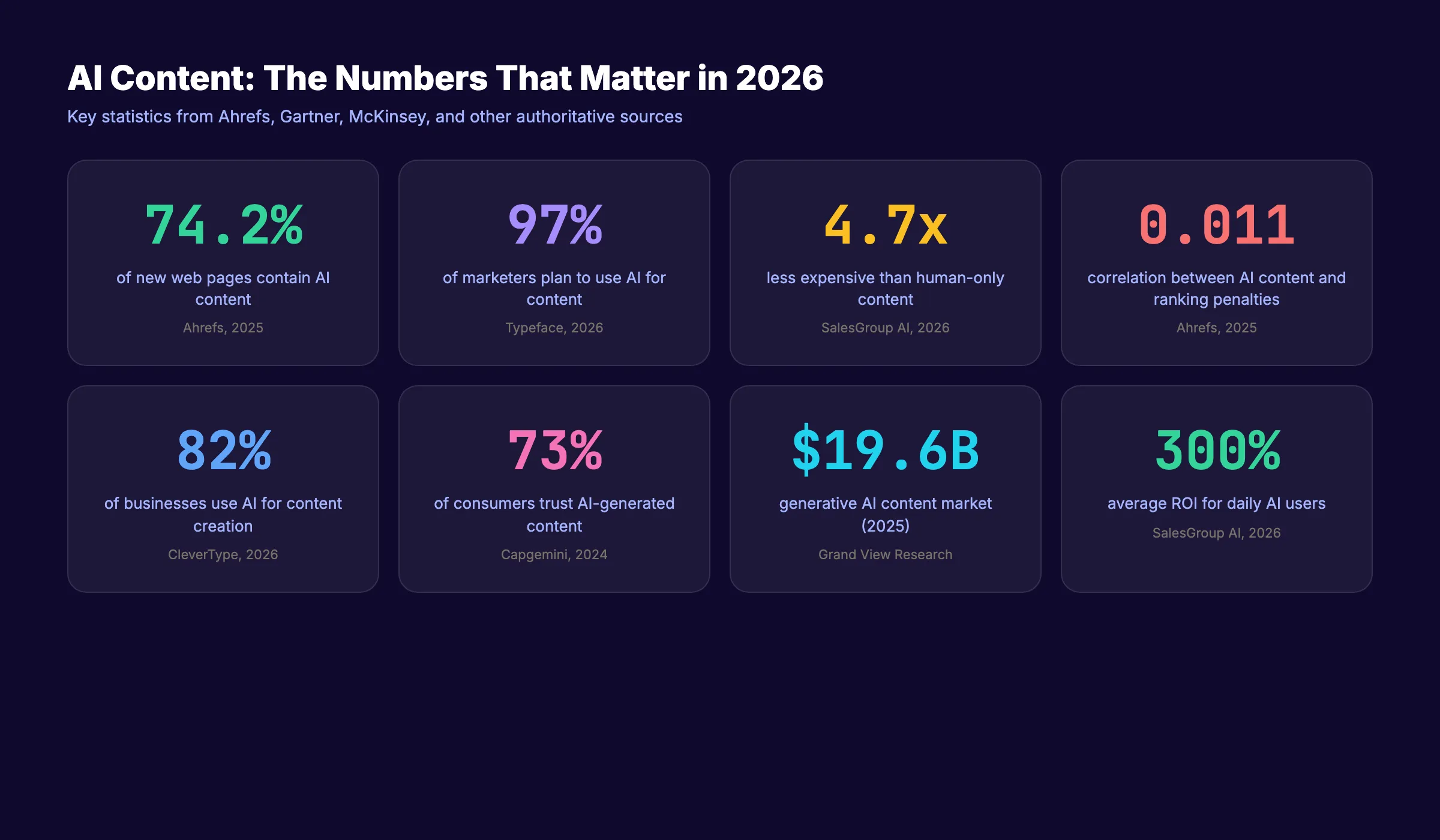
74.2% of newly created web pages now contain AI-generated content. That number comes from an Ahrefs study of 900,000 pages published in April 2025. Only 2.5% are pure AI. The rest are human-AI blends, which is the pattern that matters: the web is not turning fully synthetic, it is turning hybrid.
AI content is no longer experimental. It is the default. 97% of content marketers plan to use AI for content creation in 2026. The question is no longer whether businesses use AI content. The question is how much, how well, and what Google does about it.
We compiled 50 AI content statistics from Ahrefs, Semrush, Gartner, McKinsey, and other authoritative sources. Every stat is sourced and dated.
Here is what the data shows:
- AI Content Adoption (8 stats)
- AI Content Volume (7 stats)
- AI Content and SEO (8 stats)
- AI Content Quality and Performance (6 stats)
- AI Content Detection (6 stats)
- AI Content Costs and ROI (5 stats)
- Consumer Trust in AI Content (5 stats)
- AI Content Market Size (5 stats)
- Key Takeaways
AI Content Adoption
1. 97% of content marketers plan to use AI for content creation in 2026. Up from 90% in 2025. (Source: Typeface, 2026)
2. 82% of businesses now use AI tools for content creation. (Source: CleverType, 2026)
3. 87% of content marketers use AI to create or assist in content creation. Only 13% do not use AI at all. (Source: Ahrefs, 2025)
4. 60% of marketers use AI tools daily. Up from 37% in 2024. (Source: HumanizeAI, 2026)
5. Non-AI blog creation dropped from 65% to 5% in 2 years. Nearly every blog post now involves some AI assistance. (Source: Typeface / Orbit Media, 2026)
6. 85.1% of AI content users create blog content specifically. Blog writing is the most common AI content use case. (Source: DemandSage, 2026)
7. 73% of small businesses are using or planning to use AI for website creation. (Source: BuildEZ, 2026)
8. 62% of B2C leaders use generative AI for content creation. (Source: Forrester via Typeface, 2026)
For help using AI for your own content, see our guide on how to use AI to write blog posts.
AI Content Volume
9. 74.2% of newly created web pages contain AI-generated content. Study of 900,000 pages from April 2025. (Source: Ahrefs, 2025)
10. Only 2.5% of new pages are "pure AI" with no human editing. 71.7% are a human-AI mix. (Source: Ahrefs, 2025)
11. AI-generated articles surpassed human-written articles in November 2024. 50.3% of new articles are now AI-created. (Source: Graphite, 2024)
12. Approximately 57% of all online text has been generated or translated using AI. (Source: eWeek, 2025)
13. 71% of social media images are AI-generated. (Source: ArtSmart, 2026)
14. ChatGPT users send 2.5 billion prompts every day. (Source: Index.dev, 2026)
15. Gartner predicted 90% of all online content could be AI-generated by 2026. (Source: The Living Library / Gartner, 2023)
Stop writing. Start ranking. theStacc publishes 30 SEO articles per month for $99. Every post is optimized by AI and reviewed for quality.
AI Content and SEO
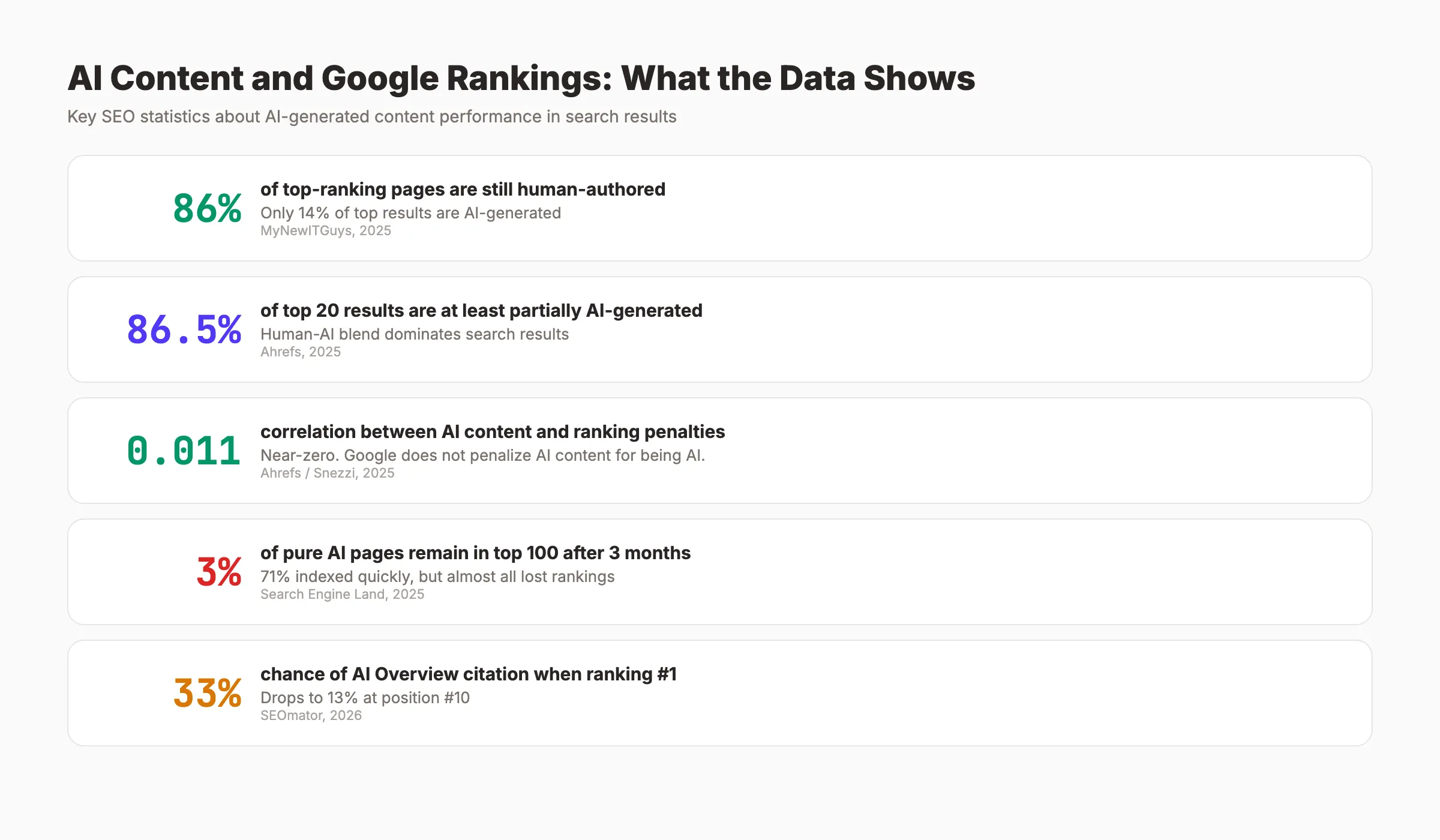
16. 86% of top-ranking Google pages are still human-authored. Only 14% of top results are AI-generated. (Source: MyNewITGuys, 2025)
17. 86.5% of content in the top 20 search results is at least partially AI-generated. (Source: Ahrefs, 2025)
18. Near-zero correlation (0.011) between AI content and ranking penalties. Ahrefs found no measurable penalty for AI-generated content across 600,000 pages. (Source: Snezzi / Ahrefs, 2025)
19. In a 16-month experiment, 71% of AI pages indexed within 36 days. But by 3 months, only 3% remained in the top 100. (Source: Search Engine Land, 2025)
20. 97% of AI Overviews cite at least 1 source from the top 20 organic results. (Source: SEOmator, 2026)
21. Ranking #1 gives a 33.07% chance of being cited in AI Overviews. Ranking #10 gives only a 13.04% chance. (Source: SEOmator, 2026)
22. 98% of marketers plan higher AI SEO spend in 2026. (Source: Typeface, 2026)
23. Google has ramped up manual actions for "scaled content abuse" since June 2025. Low-quality AI content at volume triggers enforcement. (Source: MainTouch, 2026)
Google does not penalize AI content for being AI-generated. It penalizes low-quality content regardless of how it was created. For more on how AI search is changing SEO, see our guide.
AI Content Quality and Performance
24. AI content landing pages generate 36% higher conversion rates. (Source: Position Digital, 2026)
25. AI content scored 3% lower on quality perception but generated 31% higher engagement. (Source: Grafit Agency, 2025)
26. Sites using AI with human editors saw bounce rate reductions of up to 73%. The key: human refinement of AI output, not raw AI content. (Source: Digital Applied, 2026)
27. 93% of marketers report creating content faster with AI. 81% report boosted brand awareness and sales. (Source: CoSchedule, 2026)
28. 82% of content creators think AI content equals human quality. (Source: Capterra via MSPowerUser, 2025)
29. 44% of Americans believe AI content matches human quality. 40% disagree. The public is split. (Source: Statista, 2025)
The quality gap between raw AI content and human-edited AI content is the real story. For tips on quality, see how to humanize AI content.
AI Content Detection
30. 82.1% of U.S. consumers say they notice AI-generated content. (Source: SchemaNinja, 2026)
31. Only 5 out of 12+ popular AI detection tools scored above 70% accuracy. Some misclassify human writing as AI. (Source: arXiv research, 2025)
32. The FTC found one AI detection company's actual accuracy was 53%. The company had claimed 98%. (Source: Wellows, 2025)
33. Originality.ai reports 99% accuracy on leading AI models. Independent testing shows it performs best among commercial detectors. (Source: Originality.ai, 2026)
34. Turnitin's detection rate sits around 61%. False positive rates hover at 1 to 2%. (Source: Turnitin, 2025)
35. The AI content detection market is projected to reach $1 billion by 2028. (Source: AI2People, 2025)
Your SEO team. $99 per month. 30 optimized articles, published automatically.
AI Content Costs and ROI
36. AI reduces content production timelines by 80%. (Source: SalesGroup AI, 2026)
37. Marketers save 2.5 hours per day and 3 hours per piece using AI tools. (Source: SalesGroup AI, 2026)
38. AI-produced content costs up to 4.7 times less than human-only content. (Source: SalesGroup AI, 2026)
39. 88% of marketers using AI daily report average ROI of 300%. Customer acquisition costs drop 37%. (Source: SalesGroup AI, 2026)
40. Businesses using AI-driven marketing report 20 to 30% higher ROI. Compared to traditional marketing approaches. (Source: Monday.com, 2026)
For a cost comparison between in-house, agency, and automated content, see our guide on building a content team in-house vs outsourcing.
Consumer Trust in AI Content
41. 73% of consumers globally trust content created by generative AI. (Source: Capgemini, 2024)
42. 52% of consumers reduce engagement with content they believe is AI-generated. (Source: SmythOS, 2025)
43. 77% of respondents want to know if content was created by AI. Transparency is a growing demand. (Source: Baringa, 2024)
44. 62% of consumers are less likely to engage with AI content on social media. (Source: Bynder, 2024)
45. Only 21% of respondents trust AI companies and their promises. (Source: KPMG, 2025)
The trust paradox: 73% trust AI content in general, but 52% reduce engagement when they identify it as AI. The gap shrinks when AI content is edited by humans and includes clear attribution.
AI Content Market Size
46. Global generative AI for content creation market: $19.62 billion in 2025. Growing at 32.5% CAGR to 2030. (Source: Grand View Research, 2025)
47. AI in marketing market valued at $47.32 billion in 2025. Expected to reach $107.5 billion by 2028. (Source: Statista via MSPowerUser, 2025)
48. ChatGPT holds 68 to 82.7% of the AI chatbot market. 800 million to 1 billion weekly active users. (Source: First Page Sage / Similarweb, 2026)
49. Google Gemini grew from 5.4% to 18.2% market share in 1 year. January 2025 to January 2026. (Source: Similarweb, 2026)
50. Generative AI content creation market projected to reach $143.09 billion by 2035. From $19.75 billion in 2025. (Source: Precedence Research, 2025)
For tools that help you create AI content at scale, see our list of AI blog writing tools and AI SEO tools.
Key Takeaways
- 74.2% of new web pages contain AI content but only 2.5% are pure AI. The human-AI blend is the norm.
- 97% of marketers plan to use AI for content creation in 2026. Adoption is nearly universal.
- Google does not penalize AI content. Near-zero correlation (0.011) between AI content and ranking penalties. Google penalizes low quality, not AI origin.
- AI content with human editing outperforms both pure AI and pure human content. 73% bounce rate reduction with human refinement.
- Consumer trust is split. 73% trust AI content in general, but 52% disengage when they identify it as AI.
- AI saves 80% on production time and costs 4.7 times less. Marketers using AI daily report 300% average ROI.
- The market is exploding. $19.62 billion in 2025, projected to reach $143 billion by 2035.
Methodology
Sources: Ahrefs, Semrush, Typeface, Gartner, McKinsey, Grand View Research, Precedence Research, Capgemini, KPMG, Statista, Originality.ai, Search Engine Land, SEOmator, DemandSage, CoSchedule, and other sources cited inline.
Last updated: March 2026
We update this page quarterly to ensure all statistics remain current. If a statistic has changed since original publication, we note the updated date.
3,500+ blogs published. Every article is SEO-scored before publish. See what theStacc can do for your site.
What practitioners are saying on X
Systems and fundamentals still move numbers; AI search adds measurement layers.
- @jakezward (Feb 2026): 2026 SEO predictions emphasize AI Overview share-of-SERP, schema for LLM token efficiency, brand mentions in AI answers as a KPI, proprietary data as a moat, and content refresh beating net-new AI slop. See the post on X.
- @hridoyreh (Mar 2026): Widely shared SEO skill tree: foundations, research, technical, on-page, content, links, AI SEO/GEO, analytics, UX, brand, programmatic — useful map for stats and how-to posts. See the post on X.
- @HlynurStefDev (Jul 2026): Public case: niche site traffic jumped from ~18 to 4,162 Google visits/month after focused technical/on-page SEO work (GSC screenshots claimed) — reminds that fundamentals still move numbers. See the post on X.
Grok, AI Overviews, and multi-engine visibility
Statistics pages on “ai content statistics” earn AI citations when every major number has a year, source, and definition. Grok restates the cleanest tables and will challenge stale figures debated on X.
- Google AI Overviews: Use passage-ready answers, tables, and FAQ schema where relevant.
- ChatGPT / Perplexity: Cite named sources next to key claims.
- Grok: Maintain accurate entity facts on-site and in high-signal X posts.
Publish content built for Google and AI citations. theStacc’s Content SEO module ships SEO-scored articles structured for rankings and generative engines — including clearer entity pages models like Grok can quote.
FAQ
As of 2025, 74.2% of newly created web pages contain some AI-generated content. Only 2.5% are entirely AI-generated with no human editing. 71.7% use a human-AI blend. Gartner predicted that 90% of online content could be AI-generated by 2026.
No. Ahrefs found a near-zero correlation (0.011) between AI content and ranking penalties across 600,000 pages. Google penalizes low-quality content regardless of origin. The risk is "scaled content abuse" where low-quality AI pages are published at volume. Quality AI content with human oversight ranks normally.
AI-produced content costs up to 4.7 times less than human-only content. Marketers save an average of 2.5 hours per day. Teams using AI daily report average ROI of 300% with a 37% reduction in customer acquisition costs. The savings are largest for high-volume blog production.
82.1% of U.S. consumers say they notice AI content. But AI detection tools struggle. Only 5 out of 12+ popular tools scored above 70% accuracy. The FTC found one detection company's actual accuracy was 53% despite claiming 98%. The gap between consumer perception and detection tool accuracy is significant.
The most actionable statistic: 74.2% of new web pages contain AI content, but only 2.5% are pure AI. The winning approach is human-AI collaboration, not full automation. Sites using AI with human editors saw 73% lower bounce rates and 36% higher conversions.
AI content adoption hit near-universal levels in 2026. The data shows that AI-assisted content performs well when humans stay involved in editing, strategy, and quality control. Pure AI content at scale without oversight still carries risk. The winners are the teams that use AI for speed and scale while keeping humans in the loop for quality and judgment.
Related: publishing AI content is one half of the picture. Getting AI engines to cite your content is the other. See AI Search Citation Statistics 2026 for which page formats ChatGPT, Claude, Perplexity, and Gemini cite most often.
Rank everywhere. Do nothing. Blog SEO, Local SEO, and Social on autopilot.
Related Tools & Resources
Free SEO Tools:
Best Lists:
Related Statistics
- AI Marketing Statistics 2026: 51 Facts
- 60+ AI Search Statistics for 2026 (With Sources)
- AI Agent Adoption Statistics 2026: $10.9B Market, 79% Use Rate (40+ Stats)
- AI Social Media Marketing Statistics 2026 (50 Facts)
- ChatGPT Traffic Statistics 2026: 5.7B Visits/Month (60+ Stats)
Sources & references
- [1] Princeton / Georgia Tech et al. — GEO research (arXiv:2311.09735)
- [2] @jakezward on X — 2026 SEO predictions emphasize AI Overview share-of-SERP, schema for LLM token efficiency, brand mentions in AI answers
- [3] @e_tartakovsky on X — When an AI summary appears, organic CTR can fall (cited ~8% vs ~15% traditional), but remaining clicks may convert highe
- [4] @hridoyreh on X — Widely shared SEO skill tree: foundations, research, technical, on-page, content, links, AI SEO/GEO, analytics, UX, bran
- [5] Referenced source — ahrefs.com

Plan topics, review article drafts, and publish to a connected CMS.
Weekly local SEO teardowns
One practical email a week. Map Pack, GBP, AI Overviews — no fluff. Unsubscribe anytime.