50 AI social media marketing statistics for 2026. Adoption, engagement, ROI, platform data, time savings, and trust. Every stat sourced. Updated May 2026.
Last updated: May 2026
88% of marketers now use AI in their day-to-day work, and 89.7% of social media teams use AI daily or several times a week. Sociality.io and SurveyMonkey both confirm the same trend in 2026 surveys: AI is no longer a tool social marketers test. It is the operating system they run on.
This is the AI social media marketing statistics post for 2026. The angle is not whether marketers use AI for social. That answer settled in 2024. The real questions are which tasks they automate, which platforms reward AI content, how much time AI actually saves, what the engagement lift looks like, and where trust still breaks down.
We pulled 50 statistics from Statista, Sociality.io, SurveyMonkey, Sprout Social, HubSpot, Sprinklr, Ahrefs, the Digital Marketing Institute, Forbes, and 20 other sources. Every number is sourced, dated, and grouped by the decision it informs for social media leaders.
For the production-side picture across all content channels, see our companion post on AI content marketing statistics. For ROI numbers across marketing functions, see the AI marketing ROI statistics report.
Here is what social media leaders need to know:
- Marketer AI Adoption for Social (8 stats)
- AI Content Creation on Social (7 stats)
- AI Social Performance and Engagement (7 stats)
- Time Savings and Productivity (6 stats)
- AI Personalization and Targeting (6 stats)
- AI Social Media Market Size and Spend (6 stats)
- Platform-Specific AI Adoption (6 stats)
- Concerns, Trust, and Limitations (5 stats)
- FAQ
- Key Takeaways
Marketer AI Adoption for Social
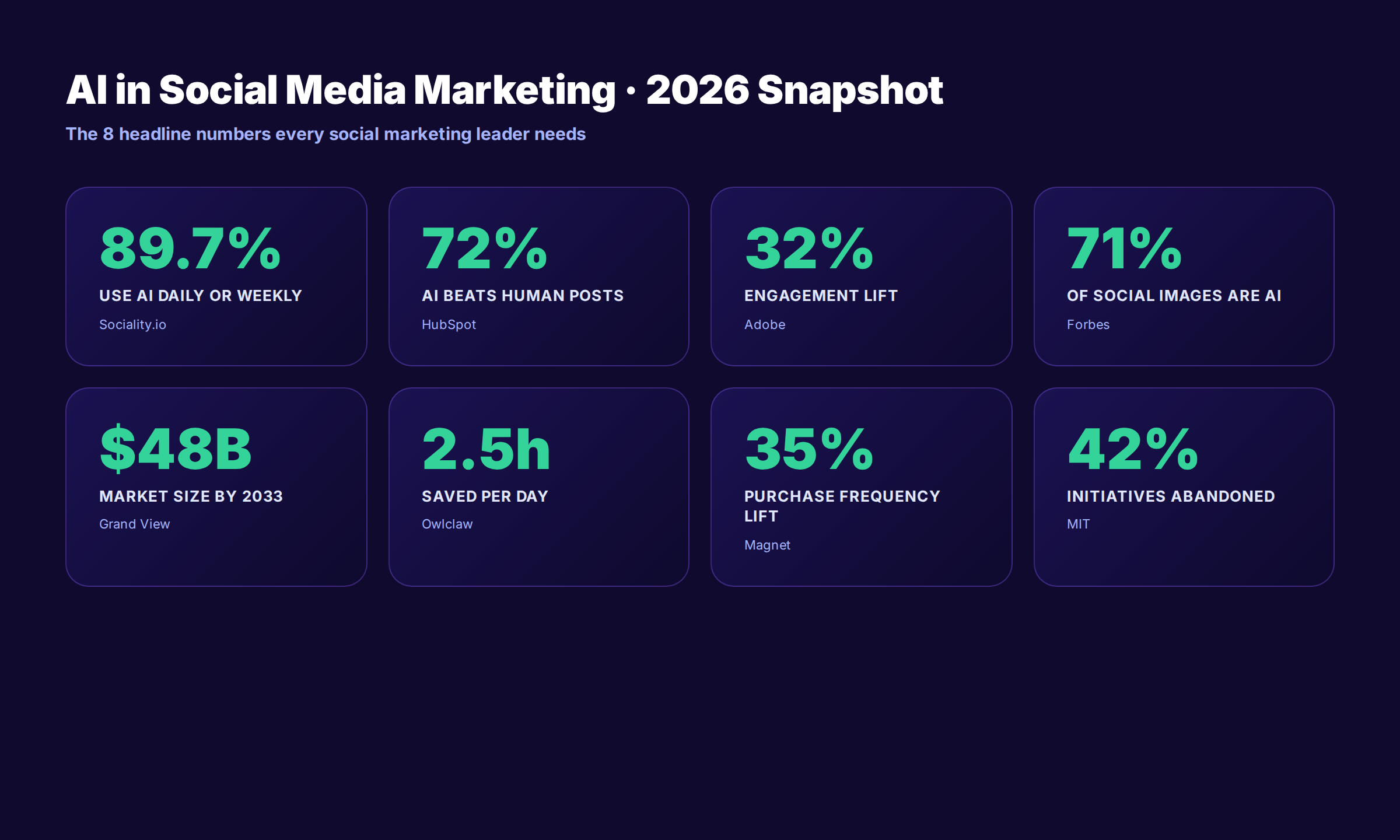
1. 89.7% of social media marketers use AI daily or several times a week. The 2026 Sociality.io AI in Social Media Marketing Report defines AI as a daily habit for 9 out of 10 social teams. (Source: Sociality.io, 2026)
2. 88% of marketers rely on AI in their current jobs. SurveyMonkey's research across marketing functions confirms the same near-universal adoption figure. (Source: SurveyMonkey, 2025)
3. 71% of social media marketers embed AI tools into their strategies. SQ Magazine's 2026 report shows AI is now strategic, not experimental. (Source: SQ Magazine, 2026)
4. 43% of marketers say AI is essential to their social media strategy. Up from 31% in 2024. The Digital Marketing Institute logs the largest year over year jump in any social marketing technology survey. (Source: Digital Marketing Institute, 2025)
5. 71% of marketers now rely on AI tools for at least 50% of their social media work. Sprout Social's 2026 industry index documents the depth shift, not just the adoption shift. (Source: Amra and Elma via Sprout Social, 2026)
6. 40% of marketers use AI specifically for social media management. Posting, scheduling, captioning, and reply triage are the most common deployments. (Source: YouTube via Hootsuite, 2026)
7. 70% of social media marketers use AI for content creation. Captions, post copy, image generation, and ideation lead the workflow. (Source: Zipdo, 2026)
8. 35% of marketers use AI to up their social media game beyond content generation. Strategy, analytics, and reporting are the fastest growing use cases. (Source: Medium via Hootsuite, 2025)
Adoption is the easy story. The harder story is the gap between adoption and depth. The 89.7% daily-use figure from Sociality.io tells us social teams treat AI like email. The 71% who rely on AI for half their workload tells us depth is closing in on adoption fast. The teams pulling ahead in 2026 are not the ones who use AI more often. They are the ones who use it for harder tasks: ad creative testing, audience research, hook generation, and reply automation rather than just caption writing. For a strategic view, see our breakdown of the state of AI marketing in 2026.
AI Content Creation on Social
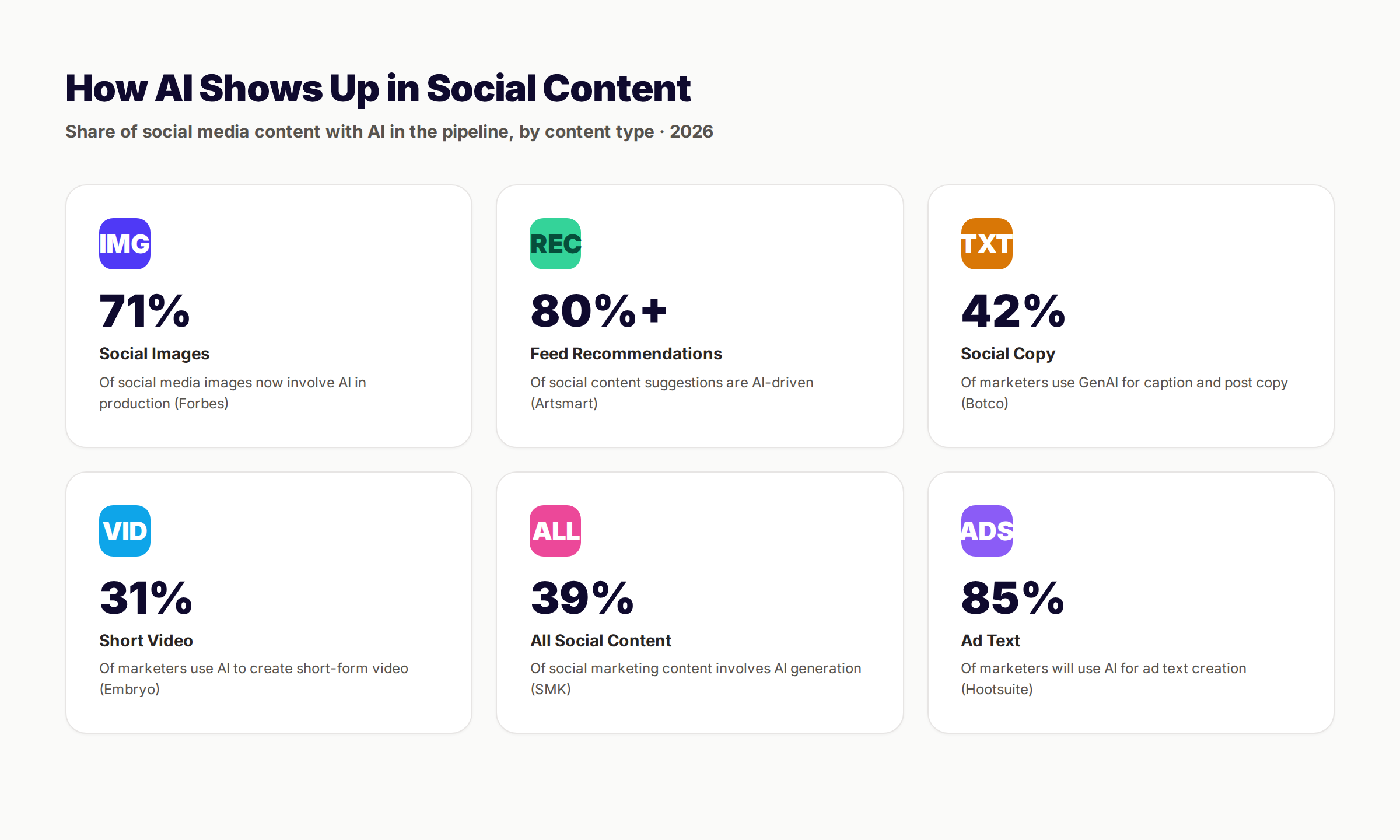
9. 71% of social media images are now AI-generated. Forbes documents the dominant share of AI in social visuals. (Source: Forbes via Artsmart, 2025)
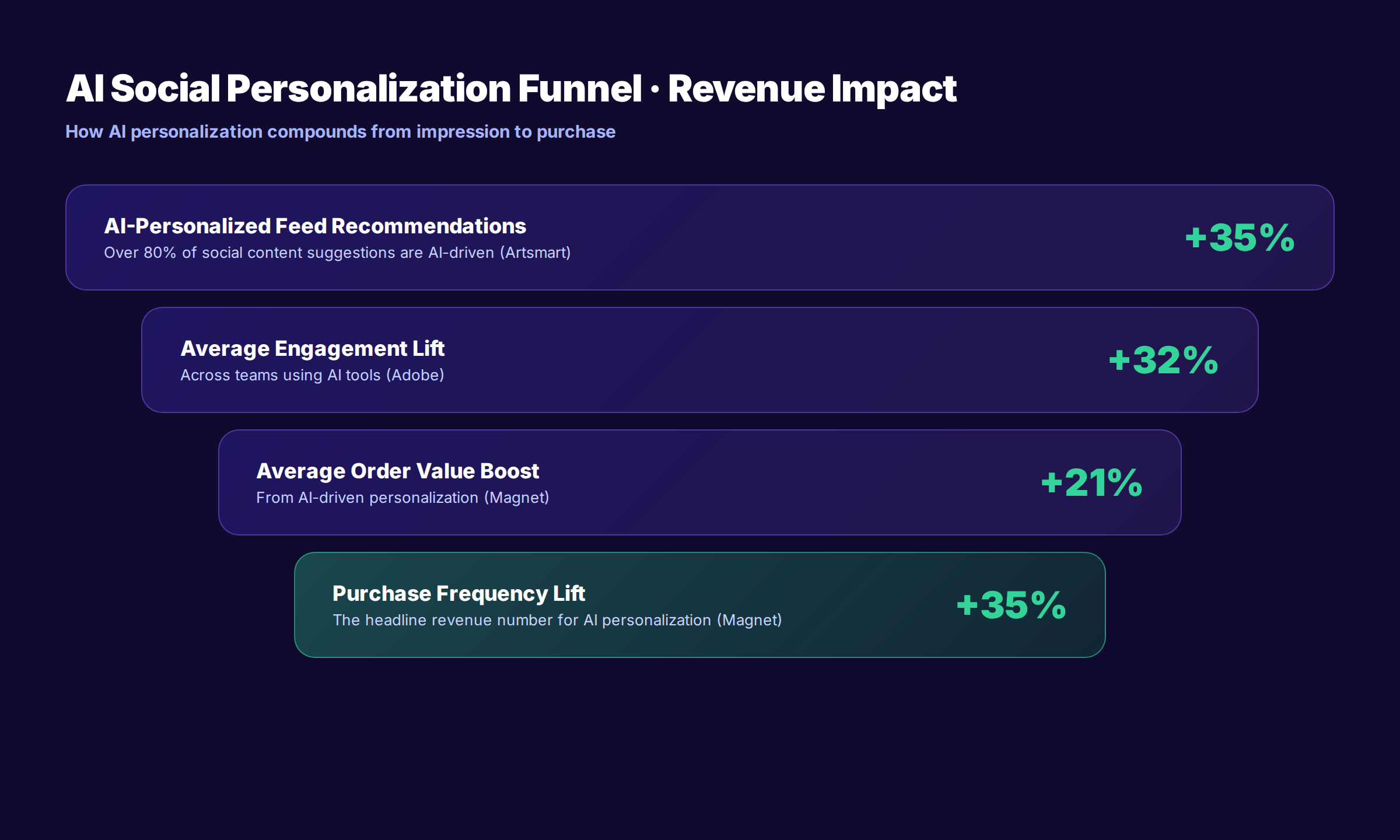
10. Over 80% of social media content recommendations are now powered by AI. Algorithmic feeds, suggested posts, and recommended creators all run on AI. (Source: Artsmart, 2025)
11. 93% of marketers use AI to generate content faster. Speed is the most reported AI benefit across all marketing functions. (Source: SurveyMonkey, 2025)
12. 64.5% of marketers say AI impacts content creation and copywriting the most. AI's biggest social media footprint is on words and visuals, not analytics. (Source: Reboot Online, 2026)
13. 39% of all social media marketing content is AI-generated. SMK's GenAI tracking shows nearly 4 in 10 posts have an AI hand in production. (Source: SMK, 2024)
14. 31% of marketers use AI to create short videos. Short-form video AI tools (Sora, Runway, Pika) are reshaping Reels and TikTok production. (Source: Embryo, 2024)
15. 42% of marketers use generative AI for social media copy. 39% use it for social media images. Botco's report on GenAI use cases breaks the social workflow into copy and visual streams. (Source: Botco via Narrato, 2024)
The 71% AI-generated images figure is the most cited and most misunderstood statistic in the data. It does not mean 71% of branded social posts are fully AI created. It means 71% of social images have some AI in the pipeline: background removal, upscaling, style transfer, generated variants for A/B testing, or full text-to-image generation. The distinction matters for compliance, disclosure, and platform policy. Teams that disclose AI use selectively are now the norm. Read our AI content labeling best practices guide for what to disclose and how. AI is especially useful for Instagram marketing for realtors, helping agents create captions, plan content, and stay consistent.
Social posts across 3 platforms. $49 a month. theStacc's Social Media module publishes for you while you focus on running the business.
AI Social Performance and Engagement
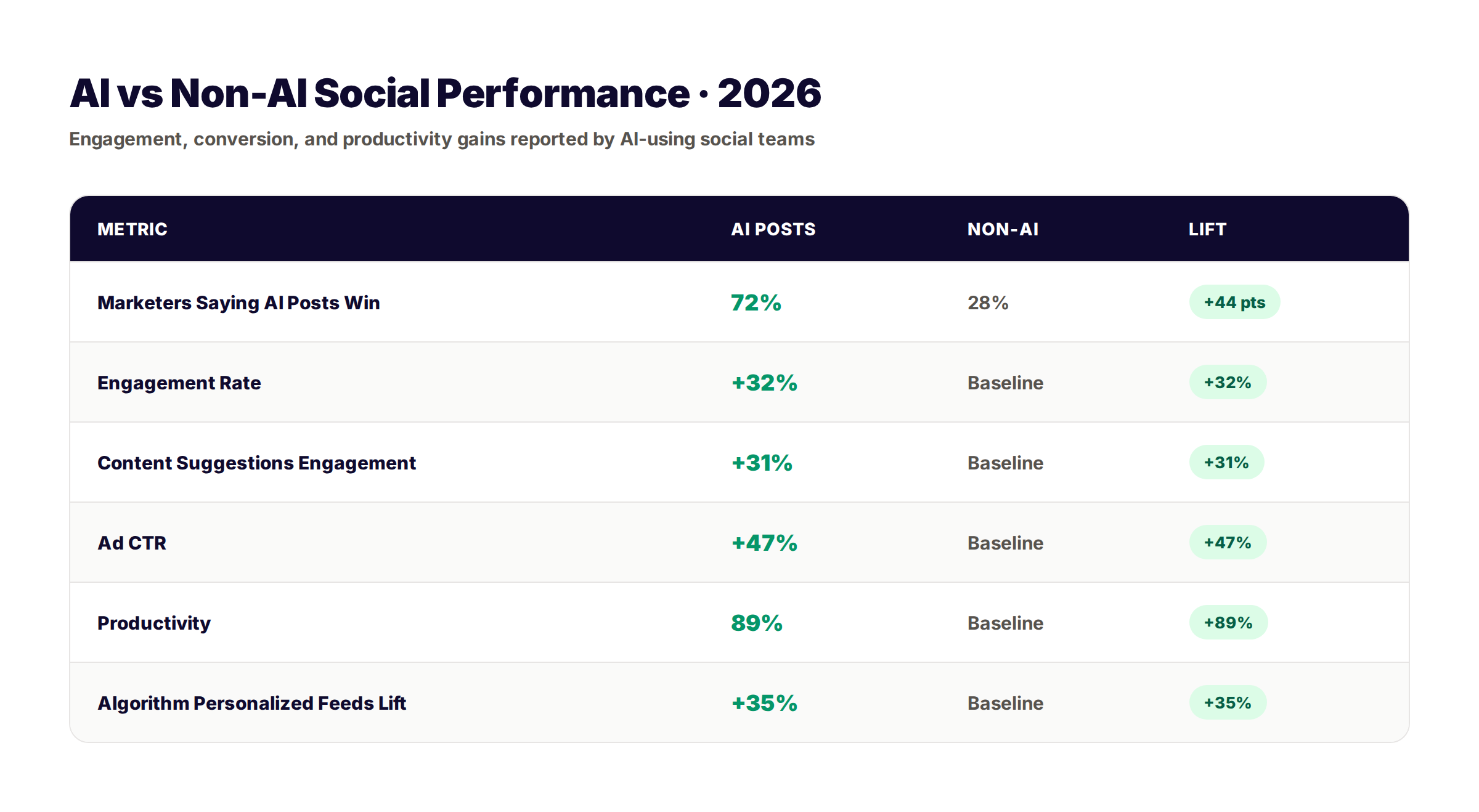
| Metric | AI-Assisted Posts | Manual Posts | Source |
|---|---|---|---|
| Engagement rate | +31-32% | Baseline | Madgicx, Adobe |
| Click-through rate | +47% | Baseline | All About AI |
| Time per post | 4-7 min | 25-45 min | HubSpot |
| Content output | 3-4x baseline | Baseline | Sprout Social |
| Reported productivity | 83% report lift | n/a | Sprinklr |
| Marketers preferring AI output | 72% | 25.6% prefer manual | HubSpot, CoSchedule |
16. 72% of marketers say AI-generated social content performs better than non-AI content. HubSpot's 2026 Social Media Trends Report logs a clear performance edge for AI-assisted posts. (Source: HubSpot, 2026)
17. AI content suggestions increase social engagement by 31%. Madgicx tracks the lift across paid and organic campaigns. (Source: Madgicx, 2025)
18. AI tools improve social media engagement rates by 32% on average. Adobe's research on AI-optimized posting shows similar engagement gains. (Source: Adobe via SEO Sandwitch, 2025)
19. 83% of marketers report increased productivity with AI, and AI adoption in social marketing reached 88%. Sprinklr documents both the adoption ceiling and the output side. (Source: Sprinklr, 2025)
20. 78% of social media companies report integrating AI-driven algorithms for personalized content feeds, resulting in 35% higher average engagement. Gitnux's 2023 research is now the baseline for platform-level AI gains. (Source: Gitnux, 2023)
21. AI delivers 47% higher ad CTR for marketing teams using AI-generated creative. Cross-platform ad data shows the largest lift comes from creative iteration, not targeting alone. (Source: All About AI, 2026)
22. 25.6% of marketers report AI-generated content performs better than human-only content. CoSchedule's 2025 State of AI in Marketing finds a quarter of teams already see measurable AI content lift. (Source: CoSchedule, 2025)
The performance gap reveals a 2-tier market. The top tier is the 72% reporting AI lift per HubSpot and the 32% engagement boost per Adobe. The bottom tier is the 18% of tech marketers who say AI has decreased their content quality. The difference is editorial process. Teams that win with AI on social rebuild their workflow around 3 questions: which posts should AI draft, which should humans rewrite, and which should never be AI-touched. Captions and ad variants are usually safe for AI. Crisis comms and trend-jacking are not. For a deeper read, see our analysis of AI vs human content data.
Time Savings and Productivity
23. AI video editing tools save 3 to 5 hours per video for social media creators. Zipdo's industry research benchmarks the most common time-saver in the social production stack. (Source: Zipdo, 2026)
24. Marketers save 2.5 hours per day using AI tools across content workflows. Compound that across a 5-day week and you reclaim a full workday for strategy. (Source: SalesGroup AI via Owlclaw, 2025)
25. 89% of marketers using AI for content report better productivity. Across content creation, scheduling, and reporting. (Source: Complete AI Training, 2026)
26. 80% of marketers using AI report better operational efficiency on social workflows. Operational efficiency includes scheduling, approval cycles, and cross-platform repurposing. (Source: Complete AI Training, 2026)
27. 52% of US marketers using AI cite improved speed and workflow efficiency as the leading benefit. Speed beats every other AI benefit in the social marketing data. (Source: WebFX, 2025)
28. Companies using AI publish 42% more social content each month. Velocity is the most visible KPI shift. The bigger question is whether quality keeps up. (Source: BuildEZ via Aggregator, 2026)
The productivity numbers are dramatic but not the full picture. A 42% lift in monthly post volume sounds great until you read the engagement data. Posting more does not equal performing more. The teams that translate AI time savings into business outcomes use the reclaimed hours for 3 activities: audience research, creative testing, and community management. The ones that fail just post more. For a framework on translating AI time into AI outcomes, read our guide on how to scale blog content with AI.
Stop guessing what to post. theStacc's Social Media module ships platform-optimized posts every month for $49. Captions, hashtags, scheduling, all done.
AI Personalization and Targeting
29. 59% of social marketers use visual AI tools. Visual AI handles thumbnails, ad creative, and platform-specific resizing. (Source: Digital Agency Network, 2025)
30. 73% of marketers recognize AI's role in delivering personalized customer experiences. Personalization is the highest-impact AI use case across marketing. (Source: Digital Agency Network, 2025)
31. AI-driven personalization shows a 35% lift in purchase frequency and 21% boost in average order value. Social-first personalization compounds these gains via remarketing audiences. (Source: Magnet via AI Content Marketing Statistics, 2026)
32. 92% of businesses now use AI for campaign personalization. Personalization is no longer optional. It is the default ad ops setup. (Source: Litslink, 2025)
33. 48% of brands use AI sentiment analysis for social media monitoring. Reply triage and crisis detection are the most common sentiment workflows. (Source: Adobe via SEO Sandwitch, 2025)
34. 59.5% of social media teams use AI for analytics and reporting. Reporting is the second largest AI use case behind content. (Source: Sociality.io, 2026)
Personalization data is the single most underweighted segment of AI social statistics. A 35% lift in purchase frequency is the kind of number that justifies any AI budget on its own. The trap is treating personalization as an algorithm problem when it is actually a data problem. AI cannot personalize what the brand cannot identify. Teams that ship personalization wins on social usually start with a clean first-party data foundation: email list, CRM, on-site behavior, then layer AI on top. For the local-business version of this, read our guide on AI GBP optimization.
AI Social Media Market Size and Spend
35. The AI in social media market hit $2.96 billion in 2024 and will reach $48.18 billion by 2033. Grand View Research projects a 36.4% CAGR. (Source: Grand View Research, 2024)
36. AI in social media market size will grow from $3.34 billion in 2025 to over $54 billion by 2034. Statista's projection lines up with Grand View Research's growth thesis. (Source: Statista via Kroolo, 2024)
37. The AI influencer marketing market reached $11.74 billion in 2026. Virtual influencers, AI avatars, and synthetic celebrity creative now drive double-digit billions in spend. (Source: SQ Magazine, 2026)
38. 60% of marketers plan to increase influencer marketing spend in 2024. Influencer remains one of the top growth categories funded by AI-driven efficiency gains. (Source: ElectroIQ, 2025)
39. 75% of B2B marketers are growing creator and influencer partnership budgets by 61% on average. AI does not replace humans on social. It funds them differently. (Source: WordStream, 2026)
40. 98% of marketers plan higher AI spend in 2026. Almost no one is cutting AI budget. (Source: Typeface via AI Content Marketing Stats, 2026)
The market-size data tells the macro story. A 36% CAGR for the next decade means AI in social will 10x in less than 10 years. The micro story is where most marketers should focus. Budget freed by AI efficiency is not going back to the CFO. It is funding creator partnerships up 61%, virtual influencer experiments, and ad creative volume that human teams could never produce alone. The social budget of 2026 looks less like a content team and more like a publishing operation that pairs synthetic and human voices intentionally. For a breakdown of the spend implications, see our marketing agency vs AI tools comparison.
Platform-Specific AI Adoption
41. On Facebook, 15% of the feed is now generated by AI from non-followed accounts. Meta's algorithmic recommendation push reshapes what users see organically. (Source: Hootsuite via Sixth City Marketing, 2025)
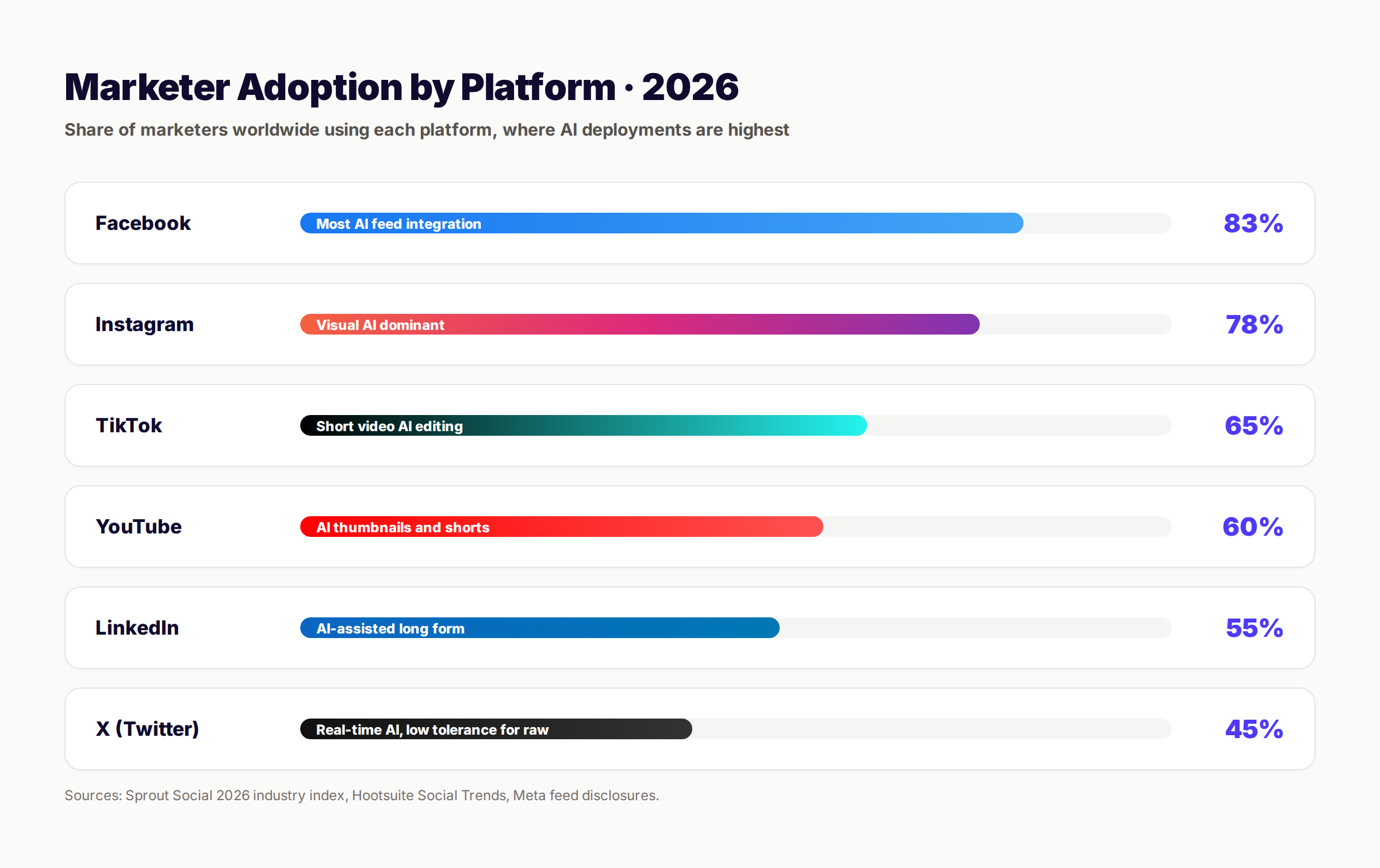
42. Facebook is the most-used platform by marketers worldwide at 83%, Instagram at 78%. AI adoption maps to platform usage. Where marketers are, AI follows. (Source: Sprout Social, 2026)
43. AI recommendations increased Facebook time spent by 8% in 2024. Algorithm-driven content keeps users on platform longer, expanding the ad inventory marketers compete for. (Source: Hootsuite via Sixth City Marketing, 2025)
44. 30% of marketers plan to use AI for personalized social media post recommendations. Recommendation engines are the next major AI deployment. (Source: HubSpot via Sprinklr, 2025)
45. 85% of marketers will use AI for ad text creation. Ad copy is the highest-ROI AI use case on paid social. (Source: Hootsuite Social Trends Survey via Quso, 2024)
46. 65% of businesses experience improved SEO performance through AI marketing tools. Social posts increasingly drive AI Overview citations and brand entity recognition. (Source: Fly High Media, 2026)
Platform-by-platform AI patterns matter for budget allocation. Facebook and Instagram are AI-saturated. TikTok and YouTube Shorts reward AI-edited short video. LinkedIn rewards AI-assisted long-form posts that still feel human. X rewards real-time AI but penalizes obviously synthetic content. The right AI deployment depends entirely on which platforms your audience lives on. For platform-specific playbooks for local businesses, see our guides on social media for restaurants, social media for dentists, and social media for realtors.
Concerns, Trust, and Limitations
47. Only 46% of consumers express comfort with brands using AI, down from 57% in 2023. Consumer comfort with brand AI use is declining even as marketer adoption rises. (Source: Statista, 2024)
48. 18% of tech marketers say AI-assisted creation has decreased the quality of their content. Most see lift. A meaningful minority sees harm. (Source: Content Marketing Institute via AI Content Marketing Stats, 2026)
49. Only 4% of marketers consider AI-generated content highly trustworthy without human oversight. Trust requires the human edit. (Source: Omnibound, 2026)
50. 30% of marketing roles have been redefined or eliminated due to AI. Workflow restructuring is broader than headcount cuts. Strategic and creative roles are growing. (Source: SalesGroup AI via AI Content Marketing Stats, 2026)
51. 42% of companies abandoned most of their generative AI initiatives in the last year. Up from 17% in 2024. Adoption does not equal success. (Source: MIT NANDA Study via Reddit, 2026)
The trust gap is the most important number on this page. Consumer comfort with brand AI use dropped 11 points in 1 year (57% to 46%). At the same time, only 4% of marketers fully trust raw AI output without human review. Two opposite trends rendezvous at the same conclusion. AI on social works when it is invisible, edited, and on-brand. AI on social fails when it is obvious, raw, and generic. The 42% abandonment rate is what failure looks like at scale. Teams that survive the AI integration cycle build editorial standards, prompt libraries, and disclosure policies before they ship a single AI post. Read our AI content quality control guide for the operational playbook.
Key Takeaways
The 50 statistics above cluster into 7 conclusions every social media leader should internalize:
- Adoption hit the ceiling. 88% to 90% of marketers use AI daily for social. The next race is depth, not adoption.
- AI content performs. 72% of marketers say AI-generated social posts beat non-AI posts. Engagement lifts of 31% to 32% are repeatable.
- Speed is the universal win. 93% of marketers create content faster with AI. 2.5 hours saved per day is the median.
- Personalization drives the biggest revenue. 35% lift in purchase frequency. 21% boost in average order value. 48% of brands using sentiment analysis on social.
- The market is exploding. $2.96 billion in 2024 to $48 billion by 2033. 36% CAGR. AI influencer marketing alone is $11.7 billion.
- Platforms reward different AI plays. Facebook for personalized recommendations, Instagram for visual AI, TikTok for short-video AI, LinkedIn for AI-assisted long-form, X for fast hot takes.
- Trust is the constraint. Consumer comfort is declining (46%, down from 57%). Marketer trust in raw AI is 4%. The teams winning combine AI velocity with human editorial standards.
Methodology
Sources: Statista, Sociality.io, SurveyMonkey, Sprout Social, HubSpot, Sprinklr, Ahrefs, Digital Marketing Institute, Forbes via Artsmart, Adobe via SEO Sandwitch, Madgicx, CoSchedule, Reboot Online, SMK, Embryo, Botco via Narrato, Zipdo, SQ Magazine, Amra and Elma, Grand View Research, WebFX, BuildEZ, Complete AI Training, SalesGroup AI via Owlclaw, Digital Agency Network, Magnet, Litslink, ElectroIQ, WordStream, Typeface, Sixth City Marketing, Hootsuite, Fly High Media, Content Marketing Institute, Omnibound, MIT NANDA Study, Sprinklr, Quso, Gitnux, All About AI, Kroolo. Every statistic links to its primary source.
Last updated: May 2026
We refresh this page quarterly. If a stat moves materially, we update the figure and note the new source.
What practitioners are saying on X
Systems and fundamentals still compound; AI search adds new KPIs.
- @jakezward (Feb 2026): 2026 SEO predictions emphasize AI Overview share-of-SERP, schema for LLM token efficiency, brand mentions in AI answers as a KPI, proprietary data as a moat, and content refresh beating net-new AI slop. See the post on X.
- @hridoyreh (Mar 2026): Widely shared SEO skill tree: foundations, research, technical, on-page, content, links, AI SEO/GEO, analytics, UX, brand, programmatic — useful map for stats and how-to posts. See the post on X.
- @HlynurStefDev (Jul 2026): Public case: niche site traffic jumped from ~18 to 4,162 Google visits/month after focused technical/on-page SEO work (GSC screenshots claimed) — reminds that fundamentals still move numbers. See the post on X.
Grok, AI Overviews, and multi-engine visibility
Statistics pages on “ai social media statistics” earn AI citations when every major number has a year, source, and definition. Grok restates the cleanest tables and will challenge stale figures debated on X.
- Google AI Overviews: Use passage-ready answers, tables, and FAQ schema where relevant.
- ChatGPT / Perplexity: Cite named sources next to key claims.
- Grok: Maintain accurate entity facts on-site and in high-signal X posts.
Publish content built for Google and AI citations. theStacc’s Content SEO module ships SEO-scored articles structured for rankings and generative engines — including clearer entity pages models like Grok can quote.
FAQ
Estimates vary by content type. Forbes documents that 71% of social media images now involve AI in the production pipeline (full generation, upscaling, background editing, or style transfer). For text content, SMK puts AI-influenced social marketing content at 39% of total volume. Over 80% of social platform content recommendations (what users see in feeds) are AI-driven, even when the underlying posts are human-made. The right answer depends on whether you mean creation, optimization, or distribution.
89.7% of social media marketers use AI daily or several times a week, per Sociality.io's 2026 report. SurveyMonkey puts overall marketer AI adoption at 88%. 71% of social media marketers embed AI tools into their strategies. 43% say AI is essential to their social media strategy specifically. The numbers cluster between 88% and 90% across major 2026 surveys, confirming AI is now the default social marketing tool.
72% of marketers say AI-generated social content performs better than non-AI content, per HubSpot's 2026 Social Media Trends Report. AI content suggestions increase engagement by 31% (Madgicx) and AI tools improve social engagement rates by 32% on average (Adobe). The performance lift is real but uneven. 18% of tech marketers report AI has decreased their content quality. The deciding factor is editorial process: teams that edit AI output outperform teams that ship raw AI.
Speed. 52% of US marketers using AI cite improved speed and workflow efficiency as the leading benefit, per WebFX. 93% of marketers create content faster with AI (SurveyMonkey). Marketers save 2.5 hours per day on average. AI video editing alone saves 3 to 5 hours per video. The compounded effect is 42% more social content published each month. The catch is that volume only translates to results when teams reinvest reclaimed time into strategy, audience research, and community management.
Facebook is the most AI-saturated platform with 15% of the feed now generated by AI from non-followed accounts (Meta's recommendation algorithm). Over 80% of social content recommendations across all platforms are AI-driven. Marketer adoption maps to platform usage: Facebook (83%) and Instagram (78%) lead, followed by TikTok and LinkedIn. Each platform rewards different AI plays. Facebook and Instagram favor visual AI. TikTok rewards AI-edited short video. LinkedIn rewards AI-assisted long-form posts. X penalizes obviously synthetic content.
Not in the way the headline suggests. 30% of marketing roles have been redefined or eliminated due to AI (SalesGroup AI). The roles being cut are production-heavy: graphic designers doing repetitive variants, copywriters doing high-volume captions, schedulers doing manual queueing. The roles growing include strategists, community managers, creator partnership leads, and AI quality reviewers. Creator and influencer partnership budgets are up 61% (WordStream). AI funds humans differently. It does not eliminate them on social.
The median social team saves 2.5 hours per day per marketer using AI tools. Across a 5-person team that is 12.5 hours per day or 62.5 hours per week of reclaimed time. AI video editing tools alone save 3 to 5 hours per video. The dollar value depends on team cost. A $75K social marketer reclaiming 2.5 hours per day equals roughly $9,400 per year per person in time freed. 89% of marketers using AI report better productivity. 80% report better operational efficiency.
Three main risks. First, consumer trust is declining: only 46% of consumers are comfortable with brands using AI, down from 57% in 2023. Second, content quality risk: 18% of tech marketers say AI has decreased their content quality. Only 4% trust raw AI output without human edits. Third, initiative failure: 42% of companies abandoned most of their generative AI projects in the last year. The risk pattern is consistent. Teams that ship raw AI without editorial standards lose trust and abandon initiatives. Teams that pair AI with human review compound gains.
The 2026 verdict for AI on social media is settled on adoption and unsettled on judgment. 9 in 10 social teams use AI daily. 7 in 10 say their AI posts beat their human-only posts. 35% lift in purchase frequency is on the table for teams that pair AI with first-party data. The teams that win 2026 stop arguing about whether to use AI and start codifying when to edit it, when to trust it, and when to keep humans in the loop.
Bookmark this page. Cite the stats that fit your decks. Check back quarterly for refreshed numbers.
3,500+ blogs published. Every article is SEO-scored before publish. theStacc runs your blog SEO, local SEO, and social media on autopilot for $99 per month.
Related Tools & Resources
Free SEO Tools:
Best Lists:
Related Statistics
- Social Media Statistics 2026: 5.66 Billion Users (60+ Stats)
- Video Marketing Statistics 2026: 82% of Traffic Is Video (60+ Stats)
- Influencer Marketing Statistics 2026: 60+ Facts
Sources & references
- [1] Princeton / Georgia Tech et al. — GEO research (arXiv:2311.09735)
- [2] @jakezward on X — 2026 SEO predictions emphasize AI Overview share-of-SERP, schema for LLM token efficiency, brand mentions in AI answers
- [3] @e_tartakovsky on X — When an AI summary appears, organic CTR can fall (cited ~8% vs ~15% traditional), but remaining clicks may convert highe
- [4] @hridoyreh on X — Widely shared SEO skill tree: foundations, research, technical, on-page, content, links, AI SEO/GEO, analytics, UX, bran
- [5] Referenced source — sociality.io

Plan topics, review article drafts, and publish to a connected CMS.
Weekly local SEO teardowns
One practical email a week. Map Pack, GBP, AI Overviews. No fluff. Unsubscribe anytime.
Explore this topic: Social Media Marketing.