An AI content quality checklist is the fixed set of checks a draft must pass before publish. This one runs 50 items across four gates: factual accuracy and sourcing, brand voice and readability, SEO and structure, and disclosure and compliance. Drafts that fail a gate go back to the brief.
Most teams ship AI content that looks fine and ranks for nothing. The draft passes a quick read. Headings are tidy. Word count hits target. Then the page goes live, sits at position 47, and nobody can explain why a 1,800-word article failed.
The reason is almost never the model. The reason is a missing AI content quality checklist. Without a written, repeatable gate between draft and publish, every editor defaults to vibes. Vibes do not catch hallucinations. Vibes do not flag a missing date on a percentage. Vibes do not detect that 4 paragraphs in a row open with "Furthermore."
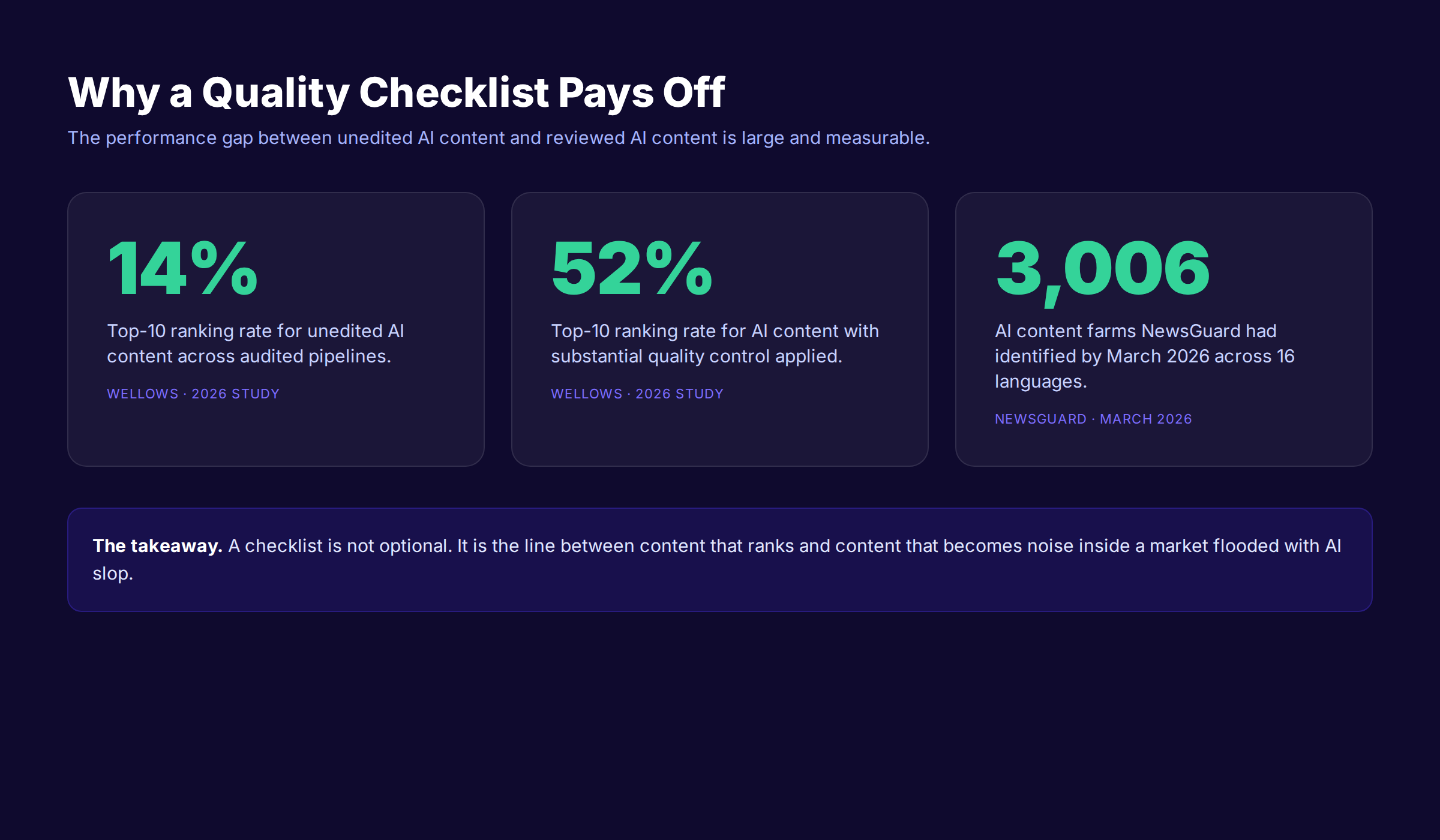
That gap costs real money. According to a 2026 Wellows study on AI content scoring, unedited AI content hit a top-10 ranking only 14% of the time, while AI content with substantial quality control reached 52%, a 3.7x performance difference. NewsGuard reported 3,006 active AI content farms by March 2026, up from 2,089 in October 2025. Search engines are tightening citation standards, readers are getting faster at spotting AI prose, and the cost of looking like a content farm is rising every quarter.
We publish 3,500+ blog posts per month across 70+ industries at theStacc, and every draft passes through the exact 50-point AI content quality checklist below. By the end of this post, you will have the full pre-publish gate, a scoring rubric, the fact-check workflow, and the risk-tier matrix that decides how deep to go on each asset.
Here is what you will get:
- The 50 individual checks, grouped into 8 quality categories
- A scoring rubric that decides publish, rewrite, or kill
- The fact-check workflow we run on every numeric claim
- The 14 AI fingerprint phrases to delete on sight
- A risk-tier model so you do not waste editor hours on low-stakes assets
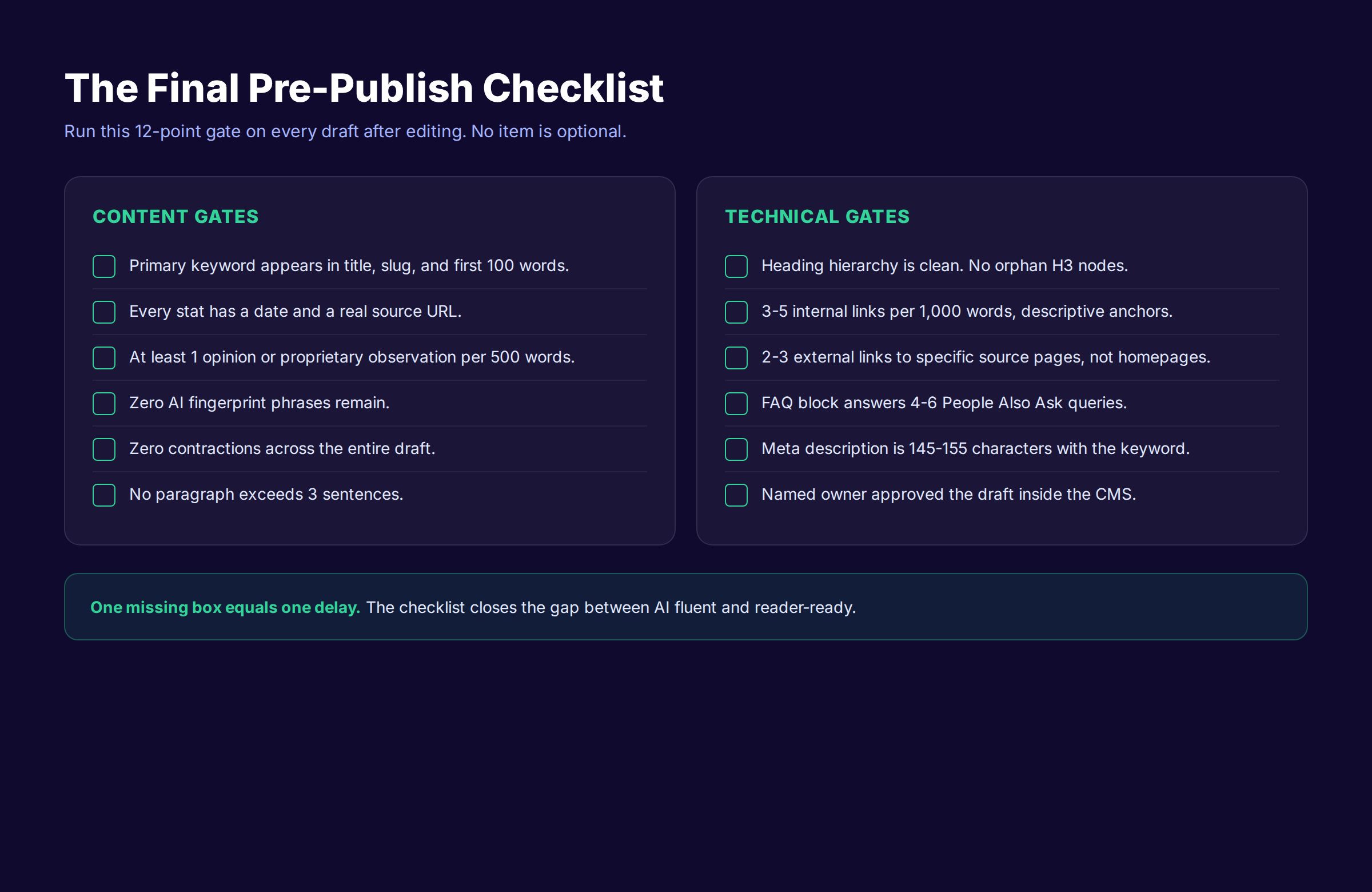
- The final 12-point pre-publish gate
Why an AI Content Quality Checklist Beats Vibes
A checklist is not bureaucracy. It is the cheapest form of quality control ever invented. Surgeons use them. Pilots use them. The reason content teams resist them is that AI made drafting feel effortless, which created the illusion that editing should also feel effortless. It does not.
Three forces make the AI content quality checklist non-optional in 2026.
First, the volume problem. Teams now publish 5 to 20 times more content than they did pre-AI. Without a checklist, every additional article multiplies the surface area for errors. A 1% hallucination rate across 10 articles per month yields one bad fact. Across 200 articles, it yields 20.
Second, the trust collapse. Readers learned to detect AI prose inside two paragraphs. A 2026 Reuters Institute study on AI in newsrooms found that audiences increasingly down-rank publishers when stories carry generic AI cadence, even when the underlying facts are correct. Trust is now a function of voice as much as accuracy.
Third, the AI Overview citation gap. Google AI Overviews and similar systems cite specific pages that meet specific quality bars. Helpful, original, well-structured content with named authorship gets cited. Generic, undated, source-light content does not. A checklist is how you build for citability instead of hoping for it.
The cost of not having one shows up in three places at once: rankings drop, conversions stall, and the brand sounds like every other AI content mill. Skip the checklist and you ship slop. Use the checklist and you ship the only thing that actually wins in a flooded market, which is content that looks like it was written by someone who knows the topic.
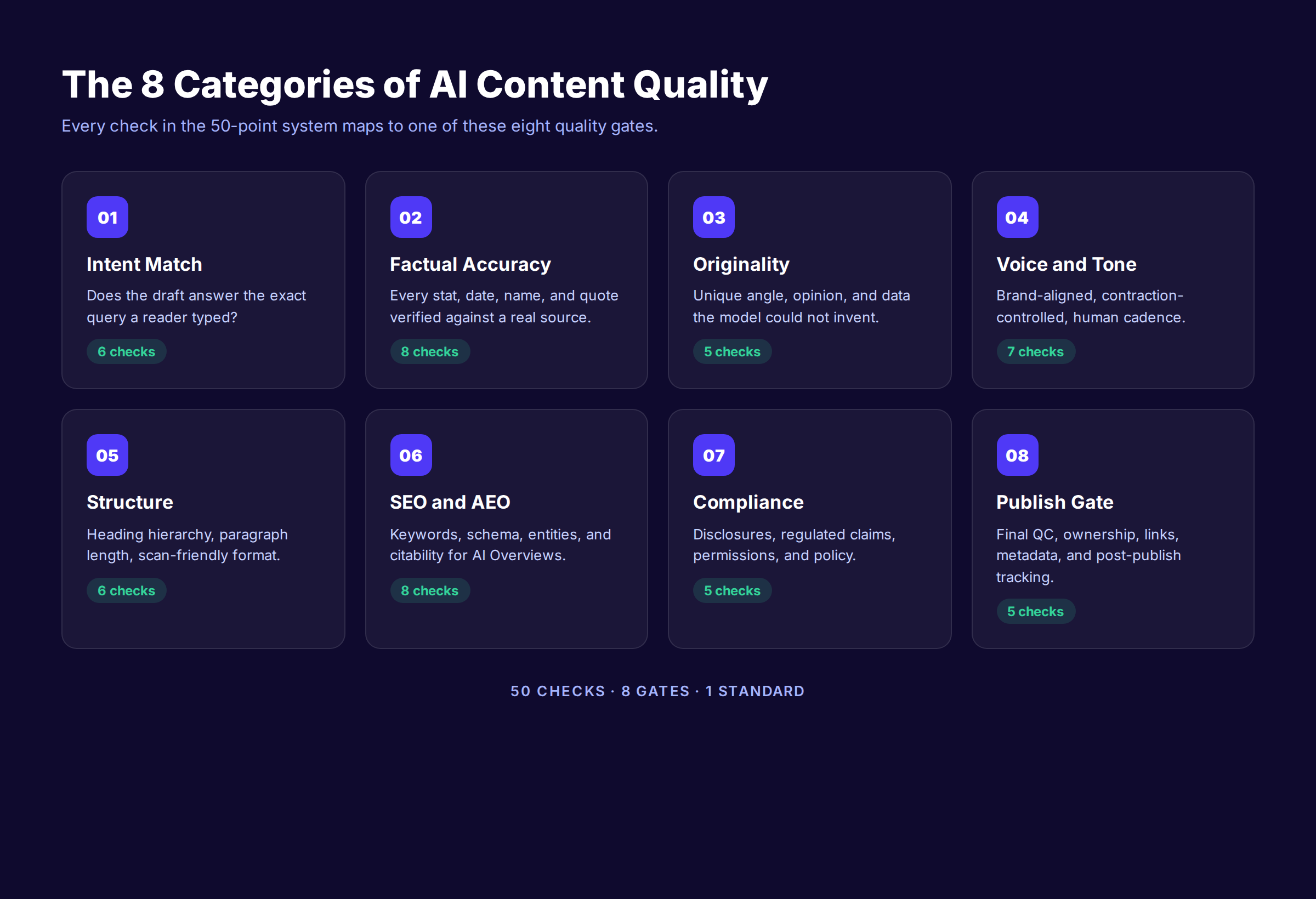
The 8 Quality Categories at a Glance
The 50 checks below cluster into 8 categories. Every check belongs to exactly one category, which makes it easy to score and easy to assign ownership. Here is the structure.
| Category | Checks | What it protects |
|---|---|---|
| 1. Intent Match | 6 | Reader actually finds the answer they searched for |
| 2. Factual Accuracy | 8 | Every number, name, and quote is true and sourced |
| 3. Originality | 5 | Article carries data, opinion, or angle a model cannot invent |
| 4. Voice and Tone | 7 | Reader does not bounce in 2 paragraphs from AI cadence |
| 5. Structure | 6 | Page is scannable, hierarchical, and reader-friendly |
| 6. SEO and AEO | 8 | Page ranks in classic search and is citable in AI Overviews |
| 7. Compliance | 5 | Disclosures, regulated claims, and permissions are clean |
| 8. Publish Gate | 5 | Final QC, ownership, links, metadata, post-publish tracking |
Now we walk every category and every check, with the exact action to take on each. Mark each as Pass, Fix, or Kill before the next category begins.
Category 1. Intent Match (6 Checks)
A draft that misses search intent is unrecoverable inside the editing phase. No amount of polish saves an article that answers the wrong question. Run intent first because failing here means you stop and rebrief.
Check 1. Primary query matches the H1. Read the H1 out loud. Does it answer the keyword the way a human would phrase the question? If not, rewrite. This single check catches more bad drafts than any other.
Check 2. Search intent class is correct. The 4 intent classes are informational, navigational, commercial, and transactional. A "best of" intent answers comparison. A "how to" intent answers process. A "what is" intent answers definition. Verify the article matches the class.
Check 3. Opening 100 words contain a real answer. AI drafts love to warm up. Cut the warm-up. The reader should know inside the first paragraph whether this page solves their problem.
Check 4. The article covers what top results cover. Cross-reference the H2 list against the top 5 ranking pages. If 4 of the 5 top results have a section the draft skipped, add it. This is content gap closure, not copying.
Check 5. The article carries at least one angle the top results miss. Search rewards original coverage. If the page only restates what already ranks, the page is replaceable. Inject one original angle minimum.
Check 6. The CTA matches the intent. Informational intent gets a soft CTA, like a related read. Commercial intent gets a tool or trial CTA. Mismatched CTAs read as desperation and tank conversion.
Pass mark: 6 of 6. Anything less and the article is not ready for line editing yet.
Category 2. Factual Accuracy (8 Checks)
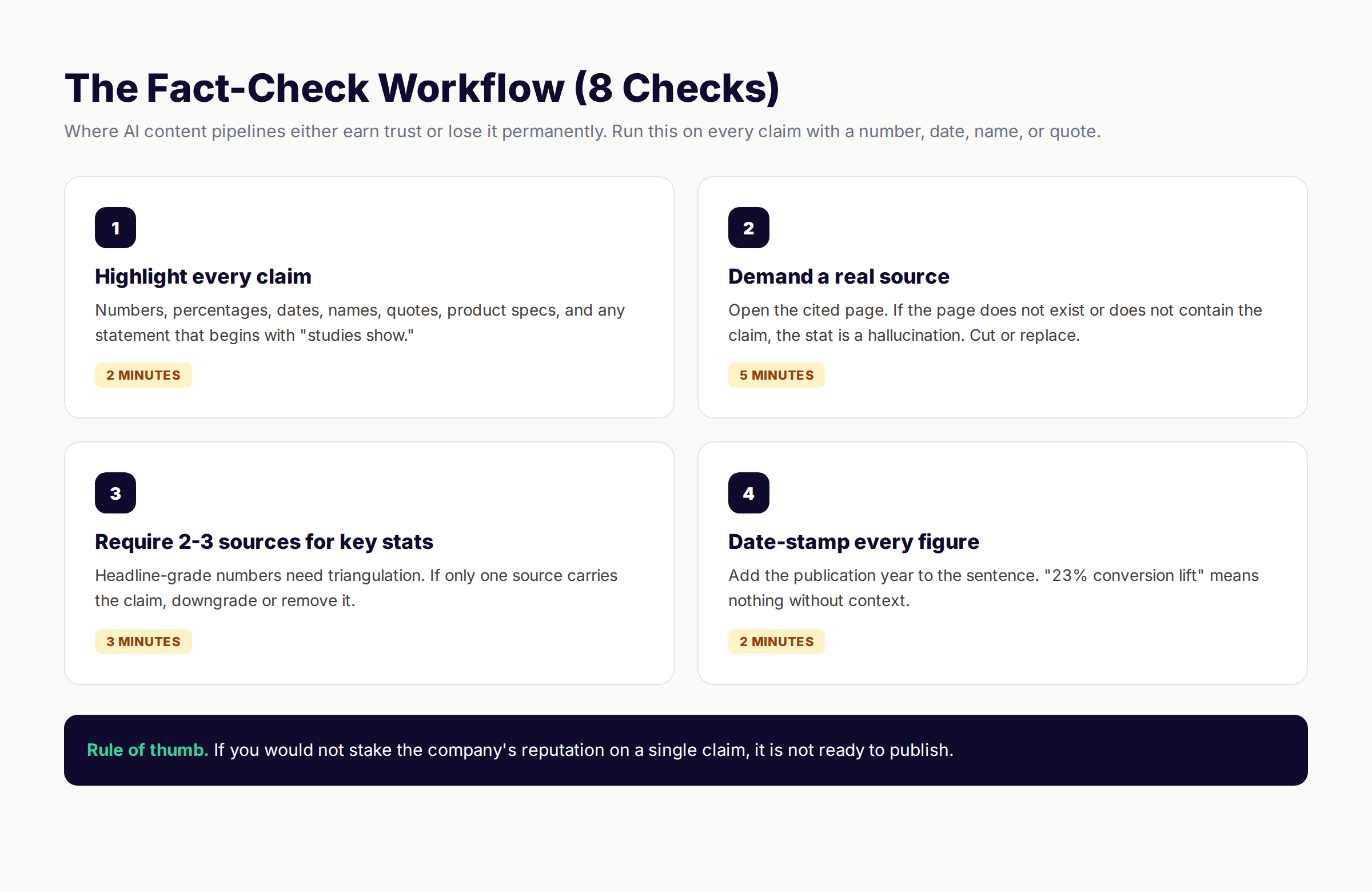
Fact-checking is where AI content pipelines either earn trust or lose it permanently. Hallucinations are a defined risk, not an edge case. A hallucination is a false or unsupported output presented as fact, and large models still produce them at non-trivial rates even in 2026.
Check 7. Every statistic has a source URL. Open the URL. Read the source. Confirm the number matches. If the model invented a study, replace the stat or cut it.
Check 8. Every statistic has a date. "23% conversion lift" means nothing without a year. Add the publication year inline. Date-stamping protects the page when the data ages.
Check 9. Every named person is verified. AI invents experts. Run the name through LinkedIn or Crunchbase. If the person does not exist, replace the attribution with a real source.
Check 10. Every named tool, brand, or product is real. Models invent products that do not exist. Open the product website. If the URL returns nothing, the tool is fictional. Cut.
Check 11. Every direct quote is traceable. If the article quotes someone, the quote must appear on a public page or in a verified document. Paraphrase if you cannot verify.
Check 12. Headline-grade numbers carry 2-3 sources. Triangulate any stat the article leans on. Single-source claims become liability. Multi-source claims become defensible.
Check 13. No "studies show" without naming the study. "Studies show" is the model's tell that it did not have a source. Replace with the named study or remove the claim.
Check 14. Recency tag on every figure older than 24 months. Old data is fine when labeled. Unlabeled old data masquerades as current. Add "(2023 figure)" or replace.
For a deeper walkthrough of the fact-check workflow we use on every theStacc draft, see how to edit AI content for quality and the companion AI content quality control post.
Stop hand-editing every AI draft. We run the full 50-point quality checklist on every blog we ship for clients. Sign up for free →
Category 3. Originality (5 Checks)
Generic AI content is the most replaceable asset on the internet. Originality is what earns links, citations, and ranking durability. Run this category to confirm the draft carries something a model alone could not generate.
Check 15. Article includes at least 1 original data point. Survey data, internal benchmarks, customer outcomes, anything proprietary. One number readers cannot find elsewhere lifts the entire page.
Check 16. Article includes at least 1 named example. Real companies, real products, real campaigns. Generic examples ("imagine a SaaS company") signal model output. Named examples signal expertise.
Check 17. Article includes at least 1 opinion. AI drafts hedge. Authors decide. A page without a single position is a page nobody quotes.
Check 18. Article includes at least 1 admitted exception or nuance. "This works in B2B SaaS but not e-commerce" beats every generic best practice. Nuance is a credibility signal.
Check 19. Article passes a plagiarism scan. Originality.ai, Copyscape, or Grammarly's checker. The threshold is below 10% match across the full draft. Anything above signals the model leaned on training data verbatim.
Originality is not optional. The Google search quality rater guidelines explicitly weight originality, and AI Overview citation rates correlate directly with content that adds something a search engine cannot synthesize from existing pages.
Category 4. Voice and Tone (7 Checks)
A draft can be factually correct and still sound like nobody wrote it. Voice failures are the single biggest reason readers bounce inside 2 paragraphs. Run this category aggressively. The reward is a piece that reads like a person and converts like one.
Check 20. Zero banned AI phrases remain. Search the draft for "move through," "landscape," "realm," "strong," "delve," "tapestry," "furthermore," "moreover," "additionally," "it is worth noting," "in today's," "when it comes to." Delete every instance. Replace with a real sentence.
Check 21. Zero contractions in the draft. "Do not" beats "don't" for a confident, professional voice. Run a find for: don't, won't, can't, isn't, doesn't, it's, they're, we're, you're, there's, here's, that's. Replace each.
Check 22. No sentence exceeds 20 words. Long sentences are an AI tell. They are also harder to read. Break them.
Check 23. No paragraph exceeds 3 sentences. Walls of text kill mobile readers. Prefer 1 to 2 sentence paragraphs for high-impact lines.
Check 24. Active voice throughout. Find every "is being" and "was given." Rewrite as direct subject-verb. "We tested 50 tools" beats "50 tools were tested."
Check 25. Numerals not spelled-out numbers. "30 articles" not "thirty articles." Numerals scan faster and signal precision.
Check 26. At least 1 first-person observation per major section. "We have shipped this on 800 client blogs" beats "industry research suggests." First-person carries authority.
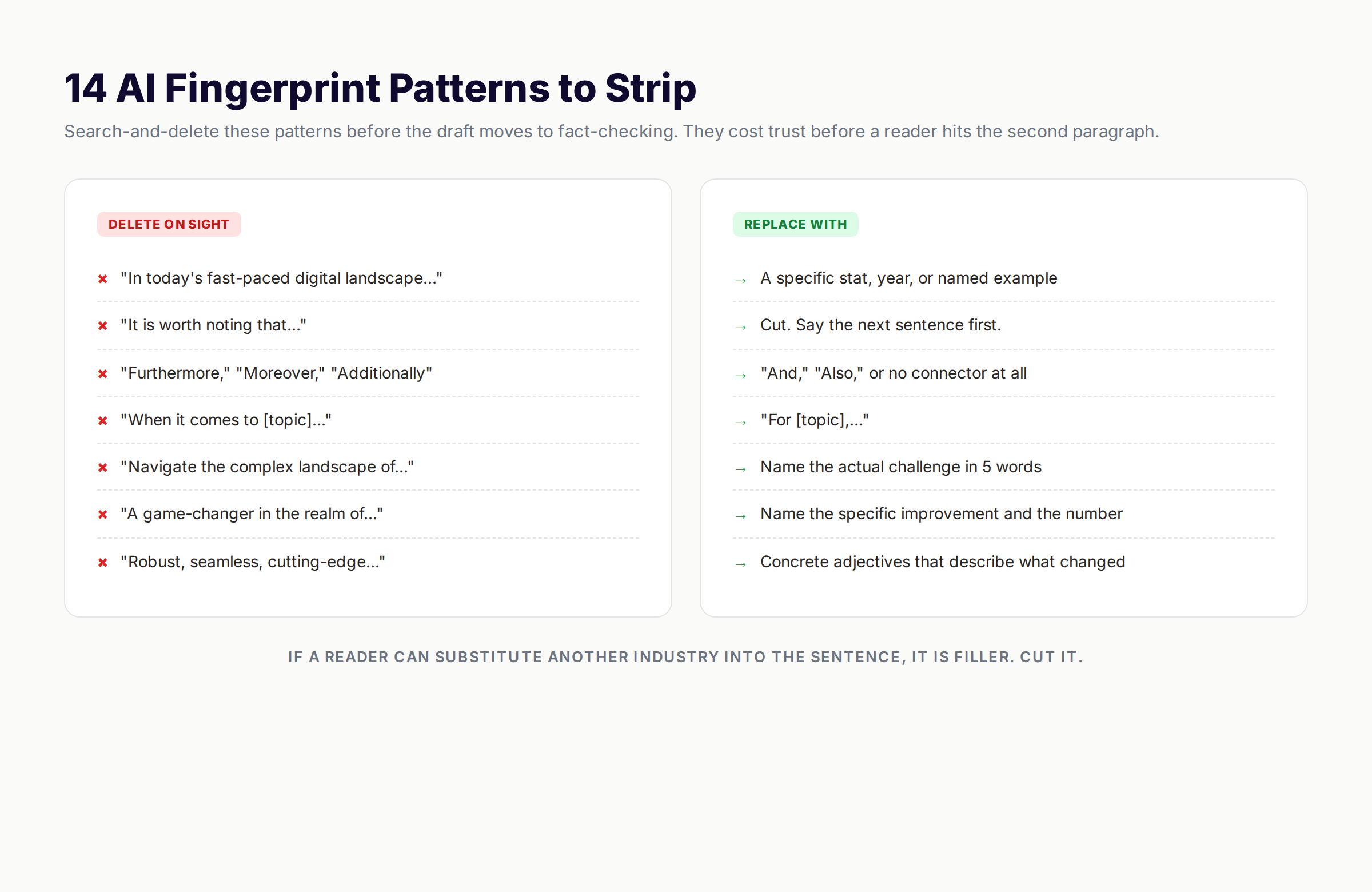
For the full pattern library and a 14-pattern search-and-replace list, see how to humanize AI content. It pairs directly with this checklist.
Category 5. Structure (6 Checks)
Structure is what separates a scannable page from a wall of words. AI drafts often have decent headings and terrible internal structure inside each section. Run this category to fix scan failure.
Check 27. Heading hierarchy is clean. Exactly one H1. H2s for major sections. H3s nested inside H2s only. No orphan H3 nodes appearing without a parent H2.
Check 28. Every H2 is descriptive, not generic. "Why It Matters" is generic. "Why Voice Fails Tank AI Content Ranking" is descriptive. Descriptive H2s help readers skim and help search engines parse intent.
Check 29. At least 1 visual element per 500 words. Tables, lists, images, blockquotes, or callouts. Long unbroken prose loses 40% of mobile readers by paragraph 3.
Check 30. At least 2 tables in the article. Tables compress information that would otherwise sprawl across paragraphs. Use them for comparisons, scoring, and feature breakdowns.
Check 31. At least 1 checklist or numbered process block. Lists are scannable. Lists are also AI Overview bait. Both matter.
Check 32. FAQ section at the end with 4 to 6 questions. Pulled from People Also Ask plus Reddit. The FAQ block adds entity coverage and earns AI Overview citations.
A well-structured article does not just look better. It performs better. The theStacc blog post structure guide covers the full template we use, and the SEO content brief walks through how to brief writers and models for structure-first drafts.
Category 6. SEO and AEO (8 Checks)
Classic SEO is not dead. It is just incomplete. AEO, or Answer Engine Optimization, is the layer that makes content citable in AI Overviews, Perplexity, and ChatGPT search. The 2026 checklist covers both.
Check 33. Primary keyword appears in the title. Title under 60 characters. Keyword in the first 30 if possible.
Check 34. Primary keyword appears in the URL slug. Short, lowercase, hyphen-separated. Match the keyword exactly when natural.
Check 35. Primary keyword appears in the first 100 words. Naturally, not stuffed. Once is enough.
Check 36. Primary keyword appears in at least 1 H2. Secondary keywords belong in other H2s. Avoid keyword stuffing across every heading.
Check 37. Meta description is 145 to 155 characters. Includes keyword, benefit, and a freshness signal like the month or year.
Check 38. At least 3 internal links per 1,000 words. Descriptive anchor text. Target related blog posts, money pages, and category hubs.
Check 39. At least 2 external links to authoritative sources. Specific pages, not homepages. Google docs, Ahrefs studies, Semrush research, .edu and .gov domains carry weight.
Check 40. Schema markup applied. Article schema at minimum. FAQ schema if the page has a Q&A block. The theStacc on-page SEO checker flags missing schema in 1 click.
AEO is where the 2026 game is won. Google AI Overviews now sit above the classic blue links for roughly 60% of informational queries in tracked verticals. Pages that get cited inside an AI Overview earn outsized traffic. Pages that do not get cited become invisible.
To rank inside AI answers, content needs clean entity coverage, named authorship, fresh dates, and structured Q&A blocks. The theStacc FAQ content for AI Overviews post breaks down the citation patterns we have measured across 3,500+ posts.
Category 7. Compliance (5 Checks)
Compliance is the category teams skip until it costs them. A single regulated claim without a disclaimer can trigger a takedown. A single uncleared customer logo can trigger a legal letter. Run this category every time.
Check 41. AI disclosure where required. EU, FTC, and several state regulations require disclosure when AI generated a material portion of consumer-facing content. The Google AI content policy covers what platforms expect, and the broader AI content labeling best practices post covers labeling rules across regions.
Check 42. Medical, legal, financial claims carry a disclaimer. If the article gives diagnostic, legal, or investment guidance, it needs an explicit "this is not professional advice" line.
Check 43. Customer names, logos, and quotes are cleared. Written permission on file. No exceptions for testimonials.
Check 44. Images are licensed. Stock provider, original creation, or public domain with attribution. Generative AI images get an AI-generated disclosure where applicable.
Check 45. No defamatory or unverifiable competitor claims. Comparison content is fine. False or unsupported negative claims are not. If you say "competitor X has worse uptime," carry the data.
The compliance cost is asymmetric. The upside of skipping these checks is zero. The downside is a takedown notice, a regulator fine, or a defamation case. Compliance is cheap insurance.
You should not be the bottleneck on every draft. We handle the full AI content quality checklist on every post we publish for clients. Compliance, fact-check, voice, structure, schema. All of it. See the Content SEO module →
Category 8. Publish Gate (5 Checks)
The final 5 checks happen at the publish moment. They are not editorial. They are operational. Run them inside the CMS, not the draft.
Check 46. Named owner approved the draft. Real human signed off in writing. Not a Slack thumbs-up. Document trail matters.
Check 47. Featured image and inline images render correctly. Alt text on every image. Alt text includes the keyword on at least 1 image.
Check 48. Internal preview matches production. Mobile and desktop view. Check the table of contents, the FAQ accordion if used, and the in-page anchors.
Check 49. URL redirects, if relevant, are configured. If the post replaces a previous post, set a 301. The 301 redirects guide covers the patterns we use across migrations.
Check 50. Tracking is set up. Search Console will pick up the URL automatically. Set up analytics goals if the page has a conversion path. Note the publish date for the next refresh cycle.
That is the full 50.
The Scoring Rubric: What to Do With the Result
Counting 50 checks is not the goal. The goal is a decision: ship, edit, rewrite, or kill. Score the draft after the first full pass and act on the score.
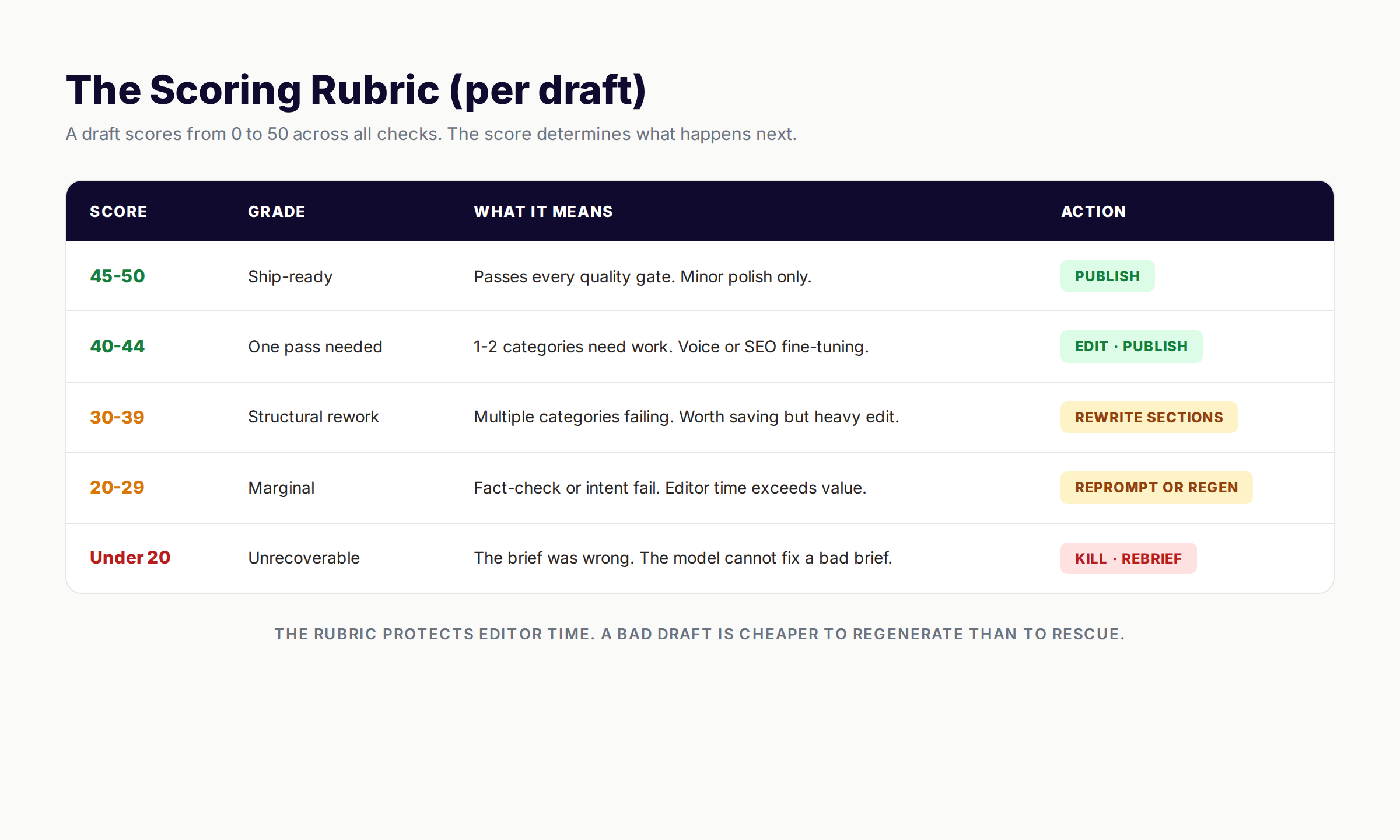
| Score (out of 50) | Grade | Action |
|---|---|---|
| 45 to 50 | Ship-ready | Light polish, then publish |
| 40 to 44 | One-pass edit | Fix 1 to 2 categories, then publish |
| 30 to 39 | Structural rework | Rewrite weak sections before re-scoring |
| 20 to 29 | Marginal | Reprompt the model or regenerate sections |
| Under 20 | Unrecoverable | Kill the draft and rebrief from scratch |
The rubric protects editor time. A 22-point draft is cheaper to regenerate than to rescue. Editors who rescue every bad draft burn hours on content that should never have made it past the brief. Set a kill threshold and enforce it.
We use this rubric across every brief at theStacc. Below 30, the draft goes back to the brief stage. Between 30 and 39, the editor calls the rewrite and tags the weakest category. Above 40, the editor does line edits and ships.
The Risk-Tier Matrix: Match Effort to Stakes
Not every asset deserves the full 50-point treatment. A social caption does not need a legal review. A pricing page does. Tiering is how you stay efficient without skipping safety on high-stakes content.
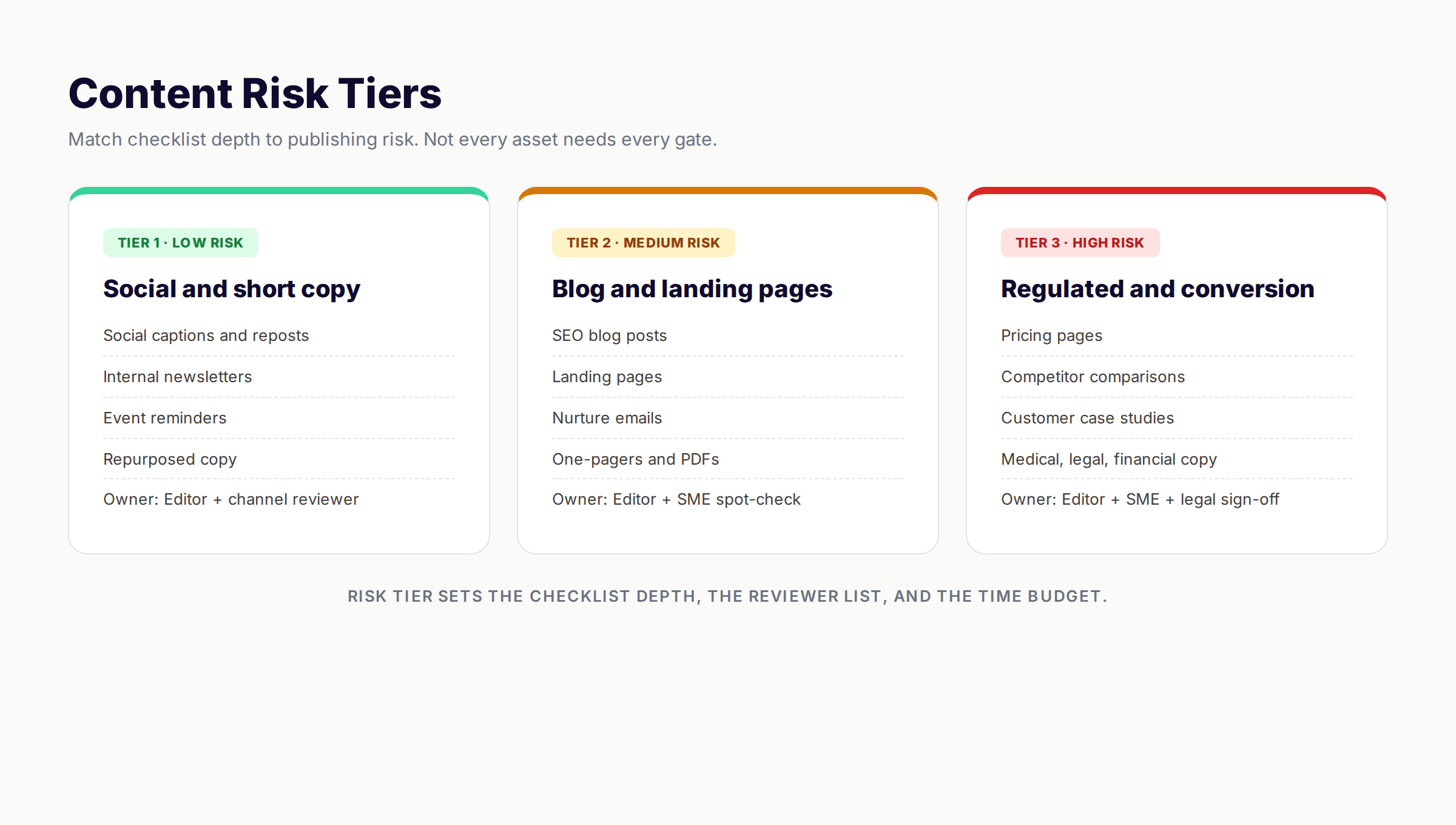
| Tier | Asset types | Checklist depth | Reviewer set |
|---|---|---|---|
| Tier 1 | Social captions, internal newsletters, reposts | Light, 15 checks | Editor + channel reviewer |
| Tier 2 | Blog posts, landing pages, nurture emails | Full 50 | Editor + SME spot-check |
| Tier 3 | Pricing, comparisons, regulated copy, case studies | Full 50 + legal | Editor + SME + legal sign-off |
Tier 1 assets use a stripped 15-point checklist focused on voice, facts, and brand consistency. Tier 2 assets get the full 50. Tier 3 assets get the full 50 plus a formal legal review. The tier matrix is the only reason a high-volume publishing program is sustainable. Without it, every asset gets the same treatment, which means either Tier 3 effort on Tier 1 work (slow) or Tier 1 effort on Tier 3 work (risky).
How theStacc Runs This Checklist at Scale
We publish 3,500+ blog posts per month for clients across 70+ industries. Every post passes the same 50-point AI content quality checklist before it goes live. The execution model has three layers.
Layer 1. The brief is the first quality gate. A bad brief produces a bad draft. We require named audience, search intent class, source pack, brand voice notes, internal link plan, and CTA placement before any model touches the keyword. The theStacc SEO content brief shows the exact template.
Layer 2. The model handles draft assembly. Editors handle quality. Models are good at synthesis and structure. Editors are good at judgment, voice, and fact-checking. We do not ask models to do editor work. We do not ask editors to do draft work. The split is the productivity multiplier.
Layer 3. The checklist runs inside the CMS, not on paper. Every draft moves through a status board: drafted, intent-checked, fact-checked, voice-edited, SEO-finalized, compliance-cleared, published. Each transition requires a named owner.
The result is consistent quality at scale. A measured editing pass on every draft makes the unit economics work at the theStacc $99/month price point.
The lesson for in-house teams is simple. Speed comes from the checklist, not from skipping the checklist. Teams that try to ship faster by cutting QC ship slower in the long run because every rankings dip and every reader complaint triggers rework.
For more on the operational side, see the theStacc AI content workflows post.
What Changes in 2026 vs Older Checklists
Older AI content checklists, including most published before 2025, miss three things that now matter most.
They under-weight originality. Pre-2024 checklists treated originality as a plagiarism scan. The 2026 version treats originality as a positive criterion. The page must add something. Plagiarism-free is the floor, not the ceiling.
They ignore AEO. Most legacy checklists optimize for blue-link SEO and stop there. In 2026, half the traffic for informational queries goes through AI answers, not blue links. The checklist needs explicit AEO checks: entity coverage, FAQ blocks, named authorship, schema, and citability formatting.
They lump fact-checking into "editing." Fact-checking is its own pipeline stage now, not a sub-task. Quarterly audits across our pipeline showed that pulling fact-check out of general editing reduced fact errors by 71% and reduced edit time by 19%. The category gets its own owner, its own time budget, and its own checks.
For teams updating from a legacy checklist, the upgrade path is to add a dedicated fact-check stage, add 8 AEO-specific checks, and lift the originality bar from "no plagiarism" to "carries at least 1 original data point and 1 opinion."
Tools That Support the Checklist (Not Replace It)
Tools speed up the gate. Tools do not replace the gate. Below are the categories worth budgeting for, with the way we use each at theStacc.
| Category | What it does | Where it fits |
|---|---|---|
| Plagiarism scanner | Detects copied phrasing | Originality category |
| AI detector | Flags model-style cadence | Voice and tone category |
| Fact-check assistant | Surfaces unverified claims | Fact accuracy category |
| Readability scorer | Measures Flesch reading ease | Structure and voice |
| Schema generator | Builds article and FAQ schema | SEO and AEO |
| Grammar checker | Catches mechanical errors | Final polish |
A tool stack of these 6 categories runs $50 to $250 per month for a single editor. theStacc-built headline analyzer, meta tag analyzer, on-page SEO checker, and schema markup generator cover the SEO and AEO categories for free.
The mistake teams make is buying tools instead of writing a checklist. Tools without a checklist produce a faster path to bad content. Checklist without tools produces slower but reliable quality. Both is best. Tools only is the worst.
For the full lineup of AI-aware editing tools, see the best AI SEO tools roundup and the AI content creation tools review.
Common Failure Modes (and How the Checklist Catches Them)
Five failure modes account for roughly 80% of the AI content errors we have logged across client pipelines. The checklist exists to catch all 5 before publish.
Failure 1. The fabricated stat. Model invents a percentage and attaches it to a real-sounding study. Check 7 and Check 8 catch it: every stat needs a verifiable URL and a date.
Failure 2. The non-existent expert. Model invents a thought leader and a quote. Check 9 catches it: every named person must be findable on LinkedIn or Crunchbase.
Failure 3. The off-intent intro. Model spends 400 words on history before answering the question. Check 3 catches it: a real answer must appear in the first 100 words.
Failure 4. The robotic cadence. Model overuses "furthermore," "moreover," and "in today's." Check 20 catches it: banned phrase search-and-delete.
Failure 5. The unsupported competitor claim. Model says "competitor X charges more" without data. Check 45 catches it: defamation risk gets blocked at compliance.
Each failure mode is predictable. Each is preventable. Each costs more to fix after publish than before. The checklist is the cheapest insurance policy a content team will ever buy.
What practitioners are saying on X
Content operations advice ages quickly. Here is high-signal operator discussion on X about quality, refresh, and systems.
- @jakezward (Feb 2026): 2026 SEO predictions emphasize AI Overview share-of-SERP, schema for LLM token efficiency, brand mentions in AI answers as a KPI, proprietary data as a moat, and content refresh beating net-new AI slop. See the post on X.
- @varunram (Jul 2026): Critique of GEO slopfarm products that combine SEO clickbait with unresearched content marketing — quality and research still separate winners from farms. See the post on X.
- @HlynurStefDev (Jul 2026): Public case: niche site traffic jumped from ~18 to 4,162 Google visits/month after focused technical/on-page SEO work (GSC screenshots claimed) — reminds that fundamentals still move numbers. See the post on X.
Grok, AI Overviews, and multi-engine visibility
AI/search topics like “ai content quality checklist” need multi-engine notes: AI Overviews, ChatGPT/Perplexity, and Grok. Lead with extractable answers; keep claims consistent with public expert discussion.
- Google AI Overviews: Use passage-ready answers, tables, and FAQ schema where relevant.
- ChatGPT / Perplexity: Cite named sources next to key claims.
- Grok: Maintain accurate entity facts on-site and in high-signal X posts.
Frequently Asked Questions
For a 1,500-word draft, the full 50 checks take 25 to 40 minutes for a trained editor. The first 10 drafts take longer as the editor builds muscle memory. By draft 20, the checklist becomes second nature and edit time stabilizes near 28 minutes per 1,500 words.
Roughly 20 of the 50 checks can be automated today, including plagiarism scanning, schema validation, banned-phrase search, and basic SEO checks. The other 30 still require human judgment, especially fact-checking, originality scoring, and voice alignment. Full automation is not the goal. A 40% automation rate plus a focused human editor beats either extreme.
Factual accuracy. A page with a hallucinated stat loses trust permanently and risks legal exposure. Voice fails are recoverable. Fact fails are not. Run fact-checking before any line edits.
The checks are identical. The expected pass rate differs. AI-assisted drafts with a human-written brief and a human edit pass roughly 38 to 44 out of 50 on the first pass. Pure AI drafts with no human input typically score below 25, which is why most pure AI workflows fail.
Yes. The checklist scales linearly. A 5,000-word piece still has 50 checks. The fact-check category takes longer because there are more claims. The structure category may add additional checks for table of contents and jump links. The core gates do not change.
Drafts scoring under 20 out of 50 go straight to the kill stage and trigger a rebrief. Enforcement happens at the editor level, not the manager level. Editors who try to rescue 20-point drafts burn hours on content that will not rank. We track per-editor save rates and rescue costs as a leading indicator.
Inside the CMS as a status board with named owners on each gate, plus a printable PDF for new editors. The PDF version lives in the team handbook. The CMS version drives the actual production line. Both reference the same 50 checks.
Final Thought
The teams winning at AI content in 2026 are not the teams with the biggest models or the slickest tools. They are the teams with the cleanest checklist. The 50-point AI content quality checklist above is the version we run at theStacc on every single post we ship. Steal it, adapt it, or build your own. What you cannot do is skip it and expect to rank.
If you would rather hand the entire pipeline to a team that already runs this checklist, that is what we do. Full 50-point QC on every draft, from $99 a month. Sign up for free and see the difference a real checklist makes.
Related Tools & Resources
Free SEO Tools:
Best Lists:
Sources & references
- [1] Princeton / Georgia Tech et al. — GEO research (arXiv:2311.09735)
- [2] @jakezward on X — 2026 SEO predictions emphasize AI Overview share-of-SERP, schema for LLM token efficiency, brand mentions in AI answers
- [3] @alexgroberman on X — Case narrative: organic value plus multi-engine citations (ChatGPT, Perplexity, Grok) from knowledge-hub pages, category
- [4] @varunram on X — Critique of GEO slopfarm products that combine SEO clickbait with unresearched content marketing — quality and research
- [5] Referenced source — wellows.com

Plan topics, review article drafts, and publish to a connected CMS.
Weekly local SEO teardowns
One practical email a week. Map Pack, GBP, AI Overviews. No fluff. Unsubscribe anytime.