
How to Edit AI Content for Quality (8-Step System)
Edit AI content quality in 8 steps. Fact-check, humanize, and rank. The exact editing system we use on 3,500+ AI drafts per month. Updated May 2026.
Most teams publish AI drafts that read like AI drafts. The piece sounds fluent. It hits the word count. It ranks for nothing and converts no one. That gap between “fluent” and “publishable” is where bad editing systems quietly destroy content programs.
The cost is bigger than wasted writing time. Google rolled out the helpful content system in 2022 and has tightened it every quarter since. Sites that publish unedited AI content lose rankings in waves. Trust signals collapse. AI Overviews stop citing pages that read like other AI Overviews. And readers detect the patterns inside 2 sentences, then bounce.
The problem is rarely the model. The problem is the editing workflow. Teams treat AI output like a finished draft when it is actually a first draft with predictable, fixable defects. Edit AI content quality the right way and a 1,500-word draft can ship to publication in 25 to 35 minutes with a 92% SEO score. Skip the system and you ship slop that damages your brand.
We publish 3,500+ blog posts per month across 70+ industries. Every draft passes through the same 8-step editing system you are about to read. By the end of this guide, you will have the exact framework, the fact-check checklist, the AI fingerprint patterns to delete on sight, and the final QC gate that prevents bad content from hitting the live site.
Here is what you will learn:
- How to identify the 14 AI fingerprint patterns that signal unedited content
- How to fact-check AI drafts in under 12 minutes per 1,500 words
- How to inject original expertise that models cannot generate
- How to align AI output with your brand voice in 3 specific edits
- How to rebuild structure for SEO and AI Overview citability
- How to run a final QC pass that catches the issues editors miss
Overview
| Detail | Info |
|---|---|
| Time required | 25 to 35 minutes per 1,500-word draft |
| Difficulty | Intermediate (basic editing experience helps) |
| What you need | The AI draft, your style guide, a fact-check browser tab, and a keyword research tool |
| Output | A publication-ready post that ranks and reads as human |
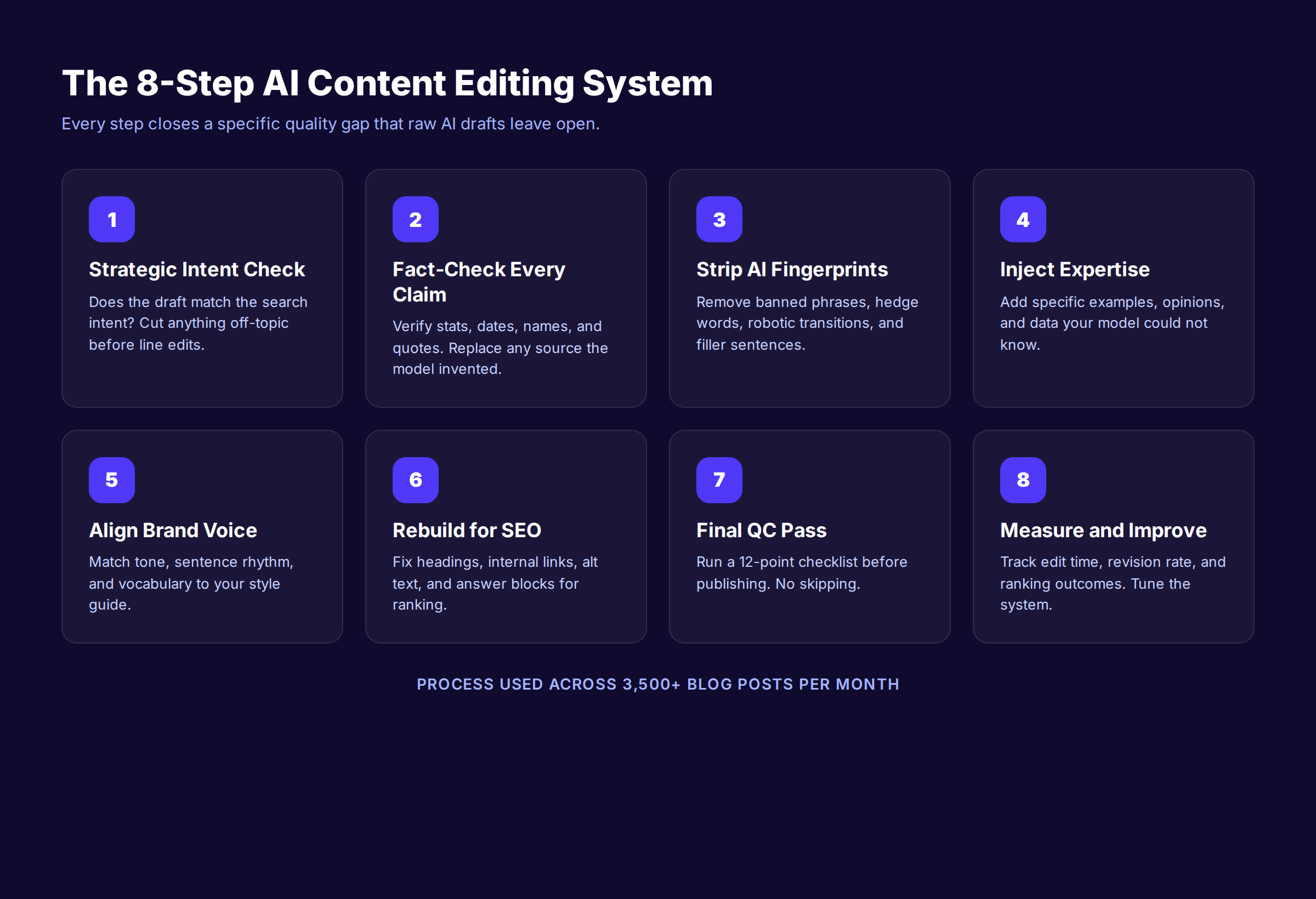
Step 1: Run a Strategic Intent Check Before Any Line Edits
Most editors open an AI draft and start rewriting sentences. That is the wrong starting move. A polished sentence inside a misaligned section is wasted effort. The first pass has to answer one question: does this draft actually serve the search intent?
Read the Draft Against the Keyword
Open the target keyword in a fresh incognito tab. Study the top 5 results. Note the dominant format (guide, listicle, comparison, definition page). Then read the AI draft and ask 4 questions:
- Does the introduction answer the searcher’s actual question in the first 100 words?
- Does the structure match the format Google rewards for this query?
- Are there off-topic sections that pad word count without serving intent?
- Does the post miss any subtopic that appears across all top 3 competitor pages?
Cut every off-topic section first. AI models often pad drafts with adjacent topics they were trained to associate with the keyword. A draft on “edit ai content quality” might wander into “how AI models are trained” or “history of natural language processing.” Both are interesting. Neither belongs.
Tag Every Unverified Claim
On this same pass, drop a [VERIFY] tag inline next to every statistic, name, date, quote, and technical claim. Do not stop to verify yet. The tag is a marker for Step 2. This separation matters because context-switching between editing and fact-checking destroys speed.
A 1,500-word AI draft typically contains 8 to 14 claims that need verification. Marking them now means you can batch the fact-check pass into a focused 10-minute block instead of bouncing between writing and Google for an hour.
Restructure Before Rewriting
If the outline is weak, fix the outline before any sentences. Move H2s around. Merge redundant sections. Split overloaded ones. A clean structure makes every downstream edit faster because you are not rewriting prose only to delete the section it lives in.
Why this step matters: Strategic edits prevent wasted line edits. Fixing structure first means you spend the remaining 25 minutes polishing content that actually deserves polish. Skip this step and you will spend 45 minutes editing a section you should have deleted in 30 seconds.
Pro tip: Read your draft alongside the content audit template we use internally. The same scoring system that grades published content works for AI drafts before they go live.
Step 2: Fact-Check Every Claim, Statistic, and Source
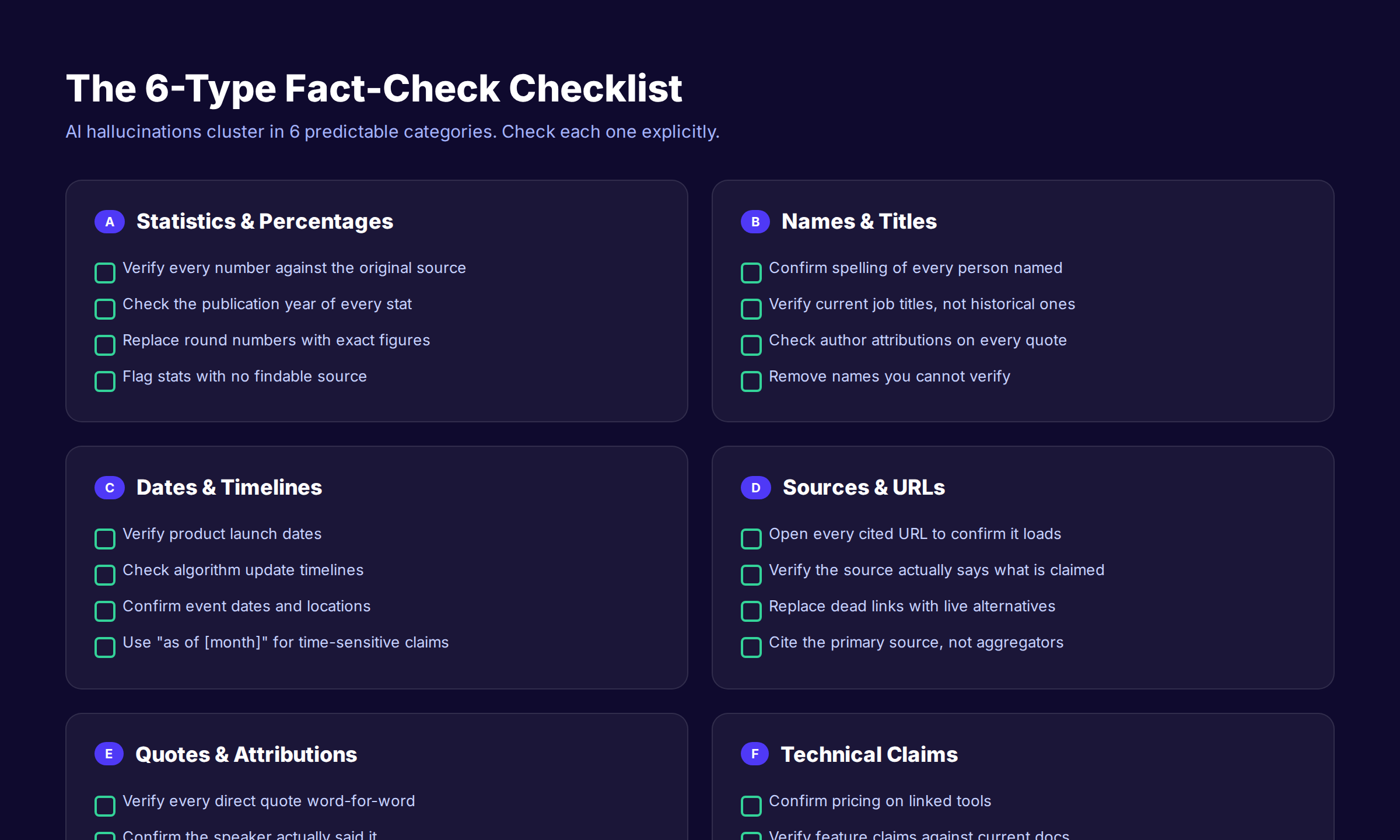
AI models hallucinate. They invent statistics that sound plausible. They cite studies that do not exist. They attribute quotes to people who never said them. Every AI draft contains at least 1 hallucination per 1,000 words on average. Some contain many more. Stanford researchers documented hallucination rates of 17% to 33% across leading large language models on factual recall tasks.
Fact-checking is the single highest-ROI edit you can make. It is also the step most teams skip. A hallucinated stat that gets cited by other writers can survive in the public record for years. The reputational damage compounds. The trust loss does not reverse.
Verify Every Statistic Against the Primary Source
For every [VERIFY] tag you dropped in Step 1, open the cited source. Read the original. Check 4 things:
| Check | What to Confirm |
|---|---|
| The number | Does the source actually report this number? |
| The year | Is the data current, or did the model cite a 2018 study as 2024? |
| The methodology | Does the source support the way the stat is being used? |
| The URL | Does the link load and point to the right page? |
If any check fails, replace the stat. If you cannot find a credible source for a specific claim, delete the claim. Vague statements are better than confident false ones.
Cross-Check Names, Titles, and Quotes
AI models routinely invent expert quotes. They generate plausible-sounding attributions like “according to John Smith, SEO Director at Acme Corp.” John Smith may not exist. Acme Corp may have a different SEO Director. The quote may be paraphrased from a different source entirely.
For every named expert or quoted claim:
- Search the person’s LinkedIn to confirm current role and spelling
- Find the original interview, paper, or post where the quote appeared
- Verify the quote is word-for-word, not a paraphrase the model invented
- If you cannot locate the source within 90 seconds, delete the quote
Replace Fabricated URLs with Live Citations
Click every external link in the draft. Models often invent URLs that look real but lead to 404 pages or unrelated content. Replace any dead or wrong link with a live source that supports the claim.
The fastest way to find replacement sources: search “[claim] site:ahrefs.com OR site:semrush.com OR site:hubspot.com OR site:moz.com” and pick the most authoritative result that actually says what is claimed.
Need an editorial system you do not have to manage? We handle the strategic intent check, fact-check, and humanization across 3,500+ AI-assisted posts every month. Your team focuses on the business. Start for $1 →
Add 2 to 3 New Citations
Every published post should cite 2 to 3 authoritative external sources. If the AI draft contains 0, add them. Prioritize: Google documentation, peer-reviewed studies, original research from Ahrefs or Semrush, and primary news reporting. Avoid linking to other content marketing blogs that themselves cite uncited sources. The citation chain matters.
Why this step matters: AI Overviews and traditional Google rankings both reward content that cites authoritative sources. Unverified claims do not just risk credibility, they actively suppress ranking. The Google AI content policy treats unverified content as a quality signal against the page.
Step 3: Strip the 14 AI Fingerprint Patterns
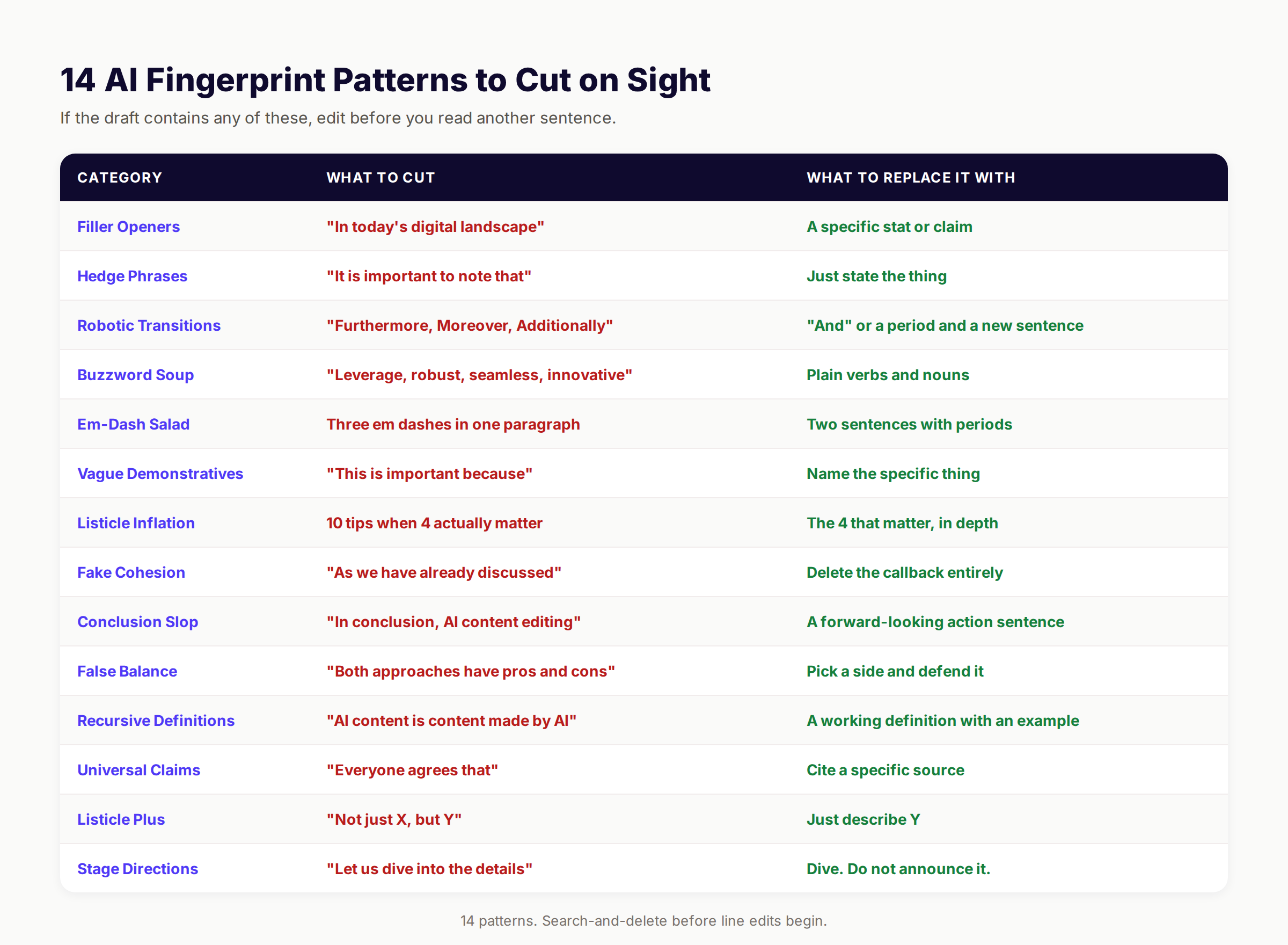
Readers detect AI patterns within 2 sentences. So does Google. The model learned these patterns from training data and reproduces them by default. Your job is to find and delete every one before publishing.
Search-and-Delete the Filler Openers
AI loves to open paragraphs with throat-clearing. “In today’s digital scene” tells the reader nothing. “It is important to note that” delays the actual note. “When it comes to content editing” is a transition that does not transition.
Run a find-and-replace on these phrases across the draft:
- “In today’s [anything]” → Delete entirely
- “It is important to note” → Delete and state the note directly
- “It is worth mentioning” → Delete
- “When it comes to” → Replace with “For” or delete
- “In the realm of” → Delete
- “Move through the [landscape/world/realm] of” → Replace with a specific verb
Each deletion tightens prose and removes a recognizable AI fingerprint. The reader gets to the point. Google’s helpful content signals improve.
Replace Hedge Phrases with Direct Claims
AI hedges because training data hedged. The result is prose that takes 3 sentences to make 1 point. Hedge phrases include “could potentially,” “may possibly,” “in some cases,” “it might be argued that,” “generally speaking,” and “perhaps.” Most of them add nothing.
Edit aggressively. “AI content might potentially be improved by editing” becomes “Editing improves AI content.” The claim is stronger. The sentence is half the length. The reader gets a clear position to agree or disagree with.
Cut Robotic Transitions
“Furthermore,” “Moreover,” and “Additionally” mark AI drafts faster than any other pattern. Real writers rarely use them. Real writers use periods and start new sentences. Replace every transition word with either “And” or nothing.
The exception: “However” stays when it signals genuine contrast. But check that the sentence after it actually contrasts the one before. AI uses “however” to fake structural rigor when the underlying logic is not there.
Banish the Buzzword Soup
Specific banned words for AI editing: use, strong, smooth, new, revolutionary, advanced, complete, holistic, synergy, paradigm, ecosystem, framework (used vaguely), solution (used vaguely), enable, supercharge, surge, game-changer, state-of-the-art.
These words signal AI generation because they replace specific verbs and nouns with vague ones. Replace each with a concrete alternative. “Leverage our platform” becomes “use our platform.” “Strong solution” becomes “tool that does X.” “Innovative approach” becomes “the approach that does X differently from the standard method of Y.”
Vary Sentence Length
AI defaults to a narrow sentence length band, usually 15 to 22 words. Real writers mix 5-word and 30-word sentences. Read your edited draft out loud. If every sentence sounds the same rhythm, break some into short fragments. Combine others into longer flows. The variation makes prose feel human.
Pro tip: The full pattern list and rewrite guidance is documented in our humanize AI content guide. Use it as the second-pass reference after the first edit.
Step 4: Inject Subject-Matter Expertise and Original Insight
Models cannot generate what they do not know. AI drafts compress what already exists on the web. They cannot add original observation, contrarian opinion, or hands-on experience. That is the editor’s job, and it is the single biggest differentiator between content that ranks and content that does not.
Google’s E-E-A-T framework explicitly rewards Experience and Expertise. Our E-E-A-T for blogs guide covers the full ranking framework. For editing purposes, focus on injecting 3 things into every AI draft.
Add Specific Examples from Your Operations
Replace generic claims with specific operational details. “Many businesses struggle with content production” is generic. “We ship 3,500+ posts per month across 70+ industries with a 92% average SEO score” is specific. The second version cannot be generated by a model because the model does not know your numbers.
Per AI draft, target at least 3 to 5 specific operational facts:
- A number you measured (clients, traffic, conversion rate)
- A timeframe from your own work (“after 6 months of testing”)
- A tool stack detail (“we use X to do Y”)
- A failure mode (“the first 200 posts we shipped had Z problem”)
- A counter-intuitive result (“we expected A, but B happened”)
These details make the content uncopyable. They earn citations from other writers. They signal first-hand experience to Google.
Insert Opinionated Claims
AI defaults to balanced, hedged, both-sides-have-merit positions. Real writers take sides. Inject at least 2 opinionated claims per 1,500 words. An opinion is a position another competent person could disagree with.
Examples of opinionated claims for an SEO post:
- “Most listicles over 10 items are inflated for word count”
- “AI Overview citations matter more than featured snippet wins in 2026”
- “Internal linking beats backlink building for sub-100-page sites”
Each opinion gives readers something to agree with, disagree with, share, or argue against. Bland content earns no engagement signals. Opinionated content earns links.
Admit a Nuance or Exception
Trust comes from honesty about limits. Every post should contain at least 1 nuance admission. Phrases like “the exception is,” “this fails when,” “we have seen this break in,” and “the trade-off here is” signal genuine experience.
A model rarely volunteers these because training data is biased toward confident assertions. Add nuance by hand. It makes the rest of the confident claims more credible.
Step 5: Align AI Output with Your Brand Voice
Voice is the hardest thing to fix in an AI draft because most editors do not know how to define their own voice precisely. Without a definition, “match the brand voice” is a vibe check that fails to scale.
Build a 5-Element Voice Spec First
Before editing for voice, define what voice means. A useful voice spec covers 5 elements:
| Element | Example for Stacc |
|---|---|
| Sentence length | Max 20 words. Mix short fragments with medium sentences. |
| Vocabulary | Plain Anglo-Saxon verbs. No buzzwords. No corporate jargon. |
| Persona | Operator. Practical. Confident. Slightly contrarian. |
| Pronoun stance | ”We publish” not “our tool publishes.” Service framing. |
| Banned words | use, strong, smooth, new, solution, enable, supercharge |
Without this spec, every editor brings their own taste. The output is inconsistent. With the spec, voice edits become mechanical: scan for violations and rewrite to fit.
Edit for the Persona, Not Just the Grammar
Persona drives word choice. An operator persona uses verbs like “ship,” “cut,” “test,” “fix.” A consultant persona uses “recommend,” “strategize,” “evaluate.” Same idea, different feel. Pick one and edit toward it.
AI drafts default to a vaguely-helpful-blog-writer persona that fits nothing specific. Edit at the verb level. Replace every weak verb with a stronger one that matches the persona. “Helps you” becomes “ships.” “Allows you to” becomes “lets you.” “Provides the ability to” becomes a single concrete verb.
Match the Pronoun Stance
This is a Stacc-specific edit, but the principle generalizes. AI tends to write as if it is a tool: “our platform generates,” “the system creates,” “AI writes.” Real businesses are services with humans behind them. Edit to match how you actually frame your offering.
For Stacc content, every “the tool” or “our AI” becomes “we.” Stacc is a service that publishes for clients. The tool framing is wrong, and AI defaults to it because the training data is full of tool-framed SaaS marketing.
Read Out Loud One Time
The final voice check is reading the edited draft out loud at normal pace. Mark every sentence where you stumble, where the rhythm feels off, or where you would never say the words to a person in conversation. Rewrite those.
A 1,500-word post takes 7 minutes to read out loud. The 7 minutes catches more voice problems than any silent reading. Skip this step and the post will sound off in ways you cannot articulate later.
Step 6: Rebuild Structure for SEO and AI Citability
A good AI draft has decent headings. A great edited draft has headings that earn featured snippets and AI Overview citations. The difference is intentional restructuring during the edit.
Rewrite Every H2 for Search
Each H2 should do 2 things: signal the subtopic to Google and answer a likely search query directly. AI drafts often produce generic H2s like “The Importance of Editing” or “Key Considerations.” These tell Google nothing.
Rewrite H2s to be specific and query-shaped:
- Generic: “Why Edit AI Content”
- Better: “How AI Content Editing Affects Google Rankings”
- Best: “Why Unedited AI Content Loses Rankings in 2026”
The best version is specific, current, and answers the question a searcher might type. It is also extractable for AI Overviews because it states a clear thesis.
Add Answer Blocks for AI Overviews
AI Overviews cite content that contains short, definitive answers to specific questions. Edit your draft to include at least 3 answer blocks of 40 to 60 words each. Each block should:
- Open with a direct answer to a specific question
- Support the answer with 1 specific number or example
- Close without hedging or qualifications
These blocks live inside your H2 sections, usually right after the heading. They give AI Overviews extractable content. They also work as featured snippets.
Tighten Internal Linking
AI rarely adds useful internal links. Edit in 3 to 5 internal links per 1,000 words. Anchor text should describe the destination, not say “click here.” Link to:
- Related guides on adjacent topics
- Tool roundups for any tool mentioned
- Definitional posts that explain a term you use
- Comparison pages when readers might choose between options
Internal linking signals topical authority to Google. It also keeps readers on your site. A page with 5 well-placed internal links has measurably higher session duration than a page with 0.
Fix Image Alt Text
Most AI drafts ship without proper alt text on images. Edit every alt text to:
- Describe what the image shows
- Include the primary keyword naturally if the image relates to it
- Stay under 125 characters
- Avoid “image of” or “picture of” prefixes
Alt text is an underused ranking factor. It also makes content accessible. Both matter.
Spend your edit time on strategy, not on copy. We publish 30, 50, or 80 SEO-optimized blog posts per month for $99 to $199. You get the same editorial system used here. See pricing →
Step 7: Run the Final Quality Control Pass
The QC pass is the last gate before publishing. It is a checklist, not a creative edit. Run it cold, fast, and unemotionally. The goal is to catch issues the strategic, factual, and stylistic passes missed.
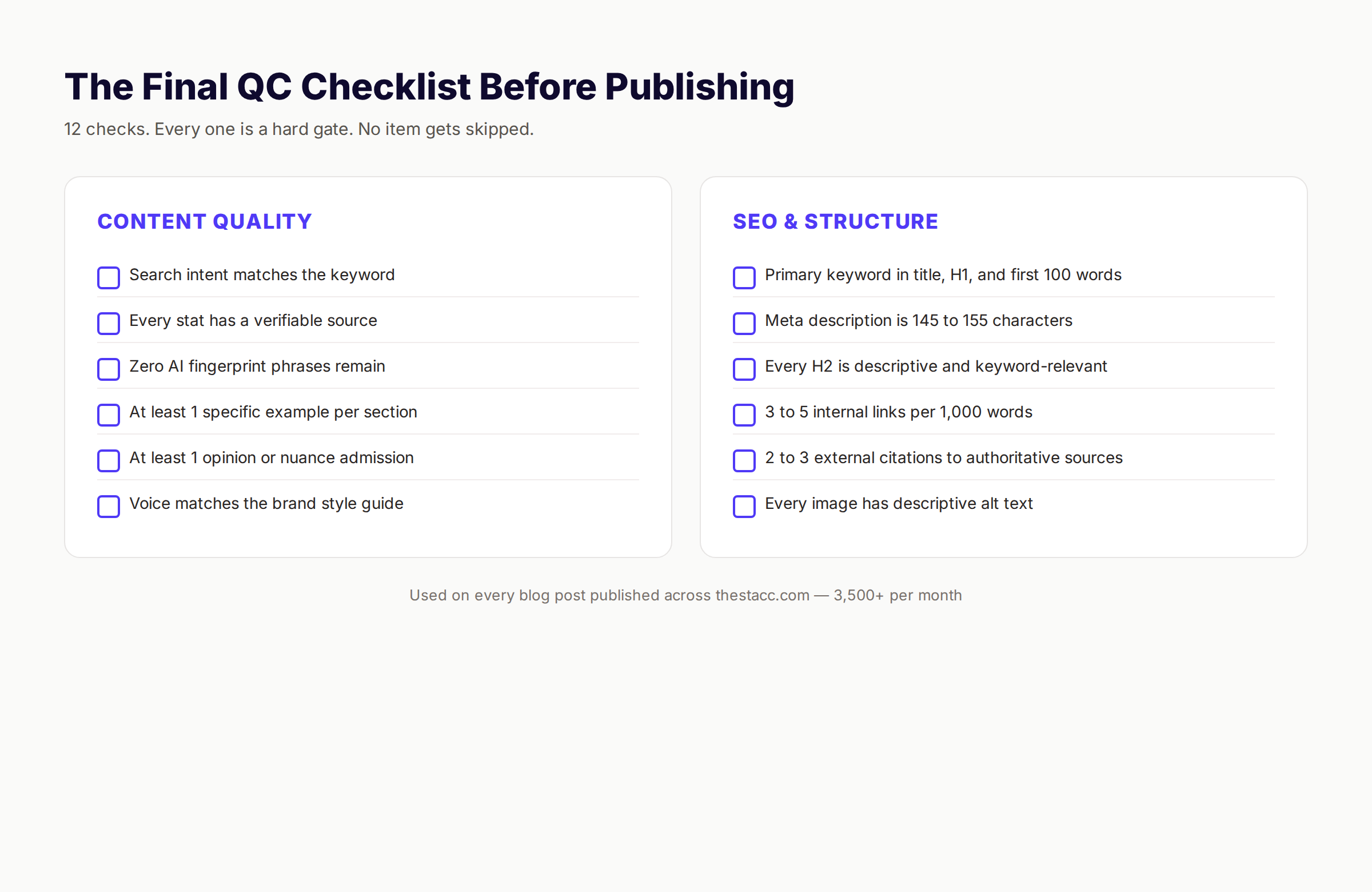
The 12-Point QC Checklist
Run every check on every post. No skipping.
- Search intent matches the keyword (re-check after edits)
- Every statistic has a verifiable source linked
- Zero AI fingerprint phrases remain (final find-and-replace)
- At least 1 specific example or operational detail per H2 section
- At least 2 opinionated claims and 1 nuance admission
- Voice matches the brand spec (read out loud one final time)
- Primary keyword in title, H1, URL, and first 100 words
- Meta description is 145 to 155 characters with the keyword
- Every H2 is descriptive and signals a subtopic
- 3 to 5 internal links per 1,000 words with descriptive anchors
- 2 to 3 external citations to authoritative primary sources
- Every image has descriptive alt text under 125 characters
If any check fails, fix the issue and rerun the check. Do not publish a post that fails any of the 12.
Time-Box the QC Pass
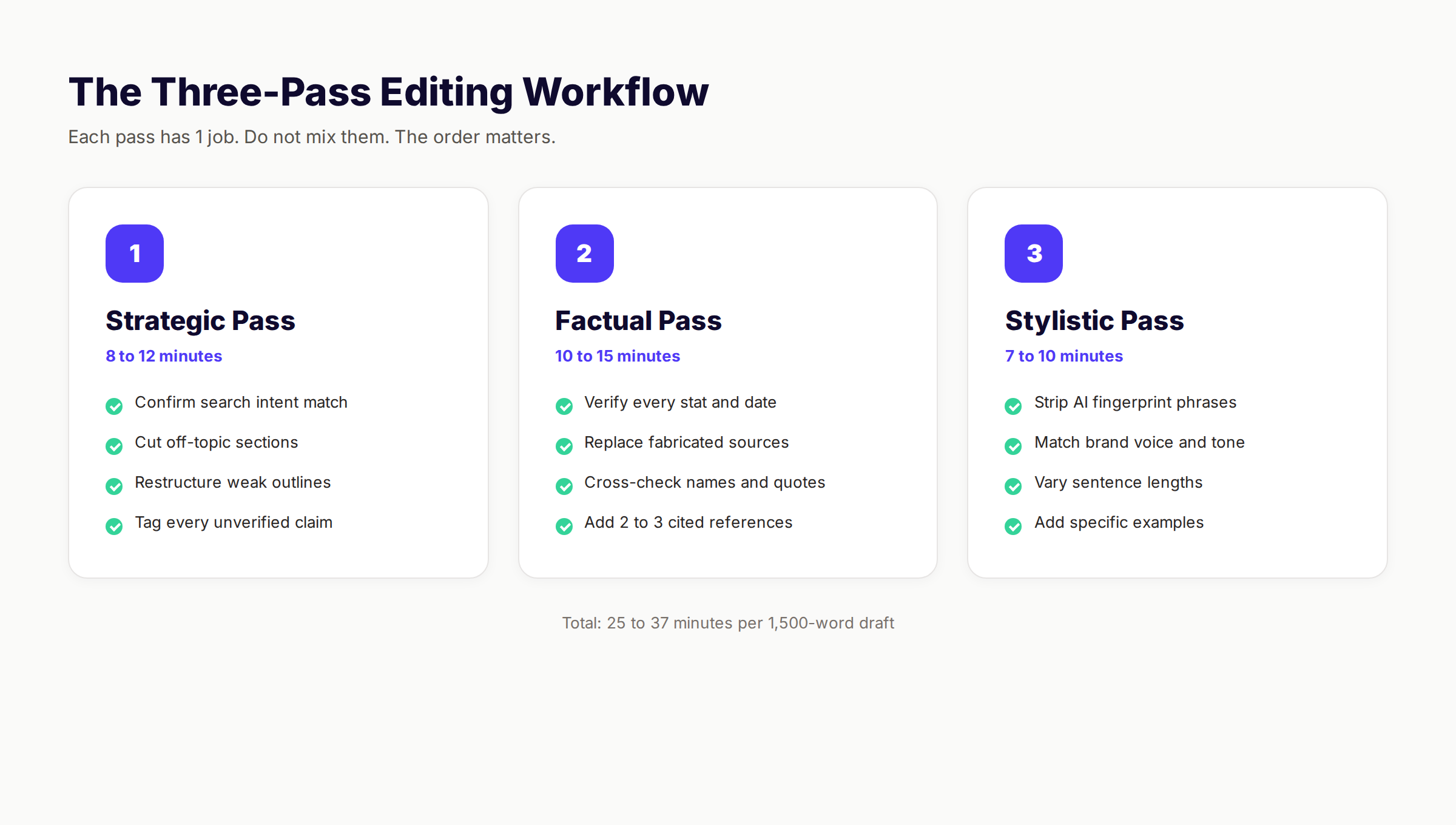
The full 12-point pass should take 5 to 8 minutes on a 1,500-word post. If it takes longer, the earlier passes were not thorough enough. The QC pass is a verification step, not a re-edit step. Catching issues here means earlier steps need tightening.
Use a Second Editor When Possible
A second pair of eyes catches what the writer missed. If you have an editorial team, the writer runs steps 1 through 6 and a second editor runs the QC pass. If you are solo, walk away for 20 minutes between the stylistic pass and the QC pass. The cold read catches more.
Step 8: Measure, Track, and Improve the Editing System
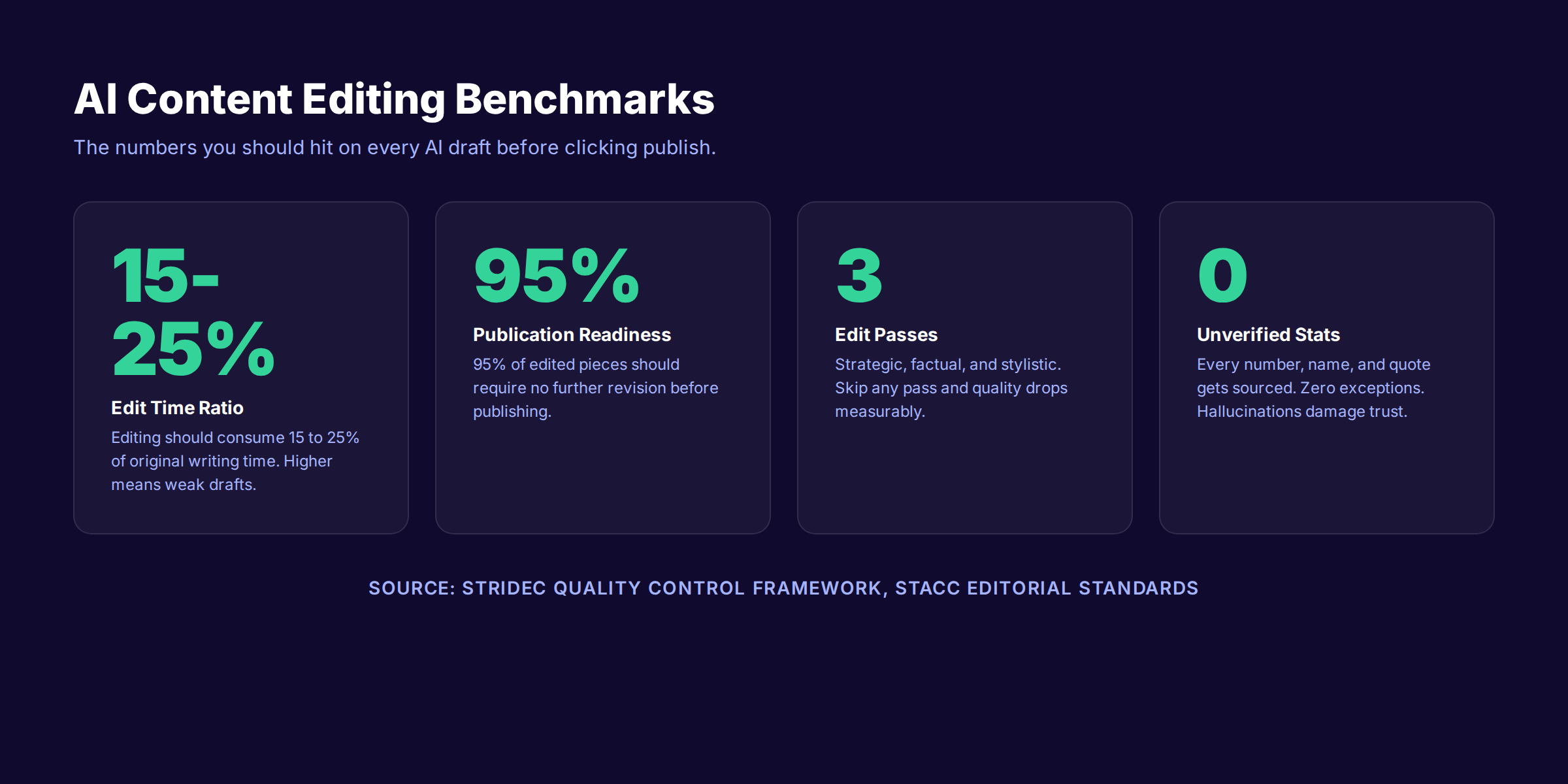
Editing AI content is a system, not an art. Systems improve when you measure them. Track 3 metrics per editor per month to spot weaknesses and fix them.
Track Edit Time Ratio
Edit time ratio is editing time divided by the writing time the draft would have taken without AI. The benchmark is 15% to 25%. Below 15% usually means edits are too light. Above 25% means the draft was so weak it should have been regenerated, not edited.
If a specific keyword type consistently lands above 25% edit time, change the AI prompt or generate the draft differently. Editing should not be a rescue operation for bad drafts.
Track Publication Readiness Rate
Publication readiness rate is the percentage of edited drafts that ship without further revisions. The benchmark is 95%+. If 1 in 5 drafts needs another round of edits, the editing system has a gap. Find the failure mode and fix the corresponding step.
Common failure modes:
| Failure | Step That Failed |
|---|---|
| Stat got challenged after publishing | Step 2 (fact-check) |
| Reader feedback said it sounded robotic | Step 3 (fingerprints) or Step 5 (voice) |
| Post did not rank for the target keyword | Step 1 (intent) or Step 6 (SEO structure) |
| Post earned no engagement signals | Step 4 (expertise) |
| Comments pointed out factual errors | Step 2 (fact-check) |
Track Ranking Outcomes by Editor
If you have multiple editors, track average ranking by editor across 90 days. The data will show which editor’s process produces the highest-ranking content. Study that editor’s workflow. Document it. Train the others to match.
This is how editorial systems compound. Most teams treat editing as a black box. Treat it as a measurable process and quality compounds over months.
Run a Monthly Editing Retro
Once per month, pull the 10 worst-performing posts from the prior 90 days. Read them. Find the edit failure that caused the ranking miss. Update the editing checklist or AI prompt to prevent the same failure on the next 1,000 posts.
This 90-minute monthly meeting is the highest-impact activity in any content program. Most teams skip it. Do not.
Common AI Content Editing Mistakes to Avoid
Even teams with a good editing system fall into the same 6 traps. Each one looks small. Each one quietly destroys quality at scale.
Mistake 1: Editing Without Reading the SERP First
If you have not studied the top 5 results for the target keyword, your edits are guesses. You cannot edit for intent without knowing what intent the SERP rewards. Always pull up the SERP before opening the draft.
Mistake 2: Trusting the Model on Anything Numeric
Numbers are where AI lies most confidently. A stat that sounds reasonable, comes with a year, and includes a percent sign still might be invented. Verify every single number. There are no exceptions.
Mistake 3: Editing for Grammar Before Editing for Structure
Grammar edits are satisfying because they show visible progress. They are also wasted if the section gets deleted in the structural pass. Always edit top-down: intent, structure, facts, then voice, then grammar. Bottom-up editing wastes time.
Mistake 4: Stripping All AI Voice Without Adding a Human One
Deleting AI patterns is half the job. The other half is adding human ones: specific examples, opinionated claims, operational details, nuance admissions. Removing what AI added without replacing it leaves bland, neutral prose that ranks nowhere.
Mistake 5: Publishing Before the Read-Out-Loud Pass
Silent reading misses voice problems. Reading out loud catches them. The 7 minutes you save by skipping this step costs you a measurably worse post.
Mistake 6: Treating Edit Time as Sunk Cost
If you have spent 45 minutes editing a 1,500-word draft and it is still not ready, regenerate. The right move is sometimes to throw away the draft, fix the prompt, and start over. Edit time is not capital you have to defend.
How This Editing System Compounds Over Time
Single-post quality matters less than the trajectory of your editing system. A team that edits well today produces content that ranks today. A team that improves its editing system every month produces content that ranks better every quarter.
Three compounding effects to expect:
Prompt quality improves. Every editing retro feeds back into how you generate drafts. After 6 months, the drafts coming out of your AI workflow need 30% less editing than the drafts you edited on day 1.
Editor speed improves. The first 100 edits feel slow. By edit 500, the patterns are reflex. By edit 1,000, you spot AI fingerprints inside 2 sentences and the structural pass takes 5 minutes instead of 15.
Content compound effect kicks in. Sites that consistently publish well-edited AI content for 12+ months accumulate topical authority. The 200th post ranks faster than the 50th because Google has more signals about the site’s expertise. Compounding rewards consistency.
The teams that win with AI content treat editing as the moat. Anyone can generate a draft. Few teams edit well enough to publish at scale. The editing system is where the durable advantage lives.
For teams that do not want to build the system internally, our content SEO module ships 30 to 80 fully-edited posts per month across the exact system documented above. Every post passes through the 8-step process. Every post hits the 12-point QC gate. You get the output without managing the operation.
Tools That Support the Editing Process
The right tools shorten edit time without compromising quality. The wrong tools introduce friction. A short stack matters more than a long one.
Editing Toolstack
| Tool Category | Use For | Examples |
|---|---|---|
| Fact-check browser | Verifying stats, names, sources | Brave, Chrome with Citation Hunter |
| Grammar pass | Catching typos and clear mistakes | Grammarly, ProWritingAid |
| AI detection check | Verifying humanization worked | Originality.ai, Copyleaks |
| SEO optimization | Keyword and structure checks | Content optimization tools |
| Internal link suggester | Finding link opportunities | Link Whisper, internal CMS search |
The full list of tools we recommend lives in our AI content creation tools roundup. Pick the 2 to 3 that fit your stack. Do not adopt all of them.
When AI Detection Tools Help
AI detection tools are not perfect. They produce false positives and false negatives. Use them as a sanity check, not a gate. If a draft scores 80%+ “AI-generated” after your edits, the humanization pass did not work. Re-edit. If it scores under 30%, the edits worked.
Note: Google does not use these detection tools for ranking. The research on whether AI content ranks on Google is clear: Google ranks well-edited AI content the same as well-edited human content. The detection score matters because it correlates with quality, not because Google checks it.
FAQ
How long should it take to edit a 1,500-word AI draft?
Budget 25 to 35 minutes total: 8 to 12 minutes for the strategic pass, 10 to 15 minutes for the factual pass, and 7 to 10 minutes for the stylistic pass. Plus 5 to 8 minutes for the final QC pass. If editing consistently takes longer, the AI prompt is producing drafts that are too weak to edit efficiently. Improve the prompt.
Can AI tools edit other AI content effectively?
Partially. AI tools handle grammar, clarity, and consistency well. They do not handle fact-checking, original insight injection, or voice alignment to a specific brand. Treat AI editing tools as a first-pass mechanical cleanup. The strategic, factual, and voice edits still require a human editor with domain knowledge.
What is the biggest sign of unedited AI content?
Generic opening sentences combined with hedged claims. “In today’s digital scene, content creation has become increasingly important” is the canonical AI opener. Real writers start with a specific claim, statistic, or observation. If the first 2 sentences could appear on any blog about any topic, the post was not properly edited.
Should I rewrite AI content from scratch instead of editing?
Sometimes. If the strategic pass reveals the draft misses the search intent entirely, regenerating with a better prompt is faster than restructuring. The rule of thumb: if editing the existing draft will take more than 50% of the time it would take to rewrite, regenerate instead. Edit time is not capital you must defend.
How do I check if my edits actually made the content rank?
Track the post in Google Search Console after publishing. Monitor 3 metrics over 90 days: average position for the target keyword, impressions, and click-through rate. A well-edited post moves into positions 10 to 20 within 30 days for low-competition keywords and continues climbing if the content is genuinely better than competitors. If a post sits at position 50+ after 90 days, the editing system has a gap. Run the editing retro and find which step failed.
Does Google penalize AI content?
No, but Google penalizes unhelpful content regardless of origin. The Google AI content policy is explicit: content quality matters, not whether AI was involved in producing it. Well-edited AI content ranks. Unedited or poorly-edited AI content does not, because it fails the helpful content criteria. The editing system is what makes AI content viable for organic search.
Ship Your Next AI Draft Through This System
The editing system documented above takes 25 to 35 minutes per 1,500-word draft and produces content that consistently hits 92%+ SEO score, ranks for target keywords within 90 days, and reads as human to readers and to Google. The system is the moat. The drafts are commodities.
Run your next AI draft through these 8 steps. Measure the edit time ratio and publication readiness rate over your next 10 posts. Update the system based on what you learn. The output improves on a curve, not a step function, but the curve is steep when the system is followed.
For teams that want the output without running the operation, we publish fully-edited content across 70+ industries starting at $99 per month. The same 8-step editing process runs on every post.
Related Tools & Resources
Free SEO Tools:
Best Lists:

Written by
Siddharth GangalSiddharth is the founder of theStacc and Arka360, and a graduate of IIT Mandi. He spent years watching great businesses lose organic traffic to competitors who simply published more. So he built a system to fix that. He writes about SEO, content at scale, and the tactics that actually move rankings.
30 SEO blog articles published every month
Keyword-optimized, scheduled, and live on your site. Automatically.
30-day trial · Cancel anytime
theStacc
Stop writing SEO content manually
30 blog articles, 30 GBP posts, and social media content. Published every month. Automatically.
Try for free$1 for 3 days · Cancel anytime